enterprise telecom sales & distribution
What are the technology changes that are
shaping the sales and distribution functions
across enterprises?
Tarun Bali
Enterprises today are striving to deliver a
personalised experience to their cus-
tomers. Further, customers have become
more digitally enabled and there is a rising
demand from them for a consistent, posi-
tive shopping experience. As a result,
enterprises are adopting new technologi-
cal solutions to enhance their sales and
distribution functions.
Sanjeev Gupta
There have not been any major technolog-
ical changes in the past few years that I
have been involved with the distribution
industry. The industry is still based on a
buy-in-bulk and sell-in-bulk model. The
distribution industry, not necessarily the
end-user sale segment, is still heavily
focused on building relationships. There-
fore, in many ways, the job of the IT team
has not been to support the function but
only to monitor it. Decisions are taken out-
side the automated framework and applica-
tions like supply chain management (SCM)
and vendor management are deployed to
implement the decision taken. This is true
for distribution industries across Europe
and Asia. While this is true for the offline
industry, the online distribution channels
have leapfrogged in term of technology
adoption. Since the online industry is
building its systems from scratch, it has the
luxury of bringing in newer technology.
For example, the offline industry still does
the majority of its payments through the
traditional banking channels, not through
the online transfer of money. On the other
hand, the online channels thrive on online
payment gateways.
Ameen Khwaja
There are three distinct technology trends
visible in the sales and distribution indus-
try. The first is the growing popularity of
mobile devices for conducting transactions
online. Mobiles have helped enterprises
target buyers any time. This has resulted
in digital sales becoming the most impor-
tant component of overall sales for enter-
prises involved in sales and distribution.
The second trend is the emergence of
advanced analytics. Today a huge amount of
data is being generated constantly. There
are a number of solutions in the market that
help enterprises leverage the available data.
For instance, Google Analytics Premium
helps enterprises optimise data and connect
to the right consumers at the right time.
The third is the adoption of cloud
computing, which has made it much easier
to maintain IT infrastructure and run en-
terprise applications. The cloud is chang-
42
ICT Blueprint
Increasing use of technology by sales and distribution enterprises
tele.net | February 2016
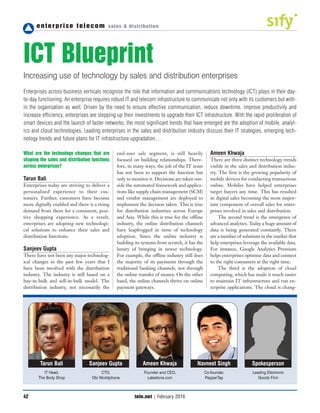
IT Head,
The Body Shop
Tarun Bali
CTO,
Obi Worldphone
Sanjeev Gupta
Co-founder,
PepperTap
Navneet Singh
Leading Electronic
Goods Firm
Spokesperson
Founder and CEO,
Latestone.com
Ameen Khwaja
Enterprises across business verticals recognise the role that information and communications technology (ICT) plays in their day-
to-day functioning. An enterprise requires robust IT and telecom infrastructure to communicate not only with its customers but with-
in the organisation as well. Driven by the need to ensure effective communication, reduce downtime, improve productivity and
increase efficiency, enterprises are stepping up their investments to upgrade their ICT infrastructure. With the rapid proliferation of
smart devices and the launch of faster networks, the most significant trends that have emerged are the adoption of mobile, analyt-
ics and cloud technologies. Leading enterprises in the sales and distribution industry discuss their IT strategies, emerging tech-
nology trends and future plans for IT infrastructure upgradation…
enterprise telecom sales & distribution
44 tele.net | February 2016
ing the way Indian enterprises operate by
influencing the manner in which technol-
ogy is delivered and consumed.
Spokesperson, Electronic Goods Firm
The biggest change being witnessed in the
sales and distribution industry is the pro-
liferation of mobile applications. We are
planning to roll out our mobile-friendly
application soon.
What is the company’s telecom and IT blue-
print? What new IT infrastructure has it
deployed?
Tarun Bali
Retail operations are very complex and
demanding in nature, and require contin-
ual improvement in technology. So, the IT
department is always on its toes to fulfil
the expectation of external as well as inter-
nal customers. The technology require-
ments can be further split into front-end
(retail outlet) and back-end (head office)
operations. For data security, we are using
a hardware-based virtual private network
(VPN) to connect to our data centre
resources using the public internet. We are
now coming up with VPN data cards for
employees to get office resources on the
move/at home under the company’s inter-
net usage policy.
In terms of business applications, we are
running an integrated customer loyalty
programme for instant gratification of cus-
tomers and plan to shortly implement a
centralised payment gateway solution to
accept plastic currency with more cus-
tomised offerings. The in-house hosted
point-of-sales (POS) application is offering
convenience billing, dynamic promotions,
and gift vouchers with relay transmission of
transactional data at the head office for
quick analytics by stakeholders. These
front-end applications are backed by the
strong, integrated enterprise resource plan-
ning (ERP) SAP ISRetail solution to fulfil
product sourcing, merchandising and sup-
ply chain demands. All these applications
are supported under LAN/WAN environ-
ments as process owners/end-consumers
are always geographically spread out.
Our in-house hosted data centre is
backed by dedicated optic fibre leased
lines to facilitate remote connectivity of
stores and e-commerce channels with the
warehouse at all times. The central ware-
house is also connected through leased
lines with additional broadband internet as
a backup line. The stores are using differ-
ent ISPs as per the availability of services.
Internet traffic includes data (POS, bio-
metric attendance) and video streaming of
CCTV footage to be viewed centrally at
the head office.
A new IT initiative that we have under-
taken in the past year is the installation of
VPN boxes at our stores that run on pub-
lic networks. This has been done with a
view to ensuring secure connectivity and is
in line with the company’s IT policy.
Sanjeev Gupta
Our IT needs are similar to what enter-
prises in general require. The role of our
IT infrastructure is to enhance productiv-
ity and efficiency. We have put in place ap-
plications such as ERP, messaging and cus-
tomer relationship management (CRM).
We use the Google Public Cloud service
for emails and messaging, and private
cloud services for hosting our CRM and
ERP applications. In addition, we have
deployed certain applications for sales
force automation. Our SCM is done
through ERP based on cloud. We have
two data centres hosted on the private
cloud, one in Delhi, which covers India,
and the other in Singapore, which caters
to the rest of the world. We are centralis-
ing most of our IT set-up in terms of
servers and software. Typically, our em-
ployees use a browser or a mobile phone.
We do not really push the use of applica-
tions among employees. Our main focus
over the past six months has been on find-
ing ways to take data out of desktops/lap-
tops and push it to our data centres. So, if
one of our sales managers loses his laptop,
there is a loss of physical assets, but no
data or productivity loss because every-
thing is on our private cloud.
Ameen Khwaja
Our IT infrastructure has three layers.
The first layer, or the front end, deals with
consumers who place orders on our portal.
This is based on the Amazon Cloud
Delivery Network. The framework that
we are using is Java ERP. The second
layer, or the middle layer, receives the
order placed by a customer on the front
end. The third layer is based on Microsoft
Dynamics ERP, where we process our
orders. This layer is involved in order
management, warehouse management,
seniority management, etc. Our IT infra-
structure is based on 50 servers currently.
Navneet Singh
All our back-end systems run on Amazon
Web Services. Customers mostly place
orders through the Android and iOS
applications, while a small fraction con-
tinues to use our website. However, going
forward, we will only be investing in our
mobile application. In terms of hardware,
most of our teams use Lenovo laptops,
while the engineering team uses Mac-
Books. There are no security issues any-
“Automatic store replenishment
systems, predictive analytics for
fulfilling customer demands
and timely delivery using GPS
tracking are the key emerging
trends in the technology space
for retail enterprises.”
Tarun Bali
“The distribution industry
has always been a low-margin
industry. Therefore, the idea
is to cut costs by improving
productivity.”
Sanjeev Gupta
“The cloud is changing the
way Indian enterprises operate
by influencing the manner in
which technology is delivered
and consumed.”
Ameen Khwaja
sales & distribution enterprise telecom
45tele.net | February 2016
where in our system. Earlier, we would
order everything online but are now
mature enough to warrant using vendors
for procurement. Having said that, we
value speed in getting things done instead
of focusing purely on price.
Spokesperson, Electronic Goods Firm
All our locations across India, including
stores and warehouses, are connected
through a multiprotocol label switching
(MPLS) network, which is entirely host-
ed on our data centre in Bengaluru. All
vendors are connected to our internal
portal. For customers, we use a CRM
application that runs on cloud. We are
now planning to deploy an internal CRM
solution with our sales force partner,
which will help move all customer-related
matters to one window.
What advantages has the company gained
from the new set-up? What were the challe-
nges in implementing the new infrastructure?
Tarun Bali
With the installation of VPN boxes, the
company has been able to ensure secure
and encrypted transmission of data. This
has enabled it to have a centralised con-
trol on data transmission, prevent data
leakage and optimise hardware resources.
A key challenge that we faced while
rolling out this infrastructure was that the
broadband networks were spread across
multiple carriers with different internet
protocol policies. Hence, the task took
considerable time and enormous resour-
ces were used to configure the asymmet-
ric network.
Sanjeev Gupta
In deploying new technologies we have
learnt that an IT set-up that works in the
US may not work in other geographies.
For instance, we are currently expanding
our operations into Latin America. We
have faced regulatory challenges related
to data retention and security. In other
countries, we have issues with how to
manage the ERP. Some countries man-
date that ERP data should stay within the
country, so one cannot use a global data-
base to drive ERP.
Ameen Khwaja
We have recently enabled Time to First
Render, an application that enables us to
target our customers better. Currently, 85-
87 per cent of our visitors access our por-
tal using mobile devices. When a con-
sumer logs in to our website through a
mobile, our website becomes mobile
friendly and downloads only limited data.
It changes according to the size of the con-
sumer’s phone screen. It also changes
according to the speed of the customer’s
mobile network connection. This has
helped us achieve 30 per cent more visitor
conversion. While there are many benefits
of such a technology, it is not easy to im-
plement a new technology as the benefits
claimed may not materialise. We had to
roll back one of the other applications that
promised an increase of 30 per cent in the
download speed of the website.
Spokesperson, Electronic Goods Firm
The biggest challenge is in ensuring con-
nectivity. It is essential that a customer is
able to get through to the customer care
centre to register feedback, either through
phone, email or other available routes.
“We are planning to deploy an
internal CRM solution with our
sales force partner, which will
help move all customer-related
matters to one window.”
Spokesperson, Electronic Goods Firm
“We are working on our
checkout and payment flows
and want to decrease the num-
ber of clicks a user needs to
place an order.”
Navneet Singh
enterprise telecom sales & distribution
46
What is the level of adoption of applications
such as CRM, SCM and sales force automa-
tion in the sales and distribution industry?
Tarun Bali
CRM, SCM, and sales force automation are
core elements of a customer-centric busi-
ness approach. However, mere upgradation
of the CRM platform does not cater to all
the needs of customers until the back-end
infrastructure is synchronised with the sales
force. In our company, we have adopted the
SAP IS platform for retail ERP and
WenPay HRMS for people management.
Ameen Khwaja
The online retail industry already has in-
house platforms for running these applica-
tions. The successful implementation of
these applications has helped the online
industry deliver a personalised experience
to its customers. However, the offline
retail industry is yet to catch up with the
online industry in terms of the adoption of
these specialised applications.
What are the key emerging trends in the
technology space for enterprises involved in
sales and distribution functions?
Tarun Bali
Automatic store replenishment systems,
predictive analytics for fulfilling customer
demands and timely delivery using global
positioning system (GPS) tracking are the
key emerging trends in the technology
space for retail enterprises.
Ameen Khwaja
While a number of applications are com-
ing up quite rapidly, for the sales and dis-
tribution functions the use of social media
will be the driving force. Platforms such as
Google Advertising help enterprises target
consumers more effectively.
Spokesperson, Electronic Goods Firm
One of the most distinct trends is the rise
in the use of social media for targeting
consumers. Our company has also built its
presence on various social media platforms
to engage with end-consumers.
What are the company’s future plans regar-
ding the upgradation of its telecom and IT
infrastructure?
Tarun Bali
In the next few years, the company plans
to replace its asymmetric digital subscriber
line networks with MPLS networks at the
top-performing stores. This will help us in
synchronising our omni-channel fulfil-
ment centres with the e-commerce chan-
nel. We are also going to soon launch in-
store 4G-enabled tablets for obtaining
feedback from consumers. This will help
us in further increasing customer loyalty.
Sanjeev Gupta
We are currently in our first build-out
phase. Therefore, every new technology
that we deploy is an upgrade. The distrib-
ution industry has always been a low-mar-
gin industry. Therefore, the idea is to cut
costs by improving productivity. Our IT
and telecom expense is significantly above
the industry average and we see that con-
tinuing for some time. In the near term,
we want to transition to a framework
where office presence would not affect an
employee’s productivity.
Ameen Khwaja
We are a rapidly growing company.
Therefore, we need to upgrade our IT
infrastructure constantly. We currently
have about 50 servers and plan to increase
this number to 100 by 2017. This will
require a change in the entire infrastruc-
ture diagram of the company. We will
also be adding another middle layer to
our IT architecture.
Navneet Singh
Over the next few quarters, we want to
actively improve customer experience.
We are working on our checkout and
payment flows and want to decrease the
number of clicks a user needs to place an
order. We are trying to make it even eas-
ier for customers to reach us. His-
torically, they could reach our customer
care team through phone and email, but
we are currently in the process of enab-
ling them to communicate through other
mediums such as chats from within the
PepperTap application. Overall, the key
metric we want to drive in the near term
is the NPS (net promoter score) of our
customers. Our entire leadership team is
behind this goal, and the technology
team is furiously working on a roadmap
for the same.
Spokesperson, Electronic Goods Firm
Our company has a presence across four
industry verticals and caters to about 4
million consumers. We need to constantly
upgrade our IT infrastructure to maintain
operations. We have recently revamped
our telecom and IT hardware. ▲
tele.net | February 2016

Tele.net_February 2016_Enterprise

  • 1.
    enterprise telecom sales& distribution What are the technology changes that are shaping the sales and distribution functions across enterprises? Tarun Bali Enterprises today are striving to deliver a personalised experience to their cus- tomers. Further, customers have become more digitally enabled and there is a rising demand from them for a consistent, posi- tive shopping experience. As a result, enterprises are adopting new technologi- cal solutions to enhance their sales and distribution functions. Sanjeev Gupta There have not been any major technolog- ical changes in the past few years that I have been involved with the distribution industry. The industry is still based on a buy-in-bulk and sell-in-bulk model. The distribution industry, not necessarily the end-user sale segment, is still heavily focused on building relationships. There- fore, in many ways, the job of the IT team has not been to support the function but only to monitor it. Decisions are taken out- side the automated framework and applica- tions like supply chain management (SCM) and vendor management are deployed to implement the decision taken. This is true for distribution industries across Europe and Asia. While this is true for the offline industry, the online distribution channels have leapfrogged in term of technology adoption. Since the online industry is building its systems from scratch, it has the luxury of bringing in newer technology. For example, the offline industry still does the majority of its payments through the traditional banking channels, not through the online transfer of money. On the other hand, the online channels thrive on online payment gateways. Ameen Khwaja There are three distinct technology trends visible in the sales and distribution indus- try. The first is the growing popularity of mobile devices for conducting transactions online. Mobiles have helped enterprises target buyers any time. This has resulted in digital sales becoming the most impor- tant component of overall sales for enter- prises involved in sales and distribution. The second trend is the emergence of advanced analytics. Today a huge amount of data is being generated constantly. There are a number of solutions in the market that help enterprises leverage the available data. For instance, Google Analytics Premium helps enterprises optimise data and connect to the right consumers at the right time. The third is the adoption of cloud computing, which has made it much easier to maintain IT infrastructure and run en- terprise applications. The cloud is chang- 42 ICT Blueprint Increasing use of technology by sales and distribution enterprises tele.net | February 2016 IT Head, The Body Shop Tarun Bali CTO, Obi Worldphone Sanjeev Gupta Co-founder, PepperTap Navneet Singh Leading Electronic Goods Firm Spokesperson Founder and CEO, Latestone.com Ameen Khwaja Enterprises across business verticals recognise the role that information and communications technology (ICT) plays in their day- to-day functioning. An enterprise requires robust IT and telecom infrastructure to communicate not only with its customers but with- in the organisation as well. Driven by the need to ensure effective communication, reduce downtime, improve productivity and increase efficiency, enterprises are stepping up their investments to upgrade their ICT infrastructure. With the rapid proliferation of smart devices and the launch of faster networks, the most significant trends that have emerged are the adoption of mobile, analyt- ics and cloud technologies. Leading enterprises in the sales and distribution industry discuss their IT strategies, emerging tech- nology trends and future plans for IT infrastructure upgradation…
  • 2.
    enterprise telecom sales& distribution 44 tele.net | February 2016 ing the way Indian enterprises operate by influencing the manner in which technol- ogy is delivered and consumed. Spokesperson, Electronic Goods Firm The biggest change being witnessed in the sales and distribution industry is the pro- liferation of mobile applications. We are planning to roll out our mobile-friendly application soon. What is the company’s telecom and IT blue- print? What new IT infrastructure has it deployed? Tarun Bali Retail operations are very complex and demanding in nature, and require contin- ual improvement in technology. So, the IT department is always on its toes to fulfil the expectation of external as well as inter- nal customers. The technology require- ments can be further split into front-end (retail outlet) and back-end (head office) operations. For data security, we are using a hardware-based virtual private network (VPN) to connect to our data centre resources using the public internet. We are now coming up with VPN data cards for employees to get office resources on the move/at home under the company’s inter- net usage policy. In terms of business applications, we are running an integrated customer loyalty programme for instant gratification of cus- tomers and plan to shortly implement a centralised payment gateway solution to accept plastic currency with more cus- tomised offerings. The in-house hosted point-of-sales (POS) application is offering convenience billing, dynamic promotions, and gift vouchers with relay transmission of transactional data at the head office for quick analytics by stakeholders. These front-end applications are backed by the strong, integrated enterprise resource plan- ning (ERP) SAP ISRetail solution to fulfil product sourcing, merchandising and sup- ply chain demands. All these applications are supported under LAN/WAN environ- ments as process owners/end-consumers are always geographically spread out. Our in-house hosted data centre is backed by dedicated optic fibre leased lines to facilitate remote connectivity of stores and e-commerce channels with the warehouse at all times. The central ware- house is also connected through leased lines with additional broadband internet as a backup line. The stores are using differ- ent ISPs as per the availability of services. Internet traffic includes data (POS, bio- metric attendance) and video streaming of CCTV footage to be viewed centrally at the head office. A new IT initiative that we have under- taken in the past year is the installation of VPN boxes at our stores that run on pub- lic networks. This has been done with a view to ensuring secure connectivity and is in line with the company’s IT policy. Sanjeev Gupta Our IT needs are similar to what enter- prises in general require. The role of our IT infrastructure is to enhance productiv- ity and efficiency. We have put in place ap- plications such as ERP, messaging and cus- tomer relationship management (CRM). We use the Google Public Cloud service for emails and messaging, and private cloud services for hosting our CRM and ERP applications. In addition, we have deployed certain applications for sales force automation. Our SCM is done through ERP based on cloud. We have two data centres hosted on the private cloud, one in Delhi, which covers India, and the other in Singapore, which caters to the rest of the world. We are centralis- ing most of our IT set-up in terms of servers and software. Typically, our em- ployees use a browser or a mobile phone. We do not really push the use of applica- tions among employees. Our main focus over the past six months has been on find- ing ways to take data out of desktops/lap- tops and push it to our data centres. So, if one of our sales managers loses his laptop, there is a loss of physical assets, but no data or productivity loss because every- thing is on our private cloud. Ameen Khwaja Our IT infrastructure has three layers. The first layer, or the front end, deals with consumers who place orders on our portal. This is based on the Amazon Cloud Delivery Network. The framework that we are using is Java ERP. The second layer, or the middle layer, receives the order placed by a customer on the front end. The third layer is based on Microsoft Dynamics ERP, where we process our orders. This layer is involved in order management, warehouse management, seniority management, etc. Our IT infra- structure is based on 50 servers currently. Navneet Singh All our back-end systems run on Amazon Web Services. Customers mostly place orders through the Android and iOS applications, while a small fraction con- tinues to use our website. However, going forward, we will only be investing in our mobile application. In terms of hardware, most of our teams use Lenovo laptops, while the engineering team uses Mac- Books. There are no security issues any- “Automatic store replenishment systems, predictive analytics for fulfilling customer demands and timely delivery using GPS tracking are the key emerging trends in the technology space for retail enterprises.” Tarun Bali “The distribution industry has always been a low-margin industry. Therefore, the idea is to cut costs by improving productivity.” Sanjeev Gupta “The cloud is changing the way Indian enterprises operate by influencing the manner in which technology is delivered and consumed.” Ameen Khwaja
  • 3.
    sales & distributionenterprise telecom 45tele.net | February 2016 where in our system. Earlier, we would order everything online but are now mature enough to warrant using vendors for procurement. Having said that, we value speed in getting things done instead of focusing purely on price. Spokesperson, Electronic Goods Firm All our locations across India, including stores and warehouses, are connected through a multiprotocol label switching (MPLS) network, which is entirely host- ed on our data centre in Bengaluru. All vendors are connected to our internal portal. For customers, we use a CRM application that runs on cloud. We are now planning to deploy an internal CRM solution with our sales force partner, which will help move all customer-related matters to one window. What advantages has the company gained from the new set-up? What were the challe- nges in implementing the new infrastructure? Tarun Bali With the installation of VPN boxes, the company has been able to ensure secure and encrypted transmission of data. This has enabled it to have a centralised con- trol on data transmission, prevent data leakage and optimise hardware resources. A key challenge that we faced while rolling out this infrastructure was that the broadband networks were spread across multiple carriers with different internet protocol policies. Hence, the task took considerable time and enormous resour- ces were used to configure the asymmet- ric network. Sanjeev Gupta In deploying new technologies we have learnt that an IT set-up that works in the US may not work in other geographies. For instance, we are currently expanding our operations into Latin America. We have faced regulatory challenges related to data retention and security. In other countries, we have issues with how to manage the ERP. Some countries man- date that ERP data should stay within the country, so one cannot use a global data- base to drive ERP. Ameen Khwaja We have recently enabled Time to First Render, an application that enables us to target our customers better. Currently, 85- 87 per cent of our visitors access our por- tal using mobile devices. When a con- sumer logs in to our website through a mobile, our website becomes mobile friendly and downloads only limited data. It changes according to the size of the con- sumer’s phone screen. It also changes according to the speed of the customer’s mobile network connection. This has helped us achieve 30 per cent more visitor conversion. While there are many benefits of such a technology, it is not easy to im- plement a new technology as the benefits claimed may not materialise. We had to roll back one of the other applications that promised an increase of 30 per cent in the download speed of the website. Spokesperson, Electronic Goods Firm The biggest challenge is in ensuring con- nectivity. It is essential that a customer is able to get through to the customer care centre to register feedback, either through phone, email or other available routes. “We are planning to deploy an internal CRM solution with our sales force partner, which will help move all customer-related matters to one window.” Spokesperson, Electronic Goods Firm “We are working on our checkout and payment flows and want to decrease the num- ber of clicks a user needs to place an order.” Navneet Singh
  • 4.
    enterprise telecom sales& distribution 46 What is the level of adoption of applications such as CRM, SCM and sales force automa- tion in the sales and distribution industry? Tarun Bali CRM, SCM, and sales force automation are core elements of a customer-centric busi- ness approach. However, mere upgradation of the CRM platform does not cater to all the needs of customers until the back-end infrastructure is synchronised with the sales force. In our company, we have adopted the SAP IS platform for retail ERP and WenPay HRMS for people management. Ameen Khwaja The online retail industry already has in- house platforms for running these applica- tions. The successful implementation of these applications has helped the online industry deliver a personalised experience to its customers. However, the offline retail industry is yet to catch up with the online industry in terms of the adoption of these specialised applications. What are the key emerging trends in the technology space for enterprises involved in sales and distribution functions? Tarun Bali Automatic store replenishment systems, predictive analytics for fulfilling customer demands and timely delivery using global positioning system (GPS) tracking are the key emerging trends in the technology space for retail enterprises. Ameen Khwaja While a number of applications are com- ing up quite rapidly, for the sales and dis- tribution functions the use of social media will be the driving force. Platforms such as Google Advertising help enterprises target consumers more effectively. Spokesperson, Electronic Goods Firm One of the most distinct trends is the rise in the use of social media for targeting consumers. Our company has also built its presence on various social media platforms to engage with end-consumers. What are the company’s future plans regar- ding the upgradation of its telecom and IT infrastructure? Tarun Bali In the next few years, the company plans to replace its asymmetric digital subscriber line networks with MPLS networks at the top-performing stores. This will help us in synchronising our omni-channel fulfil- ment centres with the e-commerce chan- nel. We are also going to soon launch in- store 4G-enabled tablets for obtaining feedback from consumers. This will help us in further increasing customer loyalty. Sanjeev Gupta We are currently in our first build-out phase. Therefore, every new technology that we deploy is an upgrade. The distrib- ution industry has always been a low-mar- gin industry. Therefore, the idea is to cut costs by improving productivity. Our IT and telecom expense is significantly above the industry average and we see that con- tinuing for some time. In the near term, we want to transition to a framework where office presence would not affect an employee’s productivity. Ameen Khwaja We are a rapidly growing company. Therefore, we need to upgrade our IT infrastructure constantly. We currently have about 50 servers and plan to increase this number to 100 by 2017. This will require a change in the entire infrastruc- ture diagram of the company. We will also be adding another middle layer to our IT architecture. Navneet Singh Over the next few quarters, we want to actively improve customer experience. We are working on our checkout and payment flows and want to decrease the number of clicks a user needs to place an order. We are trying to make it even eas- ier for customers to reach us. His- torically, they could reach our customer care team through phone and email, but we are currently in the process of enab- ling them to communicate through other mediums such as chats from within the PepperTap application. Overall, the key metric we want to drive in the near term is the NPS (net promoter score) of our customers. Our entire leadership team is behind this goal, and the technology team is furiously working on a roadmap for the same. Spokesperson, Electronic Goods Firm Our company has a presence across four industry verticals and caters to about 4 million consumers. We need to constantly upgrade our IT infrastructure to maintain operations. We have recently revamped our telecom and IT hardware. ▲ tele.net | February 2016