This document discusses the roles of technology in teaching and learning. It outlines how technology can serve as a teaching tool, learning tool, and tutor. It provides examples of how technology supports teachers through enhancing the learning environment, improving instruction, and enabling professional development. It also explains how technology helps learners by allowing them to learn independently, enhancing communication skills, and developing higher-order thinking like critical thinking and problem-solving.
Introduction to the lesson on technology's roles in education, welcoming classmates, and outlining learning outcomes.
Discusses technology's roles as a learning tool, modernizing the environment, improving processes, opening research fields, and supporting teacher professional development.
Explores how technology aids learners to acquire knowledge independently and emphasizes the importance of teachers as facilitators.
Benefits of technology-supported communication, including enhanced social interactions, problem-solving, and collaboration among learners.
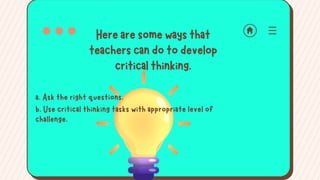
Focuses on technology's role in upgrading critical thinking and problem-solving skills, and strategies teachers can use to foster creativity.
Provides references and thanks the audience for their attention.
Learning Outcomes
1. Identifiedroles of technology in
teaching and learning
2. Appreciate the value of technology in
supporting student learning
4.
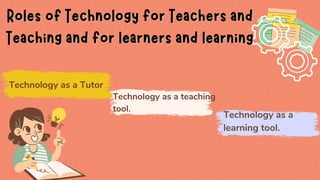
Roles of Technologyfor Teachers and
Roles of Technology for Teachers and
Teaching and for learners and learning
Technology as a
learning tool.
Technology as a teaching
tool.
Technology as a Tutor
5.
Examples of themyriad of roles that
technology can do for teachers and teaching.

1. Technology provides
enormous support to the teacher
as the facilitator of learning.
A. For Teachers and Teaching
6.
A. For Teachersand Teaching
A. For Teachers and Teaching
Examples of the myriad of roles that
technology can do for teachers and teaching.

2. Technology has modernized
the teaching-learning
environment.
7.
A. For Teachersand Teaching
A. For Teachers and Teaching
Examples of the myriad of roles that
technology can do for teachers and teaching.
3. Technology improves
teaching-learning process and
ways of teaching.
8.
A. For Teachersand Teaching
A. For Teachers and Teaching
Examples of the myriad of roles that
technology can do for teachers and teaching.
4. Technology opens new fields
in educational researches.
9.
A. For Teachersand Teaching
A. For Teachers and Teaching
Examples of the myriad of roles that
technology can do for teachers and teaching.
5. Technology adds to the
competence of teachers and
inculcates scientific outlook.
10.
A. For Teachersand Teaching
A. For Teachers and Teaching
Examples of the myriad of roles that
technology can do for teachers and teaching.
6. Technology supports teacher
professional development.
11.
A. For Teachersand Teaching
A. For Teachers and Teaching
Examples of the myriad of roles that
technology can do for teachers and teaching.
6. Technology supports teacher
professional development.
12.
B. For Learnersand Learning
B. For Learners and Learning
1. Support learners to learn how to learn
on their own.
a. Declarative knowledge consists of the discrete pieces
of information that answers the questions what, who,
when, and where. It is often learned through
memorization of facts, drills and practice.
13.
B. For Learnersand Learning
B. For Learners and Learning
1. Support learners to learn how to learn
on their own.
b. Structural knowledge consists of facts
or pieces of declarative knowledge put
together to attain some form of
meaning.
14.
B. For Learnersand Learning
B. For Learners and Learning
1. Support learners to learn how to learn
on their own.
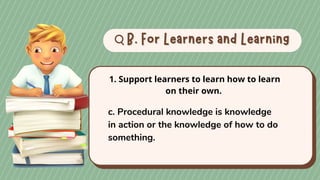
c. Procedural knowledge is knowledge
in action or the knowledge of how to do
something.
2. Technology enhanceslearners'
communication skills through social
Interactions.
B. For Learners and Learning
20.
3 BASIC COMMUNICATION
PATTERNS( Shirly (2003) &
Egbert (2009),
B. For Learners and Learning
a. Point to point two-way or one-
to-one like Internet chat, phone
conversation or even face-to-
face conversation.
21.
B. For Learnersand Learning
B. For Learners and Learning
b. One-to-many outbound like a
lecture, or television. There is no
social interaction.
3 BASIC COMMUNICATION
PATTERNS ( Shirly (2003) &
Egbert (2009),
22.
B. For Learnersand Learning
B. For Learners and Learning
c. Many-to-many like group discussion,
buzz session, heads together.
3 BASIC COMMUNICATION
PATTERNS ( Shirly (2003) &
Egbert (2009),
What are thebenefits
derived from technology
supported communication?
a. Enables any teacher to guide the learners virtually and
making learning unlimited because communication and
social interaction go beyond a school day or a school
environment
25.
What are thebenefits
derived from technology
supported communication?
b. Enhances students' freedom to express and
exchange ideas freely without the snooping
eyes of the teacher face to face
26.
What are thebenefits
derived from technology
supported communication?
c. Enables learners to construct
meaning from joint experiences
between the two or more
participants in communication
27.
What are thebenefits
derived from technology
supported communication?
d. Help learners solve problems from
multiple sources since there is
limitless sources of information that
the teacher can direct or refer to
the learners
28.
What are thebenefits
derived from technology
supported communication?
e. Teaches learners to communicate
with politeness, taking turns in
sending information and giving
appropriate feedback
29.
What are thebenefits
derived from technology
supported communication?
f. Enhances collaboration by using
communication strategies with wider
community and individuals in a
borderless learning environment
30.
What are thebenefits
derived from technology
supported communication?
g. Develops critical thinking, problem
solving and creativity throughout the
communication
31.
3. Technology upgrades
learners'higher-order-
thinking skills: critical
thinking, problem solving and
creativity
Critical thinking is part of the
cluster of higher order thinking
skills
32.
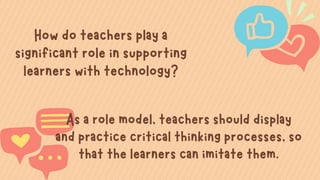
How do teachersplay a
significant role in supporting
learners with technology?
As a role model, teachers should display
and practice critical thinking processes, so
that the learners can imitate them.
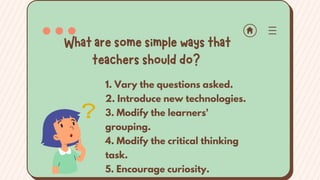
1. Vary thequestions asked.
2. Introduce new technologies.
3. Modify the learners'
grouping.
4. Modify the critical thinking
task.
5. Encourage curiosity.
Whataresomesimplewaysthat
teachersshoulddo?
35.
1. Substitute -Find something else to replace to do what it
does.
2. Combine Blend two things that do not usually go together.
3. Adapt Look for other ways this can be used.
4. Modify/Magnify/ Minify - Make a change, enlarge, decrease.
5. Put to another use - Find other uses.
6. Eliminate Reduce, remove.
7. Reverse Turn upside-down, inside out, front-side back. All
together, the strategies will be labelled as SCAMPER.
Strategiesonhowtobe
creative!