How to ace the Role Model essay
       and	 excel	 grammatically
FOCUS ON THE OBJECTIVE
• To explain WHY someone has become
  your role model
  – His/her distinguished attributes
  – Important life events that contribute/
    illustrate to the person’s characteristics
  – Achievements
  – Lesson learned


                                         2
INTRODUCTION
• Who is your role model?
  – Occupation
  – Reasons s/he became your role model
  – Characteristics


                                    3
BODIES OF PARAGRAPH
• Describe the characteristics through
  the role model’s life event[s]
  – That life event should illustrate the
    characteristics mentioned in the
    introduction
  – Pick that life events that complement/
    support your reasons in choosing your
    role model


                                     4
CONCLUSION
• Lessons learned
  – Should be congruent with life events and
    accomplishments mentioned in the
    bodies of paragraph


                                       5
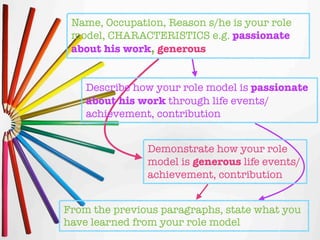
Name, Occupation, Reason s/he is your role
 model, CHARACTERISTICS e.g. passionate
 about his work, generous


    Describe how your role model is passionate
    about his work through life events/
    achievement, contribution


               Demonstrate how your role
               model is generous life events/
               achievement, contribution


From the previous paragraphs, state what you
have learned from your role model
characteristics


Illustrate through life
events/ accomplishments


  Lessons learned
                     7
A GOOD PARAGRAPH
• One clear topic
  – What attribute do you want to focus?
    •Weak: He is respected in his line of work.
     He is also a family man.
    •Why: 2 unrelated topics in 1 paragraph
    •Fix: Pick 1 topic, be it work or personal
     life, and describe/illustrate on that


                                          8
A GOOD PARAGRAPH
• What if you have 2 topics you want to
  write about?
  – Write 1 topic in 1 paragraph
  – Write ANOTHER topic in ANOTHER
    paragraph


                                    9
COHERENCE
• A sentence            • Idea
  – Support the one       – Logical
    that comes before     – Use Transition [In
  – Relate to one           addition,
    another                 However,]
• The story
  – Not skip back and
    forth


                                      10
COHERENCE
• Stick to one main idea per paragraph
• Do not introduce a new angle in the
  conclusion
• Omit any irrelevant information
  – one that does not complete or add any
    insight to the essay


                                     11
PAUSE & REFLECT
• Does the sentence you just wrote
  contain important information?
  – Does it contribute to the central idea of
    the essay?
  – Can you elaborate on that?
  – Does it relate to the one before or after?


                                        12
SUBSTANCE OVER STYLE
• Your sentence must contain an actual
  meaning. Do not write it simply
  because it sounds cool.
  – Can you explain what message you
    want to convey?
    •Yes: go ahead and explain it
    •No: delete it since it takes up your
     paragraph unproductively


                                            13
Grammar Focus
 Academic	 Writing
CRACK THE CODE
• S/V
  – Verb doesn’t agree   • Singular/Plural
    with its subject        • every, a +
• Space                       singular n.
  – Put a space          • Punctuation
    between words           • Forget a
• Capital letter              comma or a
  – Used incorrectly          period


                                     15
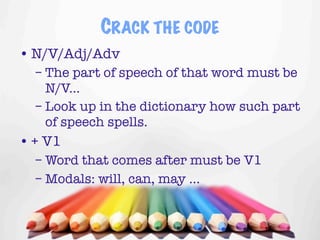
CRACK THE CODE
• N/V/Adj/Adv
  – The part of speech of that word must be
    N/V...
  – Look up in the dictionary how such part
    of speech spells.
• + V1
  – Word that comes after must be V1
  – Modals: will, can, may ...


                                       16
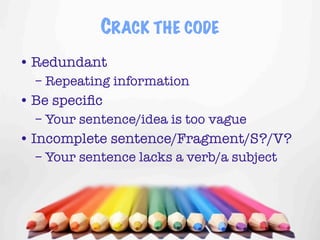
CRACK THE CODE
• Redundant
  – Repeating information
• Be specific
  – Your sentence/idea is too vague
• Incomplete sentence/Fragment/S?/V?
  – Your sentence lacks a verb/a subject


                                      17
ACADEMIC WRITING
• At the beginning of a sentence
  – But, use However,
  – And, use In addition, Furthermore,
    Moreover,
     •Don’t forget a comma [,]


                                         18
SENTENCE
• Simple sentence
  – Write a subject
    •Begin with a capital letter
  – Add a verb
  – A verb must agree with
    its subject
  – End with a full stop [.]


                                   19
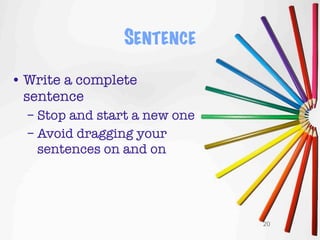
SENTENCE

• Write a complete
  sentence
  – Stop and start a new one
  – Avoid dragging your
    sentences on and on


                               20
SENTENCE
• Not so simple sentence [aka
  complex sentence]
• Use with a conjunction
  – when, because, if, although,...
• Require 2 [TWO] clauses
  – When he was born, his family
    was destitute.
  – Because she studied hard, she
    got an A.
  – If I were a billionaire, I would
    donate money to a charity.         21
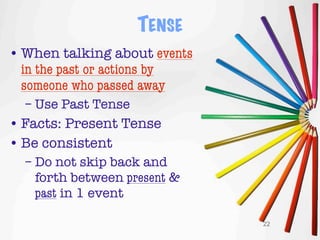
TENSE
• When talking about events
  in the past or actions by
  someone who passed away
  – Use Past Tense
• Facts: Present Tense
• Be consistent
  – Do not skip back and
    forth between present &
    past in 1 event

                              22
TIDBITS
• To state your purpose
  – To + V1 | For + Noun
• Noun
  – Countable: add an article [a, an, the]
    OR use plural
  – Uncountable: leave as it
• Comma
  – After adverb e.g. Then, Next,
  – Before conjunction e.g. and, but, as
                                           23
CHECK LIST

• Complete sentence
• Part of speech
• Use Spellcheck
• Count words
• Correct format

 DUE DATE: 20 August 2012
                            24
WHAT TO SUBMIT
    (1) The 1st draft
   (2) The final draft

        Not required
  Supporting document, CD


           Be neat
Your paper should be together,
   not scattered in pieces
                                 25
Score


Coherence and relevance [3]
    Logical thinking [2]
       Grammar [5]
                          26

Role model explained

  • 1.
    How to acethe Role Model essay and excel grammatically
  • 2.
    FOCUS ON THEOBJECTIVE • To explain WHY someone has become your role model – His/her distinguished attributes – Important life events that contribute/ illustrate to the person’s characteristics – Achievements – Lesson learned 2
  • 3.
    INTRODUCTION • Who isyour role model? – Occupation – Reasons s/he became your role model – Characteristics 3
  • 4.
    BODIES OF PARAGRAPH •Describe the characteristics through the role model’s life event[s] – That life event should illustrate the characteristics mentioned in the introduction – Pick that life events that complement/ support your reasons in choosing your role model 4
  • 5.
    CONCLUSION • Lessons learned – Should be congruent with life events and accomplishments mentioned in the bodies of paragraph 5
  • 6.
    Name, Occupation, Reasons/he is your role model, CHARACTERISTICS e.g. passionate about his work, generous Describe how your role model is passionate about his work through life events/ achievement, contribution Demonstrate how your role model is generous life events/ achievement, contribution From the previous paragraphs, state what you have learned from your role model
  • 7.
    characteristics Illustrate through life events/accomplishments Lessons learned 7
  • 8.
    A GOOD PARAGRAPH •One clear topic – What attribute do you want to focus? •Weak: He is respected in his line of work. He is also a family man. •Why: 2 unrelated topics in 1 paragraph •Fix: Pick 1 topic, be it work or personal life, and describe/illustrate on that 8
  • 9.
    A GOOD PARAGRAPH •What if you have 2 topics you want to write about? – Write 1 topic in 1 paragraph – Write ANOTHER topic in ANOTHER paragraph 9
  • 10.
    COHERENCE • A sentence • Idea – Support the one – Logical that comes before – Use Transition [In – Relate to one addition, another However,] • The story – Not skip back and forth 10
  • 11.
    COHERENCE • Stick toone main idea per paragraph • Do not introduce a new angle in the conclusion • Omit any irrelevant information – one that does not complete or add any insight to the essay 11
  • 12.
    PAUSE & REFLECT •Does the sentence you just wrote contain important information? – Does it contribute to the central idea of the essay? – Can you elaborate on that? – Does it relate to the one before or after? 12
  • 13.
    SUBSTANCE OVER STYLE •Your sentence must contain an actual meaning. Do not write it simply because it sounds cool. – Can you explain what message you want to convey? •Yes: go ahead and explain it •No: delete it since it takes up your paragraph unproductively 13
  • 14.
  • 15.
    CRACK THE CODE •S/V – Verb doesn’t agree • Singular/Plural with its subject • every, a + • Space singular n. – Put a space • Punctuation between words • Forget a • Capital letter comma or a – Used incorrectly period 15
  • 16.
    CRACK THE CODE •N/V/Adj/Adv – The part of speech of that word must be N/V... – Look up in the dictionary how such part of speech spells. • + V1 – Word that comes after must be V1 – Modals: will, can, may ... 16
  • 17.
    CRACK THE CODE •Redundant – Repeating information • Be specific – Your sentence/idea is too vague • Incomplete sentence/Fragment/S?/V? – Your sentence lacks a verb/a subject 17
  • 18.
    ACADEMIC WRITING • Atthe beginning of a sentence – But, use However, – And, use In addition, Furthermore, Moreover, •Don’t forget a comma [,] 18
  • 19.
    SENTENCE • Simple sentence – Write a subject •Begin with a capital letter – Add a verb – A verb must agree with its subject – End with a full stop [.] 19
  • 20.
    SENTENCE • Write acomplete sentence – Stop and start a new one – Avoid dragging your sentences on and on 20
  • 21.
    SENTENCE • Not sosimple sentence [aka complex sentence] • Use with a conjunction – when, because, if, although,... • Require 2 [TWO] clauses – When he was born, his family was destitute. – Because she studied hard, she got an A. – If I were a billionaire, I would donate money to a charity. 21
  • 22.
    TENSE • When talkingabout events in the past or actions by someone who passed away – Use Past Tense • Facts: Present Tense • Be consistent – Do not skip back and forth between present & past in 1 event 22
  • 23.
    TIDBITS • To stateyour purpose – To + V1 | For + Noun • Noun – Countable: add an article [a, an, the] OR use plural – Uncountable: leave as it • Comma – After adverb e.g. Then, Next, – Before conjunction e.g. and, but, as 23
  • 24.
    CHECK LIST • Completesentence • Part of speech • Use Spellcheck • Count words • Correct format DUE DATE: 20 August 2012 24
  • 25.
    WHAT TO SUBMIT (1) The 1st draft (2) The final draft Not required Supporting document, CD Be neat Your paper should be together, not scattered in pieces 25
  • 26.
    Score Coherence and relevance[3] Logical thinking [2] Grammar [5] 26