Tips for reporting, writing and self-
editing
 Readability requires a combination of factors:
 Strong reporting
 Purpose/focus
 Strong writing
 Clean writing
 Entertaining writing
 This seems obvious, but isn’t.
 The goal with any writing should be to find a
good story
 A “good” story is one that people want to read
and takes audience into account
 A “good” story is one that interests you
 A “good story” is one in which you take the
time to report and learn your subject, usually
ending up with too much information
 A “good story” has a main focus
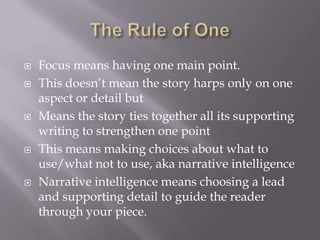
 Focus means having one main point.
 This doesn’t mean the story harps only on one
aspect or detail but
 Means the story ties together all its supporting
writing to strengthen one point
 This means making choices about what to
use/what not to use, aka narrative intelligence
 Narrative intelligence means choosing a lead
and supporting detail to guide the reader
through your piece.
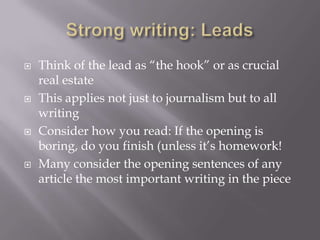
 Think of the lead as “the hook” or as crucial
real estate
 This applies not just to journalism but to all
writing
 Consider how you read: If the opening is
boring, do you finish (unless it’s homework!
 Many consider the opening sentences of any
article the most important writing in the piece
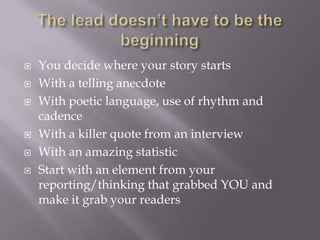
 You decide where your story starts
 With a telling anecdote
 With poetic language, use of rhythm and
cadence
 With a killer quote from an interview
 With an amazing statistic
 Start with an element from your
reporting/thinking that grabbed YOU and
make it grab your readers
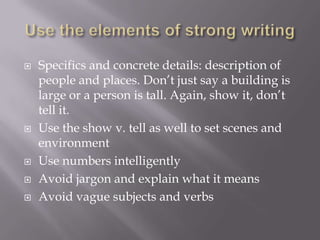
 Specifics and concrete details: description of
people and places. Don’t just say a building is
large or a person is tall. Again, show it, don’t
tell it.
 Use the show v. tell as well to set scenes and
environment
 Use numbers intelligently
 Avoid jargon and explain what it means
 Avoid vague subjects and verbs
 Outlines are used frequently in journalism
 Make a decision about the organization of your
story
 This will free you up to focus on language
 What is the best form for your story: order of
importance? Chronological? Format-busting?
Taking two minutes to decide how to organize
can have an enormous impact on the writing
process and the final outcome.
 Sloppy sentences are rewritten by editors and
copyeditors
 Clean sentences stand the test of editing (and
usually win contests, jobs etc)
 Use short simple sentences for complicated
ideas
 Use longer sentences for easier concepts
 Don’t try to explain election law using a long
and multi-compound sentence
 Use long sentences to emphasize language
when the idea is easy to understand
 Vary the length and rhythm of sentences
 Transitions are important in all writing
 But particularly important in journalism
 Transitions can create suspense and
connectivity
 Never assume the reader can connect one idea
to the next
 Consider your organization and use transitions
in and out of paragraphs to lead the reader
through your story and actually propel them to
keep reading
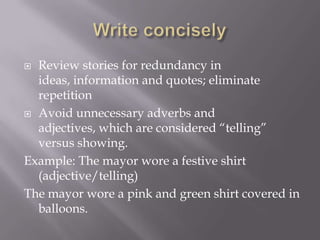
 Review stories for redundancy in
ideas, information and quotes; eliminate
repetition
 Avoid unnecessary adverbs and
adjectives, which are considered “telling”
versus showing.
Example: The mayor wore a festive shirt
(adjective/telling)
The mayor wore a pink and green shirt covered in
balloons.
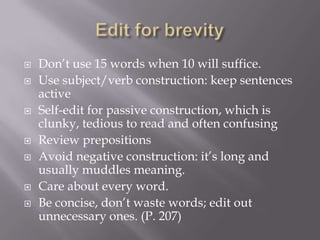
 Don’t use 15 words when 10 will suffice.
 Use subject/verb construction: keep sentences
active
 Self-edit for passive construction, which is
clunky, tedious to read and often confusing
 Review prepositions
 Avoid negative construction: it’s long and
usually muddles meaning.
 Care about every word.
 Be concise, don’t waste words; edit out
unnecessary ones. (P. 207)
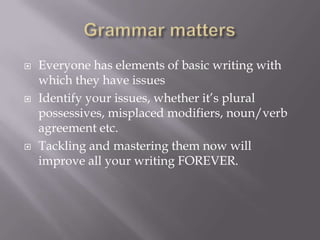
 Everyone has elements of basic writing with
which they have issues
 Identify your issues, whether it’s plural
possessives, misplaced modifiers, noun/verb
agreement etc.
 Tackling and mastering them now will
improve all your writing FOREVER.
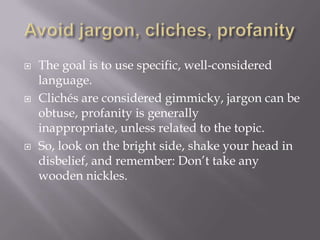
 The goal is to use specific, well-considered
language.
 Clichés are considered gimmicky, jargon can be
obtuse, profanity is generally
inappropriate, unless related to the topic.
 So, look on the bright side, shake your head in
disbelief, and remember: Don’t take any
wooden nickles.
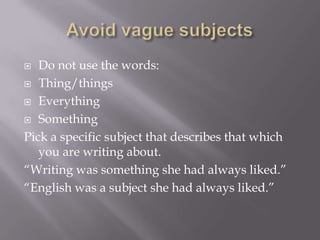
 Do not use the words:
 Thing/things
 Everything
 Something
Pick a specific subject that describes that which
you are writing about.
“Writing was something she had always liked.”
“English was a subject she had always liked.”
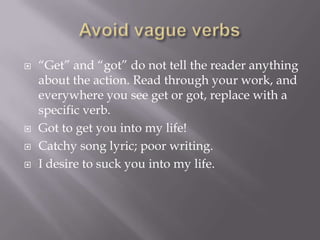
 “Get” and “got” do not tell the reader anything
about the action. Read through your work, and
everywhere you see get or got, replace with a
specific verb.
 Got to get you into my life!
 Catchy song lyric; poor writing.
 I desire to suck you into my life.
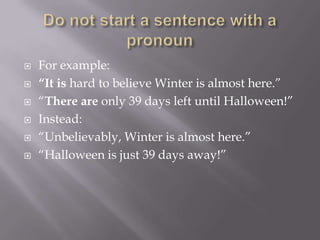
 For example:
 “It is hard to believe Winter is almost here.”
 “There are only 39 days left until Halloween!”
 Instead:
 “Unbelievably, Winter is almost here.”
 “Halloween is just 39 days away!”
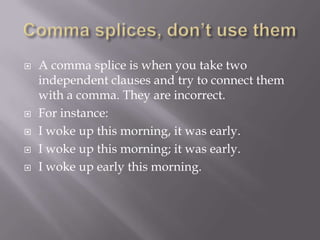
 A comma splice is when you take two
independent clauses and try to connect them
with a comma. They are incorrect.
 For instance:
 I woke up this morning, it was early.
 I woke up this morning; it was early.
 I woke up early this morning.
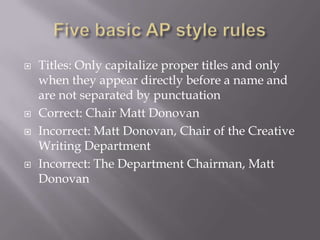
 Titles: Only capitalize proper titles and only
when they appear directly before a name and
are not separated by punctuation
 Correct: Chair Matt Donovan
 Incorrect: Matt Donovan, Chair of the Creative
Writing Department
 Incorrect: The Department Chairman, Matt
Donovan
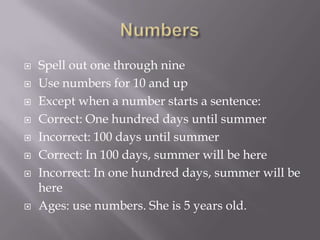
 Spell out one through nine
 Use numbers for 10 and up
 Except when a number starts a sentence:
 Correct: One hundred days until summer
 Incorrect: 100 days until summer
 Correct: In 100 days, summer will be here
 Incorrect: In one hundred days, summer will be
here
 Ages: use numbers. She is 5 years old.
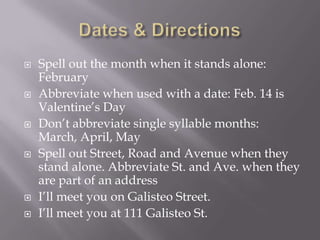
 Spell out the month when it stands alone:
February
 Abbreviate when used with a date: Feb. 14 is
Valentine’s Day
 Don’t abbreviate single syllable months:
March, April, May
 Spell out Street, Road and Avenue when they
stand alone. Abbreviate St. and Ave. when they
are part of an address
 I’ll meet you on Galisteo Street.
 I’ll meet you at 111 Galisteo St.
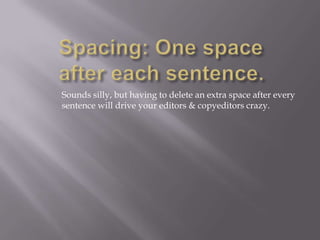
Sounds silly, but having to delete an extra space after every
sentence will drive your editors & copyeditors crazy.
 Wrong: For breakfast, I ate:
apples, bananas, and cereal
 Correct: For breakfast, I ate: apples, bananas
and cereal
 Be attentive to accuracy and always double-check
how to spell names of people and organization.
 Wrong: St. Vincent’s Hospital
 Correct: CHRISTUS St. Vincent Regional Medical
Center
 Avoid loading up a story with useless numbers.
More than three numbers in a short story is too
many.
 Avoid jargon at all costs, even if you talk to people
who use it. Make them translate so you can express
ideas clearly.
 We are going to pass each other’s articles
around and each of you (and I) will mark the
articles
 Initial your comments
 Look for unanswered questions, areas you
think more info is needed
 Look for the readability issues we’ve just
discussed
 Writers, you will then be able to review this
feedback and look for common notations to
consider for your final drafts

Realstorieswritingtoberead

  • 1.
    Tips for reporting,writing and self- editing
  • 2.
     Readability requiresa combination of factors:  Strong reporting  Purpose/focus  Strong writing  Clean writing  Entertaining writing
  • 3.
     This seemsobvious, but isn’t.  The goal with any writing should be to find a good story  A “good” story is one that people want to read and takes audience into account  A “good” story is one that interests you  A “good story” is one in which you take the time to report and learn your subject, usually ending up with too much information  A “good story” has a main focus
  • 4.
     Focus meanshaving one main point.  This doesn’t mean the story harps only on one aspect or detail but  Means the story ties together all its supporting writing to strengthen one point  This means making choices about what to use/what not to use, aka narrative intelligence  Narrative intelligence means choosing a lead and supporting detail to guide the reader through your piece.
  • 5.
     Think ofthe lead as “the hook” or as crucial real estate  This applies not just to journalism but to all writing  Consider how you read: If the opening is boring, do you finish (unless it’s homework!  Many consider the opening sentences of any article the most important writing in the piece
  • 6.
     You decidewhere your story starts  With a telling anecdote  With poetic language, use of rhythm and cadence  With a killer quote from an interview  With an amazing statistic  Start with an element from your reporting/thinking that grabbed YOU and make it grab your readers
  • 7.
     Specifics andconcrete details: description of people and places. Don’t just say a building is large or a person is tall. Again, show it, don’t tell it.  Use the show v. tell as well to set scenes and environment  Use numbers intelligently  Avoid jargon and explain what it means  Avoid vague subjects and verbs
  • 8.
     Outlines areused frequently in journalism  Make a decision about the organization of your story  This will free you up to focus on language  What is the best form for your story: order of importance? Chronological? Format-busting? Taking two minutes to decide how to organize can have an enormous impact on the writing process and the final outcome.
  • 9.
     Sloppy sentencesare rewritten by editors and copyeditors  Clean sentences stand the test of editing (and usually win contests, jobs etc)
  • 10.
     Use shortsimple sentences for complicated ideas  Use longer sentences for easier concepts  Don’t try to explain election law using a long and multi-compound sentence  Use long sentences to emphasize language when the idea is easy to understand  Vary the length and rhythm of sentences
  • 11.
     Transitions areimportant in all writing  But particularly important in journalism  Transitions can create suspense and connectivity  Never assume the reader can connect one idea to the next  Consider your organization and use transitions in and out of paragraphs to lead the reader through your story and actually propel them to keep reading
  • 12.
     Review storiesfor redundancy in ideas, information and quotes; eliminate repetition  Avoid unnecessary adverbs and adjectives, which are considered “telling” versus showing. Example: The mayor wore a festive shirt (adjective/telling) The mayor wore a pink and green shirt covered in balloons.
  • 13.
     Don’t use15 words when 10 will suffice.  Use subject/verb construction: keep sentences active  Self-edit for passive construction, which is clunky, tedious to read and often confusing  Review prepositions  Avoid negative construction: it’s long and usually muddles meaning.  Care about every word.  Be concise, don’t waste words; edit out unnecessary ones. (P. 207)
  • 14.
     Everyone haselements of basic writing with which they have issues  Identify your issues, whether it’s plural possessives, misplaced modifiers, noun/verb agreement etc.  Tackling and mastering them now will improve all your writing FOREVER.
  • 15.
     The goalis to use specific, well-considered language.  Clichés are considered gimmicky, jargon can be obtuse, profanity is generally inappropriate, unless related to the topic.  So, look on the bright side, shake your head in disbelief, and remember: Don’t take any wooden nickles.
  • 16.
     Do notuse the words:  Thing/things  Everything  Something Pick a specific subject that describes that which you are writing about. “Writing was something she had always liked.” “English was a subject she had always liked.”
  • 17.
     “Get” and“got” do not tell the reader anything about the action. Read through your work, and everywhere you see get or got, replace with a specific verb.  Got to get you into my life!  Catchy song lyric; poor writing.  I desire to suck you into my life.
  • 18.
     For example: “It is hard to believe Winter is almost here.”  “There are only 39 days left until Halloween!”  Instead:  “Unbelievably, Winter is almost here.”  “Halloween is just 39 days away!”
  • 19.
     A commasplice is when you take two independent clauses and try to connect them with a comma. They are incorrect.  For instance:  I woke up this morning, it was early.  I woke up this morning; it was early.  I woke up early this morning.
  • 20.
     Titles: Onlycapitalize proper titles and only when they appear directly before a name and are not separated by punctuation  Correct: Chair Matt Donovan  Incorrect: Matt Donovan, Chair of the Creative Writing Department  Incorrect: The Department Chairman, Matt Donovan
  • 21.
     Spell outone through nine  Use numbers for 10 and up  Except when a number starts a sentence:  Correct: One hundred days until summer  Incorrect: 100 days until summer  Correct: In 100 days, summer will be here  Incorrect: In one hundred days, summer will be here  Ages: use numbers. She is 5 years old.
  • 22.
     Spell outthe month when it stands alone: February  Abbreviate when used with a date: Feb. 14 is Valentine’s Day  Don’t abbreviate single syllable months: March, April, May  Spell out Street, Road and Avenue when they stand alone. Abbreviate St. and Ave. when they are part of an address  I’ll meet you on Galisteo Street.  I’ll meet you at 111 Galisteo St.
  • 23.
    Sounds silly, buthaving to delete an extra space after every sentence will drive your editors & copyeditors crazy.
  • 24.
     Wrong: Forbreakfast, I ate: apples, bananas, and cereal  Correct: For breakfast, I ate: apples, bananas and cereal
  • 25.
     Be attentiveto accuracy and always double-check how to spell names of people and organization.  Wrong: St. Vincent’s Hospital  Correct: CHRISTUS St. Vincent Regional Medical Center  Avoid loading up a story with useless numbers. More than three numbers in a short story is too many.  Avoid jargon at all costs, even if you talk to people who use it. Make them translate so you can express ideas clearly.
  • 26.
     We aregoing to pass each other’s articles around and each of you (and I) will mark the articles  Initial your comments  Look for unanswered questions, areas you think more info is needed  Look for the readability issues we’ve just discussed  Writers, you will then be able to review this feedback and look for common notations to consider for your final drafts

Editor's Notes

  • #19 Notice, the writing is just by that little shift, tighter and more specific.