College Success Workshop: 10 Ways
   to Improve Your Writing Today


                A Presentation given by the
                Mount Ida College Writing &
                Math Center
Number 10: A Way to Start:
   Know Your Role and Goal

   What is your role in this writing assignment?
    –   Investigator   --Explainer   --Describer
    –   Persuader      --Analyzer    --Synthesizer


   What is your goal in this writing assignment?
    –   Consider your purpose
    –   Consider your audience
    –   Consider your tone
Number 9: A Clear Thesis


   Limit yourself to one sentence within the
    introduction.
   State your position on the topic.
   Tell what your paper will be about.
   Give an idea of the scope of your paper.
Number 8: Develop Strong Paragraphs
--Organize and Exemplify

   Organize your paragraphs to best illustrate
    your thesis.
    –   Chronologically
    –   Problem/Solution
    –   Cause/Effect
    –   Reasons (Least to Greatest)
   Exemplify the main idea in each topic
    sentence with supporting details.
Number 7: Go With the Flow!
   Use Transitions Effectively

   Adding Things Up:
    –   Additionally,
    –   In addition to X, another reason is Y.
    –   Also,
   Showing Contrast:
    –   In contrast,
    –   On the other hand,
    –   However,
    –   Although X is important, one must also consider Y.
Number 7: Go With the Flow!
   Use Transitions Effectively

   Showing cause and effect:
    –   If voters don’t elect politicians who support
        environmental change, then global warming will
        continue to damage the earth.

    –   When vending machines in public schools
        provide only healthy snacks, then children will
        make better food choices.
Number 6: Be Bold!
Use Strong Nouns and Active Verbs

   Begin sentences with the most important
    idea in the sentence:
    –   Instead of: ―It is critical that our country does
        whatever it can to lessen our dependence on
        foreign oil.‖

    –   Try: ―Lessening our dependence on foreign oil is
        critical for our country.‖
Number 6: Be Bold!
Use Strong Nouns and Active Verbs

   Avoid unnecessary words at the beginning of
    sentences:

    –   Instead of: ―There is special equipment that is
        required for his job.‖

    –   Try: ―Special equipment is required for this job.‖
Number 6: Be Bold!
Use Strong Nouns and Active Verbs

   Use active verbs rather than passive voice:
    –   Instead of: ―A meaningful plan needs to be offered
        by the strongest candidate.‖

    –   Try: ―The strongest candidate needs to offer a
        meaningful plan.‖
Number 5: Avoid Run-ons and
Fragments


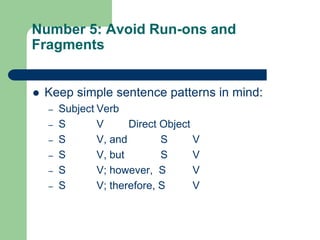
   Keep simple sentence patterns in mind:
    –   Subject Verb
    –   S       V      Direct Object
    –   S       V, and        S      V
    –   S       V, but        S      V
    –   S       V; however, S        V
    –   S       V; therefore, S      V
Number 5: Avoid Run-ons and
Fragments

   For variety, begin a sentence with a dependent
    clause:
    –   Because Joe practiced, he beat his competitors.
    –   When I show enthusiasm, I find it is infectious.
    –   Although she couldn’t offer a good explanation, Mary
        dropped out of the race.

   For variety, begin a sentence with a descriptive
    phrase:
    –   Believing in his theory, the scientist continued on with his
        research.
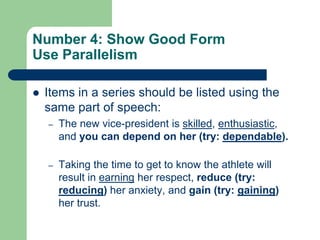
Number 4: Show Good Form
Use Parallelism

   Items in a series should be listed using the
    same part of speech:
    –   The new vice-president is skilled, enthusiastic,
        and you can depend on her (try: dependable).

    –   Taking the time to get to know the athlete will
        result in earning her respect, reduce (try:
        reducing) her anxiety, and gain (try: gaining)
        her trust.
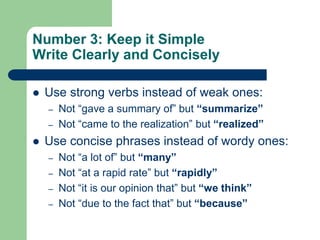
Number 3: Keep it Simple
Write Clearly and Concisely

   Use strong verbs instead of weak ones:
    –   Not ―gave a summary of‖ but “summarize”
    –   Not ―came to the realization‖ but “realized”
   Use concise phrases instead of wordy ones:
    –   Not ―a lot of‖ but “many”
    –   Not ―at a rapid rate‖ but “rapidly”
    –   Not ―it is our opinion that‖ but “we think”
    –   Not ―due to the fact that‖ but “because”
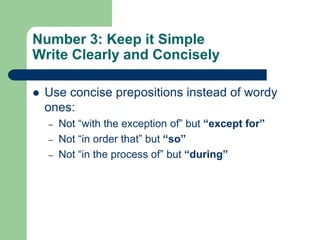
Number 3: Keep it Simple
Write Clearly and Concisely

   Use concise prepositions instead of wordy
    ones:
    –   Not ―with the exception of‖ but “except for”
    –   Not ―in order that‖ but “so”
    –   Not ―in the process of‖ but “during”
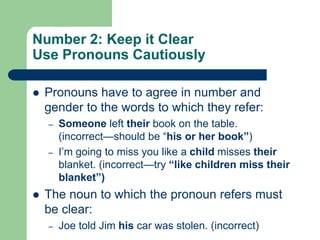
Number 2: Keep it Clear
Use Pronouns Cautiously

   Pronouns have to agree in number and
    gender to the words to which they refer:
    –   Someone left their book on the table.
        (incorrect—should be ―his or her book”)
    –   I’m going to miss you like a child misses their
        blanket. (incorrect—try “like children miss their
        blanket”)
   The noun to which the pronoun refers must
    be clear:
    –   Joe told Jim his car was stolen. (incorrect)
Number 1: Leave Time and Energy for
a Great Finish

   Write a memorable CONCLUSION:
    –   Summarize your paper but consider the BIG
        PICTURE.
   Remember to PROOFREAD:
    –   Read your paper out loud to yourself or to
        someone else.
   Come up with a great TITLE:
    –   Whether you write it first or last, a thoughtful title,
        gives your paper a polished look.
Other Things To Do . . .

   Write with someone from your class or with a group
    from your class. Read each other’s writing out loud.
   Call or email Christine McLaughlin, Director of the
    Academic Success Center/Writing & Math Center, if
    you need help with any of these tips: 617-928-7323
    or cmclaughlin@mountida.edu
   Visit the Writing & Math Center in ATC 306.
   Make an appointment at the Writing Center: 617-
    928-7322!

Some Random PowerPoint

  • 1.
    College Success Workshop:10 Ways to Improve Your Writing Today A Presentation given by the Mount Ida College Writing & Math Center
  • 2.
    Number 10: AWay to Start: Know Your Role and Goal  What is your role in this writing assignment? – Investigator --Explainer --Describer – Persuader --Analyzer --Synthesizer  What is your goal in this writing assignment? – Consider your purpose – Consider your audience – Consider your tone
  • 3.
    Number 9: AClear Thesis  Limit yourself to one sentence within the introduction.  State your position on the topic.  Tell what your paper will be about.  Give an idea of the scope of your paper.
  • 4.
    Number 8: DevelopStrong Paragraphs --Organize and Exemplify  Organize your paragraphs to best illustrate your thesis. – Chronologically – Problem/Solution – Cause/Effect – Reasons (Least to Greatest)  Exemplify the main idea in each topic sentence with supporting details.
  • 5.
    Number 7: GoWith the Flow! Use Transitions Effectively  Adding Things Up: – Additionally, – In addition to X, another reason is Y. – Also,  Showing Contrast: – In contrast, – On the other hand, – However, – Although X is important, one must also consider Y.
  • 6.
    Number 7: GoWith the Flow! Use Transitions Effectively  Showing cause and effect: – If voters don’t elect politicians who support environmental change, then global warming will continue to damage the earth. – When vending machines in public schools provide only healthy snacks, then children will make better food choices.
  • 7.
    Number 6: BeBold! Use Strong Nouns and Active Verbs  Begin sentences with the most important idea in the sentence: – Instead of: ―It is critical that our country does whatever it can to lessen our dependence on foreign oil.‖ – Try: ―Lessening our dependence on foreign oil is critical for our country.‖
  • 8.
    Number 6: BeBold! Use Strong Nouns and Active Verbs  Avoid unnecessary words at the beginning of sentences: – Instead of: ―There is special equipment that is required for his job.‖ – Try: ―Special equipment is required for this job.‖
  • 9.
    Number 6: BeBold! Use Strong Nouns and Active Verbs  Use active verbs rather than passive voice: – Instead of: ―A meaningful plan needs to be offered by the strongest candidate.‖ – Try: ―The strongest candidate needs to offer a meaningful plan.‖
  • 10.
    Number 5: AvoidRun-ons and Fragments  Keep simple sentence patterns in mind: – Subject Verb – S V Direct Object – S V, and S V – S V, but S V – S V; however, S V – S V; therefore, S V
  • 11.
    Number 5: AvoidRun-ons and Fragments  For variety, begin a sentence with a dependent clause: – Because Joe practiced, he beat his competitors. – When I show enthusiasm, I find it is infectious. – Although she couldn’t offer a good explanation, Mary dropped out of the race.  For variety, begin a sentence with a descriptive phrase: – Believing in his theory, the scientist continued on with his research.
  • 12.
    Number 4: ShowGood Form Use Parallelism  Items in a series should be listed using the same part of speech: – The new vice-president is skilled, enthusiastic, and you can depend on her (try: dependable). – Taking the time to get to know the athlete will result in earning her respect, reduce (try: reducing) her anxiety, and gain (try: gaining) her trust.
  • 13.
    Number 3: Keepit Simple Write Clearly and Concisely  Use strong verbs instead of weak ones: – Not ―gave a summary of‖ but “summarize” – Not ―came to the realization‖ but “realized”  Use concise phrases instead of wordy ones: – Not ―a lot of‖ but “many” – Not ―at a rapid rate‖ but “rapidly” – Not ―it is our opinion that‖ but “we think” – Not ―due to the fact that‖ but “because”
  • 14.
    Number 3: Keepit Simple Write Clearly and Concisely  Use concise prepositions instead of wordy ones: – Not ―with the exception of‖ but “except for” – Not ―in order that‖ but “so” – Not ―in the process of‖ but “during”
  • 15.
    Number 2: Keepit Clear Use Pronouns Cautiously  Pronouns have to agree in number and gender to the words to which they refer: – Someone left their book on the table. (incorrect—should be ―his or her book”) – I’m going to miss you like a child misses their blanket. (incorrect—try “like children miss their blanket”)  The noun to which the pronoun refers must be clear: – Joe told Jim his car was stolen. (incorrect)
  • 16.
    Number 1: LeaveTime and Energy for a Great Finish  Write a memorable CONCLUSION: – Summarize your paper but consider the BIG PICTURE.  Remember to PROOFREAD: – Read your paper out loud to yourself or to someone else.  Come up with a great TITLE: – Whether you write it first or last, a thoughtful title, gives your paper a polished look.
  • 17.
    Other Things ToDo . . .  Write with someone from your class or with a group from your class. Read each other’s writing out loud.  Call or email Christine McLaughlin, Director of the Academic Success Center/Writing & Math Center, if you need help with any of these tips: 617-928-7323 or cmclaughlin@mountida.edu  Visit the Writing & Math Center in ATC 306.  Make an appointment at the Writing Center: 617- 928-7322!