Parliamentary Procedure & Robert’s Rules of Order Tenth District Workshop District Counselor: Bro. Steven Watkins Facilitators: Bro. John Ball Bro. Kendall Franklin
Today’s Topics Section 1 – Introduction & Basic Principles Section 2 – Overview of Motions Section 3 – Details of Submitting Motions
INTRODUCTION & BASIC PRINCIPLES BRO. STEVEN G. WATKINS, ESQ TENTH DISTRICT COUNSELOR
Introduction What are parliamentary procedures? The rules that help us maintain order and ensure fairness in all decision-making processes. What are Robert’s Rules of Order? Codification of general present-day parliamentary procedures.
Basic Principles Someone must facilitate meetings and maintain order (the presiding officer) All members have a right to bring up ideas Members should come to an agreement about what course of action to take The majority rules, but the basic rights of the minority are always protected by assuring them the right to speak and to vote.
Basic Principles Parliamentary procedure enables members to take care of business in an efficient manner while maintaining order. It ensures everyone gets the right to speak and to vote. Takes up business one item at a time and promotes courtesy, justice, and impartiality.
The Presiding Officer The presiding officer (often referred to as “the chair”) is the person who conducts the meeting (in this case, Miss Gaines). The presiding officer is a role – not a position.  This means that the presiding officer is the person who occupies the chair at a given instant of time.
The Presiding Officer The general duties of the presiding officer are: To call the meeting to order at the scheduled time To announce the business that is to come before the body To recognize members who wish to speak To state and put to vote all questions that come before the body
The Presiding Officer General Duties (con’t) To protect the assembly from obviously frivolous and dilatory motions by refusing to recognize them To enforce the rules relating to debate To expedite business in an orderly manner To decide all questions of order To declare the meeting adjourned
Promoting Courtesy Members should rise to be recognized by the presiding officer. Members should ALWAYS refer to other members and officers in the third person.  Officers are referred to by title.  For example: Not “Miss Gaines,” but Madam Chairman Members should refer to each other in a cordial and courteous manner, for example:  “ the previous speaker” “ Mr. Schnieder” or “Miss Robben”
Promoting Courtesy All remarks are made through and to the chair! When correcting a member, the presiding officer does not use the member’s name, but instead should state something to the effect: “will the speaker keep his/her remarks to the issue at hand?”
Promoting Courtesy If a motion is out of order the chair states: “The motion is out of order”, not “The member is out of order” or “brother you are out of order.” Only major infractions of rules are corrected.  If a member’s rights are not being taken away and the infraction is minor, then it isn’t necessary to raise a point of order.
Order of Business Commonly referred to as an agenda, the order of business is the sequence of general business items that will be addressed in the meeting. The order of business must be adopted by the body prior to addressing business.
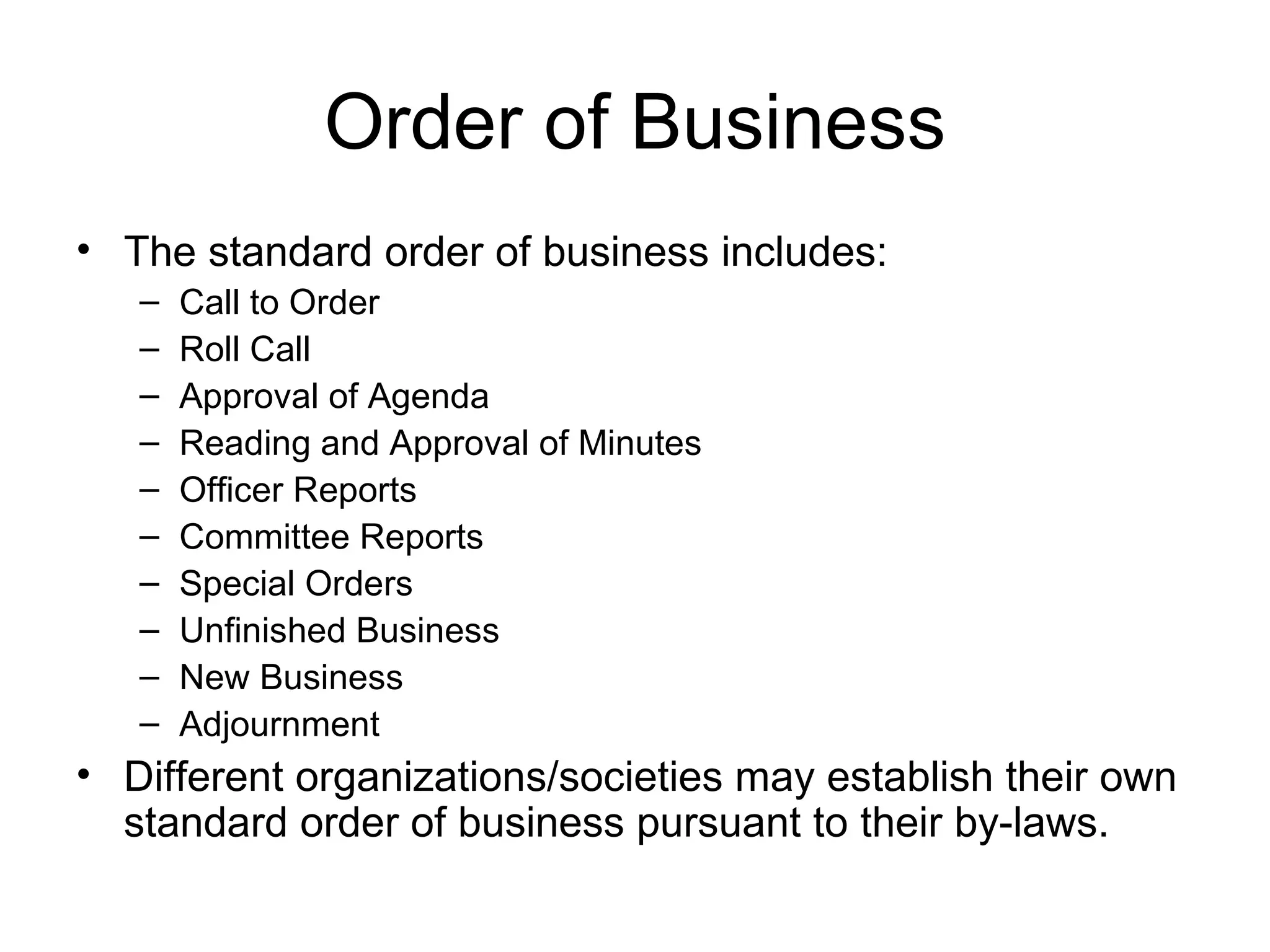
Order of Business The standard order of business includes: Call to Order Roll Call Approval of Agenda Reading and Approval of Minutes Officer Reports Committee Reports Special Orders Unfinished Business New Business Adjournment Different organizations/societies may establish their own standard order of business pursuant to their by-laws.
OVERVIEW OF MOTIONS BRO. KENDALL D. FRANKLIN
Motions A motion is a formal proposal that recommends a course of action that the body should take. A motion must be placed to the body prior to its merits being discussed. A motion contains three basic pieces of information: Who: References the maker of the motion What: References the action to be taken When: References the timeframe in which the action is to be taken.
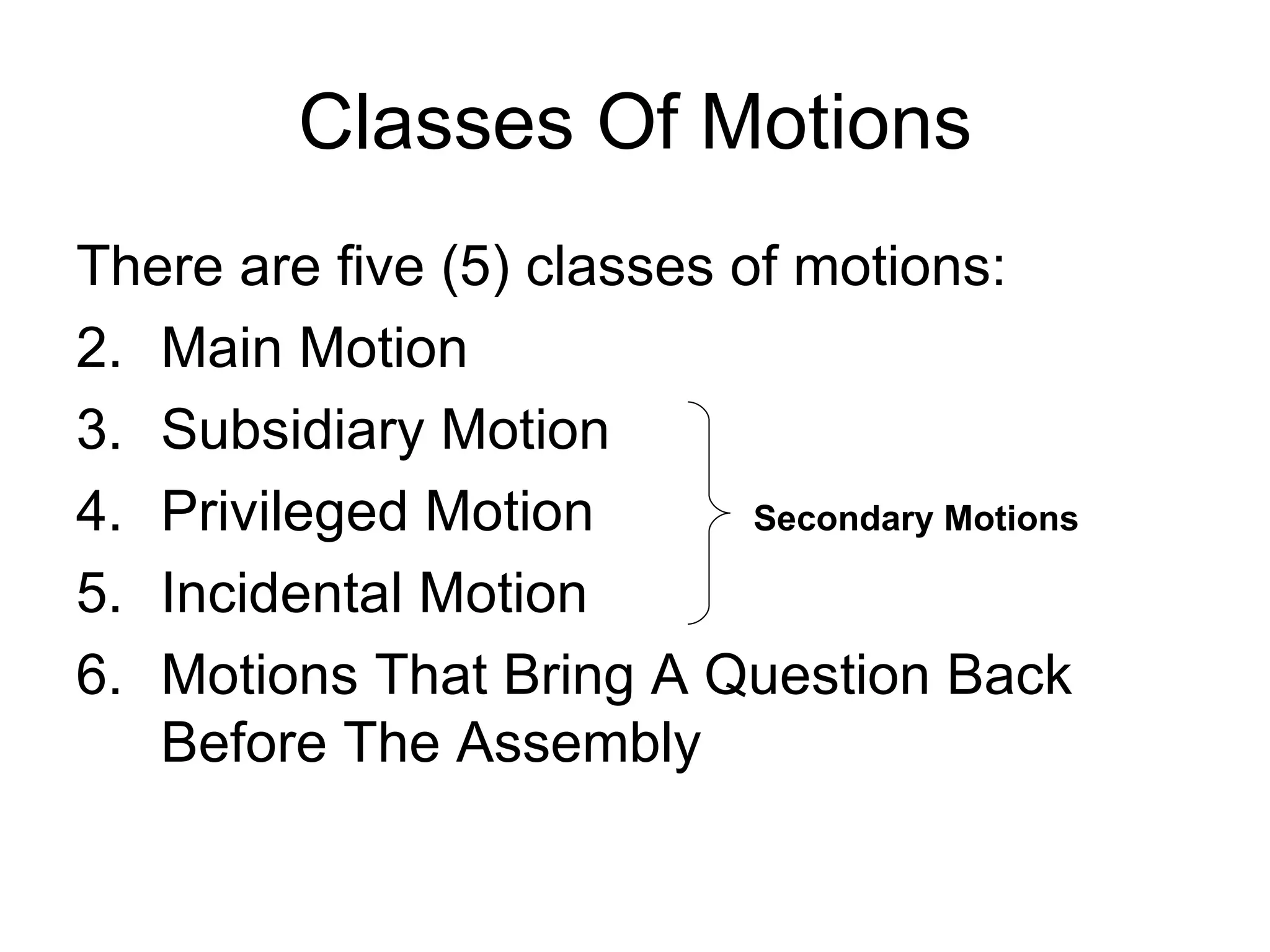
Classes Of Motions There are five (5) classes of motions: Main Motion Subsidiary Motion Privileged Motion Incidental Motion Motions That Bring A Question Back Before The Assembly Secondary Motions
Main Motions A main motion brings a specific recommendation for action before the body. Only one main motion can be considered at a time. Once a main motion has been made and seconded, it must be acted upon before another main motion is considered. In terms of order of precedence of consideration, a main motion is the lowest ranking of all motions.
THE DETAILS OF SUBMITTING MOTIONS BRO. JOHN BALL
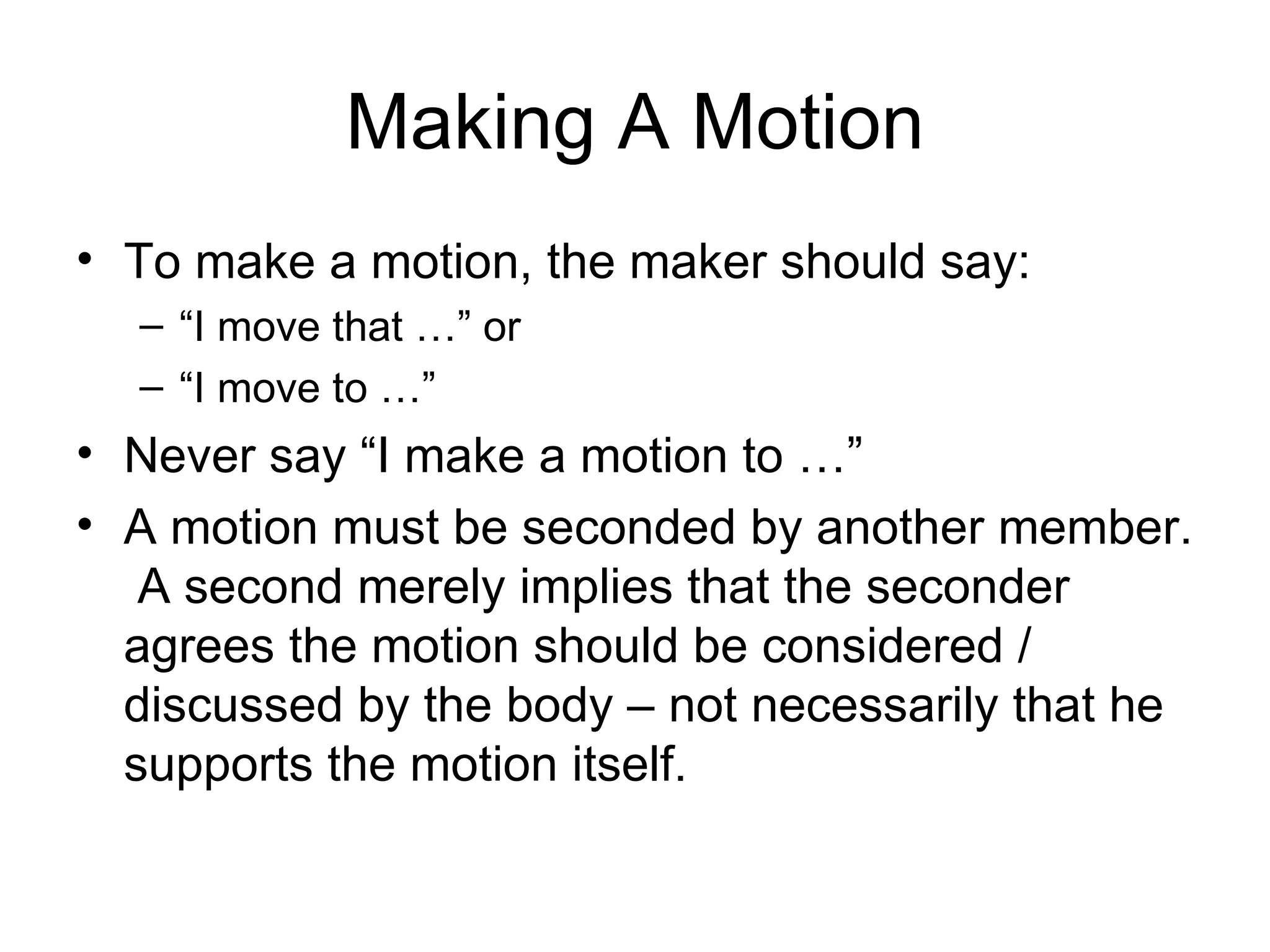
Making A Motion To make a motion, the maker should say: “ I move that …” or “ I move to …” Never say “I make a motion to …” A motion must be seconded by another member.  A second merely implies that the seconder agrees the motion should be considered / discussed by the body – not necessarily that he supports the motion itself.
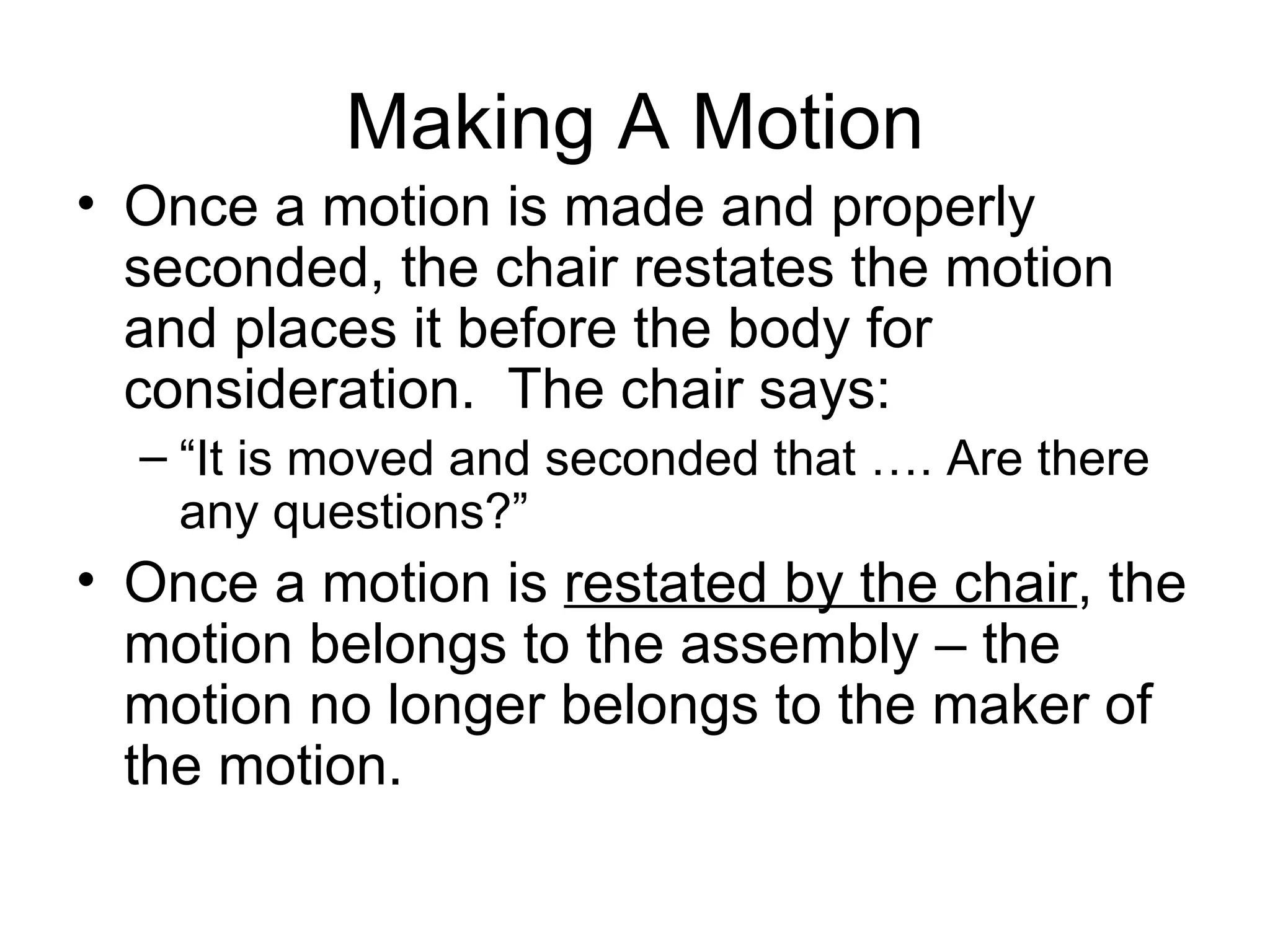
Making A Motion Once a motion is made and properly seconded, the chair restates the motion and places it before the body for consideration.  The chair says: “It is moved and seconded that …. Are there any questions?” Once a motion is  restated by the chair , the motion belongs to the assembly – the motion no longer belongs to the maker of the motion.
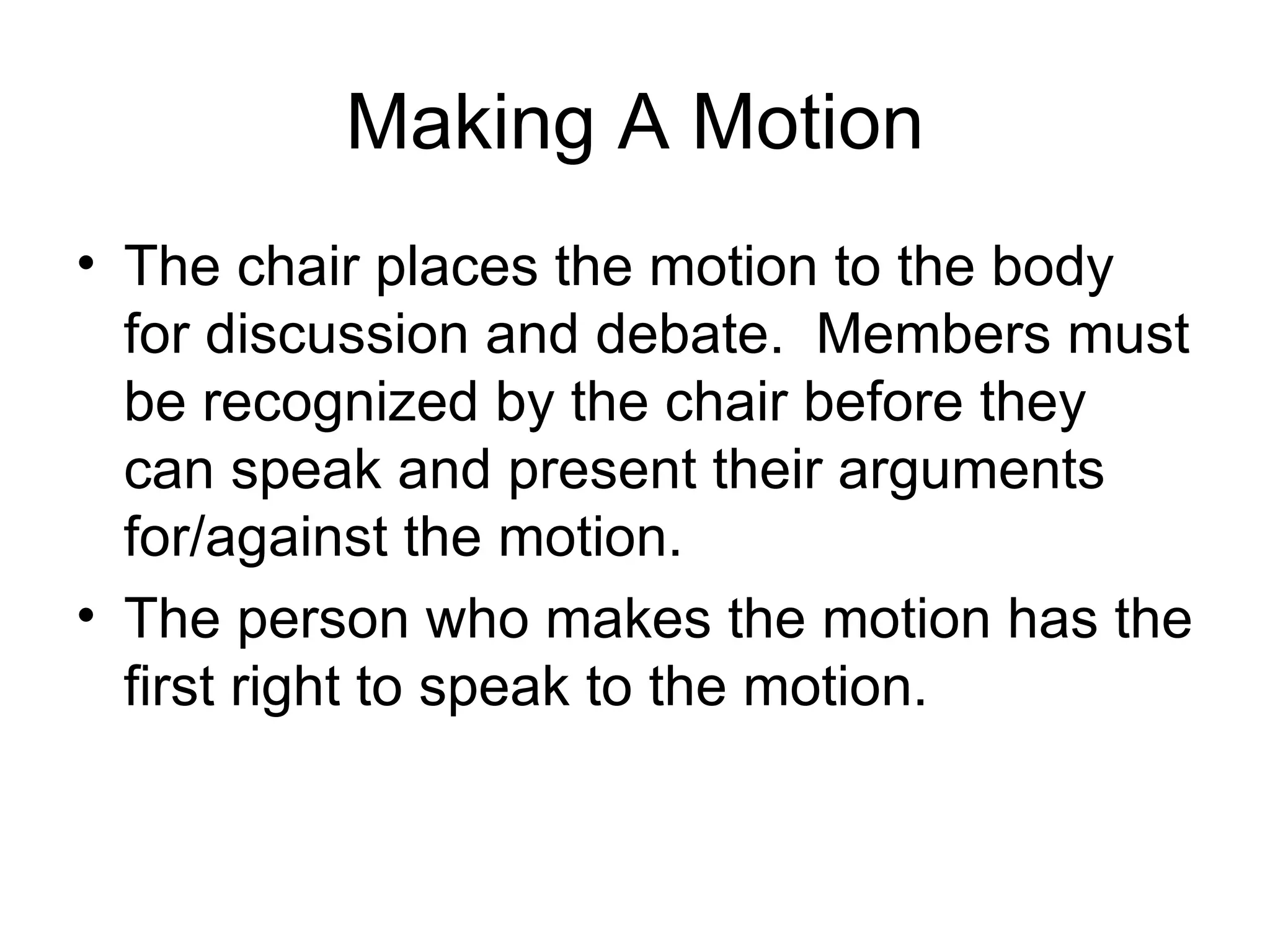
Making A Motion The chair places the motion to the body for discussion and debate.  Members must be recognized by the chair before they can speak and present their arguments for/against the motion. The person who makes the motion has the first right to speak to the motion.
Making A Motion After debate is complete, the chair puts the motion to a vote by saying: “All those in favor say Aye. … All opposed say Nay”. After the vote is tallied, the chair rules on which side won the vote.  The chair announces which side won the vote and announces who will carry out the action if the motion passes.
Amending A Motion Amending a motion means modifying a pending motion in some manner prior to voting on the pending motion. An amendment must be germane to the pending motion.  In other words, it must be related to the pending motion and have a relevant bearing on the meaning of the pending motion.
Amending A Motion The basic descriptive characteristics of an amendment are: Requires a second Can be applied to any main motion Is debatable Requires a majority vote to adopt Can be reconsidered
Amending A Motion There are three basic processes for amending a motion: To insert or to add words To strikeout words To strikeout and insert words
Lay On The Table Used to temporarily defer consideration of a pending main motion in favor of a more pressing matter of business. Must be seconded Is NOT debatable Is NOT amendable Requires a majority vote to pass When a motion is laid on the table, the motion is reconsidered during the same meeting.
Quick Summary I am the chairperson and I run the meeting. The meeting starts when someone stands, I call on them, and they make a motion. If we are to discuss the motion, someone has to “second” it. Once it’s seconded, we have a debate Again, during the debate you must stand and be called on in order to speak.
Quick Summary cont. If you wish to add or take something out of a motion, you make a motion to amend. The amendment must be seconded also. At the end, we will take a vote. Majority wins.

Robert's rules power point

  • 1.
    Parliamentary Procedure &Robert’s Rules of Order Tenth District Workshop District Counselor: Bro. Steven Watkins Facilitators: Bro. John Ball Bro. Kendall Franklin
  • 2.
    Today’s Topics Section1 – Introduction & Basic Principles Section 2 – Overview of Motions Section 3 – Details of Submitting Motions
  • 3.
    INTRODUCTION & BASICPRINCIPLES BRO. STEVEN G. WATKINS, ESQ TENTH DISTRICT COUNSELOR
  • 4.
    Introduction What areparliamentary procedures? The rules that help us maintain order and ensure fairness in all decision-making processes. What are Robert’s Rules of Order? Codification of general present-day parliamentary procedures.
  • 5.
    Basic Principles Someonemust facilitate meetings and maintain order (the presiding officer) All members have a right to bring up ideas Members should come to an agreement about what course of action to take The majority rules, but the basic rights of the minority are always protected by assuring them the right to speak and to vote.
  • 6.
    Basic Principles Parliamentaryprocedure enables members to take care of business in an efficient manner while maintaining order. It ensures everyone gets the right to speak and to vote. Takes up business one item at a time and promotes courtesy, justice, and impartiality.
  • 7.
    The Presiding OfficerThe presiding officer (often referred to as “the chair”) is the person who conducts the meeting (in this case, Miss Gaines). The presiding officer is a role – not a position. This means that the presiding officer is the person who occupies the chair at a given instant of time.
  • 8.
    The Presiding OfficerThe general duties of the presiding officer are: To call the meeting to order at the scheduled time To announce the business that is to come before the body To recognize members who wish to speak To state and put to vote all questions that come before the body
  • 9.
    The Presiding OfficerGeneral Duties (con’t) To protect the assembly from obviously frivolous and dilatory motions by refusing to recognize them To enforce the rules relating to debate To expedite business in an orderly manner To decide all questions of order To declare the meeting adjourned
  • 10.
    Promoting Courtesy Membersshould rise to be recognized by the presiding officer. Members should ALWAYS refer to other members and officers in the third person. Officers are referred to by title. For example: Not “Miss Gaines,” but Madam Chairman Members should refer to each other in a cordial and courteous manner, for example: “ the previous speaker” “ Mr. Schnieder” or “Miss Robben”
  • 11.
    Promoting Courtesy Allremarks are made through and to the chair! When correcting a member, the presiding officer does not use the member’s name, but instead should state something to the effect: “will the speaker keep his/her remarks to the issue at hand?”
  • 12.
    Promoting Courtesy Ifa motion is out of order the chair states: “The motion is out of order”, not “The member is out of order” or “brother you are out of order.” Only major infractions of rules are corrected. If a member’s rights are not being taken away and the infraction is minor, then it isn’t necessary to raise a point of order.
  • 13.
    Order of BusinessCommonly referred to as an agenda, the order of business is the sequence of general business items that will be addressed in the meeting. The order of business must be adopted by the body prior to addressing business.
  • 14.
    Order of BusinessThe standard order of business includes: Call to Order Roll Call Approval of Agenda Reading and Approval of Minutes Officer Reports Committee Reports Special Orders Unfinished Business New Business Adjournment Different organizations/societies may establish their own standard order of business pursuant to their by-laws.
  • 15.
    OVERVIEW OF MOTIONSBRO. KENDALL D. FRANKLIN
  • 16.
    Motions A motionis a formal proposal that recommends a course of action that the body should take. A motion must be placed to the body prior to its merits being discussed. A motion contains three basic pieces of information: Who: References the maker of the motion What: References the action to be taken When: References the timeframe in which the action is to be taken.
  • 17.
    Classes Of MotionsThere are five (5) classes of motions: Main Motion Subsidiary Motion Privileged Motion Incidental Motion Motions That Bring A Question Back Before The Assembly Secondary Motions
  • 18.
    Main Motions Amain motion brings a specific recommendation for action before the body. Only one main motion can be considered at a time. Once a main motion has been made and seconded, it must be acted upon before another main motion is considered. In terms of order of precedence of consideration, a main motion is the lowest ranking of all motions.
  • 19.
    THE DETAILS OFSUBMITTING MOTIONS BRO. JOHN BALL
  • 20.
    Making A MotionTo make a motion, the maker should say: “ I move that …” or “ I move to …” Never say “I make a motion to …” A motion must be seconded by another member. A second merely implies that the seconder agrees the motion should be considered / discussed by the body – not necessarily that he supports the motion itself.
  • 21.
    Making A MotionOnce a motion is made and properly seconded, the chair restates the motion and places it before the body for consideration. The chair says: “It is moved and seconded that …. Are there any questions?” Once a motion is restated by the chair , the motion belongs to the assembly – the motion no longer belongs to the maker of the motion.
  • 22.
    Making A MotionThe chair places the motion to the body for discussion and debate. Members must be recognized by the chair before they can speak and present their arguments for/against the motion. The person who makes the motion has the first right to speak to the motion.
  • 23.
    Making A MotionAfter debate is complete, the chair puts the motion to a vote by saying: “All those in favor say Aye. … All opposed say Nay”. After the vote is tallied, the chair rules on which side won the vote. The chair announces which side won the vote and announces who will carry out the action if the motion passes.
  • 24.
    Amending A MotionAmending a motion means modifying a pending motion in some manner prior to voting on the pending motion. An amendment must be germane to the pending motion. In other words, it must be related to the pending motion and have a relevant bearing on the meaning of the pending motion.
  • 25.
    Amending A MotionThe basic descriptive characteristics of an amendment are: Requires a second Can be applied to any main motion Is debatable Requires a majority vote to adopt Can be reconsidered
  • 26.
    Amending A MotionThere are three basic processes for amending a motion: To insert or to add words To strikeout words To strikeout and insert words
  • 27.
    Lay On TheTable Used to temporarily defer consideration of a pending main motion in favor of a more pressing matter of business. Must be seconded Is NOT debatable Is NOT amendable Requires a majority vote to pass When a motion is laid on the table, the motion is reconsidered during the same meeting.
  • 28.
    Quick Summary Iam the chairperson and I run the meeting. The meeting starts when someone stands, I call on them, and they make a motion. If we are to discuss the motion, someone has to “second” it. Once it’s seconded, we have a debate Again, during the debate you must stand and be called on in order to speak.
  • 29.
    Quick Summary cont.If you wish to add or take something out of a motion, you make a motion to amend. The amendment must be seconded also. At the end, we will take a vote. Majority wins.

Editor's Notes

  • #18 Citation: Robert’s Rules of Order, page 56.