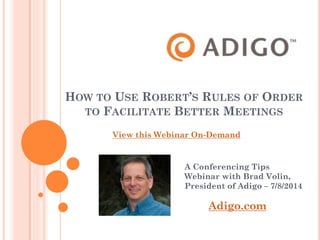
HOW TO USE ROBERT’S RULES OF ORDER
TO FACILITATE BETTER MEETINGS
A Conferencing Tips
Webinar with Brad Volin,
President of Adigo – 7/8/2014
AGENDA
 Intro’s
 Challenges
 Robert’s Rules
 Step 1
 Cheat Sheet: Precedence
 No Precedence
 Main Motion
 How-to accomplish …
 Top 4
 Mistakes to avoid
confidential
INTRODUCTIONS
 President, Adigo
 Experience at Public and Private companies
 Used Robert’s Rules
 Public service: watch City Council Meetings
 Non-profits
 Corporate
confidential
MEETINGS –
FRUSTRATION OR MODEL OF EFFICIENCY?
confidential
 Who has used RR?
 Who hosts?
 In person vs virtual – which is easier/better?
 Blog article - anything of particular interest?
 Share a good or bad experience
 What does this Mean? >>
 Ground Rules
TYPICAL MEETING SCENARIO
 Unprepared
confidential
 Politics
Not tech savvy
Etiquette
 Late comers
 Bored
 New
users
 Training
RESULT: INEFFICIENT
AND POOR DECISIONS
confidential
What is your horror
story?
Challenges:
 Don’t know each other
 Focused on other things
 Wrong people
 Data not clear
ROBERT’S RULES:
Provides common rules and procedures for
deliberation and debate in order to place the whole
membership on the same footing and speaking the
same language. The conduct of ALL business is
controlled by the general will of the whole
membership - the right of the deliberate majority to
decide.
Complementary is the right of at least a strong
minority to require the majority to be deliberate - to
act according to its considered judgment AFTER a
full and fair "working through" of the issues
involved. (no railroading through proposals)
confidential
RR – CONT’D:
Robert's Rules provides for constructive and
democratic meetings to help, not hinder, the
business of the assembly.
Under no circumstances should "undue strictness"
be allowed to intimidate members or limit full
participation.
confidential
WHAT IT DOES
 Establish ground rules
 Agendas are core
 Keeps it respectful
 Stay on task
 Removes the emotion
 Focus on the majority
 Focus on the facts
confidential
efficiency
good decisions
STEP #1:
 Provide TRAINING
 Provide Vocabulary cheat sheet
 Written Ground rules: strict adherence?,
norms, rotate chair?…
 Conduct Practice Meetings
 Designate a RR judge
confidential
RR CHEAT SHEET – PRECEDENCE
confidential
To: You Say: Interrupt?
2nd Debate Amend Vote
Adjourn I move that we
adjourn
N Y N N M
Recess IMTW recess
until
N Y N Y M
Complain Point of
privilege
Y N N N Chair
Suspend further
consideration
IMTW table it N Y N N M
End debate IM the previous
question
N Y N N 2/3
Postpone
consideration
IM we postpone
this until …
N Y Y Y M
Amend a motion IMT this motion
be amended by
N Y Y Y M
Introduce business I move that … N Y Y Y M
RR CHEAT SHEET – NO PRECEDENCE
confidential
To: You Say: Interrupt?
2nd Debate Amend Vote
Object to
procedure
Point of order Y N N N Chair
Request
information
PO information Y N N N N
Ask for vote by
count to verify
I call for a
division of the
Y N N N N
Object to
considering
I object to
consideration of
Y N N N 2/3
Take up matter
previously tabled
IM we take from
the table
Y Y N N M
Reconsider
something already
IM we
reconsider our
Y Y If orig
was
N M
Consider out of its
sched order
IM we suspend
the rules and
N Y N N 2/3
Vote on a ruling I appeal the
Chair’s decision
Y Y Y N M
PROCEDURE:
HANDLING A MAIN MOTION
1. NOTE: Nothing goes to discussion without a motion
being on the floor.
2. Obtaining and assigning the floor
3. How the Motion is Brought Before the
Assembly
4. Consideration of the Motion
1. Members can debate the motion.
2. Before speaking in debate, members obtain the floor.
3. The maker of the motion has first right to the floor if he claims it
properly
4. Debate must be confined to the merits of the motion.
5. Debate can be closed only by order of the assembly (2/3 vote) or
by the chair if no one seeks the floor for further debate.
5. The chair puts the motion to a vote
6. The chair announces the result of the vote.
confidential
ACCOMPLISH WHAT
YOU WANT TO DO IN MEETINGS
 Main motion
 Amending a motion
 Refer to a committee
 Postpone definitely
 Previous question
You think discussion has gone on for too long and you want to stop
discussion and vote.
 Limit debate
You think discussion is getting long, but you want to give a
reasonable length of time for consideration of the question.
confidential
TOP 4
1. REFER TO A COMMITTEE - You feel that an idea or
proposal being discussed needs more study and
investigation
2. LIMIT DEBATE - You think discussion is getting long,
but you want to give a reasonable length of time for
consideration of the question.
3. COMMITTEE OF THE WHOLE - You are going to
propose a question that is likely to be controversial and
you feel that some of the members will try to kill it by
various maneuvers.
4. POSTPONE DEFINITELY - want the membership to
have more time to consider the question under discussion
and you want to postpone it to a definite time
confidential
MISTAKES TO AVOID
 Don’t use as a weapon: manipulating, expert RR
 Train everyone on the basics so on same page.
“New vocabulary”
 Restate the motion
 Going too fast
confidential
17
CONNECT
Brad Volin, 888-552-3446, bvolin@adigo.com
http://linkedin.com/in/bradvolin
Click & Watch the On-Demand Webinar
For links, details and references, see our post:
How to Use Robert’s Rules of Order to Make Your Conference Calls Hum
Register for our next webinar:
Register for an upcoming Conferencing Tips Webinar
FREE RESOURCES FOR BETTER MEETINGS
AND CONFERENCE CALLS
 The Ultimate Library of Meeting Leader Guides
 International Conference Calling Guide
 Optimized Conferencing for:
 Law Firms
 Marketing & PR Agencies
 Consulting Firms
 The Hidden Costs of Generic Conferencing
 A Guide for Better Call Flows and Prompts
confidential

Using Robert's Rules of Order to Facilitate Better Meetings

  • 1.
    HOW TO USEROBERT’S RULES OF ORDER TO FACILITATE BETTER MEETINGS A Conferencing Tips Webinar with Brad Volin, President of Adigo – 7/8/2014
  • 2.
    AGENDA  Intro’s  Challenges Robert’s Rules  Step 1  Cheat Sheet: Precedence  No Precedence  Main Motion  How-to accomplish …  Top 4  Mistakes to avoid confidential
  • 3.
    INTRODUCTIONS  President, Adigo Experience at Public and Private companies  Used Robert’s Rules  Public service: watch City Council Meetings  Non-profits  Corporate confidential
  • 4.
    MEETINGS – FRUSTRATION ORMODEL OF EFFICIENCY? confidential  Who has used RR?  Who hosts?  In person vs virtual – which is easier/better?  Blog article - anything of particular interest?  Share a good or bad experience  What does this Mean? >>  Ground Rules
  • 5.
    TYPICAL MEETING SCENARIO Unprepared confidential  Politics Not tech savvy Etiquette  Late comers  Bored  New users  Training
  • 6.
    RESULT: INEFFICIENT AND POORDECISIONS confidential What is your horror story? Challenges:  Don’t know each other  Focused on other things  Wrong people  Data not clear
  • 7.
    ROBERT’S RULES: Provides commonrules and procedures for deliberation and debate in order to place the whole membership on the same footing and speaking the same language. The conduct of ALL business is controlled by the general will of the whole membership - the right of the deliberate majority to decide. Complementary is the right of at least a strong minority to require the majority to be deliberate - to act according to its considered judgment AFTER a full and fair "working through" of the issues involved. (no railroading through proposals) confidential
  • 8.
    RR – CONT’D: Robert'sRules provides for constructive and democratic meetings to help, not hinder, the business of the assembly. Under no circumstances should "undue strictness" be allowed to intimidate members or limit full participation. confidential
  • 9.
    WHAT IT DOES Establish ground rules  Agendas are core  Keeps it respectful  Stay on task  Removes the emotion  Focus on the majority  Focus on the facts confidential efficiency good decisions
  • 10.
    STEP #1:  ProvideTRAINING  Provide Vocabulary cheat sheet  Written Ground rules: strict adherence?, norms, rotate chair?…  Conduct Practice Meetings  Designate a RR judge confidential
  • 11.
    RR CHEAT SHEET– PRECEDENCE confidential To: You Say: Interrupt? 2nd Debate Amend Vote Adjourn I move that we adjourn N Y N N M Recess IMTW recess until N Y N Y M Complain Point of privilege Y N N N Chair Suspend further consideration IMTW table it N Y N N M End debate IM the previous question N Y N N 2/3 Postpone consideration IM we postpone this until … N Y Y Y M Amend a motion IMT this motion be amended by N Y Y Y M Introduce business I move that … N Y Y Y M
  • 12.
    RR CHEAT SHEET– NO PRECEDENCE confidential To: You Say: Interrupt? 2nd Debate Amend Vote Object to procedure Point of order Y N N N Chair Request information PO information Y N N N N Ask for vote by count to verify I call for a division of the Y N N N N Object to considering I object to consideration of Y N N N 2/3 Take up matter previously tabled IM we take from the table Y Y N N M Reconsider something already IM we reconsider our Y Y If orig was N M Consider out of its sched order IM we suspend the rules and N Y N N 2/3 Vote on a ruling I appeal the Chair’s decision Y Y Y N M
  • 13.
    PROCEDURE: HANDLING A MAINMOTION 1. NOTE: Nothing goes to discussion without a motion being on the floor. 2. Obtaining and assigning the floor 3. How the Motion is Brought Before the Assembly 4. Consideration of the Motion 1. Members can debate the motion. 2. Before speaking in debate, members obtain the floor. 3. The maker of the motion has first right to the floor if he claims it properly 4. Debate must be confined to the merits of the motion. 5. Debate can be closed only by order of the assembly (2/3 vote) or by the chair if no one seeks the floor for further debate. 5. The chair puts the motion to a vote 6. The chair announces the result of the vote. confidential
  • 14.
    ACCOMPLISH WHAT YOU WANTTO DO IN MEETINGS  Main motion  Amending a motion  Refer to a committee  Postpone definitely  Previous question You think discussion has gone on for too long and you want to stop discussion and vote.  Limit debate You think discussion is getting long, but you want to give a reasonable length of time for consideration of the question. confidential
  • 15.
    TOP 4 1. REFERTO A COMMITTEE - You feel that an idea or proposal being discussed needs more study and investigation 2. LIMIT DEBATE - You think discussion is getting long, but you want to give a reasonable length of time for consideration of the question. 3. COMMITTEE OF THE WHOLE - You are going to propose a question that is likely to be controversial and you feel that some of the members will try to kill it by various maneuvers. 4. POSTPONE DEFINITELY - want the membership to have more time to consider the question under discussion and you want to postpone it to a definite time confidential
  • 16.
    MISTAKES TO AVOID Don’t use as a weapon: manipulating, expert RR  Train everyone on the basics so on same page. “New vocabulary”  Restate the motion  Going too fast confidential
  • 17.
    17 CONNECT Brad Volin, 888-552-3446,bvolin@adigo.com http://linkedin.com/in/bradvolin Click & Watch the On-Demand Webinar For links, details and references, see our post: How to Use Robert’s Rules of Order to Make Your Conference Calls Hum Register for our next webinar: Register for an upcoming Conferencing Tips Webinar
  • 18.
    FREE RESOURCES FORBETTER MEETINGS AND CONFERENCE CALLS  The Ultimate Library of Meeting Leader Guides  International Conference Calling Guide  Optimized Conferencing for:  Law Firms  Marketing & PR Agencies  Consulting Firms  The Hidden Costs of Generic Conferencing  A Guide for Better Call Flows and Prompts confidential