Management & Leadership
in Ministry


       Ranks of Motions
There are 82 different types of MOTIONS
 Thankfully these 82 types of motion
 break down nicely into …

5 Big Categories of Motions
- MAIN (introduce an item of business)
- SUBSIDIARY (how to deal w motion)
   ie: lay on table; refer; amend; limit debate; postpone indefinitely/to a
       certain time.

- PRIVLEGED (big procedural issues,         UNRELATED to the motion)
   ie: adjourn; recess; question of privilege; orders of day.

- INCIDENTAL (procedural issues RELATED to the motion)
   ie: Point of Order; appeal; point of information; division of
       assembly/question; suspend rules.

-RESTORATIVE motion (help undo or reconsider a decision)
   ie: Reconsider; rescind/amend previously adopted; take from table.
The Main Concept:
MOTIONS HAVE AN ORDER OF
PRECEDENT AND IMPORTANCE (Rank
or Pecking order).
MORE IMPORTANT MOTIONS MUST
BE DEALT WITH, BEFORE A MOTION
OF LOWER IMPORTANCE IS DEALT
WITH.
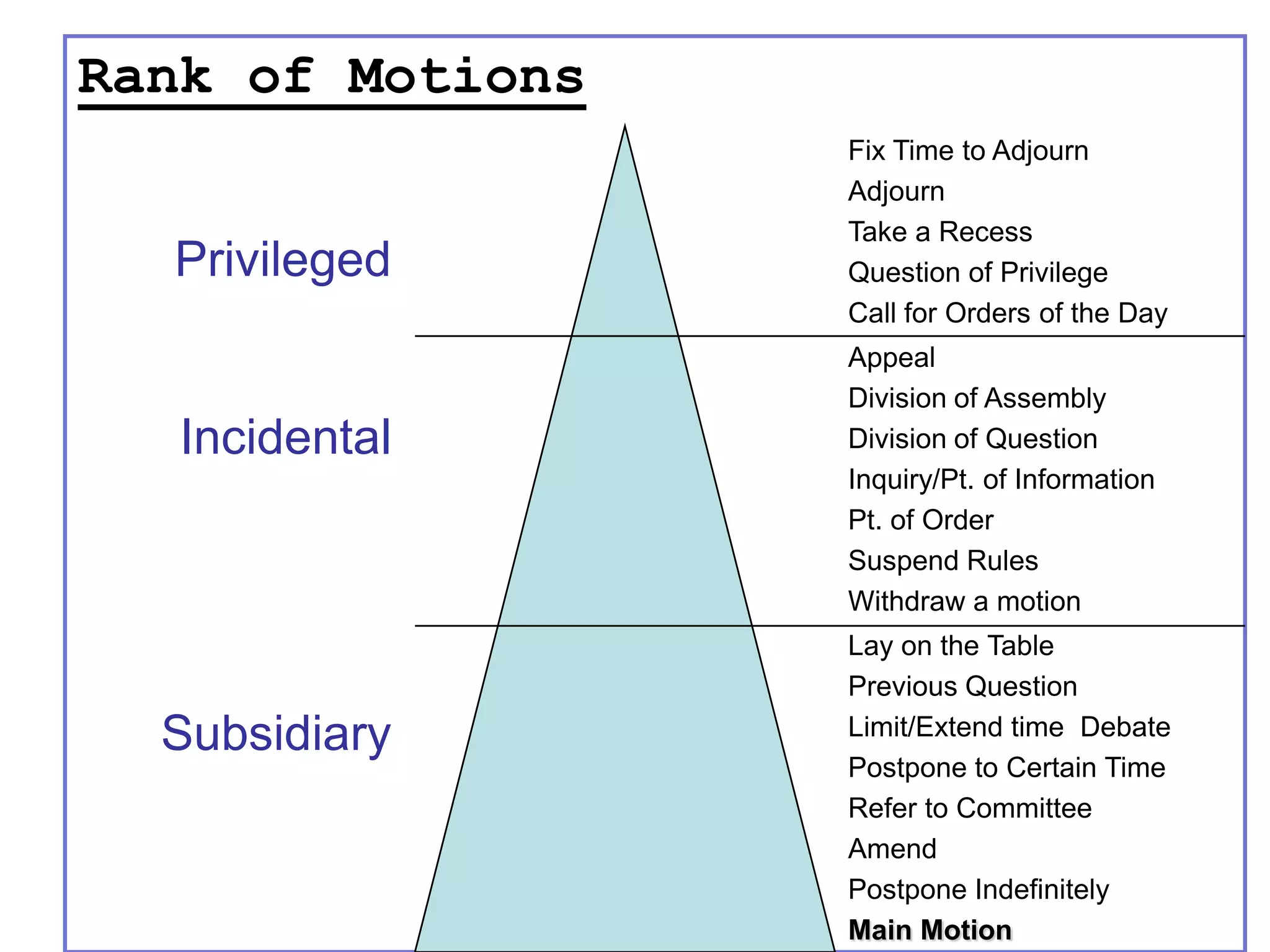
The following diagram shows
the „rank‟ of motions (the higher
 up on the triangle, the greater
 the importance of the motion).
     Note: not all motions are listed in the
following diagram, however the motions you
   are most likely need to know, are listed.
Rank of Motions
                  Fix Time to Adjourn
                  Adjourn
                  Take a Recess
  Privileged      Question of Privilege
                  Call for Orders of the Day
                  Appeal
                  Division of Assembly
   Incidental     Division of Question
                  Inquiry/Pt. of Information
                  Pt. of Order
                  Suspend Rules
                  Withdraw a motion
                  Lay on the Table
                  Previous Question
  Subsidiary      Limit/Extend time Debate
                  Postpone to Certain Time
                  Refer to Committee
                  Amend
                  Postpone Indefinitely
                  Main Motion
The 5 Big ‘Motion’ Questions:
1) Can the motion „interrupt‟ a
   person who is presently speaking
2) Does the motion need a „seconder‟
3) Can the motion be „amended‟
4) Can the motion be „debated‟
5) What type of vote is needed in order
   to „carry‟ the motion?
The following slide identifies the
answers to the 5 big questions
5 questions:Interrupt,         Second, Amendable, Debatable, Vote


                 Fix Time to Adjourn          Second, Amendable, Majority
                 Adjourn                      Second, Majority
                 Take a Recess                Second, Amendable, Majority
    Privileged   Question of Privilege        Interrupt, No Vote
                 Call for Orders of the Day   Interrupt, No Vote
                 Appeal                       Interrupt, Second, Debate, Majority
                 Division of Assembly         Interrupt, No Vote
    Incidental   Division of Question         Second, Amendable, Majority
                 Inquiry/Pt. of Information   Interrupt, No Vote
                 Pt. of Order                 Interrupt, No Vote
                 Suspend Rules                Second, 2/3 vote
                 Withdraw a motion            By mover, if there is no amendment
                 Lay on the Table             Second, Majority
                 Previous Question            Second, 2/3 vote
    Subsidiary   Limit/Extend time Debate     Second, Amendable, 2/3 vote
                 Postpone to Certain Time     Second, Amendable, Debate, Majority
                 Refer to Committee           Second, Amendable, Debate, Majority
                 Amend                        Second, Amendable, Debate, Majority
                 Postpone Indefinitely        Second, Debatable, Majority
                 Main Motion                  Second, Amendable, Debate, Majority
The following slide clarifies the
meaning / implications / purpose
   of some of the motions.
Clarifying Purpose / Meaning of Motions


 - Postpone Indefinitely: Permanently kills the
     motion (same as a negative vote)
 - Refer to Committee: Temporarily postpones a
      decision so as to empower a committee to
      get additional information.
Clarifying Purpose / Meaning of Motions

  – Postpone to a certain time: Temporarily
    postpones the decision-making so as to deal
    with more pressing issues or seek additional
    info. The motion is guaranteed to be re-
    introduced as an “Order of Business” at the
    appointed (certain) time.
            – Close/Limit or Extend debate:
              Alters the normal procedures to
              either restrict the amount of time or
              the number of people allowed to
              debate the motion – or to allow for
              more/additional discussion.
Clarifying Purpose / Meaning of Motions
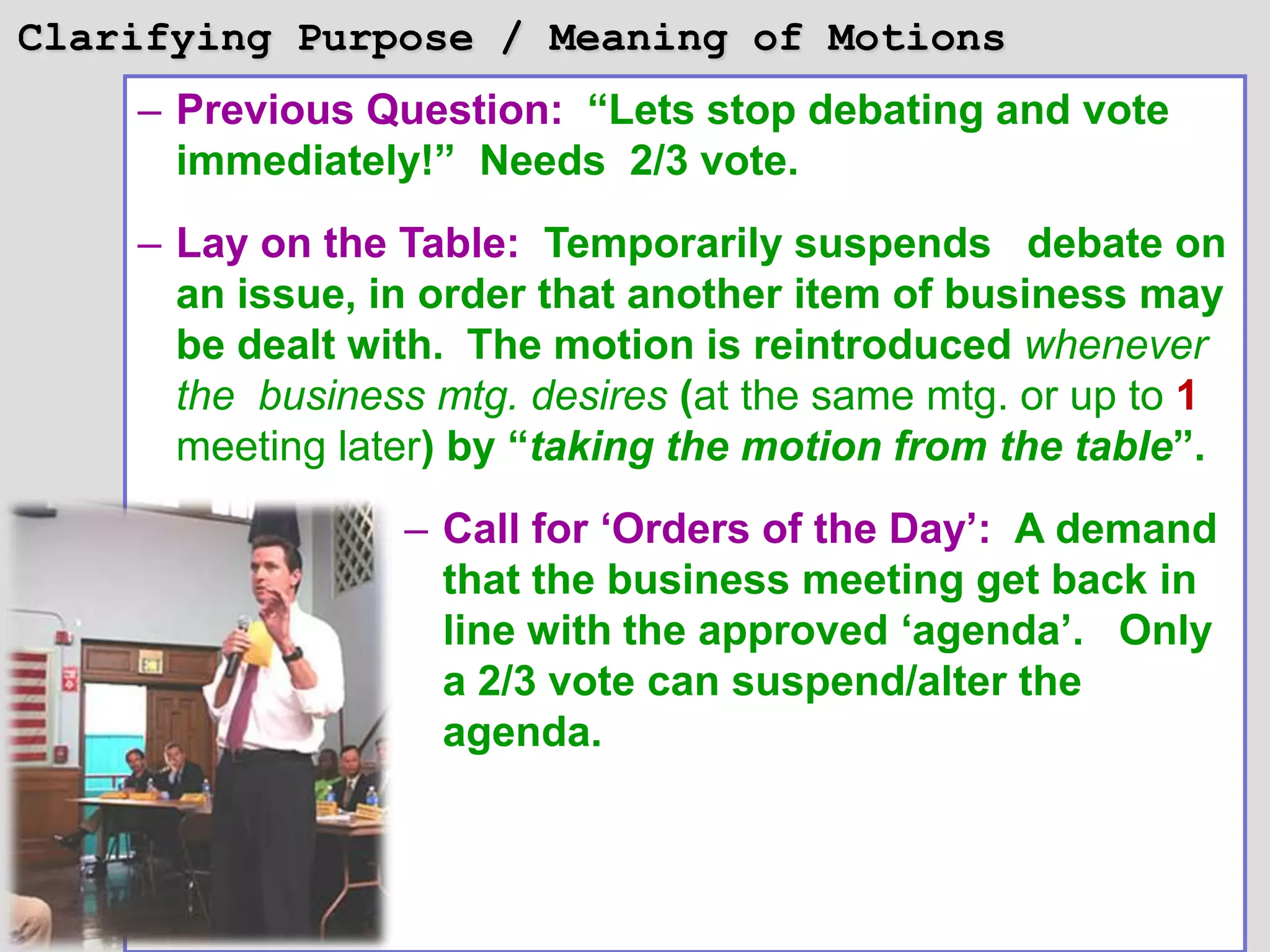
    – Previous Question: “Lets stop debating and vote
      immediately!” Needs 2/3 vote.
    – Lay on the Table: Temporarily suspends debate on
      an issue, in order that another item of business may
      be dealt with. The motion is reintroduced whenever
      the business mtg. desires (at the same mtg. or up to 1
      meeting later) by “taking the motion from the table”.
                 – Call for „Orders of the Day‟: A demand
                   that the business meeting get back in
                   line with the approved „agenda‟. Only
                   a 2/3 vote can suspend/alter the
                   agenda.
- Question of Privilege: Usually a request
  for the chairperson to address something
  concerning an issue of „comfort, safety or the
  integrity of the meeting‟ (i.e. clarifying
  inaccurate statements; adjust heating;
  improve sound systems; or to clarify the
  rights of the members)
- Point of Order: Usually an appeal to the chair to
  correct a perceived procedural error or a violation of
  the rules. “Point of Order, the member has already
  spoken twice to this issue” OR “I believe the discussion
  is off topic ”.
- Appeal: A request for the business meeting to either
  overturn (or endorse) a ruling by the chairperson.
- Inquiry or Point of Information: Usually
  a request from a person is unsure or
  confused about the proper procedures
  or is asking a question germane to the motion before the
  meeting: ‟Can someone tell me how many years our church
  has already supported the Bible Society?‟ or „Would the chair
  clarify whether we are talking about buying or renting a van‟.
- Suspend the Rules: Periodically it may be necessary to
  temporarily lay aside the normal rules of how        business
  is conducted, in order to more fully determine the will of
  the people, or to deal with an urgent matter. i.e. I would
  like to move we suspend the rules that only members may
  speak, in order to allow a non-member to speak. Requires
  2/3 vote
Prohibiting Motions
Motions are said to be ‘out of order’ or
‘not in order at this time’ IF . . .
– Another motion is on the floor for discussion/vote
– The proposed motion conflicts w. Standing Rules /By-laws
– If the motion is substantially the same OR conflicts with
                    a motion which has already been voted
                    on (at the same meeting)
                   – The motion has inappropriate language
                   – Is frivolous or absurd.
                   The chairperson should give a very brief
  explanation, each time a motion is ruled „out of order‟. The
  chair does not need to allow a person to have the floor if
  they are consistently suggesting absurd or disruptive
  motions.
Class Exercise
Fix Time to Adjourn
Adjourn
Take a Recess
Question of Privilege
Call for Orders of the Day   Scenario:
Appeal
Division of Assembly
Division of Question
                             Location: Kingswood University
Inquiry/Pt. of Information
Pt. of Order
                             Situation: Trustee meeting
Suspend Rules
Withdraw a motion
                             Motion: “Close Ingersoll House
Lay on the Table                        this fall, and require the
Previous Question
Limit/Extend time Debate                male students to live in
Postpone to Certain Time
Refer to Committee                      heated army tents, until
Amend
Postpone Indefinitely
                                        a new dorm can be
Main Motion                             built in 2014.”

5 Rank of Motions

  • 1.
    Management & Leadership inMinistry Ranks of Motions
  • 2.
    There are 82different types of MOTIONS Thankfully these 82 types of motion break down nicely into … 5 Big Categories of Motions
  • 3.
    5 Big Categoriesof Motions - MAIN (introduce an item of business) - SUBSIDIARY (how to deal w motion) ie: lay on table; refer; amend; limit debate; postpone indefinitely/to a certain time. - PRIVLEGED (big procedural issues, UNRELATED to the motion) ie: adjourn; recess; question of privilege; orders of day. - INCIDENTAL (procedural issues RELATED to the motion) ie: Point of Order; appeal; point of information; division of assembly/question; suspend rules. -RESTORATIVE motion (help undo or reconsider a decision) ie: Reconsider; rescind/amend previously adopted; take from table.
  • 4.
    The Main Concept: MOTIONSHAVE AN ORDER OF PRECEDENT AND IMPORTANCE (Rank or Pecking order). MORE IMPORTANT MOTIONS MUST BE DEALT WITH, BEFORE A MOTION OF LOWER IMPORTANCE IS DEALT WITH.
  • 5.
    The following diagramshows the „rank‟ of motions (the higher up on the triangle, the greater the importance of the motion). Note: not all motions are listed in the following diagram, however the motions you are most likely need to know, are listed.
  • 6.
    Rank of Motions Fix Time to Adjourn Adjourn Take a Recess Privileged Question of Privilege Call for Orders of the Day Appeal Division of Assembly Incidental Division of Question Inquiry/Pt. of Information Pt. of Order Suspend Rules Withdraw a motion Lay on the Table Previous Question Subsidiary Limit/Extend time Debate Postpone to Certain Time Refer to Committee Amend Postpone Indefinitely Main Motion
  • 7.
    The 5 Big‘Motion’ Questions: 1) Can the motion „interrupt‟ a person who is presently speaking 2) Does the motion need a „seconder‟ 3) Can the motion be „amended‟ 4) Can the motion be „debated‟ 5) What type of vote is needed in order to „carry‟ the motion?
  • 8.
    The following slideidentifies the answers to the 5 big questions
  • 9.
    5 questions:Interrupt, Second, Amendable, Debatable, Vote Fix Time to Adjourn Second, Amendable, Majority Adjourn Second, Majority Take a Recess Second, Amendable, Majority Privileged Question of Privilege Interrupt, No Vote Call for Orders of the Day Interrupt, No Vote Appeal Interrupt, Second, Debate, Majority Division of Assembly Interrupt, No Vote Incidental Division of Question Second, Amendable, Majority Inquiry/Pt. of Information Interrupt, No Vote Pt. of Order Interrupt, No Vote Suspend Rules Second, 2/3 vote Withdraw a motion By mover, if there is no amendment Lay on the Table Second, Majority Previous Question Second, 2/3 vote Subsidiary Limit/Extend time Debate Second, Amendable, 2/3 vote Postpone to Certain Time Second, Amendable, Debate, Majority Refer to Committee Second, Amendable, Debate, Majority Amend Second, Amendable, Debate, Majority Postpone Indefinitely Second, Debatable, Majority Main Motion Second, Amendable, Debate, Majority
  • 10.
    The following slideclarifies the meaning / implications / purpose of some of the motions.
  • 11.
    Clarifying Purpose /Meaning of Motions - Postpone Indefinitely: Permanently kills the motion (same as a negative vote) - Refer to Committee: Temporarily postpones a decision so as to empower a committee to get additional information.
  • 12.
    Clarifying Purpose /Meaning of Motions – Postpone to a certain time: Temporarily postpones the decision-making so as to deal with more pressing issues or seek additional info. The motion is guaranteed to be re- introduced as an “Order of Business” at the appointed (certain) time. – Close/Limit or Extend debate: Alters the normal procedures to either restrict the amount of time or the number of people allowed to debate the motion – or to allow for more/additional discussion.
  • 13.
    Clarifying Purpose /Meaning of Motions – Previous Question: “Lets stop debating and vote immediately!” Needs 2/3 vote. – Lay on the Table: Temporarily suspends debate on an issue, in order that another item of business may be dealt with. The motion is reintroduced whenever the business mtg. desires (at the same mtg. or up to 1 meeting later) by “taking the motion from the table”. – Call for „Orders of the Day‟: A demand that the business meeting get back in line with the approved „agenda‟. Only a 2/3 vote can suspend/alter the agenda.
  • 14.
    - Question ofPrivilege: Usually a request for the chairperson to address something concerning an issue of „comfort, safety or the integrity of the meeting‟ (i.e. clarifying inaccurate statements; adjust heating; improve sound systems; or to clarify the rights of the members) - Point of Order: Usually an appeal to the chair to correct a perceived procedural error or a violation of the rules. “Point of Order, the member has already spoken twice to this issue” OR “I believe the discussion is off topic ”. - Appeal: A request for the business meeting to either overturn (or endorse) a ruling by the chairperson.
  • 15.
    - Inquiry orPoint of Information: Usually a request from a person is unsure or confused about the proper procedures or is asking a question germane to the motion before the meeting: ‟Can someone tell me how many years our church has already supported the Bible Society?‟ or „Would the chair clarify whether we are talking about buying or renting a van‟. - Suspend the Rules: Periodically it may be necessary to temporarily lay aside the normal rules of how business is conducted, in order to more fully determine the will of the people, or to deal with an urgent matter. i.e. I would like to move we suspend the rules that only members may speak, in order to allow a non-member to speak. Requires 2/3 vote
  • 16.
    Prohibiting Motions Motions aresaid to be ‘out of order’ or ‘not in order at this time’ IF . . . – Another motion is on the floor for discussion/vote – The proposed motion conflicts w. Standing Rules /By-laws – If the motion is substantially the same OR conflicts with a motion which has already been voted on (at the same meeting) – The motion has inappropriate language – Is frivolous or absurd. The chairperson should give a very brief explanation, each time a motion is ruled „out of order‟. The chair does not need to allow a person to have the floor if they are consistently suggesting absurd or disruptive motions.
  • 17.
    Class Exercise Fix Timeto Adjourn Adjourn Take a Recess Question of Privilege Call for Orders of the Day Scenario: Appeal Division of Assembly Division of Question Location: Kingswood University Inquiry/Pt. of Information Pt. of Order Situation: Trustee meeting Suspend Rules Withdraw a motion Motion: “Close Ingersoll House Lay on the Table this fall, and require the Previous Question Limit/Extend time Debate male students to live in Postpone to Certain Time Refer to Committee heated army tents, until Amend Postpone Indefinitely a new dorm can be Main Motion built in 2014.”