An AFSCME Guide
chaira meeting
How to
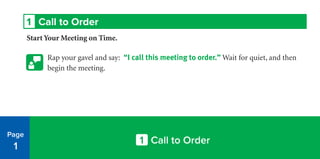
1 Call to Order
1 Call to Order
Start Your Meeting on Time.
Rap your gavel and say: “I call this meeting to order.” Wait for quiet, and then
begin the meeting.
Page
1
2 Roll Call of Officers
The Chair says: “The Recording Secretary will call the Roll of Officers.”
The Recording Secretary then calls the roll in a loud, clear voice, with pauses
for response.
3 Reading of Minutes
The Chair says: “The Secretary will read minutes of the last meeting.” Alternatively,
copies of the minutes can be distributed at the meeting and the Chair says: “Instead
of having the Secretary read the minutes, copies have been distributed for your
review.”
After the minutes are read or reviewed, the Chair asks: “Are there any additions or
corrections to the minutes? [Pause.] If not, the minutes will stand approved as
read.” If corrections to the minutes are made, ask for unanimous consent to additions
or corrections at this time. If there is an objection to any addition or correction, it will
be necessary to adopt a motion to make that change.
Page
2
2 Roll Call of Officers 3 Reading of Minutes
Page
3
4 Reading of Correspondence
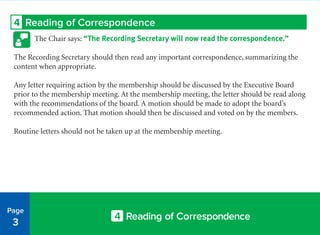
The Chair says: “The Recording Secretary will now read the correspondence.”
The Recording Secretary should then read any important correspondence, summarizing the
content when appropriate.
Any letter requiring action by the membership should be discussed by the Executive Board
prior to the membership meeting. At the membership meeting, the letter should be read along
with the recommendations of the board. A motion should be made to adopt the board’s
recommended action. That motion should then be discussed and voted on by the members.
Routine letters should not be taken up at the membership meeting.
5 Reports of Officers
The President’s Report might include such topics as:
• Problems facing the local	 • Updates on issues affecting the members
• Summary of topics discussed at the • Actions the Executive Board
latest Executive Board meeting	 recommends that the local take
If the President’s Report contains any actions recommended by the Executive
Board, a motion should be made to adopt the board’s recommended action. That
motion is then discussed and voted on by the members. To initiate discussion,
the Chair may say something like: “Does the Chair hear a motion to accept the
Executive Board’s recommendation?”
Secretary-Treasurer’s Report: This report should be copied and passed out at the
meeting. See a sample report in the AFSCME Officers Handbook, Appendix A, or in
material following Appendix E of the AFSCME International Constitution.
The Chair asks: “Does everyone have a copy of the Secretary-Treasurer’s
Report? [Pause.] Are there any questions? [Pause.] If there are no objections,
the Secretary-Treasurer’s Report will stand approved.”
If someone raises an objection, a motion of approval is required.
Page
4
5 Reports of Officers
6 Reports of Staff and Committees
Staff Report:
This may include the latest information on political and legislative issues, organizing
campaigns, important grievances, council activities, an update on contract negotiations,
or any other information of current interest to the membership.
Committee Reports:
Before the membership meeting, the President should talk with each committee
chairperson and go over his/her Committee Report. Reports from any given committee
should be made only when there is something worthwhile to report.
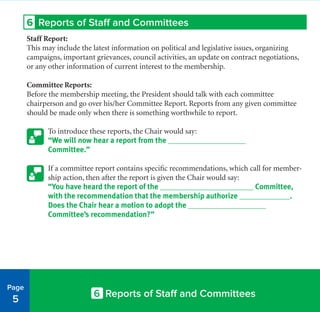
To introduce these reports, the Chair would say:
“We will now hear a report from the ____________________
Committee.”
If a committee report contains specific recommendations, which call for member-
ship action, then after the report is given the Chair would say:
“You have heard the report of the ________________________ Committee,
with the recommendation that the membership authorize _____________.
Does the Chair hear a motion to adopt the ____________________
Committee’s recommendation?”
Page
5
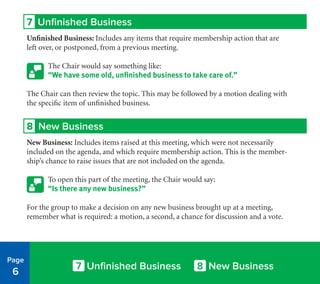
7 Unfinished Business 8 New Business
Offering an Amendment7 Unfinished Business
Unfinished Business: Includes any items that require membership action that are
left over, or postponed, from a previous meeting.
The Chair would say something like:
“We have some old, unfinished business to take care of.”
The Chair can then review the topic. This may be followed by a motion dealing with
the specific item of unfinished business.
8 New Business
New Business: Includes items raised at this meeting, which were not necessarily
included on the agenda, and which require membership action. This is the member-
ship’s chance to raise issues that are not included on the agenda.
To open this part of the meeting, the Chair would say:
“Is there any new business?”
For the group to make a decision on any new business brought up at a meeting,
remember what is required: a motion, a second, a chance for discussion and a vote.
Page
6
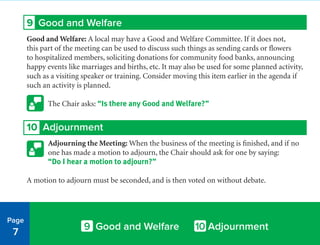
9 Good and Welfare
Good and Welfare: A local may have a Good and Welfare Committee. If it does not,
this part of the meeting can be used to discuss such things as sending cards or flowers
to hospitalized members, soliciting donations for community food banks, announcing
happy events like marriages and births, etc. It may also be used for some planned activity,
such as a visiting speaker or training. Consider moving this item earlier in the agenda if
such an activity is planned.
The Chair asks: “Is there any Good and Welfare?”
10 Adjournment
Adjourning the Meeting: When the business of the meeting is finished, and if no
one has made a motion to adjourn, the Chair should ask for one by saying:
“Do I hear a motion to adjourn?”
A motion to adjourn must be seconded, and is then voted on without debate.
Page
7
9 Good and Welfare 10 Adjournment
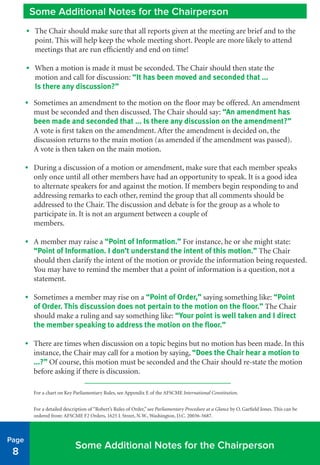
•	 Sometimes an amendment to the motion on the floor may be offered. An amendment
must be seconded and then discussed. The Chair should say: “An amendment has
been made and seconded that ... Is there any discussion on the amendment?”
A vote is first taken on the amendment. After the amendment is decided on, the
discussion returns to the main motion (as amended if the amendment was passed).
A vote is then taken on the main motion.
•	 During a discussion of a motion or amendment, make sure that each member speaks
only once until all other members have had an opportunity to speak. It is a good idea
to alternate speakers for and against the motion. If members begin responding to and
addressing remarks to each other, remind the group that all comments should be
addressed to the Chair. The discussion and debate is for the group as a whole to
participate in. It is not an argument between a couple of
members.
•	 A member may raise a “Point of Information.” For instance, he or she might state:
“Point of Information. I don’t understand the intent of this motion.” The Chair
should then clarify the intent of the motion or provide the information being requested.
You may have to remind the member that a point of information is a question, not a
statement.
•	 Sometimes a member may rise on a “Point of Order,” saying something like: “Point
of Order. This discussion does not pertain to the motion on the floor.” The Chair
should make a ruling and say something like: “Your point is well taken and I direct
the member speaking to address the motion on the floor.”
•	 There are times when discussion on a topic begins but no motion has been made. In this
instance, the Chair may call for a motion by saying, “Does the Chair hear a motion to
...?” Of course, this motion must be seconded and the Chair should re-state the motion
before asking if there is discussion.
For a chart on Key Parliamentary Rules, see Appendix E of the AFSCME International Constitution.
For a detailed description of “Robert’s Rules of Order,” see Parliamentary Procedure at a Glance by O. Garfield Jones. This can be
ordered from: AFSCME F2 Orders, 1625 L Street, N.W., Washington, D.C. 20036-5687.
Page
8
Some Additional Notes for the Chairperson
•	 The Chair should make sure that all reports given at the meeting are brief and to the
point. This will help keep the whole meeting short. People are more likely to attend
meetings that are run efficiently and end on time!
•	 When a motion is made it must be seconded. The Chair should then state the
motion and call for discussion: “It has been moved and seconded that ...
Is there any discussion?”
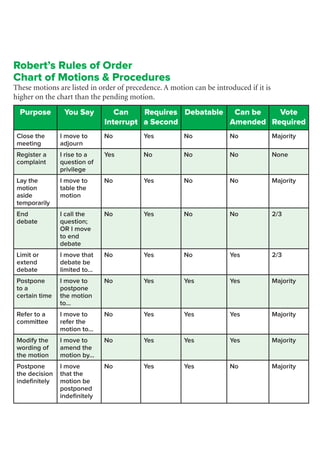
Robert’s Rules of Order
Chart of Motions & Procedures
These motions are listed in order of precedence. A motion can be introduced if it is
higher on the chart than the pending motion.
Purpose You Say Can
Interrupt
Requires
a Second
Debatable Can be
Amended
Vote
Required
Close the
meeting
I move to
adjourn
No Yes No No Majority
Register a
complaint
I rise to a
question of
privilege
Yes No No No None
Lay the
motion
aside
temporarily
I move to
table the
motion
No Yes No No Majority
End
debate
I call the
question;
OR I move
to end
debate
No Yes No No 2/3
Limit or
extend
debate
I move that
debate be
limited to…
No Yes No Yes 2/3
Postpone
to a
certain time
I move to
postpone
the motion
to…
No Yes Yes Yes Majority
Refer to a
committee
I move to
refer the
motion to…
No Yes Yes Yes Majority
Modify the
wording of
the motion
I move to
amend the
motion by…
No Yes Yes Yes Majority
Postpone
the decision
indefinitely
I move
that the
motion be
postponed
indefinitely
No Yes Yes No Majority
Robert’s Rules of Order
Page
9
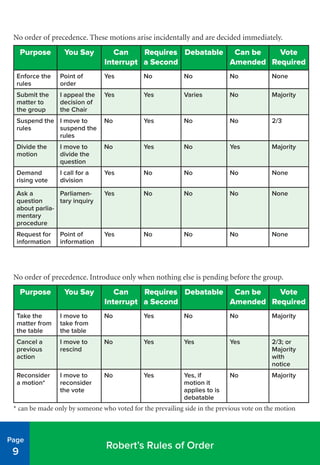
No order of precedence. These motions arise incidentally and are decided immediately.
Purpose You Say Can
Interrupt
Requires
a Second
Debatable Can be
Amended
Vote
Required
Enforce the
rules
Point of
order
Yes No No No None
Submit the
matter to
the group
I appeal the
decision of
the Chair
Yes Yes Varies No Majority
Suspend the
rules
I move to
suspend the
rules
No Yes No No 2/3
Divide the
motion
I move to
divide the
question
No Yes No Yes Majority
Demand
rising vote
I call for a
division
Yes No No No None
Ask a
question
about parlia-
mentary
procedure
Parliamen-
tary inquiry
Yes No No No None
Request for
information
Point of
information
Yes No No No None
No order of precedence. Introduce only when nothing else is pending before the group.
Purpose You Say Can
Interrupt
Requires
a Second
Debatable Can be
Amended
Vote
Required
Take the
matter from
the table
I move to
take from
the table
No Yes No No Majority
Cancel a
previous
action
I move to
rescind
No Yes Yes Yes 2/3; or
Majority
with
notice
Reconsider
a motion*
I move to
reconsider
the vote
No Yes Yes, if
motion it
applies to is
debatable
No Majority
* can be made only by someone who voted for the prevailing side in the previous vote on the motion
455-10
American Federation of State, County
and Municipal Employees, AFL-CIO
1625 L Street, NW • Washington, DC 20036
afscme.org
Gerald W. McEntee
International President
Lee A. Saunders
International Secretary-Treasurer

How to chair

  • 1.
    An AFSCME Guide chairameeting How to
  • 2.
    1 Call toOrder 1 Call to Order Start Your Meeting on Time. Rap your gavel and say: “I call this meeting to order.” Wait for quiet, and then begin the meeting. Page 1
  • 3.
    2 Roll Callof Officers The Chair says: “The Recording Secretary will call the Roll of Officers.” The Recording Secretary then calls the roll in a loud, clear voice, with pauses for response. 3 Reading of Minutes The Chair says: “The Secretary will read minutes of the last meeting.” Alternatively, copies of the minutes can be distributed at the meeting and the Chair says: “Instead of having the Secretary read the minutes, copies have been distributed for your review.” After the minutes are read or reviewed, the Chair asks: “Are there any additions or corrections to the minutes? [Pause.] If not, the minutes will stand approved as read.” If corrections to the minutes are made, ask for unanimous consent to additions or corrections at this time. If there is an objection to any addition or correction, it will be necessary to adopt a motion to make that change. Page 2 2 Roll Call of Officers 3 Reading of Minutes
  • 4.
    Page 3 4 Reading ofCorrespondence 4 Reading of Correspondence The Chair says: “The Recording Secretary will now read the correspondence.” The Recording Secretary should then read any important correspondence, summarizing the content when appropriate. Any letter requiring action by the membership should be discussed by the Executive Board prior to the membership meeting. At the membership meeting, the letter should be read along with the recommendations of the board. A motion should be made to adopt the board’s recommended action. That motion should then be discussed and voted on by the members. Routine letters should not be taken up at the membership meeting.
  • 5.
    5 Reports ofOfficers The President’s Report might include such topics as: • Problems facing the local • Updates on issues affecting the members • Summary of topics discussed at the • Actions the Executive Board latest Executive Board meeting recommends that the local take If the President’s Report contains any actions recommended by the Executive Board, a motion should be made to adopt the board’s recommended action. That motion is then discussed and voted on by the members. To initiate discussion, the Chair may say something like: “Does the Chair hear a motion to accept the Executive Board’s recommendation?” Secretary-Treasurer’s Report: This report should be copied and passed out at the meeting. See a sample report in the AFSCME Officers Handbook, Appendix A, or in material following Appendix E of the AFSCME International Constitution. The Chair asks: “Does everyone have a copy of the Secretary-Treasurer’s Report? [Pause.] Are there any questions? [Pause.] If there are no objections, the Secretary-Treasurer’s Report will stand approved.” If someone raises an objection, a motion of approval is required. Page 4 5 Reports of Officers
  • 6.
    6 Reports ofStaff and Committees 6 Reports of Staff and Committees Staff Report: This may include the latest information on political and legislative issues, organizing campaigns, important grievances, council activities, an update on contract negotiations, or any other information of current interest to the membership. Committee Reports: Before the membership meeting, the President should talk with each committee chairperson and go over his/her Committee Report. Reports from any given committee should be made only when there is something worthwhile to report. To introduce these reports, the Chair would say: “We will now hear a report from the ____________________ Committee.” If a committee report contains specific recommendations, which call for member- ship action, then after the report is given the Chair would say: “You have heard the report of the ________________________ Committee, with the recommendation that the membership authorize _____________. Does the Chair hear a motion to adopt the ____________________ Committee’s recommendation?” Page 5
  • 7.
    7 Unfinished Business8 New Business Offering an Amendment7 Unfinished Business Unfinished Business: Includes any items that require membership action that are left over, or postponed, from a previous meeting. The Chair would say something like: “We have some old, unfinished business to take care of.” The Chair can then review the topic. This may be followed by a motion dealing with the specific item of unfinished business. 8 New Business New Business: Includes items raised at this meeting, which were not necessarily included on the agenda, and which require membership action. This is the member- ship’s chance to raise issues that are not included on the agenda. To open this part of the meeting, the Chair would say: “Is there any new business?” For the group to make a decision on any new business brought up at a meeting, remember what is required: a motion, a second, a chance for discussion and a vote. Page 6
  • 8.
    9 Good andWelfare Good and Welfare: A local may have a Good and Welfare Committee. If it does not, this part of the meeting can be used to discuss such things as sending cards or flowers to hospitalized members, soliciting donations for community food banks, announcing happy events like marriages and births, etc. It may also be used for some planned activity, such as a visiting speaker or training. Consider moving this item earlier in the agenda if such an activity is planned. The Chair asks: “Is there any Good and Welfare?” 10 Adjournment Adjourning the Meeting: When the business of the meeting is finished, and if no one has made a motion to adjourn, the Chair should ask for one by saying: “Do I hear a motion to adjourn?” A motion to adjourn must be seconded, and is then voted on without debate. Page 7 9 Good and Welfare 10 Adjournment
  • 9.
    • Sometimes anamendment to the motion on the floor may be offered. An amendment must be seconded and then discussed. The Chair should say: “An amendment has been made and seconded that ... Is there any discussion on the amendment?” A vote is first taken on the amendment. After the amendment is decided on, the discussion returns to the main motion (as amended if the amendment was passed). A vote is then taken on the main motion. • During a discussion of a motion or amendment, make sure that each member speaks only once until all other members have had an opportunity to speak. It is a good idea to alternate speakers for and against the motion. If members begin responding to and addressing remarks to each other, remind the group that all comments should be addressed to the Chair. The discussion and debate is for the group as a whole to participate in. It is not an argument between a couple of members. • A member may raise a “Point of Information.” For instance, he or she might state: “Point of Information. I don’t understand the intent of this motion.” The Chair should then clarify the intent of the motion or provide the information being requested. You may have to remind the member that a point of information is a question, not a statement. • Sometimes a member may rise on a “Point of Order,” saying something like: “Point of Order. This discussion does not pertain to the motion on the floor.” The Chair should make a ruling and say something like: “Your point is well taken and I direct the member speaking to address the motion on the floor.” • There are times when discussion on a topic begins but no motion has been made. In this instance, the Chair may call for a motion by saying, “Does the Chair hear a motion to ...?” Of course, this motion must be seconded and the Chair should re-state the motion before asking if there is discussion. For a chart on Key Parliamentary Rules, see Appendix E of the AFSCME International Constitution. For a detailed description of “Robert’s Rules of Order,” see Parliamentary Procedure at a Glance by O. Garfield Jones. This can be ordered from: AFSCME F2 Orders, 1625 L Street, N.W., Washington, D.C. 20036-5687. Page 8 Some Additional Notes for the Chairperson Some Additional Notes for the Chairperson • The Chair should make sure that all reports given at the meeting are brief and to the point. This will help keep the whole meeting short. People are more likely to attend meetings that are run efficiently and end on time! • When a motion is made it must be seconded. The Chair should then state the motion and call for discussion: “It has been moved and seconded that ... Is there any discussion?”
  • 10.
    Robert’s Rules ofOrder Chart of Motions & Procedures These motions are listed in order of precedence. A motion can be introduced if it is higher on the chart than the pending motion. Purpose You Say Can Interrupt Requires a Second Debatable Can be Amended Vote Required Close the meeting I move to adjourn No Yes No No Majority Register a complaint I rise to a question of privilege Yes No No No None Lay the motion aside temporarily I move to table the motion No Yes No No Majority End debate I call the question; OR I move to end debate No Yes No No 2/3 Limit or extend debate I move that debate be limited to… No Yes No Yes 2/3 Postpone to a certain time I move to postpone the motion to… No Yes Yes Yes Majority Refer to a committee I move to refer the motion to… No Yes Yes Yes Majority Modify the wording of the motion I move to amend the motion by… No Yes Yes Yes Majority Postpone the decision indefinitely I move that the motion be postponed indefinitely No Yes Yes No Majority
  • 11.
    Robert’s Rules ofOrder Page 9 No order of precedence. These motions arise incidentally and are decided immediately. Purpose You Say Can Interrupt Requires a Second Debatable Can be Amended Vote Required Enforce the rules Point of order Yes No No No None Submit the matter to the group I appeal the decision of the Chair Yes Yes Varies No Majority Suspend the rules I move to suspend the rules No Yes No No 2/3 Divide the motion I move to divide the question No Yes No Yes Majority Demand rising vote I call for a division Yes No No No None Ask a question about parlia- mentary procedure Parliamen- tary inquiry Yes No No No None Request for information Point of information Yes No No No None No order of precedence. Introduce only when nothing else is pending before the group. Purpose You Say Can Interrupt Requires a Second Debatable Can be Amended Vote Required Take the matter from the table I move to take from the table No Yes No No Majority Cancel a previous action I move to rescind No Yes Yes Yes 2/3; or Majority with notice Reconsider a motion* I move to reconsider the vote No Yes Yes, if motion it applies to is debatable No Majority * can be made only by someone who voted for the prevailing side in the previous vote on the motion
  • 12.
    455-10 American Federation ofState, County and Municipal Employees, AFL-CIO 1625 L Street, NW • Washington, DC 20036 afscme.org Gerald W. McEntee International President Lee A. Saunders International Secretary-Treasurer