DISCIPLINARY ACTIONS
Presenter:
RAUL RIGOR MELEGRITO
CLGOO
SECTION 60. Grounds for Disciplinary Actions. - An
elective local official may be disciplined, suspended,
or removed from office on any of the following
grounds:
(a) Disloyalty to the Republic of the Philippines;
(b) Culpable violation of the Constitution;
(c) Dishonesty, oppression, misconduct in office,
gross negligence, or dereliction of duty;
(d) Commission of any offense involving moral
turpitude or an offense punishable by at least
prision mayor;
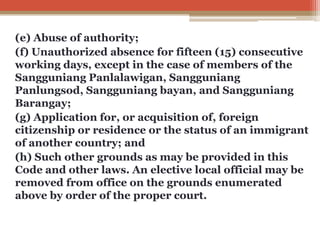
(e) Abuse of authority;
(f) Unauthorized absence for fifteen (15) consecutive
working days, except in the case of members of the
Sangguniang Panlalawigan, Sangguniang
Panlungsod, Sangguniang bayan, and Sangguniang
Barangay;
(g) Application for, or acquisition of, foreign
citizenship or residence or the status of an immigrant
of another country; and
(h) Such other grounds as may be provided in this
Code and other laws. An elective local official may be
removed from office on the grounds enumerated
above by order of the proper court.
SECTION 61. Form and Filing of Administrative
Complaints. - A verified complaint against any erring
local elective official shall be prepared as follows:
(a) A complaint against any elective official of a
province, a highly urbanized city, an independent
component city or component city shall be filed before
the Office of the President;
(b) A complaint against any elective official of a
municipality shall be filed before the Sangguniang
Panlalawigan whose decision may be appealed to the
Office of the President; and
(c) A complaint against any elective Barangay official
shall be filed before the Sangguniang Panlungsod or
Sangguniang bayan concerned whose decision shall be
final and executory.
SECTION 62. Notice of Hearing
(a)Within seven (7) days after the administrative complaint is filed,
the Office of the President or the Sanggunian concerned, as the
case may be, shall require the respondent to submit his verified
answer within fifteen (15) days from receipt thereof, and
commence the investigation of the case within ten (10) days after
receipt of such answer of the respondent. When the respondent
is an elective official of a province or highly urbanized city, such
hearing and investigation shall be conducted in the place where
he renders or holds office. For all other local elective officials, the
venue shall be the place where the Sanggunian concerned is
located.
(b)When the respondent is an elective official of a province or
highly urbanized city, such hearing and investigation shall be
conducted in the place where he renders or holds office. For all
other local elective officials, the venue shall be the place where
the Sanggunian concerned is located.
(c) However, no investigation shall be held within
ninety (90) days immediately prior to any local
election, and no preventive suspension shall be
imposed within the said period. If preventive
suspension has been imposed prior to the 90-day
period immediately preceding local election, it
shall be deemed automatically lifted upon the
start of aforesaid period.
SECTION 63. Preventive Suspension.
(a) Preventive suspension may be imposed:
(1) By the President, if the respondent is an
elective official of a province, a highly urbanized
or an independent component city;
(2) By the governor, if the respondent is an
elective official of a component city or
municipality; or
(3) By the mayor, if the respondent is an elective
official of the Barangay.
(b) Preventive suspension may be imposed at any time
after the issues are joined, when the evidence of guilt
is strong, and given the gravity other offense, there is
great probability that the continuance in office of the
respondent could influence the witnesses or pose a
threat to the safety and integrity of the records and
other evidence: Provided, That, any single preventive
suspension of local elective officials shall not extend
beyond sixty (60) days: Provided, further, That in the
event that several administrative cases are filed
against an elective official, he cannot be preventively
suspended for more than ninety (90) days within a
single year on the same ground or grounds existing
and known at the time of the first suspension.
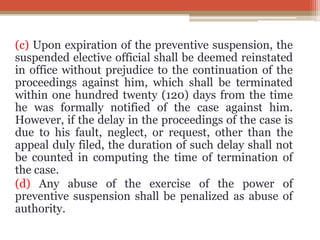
(c) Upon expiration of the preventive suspension, the
suspended elective official shall be deemed reinstated
in office without prejudice to the continuation of the
proceedings against him, which shall be terminated
within one hundred twenty (120) days from the time
he was formally notified of the case against him.
However, if the delay in the proceedings of the case is
due to his fault, neglect, or request, other than the
appeal duly filed, the duration of such delay shall not
be counted in computing the time of termination of
the case.
(d) Any abuse of the exercise of the power of
preventive suspension shall be penalized as abuse of
authority.
SECTION 64. Salary of Respondent Pending
Suspension. - The respondent official
preventively suspended from office shall
receive no salary or compensation during
such suspension; but, upon subsequent
exoneration and reinstatement, he shall be
paid full salary or compensation including
such emoluments accruing during such
suspension.
SECTION 65. Rights of Respondent - The
respondent shall be accorded full
opportunity to appear and defend himself
in person or by counsel, to confront and
cross-examine the witnesses against him,
and to require the attendance of witnesses
and the production of documentary
evidence in his favor through the
compulsory process of subpoena or
subpoena duces tecum.
SECTION 66. Form and Notice of Decision.
(a) The investigation of the case shall be
terminated within ninety (90) days from the
start thereof. Within thirty (30) days after
the end of the investigation, the Office of the
President or the Sanggunian concerned
shall render a decision in writing stating
clearly and distinctly the facts and the
reasons for such decision. Copies of said
decision shall immediately be furnished the
respondent and all interested parties.
(b) The penalty of suspension shall not
exceed the unexpired term of the
respondent or a period of six (6) months
for every administrative offense, nor shall
said penalty be a bar to the candidacy of
the respondent so suspended as long as he
meets the qualifications required for the
office.
(c) The penalty of removal from office as a
result of an administrative investigation
shall be considered a bar to the candidacy
of the respondent for any elective position.
SECTION 67. Administrative Appeals. - Decisions
in administrative cases may, within thirty (30)
days from receipt thereof, be appealed to the
following:
(a) The Sangguniang Panlalawigan, in the case of
decisions of the Sangguniang Panlungsod of component
cities and the Sangguniang bayan; and
(b) The Office of the President, in the case of decisions of
the Sangguniang Panlalawigan and the Sangguniang
Panlungsod of highly urbanized cities and independent
component cities. Decisions of the Office of the President
shall be final and executory.
SECTION 68. Execution Pending Appeal. - An
appeal shall not prevent a decision from becoming
final or executory. The respondent shall be considered
as having been placed under preventive suspension
during the pendency of an appeal in the event he wins
such appeal. In the event the appeal results in an
exoneration, he shall be paid his salary and such other
emoluments during the pendency of the appeal.
MABBALO !

Administrative investigation

  • 1.
  • 2.
    SECTION 60. Groundsfor Disciplinary Actions. - An elective local official may be disciplined, suspended, or removed from office on any of the following grounds: (a) Disloyalty to the Republic of the Philippines; (b) Culpable violation of the Constitution; (c) Dishonesty, oppression, misconduct in office, gross negligence, or dereliction of duty; (d) Commission of any offense involving moral turpitude or an offense punishable by at least prision mayor;
  • 3.
    (e) Abuse ofauthority; (f) Unauthorized absence for fifteen (15) consecutive working days, except in the case of members of the Sangguniang Panlalawigan, Sangguniang Panlungsod, Sangguniang bayan, and Sangguniang Barangay; (g) Application for, or acquisition of, foreign citizenship or residence or the status of an immigrant of another country; and (h) Such other grounds as may be provided in this Code and other laws. An elective local official may be removed from office on the grounds enumerated above by order of the proper court.
  • 4.
    SECTION 61. Formand Filing of Administrative Complaints. - A verified complaint against any erring local elective official shall be prepared as follows: (a) A complaint against any elective official of a province, a highly urbanized city, an independent component city or component city shall be filed before the Office of the President; (b) A complaint against any elective official of a municipality shall be filed before the Sangguniang Panlalawigan whose decision may be appealed to the Office of the President; and (c) A complaint against any elective Barangay official shall be filed before the Sangguniang Panlungsod or Sangguniang bayan concerned whose decision shall be final and executory.
  • 5.
    SECTION 62. Noticeof Hearing (a)Within seven (7) days after the administrative complaint is filed, the Office of the President or the Sanggunian concerned, as the case may be, shall require the respondent to submit his verified answer within fifteen (15) days from receipt thereof, and commence the investigation of the case within ten (10) days after receipt of such answer of the respondent. When the respondent is an elective official of a province or highly urbanized city, such hearing and investigation shall be conducted in the place where he renders or holds office. For all other local elective officials, the venue shall be the place where the Sanggunian concerned is located. (b)When the respondent is an elective official of a province or highly urbanized city, such hearing and investigation shall be conducted in the place where he renders or holds office. For all other local elective officials, the venue shall be the place where the Sanggunian concerned is located.
  • 6.
    (c) However, noinvestigation shall be held within ninety (90) days immediately prior to any local election, and no preventive suspension shall be imposed within the said period. If preventive suspension has been imposed prior to the 90-day period immediately preceding local election, it shall be deemed automatically lifted upon the start of aforesaid period.
  • 7.
    SECTION 63. PreventiveSuspension. (a) Preventive suspension may be imposed: (1) By the President, if the respondent is an elective official of a province, a highly urbanized or an independent component city; (2) By the governor, if the respondent is an elective official of a component city or municipality; or (3) By the mayor, if the respondent is an elective official of the Barangay.
  • 8.
    (b) Preventive suspensionmay be imposed at any time after the issues are joined, when the evidence of guilt is strong, and given the gravity other offense, there is great probability that the continuance in office of the respondent could influence the witnesses or pose a threat to the safety and integrity of the records and other evidence: Provided, That, any single preventive suspension of local elective officials shall not extend beyond sixty (60) days: Provided, further, That in the event that several administrative cases are filed against an elective official, he cannot be preventively suspended for more than ninety (90) days within a single year on the same ground or grounds existing and known at the time of the first suspension.
  • 9.
    (c) Upon expirationof the preventive suspension, the suspended elective official shall be deemed reinstated in office without prejudice to the continuation of the proceedings against him, which shall be terminated within one hundred twenty (120) days from the time he was formally notified of the case against him. However, if the delay in the proceedings of the case is due to his fault, neglect, or request, other than the appeal duly filed, the duration of such delay shall not be counted in computing the time of termination of the case. (d) Any abuse of the exercise of the power of preventive suspension shall be penalized as abuse of authority.
  • 10.
    SECTION 64. Salaryof Respondent Pending Suspension. - The respondent official preventively suspended from office shall receive no salary or compensation during such suspension; but, upon subsequent exoneration and reinstatement, he shall be paid full salary or compensation including such emoluments accruing during such suspension.
  • 11.
    SECTION 65. Rightsof Respondent - The respondent shall be accorded full opportunity to appear and defend himself in person or by counsel, to confront and cross-examine the witnesses against him, and to require the attendance of witnesses and the production of documentary evidence in his favor through the compulsory process of subpoena or subpoena duces tecum.
  • 12.
    SECTION 66. Formand Notice of Decision. (a) The investigation of the case shall be terminated within ninety (90) days from the start thereof. Within thirty (30) days after the end of the investigation, the Office of the President or the Sanggunian concerned shall render a decision in writing stating clearly and distinctly the facts and the reasons for such decision. Copies of said decision shall immediately be furnished the respondent and all interested parties.
  • 13.
    (b) The penaltyof suspension shall not exceed the unexpired term of the respondent or a period of six (6) months for every administrative offense, nor shall said penalty be a bar to the candidacy of the respondent so suspended as long as he meets the qualifications required for the office. (c) The penalty of removal from office as a result of an administrative investigation shall be considered a bar to the candidacy of the respondent for any elective position.
  • 14.
    SECTION 67. AdministrativeAppeals. - Decisions in administrative cases may, within thirty (30) days from receipt thereof, be appealed to the following: (a) The Sangguniang Panlalawigan, in the case of decisions of the Sangguniang Panlungsod of component cities and the Sangguniang bayan; and (b) The Office of the President, in the case of decisions of the Sangguniang Panlalawigan and the Sangguniang Panlungsod of highly urbanized cities and independent component cities. Decisions of the Office of the President shall be final and executory.
  • 15.
    SECTION 68. ExecutionPending Appeal. - An appeal shall not prevent a decision from becoming final or executory. The respondent shall be considered as having been placed under preventive suspension during the pendency of an appeal in the event he wins such appeal. In the event the appeal results in an exoneration, he shall be paid his salary and such other emoluments during the pendency of the appeal.
  • 16.