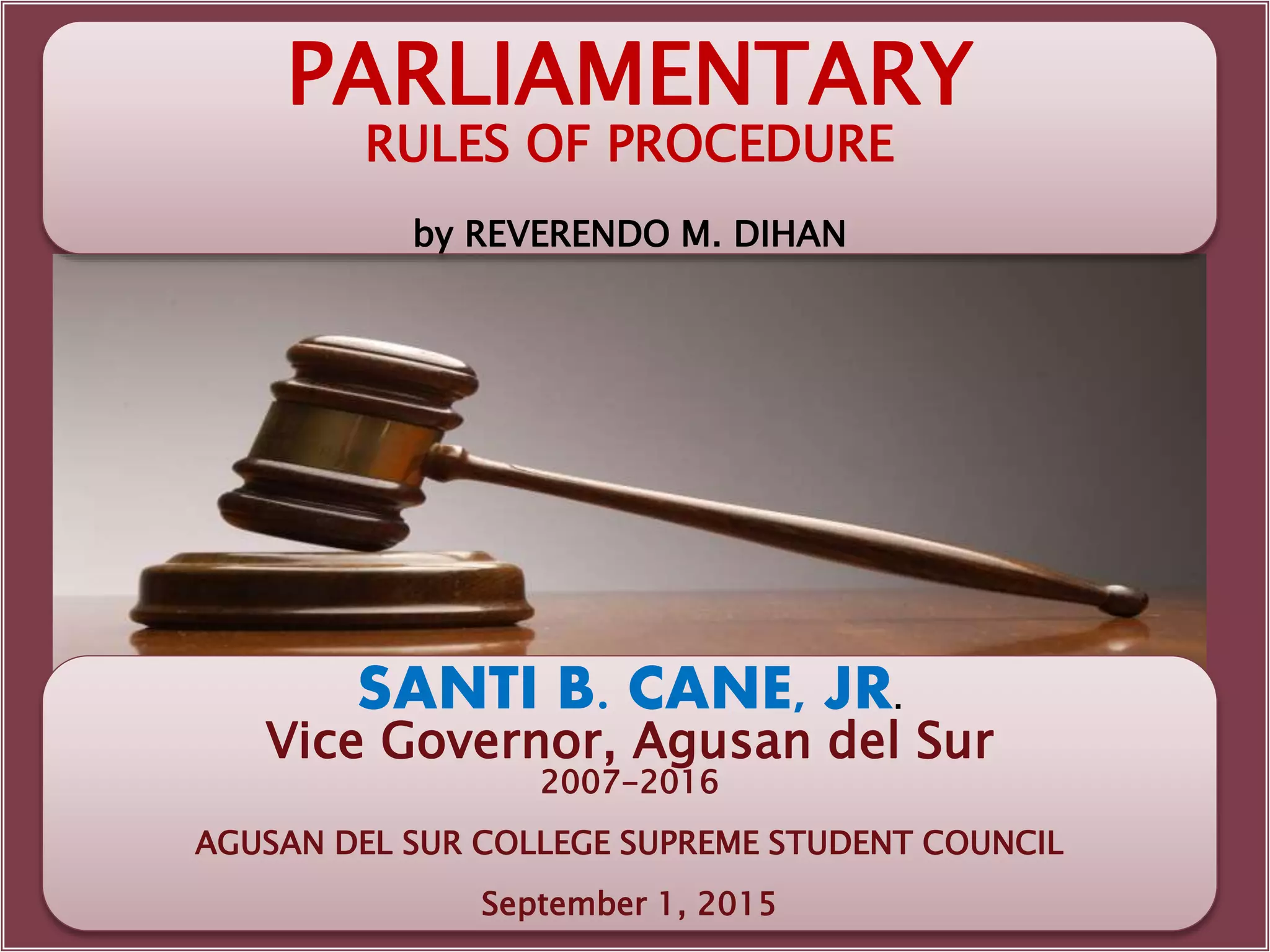
SANTI B. CANE, JR.
Vice Governor, Agusan del Sur
2007-2016
AGUSAN DEL SUR COLLEGE SUPREME STUDENT COUNCIL
September 1, 2015
PARLIAMENTARY
RULES OF PROCEDURE
by REVERENDO M. DIHAN
Meetings/sessions are conducted in
order for the body to formally and
officially come up with collegial
decisions that are often beneficial to
the general membership.
Any measure being considered for
deliberation/decision is done through a
“motion”.
MOTIONS
Meaning of the term “Motion”
A “motion” is a formal proposal submitted by a
member for consideration of the body . The formal proposal
which is expressed in the form of a “motion” may be an
exercise of a privilege, a request, a demand, or a desire, of a
member of a deliberative body.
As a general rule, a “motion” should be preceded by
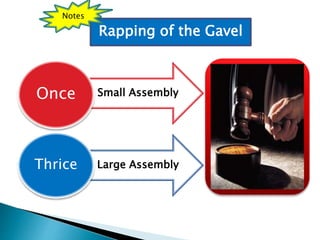
the phrase “I move that”; “I move for”; or “I move to”.
However, there are many exceptions to this rule. One such
exception is when a “motion partakes of the nature of a
request or a demand where the application of the phrase “I
move” would become irrelevant or inappropriate.
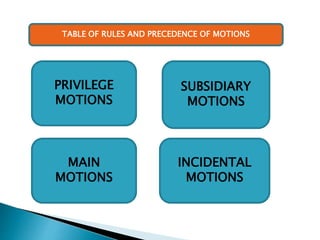
PRIVILEGE
MOTIONS
SUBSIDIARY
MOTIONS
MAIN
MOTIONS
INCIDENTAL
MOTIONS
TABLE OF RULES AND PRECEDENCE OF MOTIONS
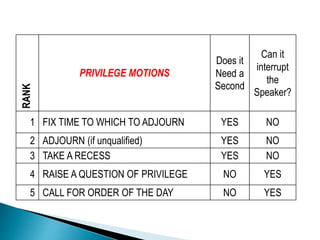
RANK
PRIVILEGE MOTIONS
Does it
Need a
Second
Can it
interrupt
the
Speaker?
1 FIX TIME TO WHICH TO ADJOURN YES NO
2 ADJOURN (if unqualified) YES NO
3 TAKE A RECESS YES NO
4 RAISE A QUESTION OF PRIVILEGE NO YES
5 CALL FOR ORDER OF THE DAY NO YES
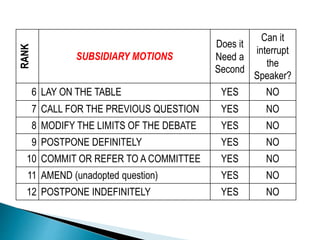
RANK
SUBSIDIARY MOTIONS
Does it
Need a
Second
Can it
interrupt
the
Speaker?
6 LAY ON THE TABLE YES NO
7 CALL FOR THE PREVIOUS QUESTION YES NO
8 MODIFY THE LIMITS OF THE DEBATE YES NO
9 POSTPONE DEFINITELY YES NO
10 COMMIT OR REFER TO A COMMITTEE YES NO
11 AMEND (unadopted question) YES NO
12 POSTPONE INDEFINITELY YES NO
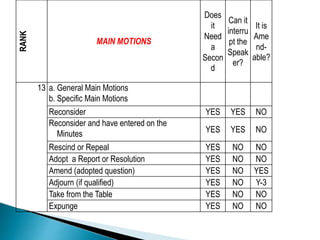
RANK
MAIN MOTIONS
Does
it
Need
a
Secon
d
Can it
interru
pt the
Speak
er?
It is
Ame
nd-
able?
13 a. General Main Motions
b. Specific Main Motions
Reconsider YES YES NO
Reconsider and have entered on the
Minutes YES YES NO
Rescind or Repeal YES NO NO
Adopt a Report or Resolution YES NO NO
Amend (adopted question) YES NO YES
Adjourn (if qualified) YES NO Y-3
Take from the Table YES NO NO
Expunge YES NO NO
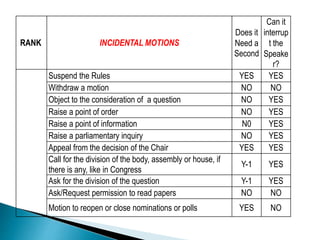
RANK INCIDENTAL MOTIONS
Does it
Need a
Second
Can it
interrup
t the
Speake
r?
Suspend the Rules YES YES
Withdraw a motion NO NO
Object to the consideration of a question NO YES
Raise a point of order NO YES
Raise a point of information N0 YES
Raise a parliamentary inquiry NO YES
Appeal from the decision of the Chair YES YES
Call for the division of the body, assembly or house, if
there is any, like in Congress
Y-1 YES
Ask for the division of the question Y-1 YES
Ask/Request permission to read papers NO NO
Motion to reopen or close nominations or polls YES NO
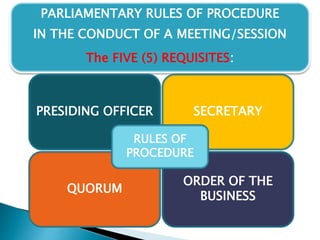
PARLIAMENTARY RULES OF PROCEDURE
IN THE CONDUCT OF A MEETING/SESSION
The FIVE (5) REQUISITES:
PRESIDING OFFICER SECRETARY
QUORUM
ORDER OF THE
BUSINESS
RULES OF
PROCEDURE
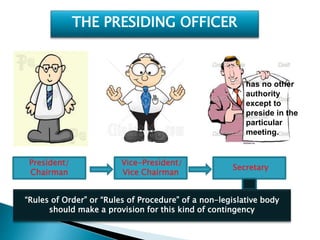
THE PRESIDING OFFICER
President/
Chairman
Vice-President/
Vice Chairman
Secretary
“Rules of Order” or “Rules of Procedure” of a non-legislative body
should make a provision for this kind of contingency
has no other
authority
except to
preside in the
particular
meeting.
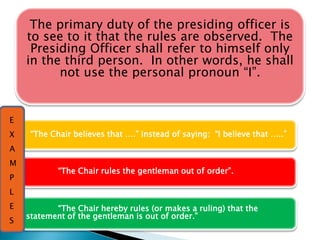
“The Chair believes that ….” instead of saying: “I believe that …..”
“The Chair rules the gentleman out of order”.
“The Chair hereby rules (or makes a ruling) that the
statement of the gentleman is out of order.”
The primary duty of the presiding officer is
to see to it that the rules are observed. The
Presiding Officer shall refer to himself only
in the third person. In other words, he shall
not use the personal pronoun “I”.
E
X
A
M
P
L
E
S
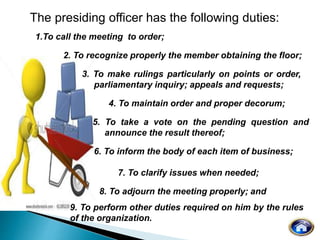
The presiding officer has the following duties:
1.To call the meeting to order;
2. To recognize properly the member obtaining the floor;
3. To make rulings particularly on points or order,
parliamentary inquiry; appeals and requests;
4. To maintain order and proper decorum;
5. To take a vote on the pending question and
announce the result thereof;
6. To inform the body of each item of business;
7. To clarify issues when needed;
8. To adjourn the meeting properly; and
9. To perform other duties required on him by the rules
of the organization.
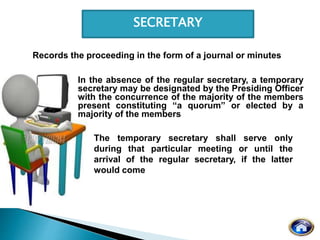
SECRETARY
Records the proceeding in the form of a journal or minutes
In the absence of the regular secretary, a temporary
secretary may be designated by the Presiding Officer
with the concurrence of the majority of the members
present constituting “a quorum” or elected by a
majority of the members
The temporary secretary shall serve only
during that particular meeting or until the
arrival of the regular secretary, if the latter
would come
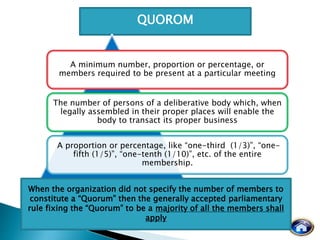
QUOROM
A minimum number, proportion or percentage, or
members required to be present at a particular meeting
The number of persons of a deliberative body which, when
legally assembled in their proper places will enable the
body to transact its proper business
A proportion or percentage, like “one-third (1/3)”, “one-
fifth (1/5)”, “one-tenth (1/10)”, etc. of the entire
membership.
When the organization did not specify the number of members to
constitute a “Quorum” then the generally accepted parliamentary
rule fixing the “Quorum” to be a majority of all the members shall
apply
Computing a Quorum
Number of members necessary for the purpose should be
based on actual membership of incumbents.
This must be limited to actual members who are not incapacitated to
discharge their duties by reason of death, incapacity, or absence from
the jurisdiction of the organization, or for other causes which make
attendance of the member concerned impossible even through
coercive process.
In the absence of a “Quorum” no business can be transacted
with legal effect even with the unanimous consent of those
present.
Decision of the BODY is null and void where said Body had no
quorum when such action was taken.
is a document containing a set of
procedural rules that govern the orderly
transaction of business and defining the
duties and responsibilities of the
officers during the conduct of meetings.
(a) Rules of Procedure distinguished
from “Standing Rules,” “By-Laws” and
“Constitution.”
RULES OF PROCEDURE
(aka Rules of Order: Internal Rules)
 is a set of rules relating to the details of the
administration of the organization which are
temporary in character, procedural in nature and
usually adopted separate from the “by-laws”.
 Examples : scheduling a meeting; imposing of
fines for erring members; election and voting
procedures and the like.
Standing Rules
 is a set of rules designed to carry-out the
provisions of the organization’s
fundamental principles embodied in its
“Constitution”.
 Examples : rules or policies on
membership, officers of the association,
committees, mechanics of elections,
meetings, quorum, order of business,
amendments of by –laws, debates, and
the like.
By-Laws
 Order of Business is the prescribed
sequence of business to be taken up
during a meeting or session which helps
as guide for an ordinary and proper
conduct of the proceedings.
ORDER OF BUSINESS
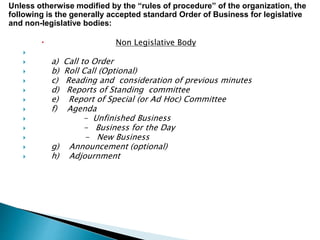
 Non Legislative Body

 a) Call to Order
 b) Roll Call (Optional)
 c) Reading and consideration of previous minutes
 d) Reports of Standing committee
 e) Report of Special (or Ad Hoc) Committee
 f) Agenda
 - Unfinished Business
 - Business for the Day
 - New Business
 g) Announcement (optional)
 h) Adjournment
Unless otherwise modified by the “rules of procedure” of the organization, the
following is the generally accepted standard Order of Business for legislative
and non-legislative bodies:
 When the scheduled time of the meeting has
arrived, the Presiding Officer should take his
assigned position in the hall and while he is
“in the Chair” he may then call the meeting to
order.
Call to Order
Rule: - The Presiding Officer should make the call
to order while he is in standing position and not
while he is already seated.
 Procedure: - The Presiding Officer holds his
gavel and while in standing position raps the
gavel (once or thrice, whichever is more
appropriate) and in a formal manner
announces:
“The meeting will please come to order”
“The Chair now calls the meeting to order”
“The Convention of the ….is now declared
open”
“The convention will please come to Order”
or any words to this effect, followed by the
rapping of the gavel.
Rapping of the Gavel
Small Assembly
Large Assembly
Once
Thrice
Notes
Invocation or Prayer
Notes
After the “call to order”
National Anthem and Prayer
During meetings: Having them is a
matter that should be left to the sound
judgment or discretion of the members
concerned
 Calling the roll of members is an optional item in
the order of business and as such it may be
dispensed with.
 Procedure: If “roll call” is to be made the
Presiding Officer assigns this task to the
Secretary by stating: “The Secretary will please
call the roll of members.” The Secretary in turn
reads aloud the names of members who should
answer “Here” or “Present”.
 If there is an attendance sheet or registration
sheet being signed by the members as they come
inside the hall, there is no need for the roll call.
Roll Call
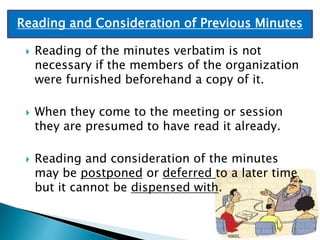
 Reading of the minutes verbatim is not
necessary if the members of the organization
were furnished beforehand a copy of it.
 When they come to the meeting or session
they are presumed to have read it already.
 Reading and consideration of the minutes
may be postponed or deferred to a later time
but it cannot be dispensed with.
Reading and Consideration of Previous Minutes
 Procedure: In submitting the minutes for
consideration of the Body, the Presiding
Officer should first ask for corrections,
thus:
 CHAIR: “Are there corrections to be made
on the minutes?” If no corrections are
offered, he adds:
 CHAIR: “There being no corrections offered
the minutes stand approved as read.”
 (Note that the minutes has been approved
without taking any vote. This is another
example of “approval by general consent”)
 If there are corrections proposed, the
Presiding Officer shall instruct the Secretary
to note them down and put the proposed
corrections to a vote by stating:
 CHAIR: “As many as are in favor of the
proposed corrections say, “aye”….. those
opposed say, “no”.
 In the preceding example, corrections on the
minutes were offered in the form of a
proposal or suggestion. When corrections
are offered in the form of a “proposal” or
“suggestion” it does not need a second.
 Another way of offering corrections to the minutes is thru a
“motion” specifically by proposing a “motion to amend”, as in
the following example:
 MEMBER: “Mr. Presiding Officer, I moved to amend the
minutes by substituting the word “petition” appearing in line
7 of page 1 thereof, with the word “request” in its stead.
 CHAIR: (If motion is seconded): “If there is no objection
to the motion, it is carried by general consent.”
 If there is an objection raised to that motion:
 CHAIR: (Putting the question to a vote):
 “The question now whether or not to substitute the word
“Petition” appearing in line 7 of page 1 of the minutes with
the word “request”.
 “Are you ready to vote?”
 “Those in favor of the motion, please raise their
right hand.” “Those against please do the same.”
 “The affirmative side has it.”
 CHAIR:“Is there any further correction to the
minutes?”
 “There being no further corrections to be made,
the minutes stand approved as corrected (or
made).”
 It will be noted from the foregoing examples that
the “Chair” is no longer waiting for any member
to propose a “motion” to approve the minutes.
This is because in parliamentary law the
Presiding Officer is allowed to “assume a motion
to be approved by general consent.”
 In order to save time, it is advisable for the Chair
to always report on the approval of the motion to
adopt the minutes, including its corrections, by
general consent, unless it becomes necessary to
put it to a formal vote.
Additional examples:
 CHAIR: “If there is no objection from the floor,
the minutes is adopted as read.”
 “If there is no objection to the proposed
correction, it is adopted by general consent.”
 “If there is no objection, the motion is
carried.”
That the Chair’s statement begins with
the phrase “If there is no objection” and thus,
if nobody would register an objection it is but
logical to assume that everybody is in
complete agreement with his “ruling.”
 Rule: If the ruling made by the Chair is not
reversed by the Body, it becomes the body’s
decision.
Note
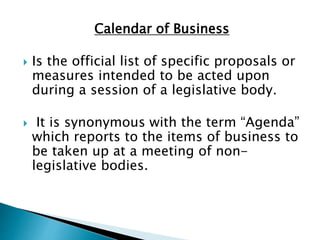
Calendar of Business
 Is the official list of specific proposals or
measures intended to be acted upon
during a session of a legislative body.
 It is synonymous with the term “Agenda”
which reports to the items of business to
be taken up at a meeting of non-
legislative bodies.
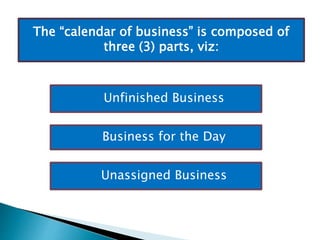
Unfinished Business
Business for the Day
Unassigned Business
The “calendar of business” is composed of
three (3) parts, viz:
Unfinished business
 This refers to any kind of business including,
but not limited to proposals or measures that
have been left unacted upon, postponed or
left unfinished during the previous meeting.
 This also includes items of business left
unfinished or un-acted at the end of the term
of the previous body.
Business for the Day
 The list of items that have been reported
out by committees and ready for
deliberation on “second reading” as
determined by the Committee on Rules.
 Also includes items that have been passed
or approved on “second reading” and are
ready for the body’s decision on “third and
final reading.”
 In “non-legislative bodies”, the items
“business for the day” refers to its main
agenda which include the proposals for
which the meeting is called for.
Unassigned Business
 Pending matters or measures and new ones arising
out during the deliberations but not yet assigned
or referred to proper committees for appropriate
action including the following:
 Matters, proposals or measurers usually in the
form of resolution or ordinance that have not yet
been referred to any particular committee albeit
they have been reported out during the period for
committee reports;
 Matters, proposals or measurers already referred to
a committee but for some reason or another was
not acted upon and the body decided to discharge
that committee from further handling it. Thus, it
becomes imperative to assign that matter to
another committee, or create a special committee
for that purpose;
 Matters, proposals or measures which have
been erroneously referred to a committee
but, for some reason, or another, was not
corrected immediately after the reading of
the minutes containing it.
( The alternative left for the committee
concerned is to include that matter in the
items under “unassigned business” and
when this period comes correction may still
be made thru a motion to that effect by
either of the following: (a) committee on
rules; (b) committee claiming jurisdiction
over it; and, (c) committee to which it was
erroneously referred;)
In non legislative bodies:
 “New Business” includes all legitimate or
pertinent matters initiated on particular meeting.
 During this period any new business can be
brought up either by a member or the presiding
officer who may bring to the attention of the
assembly any pertinent matters that he believes
should be acted upon by it.
 The term “new business” commonly used in
meetings is the equivalent of “other matters”
which is customarily used in “conferences”; or
“committee/board meetings.”
Notes
 In parliamentary law, however, there is no
such thing as “Other Matters.” What is being
advocated by parliamentarians is the term
“New Business” which is, simply, the
“unwritten agendum or agenda” but this is
appropriate only in non-legislative bodies.
The time at which the meeting or session is
officially closed or terminated.
◦ A meeting is properly adjourned if the
Presiding Officer had duly declared its
adjournment.
◦ Even if the members had already adopted
a “motion to adjourn” but there are still
some important announcements that
necessitate the continuance of the
meeting, the Chair may defer the
adjournment in order to make such
announcement.
Adjournment
 It is improper for the Chair to state:
“There being no more business to take up,
the meeting is adjourned. “This is referred to
as “illegal adjournment” because only the
“body” or “assembly” has the authority to
make such decision thru a motion to that
effect.
 It is proper for the Chair to state :
“There is no more business to take up. If
there is no objection from the floor, the Chair
on its own cognizance will declare the
meeting adjourned. The Chair hears no
objection the meeting is adjourned”.
 Or:“If there is no objection from the floor, the
meeting is adjourned.”
 Normally, there will be no objection from the
floor since there is no more business to take
up, thus, it can not be said that the Chair was
the one who adjourned the meeting because
nobody objected to the “assumed motion”
and so the adjournment is considered to be
by “general consent”.
 In case there is an objection raised by any
member, the following would be the scenario:
 MEMBER: “Mr. Presiding Officer, I object to
the adjournment.”
 CHAIR: “There is an objection to the
adjournment. The question now is on the
“assumed motion to adjourn”. As many as
are in favor that we adjourn, please raise their
right hand. Those opposed, please do the
same. The affirmative side has it. The
meeting is now declared officially adjourned.”
That the Chair did not state:
“Is there any discussion?”
“Is there any question?”
“Are you ready for the question?”
That is because an “assumed motion” is not
debatable and, therefore, any further
discussion on it would be unnecessary.
Note
 Announcements – this item is usually (but not
necessarily) placed preceding the item on
“adjournment” and it may include reading of
communications received; forthcoming programs or
result of programs already undertaken; or anything of
general interest to the members.
 Report of Officers – this item pertains to the reports
usually required by the organization from its officers
including, but not limited to, the report of the
treasurer, auditor, president and other officers of the
organization.
Other Optional Items that may be included in
the Order of Business especially that of Non-
legislative bodies:
 Special Order – this item pertains to matters that are
postponed to the next meeting with specific time for
its consideration. When that time comes all the
other matters being discussed shall be set aside, or
laid on the table and shall give way for those
matters previously agreed upon to be taken up on
that particular time, as a special order.
 General Orders – this item pertains to matters that
are postponed for consideration on succeeding
meetings, either with or without the specified time,
and when that particular meeting is held these
matters may be brought up provided that there is no
other business pending. In contract, special orders
can be taken up on the specific time set for it even if
there is another business pending discussion on
that particular time.
FORMAT OF CALENDAR OF BUSINESS AND
AGENDA
(non-legislative body)
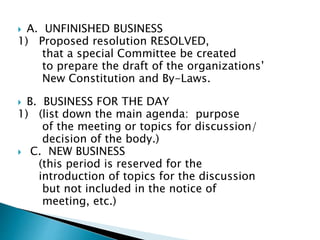
 A. UNFINISHED BUSINESS
1) Proposed resolution RESOLVED,
that a special Committee be created
to prepare the draft of the organizations’
New Constitution and By-Laws.
 B. BUSINESS FOR THE DAY
1) (list down the main agenda: purpose
of the meeting or topics for discussion/
decision of the body.)
 C. NEW BUSINESS
(this period is reserved for the
introduction of topics for the discussion
but not included in the notice of
meeting, etc.)
 Official actions which are of temporary
character shall be passed in the form of
resolutions, matters relating to proprietary
functions and to private concerns shall also
be noted upon by resolutions.
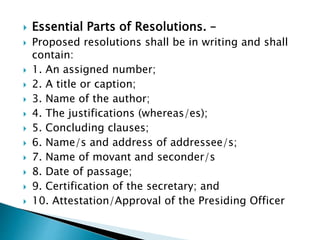
 Essential Parts of Resolutions. –
 Proposed resolutions shall be in writing and shall
contain:
 1. An assigned number;
 2. A title or caption;
 3. Name of the author;
 4. The justifications (whereas/es);
 5. Concluding clauses;
 6. Name/s and address of addressee/s;
 7. Name of movant and seconder/s
 8. Date of passage;
 9. Certification of the secretary; and
 10. Attestation/Approval of the Presiding Officer
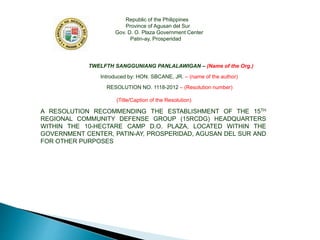
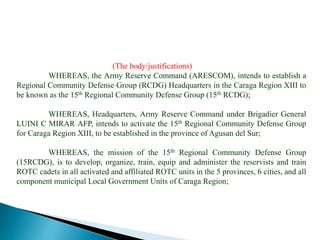
Republic of the Philippines
Province of Agusan del Sur
Gov. D. O. Plaza Government Center
Patin-ay, Prosperidad
TWELFTH SANGGUNIANG PANLALAWIGAN – (Name of the Org.)
Introduced by: HON. SBCANE, JR. – (name of the author)
RESOLUTION NO. 1118-2012 – (Resolution number)
(Title/Caption of the Resolution)
A RESOLUTION RECOMMENDING THE ESTABLISHMENT OF THE 15TH
REGIONAL COMMUNITY DEFENSE GROUP (15RCDG) HEADQUARTERS
WITHIN THE 10-HECTARE CAMP D.O. PLAZA, LOCATED WITHIN THE
GOVERNMENT CENTER, PATIN-AY, PROSPERIDAD, AGUSAN DEL SUR AND
FOR OTHER PURPOSES
(The body/justifications)
WHEREAS, the Army Reserve Command (ARESCOM), intends to establish a
Regional Community Defense Group (RCDG) Headquarters in the Caraga Region XIII to
be known as the 15th Regional Community Defense Group (15th RCDG);
WHEREAS, Headquarters, Army Reserve Command under Brigadier General
LUINI C MIRAR AFP, intends to activate the 15th Regional Community Defense Group
for Caraga Region XIII, to be established in the province of Agusan del Sur;
WHEREAS, the mission of the 15th Regional Community Defense Group
(15RCDG), is to develop, organize, train, equip and administer the reservists and train
ROTC cadets in all activated and affiliated ROTC units in the 5 provinces, 6 cities, and all
component municipal Local Government Units of Caraga Region;
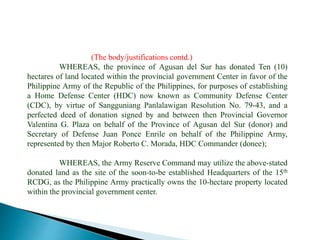
(The body/justifications contd.)
WHEREAS, the province of Agusan del Sur has donated Ten (10)
hectares of land located within the provincial government Center in favor of the
Philippine Army of the Republic of the Philippines, for purposes of establishing
a Home Defense Center (HDC) now known as Community Defense Center
(CDC), by virtue of Sangguniang Panlalawigan Resolution No. 79-43, and a
perfected deed of donation signed by and between then Provincial Governor
Valentina G. Plaza on behalf of the Province of Agusan del Sur (donor) and
Secretary of Defense Juan Ponce Enrile on behalf of the Philippine Army,
represented by then Major Roberto C. Morada, HDC Commander (donee);
WHEREAS, the Army Reserve Command may utilize the above-stated
donated land as the site of the soon-to-be established Headquarters of the 15th
RCDG, as the Philippine Army practically owns the 10-hectare property located
within the provincial government center.
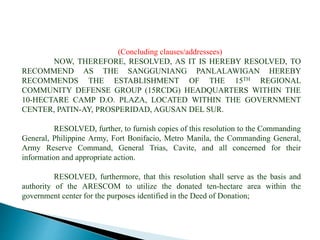
(Concluding clauses/addressees)
NOW, THEREFORE, RESOLVED, AS IT IS HEREBY RESOLVED, TO
RECOMMEND AS THE SANGGUNIANG PANLALAWIGAN HEREBY
RECOMMENDS THE ESTABLISHMENT OF THE 15TH REGIONAL
COMMUNITY DEFENSE GROUP (15RCDG) HEADQUARTERS WITHIN THE
10-HECTARE CAMP D.O. PLAZA, LOCATED WITHIN THE GOVERNMENT
CENTER, PATIN-AY, PROSPERIDAD, AGUSAN DEL SUR.
RESOLVED, further, to furnish copies of this resolution to the Commanding
General, Philippine Army, Fort Bonifacio, Metro Manila, the Commanding General,
Army Reserve Command, General Trias, Cavite, and all concerned for their
information and appropriate action.
RESOLVED, furthermore, that this resolution shall serve as the basis and
authority of the ARESCOM to utilize the donated ten-hectare area within the
government center for the purposes identified in the Deed of Donation;
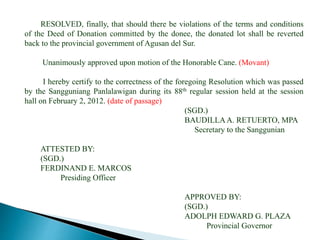
RESOLVED, finally, that should there be violations of the terms and conditions
of the Deed of Donation committed by the donee, the donated lot shall be reverted
back to the provincial government of Agusan del Sur.
Unanimously approved upon motion of the Honorable Cane. (Movant)
I hereby certify to the correctness of the foregoing Resolution which was passed
by the Sangguniang Panlalawigan during its 88th regular session held at the session
hall on February 2, 2012. (date of passage)
(SGD.)
BAUDILLAA. RETUERTO, MPA
Secretary to the Sanggunian
ATTESTED BY:
(SGD.)
FERDINAND E. MARCOS
Presiding Officer
APPROVED BY:
(SGD.)
ADOLPH EDWARD G. PLAZA
Provincial Governor
Now that you are trained…
It is expected that all your meetings
will already be fast, orderly, efficient
and effective.
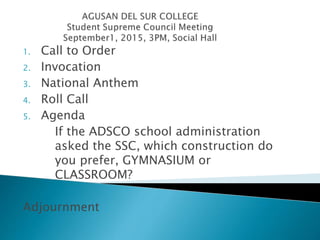
1. Call to Order
2. Invocation
3. National Anthem
4. Roll Call
5. Agenda
If the ADSCO school administration
asked the SSC, which construction do
you prefer, GYMNASIUM or
CLASSROOM?
Adjournment

Parliamentary procedure power point

  • 1.
    SANTI B. CANE,JR. Vice Governor, Agusan del Sur 2007-2016 AGUSAN DEL SUR COLLEGE SUPREME STUDENT COUNCIL September 1, 2015 PARLIAMENTARY RULES OF PROCEDURE by REVERENDO M. DIHAN
  • 2.
    Meetings/sessions are conductedin order for the body to formally and officially come up with collegial decisions that are often beneficial to the general membership. Any measure being considered for deliberation/decision is done through a “motion”.
  • 5.
    MOTIONS Meaning of theterm “Motion” A “motion” is a formal proposal submitted by a member for consideration of the body . The formal proposal which is expressed in the form of a “motion” may be an exercise of a privilege, a request, a demand, or a desire, of a member of a deliberative body. As a general rule, a “motion” should be preceded by the phrase “I move that”; “I move for”; or “I move to”. However, there are many exceptions to this rule. One such exception is when a “motion partakes of the nature of a request or a demand where the application of the phrase “I move” would become irrelevant or inappropriate.
  • 6.
  • 7.
    RANK PRIVILEGE MOTIONS Does it Needa Second Can it interrupt the Speaker? 1 FIX TIME TO WHICH TO ADJOURN YES NO 2 ADJOURN (if unqualified) YES NO 3 TAKE A RECESS YES NO 4 RAISE A QUESTION OF PRIVILEGE NO YES 5 CALL FOR ORDER OF THE DAY NO YES
  • 8.
    RANK SUBSIDIARY MOTIONS Does it Needa Second Can it interrupt the Speaker? 6 LAY ON THE TABLE YES NO 7 CALL FOR THE PREVIOUS QUESTION YES NO 8 MODIFY THE LIMITS OF THE DEBATE YES NO 9 POSTPONE DEFINITELY YES NO 10 COMMIT OR REFER TO A COMMITTEE YES NO 11 AMEND (unadopted question) YES NO 12 POSTPONE INDEFINITELY YES NO
  • 9.
    RANK MAIN MOTIONS Does it Need a Secon d Can it interru ptthe Speak er? It is Ame nd- able? 13 a. General Main Motions b. Specific Main Motions Reconsider YES YES NO Reconsider and have entered on the Minutes YES YES NO Rescind or Repeal YES NO NO Adopt a Report or Resolution YES NO NO Amend (adopted question) YES NO YES Adjourn (if qualified) YES NO Y-3 Take from the Table YES NO NO Expunge YES NO NO
  • 10.
    RANK INCIDENTAL MOTIONS Doesit Need a Second Can it interrup t the Speake r? Suspend the Rules YES YES Withdraw a motion NO NO Object to the consideration of a question NO YES Raise a point of order NO YES Raise a point of information N0 YES Raise a parliamentary inquiry NO YES Appeal from the decision of the Chair YES YES Call for the division of the body, assembly or house, if there is any, like in Congress Y-1 YES Ask for the division of the question Y-1 YES Ask/Request permission to read papers NO NO Motion to reopen or close nominations or polls YES NO
  • 11.
    PARLIAMENTARY RULES OFPROCEDURE IN THE CONDUCT OF A MEETING/SESSION The FIVE (5) REQUISITES: PRESIDING OFFICER SECRETARY QUORUM ORDER OF THE BUSINESS RULES OF PROCEDURE
  • 12.
    THE PRESIDING OFFICER President/ Chairman Vice-President/ ViceChairman Secretary “Rules of Order” or “Rules of Procedure” of a non-legislative body should make a provision for this kind of contingency has no other authority except to preside in the particular meeting.
  • 13.
    “The Chair believesthat ….” instead of saying: “I believe that …..” “The Chair rules the gentleman out of order”. “The Chair hereby rules (or makes a ruling) that the statement of the gentleman is out of order.” The primary duty of the presiding officer is to see to it that the rules are observed. The Presiding Officer shall refer to himself only in the third person. In other words, he shall not use the personal pronoun “I”. E X A M P L E S
  • 14.
    The presiding officerhas the following duties: 1.To call the meeting to order; 2. To recognize properly the member obtaining the floor; 3. To make rulings particularly on points or order, parliamentary inquiry; appeals and requests; 4. To maintain order and proper decorum; 5. To take a vote on the pending question and announce the result thereof; 6. To inform the body of each item of business; 7. To clarify issues when needed; 8. To adjourn the meeting properly; and 9. To perform other duties required on him by the rules of the organization.
  • 15.
    SECRETARY Records the proceedingin the form of a journal or minutes In the absence of the regular secretary, a temporary secretary may be designated by the Presiding Officer with the concurrence of the majority of the members present constituting “a quorum” or elected by a majority of the members The temporary secretary shall serve only during that particular meeting or until the arrival of the regular secretary, if the latter would come
  • 16.
    QUOROM A minimum number,proportion or percentage, or members required to be present at a particular meeting The number of persons of a deliberative body which, when legally assembled in their proper places will enable the body to transact its proper business A proportion or percentage, like “one-third (1/3)”, “one- fifth (1/5)”, “one-tenth (1/10)”, etc. of the entire membership. When the organization did not specify the number of members to constitute a “Quorum” then the generally accepted parliamentary rule fixing the “Quorum” to be a majority of all the members shall apply
  • 17.
    Computing a Quorum Numberof members necessary for the purpose should be based on actual membership of incumbents. This must be limited to actual members who are not incapacitated to discharge their duties by reason of death, incapacity, or absence from the jurisdiction of the organization, or for other causes which make attendance of the member concerned impossible even through coercive process. In the absence of a “Quorum” no business can be transacted with legal effect even with the unanimous consent of those present. Decision of the BODY is null and void where said Body had no quorum when such action was taken.
  • 18.
    is a documentcontaining a set of procedural rules that govern the orderly transaction of business and defining the duties and responsibilities of the officers during the conduct of meetings. (a) Rules of Procedure distinguished from “Standing Rules,” “By-Laws” and “Constitution.” RULES OF PROCEDURE (aka Rules of Order: Internal Rules)
  • 19.
     is aset of rules relating to the details of the administration of the organization which are temporary in character, procedural in nature and usually adopted separate from the “by-laws”.  Examples : scheduling a meeting; imposing of fines for erring members; election and voting procedures and the like. Standing Rules
  • 20.
     is aset of rules designed to carry-out the provisions of the organization’s fundamental principles embodied in its “Constitution”.  Examples : rules or policies on membership, officers of the association, committees, mechanics of elections, meetings, quorum, order of business, amendments of by –laws, debates, and the like. By-Laws
  • 21.
     Order ofBusiness is the prescribed sequence of business to be taken up during a meeting or session which helps as guide for an ordinary and proper conduct of the proceedings. ORDER OF BUSINESS
  • 22.
     Non LegislativeBody   a) Call to Order  b) Roll Call (Optional)  c) Reading and consideration of previous minutes  d) Reports of Standing committee  e) Report of Special (or Ad Hoc) Committee  f) Agenda  - Unfinished Business  - Business for the Day  - New Business  g) Announcement (optional)  h) Adjournment Unless otherwise modified by the “rules of procedure” of the organization, the following is the generally accepted standard Order of Business for legislative and non-legislative bodies:
  • 23.
     When thescheduled time of the meeting has arrived, the Presiding Officer should take his assigned position in the hall and while he is “in the Chair” he may then call the meeting to order. Call to Order Rule: - The Presiding Officer should make the call to order while he is in standing position and not while he is already seated.
  • 24.
     Procedure: -The Presiding Officer holds his gavel and while in standing position raps the gavel (once or thrice, whichever is more appropriate) and in a formal manner announces: “The meeting will please come to order” “The Chair now calls the meeting to order” “The Convention of the ….is now declared open” “The convention will please come to Order” or any words to this effect, followed by the rapping of the gavel.
  • 25.
    Rapping of theGavel Small Assembly Large Assembly Once Thrice Notes
  • 26.
    Invocation or Prayer Notes Afterthe “call to order” National Anthem and Prayer During meetings: Having them is a matter that should be left to the sound judgment or discretion of the members concerned
  • 27.
     Calling theroll of members is an optional item in the order of business and as such it may be dispensed with.  Procedure: If “roll call” is to be made the Presiding Officer assigns this task to the Secretary by stating: “The Secretary will please call the roll of members.” The Secretary in turn reads aloud the names of members who should answer “Here” or “Present”.  If there is an attendance sheet or registration sheet being signed by the members as they come inside the hall, there is no need for the roll call. Roll Call
  • 28.
     Reading ofthe minutes verbatim is not necessary if the members of the organization were furnished beforehand a copy of it.  When they come to the meeting or session they are presumed to have read it already.  Reading and consideration of the minutes may be postponed or deferred to a later time but it cannot be dispensed with. Reading and Consideration of Previous Minutes
  • 29.
     Procedure: Insubmitting the minutes for consideration of the Body, the Presiding Officer should first ask for corrections, thus:  CHAIR: “Are there corrections to be made on the minutes?” If no corrections are offered, he adds:  CHAIR: “There being no corrections offered the minutes stand approved as read.”  (Note that the minutes has been approved without taking any vote. This is another example of “approval by general consent”)
  • 30.
     If thereare corrections proposed, the Presiding Officer shall instruct the Secretary to note them down and put the proposed corrections to a vote by stating:  CHAIR: “As many as are in favor of the proposed corrections say, “aye”….. those opposed say, “no”.  In the preceding example, corrections on the minutes were offered in the form of a proposal or suggestion. When corrections are offered in the form of a “proposal” or “suggestion” it does not need a second.
  • 31.
     Another wayof offering corrections to the minutes is thru a “motion” specifically by proposing a “motion to amend”, as in the following example:  MEMBER: “Mr. Presiding Officer, I moved to amend the minutes by substituting the word “petition” appearing in line 7 of page 1 thereof, with the word “request” in its stead.  CHAIR: (If motion is seconded): “If there is no objection to the motion, it is carried by general consent.”  If there is an objection raised to that motion:  CHAIR: (Putting the question to a vote):  “The question now whether or not to substitute the word “Petition” appearing in line 7 of page 1 of the minutes with the word “request”.  “Are you ready to vote?”
  • 32.
     “Those infavor of the motion, please raise their right hand.” “Those against please do the same.”  “The affirmative side has it.”  CHAIR:“Is there any further correction to the minutes?”  “There being no further corrections to be made, the minutes stand approved as corrected (or made).”  It will be noted from the foregoing examples that the “Chair” is no longer waiting for any member to propose a “motion” to approve the minutes. This is because in parliamentary law the Presiding Officer is allowed to “assume a motion to be approved by general consent.”
  • 33.
     In orderto save time, it is advisable for the Chair to always report on the approval of the motion to adopt the minutes, including its corrections, by general consent, unless it becomes necessary to put it to a formal vote. Additional examples:  CHAIR: “If there is no objection from the floor, the minutes is adopted as read.”  “If there is no objection to the proposed correction, it is adopted by general consent.”  “If there is no objection, the motion is carried.”
  • 34.
    That the Chair’sstatement begins with the phrase “If there is no objection” and thus, if nobody would register an objection it is but logical to assume that everybody is in complete agreement with his “ruling.”  Rule: If the ruling made by the Chair is not reversed by the Body, it becomes the body’s decision. Note
  • 35.
    Calendar of Business Is the official list of specific proposals or measures intended to be acted upon during a session of a legislative body.  It is synonymous with the term “Agenda” which reports to the items of business to be taken up at a meeting of non- legislative bodies.
  • 36.
    Unfinished Business Business forthe Day Unassigned Business The “calendar of business” is composed of three (3) parts, viz:
  • 37.
    Unfinished business  Thisrefers to any kind of business including, but not limited to proposals or measures that have been left unacted upon, postponed or left unfinished during the previous meeting.  This also includes items of business left unfinished or un-acted at the end of the term of the previous body.
  • 38.
    Business for theDay  The list of items that have been reported out by committees and ready for deliberation on “second reading” as determined by the Committee on Rules.  Also includes items that have been passed or approved on “second reading” and are ready for the body’s decision on “third and final reading.”  In “non-legislative bodies”, the items “business for the day” refers to its main agenda which include the proposals for which the meeting is called for.
  • 39.
    Unassigned Business  Pendingmatters or measures and new ones arising out during the deliberations but not yet assigned or referred to proper committees for appropriate action including the following:  Matters, proposals or measurers usually in the form of resolution or ordinance that have not yet been referred to any particular committee albeit they have been reported out during the period for committee reports;  Matters, proposals or measurers already referred to a committee but for some reason or another was not acted upon and the body decided to discharge that committee from further handling it. Thus, it becomes imperative to assign that matter to another committee, or create a special committee for that purpose;
  • 40.
     Matters, proposalsor measures which have been erroneously referred to a committee but, for some reason, or another, was not corrected immediately after the reading of the minutes containing it. ( The alternative left for the committee concerned is to include that matter in the items under “unassigned business” and when this period comes correction may still be made thru a motion to that effect by either of the following: (a) committee on rules; (b) committee claiming jurisdiction over it; and, (c) committee to which it was erroneously referred;)
  • 41.
    In non legislativebodies:  “New Business” includes all legitimate or pertinent matters initiated on particular meeting.  During this period any new business can be brought up either by a member or the presiding officer who may bring to the attention of the assembly any pertinent matters that he believes should be acted upon by it.  The term “new business” commonly used in meetings is the equivalent of “other matters” which is customarily used in “conferences”; or “committee/board meetings.” Notes
  • 42.
     In parliamentarylaw, however, there is no such thing as “Other Matters.” What is being advocated by parliamentarians is the term “New Business” which is, simply, the “unwritten agendum or agenda” but this is appropriate only in non-legislative bodies.
  • 43.
    The time atwhich the meeting or session is officially closed or terminated. ◦ A meeting is properly adjourned if the Presiding Officer had duly declared its adjournment. ◦ Even if the members had already adopted a “motion to adjourn” but there are still some important announcements that necessitate the continuance of the meeting, the Chair may defer the adjournment in order to make such announcement. Adjournment
  • 44.
     It isimproper for the Chair to state: “There being no more business to take up, the meeting is adjourned. “This is referred to as “illegal adjournment” because only the “body” or “assembly” has the authority to make such decision thru a motion to that effect.
  • 45.
     It isproper for the Chair to state : “There is no more business to take up. If there is no objection from the floor, the Chair on its own cognizance will declare the meeting adjourned. The Chair hears no objection the meeting is adjourned”.  Or:“If there is no objection from the floor, the meeting is adjourned.”
  • 46.
     Normally, therewill be no objection from the floor since there is no more business to take up, thus, it can not be said that the Chair was the one who adjourned the meeting because nobody objected to the “assumed motion” and so the adjournment is considered to be by “general consent”.
  • 47.
     In casethere is an objection raised by any member, the following would be the scenario:  MEMBER: “Mr. Presiding Officer, I object to the adjournment.”  CHAIR: “There is an objection to the adjournment. The question now is on the “assumed motion to adjourn”. As many as are in favor that we adjourn, please raise their right hand. Those opposed, please do the same. The affirmative side has it. The meeting is now declared officially adjourned.”
  • 48.
    That the Chairdid not state: “Is there any discussion?” “Is there any question?” “Are you ready for the question?” That is because an “assumed motion” is not debatable and, therefore, any further discussion on it would be unnecessary. Note
  • 49.
     Announcements –this item is usually (but not necessarily) placed preceding the item on “adjournment” and it may include reading of communications received; forthcoming programs or result of programs already undertaken; or anything of general interest to the members.  Report of Officers – this item pertains to the reports usually required by the organization from its officers including, but not limited to, the report of the treasurer, auditor, president and other officers of the organization. Other Optional Items that may be included in the Order of Business especially that of Non- legislative bodies:
  • 50.
     Special Order– this item pertains to matters that are postponed to the next meeting with specific time for its consideration. When that time comes all the other matters being discussed shall be set aside, or laid on the table and shall give way for those matters previously agreed upon to be taken up on that particular time, as a special order.  General Orders – this item pertains to matters that are postponed for consideration on succeeding meetings, either with or without the specified time, and when that particular meeting is held these matters may be brought up provided that there is no other business pending. In contract, special orders can be taken up on the specific time set for it even if there is another business pending discussion on that particular time.
  • 51.
    FORMAT OF CALENDAROF BUSINESS AND AGENDA (non-legislative body)
  • 52.
     A. UNFINISHEDBUSINESS 1) Proposed resolution RESOLVED, that a special Committee be created to prepare the draft of the organizations’ New Constitution and By-Laws.  B. BUSINESS FOR THE DAY 1) (list down the main agenda: purpose of the meeting or topics for discussion/ decision of the body.)  C. NEW BUSINESS (this period is reserved for the introduction of topics for the discussion but not included in the notice of meeting, etc.)
  • 53.
     Official actionswhich are of temporary character shall be passed in the form of resolutions, matters relating to proprietary functions and to private concerns shall also be noted upon by resolutions.
  • 54.
     Essential Partsof Resolutions. –  Proposed resolutions shall be in writing and shall contain:  1. An assigned number;  2. A title or caption;  3. Name of the author;  4. The justifications (whereas/es);  5. Concluding clauses;  6. Name/s and address of addressee/s;  7. Name of movant and seconder/s  8. Date of passage;  9. Certification of the secretary; and  10. Attestation/Approval of the Presiding Officer
  • 55.
    Republic of thePhilippines Province of Agusan del Sur Gov. D. O. Plaza Government Center Patin-ay, Prosperidad TWELFTH SANGGUNIANG PANLALAWIGAN – (Name of the Org.) Introduced by: HON. SBCANE, JR. – (name of the author) RESOLUTION NO. 1118-2012 – (Resolution number) (Title/Caption of the Resolution) A RESOLUTION RECOMMENDING THE ESTABLISHMENT OF THE 15TH REGIONAL COMMUNITY DEFENSE GROUP (15RCDG) HEADQUARTERS WITHIN THE 10-HECTARE CAMP D.O. PLAZA, LOCATED WITHIN THE GOVERNMENT CENTER, PATIN-AY, PROSPERIDAD, AGUSAN DEL SUR AND FOR OTHER PURPOSES
  • 56.
    (The body/justifications) WHEREAS, theArmy Reserve Command (ARESCOM), intends to establish a Regional Community Defense Group (RCDG) Headquarters in the Caraga Region XIII to be known as the 15th Regional Community Defense Group (15th RCDG); WHEREAS, Headquarters, Army Reserve Command under Brigadier General LUINI C MIRAR AFP, intends to activate the 15th Regional Community Defense Group for Caraga Region XIII, to be established in the province of Agusan del Sur; WHEREAS, the mission of the 15th Regional Community Defense Group (15RCDG), is to develop, organize, train, equip and administer the reservists and train ROTC cadets in all activated and affiliated ROTC units in the 5 provinces, 6 cities, and all component municipal Local Government Units of Caraga Region;
  • 57.
    (The body/justifications contd.) WHEREAS,the province of Agusan del Sur has donated Ten (10) hectares of land located within the provincial government Center in favor of the Philippine Army of the Republic of the Philippines, for purposes of establishing a Home Defense Center (HDC) now known as Community Defense Center (CDC), by virtue of Sangguniang Panlalawigan Resolution No. 79-43, and a perfected deed of donation signed by and between then Provincial Governor Valentina G. Plaza on behalf of the Province of Agusan del Sur (donor) and Secretary of Defense Juan Ponce Enrile on behalf of the Philippine Army, represented by then Major Roberto C. Morada, HDC Commander (donee); WHEREAS, the Army Reserve Command may utilize the above-stated donated land as the site of the soon-to-be established Headquarters of the 15th RCDG, as the Philippine Army practically owns the 10-hectare property located within the provincial government center.
  • 58.
    (Concluding clauses/addressees) NOW, THEREFORE,RESOLVED, AS IT IS HEREBY RESOLVED, TO RECOMMEND AS THE SANGGUNIANG PANLALAWIGAN HEREBY RECOMMENDS THE ESTABLISHMENT OF THE 15TH REGIONAL COMMUNITY DEFENSE GROUP (15RCDG) HEADQUARTERS WITHIN THE 10-HECTARE CAMP D.O. PLAZA, LOCATED WITHIN THE GOVERNMENT CENTER, PATIN-AY, PROSPERIDAD, AGUSAN DEL SUR. RESOLVED, further, to furnish copies of this resolution to the Commanding General, Philippine Army, Fort Bonifacio, Metro Manila, the Commanding General, Army Reserve Command, General Trias, Cavite, and all concerned for their information and appropriate action. RESOLVED, furthermore, that this resolution shall serve as the basis and authority of the ARESCOM to utilize the donated ten-hectare area within the government center for the purposes identified in the Deed of Donation;
  • 59.
    RESOLVED, finally, thatshould there be violations of the terms and conditions of the Deed of Donation committed by the donee, the donated lot shall be reverted back to the provincial government of Agusan del Sur. Unanimously approved upon motion of the Honorable Cane. (Movant) I hereby certify to the correctness of the foregoing Resolution which was passed by the Sangguniang Panlalawigan during its 88th regular session held at the session hall on February 2, 2012. (date of passage) (SGD.) BAUDILLAA. RETUERTO, MPA Secretary to the Sanggunian ATTESTED BY: (SGD.) FERDINAND E. MARCOS Presiding Officer APPROVED BY: (SGD.) ADOLPH EDWARD G. PLAZA Provincial Governor
  • 60.
    Now that youare trained… It is expected that all your meetings will already be fast, orderly, efficient and effective.
  • 61.
    1. Call toOrder 2. Invocation 3. National Anthem 4. Roll Call 5. Agenda If the ADSCO school administration asked the SSC, which construction do you prefer, GYMNASIUM or CLASSROOM? Adjournment