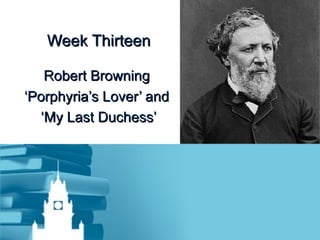
Week Thirteen Robert Browning  ‘ Porphyria’s Lover’ and  ‘ My Last Duchess’
Browning’s dramatic monologues are especially famous for the way in which their ‘true’ meaning is contrary to the explicit testimony of his monologists.  The following examples demonstrate how he uses  language ,  meter , and  syntax   to achieve this two-level system of the implicit and the explicit.
‘ Porphyria’s Lover’ The rain set early in tonight, The sullen wind was soon awake, It tore the elm-tops down for spite, And did its worst to vex the lake: I listened with heart fit to break. When glided in Porphyria; straight She shut the cold out and the storm, And kneeled and made the cheerless grate Blaze up, and all the cottage warm; Which done, she rose, and from her form Withdrew the dripping cloak and shawl,  And laid her soiled gloves by, untied Her hat and let her damp hair fall, And, last, she sat down by my side And called me. When no voice replied, […] Meter : ruptures in the iambic tetrameter coincide with apertures into the mind of the monologist. Language : personification and pathetic fallacy merge, creating an environment saturated with menace, against which the presence of Porphyria is opposed.  Syntax : The dramatic, accelerated shedding of the symbols of the harsh surroundings – largely enacted through enjambment – is brought to a climactic halt through a medial caesura as the source of new danger is announced.
Task Using headings of  Meter ,  Language , and  Syntax , spend ten minutes alone finding examples  in ‘My Last Duchess’ that similarly imply a meaning hidden by the monologist, but which Browning intends to project.
Some hints Meter Language Syntax Disjuncture, Parallelisms, Patterning, Emphasis, Connections with language and syntax, Pace, Rhythm. Word choices, Ambiguity, Connotation, Figurative language, Register, Tone. Subject,  object,  predicate,  transitivity,  pronoun,  subordination, passive/active, imperative,  inversion,  Postponement.
Now get into groups of three and spend five minutes sharing and refining your ideas, ready for discussion.

Robert browning2

  • 1.
    Week Thirteen RobertBrowning ‘ Porphyria’s Lover’ and ‘ My Last Duchess’
  • 2.
    Browning’s dramatic monologuesare especially famous for the way in which their ‘true’ meaning is contrary to the explicit testimony of his monologists. The following examples demonstrate how he uses language , meter , and syntax to achieve this two-level system of the implicit and the explicit.
  • 3.
    ‘ Porphyria’s Lover’The rain set early in tonight, The sullen wind was soon awake, It tore the elm-tops down for spite, And did its worst to vex the lake: I listened with heart fit to break. When glided in Porphyria; straight She shut the cold out and the storm, And kneeled and made the cheerless grate Blaze up, and all the cottage warm; Which done, she rose, and from her form Withdrew the dripping cloak and shawl, And laid her soiled gloves by, untied Her hat and let her damp hair fall, And, last, she sat down by my side And called me. When no voice replied, […] Meter : ruptures in the iambic tetrameter coincide with apertures into the mind of the monologist. Language : personification and pathetic fallacy merge, creating an environment saturated with menace, against which the presence of Porphyria is opposed. Syntax : The dramatic, accelerated shedding of the symbols of the harsh surroundings – largely enacted through enjambment – is brought to a climactic halt through a medial caesura as the source of new danger is announced.
  • 4.
    Task Using headingsof Meter , Language , and Syntax , spend ten minutes alone finding examples in ‘My Last Duchess’ that similarly imply a meaning hidden by the monologist, but which Browning intends to project.
  • 5.
    Some hints MeterLanguage Syntax Disjuncture, Parallelisms, Patterning, Emphasis, Connections with language and syntax, Pace, Rhythm. Word choices, Ambiguity, Connotation, Figurative language, Register, Tone. Subject, object, predicate, transitivity, pronoun, subordination, passive/active, imperative, inversion, Postponement.
  • 6.
    Now get intogroups of three and spend five minutes sharing and refining your ideas, ready for discussion.