OZYMANDIAS-P.B. SHELLEY
FA4 Group Activity
GROUP MEMBERS
ROLL NO. NAME
2 ANUJ GARG
11 KHYATISH DESAI
14 NAMAN AGARWAL
17 PANKAJ CHOUDHARY
31 VIDIT KEWALIYA
ABOUT THE POET
ABOUT THE POET
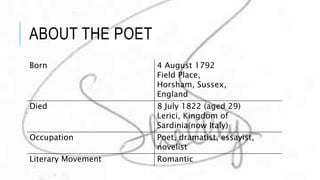
Born 4 August 1792
Field Place,
Horsham, Sussex,
England
Died 8 July 1822 (aged 29)
Lerici, Kingdom of
Sardinia(now Italy)
Occupation Poet, dramatist, essayist,
novelist
Literary Movement Romantic
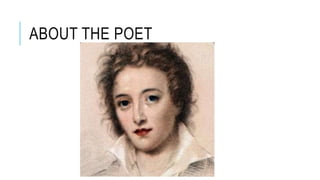
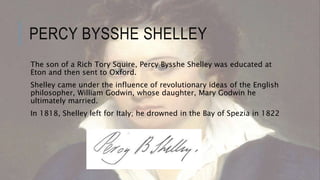
PERCY BYSSHE SHELLEY
The son of a Rich Tory Squire, Percy Bysshe Shelley was educated at
Eton and then sent to Oxford.
Shelley came under the influence of revolutionary ideas of the English
philosopher, William Godwin, whose daughter, Mary Godwin he
ultimately married.
In 1818, Shelley left for Italy; he drowned in the Bay of Spezia in 1822
POEM
ABOUT THE POEM
Written on December 1817.
Published in 1818 in the January 11 issue of The Examiner in
London.
Frequently anthologised and probably Shelley's most famous
short poem.
Written in competition with his friend Horace Smith, who wrote
another sonnet entitled "Ozymandias“.
Thought to be inspired by the arrival of the statue of “Ramses II” in
Britain.
A ‘classic’ poem which has been studied and dissected countless
times in the subject of English ever since its creation.
POEM
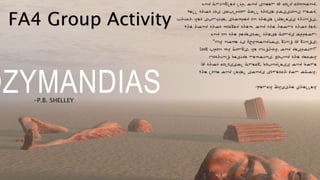
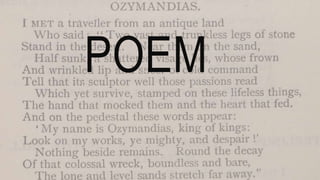
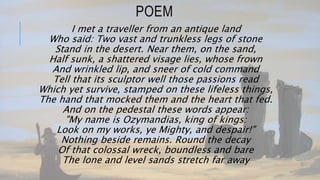
I met a traveller from an antique land
Who said: Two vast and trunkless legs of stone
Stand in the desert. Near them, on the sand,
Half sunk, a shattered visage lies, whose frown
And wrinkled lip, and sneer of cold command
Tell that its sculptor well those passions read
Which yet survive, stamped on these lifeless things,
The hand that mocked them and the heart that fed.
And on the pedestal these words appear:
"My name is Ozymandias, king of kings:
Look on my works, ye Mighty, and despair!"
Nothing beside remains. Round the decay
Of that colossal wreck, boundless and bare
The lone and level sands stretch far away
SUMMARY
The speaker recalls having met a traveller from an ancient land
who told him a story about the ruins of a statue in the desert of
his native country. The traveller said that two vast legs of stone
stand without a body and near this, a massive crumbling and
broken stone-head lies, which is half sunk in the sand. The statue
has a bitter and cruel expression of ‘sneer and cold command’
and this indicates that the sculptor had understood the passions
of his subject really well. It was obvious that the statue was of a
man who sneered with contempt for those who were weaker than
himself, yet fed his people because of something in his heart.
SUMMARY
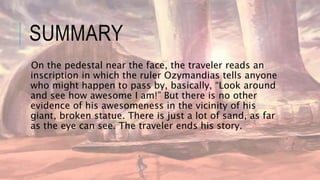
On the pedestal near the face, the traveler reads an
inscription in which the ruler Ozymandias tells anyone
who might happen to pass by, basically, “Look around
and see how awesome I am!” But there is no other
evidence of his awesomeness in the vicinity of his
giant, broken statue. There is just a lot of sand, as far
as the eye can see. The traveler ends his story.
THEME OF THE POEM
The Poem mainly consists of 4 different themes:-
Theme of Art and Culture
Theme of Pride
Theme of Man and the Natural World
Theme of Transience
THEME OF ART AND CULTURE
"Ozymandias" was inspired by a statue, and it's no
surprise that art is one of this poem's themes. The
traveler makes a point of telling us that the statue was
made by a really skilled sculptor, and the poem as a
whole explores the question of art's longevity. The
statue is in part a stand-in or substitute for all kinds
of art (painting, poetry, etc.), and the poem asks us to
think not just about sculpture, but about the fate of
other arts as well.
THEME OF PRIDE
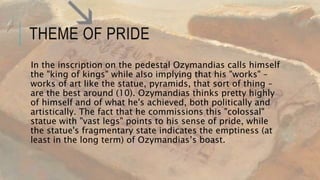
In the inscription on the pedestal Ozymandias calls himself
the "king of kings" while also implying that his "works" –
works of art like the statue, pyramids, that sort of thing –
are the best around (10). Ozymandias thinks pretty highly
of himself and of what he's achieved, both politically and
artistically. The fact that he commissions this "colossal"
statue with "vast legs" points to his sense of pride, while
the statue's fragmentary state indicates the emptiness (at
least in the long term) of Ozymandias’s boast.
THEME OF MAN AND NATURAL
WORLD
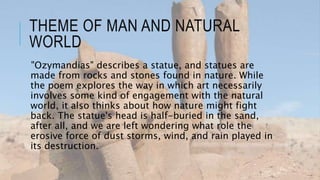
"Ozymandias" describes a statue, and statues are
made from rocks and stones found in nature. While
the poem explores the way in which art necessarily
involves some kind of engagement with the natural
world, it also thinks about how nature might fight
back. The statue's head is half-buried in the sand,
after all, and we are left wondering what role the
erosive force of dust storms, wind, and rain played in
its destruction.
THEME OF TRANSIENCE
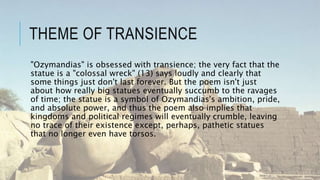
"Ozymandias" is obsessed with transience; the very fact that the
statue is a "colossal wreck" (13) says loudly and clearly that
some things just don't last forever. But the poem isn't just
about how really big statues eventually succumb to the ravages
of time; the statue is a symbol of Ozymandias's ambition, pride,
and absolute power, and thus the poem also implies that
kingdoms and political regimes will eventually crumble, leaving
no trace of their existence except, perhaps, pathetic statues
that no longer even have torsos.
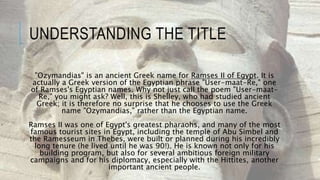
UNDERSTANDING THE TITLE
"Ozymandias" is an ancient Greek name for Ramses II of Egypt. It is
actually a Greek version of the Egyptian phrase "User-maat-Re," one
of Ramses's Egyptian names. Why not just call the poem "User-maat-
Re," you might ask? Well, this is Shelley, who had studied ancient
Greek; it is therefore no surprise that he chooses to use the Greek
name "Ozymandias," rather than the Egyptian name.
Ramses II was one of Egypt's greatest pharaohs, and many of the most
famous tourist sites in Egypt, including the temple of Abu Simbel and
the Ramesseum in Thebes, were built or planned during his incredibly
long tenure (he lived until he was 90!). He is known not only for his
building program, but also for several ambitious foreign military
campaigns and for his diplomacy, especially with the Hittites, another
important ancient people.
SETTING OF THE POEM
This poem has several settings. It begins with a strange encounter between
the speaker and a traveler from an "antique land". We have no idea where this
rendezvous takes place, which is very weird. It could be in the speaker's
head, in a dream, on the street, or in the desert; it sort of resembles
something that might occur in a youth hostel or a tavern in London. The first
appearance of Aragorn in the Fellowship of the Ring might be a good
comparison.
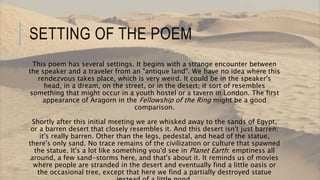
Shortly after this initial meeting we are whisked away to the sands of Egypt,
or a barren desert that closely resembles it. And this desert isn't just barren;
it's really barren. Other than the legs, pedestal, and head of the statue,
there's only sand. No trace remains of the civilization or culture that spawned
the statue. It's a lot like something you'd see in Planet Earth: emptiness all
around, a few sand-storms here, and that's about it. It reminds us of movies
where people are stranded in the desert and eventually find a little oasis or
the occasional tree, except that here we find a partially destroyed statue
OZYMANDIAS TRIVIA
Napoleon tried to steal the statue that inspired "Ozymandias" and
left a hole in its right side
Shelley was part of a larger group of friends that frequently engaged
in sonnet-writing contests. The members included Leigh Hunt and
John Keats.
Shelley used the pseudonym (fake name) "Gilrastes" when he
published "Ozymandias" in the Examiner.
Shelley's body is buried in Rome but his heart is buried in England.
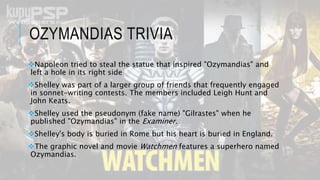
The graphic novel and movie Watchmen features a superhero named
Ozymandias.
Ozymandias - P.B. Shelley

Ozymandias - P.B. Shelley

  • 1.
  • 2.
    GROUP MEMBERS ROLL NO.NAME 2 ANUJ GARG 11 KHYATISH DESAI 14 NAMAN AGARWAL 17 PANKAJ CHOUDHARY 31 VIDIT KEWALIYA
  • 3.
  • 4.
    ABOUT THE POET Born4 August 1792 Field Place, Horsham, Sussex, England Died 8 July 1822 (aged 29) Lerici, Kingdom of Sardinia(now Italy) Occupation Poet, dramatist, essayist, novelist Literary Movement Romantic
  • 5.
    PERCY BYSSHE SHELLEY Theson of a Rich Tory Squire, Percy Bysshe Shelley was educated at Eton and then sent to Oxford. Shelley came under the influence of revolutionary ideas of the English philosopher, William Godwin, whose daughter, Mary Godwin he ultimately married. In 1818, Shelley left for Italy; he drowned in the Bay of Spezia in 1822
  • 6.
  • 7.
    ABOUT THE POEM Writtenon December 1817. Published in 1818 in the January 11 issue of The Examiner in London. Frequently anthologised and probably Shelley's most famous short poem. Written in competition with his friend Horace Smith, who wrote another sonnet entitled "Ozymandias“. Thought to be inspired by the arrival of the statue of “Ramses II” in Britain. A ‘classic’ poem which has been studied and dissected countless times in the subject of English ever since its creation.
  • 8.
    POEM I met atraveller from an antique land Who said: Two vast and trunkless legs of stone Stand in the desert. Near them, on the sand, Half sunk, a shattered visage lies, whose frown And wrinkled lip, and sneer of cold command Tell that its sculptor well those passions read Which yet survive, stamped on these lifeless things, The hand that mocked them and the heart that fed. And on the pedestal these words appear: "My name is Ozymandias, king of kings: Look on my works, ye Mighty, and despair!" Nothing beside remains. Round the decay Of that colossal wreck, boundless and bare The lone and level sands stretch far away
  • 9.
    SUMMARY The speaker recallshaving met a traveller from an ancient land who told him a story about the ruins of a statue in the desert of his native country. The traveller said that two vast legs of stone stand without a body and near this, a massive crumbling and broken stone-head lies, which is half sunk in the sand. The statue has a bitter and cruel expression of ‘sneer and cold command’ and this indicates that the sculptor had understood the passions of his subject really well. It was obvious that the statue was of a man who sneered with contempt for those who were weaker than himself, yet fed his people because of something in his heart.
  • 10.
    SUMMARY On the pedestalnear the face, the traveler reads an inscription in which the ruler Ozymandias tells anyone who might happen to pass by, basically, “Look around and see how awesome I am!” But there is no other evidence of his awesomeness in the vicinity of his giant, broken statue. There is just a lot of sand, as far as the eye can see. The traveler ends his story.
  • 11.
    THEME OF THEPOEM The Poem mainly consists of 4 different themes:- Theme of Art and Culture Theme of Pride Theme of Man and the Natural World Theme of Transience
  • 12.
    THEME OF ARTAND CULTURE "Ozymandias" was inspired by a statue, and it's no surprise that art is one of this poem's themes. The traveler makes a point of telling us that the statue was made by a really skilled sculptor, and the poem as a whole explores the question of art's longevity. The statue is in part a stand-in or substitute for all kinds of art (painting, poetry, etc.), and the poem asks us to think not just about sculpture, but about the fate of other arts as well.
  • 13.
    THEME OF PRIDE Inthe inscription on the pedestal Ozymandias calls himself the "king of kings" while also implying that his "works" – works of art like the statue, pyramids, that sort of thing – are the best around (10). Ozymandias thinks pretty highly of himself and of what he's achieved, both politically and artistically. The fact that he commissions this "colossal" statue with "vast legs" points to his sense of pride, while the statue's fragmentary state indicates the emptiness (at least in the long term) of Ozymandias’s boast.
  • 14.
    THEME OF MANAND NATURAL WORLD "Ozymandias" describes a statue, and statues are made from rocks and stones found in nature. While the poem explores the way in which art necessarily involves some kind of engagement with the natural world, it also thinks about how nature might fight back. The statue's head is half-buried in the sand, after all, and we are left wondering what role the erosive force of dust storms, wind, and rain played in its destruction.
  • 15.
    THEME OF TRANSIENCE "Ozymandias"is obsessed with transience; the very fact that the statue is a "colossal wreck" (13) says loudly and clearly that some things just don't last forever. But the poem isn't just about how really big statues eventually succumb to the ravages of time; the statue is a symbol of Ozymandias's ambition, pride, and absolute power, and thus the poem also implies that kingdoms and political regimes will eventually crumble, leaving no trace of their existence except, perhaps, pathetic statues that no longer even have torsos.
  • 16.
    UNDERSTANDING THE TITLE "Ozymandias"is an ancient Greek name for Ramses II of Egypt. It is actually a Greek version of the Egyptian phrase "User-maat-Re," one of Ramses's Egyptian names. Why not just call the poem "User-maat- Re," you might ask? Well, this is Shelley, who had studied ancient Greek; it is therefore no surprise that he chooses to use the Greek name "Ozymandias," rather than the Egyptian name. Ramses II was one of Egypt's greatest pharaohs, and many of the most famous tourist sites in Egypt, including the temple of Abu Simbel and the Ramesseum in Thebes, were built or planned during his incredibly long tenure (he lived until he was 90!). He is known not only for his building program, but also for several ambitious foreign military campaigns and for his diplomacy, especially with the Hittites, another important ancient people.
  • 17.
    SETTING OF THEPOEM This poem has several settings. It begins with a strange encounter between the speaker and a traveler from an "antique land". We have no idea where this rendezvous takes place, which is very weird. It could be in the speaker's head, in a dream, on the street, or in the desert; it sort of resembles something that might occur in a youth hostel or a tavern in London. The first appearance of Aragorn in the Fellowship of the Ring might be a good comparison. Shortly after this initial meeting we are whisked away to the sands of Egypt, or a barren desert that closely resembles it. And this desert isn't just barren; it's really barren. Other than the legs, pedestal, and head of the statue, there's only sand. No trace remains of the civilization or culture that spawned the statue. It's a lot like something you'd see in Planet Earth: emptiness all around, a few sand-storms here, and that's about it. It reminds us of movies where people are stranded in the desert and eventually find a little oasis or the occasional tree, except that here we find a partially destroyed statue
  • 18.
    OZYMANDIAS TRIVIA Napoleon triedto steal the statue that inspired "Ozymandias" and left a hole in its right side Shelley was part of a larger group of friends that frequently engaged in sonnet-writing contests. The members included Leigh Hunt and John Keats. Shelley used the pseudonym (fake name) "Gilrastes" when he published "Ozymandias" in the Examiner. Shelley's body is buried in Rome but his heart is buried in England. The graphic novel and movie Watchmen features a superhero named Ozymandias.