drama
&
SOCIAL WORK
Prepared by Van Tran
Table of content
 What is drama?
 Types of drama
 Function of drama
 Drama in Social Work: Applied Drama
 References
What is drama?
 The term “drama” comes from a Greek word meaning
action.
 An older meaning of 'drama' was the specific mode of
fiction represented in performance. (Elam, 1980).
 Drama is an adaptation, recreation and reflection of
reality on stage.
 Nowadays, drama is a term used to refer to a genre of
film or television which is more serious than comedy.
 Drama is an imitation of life.
 Definition from merriam-webster dictionary: a
composition in verse or prose intended to
portray life or character or to tell a story usually
involving conflicts and emotions through action
and dialogue and typically designed for
theatrical performance.
 The term drama is used at the following
three different levels:
1. Performance
2. Composition
3. Branch of Literature
Types of drama
 Tragedy
 Comedy
 Melodrama
 Tragi-Comedy
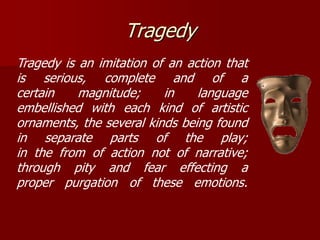
Tragedy
Tragedy is an imitation of an action that
is serious, complete and of a
certain magnitude; in language
embellished with each kind of artistic
ornaments, the several kinds being found
in separate parts of the play;
in the from of action not of narrative;
through pity and fear effecting a
proper purgation of these emotions.
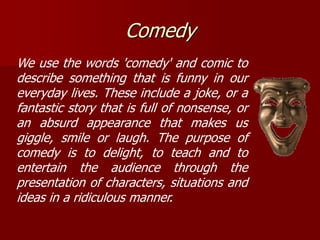
Comedy
We use the words 'comedy' and comic to
describe something that is funny in our
everyday lives. These include a joke, or a
fantastic story that is full of nonsense, or
an absurd appearance that makes us
giggle, smile or laugh. The purpose of
comedy is to delight, to teach and to
entertain the audience through the
presentation of characters, situations and
ideas in a ridiculous manner.
Melodrama
The word melodrama is coined from melo
(music) and dran (drama). It is,
therefore, a play that utilizes music
extensively. But the utilization of
music is not the only factor in
melodrama, what really makes it
melodrama is its portrayal of the
protagonist and the antagonist.
Tragi-comedy
In traditional tragedy, playwrights are not
allowed to bring in any comic action. As
time went on, even from the Elizabethan
period, comic characters were included in
tragic plays. This is called comic relief.
Tragi-comedy is a play that mixes both
comic and tragic elements in equal
proportion of each.
Function of drama
 To entertain, inform and educate people.
 Drama assists in the development of :
- the use of imagination
- powers of creative self expression
- decision making and problem solving skills
- understanding of self and the world
- self confidence, sense of worth and respect and
consideration for others.
 The drama of any society, therefore, reflects the
problems, aspirations, philosophy and cultural background
of the people.
Drama in Social Work: Applied Drama
 Applied Drama: drama practice in a specific
social context.
 Helen Nicholson, Royal Holloway, University
of London, UK: Applied drama/theatre
relates to work which is orientated
towards aspects of social change, personal
development and community-building
through various forms of participation in
drama, theatre and other performance
practices.
Drama Therapy
 The ancient Greeks used drama for
catharsis. As anyone who has acted
knows, theater can tap into emotions,
build self esteem, and reduce feelings of
isolation.
 Drama therapy uses drama and theatre
processes intentionally to achieve
therapeutic goals. These include:
- symptom relief
- emotional and physical integration
- improvement of interpersonal skills and
relationships
- personal growth.
- healing trauma.
 Drama therapy has been used in a wide
array of settings, including mental health
facilities, schools, hospitals, substance
abuse treatment centers, correctional
facilities, adolescent group homes, nursing
homes, housing projects, and theaters,
among others.
Target of Drama Therapy
 Children, adolescents and adults who show
psychological and behavioral problems.
 Young offenders
 Youth at risk
 Addicted clients
How can drama therapy help
heal communities?
References
 Elements of Drama, National Open University of Nigeria
 Interactive theatre: Drama as social intervention (John
William Somers, 2008)
 http://www.socialworker.com/feature-
articles/practice/Theater_Processes_Therapeutic_in_Drama_T
herapy
 Drama as therapy for young offenders
 http://www.merriam-webster.com/dictionary/drama
 (2006) Applied Theatre/Drama: an e-debate in 2004,
Research in Drama Education: The Journal of Applied Theatre
and Performance, 11:1, 90-95,
DOI:10.1080/13569780500437960
Thank you for your attention!

Drama Therapy & Social Work

  • 1.
  • 2.
    Table of content What is drama?  Types of drama  Function of drama  Drama in Social Work: Applied Drama  References
  • 3.
    What is drama? The term “drama” comes from a Greek word meaning action.  An older meaning of 'drama' was the specific mode of fiction represented in performance. (Elam, 1980).  Drama is an adaptation, recreation and reflection of reality on stage.  Nowadays, drama is a term used to refer to a genre of film or television which is more serious than comedy.  Drama is an imitation of life.
  • 4.
     Definition frommerriam-webster dictionary: a composition in verse or prose intended to portray life or character or to tell a story usually involving conflicts and emotions through action and dialogue and typically designed for theatrical performance.
  • 5.
     The termdrama is used at the following three different levels: 1. Performance 2. Composition 3. Branch of Literature
  • 6.
    Types of drama Tragedy  Comedy  Melodrama  Tragi-Comedy
  • 7.
    Tragedy Tragedy is animitation of an action that is serious, complete and of a certain magnitude; in language embellished with each kind of artistic ornaments, the several kinds being found in separate parts of the play; in the from of action not of narrative; through pity and fear effecting a proper purgation of these emotions.
  • 8.
    Comedy We use thewords 'comedy' and comic to describe something that is funny in our everyday lives. These include a joke, or a fantastic story that is full of nonsense, or an absurd appearance that makes us giggle, smile or laugh. The purpose of comedy is to delight, to teach and to entertain the audience through the presentation of characters, situations and ideas in a ridiculous manner.
  • 9.
    Melodrama The word melodramais coined from melo (music) and dran (drama). It is, therefore, a play that utilizes music extensively. But the utilization of music is not the only factor in melodrama, what really makes it melodrama is its portrayal of the protagonist and the antagonist.
  • 10.
    Tragi-comedy In traditional tragedy,playwrights are not allowed to bring in any comic action. As time went on, even from the Elizabethan period, comic characters were included in tragic plays. This is called comic relief. Tragi-comedy is a play that mixes both comic and tragic elements in equal proportion of each.
  • 11.
    Function of drama To entertain, inform and educate people.  Drama assists in the development of : - the use of imagination - powers of creative self expression - decision making and problem solving skills - understanding of self and the world - self confidence, sense of worth and respect and consideration for others.  The drama of any society, therefore, reflects the problems, aspirations, philosophy and cultural background of the people.
  • 12.
    Drama in SocialWork: Applied Drama  Applied Drama: drama practice in a specific social context.  Helen Nicholson, Royal Holloway, University of London, UK: Applied drama/theatre relates to work which is orientated towards aspects of social change, personal development and community-building through various forms of participation in drama, theatre and other performance practices.
  • 13.
    Drama Therapy  Theancient Greeks used drama for catharsis. As anyone who has acted knows, theater can tap into emotions, build self esteem, and reduce feelings of isolation.
  • 14.
     Drama therapyuses drama and theatre processes intentionally to achieve therapeutic goals. These include: - symptom relief - emotional and physical integration - improvement of interpersonal skills and relationships - personal growth. - healing trauma.
  • 15.
     Drama therapyhas been used in a wide array of settings, including mental health facilities, schools, hospitals, substance abuse treatment centers, correctional facilities, adolescent group homes, nursing homes, housing projects, and theaters, among others.
  • 16.
    Target of DramaTherapy  Children, adolescents and adults who show psychological and behavioral problems.  Young offenders  Youth at risk  Addicted clients
  • 17.
    How can dramatherapy help heal communities?
  • 18.
    References  Elements ofDrama, National Open University of Nigeria  Interactive theatre: Drama as social intervention (John William Somers, 2008)  http://www.socialworker.com/feature- articles/practice/Theater_Processes_Therapeutic_in_Drama_T herapy  Drama as therapy for young offenders  http://www.merriam-webster.com/dictionary/drama  (2006) Applied Theatre/Drama: an e-debate in 2004, Research in Drama Education: The Journal of Applied Theatre and Performance, 11:1, 90-95, DOI:10.1080/13569780500437960
  • 19.
    Thank you foryour attention!

Editor's Notes

  • #14 Drama therapy with couples https://www.youtube.com/watch?v=7JbI2D-tIf0 How can drama therapy help heal communities? https://www.youtube.com/watch?v=qi5D9EJGwGA