Week Eight William Wordsworth ‘Expostulation and Reply’ ‘The Tables Turned’
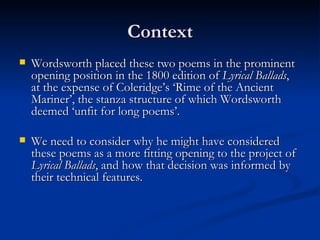
Context Wordsworth placed these two poems in the prominent opening position in the 1800 edition of  Lyrical Ballads , at the expense of Coleridge’s ‘Rime of the Ancient Mariner’, the stanza structure of which Wordsworth deemed ‘unfit for long poems’. We need to consider why he might have considered these poems as a more fitting opening to the project of  Lyrical Ballads , and how that decision was informed by their technical features.
‘ Expostulation and Reply’ “ Why, William, on that old gray stone, Thus for the length of half a day, Why, William, sit you thus alone, And dream your time away? 5 “Where are your books? – that light bequeathed To Beings else forlorn and blind! Up! up! and drink the spirit breathed From dead men to their kind. “ You look round on your Mother Earth,  10 As if she for no purpose bore you; As if you were her first-born birth, And none had lived before you!” One morning thus, by Esthwaite lake When life was sweet, I knew not why, 15 To me my good friend Matthew spake,  And thus I made reply.
‘ Expostulation and Reply’ “ The eye – it cannot choose but see; We cannot bid the ear be still; Our bodies feel, where’er they be. 20 Against or with our will. “ Nor less I deem that there are Powers Which of themselves our minds impress; That we can feed this mind of ours In a wise passiveness. 25 “Think you, ‘mid all this mighty sum Of things for ever speaking, That nothing of itself will come, But we must still be seeking? “ –  Then ask not wherefore, here, alone, 30 Conversing as I may, I sit upon this old gray stone, And dream my time away.”
Initial analysis Write one sentence to describe the ‘message’ of the poem.
Initial  scansion Without worrying on which exact syllables they fall, count the stresses on each line.
Stresses per line? “ Why, William, on that old gray stone, Thus for the length of half a day, Why, William, sit you thus alone, And dream your time away? 5 “Where are your books? – that light bequeathed To Beings else forlorn and blind! Up! up! and drink the spirit breathed From dead men to their kind. “ You look round on your Mother Earth,  10 As if she for no purpose bore you; As if you were her first-born birth, And none had lived before you!” One morning thus, by Esthwaite lake When life was sweet, I knew not why, 15 To me my good friend Matthew spake,  And thus I made reply. 4 4 4 3 4 4 4 3 4 4 4 3 4 4 4 3
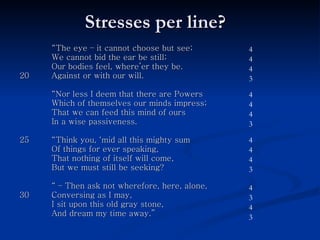
Stresses per line? “ The eye – it cannot choose but see; We cannot bid the ear be still; Our bodies feel, where’er they be. 20 Against or with our will. “ Nor less I deem that there are Powers Which of themselves our minds impress; That we can feed this mind of ours In a wise passiveness. 25 “Think you, ‘mid all this mighty sum Of things for ever speaking, That nothing of itself will come, But we must still be seeking? “ –  Then ask not wherefore, here, alone, 30 Conversing as I may, I sit upon this old gray stone, And dream my time away.”   4 4 4 3 4 4 4 3 4 4 4 3 4 3 4 3
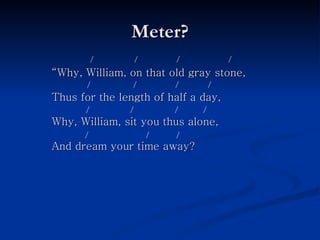
Meter? “ Why, William, on that old gray stone, Thus for the length of half a day, Why, William, sit you thus alone, And dream your time away?   /   /   /   / /    /   /  /   /   /  /  /   /  /  /
Some questions But are those first three lines unequivocally in iambic tetrameter? Which words – and, more generally, which  types  of words – seem to enforce or negate greater emphasis, and how does Wordsworth play with this natural readerly response?
Some distinctions regarding stress Etymological Accent (or Word Accent):  emphasis given to a word by historical usage. Rhetorical Accent (or Sense Accent):  emphasis given to a word by its relative importance in a phrase or sentence. Metrical Accent (or Stress):  emphasis given by the insistence of a repeated accentual pattern.
Why, William, on that old gray stone What reasons – phonetic and/or syntactic – might account for the apparent resistance of the word “gray” to the meter? Syntactic stress hierarchies  (in this case adjective-adjective-noun).  Insistent monosyllables. Sonic similarities in the sequence of long vowels (“old” “gray” “stone”).
Wordsworth states in his 1815 preface that metrical tension awakens a ‘voluntary power to modulate’ the ‘music of the poem’ as the ‘spirit of versification’ is felt to play with and against the ‘letter of the metre’. Considering the subject matter of the poem, what might be the specific resonance of this battle between the ‘spirit’ and the ‘letter’? In what semantic context is the meter most playfully varied?  In what semantic context is the meter most strictly controlled?  In both cases, why might this be?  A contest between the ‘spirit’ and the ‘letter’
‘ The Tables Turned’ This is a companion piece to ‘Expostulation and Reply’. Attempt in pairs to construct an analysis of this poem in the light of today’s discussion. Look specifically for tensions between meter and rhythm, and attempt to account for them both technically and in terms of their effects.

William wordsworth2

  • 1.
    Week Eight WilliamWordsworth ‘Expostulation and Reply’ ‘The Tables Turned’
  • 2.
    Context Wordsworth placedthese two poems in the prominent opening position in the 1800 edition of Lyrical Ballads , at the expense of Coleridge’s ‘Rime of the Ancient Mariner’, the stanza structure of which Wordsworth deemed ‘unfit for long poems’. We need to consider why he might have considered these poems as a more fitting opening to the project of Lyrical Ballads , and how that decision was informed by their technical features.
  • 3.
    ‘ Expostulation andReply’ “ Why, William, on that old gray stone, Thus for the length of half a day, Why, William, sit you thus alone, And dream your time away? 5 “Where are your books? – that light bequeathed To Beings else forlorn and blind! Up! up! and drink the spirit breathed From dead men to their kind. “ You look round on your Mother Earth, 10 As if she for no purpose bore you; As if you were her first-born birth, And none had lived before you!” One morning thus, by Esthwaite lake When life was sweet, I knew not why, 15 To me my good friend Matthew spake, And thus I made reply.
  • 4.
    ‘ Expostulation andReply’ “ The eye – it cannot choose but see; We cannot bid the ear be still; Our bodies feel, where’er they be. 20 Against or with our will. “ Nor less I deem that there are Powers Which of themselves our minds impress; That we can feed this mind of ours In a wise passiveness. 25 “Think you, ‘mid all this mighty sum Of things for ever speaking, That nothing of itself will come, But we must still be seeking? “ – Then ask not wherefore, here, alone, 30 Conversing as I may, I sit upon this old gray stone, And dream my time away.”
  • 5.
    Initial analysis Writeone sentence to describe the ‘message’ of the poem.
  • 6.
    Initial scansionWithout worrying on which exact syllables they fall, count the stresses on each line.
  • 7.
    Stresses per line?“ Why, William, on that old gray stone, Thus for the length of half a day, Why, William, sit you thus alone, And dream your time away? 5 “Where are your books? – that light bequeathed To Beings else forlorn and blind! Up! up! and drink the spirit breathed From dead men to their kind. “ You look round on your Mother Earth, 10 As if she for no purpose bore you; As if you were her first-born birth, And none had lived before you!” One morning thus, by Esthwaite lake When life was sweet, I knew not why, 15 To me my good friend Matthew spake, And thus I made reply. 4 4 4 3 4 4 4 3 4 4 4 3 4 4 4 3
  • 8.
    Stresses per line?“ The eye – it cannot choose but see; We cannot bid the ear be still; Our bodies feel, where’er they be. 20 Against or with our will. “ Nor less I deem that there are Powers Which of themselves our minds impress; That we can feed this mind of ours In a wise passiveness. 25 “Think you, ‘mid all this mighty sum Of things for ever speaking, That nothing of itself will come, But we must still be seeking? “ – Then ask not wherefore, here, alone, 30 Conversing as I may, I sit upon this old gray stone, And dream my time away.” 4 4 4 3 4 4 4 3 4 4 4 3 4 3 4 3
  • 9.
    Meter? “ Why,William, on that old gray stone, Thus for the length of half a day, Why, William, sit you thus alone, And dream your time away? / / / / / / / / / / / / / / /
  • 10.
    Some questions Butare those first three lines unequivocally in iambic tetrameter? Which words – and, more generally, which types of words – seem to enforce or negate greater emphasis, and how does Wordsworth play with this natural readerly response?
  • 11.
    Some distinctions regardingstress Etymological Accent (or Word Accent): emphasis given to a word by historical usage. Rhetorical Accent (or Sense Accent): emphasis given to a word by its relative importance in a phrase or sentence. Metrical Accent (or Stress): emphasis given by the insistence of a repeated accentual pattern.
  • 12.
    Why, William, onthat old gray stone What reasons – phonetic and/or syntactic – might account for the apparent resistance of the word “gray” to the meter? Syntactic stress hierarchies (in this case adjective-adjective-noun). Insistent monosyllables. Sonic similarities in the sequence of long vowels (“old” “gray” “stone”).
  • 13.
    Wordsworth states inhis 1815 preface that metrical tension awakens a ‘voluntary power to modulate’ the ‘music of the poem’ as the ‘spirit of versification’ is felt to play with and against the ‘letter of the metre’. Considering the subject matter of the poem, what might be the specific resonance of this battle between the ‘spirit’ and the ‘letter’? In what semantic context is the meter most playfully varied? In what semantic context is the meter most strictly controlled? In both cases, why might this be? A contest between the ‘spirit’ and the ‘letter’
  • 14.
    ‘ The TablesTurned’ This is a companion piece to ‘Expostulation and Reply’. Attempt in pairs to construct an analysis of this poem in the light of today’s discussion. Look specifically for tensions between meter and rhythm, and attempt to account for them both technically and in terms of their effects.