DRAMA TEKS
• explain how dramatic conventions (e.g.,
monologues, soliloquies, dramatic irony)
enhance dramatic text.[4A]
Based on Holt McDougal Literature Grade
9, Unit 10
1
Romeo & Juliet
Literary Workshop, Part 1
Part 1
Characteristics
of Shakespearean Tragedy
2
Based on Holt McDougal Literature Grade
9, Unit 10
Part 1, Model 1: Character
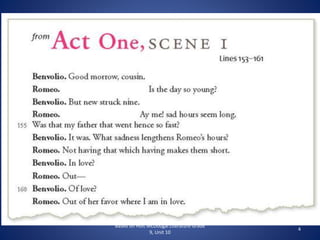
• Inthefollowingexcerpt,Romeo—theyoung
protagonistoftheplayandamemberofthe
Montaguefamily—complainstohiscousin,
Benvolio,aboutaproblemthatisplaguinghim. As
youread,consider…
1. WhatisRomeoexperiencingthatyoucanrelateto?
2. WhatpossibleweaknessorflawdoesRomeo’s
attitudehintat?
3. WhatdoyoulearnaboutRomeo’spersonality?
3
Based on Holt McDougal Literature Grade
9, Unit 10
4
Based on Holt McDougal Literature Grade
9, Unit 10
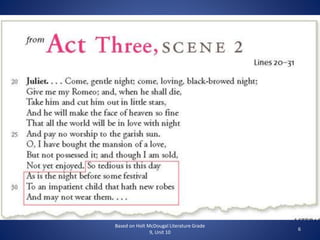
Part 1, Model 2: Soliloquy
• Throughthissoliloquy, readersgainaccesstothe
thoughtsandfeelingsofJuliet,aCapulet—and
thereforeahatedenemyofanyMontague. Asyou
read,consider…
1. Whatdoestheimageryinlines20–25revealabout
Juliet’sfeelingsforRomeo?
2. Rereadtheboxedtext.WhatisJuliet’smoodasshe
waitsforRomeo?Pointoutspecific wordsand
details thatrevealherstateofmind.
5
Based on Holt McDougal Literature Grade
9, Unit 10
Based on Holt McDougal Literature Grade
9, Unit 10
6
Romeo & Juliet
Literary Workshop, Part 2
Part 2
The Language
of Shakespeare
7
Based on Holt McDougal Literature Grade
9, Unit 10
Part 2: The Language of Shakespeare
• Shakespeare’s plays deal with experiences and
emotions that are easy to relate to, but his
language can be challenging for today’s
readers to understand.
• Once you get past the unfamiliar language,
learn the rhythm and learn to “get” his
allusions and puns, you’ll find his sense of
romance, drama and humor fascinating.
Based on Holt McDougal Literature Grade
9, Unit 10
8
Part 2: The Language of Shakespeare
— Blank Verse
• Shakespeare wrote mostly in a poetic form
called blank verse.
• Blank verse is a poetic form that does not
rhyme.
• It carries the rhythm of natural speech.
• Blank verse is made up of unrhymed lines that
follow a rhythm of iambic pentameter.
Based on Holt McDougal Literature Grade
9, Unit 10
9
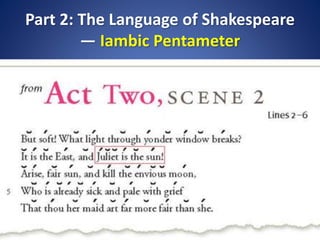
Part 2: The Language of Shakespeare
— Iambic Pentameter
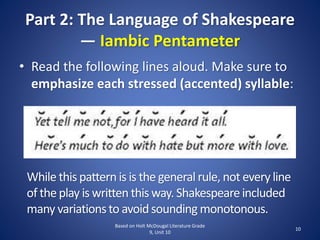
• Read the following lines aloud. Make sure to
emphasize each stressed (accented) syllable:
Based on Holt McDougal Literature Grade
9, Unit 10
10
While this pattern is is thegeneralrule, not every line
of the play is written this way. Shakespeareincluded
many variationsto avoidsounding monotonous.
Part 2: The Language of Shakespeare
— Iambic Pentameter
Based on Holt McDougal Literature Grade
9, Unit 10
11
Part 2: The Language of Shakespeare
— Allusion and Word Play
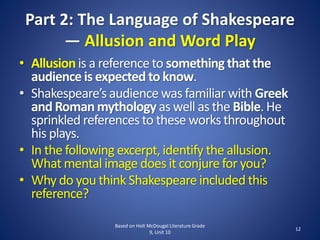
• Allusionis a referenceto something that the
audience is expected to know.
• Shakespeare’s audience was familiar with Greek
and Roman mythology as well as the Bible. He
sprinkled references to these works throughout
his plays.
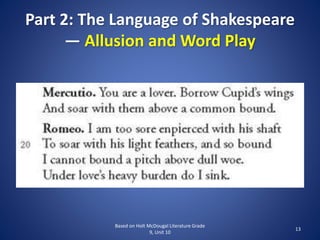
• In the following excerpt, identify the allusion.
What mental image does it conjurefor you?
• Why do you think Shakespeareincluded this
reference?
Based on Holt McDougal Literature Grade
9, Unit 10
12
Part 2: The Language of Shakespeare
— Allusion and Word Play
Based on Holt McDougal Literature Grade
9, Unit 10
13
Part 2: The Language of Shakespeare
— Pun
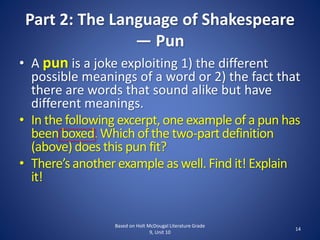
• A pun is a joke exploiting 1) the different
possible meanings of a word or 2) the fact that
there are words that sound alike but have
different meanings.
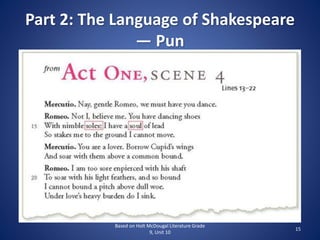
• In the following excerpt,one example of a pun has
been boxed. Which of the two-part definition
(above) does this pun fit?
• There’s another example as well. Find it! Explain
it!
Based on Holt McDougal Literature Grade
9, Unit 10
14
Part 2: The Language of Shakespeare
— Pun
Based on Holt McDougal Literature Grade
9, Unit 10
15
Romeo & Juliet
Literary Workshop, Part 3
Part 3
Strategies for Reading
Shakespearean Drama
16
Based on Holt McDougal Literature Grade
9, Unit 10
Part 3: Reading Shakespearean Drama
• BEFORE you begin reading each Act of a
Shakespearean play:
• Study the opening Cast of Characters
– Who are these people? Why should you care?
• Read the Stage Directions
– Where does the scene take place?
– Who’s on stage?
– What are they doing there?
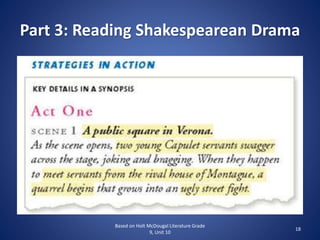
• Read the Synopsis at the beginning of the scene.
Based on Holt McDougal Literature Grade
9, Unit 10
17
Part 3: Reading Shakespearean Drama
Based on Holt McDougal Literature Grade
9, Unit 10
18
Part 3: Reading Shakespearean
Tragedy: Relationships
Based on Holt McDougal Literature Grade
9, Unit 10
19
• Keep track of relationships between characters:
• Are they
– Friends?
– Relatives?
– Enemies?
Part 3: Reading Shakespearean
Tragedy: Relationships
Based on Holt McDougal Literature Grade
9, Unit 10
20
• What arethe characterroles — how are the related
in terms of plot and action?
• TragicHero?
• Foil?
• Antagonist?
• Comic Relief?
• Write the names of charactersin the “Examples”
spaceon the appropriateFrayer Model sheetyou
began filling out last week.
Part 3: Reading Shakespearean
Tragedy: Relationships
Based on Holt McDougal Literature Grade
9, Unit 10
21
• What are the Charactertraits of the characters?
• Character traits are revealed through dialog,
soliloquies and asides as well as through actions.
• Does the character exhibit any flaws or
weaknesses? (Characterflaws and weaknesses
are particularly important to note in tragedies like
Romeo& Juliet.)
Part 3: Reading Shakespearean
Tragedy: Relationships
Based on Holt McDougal Literature Grade
9, Unit 10
22
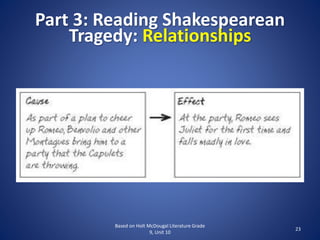
• Look for Cause-and-Effectrelationships between
events — especially events that lead to tragic
outcome.
• Tracking Cause-and-Effectrelationships is
extremely important for writing your essay this
six weeks — “Who Is Most Responsible for the
Deaths of Romeo & Juliet?”
• Track them on a Graphic Organizer, like the one on
the following slide…
Part 3: Reading Shakespearean
Tragedy: Relationships
Based on Holt McDougal Literature Grade
9, Unit 10
23
Part 3: Reading Shakespearean
Language: Unfamiliar Words and
Phrases
Based on Holt McDougal Literature Grade
9, Unit 10
24
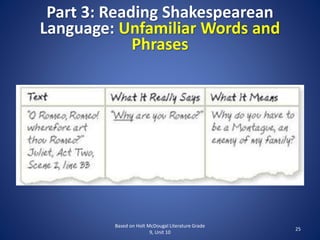
• In reading Romeo & Juliet, you will encounter
a number of unfamiliar words and phrases.
• Take care to write down and paraphrase
unfamiliar terms into terms you understand.
• You can track unfamiliar words and phrases
on a Graphic Organizer like the one on the
next page…
Part 3: Reading Shakespearean
Language: Unfamiliar Words and
Phrases
Based on Holt McDougal Literature Grade
9, Unit 10
25
Part 3 Model:
Reading Shakespearean Drama
• Let’s read together the fight scene in Act 1,
Scene 1…
• Setting: Verona, where the play is set; an open
marketplace
• Action: Sampson and Gregory, servants of the
Capulets, have gotten into a heated argument
with Abram and Balthasar, servants of the
Montagues.
Based on Holt McDougal Literature Grade
9, Unit 10
26
Part 3 Model:
Reading Shakespearean Drama
• Use the strategies we’ve discussed so far to
analyze the following episode…
Based on Holt McDougal Literature Grade
9, Unit 10
27
Part 3 Model:
Reading Shakespearean Drama
Based on Holt McDougal Literature Grade
9, Unit 10
28
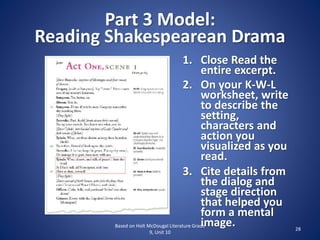
1. Close Read the
entire excerpt.
2. On your K-W-L
worksheet, write
to describe the
setting,
characters and
action you
visualized as you
read.
3. Cite details from
the dialog and
stage direction
that helped you
form a mental
image.
Part 3 Model:
Reading Shakespearean Drama
Based on Holt McDougal Literature Grade
9, Unit 10
29
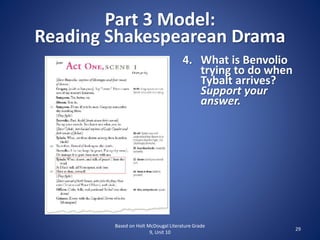
4. What is Benvolio
trying to do when
Tybalt arrives?
Support your
answer.
Part 3 Model:
Reading Shakespearean Drama
Based on Holt McDougal Literature Grade
9, Unit 10
30
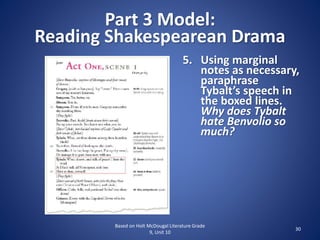
5. Using marginal
notes as necessary,
paraphrase
Tybalt’s speech in
the boxed lines.
Why does Tybalt
hate Benvolio so
much?
Part 3 Model:
Reading Shakespearean Drama
Based on Holt McDougal Literature Grade
9, Unit 10
31
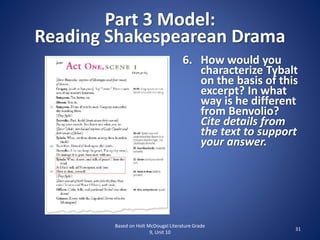
6. How would you
characterize Tybalt
on the basis of this
excerpt? In what
way is he different
from Benvolio?
Cite details from
the text to support
your answer.
Romeo & Juliet
Literary Workshop, Part 4
Part 4
Analyze the Literature
32
Based on Holt McDougal Literature Grade
9, Unit 10
Part 4: Analyze the Literature
• Apply the strategies you’ve learned so far to
analyze a longer excerpt from the beginning of
the tragedy (next slide):
• Setting: A costume party at the Capulets.
Disguised with masks, Romeo and other
Montagues have crashed the party.
• Action: Romeo sees Juliet from across the
room; he falls in love at first sight. This sets
the course of tragic events in motion.
Based on Holt McDougal Literature Grade
9, Unit 10
33
Part 4 Model:
Analyze the Literature
Based on Holt McDougal Literature Grade
9, Unit 10
34
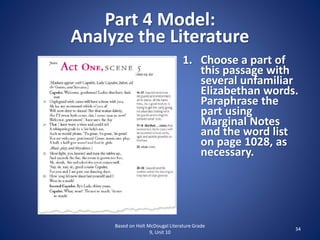
1. Choose a part of
this passage with
several unfamiliar
Elizabethan words.
Paraphrase the
part using
Marginal Notes
and the word list
on page 1028, as
necessary.
Part 4 Model:
Analyze the Literature
Based on Holt McDougal Literature Grade
9, Unit 10
35
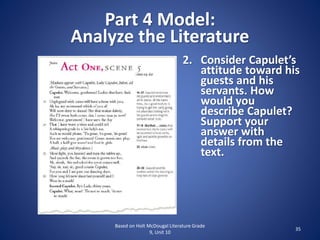
2. Consider Capulet’s
attitude toward his
guests and his
servants. How
would you
describe Capulet?
Support your
answer with
details from the
text.
Part 4 Model:
Analyze the Literature
Based on Holt McDougal Literature Grade
9, Unit 10
36
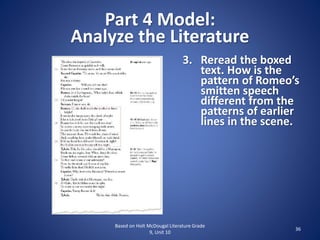
3. Reread the boxed
text. How is the
pattern of Romeo’s
smitten speech
different from the
patterns of earlier
lines in the scene.
Part 4 Model:
Analyze the Literature
Based on Holt McDougal Literature Grade
9, Unit 10
37
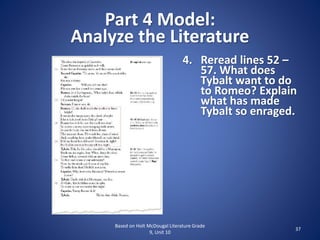
4. Reread lines 52 –
57. What does
Tybalt want to do
to Romeo? Explain
what has made
Tybalt so enraged.
Part 4 Model:
Analyze the Literature
Based on Holt McDougal Literature Grade
9, Unit 10
38
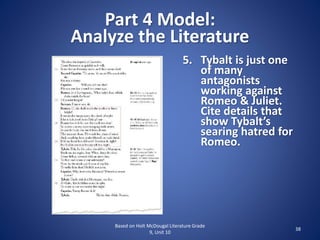
5. Tybalt is just one
of many
antagonists
working against
Romeo & Juliet.
Cite details that
show Tybalt’s
searing hatred for
Romeo.
Part 4 Model:
Analyze the Literature
Based on Holt McDougal Literature Grade
9, Unit 10
39
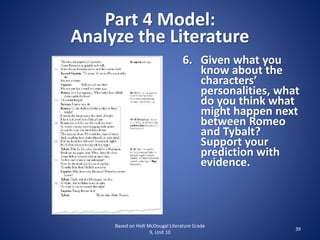
6. Given what you
know about the
characters’
personalities, what
do you think what
might happen next
between Romeo
and Tybalt?
Support your
prediction with
evidence.

R&j lit workshop1

  • 1.
    DRAMA TEKS • explainhow dramatic conventions (e.g., monologues, soliloquies, dramatic irony) enhance dramatic text.[4A] Based on Holt McDougal Literature Grade 9, Unit 10 1
  • 2.
    Romeo & Juliet LiteraryWorkshop, Part 1 Part 1 Characteristics of Shakespearean Tragedy 2 Based on Holt McDougal Literature Grade 9, Unit 10
  • 3.
    Part 1, Model1: Character • Inthefollowingexcerpt,Romeo—theyoung protagonistoftheplayandamemberofthe Montaguefamily—complainstohiscousin, Benvolio,aboutaproblemthatisplaguinghim. As youread,consider… 1. WhatisRomeoexperiencingthatyoucanrelateto? 2. WhatpossibleweaknessorflawdoesRomeo’s attitudehintat? 3. WhatdoyoulearnaboutRomeo’spersonality? 3 Based on Holt McDougal Literature Grade 9, Unit 10
  • 4.
    4 Based on HoltMcDougal Literature Grade 9, Unit 10
  • 5.
    Part 1, Model2: Soliloquy • Throughthissoliloquy, readersgainaccesstothe thoughtsandfeelingsofJuliet,aCapulet—and thereforeahatedenemyofanyMontague. Asyou read,consider… 1. Whatdoestheimageryinlines20–25revealabout Juliet’sfeelingsforRomeo? 2. Rereadtheboxedtext.WhatisJuliet’smoodasshe waitsforRomeo?Pointoutspecific wordsand details thatrevealherstateofmind. 5 Based on Holt McDougal Literature Grade 9, Unit 10
  • 6.
    Based on HoltMcDougal Literature Grade 9, Unit 10 6
  • 7.
    Romeo & Juliet LiteraryWorkshop, Part 2 Part 2 The Language of Shakespeare 7 Based on Holt McDougal Literature Grade 9, Unit 10
  • 8.
    Part 2: TheLanguage of Shakespeare • Shakespeare’s plays deal with experiences and emotions that are easy to relate to, but his language can be challenging for today’s readers to understand. • Once you get past the unfamiliar language, learn the rhythm and learn to “get” his allusions and puns, you’ll find his sense of romance, drama and humor fascinating. Based on Holt McDougal Literature Grade 9, Unit 10 8
  • 9.
    Part 2: TheLanguage of Shakespeare — Blank Verse • Shakespeare wrote mostly in a poetic form called blank verse. • Blank verse is a poetic form that does not rhyme. • It carries the rhythm of natural speech. • Blank verse is made up of unrhymed lines that follow a rhythm of iambic pentameter. Based on Holt McDougal Literature Grade 9, Unit 10 9
  • 10.
    Part 2: TheLanguage of Shakespeare — Iambic Pentameter • Read the following lines aloud. Make sure to emphasize each stressed (accented) syllable: Based on Holt McDougal Literature Grade 9, Unit 10 10 While this pattern is is thegeneralrule, not every line of the play is written this way. Shakespeareincluded many variationsto avoidsounding monotonous.
  • 11.
    Part 2: TheLanguage of Shakespeare — Iambic Pentameter Based on Holt McDougal Literature Grade 9, Unit 10 11
  • 12.
    Part 2: TheLanguage of Shakespeare — Allusion and Word Play • Allusionis a referenceto something that the audience is expected to know. • Shakespeare’s audience was familiar with Greek and Roman mythology as well as the Bible. He sprinkled references to these works throughout his plays. • In the following excerpt, identify the allusion. What mental image does it conjurefor you? • Why do you think Shakespeareincluded this reference? Based on Holt McDougal Literature Grade 9, Unit 10 12
  • 13.
    Part 2: TheLanguage of Shakespeare — Allusion and Word Play Based on Holt McDougal Literature Grade 9, Unit 10 13
  • 14.
    Part 2: TheLanguage of Shakespeare — Pun • A pun is a joke exploiting 1) the different possible meanings of a word or 2) the fact that there are words that sound alike but have different meanings. • In the following excerpt,one example of a pun has been boxed. Which of the two-part definition (above) does this pun fit? • There’s another example as well. Find it! Explain it! Based on Holt McDougal Literature Grade 9, Unit 10 14
  • 15.
    Part 2: TheLanguage of Shakespeare — Pun Based on Holt McDougal Literature Grade 9, Unit 10 15
  • 16.
    Romeo & Juliet LiteraryWorkshop, Part 3 Part 3 Strategies for Reading Shakespearean Drama 16 Based on Holt McDougal Literature Grade 9, Unit 10
  • 17.
    Part 3: ReadingShakespearean Drama • BEFORE you begin reading each Act of a Shakespearean play: • Study the opening Cast of Characters – Who are these people? Why should you care? • Read the Stage Directions – Where does the scene take place? – Who’s on stage? – What are they doing there? • Read the Synopsis at the beginning of the scene. Based on Holt McDougal Literature Grade 9, Unit 10 17
  • 18.
    Part 3: ReadingShakespearean Drama Based on Holt McDougal Literature Grade 9, Unit 10 18
  • 19.
    Part 3: ReadingShakespearean Tragedy: Relationships Based on Holt McDougal Literature Grade 9, Unit 10 19 • Keep track of relationships between characters: • Are they – Friends? – Relatives? – Enemies?
  • 20.
    Part 3: ReadingShakespearean Tragedy: Relationships Based on Holt McDougal Literature Grade 9, Unit 10 20 • What arethe characterroles — how are the related in terms of plot and action? • TragicHero? • Foil? • Antagonist? • Comic Relief? • Write the names of charactersin the “Examples” spaceon the appropriateFrayer Model sheetyou began filling out last week.
  • 21.
    Part 3: ReadingShakespearean Tragedy: Relationships Based on Holt McDougal Literature Grade 9, Unit 10 21 • What are the Charactertraits of the characters? • Character traits are revealed through dialog, soliloquies and asides as well as through actions. • Does the character exhibit any flaws or weaknesses? (Characterflaws and weaknesses are particularly important to note in tragedies like Romeo& Juliet.)
  • 22.
    Part 3: ReadingShakespearean Tragedy: Relationships Based on Holt McDougal Literature Grade 9, Unit 10 22 • Look for Cause-and-Effectrelationships between events — especially events that lead to tragic outcome. • Tracking Cause-and-Effectrelationships is extremely important for writing your essay this six weeks — “Who Is Most Responsible for the Deaths of Romeo & Juliet?” • Track them on a Graphic Organizer, like the one on the following slide…
  • 23.
    Part 3: ReadingShakespearean Tragedy: Relationships Based on Holt McDougal Literature Grade 9, Unit 10 23
  • 24.
    Part 3: ReadingShakespearean Language: Unfamiliar Words and Phrases Based on Holt McDougal Literature Grade 9, Unit 10 24 • In reading Romeo & Juliet, you will encounter a number of unfamiliar words and phrases. • Take care to write down and paraphrase unfamiliar terms into terms you understand. • You can track unfamiliar words and phrases on a Graphic Organizer like the one on the next page…
  • 25.
    Part 3: ReadingShakespearean Language: Unfamiliar Words and Phrases Based on Holt McDougal Literature Grade 9, Unit 10 25
  • 26.
    Part 3 Model: ReadingShakespearean Drama • Let’s read together the fight scene in Act 1, Scene 1… • Setting: Verona, where the play is set; an open marketplace • Action: Sampson and Gregory, servants of the Capulets, have gotten into a heated argument with Abram and Balthasar, servants of the Montagues. Based on Holt McDougal Literature Grade 9, Unit 10 26
  • 27.
    Part 3 Model: ReadingShakespearean Drama • Use the strategies we’ve discussed so far to analyze the following episode… Based on Holt McDougal Literature Grade 9, Unit 10 27
  • 28.
    Part 3 Model: ReadingShakespearean Drama Based on Holt McDougal Literature Grade 9, Unit 10 28 1. Close Read the entire excerpt. 2. On your K-W-L worksheet, write to describe the setting, characters and action you visualized as you read. 3. Cite details from the dialog and stage direction that helped you form a mental image.
  • 29.
    Part 3 Model: ReadingShakespearean Drama Based on Holt McDougal Literature Grade 9, Unit 10 29 4. What is Benvolio trying to do when Tybalt arrives? Support your answer.
  • 30.
    Part 3 Model: ReadingShakespearean Drama Based on Holt McDougal Literature Grade 9, Unit 10 30 5. Using marginal notes as necessary, paraphrase Tybalt’s speech in the boxed lines. Why does Tybalt hate Benvolio so much?
  • 31.
    Part 3 Model: ReadingShakespearean Drama Based on Holt McDougal Literature Grade 9, Unit 10 31 6. How would you characterize Tybalt on the basis of this excerpt? In what way is he different from Benvolio? Cite details from the text to support your answer.
  • 32.
    Romeo & Juliet LiteraryWorkshop, Part 4 Part 4 Analyze the Literature 32 Based on Holt McDougal Literature Grade 9, Unit 10
  • 33.
    Part 4: Analyzethe Literature • Apply the strategies you’ve learned so far to analyze a longer excerpt from the beginning of the tragedy (next slide): • Setting: A costume party at the Capulets. Disguised with masks, Romeo and other Montagues have crashed the party. • Action: Romeo sees Juliet from across the room; he falls in love at first sight. This sets the course of tragic events in motion. Based on Holt McDougal Literature Grade 9, Unit 10 33
  • 34.
    Part 4 Model: Analyzethe Literature Based on Holt McDougal Literature Grade 9, Unit 10 34 1. Choose a part of this passage with several unfamiliar Elizabethan words. Paraphrase the part using Marginal Notes and the word list on page 1028, as necessary.
  • 35.
    Part 4 Model: Analyzethe Literature Based on Holt McDougal Literature Grade 9, Unit 10 35 2. Consider Capulet’s attitude toward his guests and his servants. How would you describe Capulet? Support your answer with details from the text.
  • 36.
    Part 4 Model: Analyzethe Literature Based on Holt McDougal Literature Grade 9, Unit 10 36 3. Reread the boxed text. How is the pattern of Romeo’s smitten speech different from the patterns of earlier lines in the scene.
  • 37.
    Part 4 Model: Analyzethe Literature Based on Holt McDougal Literature Grade 9, Unit 10 37 4. Reread lines 52 – 57. What does Tybalt want to do to Romeo? Explain what has made Tybalt so enraged.
  • 38.
    Part 4 Model: Analyzethe Literature Based on Holt McDougal Literature Grade 9, Unit 10 38 5. Tybalt is just one of many antagonists working against Romeo & Juliet. Cite details that show Tybalt’s searing hatred for Romeo.
  • 39.
    Part 4 Model: Analyzethe Literature Based on Holt McDougal Literature Grade 9, Unit 10 39 6. Given what you know about the characters’ personalities, what do you think what might happen next between Romeo and Tybalt? Support your prediction with evidence.