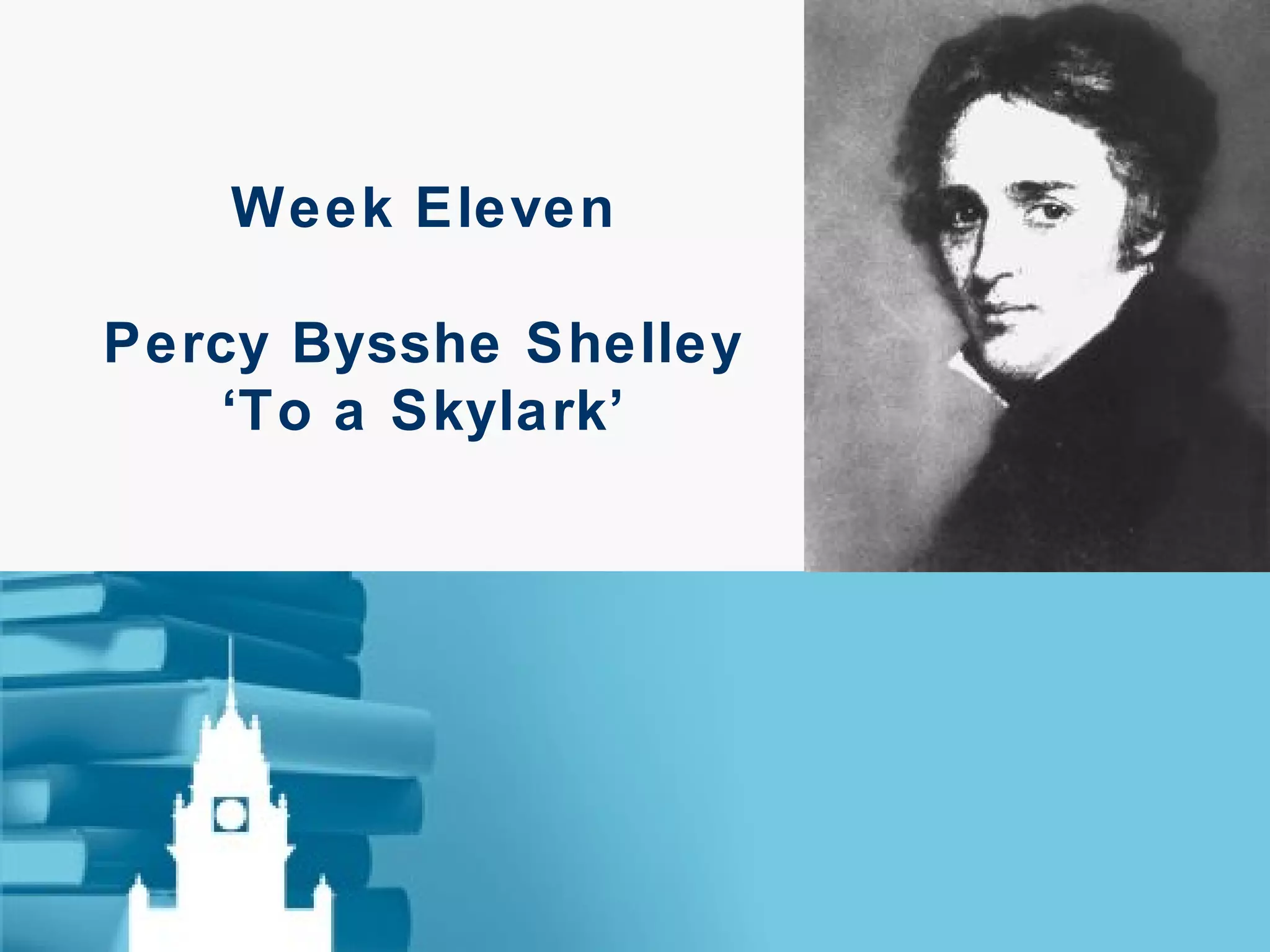
Week Eleven Percy Bysshe Shelley ‘To a Skylark’
What thou art we know not;  What is most like thee? ‘ To a Skylark’ uses several modes of comparison in order to achieve its overall effect. Try to find as many comparisons with the skylark as you can in five minutes.
How might these comparisons draw an overall picture of paradox or confusion in the poet’s reaction to the skylark? 1)  immerses the skylark in its natural, near-celestial surroundings, using the concept of comparison to forge connections; 2)  singles out the skylark as exceptional, but in a way that challenges the faculties of perception.
Abstract / Concrete Another competition… Find as many examples as you can in which concrete and abstract notions are conflated (i.e. fused together, with seeming illogic).
Synaesthesia And another… Find as many examples as you can in which the senses are conflated (i.e. fused together, with seeming illogic).
Shelley and Revolutionary Politics Why might Shelley, a bourgeois revolutionary, want to show that even our most lucid comparisons and our most profound sensory responses are inadequate to the task of representing truth and beauty? In the wake of such failure, why write at all?
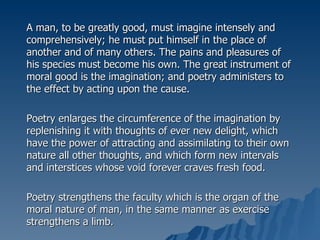
A man, to be greatly good, must imagine intensely and comprehensively; he must put himself in the place of another and of many others. The pains and pleasures of his species must become his own. The great instrument of moral good is the imagination; and poetry administers to the effect by acting upon the cause.  Poetry enlarges the circumference of the imagination by replenishing it with thoughts of ever new delight, which have the power of attracting and assimilating to their own nature all other thoughts, and which form new intervals and interstices whose void forever craves fresh food. Poetry strengthens the faculty which is the organ of the moral nature of man, in the same manner as exercise strengthens a limb.
Three Romantic Ideologies  Byron: rebellion, amorality, sensuousness  Keats: beauty for its own sake; Shelley: art as an agent for moral and social improvement.
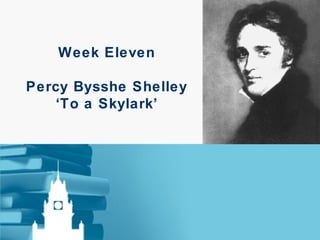
Percy bysshe shelley (1792 1822)

  • 1.
    Week Eleven PercyBysshe Shelley ‘To a Skylark’
  • 2.
    What thou artwe know not; What is most like thee? ‘ To a Skylark’ uses several modes of comparison in order to achieve its overall effect. Try to find as many comparisons with the skylark as you can in five minutes.
  • 3.
    How might thesecomparisons draw an overall picture of paradox or confusion in the poet’s reaction to the skylark? 1) immerses the skylark in its natural, near-celestial surroundings, using the concept of comparison to forge connections; 2) singles out the skylark as exceptional, but in a way that challenges the faculties of perception.
  • 4.
    Abstract / ConcreteAnother competition… Find as many examples as you can in which concrete and abstract notions are conflated (i.e. fused together, with seeming illogic).
  • 5.
    Synaesthesia And another…Find as many examples as you can in which the senses are conflated (i.e. fused together, with seeming illogic).
  • 6.
    Shelley and RevolutionaryPolitics Why might Shelley, a bourgeois revolutionary, want to show that even our most lucid comparisons and our most profound sensory responses are inadequate to the task of representing truth and beauty? In the wake of such failure, why write at all?
  • 7.
    A man, tobe greatly good, must imagine intensely and comprehensively; he must put himself in the place of another and of many others. The pains and pleasures of his species must become his own. The great instrument of moral good is the imagination; and poetry administers to the effect by acting upon the cause. Poetry enlarges the circumference of the imagination by replenishing it with thoughts of ever new delight, which have the power of attracting and assimilating to their own nature all other thoughts, and which form new intervals and interstices whose void forever craves fresh food. Poetry strengthens the faculty which is the organ of the moral nature of man, in the same manner as exercise strengthens a limb.
  • 8.
    Three Romantic Ideologies Byron: rebellion, amorality, sensuousness Keats: beauty for its own sake; Shelley: art as an agent for moral and social improvement.