Poetry Across Time: Character and voice
My Last Duchess
FERRARA
That’s my last Duchess painted on the wall,
Looking as if she were alive. I call
That piece a wonder, now: Fra Pandolf’s hands
Worked busily a day, and there she stands.
Will’t please you sit and look at her? I said
“Fra Pandolf” by design, for never read
Strangers like you that pictured countenance,
The depth and passion of its earnest glance,
But to myself they turned (since none puts by
the curtain I have drawn for you, but I)
And seemed they would ask me, if they durst,
How such a glace came there; so not the first
Are you to turn and ask thus. Sir, ‘twas not
Her husband’s presence only, called that spot
Of joy into the Duchess’s cheek: perhaps
Fra Pandolf chanced to say “Her mantle laps
Must never hope to reproduce the faint
Half flush that dies along her throat”: such stuff
Was courtesy, she thought, and cause enough
For calling up that spot of you. She had
A heart-how shall I say? –too soon made glad,
Too easily impressed; she liked whate’er
She looked on, and her looks went everywhere.
Sir, ‘twas all one! My favor at her breast,
The dropping of the daylight in the West,
The bough of cherries some officious fool
Broke in the orchard for her, the white mule
Key
Language: connotation, imagery, metaphor, simile
Structure and form: stanzas, type, patterns, contrast, juxtaposition
Poetic methods: alliteration, caesura, assonance, rhythm, rhyme
Character and voice: who is speaking and to whom? Tone of voice
Links: comparisons to other speakers, methods and themes
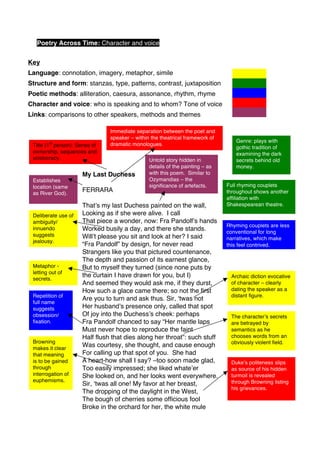
Title (1
st
person): Sense of
ownership, sequences and
aristocracy.
Establishes
location (same
as River God).
Immediate separation between the poet and
speaker – within the theatrical framework of
dramatic monologues.
Genre: plays with
gothic tradition of
examining the dark
secrets behind old
money.
Untold story hidden in
details of the painting – as
with this poem. Similar to
Ozymandias – the
significance of artefacts.
Deliberate use of
ambiguity/
innuendo
suggests
jealousy.
Full rhyming couplets
throughout shows another
affiliation with
Shakespearean theatre.
Metaphor -
letting out of
secrets. Archaic diction evocative
of character – clearly
dating the speaker as a
distant figure.Repetition of
full name
suggests
obsession/
fixation.
The character’s secrets
are betrayed by
semantics as he
chooses words from an
obviously violent field.Browning
makes it clear
that meaning
is to be gained
through
interrogation of
euphemisms.
Duke’s politeness slips
as source of his hidden
turmoil is revealed
through Browning listing
his grievances.
Rhyming couplets are less
conventional for long
narratives, which make
this feel contrived.
She rode with round the terrace—all and each
Would draw from her alike the approving speech,
Or blush, at least. She thanks men—good! But thanked
Somehow—I know not how—as if she ranked
My gift of a nine-hundred-years-old name
With anybody’s gift. Who’d stoop to blame
This sort of trifling? Even had you skill
In speech—(which I have not)—to make your will
Quite clear to such a one, and say, “Just this
Or that in you disgusts me; here you miss
Or there exceed the mark”—and if she let
Herself be lessoned so, not plainly set
her wits to yours, forsooth, and made excuse
--E’en then would be some stooping; and I choose
Never to stoop. Oh sir, she smiled, no doubt
Whene’er I passed her; but passed without
Much the same smile? This grew; I gave her commands;
Then all smiles stopped together. There she stands
As if alive. Will’t please you rise? We’ll meet
the company below, then. I repeat
The count your mater’s known munificence
Is ample warrant that no just pretence
Of mine dowry will be disallowed
Though his fair daughter’s self, as I avowed
At starting, is my object. Nay, we’ll go
Together down, sir. Notice Neptune, though,
Taming a sea horse, thought a rarity,
Which Claus of Innsbruck cast in bronze for me!
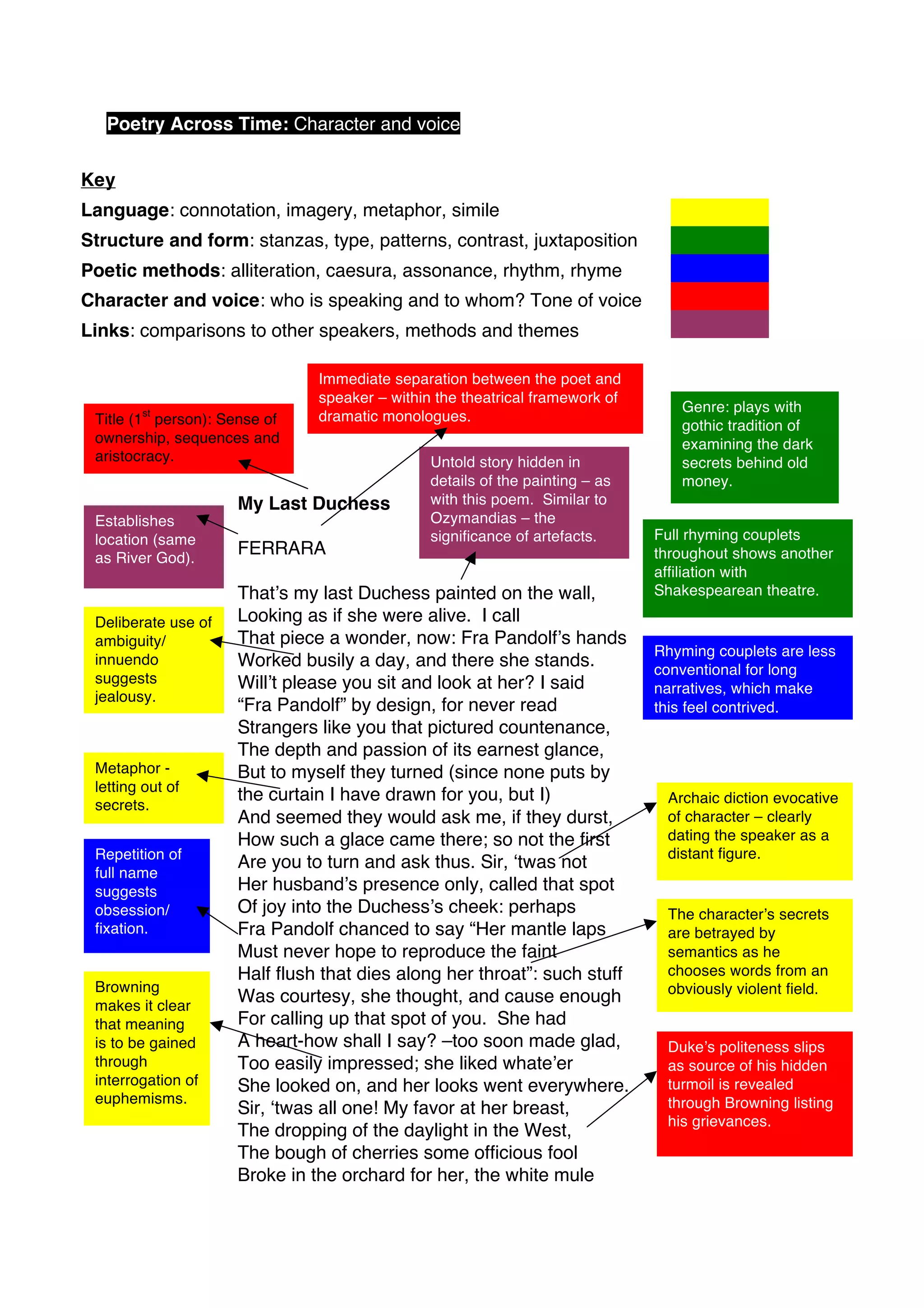
Duke’s self-interjections become a sign of
his instability or inability to conceal his guilt.
C&V themes – what do each of
the characters in these poems
value most? Speaker is born
into a wealthy
lineage,
cementing the
gothic nature
and creating a
sense of
superiority.
Emphasis on
the importance
of keeping up
appearances –
a character
who values
this over
human life. Enjambment, as with
‘river God’ shows an
inability to fully collate
and separate his
stories from his
emotions.
Rhetorical
question
suggests Duke
has no real
awareness of
who he is
speaking to or
his vast
impropriety.
Ambiguity –
Duke thinks he
has been
cleverer than he
has –
Browning’s
comment on
arrogance and
wealth?
Browning hints
at a sense of
guilt behind
the tyranny?
Voice: clear distinction between
public and private conversations.
Browning’s evocation of
an extreme patriarchy
(comment on Italian
society?)
Chooses art
appealing to
his
vanity/desire
to be god-like.
Preoccupation with artists and prestige.
Structure: we only find out who the listener is at the end to give a
sense of the Duke’s contrived behaviour and also for a bleak, comic
effect in realising who is being told all this info.
Interpretations of the poem:
 A commentary on the arrogance of wealthy and powerful men
who see the world as a series of things to be possessed.
 A study in how our own subconscious betrays the secrets we
keep when we allow ourselves the vanity to talk at length.

My Last Duchess

  • 1.
    Poetry Across Time:Character and voice My Last Duchess FERRARA That’s my last Duchess painted on the wall, Looking as if she were alive. I call That piece a wonder, now: Fra Pandolf’s hands Worked busily a day, and there she stands. Will’t please you sit and look at her? I said “Fra Pandolf” by design, for never read Strangers like you that pictured countenance, The depth and passion of its earnest glance, But to myself they turned (since none puts by the curtain I have drawn for you, but I) And seemed they would ask me, if they durst, How such a glace came there; so not the first Are you to turn and ask thus. Sir, ‘twas not Her husband’s presence only, called that spot Of joy into the Duchess’s cheek: perhaps Fra Pandolf chanced to say “Her mantle laps Must never hope to reproduce the faint Half flush that dies along her throat”: such stuff Was courtesy, she thought, and cause enough For calling up that spot of you. She had A heart-how shall I say? –too soon made glad, Too easily impressed; she liked whate’er She looked on, and her looks went everywhere. Sir, ‘twas all one! My favor at her breast, The dropping of the daylight in the West, The bough of cherries some officious fool Broke in the orchard for her, the white mule Key Language: connotation, imagery, metaphor, simile Structure and form: stanzas, type, patterns, contrast, juxtaposition Poetic methods: alliteration, caesura, assonance, rhythm, rhyme Character and voice: who is speaking and to whom? Tone of voice Links: comparisons to other speakers, methods and themes Title (1 st person): Sense of ownership, sequences and aristocracy. Establishes location (same as River God). Immediate separation between the poet and speaker – within the theatrical framework of dramatic monologues. Genre: plays with gothic tradition of examining the dark secrets behind old money. Untold story hidden in details of the painting – as with this poem. Similar to Ozymandias – the significance of artefacts. Deliberate use of ambiguity/ innuendo suggests jealousy. Full rhyming couplets throughout shows another affiliation with Shakespearean theatre. Metaphor - letting out of secrets. Archaic diction evocative of character – clearly dating the speaker as a distant figure.Repetition of full name suggests obsession/ fixation. The character’s secrets are betrayed by semantics as he chooses words from an obviously violent field.Browning makes it clear that meaning is to be gained through interrogation of euphemisms. Duke’s politeness slips as source of his hidden turmoil is revealed through Browning listing his grievances. Rhyming couplets are less conventional for long narratives, which make this feel contrived.
  • 2.
    She rode withround the terrace—all and each Would draw from her alike the approving speech, Or blush, at least. She thanks men—good! But thanked Somehow—I know not how—as if she ranked My gift of a nine-hundred-years-old name With anybody’s gift. Who’d stoop to blame This sort of trifling? Even had you skill In speech—(which I have not)—to make your will Quite clear to such a one, and say, “Just this Or that in you disgusts me; here you miss Or there exceed the mark”—and if she let Herself be lessoned so, not plainly set her wits to yours, forsooth, and made excuse --E’en then would be some stooping; and I choose Never to stoop. Oh sir, she smiled, no doubt Whene’er I passed her; but passed without Much the same smile? This grew; I gave her commands; Then all smiles stopped together. There she stands As if alive. Will’t please you rise? We’ll meet the company below, then. I repeat The count your mater’s known munificence Is ample warrant that no just pretence Of mine dowry will be disallowed Though his fair daughter’s self, as I avowed At starting, is my object. Nay, we’ll go Together down, sir. Notice Neptune, though, Taming a sea horse, thought a rarity, Which Claus of Innsbruck cast in bronze for me! Duke’s self-interjections become a sign of his instability or inability to conceal his guilt. C&V themes – what do each of the characters in these poems value most? Speaker is born into a wealthy lineage, cementing the gothic nature and creating a sense of superiority. Emphasis on the importance of keeping up appearances – a character who values this over human life. Enjambment, as with ‘river God’ shows an inability to fully collate and separate his stories from his emotions. Rhetorical question suggests Duke has no real awareness of who he is speaking to or his vast impropriety. Ambiguity – Duke thinks he has been cleverer than he has – Browning’s comment on arrogance and wealth? Browning hints at a sense of guilt behind the tyranny? Voice: clear distinction between public and private conversations. Browning’s evocation of an extreme patriarchy (comment on Italian society?) Chooses art appealing to his vanity/desire to be god-like. Preoccupation with artists and prestige. Structure: we only find out who the listener is at the end to give a sense of the Duke’s contrived behaviour and also for a bleak, comic effect in realising who is being told all this info. Interpretations of the poem:  A commentary on the arrogance of wealthy and powerful men who see the world as a series of things to be possessed.  A study in how our own subconscious betrays the secrets we keep when we allow ourselves the vanity to talk at length.