Thou odiferous boil-
brained bum-bailey!
[You] speak an infinite
deal of nothing.
Merchant of Venice
PoetryProse
 Poetry (Verse)
* a piece of writing that usually has figurative
language and that is written in separate lines
that often have a repeated rhythm and
sometimes rhyme
 Prose
*the ordinary language that people use when they
speak or write
*(anything that isn’t poetry!)
http://www.learnersdictionary.com/definition/poem
Raw celery is crunchy
and makes your jaw
work. Cooked celery is
easier to eat.
Celery raw
Develops the jaw.
But celery, stewed,
Is more quietly chewed.
Ogden Nash
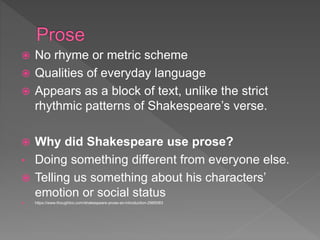
 No rhyme or metric scheme
 Qualities of everyday language
 Appears as a block of text, unlike the strict
rhythmic patterns of Shakespeare’s verse.
 Why did Shakespeare use prose?
• Doing something different from everyone else.
 Telling us something about his characters’
emotion or social status
 https://www.thoughtco.com/shakespeare-prose-an-introduction-2985083
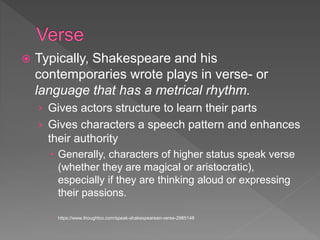
 Typically, Shakespeare and his
contemporaries wrote plays in verse- or
language that has a metrical rhythm.
› Gives actors structure to learn their parts
› Gives characters a speech pattern and enhances
their authority
 Generally, characters of higher status speak verse
(whether they are magical or aristocratic),
especially if they are thinking aloud or expressing
their passions.
 https://www.thoughtco.com/speak-shakespearean-verse-2985148
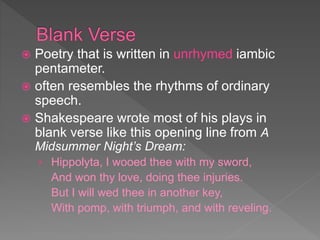
 Poetry that is written in unrhymed iambic
pentameter.
 often resembles the rhythms of ordinary
speech.
 Shakespeare wrote most of his plays in
blank verse like this opening line from A
Midsummer Night’s Dream:
› Hippolyta, I wooed thee with my sword,
And won thy love, doing thee injuries.
But I will wed thee in another key,
With pomp, with triumph, and with reveling.
 used mainly
› for passionate, lofty or momentous occasions
› for introspection
Many of Shakespeare's most famous speeches are
written in blank verse
› a speech or scene in blank verse may end with a
single rhyming couplet known as a capping
couplet.
› It is used to lend a final punch, a concluding
flourish or a note of climax to the end of a speech
or scene.
› http://cola.calpoly.edu/~dschwart/engl339/verseprose.html
 Act One Scene One
› I will , my Hermia. Helena , adieu.
As you on him, Demetrius dote on you!
 Act One Scene Two
At the Duke’s Oak we meet.
Enough. Hold, or cut bowstrings
 Act Two Scene One
› And look thou meet me ere the first cock crow.
Fear not, my lord. Your servant shall do so.
 Act Two Scene Two
› No? Then I well perceive you are not nigh.
Either death or you I’ll find immediately.
 Iambic Pentameter
(unstressed followed by stressed = iamb; five of these units = pent)
The COURSE of TRUE love NEver DID run SMOOTH
This has rhythm but that is not the same thing as rhyme… it is blank
verse.
 That task will ask some tears in the true
performing of it. If I do it, let the audience look to
their eyes.
 Take comfort: he no more shall see my face.
Lysander and myself will fly this place.
 for ritualistic or choral effects and for highly lyrical or judgmental passages
that give advice or point to a moral
 for songs
 in examples of bad verse (the Pyramus and Thisbe play)- to make fun of it
 in Prologues, Epilogues and in plays-within-plays (Pyramus and Thisbe)
where it distinguishes these imaginary performances from the "real world"
of the play.
 To show the supernatural-- the fairies especially-- but not for ghosts who retain the
human use of blank verse.
 EXAMPLE: And Phibbus’ car/Shall shine from far/ and make and mar/ the foolish
Fates
 http://cola.calpoly.edu/~dschwart/engl339/verseprose.html
 in Shakespeare's plays rhymed verse is
usually in rhymed couplets
 When the two lines of a rhyming couplet are
in iambic pentameter, they are called heroic
couplets:
Helena (Act one scene one)
Demetrius loves your fair. O happy fair!
Your eyes are lodestars and your tongue’s sweet air
More tunable than lark to shepherd’s ear
When wheat is green, when hawthorn buds appear!
Love looks not with the eyes, but with the mind;
And therefore is winged Cupid painted blind.
Nor hath Love's mind of any judgment taste;
Wings, and no eyes, figure unheedy haste:
And therefore is Love said to be a child,
Because in choice he is so oft beguiled.
Helena- Act One Scene One
 Four days will quickly steep themselves in night;
Four nights will quickly dream away the time;
 Full of vexation come I, with complaint
Against my child, my daughter Hermia
 Over hill, over dale,
Thorough bush, thorough brier,
Over park, over pale,
Thorough flood, thorough fire;
 Shakespeare’s characters often speak to themselves
during his plays. This is not because they are crazy
(though, some of them actually might be), but it is to let
the audience know what s/he is thinking at this point in
the story.
 Definition = a dramatic or literary form of
discourse in which a character talks to
himself or herself or reveals his or her
thoughts without addressing a listener
 http://www.thefreedictionary.com/soliloquy
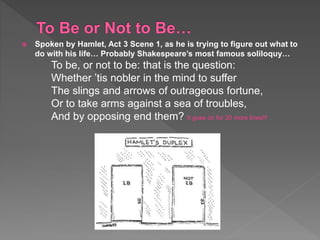
 Spoken by Hamlet, Act 3 Scene 1, as he is trying to figure out what to
do with his life… Probably Shakespeare’s most famous soliloquy…
To be, or not to be: that is the question:
Whether ’tis nobler in the mind to suffer
The slings and arrows of outrageous fortune,
Or to take arms against a sea of troubles,
And by opposing end them? It goes on for 30 more lines!!!
 Definition: the usually unintentionally humorous
misuse or distortion of a word or phrase;
especially : the use of a word sounding
somewhat like the one intended but ridiculously
wrong in the context
Examples:
There we may rehearse most obscenely
(there we may rehearse most discreetly)
http://www.dictionary.com/browse/malapropistic

Shakespeare language

  • 1.
    Thou odiferous boil- brainedbum-bailey! [You] speak an infinite deal of nothing. Merchant of Venice
  • 2.
    PoetryProse  Poetry (Verse) *a piece of writing that usually has figurative language and that is written in separate lines that often have a repeated rhythm and sometimes rhyme  Prose *the ordinary language that people use when they speak or write *(anything that isn’t poetry!) http://www.learnersdictionary.com/definition/poem
  • 3.
    Raw celery iscrunchy and makes your jaw work. Cooked celery is easier to eat. Celery raw Develops the jaw. But celery, stewed, Is more quietly chewed. Ogden Nash
  • 4.
     No rhymeor metric scheme  Qualities of everyday language  Appears as a block of text, unlike the strict rhythmic patterns of Shakespeare’s verse.  Why did Shakespeare use prose? • Doing something different from everyone else.  Telling us something about his characters’ emotion or social status  https://www.thoughtco.com/shakespeare-prose-an-introduction-2985083
  • 5.
     Typically, Shakespeareand his contemporaries wrote plays in verse- or language that has a metrical rhythm. › Gives actors structure to learn their parts › Gives characters a speech pattern and enhances their authority  Generally, characters of higher status speak verse (whether they are magical or aristocratic), especially if they are thinking aloud or expressing their passions.  https://www.thoughtco.com/speak-shakespearean-verse-2985148
  • 6.
     Poetry thatis written in unrhymed iambic pentameter.  often resembles the rhythms of ordinary speech.  Shakespeare wrote most of his plays in blank verse like this opening line from A Midsummer Night’s Dream: › Hippolyta, I wooed thee with my sword, And won thy love, doing thee injuries. But I will wed thee in another key, With pomp, with triumph, and with reveling.
  • 7.
     used mainly ›for passionate, lofty or momentous occasions › for introspection Many of Shakespeare's most famous speeches are written in blank verse › a speech or scene in blank verse may end with a single rhyming couplet known as a capping couplet. › It is used to lend a final punch, a concluding flourish or a note of climax to the end of a speech or scene. › http://cola.calpoly.edu/~dschwart/engl339/verseprose.html
  • 8.
     Act OneScene One › I will , my Hermia. Helena , adieu. As you on him, Demetrius dote on you!  Act One Scene Two At the Duke’s Oak we meet. Enough. Hold, or cut bowstrings  Act Two Scene One › And look thou meet me ere the first cock crow. Fear not, my lord. Your servant shall do so.  Act Two Scene Two › No? Then I well perceive you are not nigh. Either death or you I’ll find immediately.
  • 9.
     Iambic Pentameter (unstressedfollowed by stressed = iamb; five of these units = pent) The COURSE of TRUE love NEver DID run SMOOTH This has rhythm but that is not the same thing as rhyme… it is blank verse.
  • 10.
     That taskwill ask some tears in the true performing of it. If I do it, let the audience look to their eyes.  Take comfort: he no more shall see my face. Lysander and myself will fly this place.
  • 11.
     for ritualisticor choral effects and for highly lyrical or judgmental passages that give advice or point to a moral  for songs  in examples of bad verse (the Pyramus and Thisbe play)- to make fun of it  in Prologues, Epilogues and in plays-within-plays (Pyramus and Thisbe) where it distinguishes these imaginary performances from the "real world" of the play.  To show the supernatural-- the fairies especially-- but not for ghosts who retain the human use of blank verse.  EXAMPLE: And Phibbus’ car/Shall shine from far/ and make and mar/ the foolish Fates  http://cola.calpoly.edu/~dschwart/engl339/verseprose.html
  • 12.
     in Shakespeare'splays rhymed verse is usually in rhymed couplets  When the two lines of a rhyming couplet are in iambic pentameter, they are called heroic couplets: Helena (Act one scene one) Demetrius loves your fair. O happy fair! Your eyes are lodestars and your tongue’s sweet air More tunable than lark to shepherd’s ear When wheat is green, when hawthorn buds appear!
  • 13.
    Love looks notwith the eyes, but with the mind; And therefore is winged Cupid painted blind. Nor hath Love's mind of any judgment taste; Wings, and no eyes, figure unheedy haste: And therefore is Love said to be a child, Because in choice he is so oft beguiled. Helena- Act One Scene One
  • 14.
     Four dayswill quickly steep themselves in night; Four nights will quickly dream away the time;  Full of vexation come I, with complaint Against my child, my daughter Hermia  Over hill, over dale, Thorough bush, thorough brier, Over park, over pale, Thorough flood, thorough fire;
  • 15.
     Shakespeare’s charactersoften speak to themselves during his plays. This is not because they are crazy (though, some of them actually might be), but it is to let the audience know what s/he is thinking at this point in the story.  Definition = a dramatic or literary form of discourse in which a character talks to himself or herself or reveals his or her thoughts without addressing a listener  http://www.thefreedictionary.com/soliloquy
  • 16.
     Spoken byHamlet, Act 3 Scene 1, as he is trying to figure out what to do with his life… Probably Shakespeare’s most famous soliloquy… To be, or not to be: that is the question: Whether ’tis nobler in the mind to suffer The slings and arrows of outrageous fortune, Or to take arms against a sea of troubles, And by opposing end them? It goes on for 30 more lines!!!
  • 17.
     Definition: theusually unintentionally humorous misuse or distortion of a word or phrase; especially : the use of a word sounding somewhat like the one intended but ridiculously wrong in the context Examples: There we may rehearse most obscenely (there we may rehearse most discreetly) http://www.dictionary.com/browse/malapropistic