(AKA the poetic power-duo)
ELIZABETH & ROBERT BROWNING
“I do, as I say, love these books
with all my heart—and I love you
too.”
(Norton Anthology, pg 585)
A ROMANCE FOR THE STORYBOOKS
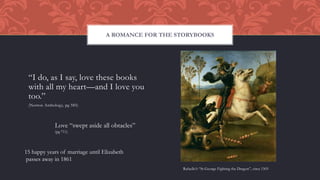
Rafaello’s “St George Fighting the Dragon”, circa 1505
Love “swept aside all obtacles”
(pg 711)
15 happy years of marriage until Elizabeth
passes away in 1861
-born in 1812
-married Elizabeth in 1846
-throughout their marriage was known as merely “Mrs. Browning’s husband”
-inspired by the likes of Shakespeare and Percy Shelley
-dramatic monologue
-looking at only one character’s point of view
-must parse through the speaker’s words to derive meaning
-many characters were twisted or unstable
-addresses moral issues indirectly
ROBERT BROWNING
The rain set early in tonight,
The sullen wind was soon
awake,
It tore the elm-tops down for
spite,
and did its worst to vex the
lake:
I listened with heart fit to
break.
When glided in Porphyria;
straight
She shut the cold out and the
storm,
And kneeled and made the
cheerless grate
Blaze up, and all the cottage
warm;
Which done, she rose, and from
her form
Withdrew the dripping cloak
and shawl,
And laid her soiled gloves by,
untied
Her hat and let the damp hair
fall,
And, last, she sat down by my
side
And called me. When no voice
replied,
She put my arm about her
waist,
And made her smooth white
shoulder bare,
And all her yellow hair
displaced,
And, stooping, made my cheek
lie there,
And spread, o’er all, her yellow
hair,
Murmuring how she loved
me—she
Too weak, for all her heart’s
endeavor,
To set its struggling passion
free
From pride, and vainer ties
dissever,
And give herself to me forever.
But passion sometimes would
prevail,
Nor could tonight’s gay feast
restrain
A sudden thought of one so
pale
For love of her, and all in vain:
So, she was come through wind
and rain.
Be sure I looked up at her eyes
Happy and proud; at last I
knew
Porphyria worshiped me:
surprise
Made my heart swell, and still it
grew
While I debated what to do.
That moment she was mine,
mine, fair,
Perfectly pure and good: I
found
A thing to do, and all her hair
In one long yellow string I
wound
Three times her little throat
around,
And strangled her. No pain felt
she;
I am quite sure she felt no pain.
As a shut bud that holds a bee,
I warily oped her lids: again
Laughed the blue eyes without
a stain.
And I untightened next the
tress
About her neck; her cheek once
more
Blushed bright beneath my
burning kiss:
I propped her head up as
before
Only, this time my shoulder
bore
Her head, which droops upon it
still:
The smiling rosy little head,
So glad it has its utmost will,
That all it scorned at once is
fled,
And I, its love, am gained
instead!
Porphyria’s love: she guessed
not how
Her darling one wish would be
heard.
And thus we sit together now,
And all night long we have not
stirred,
And yet God has not said a
word!
PORPHYRIA'S LOVER
“Gr-r-r—there go, my heart’s abhorrence!
Water your damned flower-pots, do!
If hate killed men, Brother Lawrence,
God’s blood, would not mine kill you!
What? your myrtle-bush wants trimming?
Needs its leaden vase filled brimming?
Hell dry you up with its flames!” [1-8]
“When he finishes refection,
Knife and fork he never lays
Cross-wise, to my recollection,
As do I, in Jesu’s praise.
I the Trinity illustrate” [33-37]
“What’s the Latin name for ‘parsley’?
What’s the Greek name for ‘swine’s snout’?”
[15-16]
“Or, there’s Satan!--one might venture
Pledge one’s soul to him…” [65-68]
EXCERPTS FROM SOLILOQUY OF THE
SPANISH CLOISTER
What do “My Last Duchess,” “Porphyria’s Lover,” and
“Soliloquy of the Spanish Cloister” have in common? Consider not only the
speakers but also the tone, setting, theme, etc.
How are these poems different?
-1806 – 1861
-an “unusal” education (Latin, Greek, history, philosophy, literature)
-ill health improved after marrying Robert Browning and moving to Italy
-very engaged with current events/issues
-strong sense of morality and emotional appeal in her works
“The Cry of the Children” – coal mines and the corrupt industry
“The Runaway Slave at Pilgrim’s Point” – slavery
Aurora Leigh focuses on a woman concerned with social issues and longing for freedom
ELIZABETH BARRETT BROWNING
“Now tell the poor young children; O my brothers,
To look up to Him and pray;
So the blessed One who blesseth all the others,
Will bless them another day.
They answer, ‘Who is God that He should hear us,
While the rushing of the iron wheels is stirred?
When we sob aloud, the human creatures near us
Pas by, hearing not, or answer not a word.
And we hear not (for the wheels in their resounding)
Strangers speaking at the door:
Is it likely God, with angels singing round Him,
Hears our weeping any more?”
THE CRY OF THE CHILDREN
-How many distinct people / characters are
involved in this stanza?
-How many points of view are heard?
-How does this compare with Robert’s works?
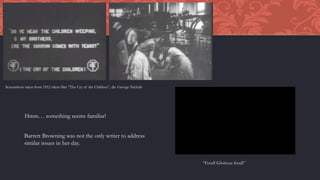
Screenshots taken from 1912 silent film “The Cry of the Children”, dir. Geroge Nichols
“Food! Glorious food!”
Hmm… something seems familiar!
Barrett Browning was not the only writer to address
similar issues in her day.
Of the poems we have reviewed, both Robert and Elizabeth Browning utilized the power of voice and
point-of-view to aid interpretation.
How might all these works be different if we heard from different characters?
In your groups, consider a voice you have not heard from any one of these poems.
(the duke’s dead wife? Brother Lawrence? An owner of a coal mine? Someone else? Use your
imagination!)
Compose a brief poem (4 or 6 lines) from the perspective of this new voice. Present what you have
written.
BONUS POINTS if you make it into a musical number!
THE POWER OF VOICES
Both authors took different ways to present moral issues. Robert is darker and hints at
wrong, but does not explicitly state it is wrong. Elizabeth makes clear the distinctions
between good and bad.
Which style do you find to be more effective in getting you to think about morality?
Why? Pick a particular poem to use in your answer. Then find a modern-day example of
a person (author, movie director, etc) or a work (tv show, book, etc) which also
addresses morality in a similar way. Respond to at least two other students in the
discussion board.
DISCUSSION BOARD: WHO DID IT BETTER?

Robert and elizabeth browning

  • 1.
    (AKA the poeticpower-duo) ELIZABETH & ROBERT BROWNING
  • 2.
    “I do, asI say, love these books with all my heart—and I love you too.” (Norton Anthology, pg 585) A ROMANCE FOR THE STORYBOOKS Rafaello’s “St George Fighting the Dragon”, circa 1505 Love “swept aside all obtacles” (pg 711) 15 happy years of marriage until Elizabeth passes away in 1861
  • 3.
    -born in 1812 -marriedElizabeth in 1846 -throughout their marriage was known as merely “Mrs. Browning’s husband” -inspired by the likes of Shakespeare and Percy Shelley -dramatic monologue -looking at only one character’s point of view -must parse through the speaker’s words to derive meaning -many characters were twisted or unstable -addresses moral issues indirectly ROBERT BROWNING
  • 4.
    The rain setearly in tonight, The sullen wind was soon awake, It tore the elm-tops down for spite, and did its worst to vex the lake: I listened with heart fit to break. When glided in Porphyria; straight She shut the cold out and the storm, And kneeled and made the cheerless grate Blaze up, and all the cottage warm; Which done, she rose, and from her form Withdrew the dripping cloak and shawl, And laid her soiled gloves by, untied Her hat and let the damp hair fall, And, last, she sat down by my side And called me. When no voice replied, She put my arm about her waist, And made her smooth white shoulder bare, And all her yellow hair displaced, And, stooping, made my cheek lie there, And spread, o’er all, her yellow hair, Murmuring how she loved me—she Too weak, for all her heart’s endeavor, To set its struggling passion free From pride, and vainer ties dissever, And give herself to me forever. But passion sometimes would prevail, Nor could tonight’s gay feast restrain A sudden thought of one so pale For love of her, and all in vain: So, she was come through wind and rain. Be sure I looked up at her eyes Happy and proud; at last I knew Porphyria worshiped me: surprise Made my heart swell, and still it grew While I debated what to do. That moment she was mine, mine, fair, Perfectly pure and good: I found A thing to do, and all her hair In one long yellow string I wound Three times her little throat around, And strangled her. No pain felt she; I am quite sure she felt no pain. As a shut bud that holds a bee, I warily oped her lids: again Laughed the blue eyes without a stain. And I untightened next the tress About her neck; her cheek once more Blushed bright beneath my burning kiss: I propped her head up as before Only, this time my shoulder bore Her head, which droops upon it still: The smiling rosy little head, So glad it has its utmost will, That all it scorned at once is fled, And I, its love, am gained instead! Porphyria’s love: she guessed not how Her darling one wish would be heard. And thus we sit together now, And all night long we have not stirred, And yet God has not said a word! PORPHYRIA'S LOVER
  • 5.
    “Gr-r-r—there go, myheart’s abhorrence! Water your damned flower-pots, do! If hate killed men, Brother Lawrence, God’s blood, would not mine kill you! What? your myrtle-bush wants trimming? Needs its leaden vase filled brimming? Hell dry you up with its flames!” [1-8] “When he finishes refection, Knife and fork he never lays Cross-wise, to my recollection, As do I, in Jesu’s praise. I the Trinity illustrate” [33-37] “What’s the Latin name for ‘parsley’? What’s the Greek name for ‘swine’s snout’?” [15-16] “Or, there’s Satan!--one might venture Pledge one’s soul to him…” [65-68] EXCERPTS FROM SOLILOQUY OF THE SPANISH CLOISTER
  • 6.
    What do “MyLast Duchess,” “Porphyria’s Lover,” and “Soliloquy of the Spanish Cloister” have in common? Consider not only the speakers but also the tone, setting, theme, etc. How are these poems different?
  • 7.
    -1806 – 1861 -an“unusal” education (Latin, Greek, history, philosophy, literature) -ill health improved after marrying Robert Browning and moving to Italy -very engaged with current events/issues -strong sense of morality and emotional appeal in her works “The Cry of the Children” – coal mines and the corrupt industry “The Runaway Slave at Pilgrim’s Point” – slavery Aurora Leigh focuses on a woman concerned with social issues and longing for freedom ELIZABETH BARRETT BROWNING
  • 8.
    “Now tell thepoor young children; O my brothers, To look up to Him and pray; So the blessed One who blesseth all the others, Will bless them another day. They answer, ‘Who is God that He should hear us, While the rushing of the iron wheels is stirred? When we sob aloud, the human creatures near us Pas by, hearing not, or answer not a word. And we hear not (for the wheels in their resounding) Strangers speaking at the door: Is it likely God, with angels singing round Him, Hears our weeping any more?” THE CRY OF THE CHILDREN -How many distinct people / characters are involved in this stanza? -How many points of view are heard? -How does this compare with Robert’s works?
  • 9.
    Screenshots taken from1912 silent film “The Cry of the Children”, dir. Geroge Nichols “Food! Glorious food!” Hmm… something seems familiar! Barrett Browning was not the only writer to address similar issues in her day.
  • 10.
    Of the poemswe have reviewed, both Robert and Elizabeth Browning utilized the power of voice and point-of-view to aid interpretation. How might all these works be different if we heard from different characters? In your groups, consider a voice you have not heard from any one of these poems. (the duke’s dead wife? Brother Lawrence? An owner of a coal mine? Someone else? Use your imagination!) Compose a brief poem (4 or 6 lines) from the perspective of this new voice. Present what you have written. BONUS POINTS if you make it into a musical number! THE POWER OF VOICES
  • 11.
    Both authors tookdifferent ways to present moral issues. Robert is darker and hints at wrong, but does not explicitly state it is wrong. Elizabeth makes clear the distinctions between good and bad. Which style do you find to be more effective in getting you to think about morality? Why? Pick a particular poem to use in your answer. Then find a modern-day example of a person (author, movie director, etc) or a work (tv show, book, etc) which also addresses morality in a similar way. Respond to at least two other students in the discussion board. DISCUSSION BOARD: WHO DID IT BETTER?