TOPIC NAME : VICTORIAN DRAMATIST
(ROBERT BROWNING)
PREPARED BY : BHATT RIDDHI D.
(SEM-1)
ROLL NO. : 16
PG ENROLLMENT NO : 3069206420200004
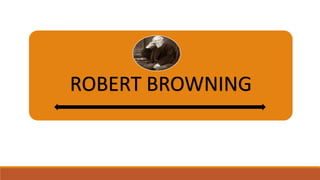
ROBERT BROWNING
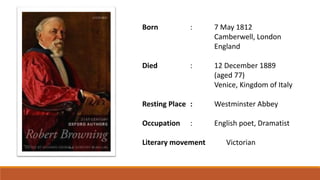
Born : 7 May 1812
Camberwell, London
England
Died : 12 December 1889
(aged 77)
Venice, Kingdom of Italy
Resting Place : Westminster Abbey
Occupation : English poet, Dramatist
Literary movement Victorian
Early Life
May 7, 1812-December 12, 1889
an English poet, playwright whose mastery of dramatic verse especially
dramatic monologues.
only son of Sarah Anna and Robert Browning.
Robert’s father was a well-paid clerk for the Bank of England(earning about £
150 per year
 His mother was the daughter of German shipowner
Robert’s father is a literary collector where he was raised in a household
significant literary resources.
His mother, to whom he was very close
By 12, he had written a book of poetry which he later destroyed when no
publisher could be found.
 By 14, he was fluent in French, Greek, Italian, Latin. He became a great admire
of the Romantic poets, especially Shelley.
 He was educated at home by a tutor via the resources if his father’s extensive
library around 6,000 books
 He refused a formal career and dedicated himself to poetry.
He stayed at home until the age of34 and dependent to is family until marriage
 His father sponsored the publication of his son’s poems.
In 1834, he accompanied Chevailer George de Benkhausen, the Russian consul-
general. On brief visit to St Petersburg and began Paracelsus published in 1835.
The subject of 16 th century savant and alchemist was probably suggested to him
by the Comte Amedee de Ripart- monclar
The publication had some commercial and critical success being noticed by
Wordsworth, Dickens, Landor and Tennyson
It was a monodrama without action , dealing with the problems confronting an
intellectual trying to find his role in society
 It gained him access to the London literary world
 As a result, he met Macready who invited him to write a play..
Marriage Life
 In 1845, he met the poet Elizabeth Barrett. They began regularly corresponding and
gradually a romance developed between them leading to their marriage
 The marriage was initially secret because Elizabethan’s father disapproved of marriage
for any of his children
 Elizabeth’s poems included love sonnets that increased her popularity cementing her
as an eminent Victorian poet.
 She was a contender to become Poet Laureate after William Wordsworth death , the
position eventually going to Tennyson.
From the time of their marriage until Elizabeth’s death, he lived in Italy residing
Florence at Casa Guidi which is now a museum to the irmemory.
Elizabeth and Robert’s only child was Robert Wiedemann Barret Browning.
Political views &Religious beliefs
Browning identified as a Liberal , supported the emancipation of women, and opposed
slavery, expressing sympathy for the North in the American Civil War.
In 1877 he wrote a poem explaining "Why I am a Liberal" in which he declared: "Who
then dares hold – emancipated thus / His fellow shall continue bound? Not I.
Browning was raised in an evangelical non-conformist household.
 However, after his reading of Shelley he is said to have briefly become an atheist.
However, many have dismissed the usefulness of these works at discovering
Browning's own religious views due to the consistent use of dramatic monologue which
regularly expresses hypothetical views which cannot be ascribed to the author himself.
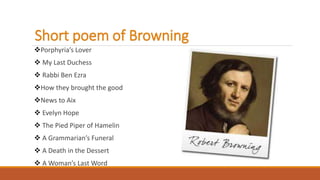
Short poem of Browning
Porphyria’s Lover
 My Last Duchess
 Rabbi Ben Ezra
How they brought the good
News to Aix
 Evelyn Hope
 The Pied Piper of Hamelin
 A Grammarian’s Funeral
 A Death in the Dessert
 A Woman’s Last Word
Major work of Browning
Men and Women
 In 1853, he worked with this two volume poem for he is now well known and it made
a little impact
The Ring and The Book
 In 1868, he published this long blank verse based on convoluted murder-case It is
composed of 12 books and ten lengthy dramatic monologues.
 Concluded by Browning himself Poet’s most ambitious project and arguably his
greatest work.
 It was successful both commercially and critically. Robert Browning Society was
formed in 1881 and his work was recognized as belonging within the British Literary
Canon. An Epic-length poem that justify the ways of GOD to humanity.
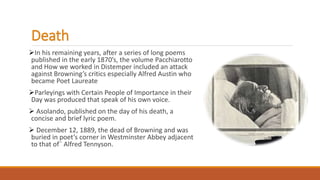
Death
In his remaining years, after a series of long poems
published in the early 1870’s, the volume Pacchiarotto
and How we worked in Distemper included an attack
against Browning’s critics especially Alfred Austin who
became Poet Laureate
Parleyings with Certain People of Importance in their
Day was produced that speak of his own voice.
 Asolando, published on the day of his death, a
concise and brief lyric poem.
 December 12, 1889, the dead of Browning and was
buried in poet’s corner in Westminster Abbey adjacent
to that of¨ Alfred Tennyson.
THANKYOU

Robert browning ppt

  • 1.
    TOPIC NAME :VICTORIAN DRAMATIST (ROBERT BROWNING) PREPARED BY : BHATT RIDDHI D. (SEM-1) ROLL NO. : 16 PG ENROLLMENT NO : 3069206420200004
  • 2.
  • 3.
    Born : 7May 1812 Camberwell, London England Died : 12 December 1889 (aged 77) Venice, Kingdom of Italy Resting Place : Westminster Abbey Occupation : English poet, Dramatist Literary movement Victorian
  • 4.
    Early Life May 7,1812-December 12, 1889 an English poet, playwright whose mastery of dramatic verse especially dramatic monologues. only son of Sarah Anna and Robert Browning. Robert’s father was a well-paid clerk for the Bank of England(earning about £ 150 per year  His mother was the daughter of German shipowner Robert’s father is a literary collector where he was raised in a household significant literary resources.
  • 5.
    His mother, towhom he was very close By 12, he had written a book of poetry which he later destroyed when no publisher could be found.  By 14, he was fluent in French, Greek, Italian, Latin. He became a great admire of the Romantic poets, especially Shelley.  He was educated at home by a tutor via the resources if his father’s extensive library around 6,000 books  He refused a formal career and dedicated himself to poetry. He stayed at home until the age of34 and dependent to is family until marriage  His father sponsored the publication of his son’s poems.
  • 6.
    In 1834, heaccompanied Chevailer George de Benkhausen, the Russian consul- general. On brief visit to St Petersburg and began Paracelsus published in 1835. The subject of 16 th century savant and alchemist was probably suggested to him by the Comte Amedee de Ripart- monclar The publication had some commercial and critical success being noticed by Wordsworth, Dickens, Landor and Tennyson It was a monodrama without action , dealing with the problems confronting an intellectual trying to find his role in society  It gained him access to the London literary world  As a result, he met Macready who invited him to write a play..
  • 7.
    Marriage Life  In1845, he met the poet Elizabeth Barrett. They began regularly corresponding and gradually a romance developed between them leading to their marriage  The marriage was initially secret because Elizabethan’s father disapproved of marriage for any of his children  Elizabeth’s poems included love sonnets that increased her popularity cementing her as an eminent Victorian poet.  She was a contender to become Poet Laureate after William Wordsworth death , the position eventually going to Tennyson. From the time of their marriage until Elizabeth’s death, he lived in Italy residing Florence at Casa Guidi which is now a museum to the irmemory. Elizabeth and Robert’s only child was Robert Wiedemann Barret Browning.
  • 8.
    Political views &Religiousbeliefs Browning identified as a Liberal , supported the emancipation of women, and opposed slavery, expressing sympathy for the North in the American Civil War. In 1877 he wrote a poem explaining "Why I am a Liberal" in which he declared: "Who then dares hold – emancipated thus / His fellow shall continue bound? Not I. Browning was raised in an evangelical non-conformist household.  However, after his reading of Shelley he is said to have briefly become an atheist. However, many have dismissed the usefulness of these works at discovering Browning's own religious views due to the consistent use of dramatic monologue which regularly expresses hypothetical views which cannot be ascribed to the author himself.
  • 9.
    Short poem ofBrowning Porphyria’s Lover  My Last Duchess  Rabbi Ben Ezra How they brought the good News to Aix  Evelyn Hope  The Pied Piper of Hamelin  A Grammarian’s Funeral  A Death in the Dessert  A Woman’s Last Word
  • 10.
    Major work ofBrowning Men and Women  In 1853, he worked with this two volume poem for he is now well known and it made a little impact The Ring and The Book  In 1868, he published this long blank verse based on convoluted murder-case It is composed of 12 books and ten lengthy dramatic monologues.  Concluded by Browning himself Poet’s most ambitious project and arguably his greatest work.  It was successful both commercially and critically. Robert Browning Society was formed in 1881 and his work was recognized as belonging within the British Literary Canon. An Epic-length poem that justify the ways of GOD to humanity.
  • 11.
    Death In his remainingyears, after a series of long poems published in the early 1870’s, the volume Pacchiarotto and How we worked in Distemper included an attack against Browning’s critics especially Alfred Austin who became Poet Laureate Parleyings with Certain People of Importance in their Day was produced that speak of his own voice.  Asolando, published on the day of his death, a concise and brief lyric poem.  December 12, 1889, the dead of Browning and was buried in poet’s corner in Westminster Abbey adjacent to that of¨ Alfred Tennyson.
  • 12.