


Increase awareness around DevOps
infra security
DevOoops
Gianluca Varisco
@gvarisco
$ whoami
VP	Security	@	Rocket	Internet	SE
Formerly	at	Red	Hat,	Lastminute.com Group,	 PrivateWave
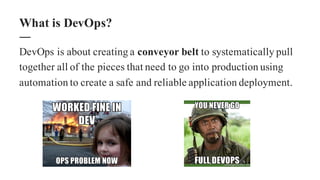
DevOps is about creating a conveyor belt to systematically pull
together all of the pieces that need to go into production using
automation to create a safe and reliable application deployment.
What is DevOps?
Why Security needs DevOps
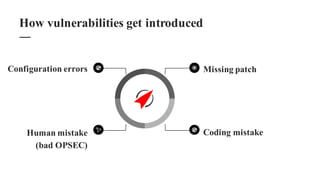
How vulnerabilities get introduced
Configuration errors Missing patch
Coding mistakeHuman mistake
(bad OPSEC)
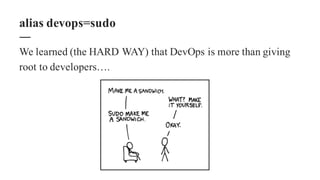
We learned (the HARD WAY) that DevOps is more than giving
root to developers….
alias devops=sudo
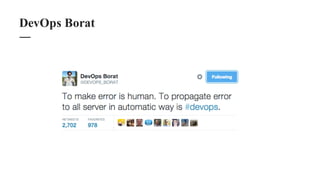
DevOps Borat
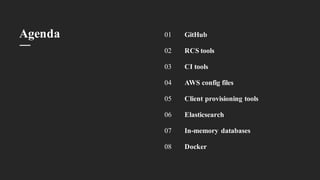
01 GitHub
02 RCS tools
03 CI tools
04 AWS config files
05 Client provisioning tools
06 Elasticsearch
07 In-memory databases
Agenda
08 Docker
GitHub
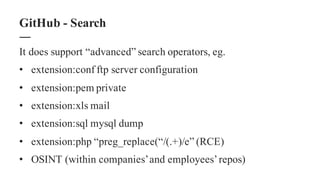
It does support “advanced” search operators, eg.
• extension:conf ftp server configuration
• extension:pem private
• extension:xls mail
• extension:sql mysql dump
• extension:php “preg_replace(“/(.+)/e” (RCE)
• OSINT (within companies’and employees’repos)
GitHub - Search
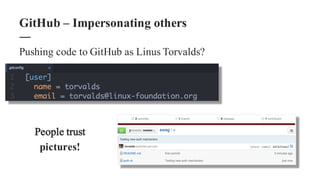
Pushing code to GitHub as Linus Torvalds?
GitHub – Impersonating others
People trust
pictures!
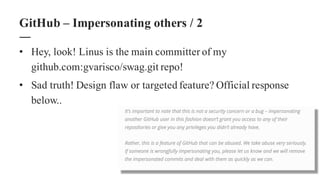
• Hey, look! Linus is the main committer of my
github.com:gvarisco/swag.git repo!
• Sad truth! Design flaw or targeted feature? Official response
below..
GitHub – Impersonating others / 2
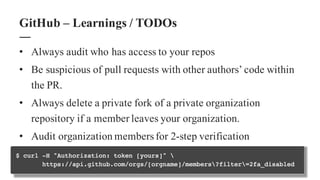
• Always audit who has access to your repos
• Be suspicious of pull requests with other authors’ code within
the PR.
• Always delete a private fork of a private organization
repository if a member leaves your organization.
• Audit organization members for 2-step verification
GitHub – Learnings / TODOs
RCS tools
Does your website expose the .git/ folder on a webserver out
there?
§ Access to such content lets you downloadthe full source
code
§ tl;dr: NO, Turning DirectoryIndex (Apache)/ autoindex
(nginx)ON/OFF is NOT the fix!
.git exposure
• Source code, config files, credentials,developernames,
public/private keys,SSLcertificates, e-mail addresses,etc.
• Repo HISTORY(security issues fixed,password wrongly
committed and removed later)
• Archives / backups {My,Postgre,XYZ}SQLdumps
• Session generationkeys
.git exposure / What can you get?
• $ mkdir website-source-code
• $ cd website-source-code
• $ wget –mirror –include-directories=/.git
http://www.example.com/.git
• $ cd www.example.com
• $ git reset –hard
HEAD is now at […]
.git exposure / DirectoryIndex ON
• Git-fsck to the rescue!
• Bruteforce: Predictable file names and known object hashes,
etc.
• DVCS-{Pillage,Ripper} do it for you
• Many admins tend to answer either 403 or 404 for .git/ but
.git/configworks just fine.
• Git stores file information withinthe objects folder.
.git exposure / DirectoryIndex OFF
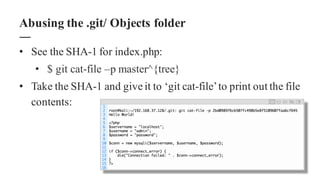
• See the SHA-1 for index.php:
• $ git cat-file –p master^{tree}
• Take the SHA-1 and give it to ‘git cat-file’to print out the file
contents:
Abusing the .git/ Objects folder
• 1.6.x and earlier
• Check for .entriesfiles
• Walk SVN chain to retrieve all files. Metasploit does it
for you (auxiliary/scanner/http/svn_scanner)
Subversion 1.6.x
• 1.7.x uses SQLite.
• Metasploit’s auxiliary/scanner/http/svn_wcdb_scanner
to the rescue! It will retrieve SVN’s wc.db for you
• As we know the file name and the SHA-1 used,
we can map all files.
Subversion 1.7.x
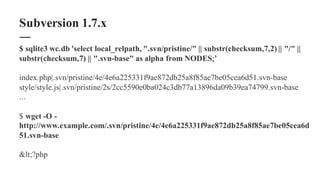
$ sqlite3 wc.db 'select local_relpath, ".svn/pristine/" || substr(checksum,7,2) || "/" ||
substr(checksum,7) || ".svn-base" as alpha from NODES;’
index.php|.svn/pristine/4e/4e6a225331f9ae872db25a8f85ae7be05cea6d51.svn-base
style/style.js|.svn/pristine/2s/2cc5590e0ba024c3db77a13896da09b39ea74799.svn-base
...
$ wget -O -
http://www.example.com/.svn/pristine/4e/4e6a225331f9ae872db25a8f85ae7be05cea6d
51.svn-base
<?php
Subversion 1.7.x
CI tools
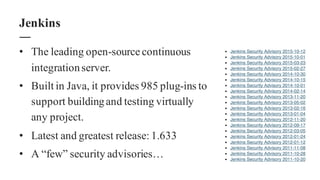
• The leading open-source continuous
integrationserver.
• Built in Java, it provides 985 plug-ins to
support buildingand testing virtually
any project.
• Latest and greatest release: 1.633
• A “few” security advisories…
Jenkins
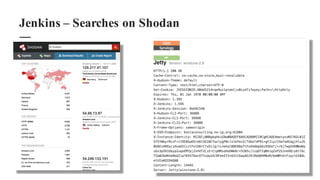
Jenkins – Searches on Shodan
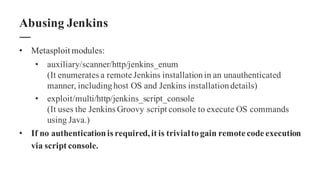
• Metasploit modules:
• auxiliary/scanner/http/jenkins_enum
(It enumerates a remote Jenkins installationin an unauthenticated
manner, includinghost OS and Jenkins installationdetails)
• exploit/multi/http/jenkins_script_console
(It uses the Jenkins Groovy script console to execute OS commands
using Java.)
• If no authenticationis required,it is trivialtogain remote code execution
via script console.
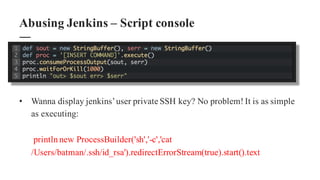
Abusing Jenkins
• Wanna display jenkins’user private SSH key? No problem! It is as simple
as executing:
printlnnew ProcessBuilder('sh','-c','cat
/Users/batman/.ssh/id_rsa').redirectErrorStream(true).start().text
Abusing Jenkins – Script console
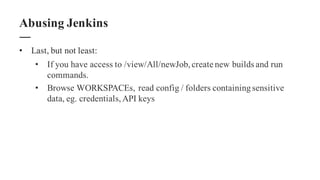
• Last, but not least:
• If you have access to /view/All/newJob,create new builds and run
commands.
• Browse WORKSPACEs, read config / folders containingsensitive
data, eg. credentials,API keys
Abusing Jenkins
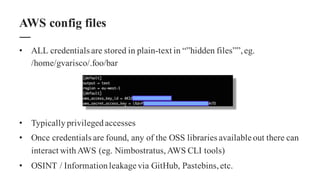
AWS config files
• ALL credentials are stored in plain-text in “”hidden files””,eg.
/home/gvarisco/.foo/bar
• Typicallyprivilegedaccesses
• Once credentials are found, any of the OSS libraries available out there can
interact withAWS (eg. Nimbostratus,AWS CLI tools)
• OSINT / Informationleakage via GitHub, Pastebins,etc.
AWS config files
Provisioning tools
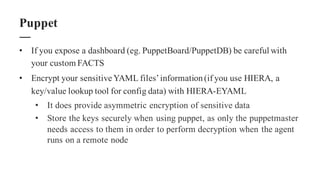
• If you expose a dashboard (eg. PuppetBoard/PuppetDB) be careful with
your custom FACTS
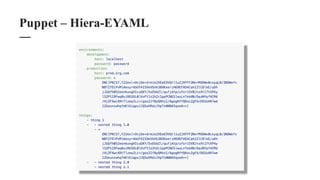
• Encrypt your sensitive YAML files’information(if you use HIERA, a
key/value lookup tool for config data) with HIERA-EYAML
• It does provide asymmetric encryption of sensitive data
• Store the keys securely when using puppet, as only the puppetmaster
needs access to them in order to perform decryption when the agent
runs on a remote node
Puppet
Puppet – Hiera-EYAML
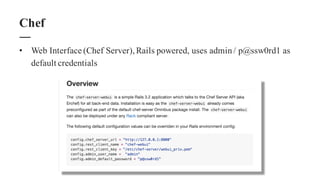
• Web Interface (Chef Server),Rails powered, uses admin/ p@ssw0rd1 as
default credentials
Chef
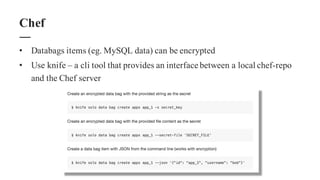
• Databags items (eg. MySQL data) can be encrypted
• Use knife – a cli tool that provides an interface between a local chef-repo
and the Chef server
Chef
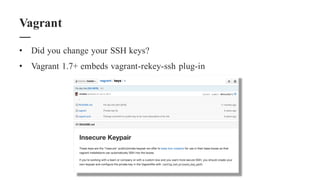
• Did you change your SSH keys?
• Vagrant 1.7+ embeds vagrant-rekey-ssh plug-in
Vagrant
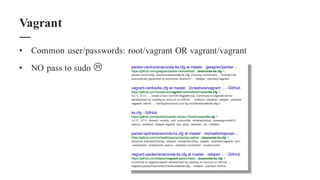
• Common user/passwords: root/vagrant OR vagrant/vagrant
• NO pass to sudo L
Vagrant
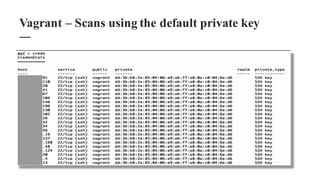
Vagrant – Scans using the default private key
• Vagrant workflows encourage you to edit your code outside the VM.
• That’s why it helpfully shares the project directory as /vagrant/ in the
VM.
“Put evil things in /vagrant/.git/hooks/post-commit and wait for the user to
commit some code. Since the /vagrant/ directory is mounted from the host,
such hook will persist even if the user destroys the VM.”
Vagrant – breaking in!
• Root passwords are either set:
• During installation
• Crypted hash defined in the KS file (rootpw –iscrypted)
• Clear text defined in the KS file (rootpw –plaintext)
Kickstart files (Red Hat, CentOS, …)
Elasticsearch
• A distributed full-text search engine with a RESTful web interface and
schema-free JSON documents
• 9200/TCP (GET request shows version)
• No authentication
• Can search stored data via HTTP API
• Update data with PUT requests
• Join an existing, open cluster and get all the data
• REMOTE CODE EXECUTION prior to 1.2.0
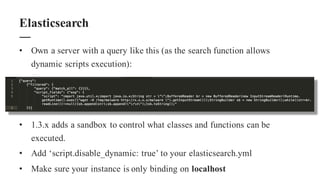
Elasticsearch
• Own a server with a query like this (as the search function allows
dynamic scripts execution):
• 1.3.x adds a sandbox to control what classes and functions can be
executed.
• Add ‘script.disable_dynamic: true’ to your elasticsearch.yml
• Make sure your instance is only binding on localhost
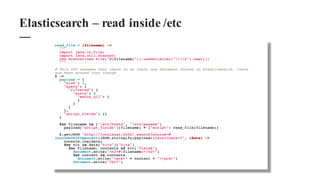
Elasticsearch
Elasticsearch – read inside /etc
In-memory databases
• Default config comes with:
• NO encrypted communication
• NO credentials
• 6379/TCP
• Binds to all interfaces
Redis
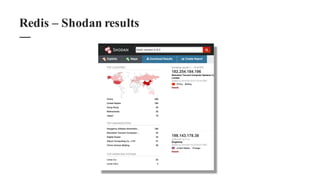
Redis – Shodan results
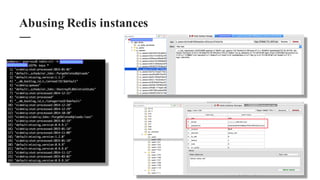
Abusing Redis instances
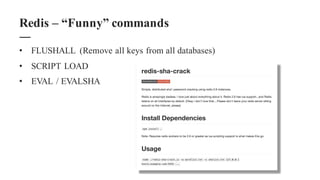
• FLUSHALL (Remove all keys from all databases)
• SCRIPT LOAD
• EVAL / EVALSHA
Redis – “Funny” commands
• Free & open-source
• High-performance, distributed memory object caching system
• Fun things get put into memcache
• SECURE IT:
• First and always, FIREWALL
• Check your bindings (interfaces)
• If you need it, use SASL
• DO NOT RUNAS ROOT
Memcache
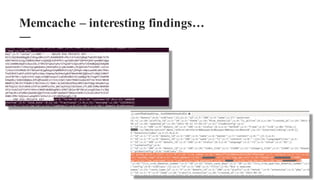
Memcache – interesting findings…
Docker
• It automates the deployment of applications insidesoftware containers
• Docker works as a client that communicates with a daemon process
(dockerd) via a Unix domain socket called /var/run/docker.sock
• Highly privileged, effectivelyhaving root access
Docker
• Error:
# docker run -t -i -v /var/run/docker.sock:/var/run/docker.sock
• PoC:
• The container gets a docker client of its own, pointed at the
/var/run/docker.sock
• The container launches a new container mounting / on /host
(It’s the host root filesystem, not the first container’s)
• The second container chroots to /host, and is now effectively root
on the host..
Don’t expose the Docker socket!
Video
• Add authentication to Jenkins
• Make sure all your tools / systems are only available from/to hosts that
need it
• Change default private keys / credentials EVERYWHERE
• Update to latest versions of all your devops tools
And now what?
• Don’t push DevOps back but rather embrace it.
• Participate in or create cookbooks/modules/scripts for security
• Check for known security items you don’t want going into
production by creating audit scripts
Go forward
THANKS!
Questions?
• Ken Johnson
• Chris Gates
• Laurens Van Houtven
• Rocket Internet’s Security Team
Credits
© 2015 Rocket Internet SE. All rights reserved.

Road to Opscon (Pisa '15) - DevOoops

  • 1.
    Increase awareness aroundDevOps infra security DevOoops Gianluca Varisco @gvarisco
  • 2.
  • 3.
    DevOps is aboutcreating a conveyor belt to systematically pull together all of the pieces that need to go into production using automation to create a safe and reliable application deployment. What is DevOps?
  • 4.
  • 5.
    How vulnerabilities getintroduced Configuration errors Missing patch Coding mistakeHuman mistake (bad OPSEC)
  • 6.
    We learned (theHARD WAY) that DevOps is more than giving root to developers…. alias devops=sudo
  • 7.
  • 8.
    01 GitHub 02 RCStools 03 CI tools 04 AWS config files 05 Client provisioning tools 06 Elasticsearch 07 In-memory databases Agenda 08 Docker
  • 9.
  • 10.
    It does support“advanced” search operators, eg. • extension:conf ftp server configuration • extension:pem private • extension:xls mail • extension:sql mysql dump • extension:php “preg_replace(“/(.+)/e” (RCE) • OSINT (within companies’and employees’repos) GitHub - Search
  • 11.
    Pushing code toGitHub as Linus Torvalds? GitHub – Impersonating others People trust pictures!
  • 12.
    • Hey, look!Linus is the main committer of my github.com:gvarisco/swag.git repo! • Sad truth! Design flaw or targeted feature? Official response below.. GitHub – Impersonating others / 2
  • 13.
    • Always auditwho has access to your repos • Be suspicious of pull requests with other authors’ code within the PR. • Always delete a private fork of a private organization repository if a member leaves your organization. • Audit organization members for 2-step verification GitHub – Learnings / TODOs
  • 14.
  • 15.
    Does your websiteexpose the .git/ folder on a webserver out there? § Access to such content lets you downloadthe full source code § tl;dr: NO, Turning DirectoryIndex (Apache)/ autoindex (nginx)ON/OFF is NOT the fix! .git exposure
  • 16.
    • Source code,config files, credentials,developernames, public/private keys,SSLcertificates, e-mail addresses,etc. • Repo HISTORY(security issues fixed,password wrongly committed and removed later) • Archives / backups {My,Postgre,XYZ}SQLdumps • Session generationkeys .git exposure / What can you get?
  • 17.
    • $ mkdirwebsite-source-code • $ cd website-source-code • $ wget –mirror –include-directories=/.git http://www.example.com/.git • $ cd www.example.com • $ git reset –hard HEAD is now at […] .git exposure / DirectoryIndex ON
  • 18.
    • Git-fsck tothe rescue! • Bruteforce: Predictable file names and known object hashes, etc. • DVCS-{Pillage,Ripper} do it for you • Many admins tend to answer either 403 or 404 for .git/ but .git/configworks just fine. • Git stores file information withinthe objects folder. .git exposure / DirectoryIndex OFF
  • 19.
    • See theSHA-1 for index.php: • $ git cat-file –p master^{tree} • Take the SHA-1 and give it to ‘git cat-file’to print out the file contents: Abusing the .git/ Objects folder
  • 20.
    • 1.6.x andearlier • Check for .entriesfiles • Walk SVN chain to retrieve all files. Metasploit does it for you (auxiliary/scanner/http/svn_scanner) Subversion 1.6.x
  • 21.
    • 1.7.x usesSQLite. • Metasploit’s auxiliary/scanner/http/svn_wcdb_scanner to the rescue! It will retrieve SVN’s wc.db for you • As we know the file name and the SHA-1 used, we can map all files. Subversion 1.7.x
  • 22.
    $ sqlite3 wc.db'select local_relpath, ".svn/pristine/" || substr(checksum,7,2) || "/" || substr(checksum,7) || ".svn-base" as alpha from NODES;’ index.php|.svn/pristine/4e/4e6a225331f9ae872db25a8f85ae7be05cea6d51.svn-base style/style.js|.svn/pristine/2s/2cc5590e0ba024c3db77a13896da09b39ea74799.svn-base ... $ wget -O - http://www.example.com/.svn/pristine/4e/4e6a225331f9ae872db25a8f85ae7be05cea6d 51.svn-base <?php Subversion 1.7.x
  • 23.
  • 24.
    • The leadingopen-source continuous integrationserver. • Built in Java, it provides 985 plug-ins to support buildingand testing virtually any project. • Latest and greatest release: 1.633 • A “few” security advisories… Jenkins
  • 25.
  • 26.
    • Metasploit modules: •auxiliary/scanner/http/jenkins_enum (It enumerates a remote Jenkins installationin an unauthenticated manner, includinghost OS and Jenkins installationdetails) • exploit/multi/http/jenkins_script_console (It uses the Jenkins Groovy script console to execute OS commands using Java.) • If no authenticationis required,it is trivialtogain remote code execution via script console. Abusing Jenkins
  • 27.
    • Wanna displayjenkins’user private SSH key? No problem! It is as simple as executing: printlnnew ProcessBuilder('sh','-c','cat /Users/batman/.ssh/id_rsa').redirectErrorStream(true).start().text Abusing Jenkins – Script console
  • 28.
    • Last, butnot least: • If you have access to /view/All/newJob,create new builds and run commands. • Browse WORKSPACEs, read config / folders containingsensitive data, eg. credentials,API keys Abusing Jenkins
  • 29.
  • 30.
    • ALL credentialsare stored in plain-text in “”hidden files””,eg. /home/gvarisco/.foo/bar • Typicallyprivilegedaccesses • Once credentials are found, any of the OSS libraries available out there can interact withAWS (eg. Nimbostratus,AWS CLI tools) • OSINT / Informationleakage via GitHub, Pastebins,etc. AWS config files
  • 31.
  • 32.
    • If youexpose a dashboard (eg. PuppetBoard/PuppetDB) be careful with your custom FACTS • Encrypt your sensitive YAML files’information(if you use HIERA, a key/value lookup tool for config data) with HIERA-EYAML • It does provide asymmetric encryption of sensitive data • Store the keys securely when using puppet, as only the puppetmaster needs access to them in order to perform decryption when the agent runs on a remote node Puppet
  • 33.
  • 34.
    • Web Interface(Chef Server),Rails powered, uses admin/ p@ssw0rd1 as default credentials Chef
  • 35.
    • Databags items(eg. MySQL data) can be encrypted • Use knife – a cli tool that provides an interface between a local chef-repo and the Chef server Chef
  • 36.
    • Did youchange your SSH keys? • Vagrant 1.7+ embeds vagrant-rekey-ssh plug-in Vagrant
  • 37.
    • Common user/passwords:root/vagrant OR vagrant/vagrant • NO pass to sudo L Vagrant
  • 38.
    Vagrant – Scansusing the default private key
  • 39.
    • Vagrant workflowsencourage you to edit your code outside the VM. • That’s why it helpfully shares the project directory as /vagrant/ in the VM. “Put evil things in /vagrant/.git/hooks/post-commit and wait for the user to commit some code. Since the /vagrant/ directory is mounted from the host, such hook will persist even if the user destroys the VM.” Vagrant – breaking in!
  • 40.
    • Root passwordsare either set: • During installation • Crypted hash defined in the KS file (rootpw –iscrypted) • Clear text defined in the KS file (rootpw –plaintext) Kickstart files (Red Hat, CentOS, …)
  • 41.
  • 42.
    • A distributedfull-text search engine with a RESTful web interface and schema-free JSON documents • 9200/TCP (GET request shows version) • No authentication • Can search stored data via HTTP API • Update data with PUT requests • Join an existing, open cluster and get all the data • REMOTE CODE EXECUTION prior to 1.2.0 Elasticsearch
  • 43.
    • Own aserver with a query like this (as the search function allows dynamic scripts execution): • 1.3.x adds a sandbox to control what classes and functions can be executed. • Add ‘script.disable_dynamic: true’ to your elasticsearch.yml • Make sure your instance is only binding on localhost Elasticsearch
  • 44.
  • 45.
  • 46.
    • Default configcomes with: • NO encrypted communication • NO credentials • 6379/TCP • Binds to all interfaces Redis
  • 47.
  • 48.
  • 49.
    • FLUSHALL (Removeall keys from all databases) • SCRIPT LOAD • EVAL / EVALSHA Redis – “Funny” commands
  • 50.
    • Free &open-source • High-performance, distributed memory object caching system • Fun things get put into memcache • SECURE IT: • First and always, FIREWALL • Check your bindings (interfaces) • If you need it, use SASL • DO NOT RUNAS ROOT Memcache
  • 51.
  • 52.
  • 53.
    • It automatesthe deployment of applications insidesoftware containers • Docker works as a client that communicates with a daemon process (dockerd) via a Unix domain socket called /var/run/docker.sock • Highly privileged, effectivelyhaving root access Docker
  • 54.
    • Error: # dockerrun -t -i -v /var/run/docker.sock:/var/run/docker.sock • PoC: • The container gets a docker client of its own, pointed at the /var/run/docker.sock • The container launches a new container mounting / on /host (It’s the host root filesystem, not the first container’s) • The second container chroots to /host, and is now effectively root on the host.. Don’t expose the Docker socket!
  • 55.
  • 56.
    • Add authenticationto Jenkins • Make sure all your tools / systems are only available from/to hosts that need it • Change default private keys / credentials EVERYWHERE • Update to latest versions of all your devops tools And now what?
  • 57.
    • Don’t pushDevOps back but rather embrace it. • Participate in or create cookbooks/modules/scripts for security • Check for known security items you don’t want going into production by creating audit scripts Go forward
  • 58.
  • 59.
    • Ken Johnson •Chris Gates • Laurens Van Houtven • Rocket Internet’s Security Team Credits
  • 60.
    © 2015 RocketInternet SE. All rights reserved.