Slide 1
Road Map for Management of
Indoor Air Quality
By
Dr. Prasad Modak,
Director, Ekonnect Knowledge Foundation
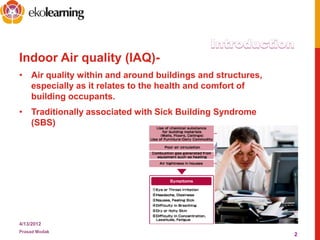
Indoor Air quality (IAQ)-
• Air quality within and around buildings and structures,
especially as it relates to the health and comfort of
building occupants.
• Traditionally associated with Sick Building Syndrome
(SBS)
4/13/2012
Prasad Modak
2
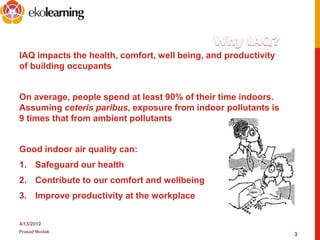
IAQ impacts the health, comfort, well being, and productivity
of building occupants
On average, people spend at least 90% of their time indoors.
Assuming ceteris paribus, exposure from indoor pollutants is
9 times that from ambient pollutants
Good indoor air quality can:
1. Safeguard our health
2. Contribute to our comfort and wellbeing
3. Improve productivity at the workplace
4/13/2012
Prasad Modak
3
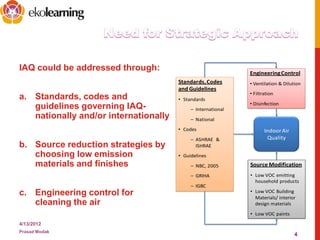
IAQ could be addressed through:
a. Standards, codes and
guidelines governing IAQ-
nationally and/or internationally
b. Source reduction strategies by
choosing low emission
materials and finishes
c. Engineering control for
cleaning the air
4/13/2012
Prasad Modak
4
Standards,Codes
and Guidelines
• Standards
– International
– National
• Codes
– ASHRAE &
ISHRAE
• Guidelines
– NBC, 2005
– GRIHA
– IGBC
IndoorAir
Quality
Source Modification
• Low VOC emitting
household products
• Low VOC Building
Materials/ interior
design materials
• Low VOC paints
EngineeringControl
• Ventilation & Dilution
• Filtration
• Disinfection
4/13/2012
Prasad Modak
5
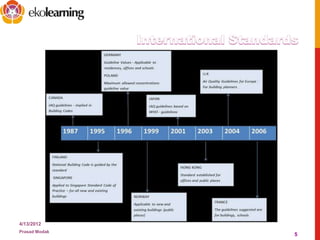
• Most countries have used combination of regulatory standards
supported by building codes.
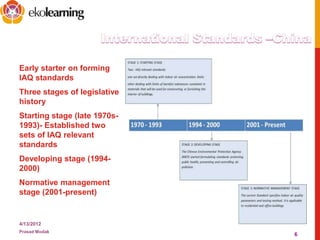
Early starter on forming
IAQ standards
Three stages of legislative
history
Starting stage (late 1970s-
1993)- Established two
sets of IAQ relevant
standards
Developing stage (1994-
2000)
Normative management
stage (2001-present)
4/13/2012
Prasad Modak
6
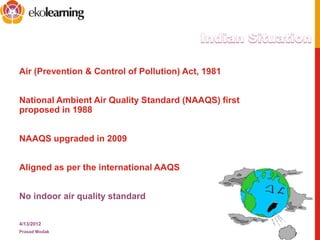
Air (Prevention & Control of Pollution) Act, 1981
National Ambient Air Quality Standard (NAAQS) first
proposed in 1988
NAAQS upgraded in 2009
Aligned as per the international AAQS
No indoor air quality standard
4/13/2012
Prasad Modak
7
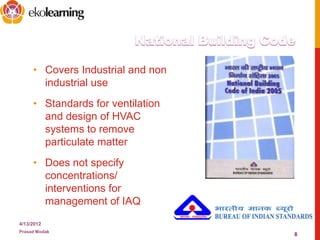
• Covers Industrial and non
industrial use
• Standards for ventilation
and design of HVAC
systems to remove
particulate matter
• Does not specify
concentrations/
interventions for
management of IAQ
4/13/2012
Prasad Modak
8
• Covers new construction, major renovations and
core and shell.
• Has stringent requirements. Includes air quality
performance and ETS control. Also monitoring and
preparing a management plan
4/13/2012
Prasad Modak
9
• Areas covered- Homes, townships, SEZ
and factory buildings. Separate guide on
each type gives information about the
credits and requirements
• Focuses mainly on tobacco smoke
control and VOC. It does not include
monitoring and management of indoor air
quality
4/13/2012
Prasad Modak
10
–Different types of new and existing buildings
(commercial, institutional or residential.)
–Focus on Low VOC materials and ETS
–No emphasis on ventilation rates, monitoring or
management of IAQ
4/13/2012
Prasad Modak
11
–Focus on HVAC design
–Covers all types of buildings
–ASHRAE has performance based procedures and not
occupancy based
–also referred in LEED
4/13/2012
Prasad Modak
12
Maintaining good IAQ requires enhanced ventilation and hence
increased consumption of energy and thus higher operating
costs.
Reducing ventilation rates to save energy, with no
countermeasures, increases indoor-generated VOCs and small
particles by an amount that may pose health risks.
To strike balance between two, integrated design approach
towards IAQ and energy should be used.
Such an approach needs to be reflected in India's
building codes, standards and rating systems.
4/13/2012
Prasad Modak
13
• Most studies based on short term measurement and/or suffer
from smaller sample size
• Focus on either rural and/or urban poor areas (slums). Cooking
stoves as source of pollutants.
• Focus of research is limited to conventional pollutants like PM10,
NO2 and/or CO. Cumulative aspects not studied
• Hardly any studies conducted on urban or peri-urban
households, using natural and/or artificial ventilation
• Impacts on artificial ventilation on the build up of indoor pollutant
levels are yet to be investigated
• Very few studies have been conducted at public places
(auditoriums, cinema, Metro)
4/13/2012
Prasad Modak
14
Broad scale, sufficiently long term experiments should be
conducted in both artificially and naturally ventilated houses
in both rural and urban areas in India. Will allow better
understanding of IAQ and its health implications to develop
appropriate interventions.
Apart from PM10, NO2, SO2 and CO, pollutants like PM2.5,
Benzene-Toluene-Xylene, Formaldehyde, Polycyclic Aromatic
Hydrocarbons (especially benzo[a]pyrene), Trichloroethylene
and Tetrachloroethylene should be analyzed in chemical
parameters. Biological parameters like growth of molds,
spores, dust mites and bacteria should be considered.
4/13/2012
Prasad Modak
15
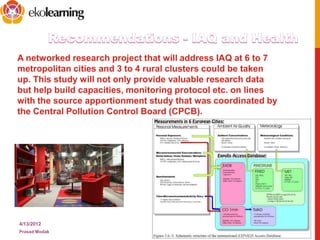
A networked research project that will address IAQ at 6 to 7
metropolitan cities and 3 to 4 rural clusters could be taken
up. This study will not only provide valuable research data
but help build capacities, monitoring protocol etc. on lines
with the source apportionment study that was coordinated by
the Central Pollution Control Board (CPCB).
4/13/2012
Prasad Modak
16
• There is a need to set up a National Centre of
Excellence researching on IAQ with
appropriate infrastructure.
The INDOORTRON facility is one excellent
example
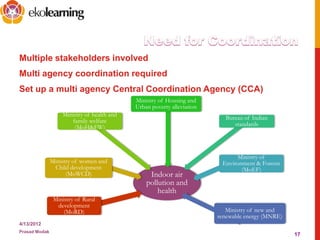
Multiple stakeholders involved
Multi agency coordination required
Set up a multi agency Central Coordination Agency (CCA)
4/13/2012
Prasad Modak
17
Indoor air
pollution and
health
Ministry of Rural
development
(MoRD)
Ministry of women and
Child development
(MoWCD)
Ministry of health and
family welfare
(MoH&FW)
Ministry of Housing and
Urban poverty alleviation
Bureau of Indian
standards
Ministry of
Environment & Forests
(MoEF)
Ministry of new and
renewable energy (MNRE)
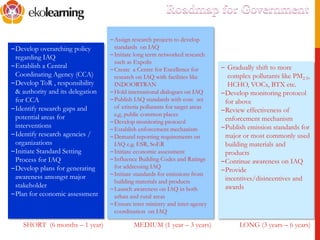
–Develop overarching policy
regarding IAQ
–Establish a Central
Coordinating Agency (CCA)
–Develop ToR , responsibility
& authority and its delegation
for CCA
–Identify research gaps and
potential areas for
interventions
–Identify research agencies /
organizations
–Initiate Standard Setting
Process for IAQ
–Develop plans for generating
awareness amongst major
stakeholder
–Plan for economic assessment
–Assign research projects to develop
standards on IAQ
–Initiate long term networked research
such as Expolis
–Create a Centre for Excellence for
research on IAQ with facilities like
INDOORTRAN
–Hold international dialogues on IAQ
–Publish IAQ standards with core set
of criteria pollutants for target areas
e,g, public common places
–Develop monitoring protocol
–Establish enforcement mechanism
–Demand reporting requirements on
IAQ e.g. ESR, SoER
–Initiate economic assessment
–Influence Building Codes and Ratings
for addressing IAQ
–Initiate standards for emissions from
building materials and products
–Launch awareness on IAQ in both
urban and rural areas
–Ensure inter ministry and inter-agency
coordination on IAQ
– Gradually shift to more
complex pollutants like PM2.5,
HCHO, VOCs, BTX etc.
–Develop monitoring protocol
for above
–Review effectiveness of
enforcement mechanism
–Publish emission standards for
major or most commonly used
building materials and
products
–Continue awareness on IAQ
–Provide
incentives/disincentives and
awards
SHORT (6 months – 1 year) MEDIUM (1 year – 3 years) LONG (3 years – 6 years)
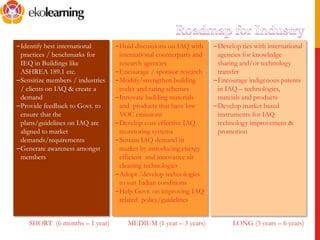
–Identify best international
practices / benchmarks for
IEQ in Buildings like
ASHREA 189.1 etc.
–Sensitize members / industries
/ clients on IAQ & create a
demand
–Provide feedback to Govt. to
ensure that the
plans/guidelines on IAQ are
aligned to market
demands/requirements
–Generate awareness amongst
members
–Hold discussions on IAQ with
international counterparts and
research agencies
–Encourage / sponsor research
–Modify/strengthen building
codes and rating schemes
–Innovate building materials
and products that have low
VOC emissions
–Develop cost-effective IAQ
monitoring systems
–Sustain IAQ demand in
market by introducing energy
efficient and innovative air
cleaning technologies
–Adopt /develop technologies
to suit Indian conditions
–Help Govt. on improving IAQ
related policy/guidelines
–Develop ties with international
agencies for knowledge
sharing and/or technology
transfer
–Encourage indigenous patents
in IAQ – technologies,
mateials and products
–Develop market based
instruments for IAQ
technology improvement &
promotion
SHORT (6 months – 1 year) MEDIUM (1 year – 3 years) LONG (3 years – 6 years)
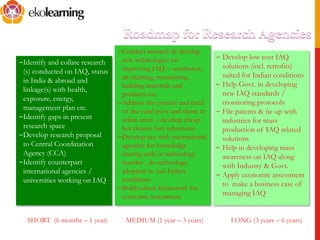
–Identify and collate research
(s) conducted on IAQ, status
in India & abroad and
linkage(s) with health,
exposure, energy,
management plan etc.
–Identify gaps in present
research space
–Develop research proposal
to Central Coordination
Agency (CCA)
–Identify counterpart
international agencies /
universities working on IAQ
–Conduct research & develop
new technologies on
improving IAQ – ventilation,
air cleaning, monitoring,
building materials and
products etc.
–Address the context and need
of the rural poor and slums in
urban areas – develop cheap
but cleaner fuel substitutes
–Develop ties with international
agencies for knowledge
sharing and/or technology
transfer , do technology
adoption to suit Indian
conditions
–Build robust framework for
economic assessment
– Develop low cost IAQ
solutions (incl. retrofits)
suited for Indian conditions
– Help Govt. in developing
new IAQ standards /
monitoring protocols
– File patents & tie up with
industries for mass
production of IAQ related
solutions
– Help in developing mass
awareness on IAQ along
with Industry & Govt.
– Apply economic assessment
to make a business case of
managing IAQ
SHORT (6 months – 1 year) MEDIUM (1 year – 3 years) LONG (3 years – 6 years)
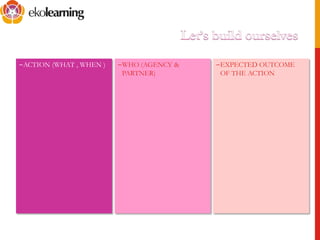
–EXPECTED OUTCOME
OF THE ACTION
–ACTION (WHAT , WHEN ) –WHO (AGENCY &
PARTNER)
4/13/2012
Prasad Modak
22
Questions / suggestions ?
Email prasad.modak@emcentre.com
URL: www.emcentre.com

Road Map for Management of Indoor Air Quality

  • 1.
    Slide 1 Road Mapfor Management of Indoor Air Quality By Dr. Prasad Modak, Director, Ekonnect Knowledge Foundation
  • 2.
    Indoor Air quality(IAQ)- • Air quality within and around buildings and structures, especially as it relates to the health and comfort of building occupants. • Traditionally associated with Sick Building Syndrome (SBS) 4/13/2012 Prasad Modak 2
  • 3.
    IAQ impacts thehealth, comfort, well being, and productivity of building occupants On average, people spend at least 90% of their time indoors. Assuming ceteris paribus, exposure from indoor pollutants is 9 times that from ambient pollutants Good indoor air quality can: 1. Safeguard our health 2. Contribute to our comfort and wellbeing 3. Improve productivity at the workplace 4/13/2012 Prasad Modak 3
  • 4.
    IAQ could beaddressed through: a. Standards, codes and guidelines governing IAQ- nationally and/or internationally b. Source reduction strategies by choosing low emission materials and finishes c. Engineering control for cleaning the air 4/13/2012 Prasad Modak 4 Standards,Codes and Guidelines • Standards – International – National • Codes – ASHRAE & ISHRAE • Guidelines – NBC, 2005 – GRIHA – IGBC IndoorAir Quality Source Modification • Low VOC emitting household products • Low VOC Building Materials/ interior design materials • Low VOC paints EngineeringControl • Ventilation & Dilution • Filtration • Disinfection
  • 5.
    4/13/2012 Prasad Modak 5 • Mostcountries have used combination of regulatory standards supported by building codes.
  • 6.
    Early starter onforming IAQ standards Three stages of legislative history Starting stage (late 1970s- 1993)- Established two sets of IAQ relevant standards Developing stage (1994- 2000) Normative management stage (2001-present) 4/13/2012 Prasad Modak 6
  • 7.
    Air (Prevention &Control of Pollution) Act, 1981 National Ambient Air Quality Standard (NAAQS) first proposed in 1988 NAAQS upgraded in 2009 Aligned as per the international AAQS No indoor air quality standard 4/13/2012 Prasad Modak 7
  • 8.
    • Covers Industrialand non industrial use • Standards for ventilation and design of HVAC systems to remove particulate matter • Does not specify concentrations/ interventions for management of IAQ 4/13/2012 Prasad Modak 8
  • 9.
    • Covers newconstruction, major renovations and core and shell. • Has stringent requirements. Includes air quality performance and ETS control. Also monitoring and preparing a management plan 4/13/2012 Prasad Modak 9
  • 10.
    • Areas covered-Homes, townships, SEZ and factory buildings. Separate guide on each type gives information about the credits and requirements • Focuses mainly on tobacco smoke control and VOC. It does not include monitoring and management of indoor air quality 4/13/2012 Prasad Modak 10
  • 11.
    –Different types ofnew and existing buildings (commercial, institutional or residential.) –Focus on Low VOC materials and ETS –No emphasis on ventilation rates, monitoring or management of IAQ 4/13/2012 Prasad Modak 11
  • 12.
    –Focus on HVACdesign –Covers all types of buildings –ASHRAE has performance based procedures and not occupancy based –also referred in LEED 4/13/2012 Prasad Modak 12
  • 13.
    Maintaining good IAQrequires enhanced ventilation and hence increased consumption of energy and thus higher operating costs. Reducing ventilation rates to save energy, with no countermeasures, increases indoor-generated VOCs and small particles by an amount that may pose health risks. To strike balance between two, integrated design approach towards IAQ and energy should be used. Such an approach needs to be reflected in India's building codes, standards and rating systems. 4/13/2012 Prasad Modak 13
  • 14.
    • Most studiesbased on short term measurement and/or suffer from smaller sample size • Focus on either rural and/or urban poor areas (slums). Cooking stoves as source of pollutants. • Focus of research is limited to conventional pollutants like PM10, NO2 and/or CO. Cumulative aspects not studied • Hardly any studies conducted on urban or peri-urban households, using natural and/or artificial ventilation • Impacts on artificial ventilation on the build up of indoor pollutant levels are yet to be investigated • Very few studies have been conducted at public places (auditoriums, cinema, Metro) 4/13/2012 Prasad Modak 14
  • 15.
    Broad scale, sufficientlylong term experiments should be conducted in both artificially and naturally ventilated houses in both rural and urban areas in India. Will allow better understanding of IAQ and its health implications to develop appropriate interventions. Apart from PM10, NO2, SO2 and CO, pollutants like PM2.5, Benzene-Toluene-Xylene, Formaldehyde, Polycyclic Aromatic Hydrocarbons (especially benzo[a]pyrene), Trichloroethylene and Tetrachloroethylene should be analyzed in chemical parameters. Biological parameters like growth of molds, spores, dust mites and bacteria should be considered. 4/13/2012 Prasad Modak 15
  • 16.
    A networked researchproject that will address IAQ at 6 to 7 metropolitan cities and 3 to 4 rural clusters could be taken up. This study will not only provide valuable research data but help build capacities, monitoring protocol etc. on lines with the source apportionment study that was coordinated by the Central Pollution Control Board (CPCB). 4/13/2012 Prasad Modak 16 • There is a need to set up a National Centre of Excellence researching on IAQ with appropriate infrastructure. The INDOORTRON facility is one excellent example
  • 17.
    Multiple stakeholders involved Multiagency coordination required Set up a multi agency Central Coordination Agency (CCA) 4/13/2012 Prasad Modak 17 Indoor air pollution and health Ministry of Rural development (MoRD) Ministry of women and Child development (MoWCD) Ministry of health and family welfare (MoH&FW) Ministry of Housing and Urban poverty alleviation Bureau of Indian standards Ministry of Environment & Forests (MoEF) Ministry of new and renewable energy (MNRE)
  • 18.
    –Develop overarching policy regardingIAQ –Establish a Central Coordinating Agency (CCA) –Develop ToR , responsibility & authority and its delegation for CCA –Identify research gaps and potential areas for interventions –Identify research agencies / organizations –Initiate Standard Setting Process for IAQ –Develop plans for generating awareness amongst major stakeholder –Plan for economic assessment –Assign research projects to develop standards on IAQ –Initiate long term networked research such as Expolis –Create a Centre for Excellence for research on IAQ with facilities like INDOORTRAN –Hold international dialogues on IAQ –Publish IAQ standards with core set of criteria pollutants for target areas e,g, public common places –Develop monitoring protocol –Establish enforcement mechanism –Demand reporting requirements on IAQ e.g. ESR, SoER –Initiate economic assessment –Influence Building Codes and Ratings for addressing IAQ –Initiate standards for emissions from building materials and products –Launch awareness on IAQ in both urban and rural areas –Ensure inter ministry and inter-agency coordination on IAQ – Gradually shift to more complex pollutants like PM2.5, HCHO, VOCs, BTX etc. –Develop monitoring protocol for above –Review effectiveness of enforcement mechanism –Publish emission standards for major or most commonly used building materials and products –Continue awareness on IAQ –Provide incentives/disincentives and awards SHORT (6 months – 1 year) MEDIUM (1 year – 3 years) LONG (3 years – 6 years)
  • 19.
    –Identify best international practices/ benchmarks for IEQ in Buildings like ASHREA 189.1 etc. –Sensitize members / industries / clients on IAQ & create a demand –Provide feedback to Govt. to ensure that the plans/guidelines on IAQ are aligned to market demands/requirements –Generate awareness amongst members –Hold discussions on IAQ with international counterparts and research agencies –Encourage / sponsor research –Modify/strengthen building codes and rating schemes –Innovate building materials and products that have low VOC emissions –Develop cost-effective IAQ monitoring systems –Sustain IAQ demand in market by introducing energy efficient and innovative air cleaning technologies –Adopt /develop technologies to suit Indian conditions –Help Govt. on improving IAQ related policy/guidelines –Develop ties with international agencies for knowledge sharing and/or technology transfer –Encourage indigenous patents in IAQ – technologies, mateials and products –Develop market based instruments for IAQ technology improvement & promotion SHORT (6 months – 1 year) MEDIUM (1 year – 3 years) LONG (3 years – 6 years)
  • 20.
    –Identify and collateresearch (s) conducted on IAQ, status in India & abroad and linkage(s) with health, exposure, energy, management plan etc. –Identify gaps in present research space –Develop research proposal to Central Coordination Agency (CCA) –Identify counterpart international agencies / universities working on IAQ –Conduct research & develop new technologies on improving IAQ – ventilation, air cleaning, monitoring, building materials and products etc. –Address the context and need of the rural poor and slums in urban areas – develop cheap but cleaner fuel substitutes –Develop ties with international agencies for knowledge sharing and/or technology transfer , do technology adoption to suit Indian conditions –Build robust framework for economic assessment – Develop low cost IAQ solutions (incl. retrofits) suited for Indian conditions – Help Govt. in developing new IAQ standards / monitoring protocols – File patents & tie up with industries for mass production of IAQ related solutions – Help in developing mass awareness on IAQ along with Industry & Govt. – Apply economic assessment to make a business case of managing IAQ SHORT (6 months – 1 year) MEDIUM (1 year – 3 years) LONG (3 years – 6 years)
  • 21.
    –EXPECTED OUTCOME OF THEACTION –ACTION (WHAT , WHEN ) –WHO (AGENCY & PARTNER)
  • 22.
    4/13/2012 Prasad Modak 22 Questions /suggestions ? Email prasad.modak@emcentre.com URL: www.emcentre.com