USGBC Course ID 90006150 
Commercial Building Science - 
Comfortable Environments 
Through Sustainable Design
CertainTeed is a Registered Provider with the American 
Institute of Architects Continuing Education System. 
Credit earned upon completion of this program will be 
reported to CES records for all AIA members. 
Certificates of Completion for non-AIA members are 
available upon request. 
This program is registered with AIA/CES for continuing professional 
education. As such, it does not include content that may be deemed or 
construed to be an approval or endorsement by the AIA of any material 
of construction or any method or manner of handling, using, 
distributing, or dealing in any material product. Questions related to 
specific materials, methods, and services will be addressed at the 
conclusion of this presentation. 
This course qualifies for HSW credit. 
This course qualifies for Sustainable Design credit.
CertainTeed Building Solutions 
1
Copyright 
This presentation is protected by U.S. and international copyright 
laws. Reproduction and distribution of this presentation without 
written permission of the sponsor is prohibited.  CertainTeed 
Corporation
Learning Objectives 
After completing this course you will be able to: 
• Understand concepts of green building through sustainable 
design 
• Describe three principles of sustainable design 
• Understand credit categories for a green building rating system 
• Describe several factors affecting thermal comfort 
• Understand ways to improve indoor air quality through 
controlled ventilation & material selection 
• Understand how to create superior acoustical environments 
through sound control design practices 
• Understand design strategies that help create a high quality 
visual environment
Contents 
1. Overview of Green/Sustainable Design 
2. Principles of Sustainable Design 
3. Overview of LEED green building rating system 
4. Thermal comfort 
5. Indoor air quality 
6. Acoustical comfort 
7. Visual comfort
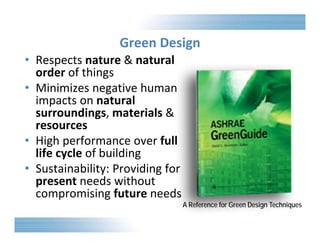
Green Design 
A Reference for Green Design Techniques 
• Respects nature & natural 
order of things 
• Minimizes negative human 
impacts on natural 
surroundings, materials & 
resources 
• High performance over full 
life cycle of building 
• Sustainability: Providing for 
present needs without 
compromising future needs
Sustainable Design 
• Basic objectives: 
– Reduce consumption of non‐renewable resources 
– Minimize waste 
– Create productive environments 
• Building projects should result in an optimal balance of: 
– Costs 
– Environmental benefits 
– Societal benefits 
– Human benefits 
– Meeting mission & function of intended facility 
• May cost more initially, but can yield savings over time
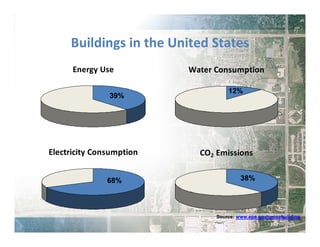
Buildings in the United States 
Energy Use Water Consumption 
39% 12% 
Electricity Consumption CO2 Emissions 
68% 38% 
Source: www.epa.gov/greenbuilding
Module 1 
Principles of Sustainable Design
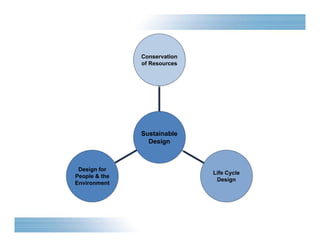
Design for 
People & the 
Environment 
Life Cycle 
Design 
Conservation 
of Resources 
Sustainable 
Design
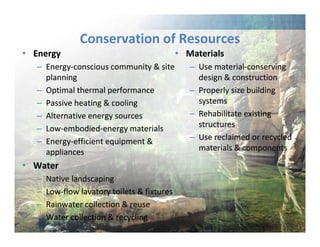
• Energy 
Conservation of Resources 
– Energy‐conscious community & site 
planning 
– Optimal thermal performance 
– Passive heating & cooling 
– Alternative energy sources 
– Low‐embodied‐energy materials 
– Energy‐efficient equipment & 
appliances 
• Water 
– Native landscaping 
– Low‐flow lavatory toilets & fixtures 
– Rainwater collection & reuse 
– Water collection & recycling 
• Materials 
– Use material‐conserving 
design & construction 
– Properly size building 
systems 
– Rehabilitate existing 
structures 
– Use reclaimed or recycled 
materials & components
Life‐Cycle Design 
• Pre‐building phase 
– Manufactured with renewable resources 
– Harvested/extracted without ecological 
damage 
– Recycled or recyclable 
– Durable over time with low maintenance 
– Distributed with low energy costs 
• Building phase 
– Minimize site impact on ecosystem 
– Provide waste water separation facilities 
– Use non‐toxic construction materials 
– Plan routine maintenance with 
environmentally friendly material 
• Occupancy phase 
– Recycle building 
components & materials 
– Adapt existing structures 
to new occupants 
– Develop existing land & 
infrastructure
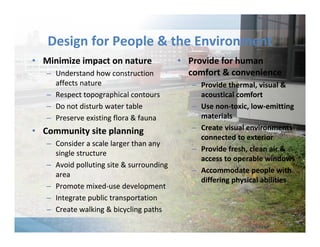
Design for People & the Environment 
• Minimize impact on nature 
– Understand how construction 
affects nature 
– Respect topographical contours 
– Do not disturb water table 
– Preserve existing flora & fauna 
• Community site planning 
– Consider a scale larger than any 
single structure 
– Avoid polluting site & surrounding 
area 
– Promote mixed‐use development 
– Integrate public transportation 
– Create walking & bicycling paths 
• Provide for human 
comfort & convenience 
– Provide thermal, visual & 
acoustical comfort 
– Use non‐toxic, low‐emitting 
materials 
– Create visual environments 
connected to exterior 
– Provide fresh, clean air & 
access to operable windows 
– Accommodate people with 
differing physical abilities
Module 2 
Understanding the LEED 
Green Building Rating System
What is LEED? 
• Independent third party rating system 
• Developed by U.S. Green Building Council (USGBC) 
• Standard for measuring a building’s environmental 
performance
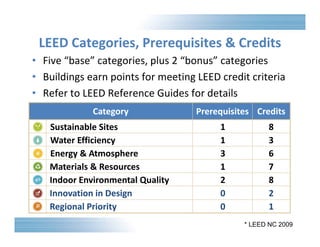
LEED Categories, Prerequisites & Credits 
• Five “base” categories, plus 2 “bonus” categories 
• Buildings earn points for meeting LEED credit criteria 
• Refer to LEED Reference Guides for details 
Category Prerequisites Credits 
Sustainable Sites 1 8 
Water Efficiency 1 3 
Energy & Atmosphere 3 6 
Materials & Resources 1 7 
Indoor Environmental Quality 2 8 
Innovation in Design 0 2 
Regional Priority 0 1 
* LEED NC 2009
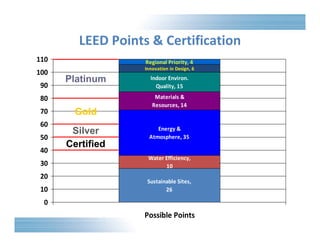
LEED Points & Certification 
Regional Priority, 4 
Innovation in Design, 6 
Indoor Environ. 
Quality, 15 
Materials & 
Resources, 14 
Energy & 
Atmosphere, 35 
Water Efficiency, 
10 
Sustainable Sites, 
26 
110 
100 
90 
80 
70 
60 
50 
40 
30 
20 
10 
0 
Possible Points 
Platinum 
Gold 
Silver 
Certified
Resources for Sustainable Design 
• US EPA 
www.epa.gov/greenbuilding 
• US Green Building Council (USGBC) 
www.usgbc.org 
• Sustainable Buildings Industry 
Council 
www.sbicouncil.org 
• Department of Energy Sustainable 
Design Program 
www.pnl.gov/doesustainabledesign 
• Whole Building Design Guide 
www.wbdg.org/design 
• High‐Performance School 
Buildings Resource and Strategy 
Guide 
www.hpschooldesigntraining.com 
• Lawrence Berkeley National 
Laboratory 
Environmental Design Library 
www.lib.berkeley.edu/ENVI/GreenA 
ll.html 
• University of Michigan – School 
of Natural Resources 
Environment, Sustainable 
Architecture Module: 
– Introduction to Sustainable 
Design 
www.css.snre.umich.edu
Module 3 
Thermal Comfort
Meeting Standards for Comfort 
• ASHRAE Standard 55 
“Thermal Environmental Conditions for Human Occupancy” 
• ISO 7726: 1998 
“Ergonomics of the thermal environment ― Instruments for 
measuring physical quantities” 
• ISO 7730: 1994 
“Moderate thermal environments ― Determination of the 
PMV & PPD indices and specification of the conditions for 
thermal comfort”
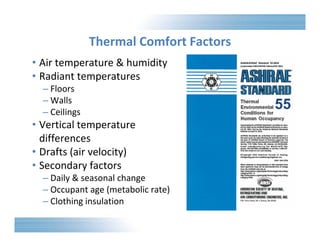
Thermal Comfort Factors 
• Air temperature & humidity 
• Radiant temperatures 
– Floors 
– Walls 
– Ceilings 
• Vertical temperature 
differences 
• Drafts (air velocity) 
• Secondary factors 
– Daily & seasonal change 
– Occupant age (metabolic rate) 
– Clothing insulation 
55
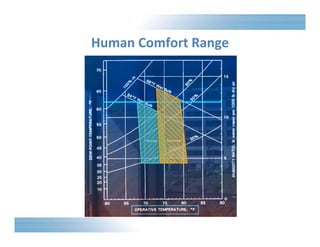
Human Comfort Range
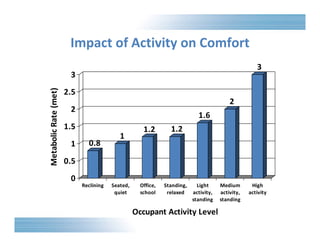
Impact of Activity on Comfort 
0.8 
1 
1.2 1.2 
1.6 
2 
3 
3 
2.5 
2 
1.5 
1 
0.5 
0 
Metabolic Rate (met) 
Reclining Seated, 
quiet 
Office, 
school 
Standing, 
relaxed 
Light 
activity, 
standing 
Medium 
activity, 
standing 
High 
activity 
Occupant Activity Level
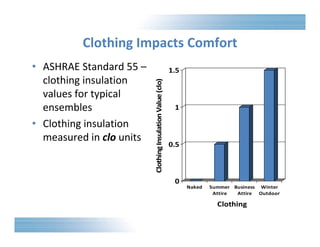
Clothing Impacts Comfort 
• ASHRAE Standard 55 – 
clothing insulation 
values for typical 
ensembles 
• Clothing insulation 
measured in clo units 
1.5 
1 
0.5 
0 
Clothing Insulation Value (clo) 
Naked Summer 
Attire 
Business 
Attire 
Winter 
Outdoor 
Clothing
Module 4 
Indoor Air Quality
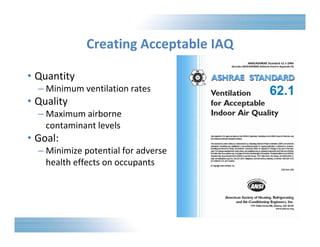
Creating Acceptable IAQ 
• Quantity 
– Minimum ventilation rates 
• Quality 
– Maximum airborne 
contaminant levels 
• Goal: 
– Minimize potential for adverse 
health effects on occupants 
62.1
• Ventilation 
Quantity Control 
– Air flow rates in breathing zones 
– Air distribution effectiveness 
– Air flow zone requirements at diffusers 
• Air distribution 
– Exhaust duct location 
– Outdoor air intake 
– Combustion air
Quality Control 
• Moisture management 
– HVAC System 
• Dehumidification systems 
• Drain pans 
• Humidifiers & water spray 
systems 
– Building envelope 
• Weather resistive barriers 
• Vapor retarders 
• Continuous air barriers 
• Air stream surfaces 
– Mold growth resistance 
– Erosion resistance 
• Contaminant capture 
– Particulates 
• Filtration (MERV) 
– Gases 
• Concentration monitoring 
• Removal (activated charcoal) 
– Heat exchanger & finned‐tube 
coil cleaning
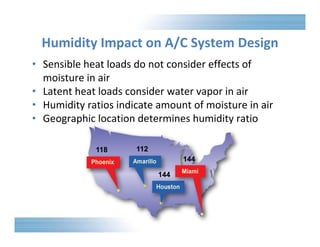
Humidity Impact on A/C System Design 
• Sensible heat loads do not consider effects of 
moisture in air 
• Latent heat loads consider water vapor in air 
• Humidity ratios indicate amount of moisture in air 
• Geographic location determines humidity ratio 
118 112 
144 
144
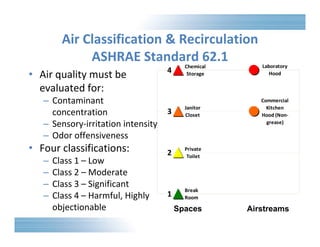
Air Classification & Recirculation 
ASHRAE Standard 62.1 
• Air quality must be 
evaluated for: 
– Contaminant 
concentration 
– Sensory‐irritation intensity 
– Odor offensiveness 
• Four classifications: 
– Class 1 – Low 
– Class 2 –Moderate 
– Class 3 – Significant 
– Class 4 – Harmful, Highly 
objectionable 
Chemical 
Storage 
Janitor 
Closet 
Private 
Toilet 
Break 
Room 
Laboratory 
Hood 
Commercial 
Kitchen 
Hood (Non‐grease) 
4 
3 
2 
1 
Spaces Airstreams
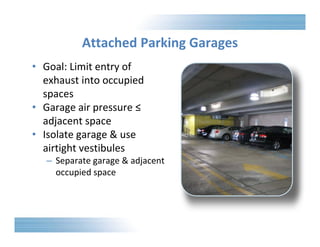
Attached Parking Garages 
• Goal: Limit entry of 
exhaust into occupied 
spaces 
• Garage air pressure ≤ 
adjacent space 
• Isolate garage & use 
airtight vestibules 
– Separate garage & adjacent 
occupied space
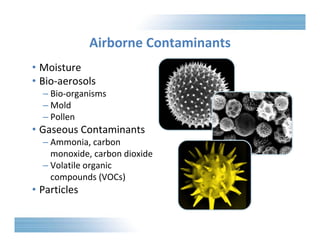
Airborne Contaminants 
• Moisture 
• Bio‐aerosols 
– Bio‐organisms 
– Mold 
– Pollen 
• Gaseous Contaminants 
– Ammonia, carbon 
monoxide, carbon dioxide 
– Volatile organic 
compounds (VOCs) 
• Particles
Guidelines for Environmental Emissions 
• Provides guidelines on air pollution 
due to product emissions 
• Certifies products for IAQ 
performance 
– Formaldehyde & other aldehydes 
– Volatile organic compounds (VOCs) 
– Respirable particles 
– Gases 
• Ozone 
• Carbon monoxide 
• Nitrogen oxide
Module 5 
Acoustical Comfort
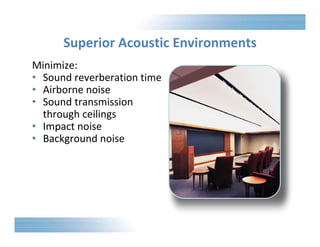
Superior Acoustic Environments 
Minimize: 
• Sound reverberation time 
• Airborne noise 
• Sound transmission 
through ceilings 
• Impact noise 
• Background noise
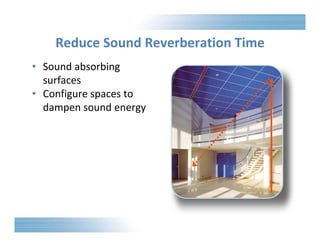
Reduce Sound Reverberation Time 
• Sound absorbing 
surfaces 
• Configure spaces to 
dampen sound energy
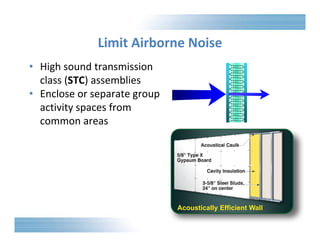
Limit Airborne Noise 
• High sound transmission 
class (STC) assemblies 
• Enclose or separate group 
activity spaces from 
common areas 
Acoustically Efficient Wall
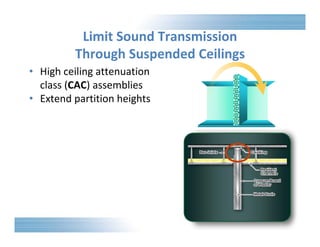
Limit Sound Transmission 
Through Suspended Ceilings 
• High ceiling attenuation 
class (CAC) assemblies 
• Extend partition heights
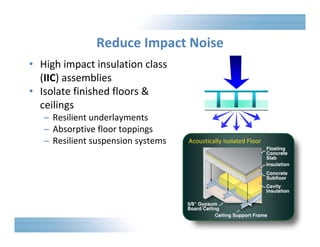
Reduce Impact Noise 
• High impact insulation class 
(IIC) assemblies 
• Isolate finished floors & 
ceilings 
– Resilient underlayments 
– Absorptive floor toppings 
– Resilient suspension systems Acoustically Isolated Floor
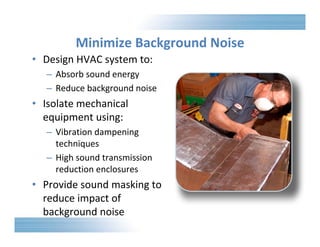
Minimize Background Noise 
• Design HVAC system to: 
– Absorb sound energy 
– Reduce background noise 
• Isolate mechanical 
equipment using: 
– Vibration dampening 
techniques 
– High sound transmission 
reduction enclosures 
• Provide sound masking to 
reduce impact of 
background noise
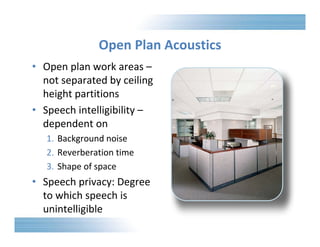
Open Plan Acoustics 
• Open plan work areas – 
not separated by ceiling 
height partitions 
• Speech intelligibility – 
dependent on 
1. Background noise 
2. Reverberation time 
3. Shape of space 
• Speech privacy: Degree 
to which speech is 
unintelligible
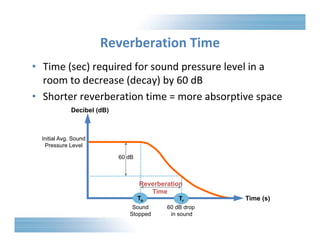
Reverberation Time 
• Time (sec) required for sound pressure level in a 
room to decrease (decay) by 60 dB 
• Shorter reverberation time = more absorptive space 
60 dB drop 
in sound 
Decibel (dB) 
Reverberation 
Time 
Sound 
Stopped 
Time (s) 
60 dB 
Initial Avg. Sound 
Pressure Level 
To Tr
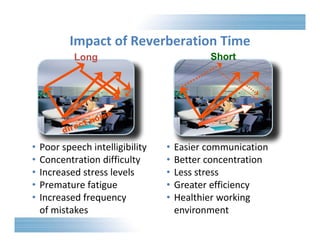
Impact of Reverberation Time 
• Poor speech intelligibility 
• Concentration difficulty 
• Increased stress levels 
• Premature fatigue 
• Increased frequency 
of mistakes 
• Easier communication 
• Better concentration 
• Less stress 
• Greater efficiency 
• Healthier working 
environment
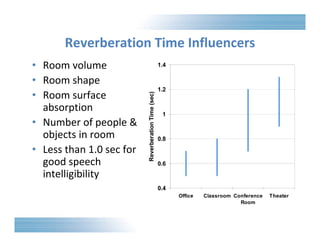
Reverberation Time Influencers 
1.4 
1.2 
1 
0.8 
0.6 
0.4 
Office Classroom Conference 
Room 
Theater 
Reverberation Time (sec) 
• Room volume 
• Room shape 
• Room surface 
absorption 
• Number of people & 
objects in room 
• Less than 1.0 sec for 
good speech 
intelligibility
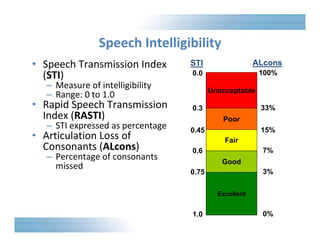
Speech Intelligibility 
• Speech Transmission Index 
(STI) 
– Measure of intelligibility 
– Range: 0 to 1.0 
• Rapid Speech Transmission 
Index (RASTI) 
– STI expressed as percentage 
• Articulation Loss of 
Consonants (ALcons) 
– Percentage of consonants 
missed 
STI ALcons 
Unacceptable 
Poor 
Fair 
Good 
Excellent 
100% 
33% 
15% 
7% 
3% 
0.0 
0.3 
0.45 
0.6 
0.75 
1.0 0%
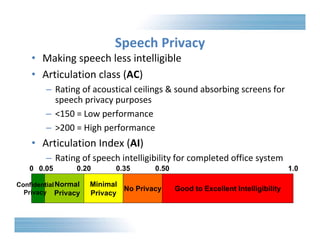
Speech Privacy 
• Making speech less intelligible 
• Articulation class (AC) 
– Rating of acoustical ceilings & sound absorbing screens for 
speech privacy purposes 
– <150 = Low performance 
– >200 = High performance 
• Articulation Index (AI) 
– Rating of speech intelligibility for completed office system 
0 0.05 0.20 0.35 0.50 1.0 
Normal 
Privacy 
Minimal 
Privacy No Privacy Good to Excellent Intelligibility 
Confidential 
Privacy
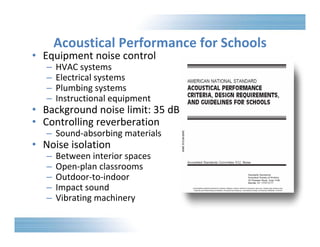
Acoustical Performance for Schools 
• Equipment noise control 
– HVAC systems 
– Electrical systems 
– Plumbing systems 
– Instructional equipment 
• Background noise limit: 35 dB 
• Controlling reverberation 
– Sound‐absorbing materials 
• Noise isolation 
– Between interior spaces 
– Open‐plan classrooms 
– Outdoor‐to‐indoor 
– Impact sound 
– Vibrating machinery
Module 6 
Visual Comfort
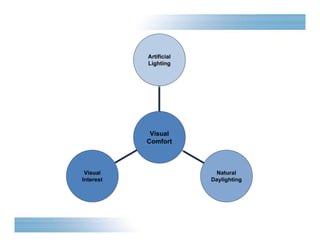
Visual 
Interest 
Natural 
Daylighting 
Artificial 
Lighting 
Visual 
Comfort
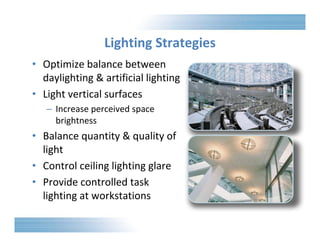
Lighting Strategies 
• Optimize balance between 
daylighting & artificial lighting 
• Light vertical surfaces 
– Increase perceived space 
brightness 
• Balance quantity & quality of 
light 
• Control ceiling lighting glare 
• Provide controlled task 
lighting at workstations
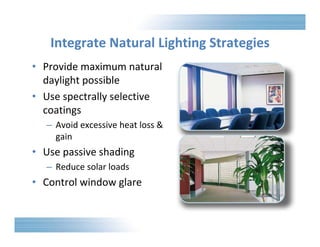
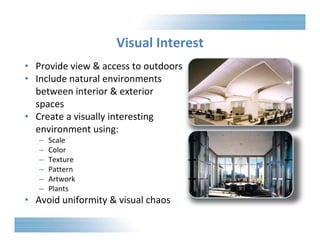
Integrate Natural Lighting Strategies 
• Provide maximum natural 
daylight possible 
• Use spectrally selective 
coatings 
– Avoid excessive heat loss & 
gain 
• Use passive shading 
– Reduce solar loads 
• Control window glare
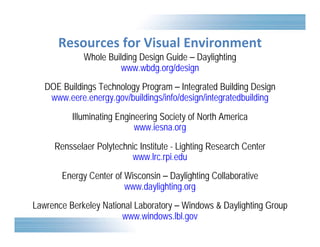
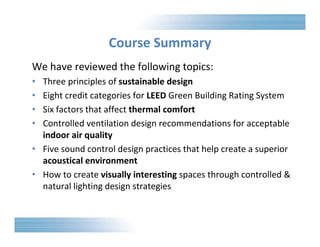
Visual Interest 
• Provide view & access to outdoors 
• Include natural environments 
between interior & exterior 
spaces 
• Create a visually interesting 
environment using: 
– Scale 
– Color 
– Texture 
– Pattern 
– Artwork 
– Plants 
• Avoid uniformity & visual chaos
Resources for Visual Environment 
Whole Building Design Guide – Daylighting 
www.wbdg.org/design 
DOE Buildings Technology Program – Integrated Building Design 
www.eere.energy.gov/buildings/info/design/integratedbuilding 
Illuminating Engineering Society of North America 
www.iesna.org 
Rensselaer Polytechnic Institute - Lighting Research Center 
www.lrc.rpi.edu 
Energy Center of Wisconsin – Daylighting Collaborative 
www.daylighting.org 
Lawrence Berkeley National Laboratory – Windows & Daylighting Group 
www.windows.lbl.gov
Course Summary 
We have reviewed the following topics: 
• Three principles of sustainable design 
• Eight credit categories for LEED Green Building Rating System 
• Six factors that affect thermal comfort 
• Controlled ventilation design recommendations for acceptable 
indoor air quality 
• Five sound control design practices that help create a superior 
acoustical environment 
• How to create visually interesting spaces through controlled & 
natural lighting design strategies
Thank You for Your 
Participation 
Any 
Questions?
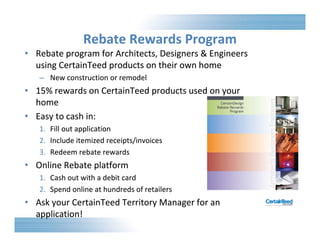
Rebate Rewards Program 
• Architects, Rebate program for Designers & Engineers 
using CertainTeed products on their own home 
– New construction or remodel 
• 15% rewards on CertainTeed products used on your 
home 
• Easy to cash in: 
1. Fill out application 
2. Include itemized receipts/invoices 
3. Redeem rebate rewards 
• Online Rebate platform 
1. Cash out with a debit card 
2. Spend online at hundreds of retailers 
• Ask your CertainTeed Territory Manager for an 
application!

Commercial Building Science - Comfortable Environments Through Sustainable Design

  • 1.
    USGBC Course ID90006150 Commercial Building Science - Comfortable Environments Through Sustainable Design
  • 2.
    CertainTeed is aRegistered Provider with the American Institute of Architects Continuing Education System. Credit earned upon completion of this program will be reported to CES records for all AIA members. Certificates of Completion for non-AIA members are available upon request. This program is registered with AIA/CES for continuing professional education. As such, it does not include content that may be deemed or construed to be an approval or endorsement by the AIA of any material of construction or any method or manner of handling, using, distributing, or dealing in any material product. Questions related to specific materials, methods, and services will be addressed at the conclusion of this presentation. This course qualifies for HSW credit. This course qualifies for Sustainable Design credit.
  • 3.
  • 4.
    Copyright This presentationis protected by U.S. and international copyright laws. Reproduction and distribution of this presentation without written permission of the sponsor is prohibited.  CertainTeed Corporation
  • 5.
    Learning Objectives Aftercompleting this course you will be able to: • Understand concepts of green building through sustainable design • Describe three principles of sustainable design • Understand credit categories for a green building rating system • Describe several factors affecting thermal comfort • Understand ways to improve indoor air quality through controlled ventilation & material selection • Understand how to create superior acoustical environments through sound control design practices • Understand design strategies that help create a high quality visual environment
  • 6.
    Contents 1. Overviewof Green/Sustainable Design 2. Principles of Sustainable Design 3. Overview of LEED green building rating system 4. Thermal comfort 5. Indoor air quality 6. Acoustical comfort 7. Visual comfort
  • 7.
    Green Design AReference for Green Design Techniques • Respects nature & natural order of things • Minimizes negative human impacts on natural surroundings, materials & resources • High performance over full life cycle of building • Sustainability: Providing for present needs without compromising future needs
  • 8.
    Sustainable Design •Basic objectives: – Reduce consumption of non‐renewable resources – Minimize waste – Create productive environments • Building projects should result in an optimal balance of: – Costs – Environmental benefits – Societal benefits – Human benefits – Meeting mission & function of intended facility • May cost more initially, but can yield savings over time
  • 9.
    Buildings in theUnited States Energy Use Water Consumption 39% 12% Electricity Consumption CO2 Emissions 68% 38% Source: www.epa.gov/greenbuilding
  • 10.
    Module 1 Principlesof Sustainable Design
  • 11.
    Design for People& the Environment Life Cycle Design Conservation of Resources Sustainable Design
  • 12.
    • Energy Conservationof Resources – Energy‐conscious community & site planning – Optimal thermal performance – Passive heating & cooling – Alternative energy sources – Low‐embodied‐energy materials – Energy‐efficient equipment & appliances • Water – Native landscaping – Low‐flow lavatory toilets & fixtures – Rainwater collection & reuse – Water collection & recycling • Materials – Use material‐conserving design & construction – Properly size building systems – Rehabilitate existing structures – Use reclaimed or recycled materials & components
  • 13.
    Life‐Cycle Design •Pre‐building phase – Manufactured with renewable resources – Harvested/extracted without ecological damage – Recycled or recyclable – Durable over time with low maintenance – Distributed with low energy costs • Building phase – Minimize site impact on ecosystem – Provide waste water separation facilities – Use non‐toxic construction materials – Plan routine maintenance with environmentally friendly material • Occupancy phase – Recycle building components & materials – Adapt existing structures to new occupants – Develop existing land & infrastructure
  • 14.
    Design for People& the Environment • Minimize impact on nature – Understand how construction affects nature – Respect topographical contours – Do not disturb water table – Preserve existing flora & fauna • Community site planning – Consider a scale larger than any single structure – Avoid polluting site & surrounding area – Promote mixed‐use development – Integrate public transportation – Create walking & bicycling paths • Provide for human comfort & convenience – Provide thermal, visual & acoustical comfort – Use non‐toxic, low‐emitting materials – Create visual environments connected to exterior – Provide fresh, clean air & access to operable windows – Accommodate people with differing physical abilities
  • 15.
    Module 2 Understandingthe LEED Green Building Rating System
  • 16.
    What is LEED? • Independent third party rating system • Developed by U.S. Green Building Council (USGBC) • Standard for measuring a building’s environmental performance
  • 17.
    LEED Categories, Prerequisites& Credits • Five “base” categories, plus 2 “bonus” categories • Buildings earn points for meeting LEED credit criteria • Refer to LEED Reference Guides for details Category Prerequisites Credits Sustainable Sites 1 8 Water Efficiency 1 3 Energy & Atmosphere 3 6 Materials & Resources 1 7 Indoor Environmental Quality 2 8 Innovation in Design 0 2 Regional Priority 0 1 * LEED NC 2009
  • 18.
    LEED Points &Certification Regional Priority, 4 Innovation in Design, 6 Indoor Environ. Quality, 15 Materials & Resources, 14 Energy & Atmosphere, 35 Water Efficiency, 10 Sustainable Sites, 26 110 100 90 80 70 60 50 40 30 20 10 0 Possible Points Platinum Gold Silver Certified
  • 19.
    Resources for SustainableDesign • US EPA www.epa.gov/greenbuilding • US Green Building Council (USGBC) www.usgbc.org • Sustainable Buildings Industry Council www.sbicouncil.org • Department of Energy Sustainable Design Program www.pnl.gov/doesustainabledesign • Whole Building Design Guide www.wbdg.org/design • High‐Performance School Buildings Resource and Strategy Guide www.hpschooldesigntraining.com • Lawrence Berkeley National Laboratory Environmental Design Library www.lib.berkeley.edu/ENVI/GreenA ll.html • University of Michigan – School of Natural Resources Environment, Sustainable Architecture Module: – Introduction to Sustainable Design www.css.snre.umich.edu
  • 20.
  • 21.
    Meeting Standards forComfort • ASHRAE Standard 55 “Thermal Environmental Conditions for Human Occupancy” • ISO 7726: 1998 “Ergonomics of the thermal environment ― Instruments for measuring physical quantities” • ISO 7730: 1994 “Moderate thermal environments ― Determination of the PMV & PPD indices and specification of the conditions for thermal comfort”
  • 22.
    Thermal Comfort Factors • Air temperature & humidity • Radiant temperatures – Floors – Walls – Ceilings • Vertical temperature differences • Drafts (air velocity) • Secondary factors – Daily & seasonal change – Occupant age (metabolic rate) – Clothing insulation 55
  • 23.
  • 24.
    Impact of Activityon Comfort 0.8 1 1.2 1.2 1.6 2 3 3 2.5 2 1.5 1 0.5 0 Metabolic Rate (met) Reclining Seated, quiet Office, school Standing, relaxed Light activity, standing Medium activity, standing High activity Occupant Activity Level
  • 25.
    Clothing Impacts Comfort • ASHRAE Standard 55 – clothing insulation values for typical ensembles • Clothing insulation measured in clo units 1.5 1 0.5 0 Clothing Insulation Value (clo) Naked Summer Attire Business Attire Winter Outdoor Clothing
  • 26.
    Module 4 IndoorAir Quality
  • 27.
    Creating Acceptable IAQ • Quantity – Minimum ventilation rates • Quality – Maximum airborne contaminant levels • Goal: – Minimize potential for adverse health effects on occupants 62.1
  • 28.
    • Ventilation QuantityControl – Air flow rates in breathing zones – Air distribution effectiveness – Air flow zone requirements at diffusers • Air distribution – Exhaust duct location – Outdoor air intake – Combustion air
  • 29.
    Quality Control •Moisture management – HVAC System • Dehumidification systems • Drain pans • Humidifiers & water spray systems – Building envelope • Weather resistive barriers • Vapor retarders • Continuous air barriers • Air stream surfaces – Mold growth resistance – Erosion resistance • Contaminant capture – Particulates • Filtration (MERV) – Gases • Concentration monitoring • Removal (activated charcoal) – Heat exchanger & finned‐tube coil cleaning
  • 30.
    Humidity Impact onA/C System Design • Sensible heat loads do not consider effects of moisture in air • Latent heat loads consider water vapor in air • Humidity ratios indicate amount of moisture in air • Geographic location determines humidity ratio 118 112 144 144
  • 31.
    Air Classification &Recirculation ASHRAE Standard 62.1 • Air quality must be evaluated for: – Contaminant concentration – Sensory‐irritation intensity – Odor offensiveness • Four classifications: – Class 1 – Low – Class 2 –Moderate – Class 3 – Significant – Class 4 – Harmful, Highly objectionable Chemical Storage Janitor Closet Private Toilet Break Room Laboratory Hood Commercial Kitchen Hood (Non‐grease) 4 3 2 1 Spaces Airstreams
  • 32.
    Attached Parking Garages • Goal: Limit entry of exhaust into occupied spaces • Garage air pressure ≤ adjacent space • Isolate garage & use airtight vestibules – Separate garage & adjacent occupied space
  • 33.
    Airborne Contaminants •Moisture • Bio‐aerosols – Bio‐organisms – Mold – Pollen • Gaseous Contaminants – Ammonia, carbon monoxide, carbon dioxide – Volatile organic compounds (VOCs) • Particles
  • 34.
    Guidelines for EnvironmentalEmissions • Provides guidelines on air pollution due to product emissions • Certifies products for IAQ performance – Formaldehyde & other aldehydes – Volatile organic compounds (VOCs) – Respirable particles – Gases • Ozone • Carbon monoxide • Nitrogen oxide
  • 35.
  • 36.
    Superior Acoustic Environments Minimize: • Sound reverberation time • Airborne noise • Sound transmission through ceilings • Impact noise • Background noise
  • 37.
    Reduce Sound ReverberationTime • Sound absorbing surfaces • Configure spaces to dampen sound energy
  • 38.
    Limit Airborne Noise • High sound transmission class (STC) assemblies • Enclose or separate group activity spaces from common areas Acoustically Efficient Wall
  • 39.
    Limit Sound Transmission Through Suspended Ceilings • High ceiling attenuation class (CAC) assemblies • Extend partition heights
  • 40.
    Reduce Impact Noise • High impact insulation class (IIC) assemblies • Isolate finished floors & ceilings – Resilient underlayments – Absorptive floor toppings – Resilient suspension systems Acoustically Isolated Floor
  • 41.
    Minimize Background Noise • Design HVAC system to: – Absorb sound energy – Reduce background noise • Isolate mechanical equipment using: – Vibration dampening techniques – High sound transmission reduction enclosures • Provide sound masking to reduce impact of background noise
  • 42.
    Open Plan Acoustics • Open plan work areas – not separated by ceiling height partitions • Speech intelligibility – dependent on 1. Background noise 2. Reverberation time 3. Shape of space • Speech privacy: Degree to which speech is unintelligible
  • 43.
    Reverberation Time •Time (sec) required for sound pressure level in a room to decrease (decay) by 60 dB • Shorter reverberation time = more absorptive space 60 dB drop in sound Decibel (dB) Reverberation Time Sound Stopped Time (s) 60 dB Initial Avg. Sound Pressure Level To Tr
  • 44.
    Impact of ReverberationTime • Poor speech intelligibility • Concentration difficulty • Increased stress levels • Premature fatigue • Increased frequency of mistakes • Easier communication • Better concentration • Less stress • Greater efficiency • Healthier working environment
  • 45.
    Reverberation Time Influencers 1.4 1.2 1 0.8 0.6 0.4 Office Classroom Conference Room Theater Reverberation Time (sec) • Room volume • Room shape • Room surface absorption • Number of people & objects in room • Less than 1.0 sec for good speech intelligibility
  • 46.
    Speech Intelligibility •Speech Transmission Index (STI) – Measure of intelligibility – Range: 0 to 1.0 • Rapid Speech Transmission Index (RASTI) – STI expressed as percentage • Articulation Loss of Consonants (ALcons) – Percentage of consonants missed STI ALcons Unacceptable Poor Fair Good Excellent 100% 33% 15% 7% 3% 0.0 0.3 0.45 0.6 0.75 1.0 0%
  • 47.
    Speech Privacy •Making speech less intelligible • Articulation class (AC) – Rating of acoustical ceilings & sound absorbing screens for speech privacy purposes – <150 = Low performance – >200 = High performance • Articulation Index (AI) – Rating of speech intelligibility for completed office system 0 0.05 0.20 0.35 0.50 1.0 Normal Privacy Minimal Privacy No Privacy Good to Excellent Intelligibility Confidential Privacy
  • 48.
    Acoustical Performance forSchools • Equipment noise control – HVAC systems – Electrical systems – Plumbing systems – Instructional equipment • Background noise limit: 35 dB • Controlling reverberation – Sound‐absorbing materials • Noise isolation – Between interior spaces – Open‐plan classrooms – Outdoor‐to‐indoor – Impact sound – Vibrating machinery
  • 49.
  • 50.
    Visual Interest Natural Daylighting Artificial Lighting Visual Comfort
  • 51.
    Lighting Strategies •Optimize balance between daylighting & artificial lighting • Light vertical surfaces – Increase perceived space brightness • Balance quantity & quality of light • Control ceiling lighting glare • Provide controlled task lighting at workstations
  • 52.
    Integrate Natural LightingStrategies • Provide maximum natural daylight possible • Use spectrally selective coatings – Avoid excessive heat loss & gain • Use passive shading – Reduce solar loads • Control window glare
  • 53.
    Visual Interest •Provide view & access to outdoors • Include natural environments between interior & exterior spaces • Create a visually interesting environment using: – Scale – Color – Texture – Pattern – Artwork – Plants • Avoid uniformity & visual chaos
  • 54.
    Resources for VisualEnvironment Whole Building Design Guide – Daylighting www.wbdg.org/design DOE Buildings Technology Program – Integrated Building Design www.eere.energy.gov/buildings/info/design/integratedbuilding Illuminating Engineering Society of North America www.iesna.org Rensselaer Polytechnic Institute - Lighting Research Center www.lrc.rpi.edu Energy Center of Wisconsin – Daylighting Collaborative www.daylighting.org Lawrence Berkeley National Laboratory – Windows & Daylighting Group www.windows.lbl.gov
  • 55.
    Course Summary Wehave reviewed the following topics: • Three principles of sustainable design • Eight credit categories for LEED Green Building Rating System • Six factors that affect thermal comfort • Controlled ventilation design recommendations for acceptable indoor air quality • Five sound control design practices that help create a superior acoustical environment • How to create visually interesting spaces through controlled & natural lighting design strategies
  • 56.
    Thank You forYour Participation Any Questions?
  • 57.
    Rebate Rewards Program • Architects, Rebate program for Designers & Engineers using CertainTeed products on their own home – New construction or remodel • 15% rewards on CertainTeed products used on your home • Easy to cash in: 1. Fill out application 2. Include itemized receipts/invoices 3. Redeem rebate rewards • Online Rebate platform 1. Cash out with a debit card 2. Spend online at hundreds of retailers • Ask your CertainTeed Territory Manager for an application!