International Journal of Modern Engineering Research (IJMER)
              www.ijmer.com             Vol.3, Issue.2, March-April. 2013 pp-891-897      ISSN: 2249-6645


                    Indoor Air Quality Monitoring For Human Health

                                             Prajakta P. Shrimandilkar
  Department of Electronics Engineering Amrutvahini College of Engineering, Sangamner Guide Name: R. B. Sonawane
                                                 Sangamner, India

Abstract: The assessment of indoor air quality (IAQ) risks to building occupants has become a complex and challenging
issue for building owners and facility managers. Recent research has defined causal links between construction practices and
infection rates in health care building and renovation projects. Attention to IAQ management during building construction
is being elevated because of its potential role in fungal, mold, related problems in buildings. Advanced environmental
control techniques and are now being developed to better manage IAQ in health care facilities, including improved
particulate control, air disinfection systems, moisture control, and pressurization strategies. Each of these creates additional
sequencing and process requirements during construction with related implications for construction cost and schedules. As a
result, the role of the contractor in managing and implementing indoor air quality in health care construction and renovation
is becoming increasingly complex. This paper presents an analysis the relationships emerging between IAQ technologies and
construction practices, with an emphasis on heath care facility construction. A case study of IAQ management during
construction is presented to illustrate the lack of current formal processes, and the implications of state-of-the art infection
control strategies on construction projects. Recommendations are made for improved assessment, control, and monitoring of
moisture in buildings during construction as an example of how to improve current practice. Future directions for research in
this critical area of the construction industry are also provided.

Keywords: Indoor Air Quality, ealth care Construction, Mold, Allergen, IAQ Risk

                                                      I. Introduction
         Air-conditioning systems have been used in many parts of the world. The purpose of most systems is to provide
thermal Comfort and an acceptable indoor air quality (IAQ) for Occupants. With the improvement of standard of living,
occupants require more and more comfortable and healthful Indoor environment. People spend 80_90% of their time
indoors, and indoor environment has important effects on human health and work efficiency. The factors affecting
indoor environment mainly include temperature, humidity, air exchange rate, air movement, ventilation, particle pollutants,
biological pollutants, and gaseous pollutants (Graudenzet al., 2005). By analyzing recent studies, Seppanen and Fisk (2002)
found that there was an increase in prevalence of sick building syndrome (SBS) between 30% and 200% in the buildings
with air-conditioning systems when compared with natural ventilation systems. Death caused by Legionnaires’ disease
even occurred in air conditioned buildings. In addition, SARSoccurred in 2003. All of these events are a warning for indoor
environment problems related to AC systems. It is fair to say that indoor environment problems still exist in many air-
conditioned and mechanically ventilated buildings, even though existing standards may be met. One of the
consequences of the worldwide energy crisis in 1970s is the public recognition of the importance of energy saving. The
buildings built since then are more airtight and use a great deal of insulation materials to minimize the loss of energy through
the building envelope. Fresh air is reduced in air-conditioning systems in order to reduce the energy consumption.
Meanwhile, synthetic materials and chemical products (e.g., building materials and decorating materials) have widely been
used indoors. The combination of low ventilation rates and the presence of numerous synthetic chemicals results in elevated
concentrations of indoor particle pollutants and volatile organic compounds (VOCs) (e.g. benzene, toluene, and
formaldehyde). This is deemed to be a major contributing factor to compound hypersensitiveness (Wang et al., 2004a).
However, it is exciting that some comfortable and healthy air- conditioning systems were proposed in the past few years.
         In order to control the concentration level of indoor pollutants and to improve IAQ, many researchers have
investigated the control methods of IAQ. In this paper, recent research will be reviewed on air-conditioning systems and
indoor air quality control for human health.2. Indoor air environment indoor air environments must meet the requirement of
thermal comfort and IAQ. Thermal comfort is affected by many factors, which mainly include air temperature, air humidity,
air velocity, mean radiant temperature, human clothing, and activity levels. The wide use of air conditioning helps to
improve thermal comfort, but health problems associated with poor IAQ appear more frequently (e.g., SBS) (Niu,
2004).Many experts believe that IAQ may be the most important and relatively overlooked environmental issue of our time
(Gao, 2002). It is indoor pollutants that lead to poor IAQ. Indoor pollutants include particle pollutants and gaseous
pollutants.

                                                  II. Particle Pollutants
          The sources of indoor particle pollutants can be divided into Indoor pollution sources and outdoor pollution sources,
and the concentrations and composition of indoor particle pollutants are different with different pollution sources. In
residential buildings, particles released by indoor pollution sources (e.g., cooking, smoking) were mostly fine particles and
ultra-fine particles which were about 80% of the particles in terms of particle counts (See and Bala subramanian, 2006).


                                                            www.ijmer.com                                            891 | Page
International Journal of Modern Engineering Research (IJMER)
              www.ijmer.com             Vol.3, Issue.2, March-April. 2013 pp-891-897      ISSN: 2249-6645

          And PM2.5 concentrations could be up to 3and 30 times higher than the ordinary levels during smoking and
cooking, respectively (He et al., 2004). The sources such as sweeping and vacuum cleaner tended to elevate concentrations
in the coarse fraction (Howard-Reed et al., 2003). Outdoor particles penetrate into indoor environment through the
aperture of doors and windows, and the fresh air of air-conditioning systems. In an urban environment the most
abundant particulate matter in terms of number was in the ultra-fine size, smaller than 0.1 mm. There was only a very small
share of particles (less than 10%) with diameters larger than 0.1 mm (Thomas and Morawska, 2002; Gramotnev and
Ristovski, 2004; Morawska et al., 2004).Chemical characteristic of indoor particles is another research topic. Sawant et al.
(2004) and Cao et al. (2005) investigated the chemical characteristics of PM2.5. The main composition of PM2.5 and mass
percentage inside the residences are organic carbon (40–60%), nitrate (13–14%), trace elements (11–12%), ammonium (8%),
elemental carbon (6%), and sulfate (4%). The main composition of PM2.5 and mass percentage at the schoolroom sites are
organic carbon (26–50%), nitrate (20%), trace elements (22%), elemental carbon (6–7%), and sulfate (6–7%). From the
results above, it can be found that organic carbon is the largest contributor toPM2.5, and has largest impact on the
characteristics of PM2.5.PM2.5 containing much organic carbon not only contribute to the propagation of bacteria, but
help bacterial spread. PM2.5endanger occupants’ health directly or indirectly. Furthermore, the dust accumulating on hot
surfaces (e.g. heaters and light fixtures) is likely to emit chemicals when heated. Pedersen et al. (2001, 2003) compared the
emission characteristics of VOCs during heating of different dust samples relevant to the indoor environment. Emissions of
VOCs from heated dust from different sources were surprisingly similar. For most of the samples studied, the emissions
were considerable already at 150 _C. Inorganic gases such as CO, CO2, NOX and NH3 have been identified among the
emissions from indoor dust heated at 150–600 _C. Particle pollutants endanger human body through three approaches,
namely respiration canal, skin, and alimentary canal. It is the most dangerous approach that particle pollutants enter human
body through respiration canal (Kavourasand Stephanou, 2002). The harm degree of particle pollutants to human body is
related to the chemical characteristic, diameter magnitude, and quantity. The chemical characteristic of particle pollutants
is the main factor because the chemical characteristic determines the degree and speed of biochemistry processes which
particle pollutants participate in and disturb in human body. Most of the particle pollutants in air are quite small. They have
difficulty in settling and being captured. Conversely, it is easy for them to enter respiration canal deeply together with
inhaled air. Moreover, the surface of particle pollutants can adsorb harmful gases, liquid and microbe, which increases
the harm to human body (Tham and Zuraimi, 2005;Morawska, 2006).Most of indoor particle pollutants are ultra-fine
particles (smaller than 100 nm, nanoscale particles called by toxicologist)in terms of particle counts. Ultra-fine particles
possess new physical, chemical and biologic characteristics (Kagonet al., 2005). Therefore future research could explore the
behavior of indoor ultra-fine particles, distribution and effects on indoor environment, and the aggradations of ultra- fine
particles in human body, movement and effects on health.

2.1. Gaseous pollutants
2.1.1. Primary gaseous pollutants
          Primary gaseous pollutants mainly include CO, CO2, SO2, NOX, O3, radon and VOCs. Chemical materials have
widely been used indoors recently. The chemical materials can release many kinds of chemical pollutants at room
temperature, and VOCs are the main composition of these chemical pollutants.VOCs can cause many symptoms, such as
headache; eye, nose, and throat irritations; dry cough; dizziness and nausea; tiredness. VOCs also have bad effects on
respiration systems, blood vessel systems, and nerve systems. Moreover, VOCs may be carcinogenic (Huang and Highlight,
2002). The physical and chemical characteristics of VOCs attract many researchers, and become a research topic. Indoor
pollution sources of VOCs mainly include building materials, decorating materials, and articles used indoors. Among them
building materials and decorating materials are the main pollution sources of VOCs (Cox et al., 2002).They mainly include
carpet, man-made board, fine board, agglutination board, composite floor, cork, paint, adiabatic layer, and heat pipeline.
Many numerical models have been developed for simulating the surface emission of VOCs from building materials and
decorating materials, and VOC absorption (Won et al., 2001; Yang et al., 2001; Hodgson et al., 2002; Highlight and Huang,
2003; Huang and Haghighat,2003; Murakami et al., 2003; Zhang and Xu, 2003; Wilke et al.,2004; Xu and Zhang, 2004;
Zhang and Niu, 2004; Kim and Kim, 2005; Lee et al., 2005; Li and Niu, 2005). Some experiments have also been performed
to investigate VOCs diffusion inside the materials (Meininghaus and Uhde, 2002; Onwandee et al., 2005; Huang et al., 2006;
Zhang et al., 2007).

The main Conclusions are as follows:
_the dimensionless emission rate of VOCs is only a function of the ratio of mass transfer Biot number to the partition
coefficient and of mass transfer Fourier number.
_For the multi-layer materials, the top layer materials Strongly delay VOCs emission from the bottom layer Materials. The
multi-layer materials have a much longer VOCs emission time and a slower VOCs decay rate than the single-layer materials.
_Polar VOCs are more easily adsorbed and quickly desorbed from building materials and decorating materials, which can
reduce VOCs concentrations in the room air initially and elevate them as the time progresses .Plenty of paint is usually
used to protect or beautify decorating materials and furniture, but VOCs emitted by paint affect IAQ more seriously. Many
experimental and numerical investigations on the emission of VOCs from paint have been conducted (Chang et al., 2002;
Fja¨ llstro¨m et al., 2003; Zhang and Niu, 2003a, b; Li et al., 2006).


                                                            www.ijmer.com                                           892 | Page
International Journal of Modern Engineering Research (IJMER)
              www.ijmer.com             Vol.3, Issue.2, March-April. 2013 pp-891-897      ISSN: 2249-6645

The main conclusions are as follows:
_23 individual VOCs were detected and the 7 major VOCs Were1-ethyl-3-methylbenzene, 1, 2, 4-trimethylbenzene,
nhexane, 1, 3, 5-trimethylbenzene, propylbenzene, o-xylene, and toluene. The sum of the amount of these 7 VOCs was 85%
of that of the total VOCs detected.
_ about 65.2% of the VOCs were emitted within the first 4 h, and the emission then slows down and persists for a long
period. After 10 days, about 99% of the VOCs were released to indoor air.
_the substrates with high adsorption capacity act as a secondary source for VOCs emission, and such effects may prolong the
decay of VOCs. Although the emission and sorption of many VOCs pollution sources have been investigated experimentally
and numerically, the following need to be researched further.
_Some hypothesizes have been adopted in the numerical Models, such as one-dimensional mass transfer, constant Physical
properties and uniform materials. Many materials actually do not meet these hypothesizes.
_ Excessive VOCs do damage human health, but the damage of individual VOCs in pathology is lack of research. Moreover,
it is not clear that the effect mechanism of VOCs to human body and the influences of exposure concentrations and exposure
time on human health are uncertain.

2.2.2. Secondary gaseous pollutants
          The mix of pollutants in indoor environments can be transformed as a consequence of chemical reaction. Reaction
Between ozone and some unsaturated hydrocarbons is an important source of indoor secondary pollutants which mainly
include free radicals, aldehydes, ketones, alcohols, carboxylic acids, and fine particulate matter (Sarwar et al., 2003).
Secondary pollutants may be more irritating than the original reactants (Wainman et al., 2002; Rohr et al., 2003).During the
past few years, many investigations were conducted on indoor secondary pollution due to ozone reacting with limonene
(Clausen et al., 2001; Schell et al., 2001;Knudsen et al., 2002; Nøjgaard et al., 2005; Sirakarn et al.,2005; Tama´s et al.,
2006; Sarwar and Corsi, 2007), terpene(Knudsen et al., 2002; Weschler and Shields, 2003; Kleno and Wolkoff, 2004;
Sarwar et al., 2004; Fiedler et al., 2005; Nøjgaardet al., 2005), a-pinene (Fick et al., 2003; Pommer, 2003; Pommeret al.,
2004), VOCs (Fan et al., 2003; Liu et al., 2004), organism deposited on a dirty filter (Beko¨ et al., 2003; Hyttinen et
al.,2003), and airborne particulate (Mølhave et al., 2004, 2005).Much significant research has occurred in three
subtopics:
_confirming the importance of hydroxyl radical in indoor transformations. Hydroxyln radical is a product of ozone/terpene
reactions and goes on to react with other products. Hydroxyl radical is responsible for a large fraction of oxidized products,
including certain products that cannot be made by ozone pathways alone.
_Chemical reactions that occur on indoor surfaces. Such reactions may have larger impact on IAQ than those that occur in
the gas phase because of the large indoor surface to-volume ratio.
_the impact of secondary pollutants on occupants. A major Limitation in evaluating the impact of secondary pollutants is the
inability to measure many of the reaction products .Sensory measurements are useful in detecting changes derived from
indoor chemistry and changes missed by the Analytical methods routinely used to evaluate indoor air. Indoor secondary
pollutants have significant impact on comfort and human health, but the degree of impact and the frequency of occurrence
are uncertain at present. In addition, many secondary pollutants cannot be measured because of the complexity of
composition and it is necessary to improve the measure level.

                                            III. Air-conditioning systems
3.1. Air-conditioning systems
Many kinds of AC systems are used to improve indoor thermal comfort and IAQ. Recent research is focused on dedicated
outdoor air system (DOAS), independent control of temperature and humidity system (ICTHS), and cooling ceiling and
displacement ventilation systems (CC/DV).

3.1.1. Dedicated outdoor air system (DOAS)
With the occurrence of SARS, avian flu and anthracnose in some countries, the safety of AC systems becomes more
important .DOAS, an effective measure to realize ‘‘immune building’’, has gradually been appreciated by international AC
industry (Mumma, 2001). The reason why DOAS is called
‘‘new concept’’ AC system is that the techniques used in DOAS have widely been applied but are subtly combined to Show
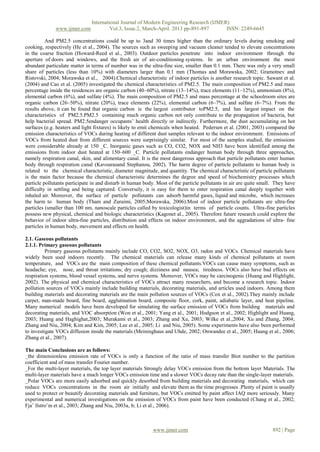
its broad prospect.DOAS results in a significant revolution in air-conditioning industry Typical DOAS, shown in Fig. 1,
consists of the following several parts (Yin and Mumma, 2003):
_Cold source: As the outlet air temperature of the outdoor air Producer is required to be no more than 7 _C, its inlet water
temperature should be no more than4
_C.Though the conventional chiller could be used as the cold source of DOAS, the outlet water temperature of the chiller
should be no more than5 _C. So the chiller should be redesigned. The optimal cold source will be the ice-storage system.
_Outdoor air processor: To ensure that indoor terminal devices run in dry condition, outdoor air heat load, total latent heat
load and partial sensible heat load are removed by Fig. 1


                                                           www.ijmer.com                                           893 | Page
International Journal of Modern Engineering Research (IJMER)
              www.ijmer.com            Vol.3, Issue.2, March-April. 2013 pp-891-897      ISSN: 2249-6645


                                       Fig.1–: Schematic diagram of typical DOAS.

Outdoor air processor whose outlet air temperature should be no more than 7_C
_Sensible heat removing terminal device (SHRTD): The residual sensible heat load is removed by SHRTD which
includes cooling ceiling (CC), fan coil unit (FCU), and unitary air conditioner. Among them CC is the best one. DOAS using
CC as SHRTD can save the primary energy by 18%, compared with DOAS using FCU as SHRTD (Li and Zhang, 2007).
_Total heat exchanger: Outdoor air is dehumidified by solid Dehumidizer in desiccant wheel, and then exchanges total heat
or sensible heat with exhaust air in heat recovery wheel to recover the energy of exhaust air._ Automatic control system:
Automatic control system is necessary for DOAS. The controlled parameters mainly include the outlet water
temperature and the cold water flux of outdoor air processor, cold water flux and inlet water temperature of SHRTD, indoor
dry-bulb temperature and dew-point temperature. The inlet water temperature of SHRTD is controlled based on indoor dew-
point temperature, and the total latent heat load is removed by outdoor air processor. Therefore, SHRTD runs in dry
condition completely and there is no need to worry about the condensing water. Moreover, DOAS is an all air system
without return air, and it eliminates intercrossing infection existing in all air system with return air. DOAS also exhibits
better effect of energy saving. When the effectiveness of total heat exchanger is 65%, DOAS using CC as SHRTD can save
the electric energy by 42%, compared with conventional VAV systems (Jeong et al., 2003). As the energy consumption of
DOAS highly depends on the efficiency of total heat recovery devices, it would be important to develop the heat recovery
devices with high efficiency. In addition, to ensure that DOAS runs effectively and safely, further work needs to be done to
improve automatic control system and to enhance the Compatibility among different parts of DOAS.


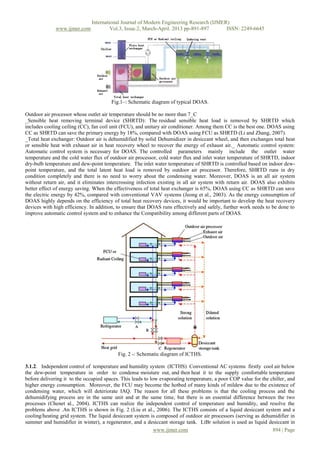
                                           Fig. 2 -: Schematic diagram of ICTHS.

3.1.2. Independent control of temperature and humidity system (ICTHS) Conventional AC systems firstly cool air below
the dew-point temperature in order to condense moisture out, and then heat it to the supply comfortable temperature
before delivering it to the occupied spaces. This leads to low evaporating temperature, a poor COP value for the chiller, and
higher energy consumption. Moreover, the FCU may become the hotbed of many kinds of mildew due to the existence of
condensing water, which will deteriorate IAQ. The reason for all these problems is that the cooling process and the
dehumidifying process are in the same unit and at the same time, but there is an essential difference between the two
processes (Chenet al., 2004). ICTHS can realize the independent control of temperature and humidity, and resolve the
problems above .An ICTHS is shown in Fig. 2 (Liu et al., 2006). The ICTHS consists of a liquid desiccant system and a
cooling/heating grid system. The liquid desiccant system is composed of outdoor air processors (serving as dehumidifier in
summer and humidifier in winter), a regenerator, and a desiccant storage tank. LiBr solution is used as liquid desiccant in
                                                             www.ijmer.com                                        894 | Page
International Journal of Modern Engineering Research (IJMER)
              www.ijmer.com             Vol.3, Issue.2, March-April. 2013 pp-891-897      ISSN: 2249-6645

the system and the regeneration temperature is about 60 _C. The cooling/ heating grid system is composed of the power
driven refrigerator, the heat grid, and the FCU or radiant ceiling. In summer operations, valves A and C are turned on and
valve B is turned off, and the ICTHS performs dehumidification and cooling of the air. Chilled water with temperature of
15–18 _C flows from the refrigerator into the outdoor air processors and the indoor terminal devices. The outdoor air
processors remove the total latent load and a portion of sensible load of the occupied space, while the indoor
terminal Devices deal with the remained sensible load. IAQ is greatly Improved because of the following two main
reasons: (i) indoor terminal devices operate in dry condition, and no condensing water will be produced on the surfaces
of the AC system; (ii) the liquid desiccant can remove a number of pollutants from the air stream. In winter operations,
valves A and C are turned off and valve B is turned on, and the ICTHS Performs humidification and heating of the air. Hot
water from the heat grid flows into the outdoor air processors and indoor terminal devices. The operating principle of the
outdoor air processor is shown in Fig. 3. The outdoor air processor consists of two parts. The left of the broken line is a three
stage total heat recovery device using liquid desiccant, and the right of the broken line is a single-stage spray unit(Li et al.,
2003).The ICTHS can not only improve IAQ but reduce energy consumption and operation cost. In summer, when the latent
load of the building covers from 10% to 50%, the primary energy consumption of the ICTHS is 76–80% and the operation
cost is about 75% of that of the conventional AC systems. In winter, when latent load of the building are 5%, 10% and 15%,
the primary energy consumption of the ICTHS is 77%, 62% and 45%, respectively, and the operation cost is 75%, 57% and
42%, respectively, compared with that of a conventional AC systems (Liu et al., 2006). If solar energy or waste Fig. 2 –
Schematic diagram of ICTHS. Heat is used to regenerate desiccant, and ground water is used to cool indoor air, more energy
and operation cost would be saved. However, the FCU in ICTHS is only used to cool indoor air and is different from the
FCU in conventional AC systems. So the FCU in ICTHS needs to be redesigned

                                                   IV. Control of IAQ
          In order to provide a comfortable and healthy indoor air Environment, measures must be adopted to control the
concentration level of indoor pollutants and improve IAQ. The current methods mainly include control of pollution sources,
ventilation and indoor air purification. The recent research on ventilation has been described .Control of pollution source sIt
is a most economical and effective approach in improving IAQ to eliminate or reduce indoor pollution sources (Guo et al.,
2003). The best ways of controlling indoor air pollution are to use pollution-free or low-pollution materials and to adopt
the design and maintenance measures that avoid producing indoor pollutants. They are outlined in detail in

The following (Li et al., 2004; Zhang et al., 2005a; Zhang et al., 2006b):
_Filtrating the outdoor air to prevent outdoor pollutants from entering the room.
_Isolating the sites that may form pollution sources (e.g, copycat rooms, printer rooms, kitchen and toilet) in order to avoid
intercrossing infection, and using the enforced ventilation when necessary.
_making full use of pollution-free or low-pollution building Materials and decorating materials Preventing building products
with high pollution from entering market by government Legislating and setting up industry standard. For the products in
markets, government can label them with different grade. The building materials and decorating materials with high
pollution can be eliminated by market mechanism.
_Dust and liquid drops are the important medium for bacteria to spread. It is necessary to trebly clean the components that
are easy to be infected in air-conditioning systems (e.g., filter, heat exchanger and muffler) and to replace them in time in
order to avoid the aggradations of pollutants. Moreover, the condensing water should be eliminated in time or ICTHS is
employed in air-conditioning systems to prevent bacteria from propagating. In addition, occupants’ behavior is also an
important origin for indoor pollutants, so we should form better customs such as no high strength activities in room,
keeping better individual sanitation, no smoking in room, and avoiding using pressurized spray and cosmetic. Researchers
should keep on investigating chemical pollutants’ releasing characteristics of materials used indoors and exploiting new
types of materials without release of pollutants.


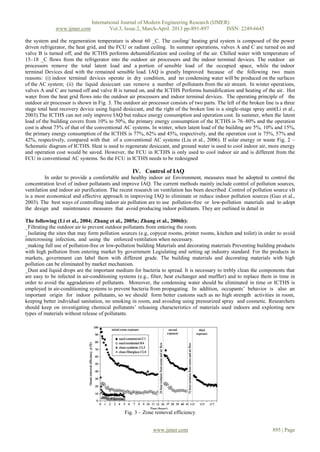
                                               Fig. 3 – Zone removal efficiency


                                                             www.ijmer.com                                            895 | Page
International Journal of Modern Engineering Research (IJMER)
              www.ijmer.com             Vol.3, Issue.2, March-April. 2013 pp-891-897      ISSN: 2249-6645

4.2. Indoor air purification
          Indoor air purification is an important method of removing indoor pollutants and improving IAQ under the
circumstances that the ventilation and the control of pollution sources are impossible. The major methods of indoor air
purification include filtration, adsorption, photo catalytic oxidation (PCO), Negative air ions (NAIs) and non-thermal plasma
(NTP).

4.2.1. Filtration
           Filtration is a quite economical and efficient method of improving IAQ. Filters are important components in all AC
systems. It has been found that AC filters can remove ozone significantly at steady state (Hyttinen et al., 2003, 2006; Beko¨
et al., 2005, 2006). Zhao et al. (2007) measured the ozone removal efficiencies of clean filters and field-loaded residential
and commercial filters in a controlled laboratory (air temperature 22–26_C, 45–60% RH). The steady-state ozone removal
efficiency varied from 0% to 9% for clean filters. The mean steady-state ozone removal efficiencies for loaded residential
and commercial filters were 10% and 41%, respectively. From the results above it can be seen that the particles deposited on
the filters can increase the ozone removal efficiencies.
           Zhao et al. (2007) also observed a partial regeneration of ozone removal efficiency after filters were isolated
from ozone and treated with clean air, nitrogen, and/or heat (Fig. 3). The ozone removal efficiency of AC filters appeared to
decay with time (Hyttinen et al., 2006; Beko¨ et al., 2005, 2006). Beko¨etal. (2006) found that the initial ozone removal
efficiency was 35–50%, only 5–10% after an hour. The removal of ozone from indoor environments is generally desirable.
However, the ozone removal on AC filters is mainly due to the chemical reactions between ozone and the particles deposited
on the filters, which can lead to oxidation products such as formaldehyde, carbonyls, formic acid, and ultra-fine particles
(Beko¨ et al., 2005; Hyttinen et al., 2006). Processes involved in the removal of ozone on HVAC filters include: (i) ozone
advection through the filter, (ii) ozone diffusion into the boundary layer near particles, (iii) ozone diffusion into
particles, (iv) diffusion of reactive organic compounds out of particles, and (v) ozone reactions with reactive organic
compounds. Based on time scales analysis, it appeared that the diffusion processes of ozone and reactive organic compounds
were the limiting factors for ozone removal in filters. The speed of the two processes depended largely on the
composition of deposited particles (Zhao et al., 2007). Further research is needed to identify and quantify time-dependent
emissions of oxidized products and their potential significance with respect to IAQ. Despite the fact that air filtration systems
represent a good solution for the improvement of IAQ, they could become a source of contamination from micro-
organisms harmful to human health. The organic/inorganic matter deposited on the filter contributes to microbial growth,
which inevitably leads to a loss of filter efficiency and filter deterioration. Anti-microbial treatments of filters may be a
solution to these problems (Verdenelli et al., 2003). It is possible to          prevent the accumulation and dispersion of
microorganisms by adding anti-microbial agents on the surfaces of filter, which contributes to the improvement of air
quality. The filter sections stereomicroscope analysis on untreated and treated filter media showed that the anti- microbial
treatments can reduce microbial colonization significantly (Cecchini et al., 2004). The active component of the anti-
microbial agent is cis-1-(3-chloroallyl)-3, 5, 7-triaza-1- azoniaadamantane chloride. The incubation experiments indicated
that untreated filter medium released microorganisms after 27 days, while release from the treated filter medium was
delayed, after 67 days. The experimental results of Verdenelli et al. (2003) also showed that compared with untreated
filters, the anti-microbial treatments could delay the deterioration of filter and result in a lower release of metabolic
products. Verdenelli et al. (2003) experimentally investigated the pressure loss of the untreated.

4.2. Indoor air purification
          Indoor air purification is an important method of removing indoor pollutants and improving IAQ under the
circumstances that the ventilation and the control of pollution sources are impossible. The major methods of indoor air
purification include filtration, adsorption, photo catalytic oxidation (PCO), Negative air ions (NAIs), and non-thermal
plasma (NTP).

                                                      V. Conclusion
         A comfortable and healthy indoor air environment is favorable to occupants. In recent years, indoor thermal
comfort has been improved greatly due to the development of air-conditioning systems. However, health problems related to
poor IAQ appear more frequently, and it is the indoor pollutants that lead to poor IAQ. Many researchers have widely
investigated the composition of indoor pollutants, sources, physical and chemical characteristics, and effects on human
health. However, a given symptom usually has different causes, and a given pollutant may result in (or trigger) many
different symptoms. The biological effects of different pollutants may differ by orders of magnitude. Moreover, the
composition of indoor pollutants is quite complex and their concentrations are greatly different. The chemical reactions
among indoor pollutants may occur, which can produce more irritating secondary pollutants .Many secondary pollutants
even cannot be measured for the moment. It is not clear that the effect mechanism of these pollutants to human body with
exposure under low concentrations and short time levels. It is also uncertain that the impact of exposure amount and
exposure time on human health. Only if these problems are resolved can indoor air environment be controlled accurately
and reasonably.


                                                             www.ijmer.com                                            896 | Page
International Journal of Modern Engineering Research (IJMER)
               www.ijmer.com              Vol.3, Issue.2, March-April. 2013 pp-891-897      ISSN: 2249-6645

                                                          REFERENCES
[1]   Boyd N, Mindorff C, Bruce D et al. Infection prevention during construction/renovation in hospitals: sample policies and
      bibliography. Sarnia, Ontario: St. Joseph’s Health Centre, 1995.
[2]   Cheple M., Construction and Renovation Impact on Indoor Air Quality-Control Strategies, University of Minnesota, Vol. 1, Issue 2,
      August 1998.
[3]   James C.A., Article on Air Pollution in Healthcare Facilities, Indoor Air Quality Problems in Healthcare Facilities, 2003.
[4]   Keiser R., Planning Is Easier Said than Done, 2002, http://www.facilitiesnet.com/BOM/Sep02/Sep02constructio na.shtmlKuehn, T.
      Construction/renovation influence on indoor air quality. ASHRAE Journal, 1996.
[5]   Martone WJ, Jarvis WR, Incidence and nature of endemic and epidemic nosocomial infections (p.577-596).MS Hospital Consulting,
      2001 (http://www.mshospitalconsulting.com/page20.htm)
[6]   Streifel J., C. Henrickson, Assessment of Health Risks Related to Construction, Minimizing the threat of infection from
      construction-induced air pollution in health-care facilities, Minneapolis, Minn., HPAC Engineering, 2002
[7]   Sandrick K., Health Facilities Management, Using environmentally friendly construction, 2003


                                                               www.ijmer.com                                               897 | Page

Bv32891897

  • 1.
    International Journal ofModern Engineering Research (IJMER) www.ijmer.com Vol.3, Issue.2, March-April. 2013 pp-891-897 ISSN: 2249-6645 Indoor Air Quality Monitoring For Human Health Prajakta P. Shrimandilkar Department of Electronics Engineering Amrutvahini College of Engineering, Sangamner Guide Name: R. B. Sonawane Sangamner, India Abstract: The assessment of indoor air quality (IAQ) risks to building occupants has become a complex and challenging issue for building owners and facility managers. Recent research has defined causal links between construction practices and infection rates in health care building and renovation projects. Attention to IAQ management during building construction is being elevated because of its potential role in fungal, mold, related problems in buildings. Advanced environmental control techniques and are now being developed to better manage IAQ in health care facilities, including improved particulate control, air disinfection systems, moisture control, and pressurization strategies. Each of these creates additional sequencing and process requirements during construction with related implications for construction cost and schedules. As a result, the role of the contractor in managing and implementing indoor air quality in health care construction and renovation is becoming increasingly complex. This paper presents an analysis the relationships emerging between IAQ technologies and construction practices, with an emphasis on heath care facility construction. A case study of IAQ management during construction is presented to illustrate the lack of current formal processes, and the implications of state-of-the art infection control strategies on construction projects. Recommendations are made for improved assessment, control, and monitoring of moisture in buildings during construction as an example of how to improve current practice. Future directions for research in this critical area of the construction industry are also provided. Keywords: Indoor Air Quality, ealth care Construction, Mold, Allergen, IAQ Risk I. Introduction Air-conditioning systems have been used in many parts of the world. The purpose of most systems is to provide thermal Comfort and an acceptable indoor air quality (IAQ) for Occupants. With the improvement of standard of living, occupants require more and more comfortable and healthful Indoor environment. People spend 80_90% of their time indoors, and indoor environment has important effects on human health and work efficiency. The factors affecting indoor environment mainly include temperature, humidity, air exchange rate, air movement, ventilation, particle pollutants, biological pollutants, and gaseous pollutants (Graudenzet al., 2005). By analyzing recent studies, Seppanen and Fisk (2002) found that there was an increase in prevalence of sick building syndrome (SBS) between 30% and 200% in the buildings with air-conditioning systems when compared with natural ventilation systems. Death caused by Legionnaires’ disease even occurred in air conditioned buildings. In addition, SARSoccurred in 2003. All of these events are a warning for indoor environment problems related to AC systems. It is fair to say that indoor environment problems still exist in many air- conditioned and mechanically ventilated buildings, even though existing standards may be met. One of the consequences of the worldwide energy crisis in 1970s is the public recognition of the importance of energy saving. The buildings built since then are more airtight and use a great deal of insulation materials to minimize the loss of energy through the building envelope. Fresh air is reduced in air-conditioning systems in order to reduce the energy consumption. Meanwhile, synthetic materials and chemical products (e.g., building materials and decorating materials) have widely been used indoors. The combination of low ventilation rates and the presence of numerous synthetic chemicals results in elevated concentrations of indoor particle pollutants and volatile organic compounds (VOCs) (e.g. benzene, toluene, and formaldehyde). This is deemed to be a major contributing factor to compound hypersensitiveness (Wang et al., 2004a). However, it is exciting that some comfortable and healthy air- conditioning systems were proposed in the past few years. In order to control the concentration level of indoor pollutants and to improve IAQ, many researchers have investigated the control methods of IAQ. In this paper, recent research will be reviewed on air-conditioning systems and indoor air quality control for human health.2. Indoor air environment indoor air environments must meet the requirement of thermal comfort and IAQ. Thermal comfort is affected by many factors, which mainly include air temperature, air humidity, air velocity, mean radiant temperature, human clothing, and activity levels. The wide use of air conditioning helps to improve thermal comfort, but health problems associated with poor IAQ appear more frequently (e.g., SBS) (Niu, 2004).Many experts believe that IAQ may be the most important and relatively overlooked environmental issue of our time (Gao, 2002). It is indoor pollutants that lead to poor IAQ. Indoor pollutants include particle pollutants and gaseous pollutants. II. Particle Pollutants The sources of indoor particle pollutants can be divided into Indoor pollution sources and outdoor pollution sources, and the concentrations and composition of indoor particle pollutants are different with different pollution sources. In residential buildings, particles released by indoor pollution sources (e.g., cooking, smoking) were mostly fine particles and ultra-fine particles which were about 80% of the particles in terms of particle counts (See and Bala subramanian, 2006). www.ijmer.com 891 | Page
  • 2.
    International Journal ofModern Engineering Research (IJMER) www.ijmer.com Vol.3, Issue.2, March-April. 2013 pp-891-897 ISSN: 2249-6645 And PM2.5 concentrations could be up to 3and 30 times higher than the ordinary levels during smoking and cooking, respectively (He et al., 2004). The sources such as sweeping and vacuum cleaner tended to elevate concentrations in the coarse fraction (Howard-Reed et al., 2003). Outdoor particles penetrate into indoor environment through the aperture of doors and windows, and the fresh air of air-conditioning systems. In an urban environment the most abundant particulate matter in terms of number was in the ultra-fine size, smaller than 0.1 mm. There was only a very small share of particles (less than 10%) with diameters larger than 0.1 mm (Thomas and Morawska, 2002; Gramotnev and Ristovski, 2004; Morawska et al., 2004).Chemical characteristic of indoor particles is another research topic. Sawant et al. (2004) and Cao et al. (2005) investigated the chemical characteristics of PM2.5. The main composition of PM2.5 and mass percentage inside the residences are organic carbon (40–60%), nitrate (13–14%), trace elements (11–12%), ammonium (8%), elemental carbon (6%), and sulfate (4%). The main composition of PM2.5 and mass percentage at the schoolroom sites are organic carbon (26–50%), nitrate (20%), trace elements (22%), elemental carbon (6–7%), and sulfate (6–7%). From the results above, it can be found that organic carbon is the largest contributor toPM2.5, and has largest impact on the characteristics of PM2.5.PM2.5 containing much organic carbon not only contribute to the propagation of bacteria, but help bacterial spread. PM2.5endanger occupants’ health directly or indirectly. Furthermore, the dust accumulating on hot surfaces (e.g. heaters and light fixtures) is likely to emit chemicals when heated. Pedersen et al. (2001, 2003) compared the emission characteristics of VOCs during heating of different dust samples relevant to the indoor environment. Emissions of VOCs from heated dust from different sources were surprisingly similar. For most of the samples studied, the emissions were considerable already at 150 _C. Inorganic gases such as CO, CO2, NOX and NH3 have been identified among the emissions from indoor dust heated at 150–600 _C. Particle pollutants endanger human body through three approaches, namely respiration canal, skin, and alimentary canal. It is the most dangerous approach that particle pollutants enter human body through respiration canal (Kavourasand Stephanou, 2002). The harm degree of particle pollutants to human body is related to the chemical characteristic, diameter magnitude, and quantity. The chemical characteristic of particle pollutants is the main factor because the chemical characteristic determines the degree and speed of biochemistry processes which particle pollutants participate in and disturb in human body. Most of the particle pollutants in air are quite small. They have difficulty in settling and being captured. Conversely, it is easy for them to enter respiration canal deeply together with inhaled air. Moreover, the surface of particle pollutants can adsorb harmful gases, liquid and microbe, which increases the harm to human body (Tham and Zuraimi, 2005;Morawska, 2006).Most of indoor particle pollutants are ultra-fine particles (smaller than 100 nm, nanoscale particles called by toxicologist)in terms of particle counts. Ultra-fine particles possess new physical, chemical and biologic characteristics (Kagonet al., 2005). Therefore future research could explore the behavior of indoor ultra-fine particles, distribution and effects on indoor environment, and the aggradations of ultra- fine particles in human body, movement and effects on health. 2.1. Gaseous pollutants 2.1.1. Primary gaseous pollutants Primary gaseous pollutants mainly include CO, CO2, SO2, NOX, O3, radon and VOCs. Chemical materials have widely been used indoors recently. The chemical materials can release many kinds of chemical pollutants at room temperature, and VOCs are the main composition of these chemical pollutants.VOCs can cause many symptoms, such as headache; eye, nose, and throat irritations; dry cough; dizziness and nausea; tiredness. VOCs also have bad effects on respiration systems, blood vessel systems, and nerve systems. Moreover, VOCs may be carcinogenic (Huang and Highlight, 2002). The physical and chemical characteristics of VOCs attract many researchers, and become a research topic. Indoor pollution sources of VOCs mainly include building materials, decorating materials, and articles used indoors. Among them building materials and decorating materials are the main pollution sources of VOCs (Cox et al., 2002).They mainly include carpet, man-made board, fine board, agglutination board, composite floor, cork, paint, adiabatic layer, and heat pipeline. Many numerical models have been developed for simulating the surface emission of VOCs from building materials and decorating materials, and VOC absorption (Won et al., 2001; Yang et al., 2001; Hodgson et al., 2002; Highlight and Huang, 2003; Huang and Haghighat,2003; Murakami et al., 2003; Zhang and Xu, 2003; Wilke et al.,2004; Xu and Zhang, 2004; Zhang and Niu, 2004; Kim and Kim, 2005; Lee et al., 2005; Li and Niu, 2005). Some experiments have also been performed to investigate VOCs diffusion inside the materials (Meininghaus and Uhde, 2002; Onwandee et al., 2005; Huang et al., 2006; Zhang et al., 2007). The main Conclusions are as follows: _the dimensionless emission rate of VOCs is only a function of the ratio of mass transfer Biot number to the partition coefficient and of mass transfer Fourier number. _For the multi-layer materials, the top layer materials Strongly delay VOCs emission from the bottom layer Materials. The multi-layer materials have a much longer VOCs emission time and a slower VOCs decay rate than the single-layer materials. _Polar VOCs are more easily adsorbed and quickly desorbed from building materials and decorating materials, which can reduce VOCs concentrations in the room air initially and elevate them as the time progresses .Plenty of paint is usually used to protect or beautify decorating materials and furniture, but VOCs emitted by paint affect IAQ more seriously. Many experimental and numerical investigations on the emission of VOCs from paint have been conducted (Chang et al., 2002; Fja¨ llstro¨m et al., 2003; Zhang and Niu, 2003a, b; Li et al., 2006). www.ijmer.com 892 | Page
  • 3.
    International Journal ofModern Engineering Research (IJMER) www.ijmer.com Vol.3, Issue.2, March-April. 2013 pp-891-897 ISSN: 2249-6645 The main conclusions are as follows: _23 individual VOCs were detected and the 7 major VOCs Were1-ethyl-3-methylbenzene, 1, 2, 4-trimethylbenzene, nhexane, 1, 3, 5-trimethylbenzene, propylbenzene, o-xylene, and toluene. The sum of the amount of these 7 VOCs was 85% of that of the total VOCs detected. _ about 65.2% of the VOCs were emitted within the first 4 h, and the emission then slows down and persists for a long period. After 10 days, about 99% of the VOCs were released to indoor air. _the substrates with high adsorption capacity act as a secondary source for VOCs emission, and such effects may prolong the decay of VOCs. Although the emission and sorption of many VOCs pollution sources have been investigated experimentally and numerically, the following need to be researched further. _Some hypothesizes have been adopted in the numerical Models, such as one-dimensional mass transfer, constant Physical properties and uniform materials. Many materials actually do not meet these hypothesizes. _ Excessive VOCs do damage human health, but the damage of individual VOCs in pathology is lack of research. Moreover, it is not clear that the effect mechanism of VOCs to human body and the influences of exposure concentrations and exposure time on human health are uncertain. 2.2.2. Secondary gaseous pollutants The mix of pollutants in indoor environments can be transformed as a consequence of chemical reaction. Reaction Between ozone and some unsaturated hydrocarbons is an important source of indoor secondary pollutants which mainly include free radicals, aldehydes, ketones, alcohols, carboxylic acids, and fine particulate matter (Sarwar et al., 2003). Secondary pollutants may be more irritating than the original reactants (Wainman et al., 2002; Rohr et al., 2003).During the past few years, many investigations were conducted on indoor secondary pollution due to ozone reacting with limonene (Clausen et al., 2001; Schell et al., 2001;Knudsen et al., 2002; Nøjgaard et al., 2005; Sirakarn et al.,2005; Tama´s et al., 2006; Sarwar and Corsi, 2007), terpene(Knudsen et al., 2002; Weschler and Shields, 2003; Kleno and Wolkoff, 2004; Sarwar et al., 2004; Fiedler et al., 2005; Nøjgaardet al., 2005), a-pinene (Fick et al., 2003; Pommer, 2003; Pommeret al., 2004), VOCs (Fan et al., 2003; Liu et al., 2004), organism deposited on a dirty filter (Beko¨ et al., 2003; Hyttinen et al.,2003), and airborne particulate (Mølhave et al., 2004, 2005).Much significant research has occurred in three subtopics: _confirming the importance of hydroxyl radical in indoor transformations. Hydroxyln radical is a product of ozone/terpene reactions and goes on to react with other products. Hydroxyl radical is responsible for a large fraction of oxidized products, including certain products that cannot be made by ozone pathways alone. _Chemical reactions that occur on indoor surfaces. Such reactions may have larger impact on IAQ than those that occur in the gas phase because of the large indoor surface to-volume ratio. _the impact of secondary pollutants on occupants. A major Limitation in evaluating the impact of secondary pollutants is the inability to measure many of the reaction products .Sensory measurements are useful in detecting changes derived from indoor chemistry and changes missed by the Analytical methods routinely used to evaluate indoor air. Indoor secondary pollutants have significant impact on comfort and human health, but the degree of impact and the frequency of occurrence are uncertain at present. In addition, many secondary pollutants cannot be measured because of the complexity of composition and it is necessary to improve the measure level. III. Air-conditioning systems 3.1. Air-conditioning systems Many kinds of AC systems are used to improve indoor thermal comfort and IAQ. Recent research is focused on dedicated outdoor air system (DOAS), independent control of temperature and humidity system (ICTHS), and cooling ceiling and displacement ventilation systems (CC/DV). 3.1.1. Dedicated outdoor air system (DOAS) With the occurrence of SARS, avian flu and anthracnose in some countries, the safety of AC systems becomes more important .DOAS, an effective measure to realize ‘‘immune building’’, has gradually been appreciated by international AC industry (Mumma, 2001). The reason why DOAS is called ‘‘new concept’’ AC system is that the techniques used in DOAS have widely been applied but are subtly combined to Show its broad prospect.DOAS results in a significant revolution in air-conditioning industry Typical DOAS, shown in Fig. 1, consists of the following several parts (Yin and Mumma, 2003): _Cold source: As the outlet air temperature of the outdoor air Producer is required to be no more than 7 _C, its inlet water temperature should be no more than4 _C.Though the conventional chiller could be used as the cold source of DOAS, the outlet water temperature of the chiller should be no more than5 _C. So the chiller should be redesigned. The optimal cold source will be the ice-storage system. _Outdoor air processor: To ensure that indoor terminal devices run in dry condition, outdoor air heat load, total latent heat load and partial sensible heat load are removed by Fig. 1 www.ijmer.com 893 | Page
  • 4.
    International Journal ofModern Engineering Research (IJMER) www.ijmer.com Vol.3, Issue.2, March-April. 2013 pp-891-897 ISSN: 2249-6645 Fig.1–: Schematic diagram of typical DOAS. Outdoor air processor whose outlet air temperature should be no more than 7_C _Sensible heat removing terminal device (SHRTD): The residual sensible heat load is removed by SHRTD which includes cooling ceiling (CC), fan coil unit (FCU), and unitary air conditioner. Among them CC is the best one. DOAS using CC as SHRTD can save the primary energy by 18%, compared with DOAS using FCU as SHRTD (Li and Zhang, 2007). _Total heat exchanger: Outdoor air is dehumidified by solid Dehumidizer in desiccant wheel, and then exchanges total heat or sensible heat with exhaust air in heat recovery wheel to recover the energy of exhaust air._ Automatic control system: Automatic control system is necessary for DOAS. The controlled parameters mainly include the outlet water temperature and the cold water flux of outdoor air processor, cold water flux and inlet water temperature of SHRTD, indoor dry-bulb temperature and dew-point temperature. The inlet water temperature of SHRTD is controlled based on indoor dew- point temperature, and the total latent heat load is removed by outdoor air processor. Therefore, SHRTD runs in dry condition completely and there is no need to worry about the condensing water. Moreover, DOAS is an all air system without return air, and it eliminates intercrossing infection existing in all air system with return air. DOAS also exhibits better effect of energy saving. When the effectiveness of total heat exchanger is 65%, DOAS using CC as SHRTD can save the electric energy by 42%, compared with conventional VAV systems (Jeong et al., 2003). As the energy consumption of DOAS highly depends on the efficiency of total heat recovery devices, it would be important to develop the heat recovery devices with high efficiency. In addition, to ensure that DOAS runs effectively and safely, further work needs to be done to improve automatic control system and to enhance the Compatibility among different parts of DOAS. Fig. 2 -: Schematic diagram of ICTHS. 3.1.2. Independent control of temperature and humidity system (ICTHS) Conventional AC systems firstly cool air below the dew-point temperature in order to condense moisture out, and then heat it to the supply comfortable temperature before delivering it to the occupied spaces. This leads to low evaporating temperature, a poor COP value for the chiller, and higher energy consumption. Moreover, the FCU may become the hotbed of many kinds of mildew due to the existence of condensing water, which will deteriorate IAQ. The reason for all these problems is that the cooling process and the dehumidifying process are in the same unit and at the same time, but there is an essential difference between the two processes (Chenet al., 2004). ICTHS can realize the independent control of temperature and humidity, and resolve the problems above .An ICTHS is shown in Fig. 2 (Liu et al., 2006). The ICTHS consists of a liquid desiccant system and a cooling/heating grid system. The liquid desiccant system is composed of outdoor air processors (serving as dehumidifier in summer and humidifier in winter), a regenerator, and a desiccant storage tank. LiBr solution is used as liquid desiccant in www.ijmer.com 894 | Page
  • 5.
    International Journal ofModern Engineering Research (IJMER) www.ijmer.com Vol.3, Issue.2, March-April. 2013 pp-891-897 ISSN: 2249-6645 the system and the regeneration temperature is about 60 _C. The cooling/ heating grid system is composed of the power driven refrigerator, the heat grid, and the FCU or radiant ceiling. In summer operations, valves A and C are turned on and valve B is turned off, and the ICTHS performs dehumidification and cooling of the air. Chilled water with temperature of 15–18 _C flows from the refrigerator into the outdoor air processors and the indoor terminal devices. The outdoor air processors remove the total latent load and a portion of sensible load of the occupied space, while the indoor terminal Devices deal with the remained sensible load. IAQ is greatly Improved because of the following two main reasons: (i) indoor terminal devices operate in dry condition, and no condensing water will be produced on the surfaces of the AC system; (ii) the liquid desiccant can remove a number of pollutants from the air stream. In winter operations, valves A and C are turned off and valve B is turned on, and the ICTHS Performs humidification and heating of the air. Hot water from the heat grid flows into the outdoor air processors and indoor terminal devices. The operating principle of the outdoor air processor is shown in Fig. 3. The outdoor air processor consists of two parts. The left of the broken line is a three stage total heat recovery device using liquid desiccant, and the right of the broken line is a single-stage spray unit(Li et al., 2003).The ICTHS can not only improve IAQ but reduce energy consumption and operation cost. In summer, when the latent load of the building covers from 10% to 50%, the primary energy consumption of the ICTHS is 76–80% and the operation cost is about 75% of that of the conventional AC systems. In winter, when latent load of the building are 5%, 10% and 15%, the primary energy consumption of the ICTHS is 77%, 62% and 45%, respectively, and the operation cost is 75%, 57% and 42%, respectively, compared with that of a conventional AC systems (Liu et al., 2006). If solar energy or waste Fig. 2 – Schematic diagram of ICTHS. Heat is used to regenerate desiccant, and ground water is used to cool indoor air, more energy and operation cost would be saved. However, the FCU in ICTHS is only used to cool indoor air and is different from the FCU in conventional AC systems. So the FCU in ICTHS needs to be redesigned IV. Control of IAQ In order to provide a comfortable and healthy indoor air Environment, measures must be adopted to control the concentration level of indoor pollutants and improve IAQ. The current methods mainly include control of pollution sources, ventilation and indoor air purification. The recent research on ventilation has been described .Control of pollution source sIt is a most economical and effective approach in improving IAQ to eliminate or reduce indoor pollution sources (Guo et al., 2003). The best ways of controlling indoor air pollution are to use pollution-free or low-pollution materials and to adopt the design and maintenance measures that avoid producing indoor pollutants. They are outlined in detail in The following (Li et al., 2004; Zhang et al., 2005a; Zhang et al., 2006b): _Filtrating the outdoor air to prevent outdoor pollutants from entering the room. _Isolating the sites that may form pollution sources (e.g, copycat rooms, printer rooms, kitchen and toilet) in order to avoid intercrossing infection, and using the enforced ventilation when necessary. _making full use of pollution-free or low-pollution building Materials and decorating materials Preventing building products with high pollution from entering market by government Legislating and setting up industry standard. For the products in markets, government can label them with different grade. The building materials and decorating materials with high pollution can be eliminated by market mechanism. _Dust and liquid drops are the important medium for bacteria to spread. It is necessary to trebly clean the components that are easy to be infected in air-conditioning systems (e.g., filter, heat exchanger and muffler) and to replace them in time in order to avoid the aggradations of pollutants. Moreover, the condensing water should be eliminated in time or ICTHS is employed in air-conditioning systems to prevent bacteria from propagating. In addition, occupants’ behavior is also an important origin for indoor pollutants, so we should form better customs such as no high strength activities in room, keeping better individual sanitation, no smoking in room, and avoiding using pressurized spray and cosmetic. Researchers should keep on investigating chemical pollutants’ releasing characteristics of materials used indoors and exploiting new types of materials without release of pollutants. Fig. 3 – Zone removal efficiency www.ijmer.com 895 | Page
  • 6.
    International Journal ofModern Engineering Research (IJMER) www.ijmer.com Vol.3, Issue.2, March-April. 2013 pp-891-897 ISSN: 2249-6645 4.2. Indoor air purification Indoor air purification is an important method of removing indoor pollutants and improving IAQ under the circumstances that the ventilation and the control of pollution sources are impossible. The major methods of indoor air purification include filtration, adsorption, photo catalytic oxidation (PCO), Negative air ions (NAIs) and non-thermal plasma (NTP). 4.2.1. Filtration Filtration is a quite economical and efficient method of improving IAQ. Filters are important components in all AC systems. It has been found that AC filters can remove ozone significantly at steady state (Hyttinen et al., 2003, 2006; Beko¨ et al., 2005, 2006). Zhao et al. (2007) measured the ozone removal efficiencies of clean filters and field-loaded residential and commercial filters in a controlled laboratory (air temperature 22–26_C, 45–60% RH). The steady-state ozone removal efficiency varied from 0% to 9% for clean filters. The mean steady-state ozone removal efficiencies for loaded residential and commercial filters were 10% and 41%, respectively. From the results above it can be seen that the particles deposited on the filters can increase the ozone removal efficiencies. Zhao et al. (2007) also observed a partial regeneration of ozone removal efficiency after filters were isolated from ozone and treated with clean air, nitrogen, and/or heat (Fig. 3). The ozone removal efficiency of AC filters appeared to decay with time (Hyttinen et al., 2006; Beko¨ et al., 2005, 2006). Beko¨etal. (2006) found that the initial ozone removal efficiency was 35–50%, only 5–10% after an hour. The removal of ozone from indoor environments is generally desirable. However, the ozone removal on AC filters is mainly due to the chemical reactions between ozone and the particles deposited on the filters, which can lead to oxidation products such as formaldehyde, carbonyls, formic acid, and ultra-fine particles (Beko¨ et al., 2005; Hyttinen et al., 2006). Processes involved in the removal of ozone on HVAC filters include: (i) ozone advection through the filter, (ii) ozone diffusion into the boundary layer near particles, (iii) ozone diffusion into particles, (iv) diffusion of reactive organic compounds out of particles, and (v) ozone reactions with reactive organic compounds. Based on time scales analysis, it appeared that the diffusion processes of ozone and reactive organic compounds were the limiting factors for ozone removal in filters. The speed of the two processes depended largely on the composition of deposited particles (Zhao et al., 2007). Further research is needed to identify and quantify time-dependent emissions of oxidized products and their potential significance with respect to IAQ. Despite the fact that air filtration systems represent a good solution for the improvement of IAQ, they could become a source of contamination from micro- organisms harmful to human health. The organic/inorganic matter deposited on the filter contributes to microbial growth, which inevitably leads to a loss of filter efficiency and filter deterioration. Anti-microbial treatments of filters may be a solution to these problems (Verdenelli et al., 2003). It is possible to prevent the accumulation and dispersion of microorganisms by adding anti-microbial agents on the surfaces of filter, which contributes to the improvement of air quality. The filter sections stereomicroscope analysis on untreated and treated filter media showed that the anti- microbial treatments can reduce microbial colonization significantly (Cecchini et al., 2004). The active component of the anti- microbial agent is cis-1-(3-chloroallyl)-3, 5, 7-triaza-1- azoniaadamantane chloride. The incubation experiments indicated that untreated filter medium released microorganisms after 27 days, while release from the treated filter medium was delayed, after 67 days. The experimental results of Verdenelli et al. (2003) also showed that compared with untreated filters, the anti-microbial treatments could delay the deterioration of filter and result in a lower release of metabolic products. Verdenelli et al. (2003) experimentally investigated the pressure loss of the untreated. 4.2. Indoor air purification Indoor air purification is an important method of removing indoor pollutants and improving IAQ under the circumstances that the ventilation and the control of pollution sources are impossible. The major methods of indoor air purification include filtration, adsorption, photo catalytic oxidation (PCO), Negative air ions (NAIs), and non-thermal plasma (NTP). V. Conclusion A comfortable and healthy indoor air environment is favorable to occupants. In recent years, indoor thermal comfort has been improved greatly due to the development of air-conditioning systems. However, health problems related to poor IAQ appear more frequently, and it is the indoor pollutants that lead to poor IAQ. Many researchers have widely investigated the composition of indoor pollutants, sources, physical and chemical characteristics, and effects on human health. However, a given symptom usually has different causes, and a given pollutant may result in (or trigger) many different symptoms. The biological effects of different pollutants may differ by orders of magnitude. Moreover, the composition of indoor pollutants is quite complex and their concentrations are greatly different. The chemical reactions among indoor pollutants may occur, which can produce more irritating secondary pollutants .Many secondary pollutants even cannot be measured for the moment. It is not clear that the effect mechanism of these pollutants to human body with exposure under low concentrations and short time levels. It is also uncertain that the impact of exposure amount and exposure time on human health. Only if these problems are resolved can indoor air environment be controlled accurately and reasonably. www.ijmer.com 896 | Page
  • 7.
    International Journal ofModern Engineering Research (IJMER) www.ijmer.com Vol.3, Issue.2, March-April. 2013 pp-891-897 ISSN: 2249-6645 REFERENCES [1] Boyd N, Mindorff C, Bruce D et al. Infection prevention during construction/renovation in hospitals: sample policies and bibliography. Sarnia, Ontario: St. Joseph’s Health Centre, 1995. [2] Cheple M., Construction and Renovation Impact on Indoor Air Quality-Control Strategies, University of Minnesota, Vol. 1, Issue 2, August 1998. [3] James C.A., Article on Air Pollution in Healthcare Facilities, Indoor Air Quality Problems in Healthcare Facilities, 2003. [4] Keiser R., Planning Is Easier Said than Done, 2002, http://www.facilitiesnet.com/BOM/Sep02/Sep02constructio na.shtmlKuehn, T. Construction/renovation influence on indoor air quality. ASHRAE Journal, 1996. [5] Martone WJ, Jarvis WR, Incidence and nature of endemic and epidemic nosocomial infections (p.577-596).MS Hospital Consulting, 2001 (http://www.mshospitalconsulting.com/page20.htm) [6] Streifel J., C. Henrickson, Assessment of Health Risks Related to Construction, Minimizing the threat of infection from construction-induced air pollution in health-care facilities, Minneapolis, Minn., HPAC Engineering, 2002 [7] Sandrick K., Health Facilities Management, Using environmentally friendly construction, 2003 www.ijmer.com 897 | Page