REPORT
ON
POST IMPACT ASSESSMENT (PIA)
STUDIES
FOR
NESTLE TRI – GENERATION
POWER PLANT
FEB, 2012
PIA CONTENT / OUTLINE
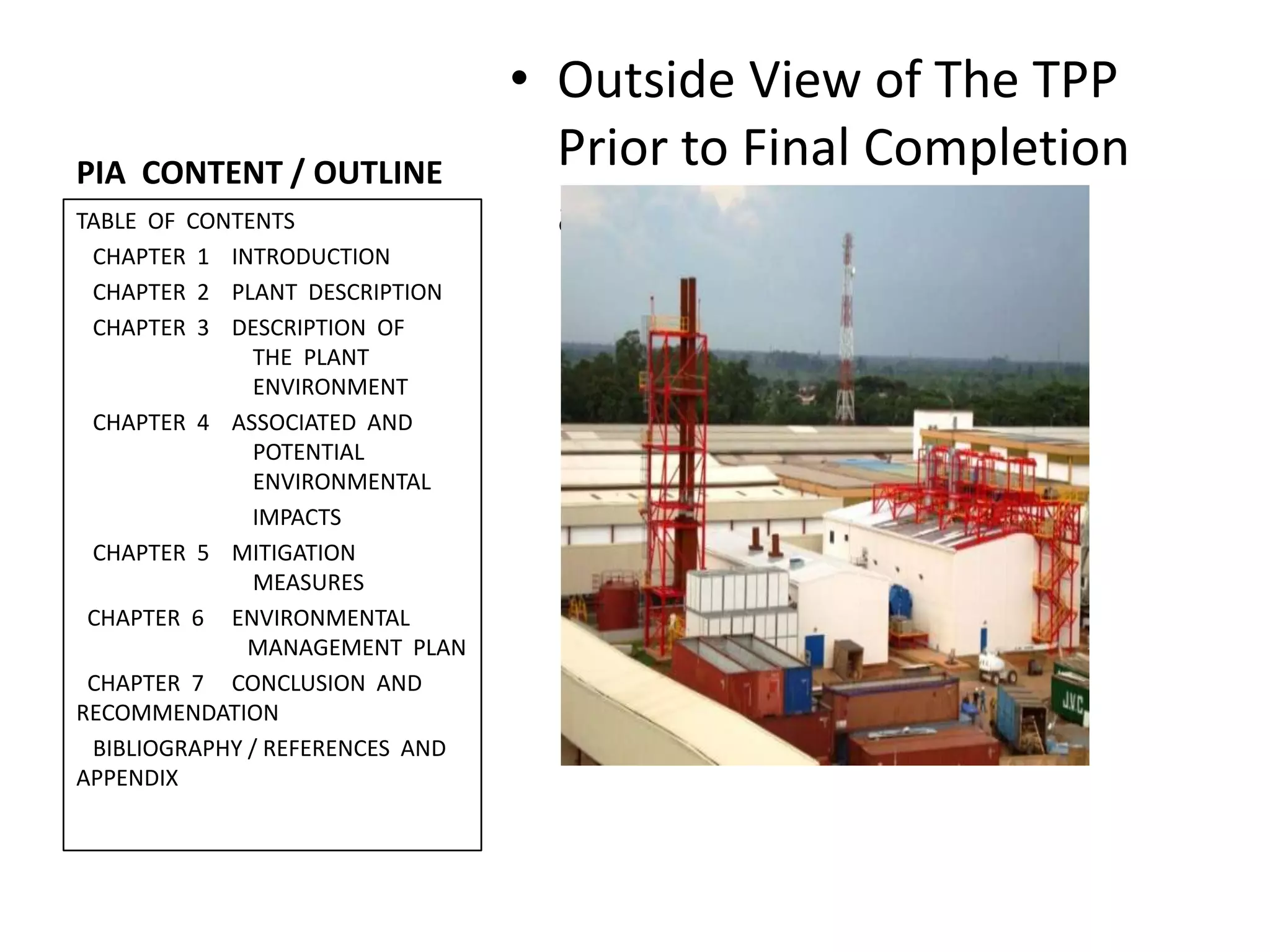
• Outside View of The TPP
Prior to Final Completion
and CommissioningTABLE OF CONTENTS
CHAPTER 1 INTRODUCTION
CHAPTER 2 PLANT DESCRIPTION
CHAPTER 3 DESCRIPTION OF
THE PLANT
ENVIRONMENT
CHAPTER 4 ASSOCIATED AND
POTENTIAL
ENVIRONMENTAL
IMPACTS
CHAPTER 5 MITIGATION
MEASURES
CHAPTER 6 ENVIRONMENTAL
MANAGEMENT PLAN
CHAPTER 7 CONCLUSION AND
RECOMMENDATION
BIBLIOGRAPHY / REFERENCES AND
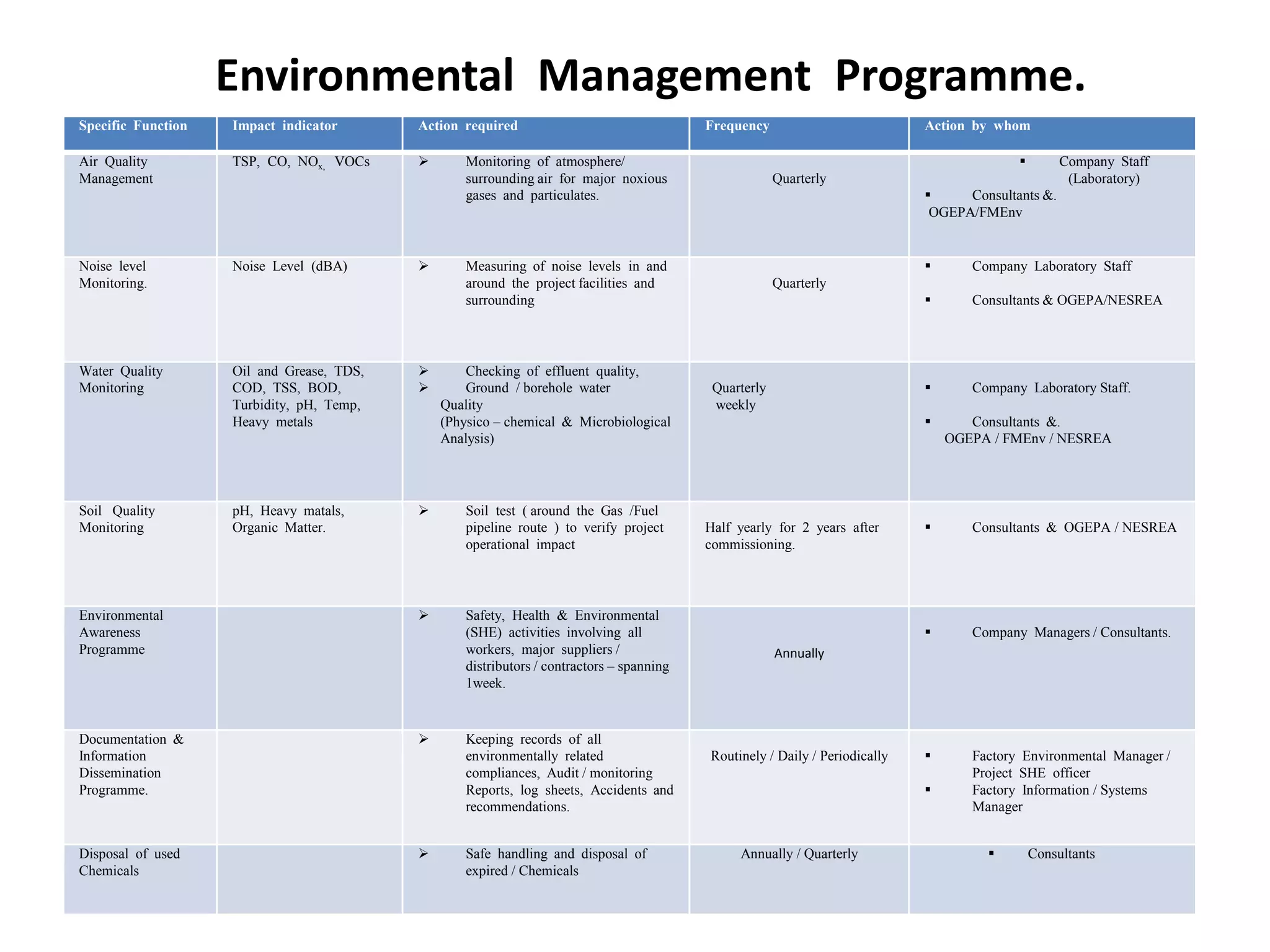
APPENDIX
CHAPTER ONE
APPLICANT AND BACKGROUND INFORMATION
• Nestle Nigeria Plc, Agbara Factory, a leading
Food & Beverages company and popularly
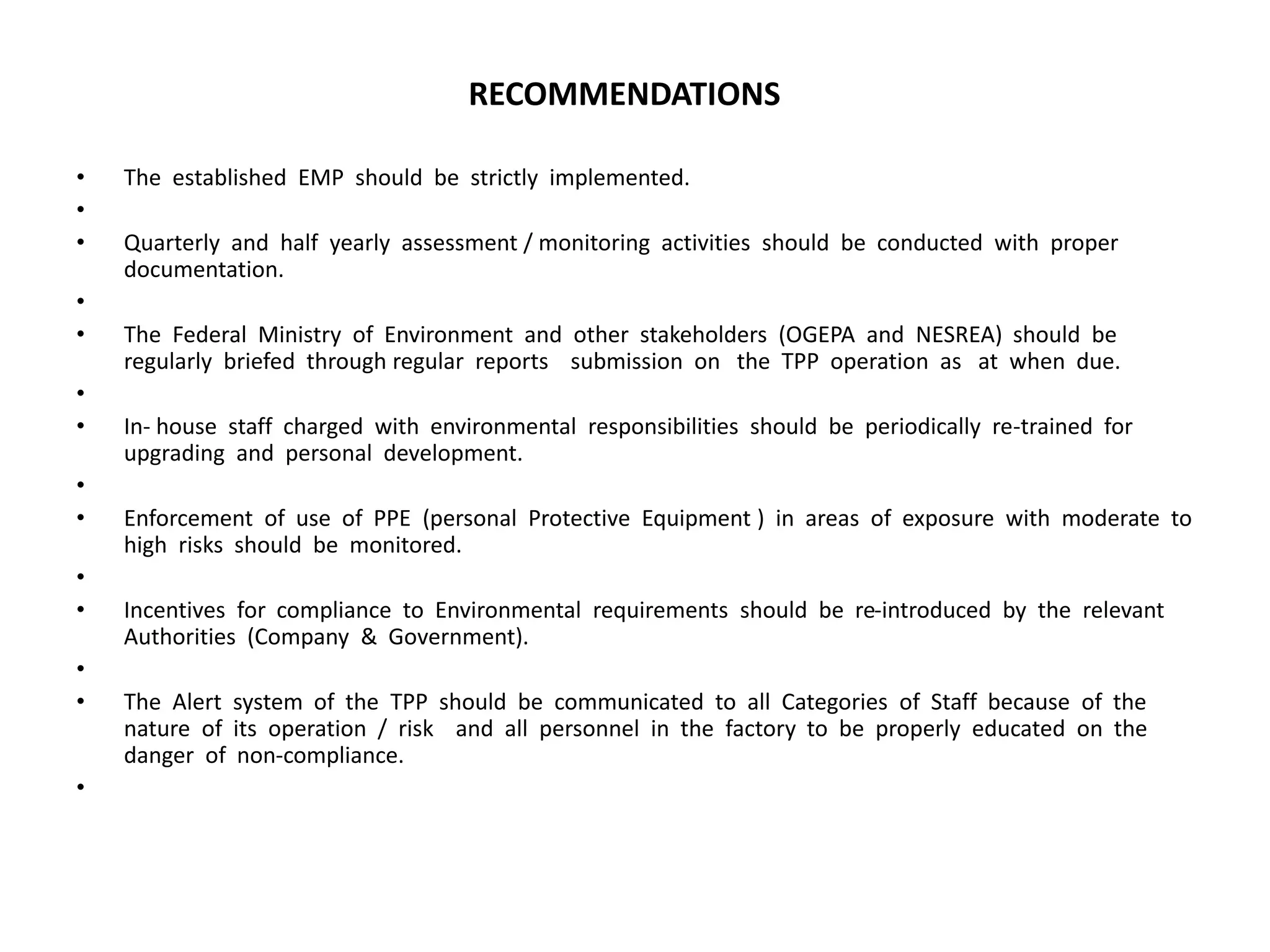
known for its range of high quality products
like Milo, Maggi, Golden Morn, Cerelac etc
• NEED FOR THE PROJECT
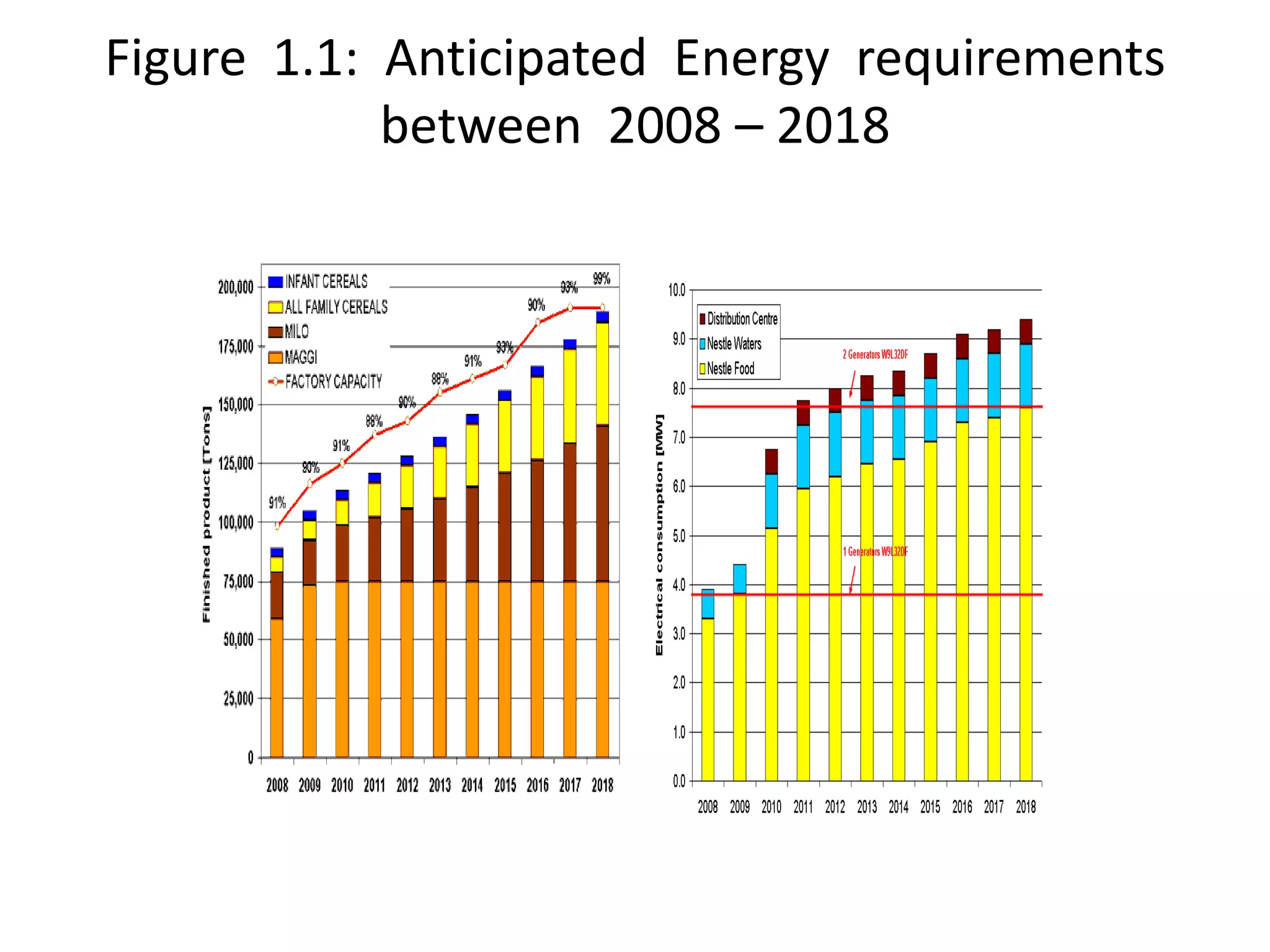
• The worsening state of Public power supply
• Anticipated factory energy requirement by
2018
Figure 1.1: Anticipated Energy requirements
between 2008 – 2018
LEGAL AND ADMINISTRATIVE FRAMEWORK
Applicable laws and guidelines relevant to the execution of this audit and sighted
in the report are as follows:
• Environmental Impact Assessment (EIA)
(Decree 86, 1992).
• National Environmental Standards and
Regulations Enforcement Agency Act,
2007 And National Environmental
(Food, Beverages and Tobacco Sector)
Regulations 2008.
• National Environmental Standards and
Regulations Enforcement Agency Act,
2007 And National Environmental
(Electrical / Electronic Sector)
Regulations S.I. 23 of 2011 (Federal
Government Gazette 50, Vol. 98
25/05/2011)
• Electric Power Sector Reform Act 2005
• Nigeria Electricity Regulatory
Commission (Application For Licences,
Generation, Transmission, System
Operations, Distribution And Trading)
Regulations, 2006
• Nigeria Electricity Regulatory
Commission (Licence and Operating
Fees) Regulations, 2006
• Ogun State Environmental Protection
Agency (OGEPA) Edict No.1 of 1995
And Environmental (Miscellaneous
Provision) Regulations 2005 (Section 10
(1) ).
OBJECTIVES & TERMS of REFRENCE THE OF THE PIA Studies
OBJECTIVES
• Provision of instrument for establishing any
activity that may likely or to a significant
extent affect the environment adversely by the
New Project.
• to promote the implementation of appropriate
mitigation measures / policy that would lead to
reduction of the negative environmental
impacts.
• To encourage the development of procedures
for information exchange, notification and
consultation between the Company, NESTLE
and other stakeholders wherever the New
Project operations are / may likely to have
significant adverse effects on the neighbouring
establishments, towns and villages.
• To assist the company, NESTLE, in the
establishment and achievement of long term
management objectives of minimizing
environmental risks and associated financial
losses.
• To ensure that the New Project does not lead
to non – compliance of the existing internal,
NESTLE (where available), and statutory
environmental laws and regulations.
TERMS OF REFERENCE
– Measurement of the air quality and noise level
within the TPP area.
– Collection and analysis of liquid effluent, gaseous
emissions from the TPP plant.
– Establishment of compliance of the TPP with the
standard limits set by FMENV / NESREA for
gaseous emission, liquid effluent and noise level.
– Assessment of the Safety, Health and
Environmental (SHE) policy of Nestle as it relates
to the TPP operation..
– Assessment of the plant’s internal environmental
management system to implement the above
policies.
– Examining the sanitary and aesthetic conditions of
the TPP
– Examination of sources of waste, existing waste
disposal methods and waste reduction options
available in the plant and specifically for the
TPP.
– Proposing appropriate and practicable
recommendation on i - vii
– Preparation of Post - Impact Assessment Studies
Report for the TPP operation and submission to
the appropriate Regulatory Authority
• SCOPE OF STUDY
As Outlined in the Report includes among others :
• Review of the Nestle / TPP’s environmental policy and set objectives.
• Tri-generation Power Plant operations / management
• TPP Environmental Management System (EMS)
• air pollution levels and control
• water pollution potential and spill prevention
• solid and hazardous waste disposal
• noise level measurement and abatement
• handling and storage of chemicals
• occupational health
• PERIOD OF STUDY
• The study was undertaken between December 2011 and February 2012. Both the
Consultants team and the Project’s team were involved in preparing the report to
ensure the necessary auditing expertise and inputs.
• METHODOLOGY
Details in the report
CHAPTER TWO
PLANT DESCRIPTION
 NATURE OF PLANT
• Tri-generation Power Plant (TPP) is an integrated power (Electricity), Hot
water (Heat) and Chilled water (Cooling) System facility.
 THE PLANT LOCATION
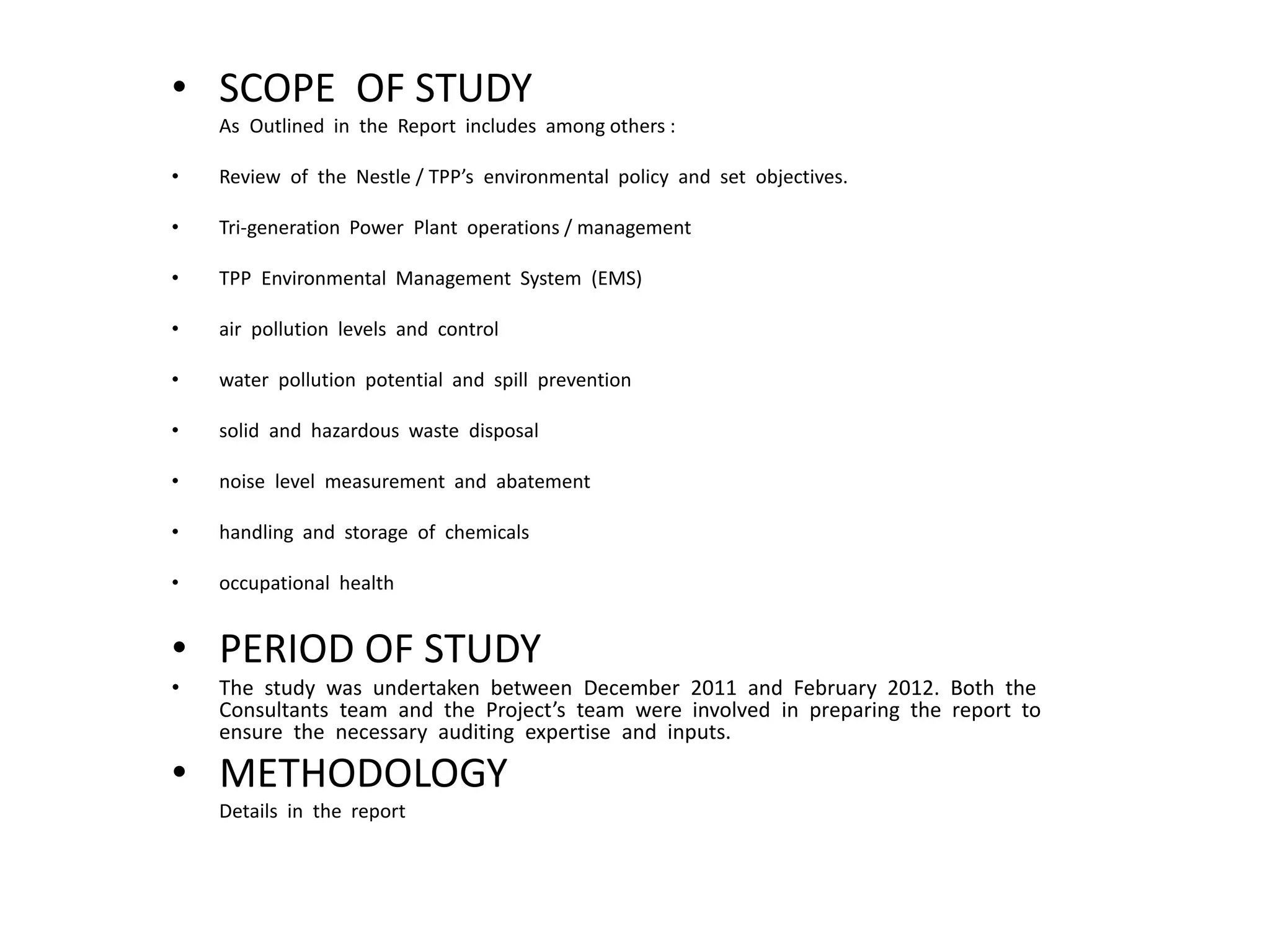
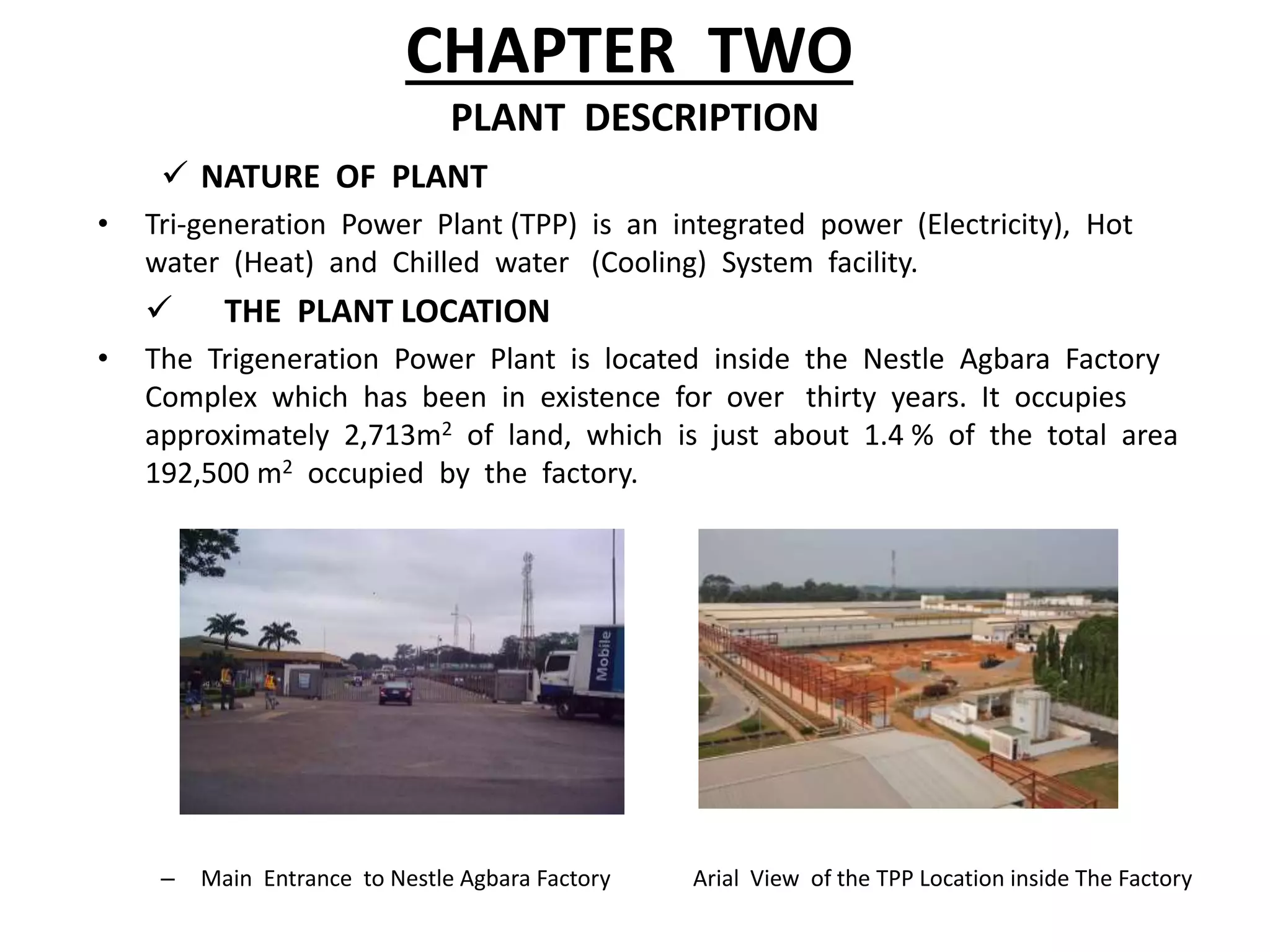
• The Trigeneration Power Plant is located inside the Nestle Agbara Factory
Complex which has been in existence for over thirty years. It occupies
approximately 2,713m2 of land, which is just about 1.4 % of the total area
192,500 m2 occupied by the factory.
– Main Entrance to Nestle Agbara Factory Arial View of the TPP Location inside The Factory
THE PLANT LAYOUT
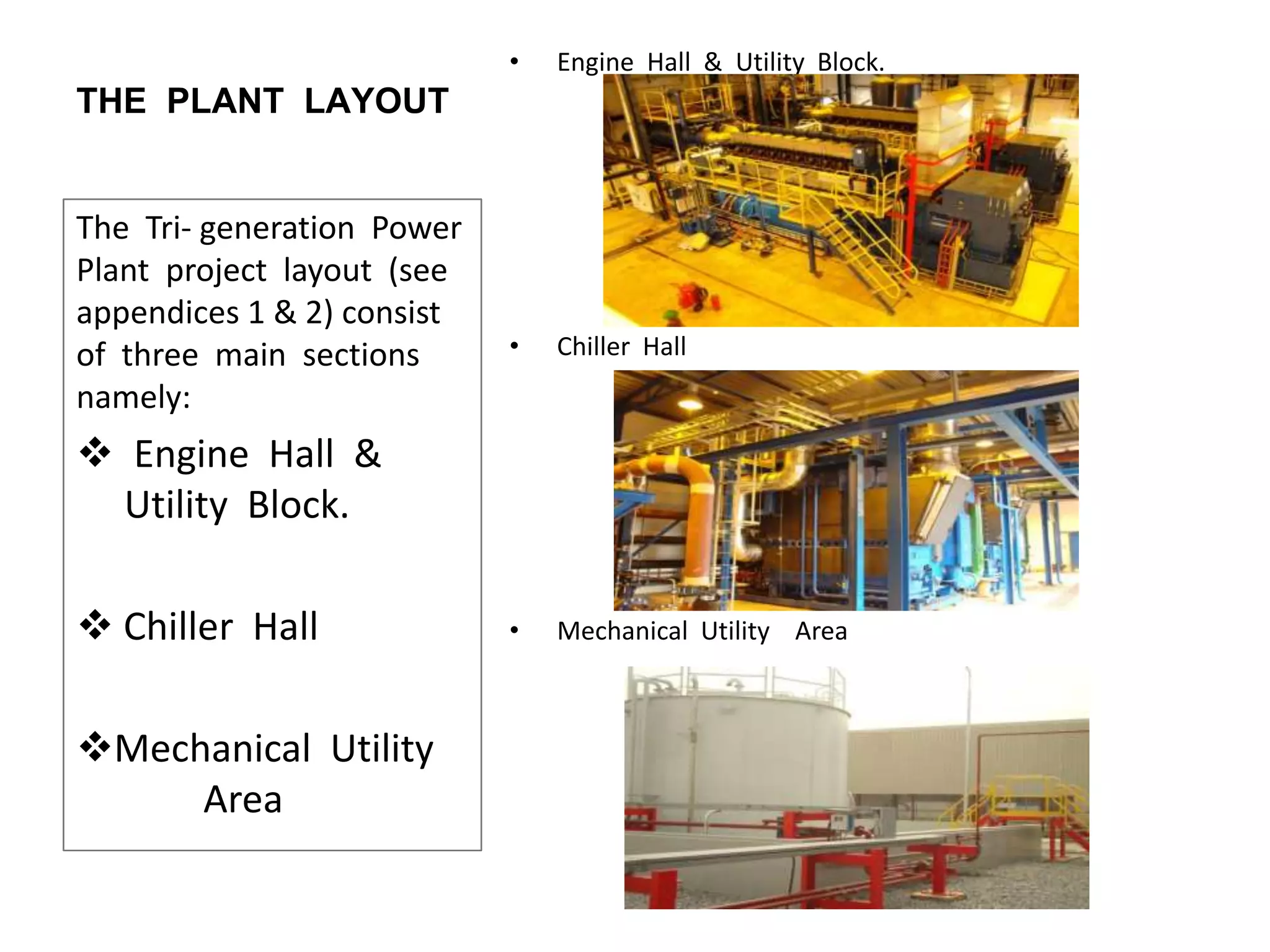
• Engine Hall & Utility Block.
• Chiller Hall
• Mechanical Utility Area
The Tri- generation Power
Plant project layout (see
appendices 1 & 2) consist
of three main sections
namely:
 Engine Hall &
Utility Block.
 Chiller Hall
Mechanical Utility
Area
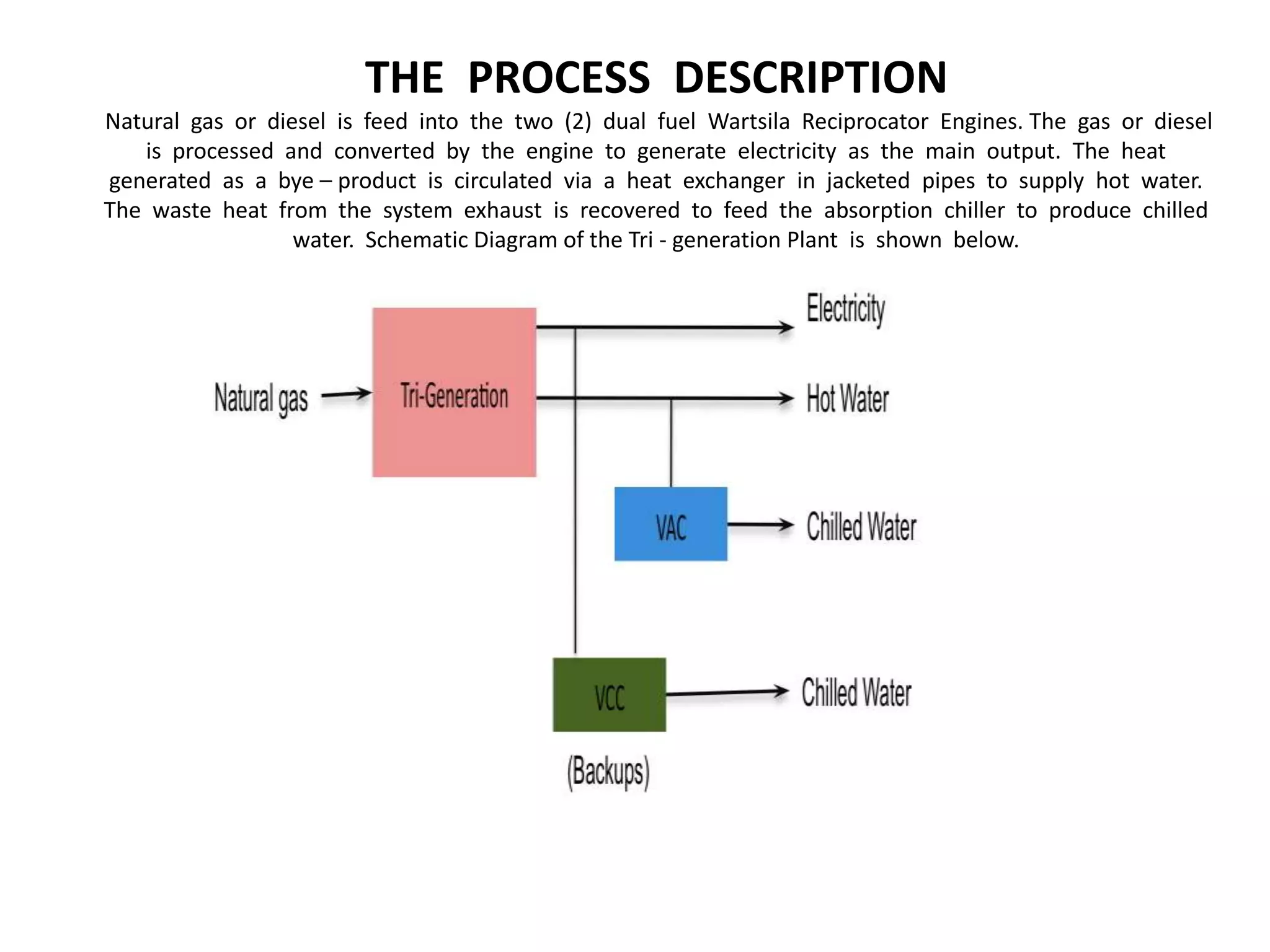
THE PROCESS DESCRIPTION
Natural gas or diesel is feed into the two (2) dual fuel Wartsila Reciprocator Engines. The gas or diesel
is processed and converted by the engine to generate electricity as the main output. The heat
generated as a bye – product is circulated via a heat exchanger in jacketed pipes to supply hot water.
The waste heat from the system exhaust is recovered to feed the absorption chiller to produce chilled
water. Schematic Diagram of the Tri - generation Plant is shown below.
PLANT OPERATION AND PERSONNEL
• The TPP is managed by the Agbara Factory
Project Department headed by the Project
Manager.
• A model shift on duty consists of a control
room operator, a mechanical technician, an
Electrical technician. In addition there is
always a mechanical and an Electrical team
on general day duty.
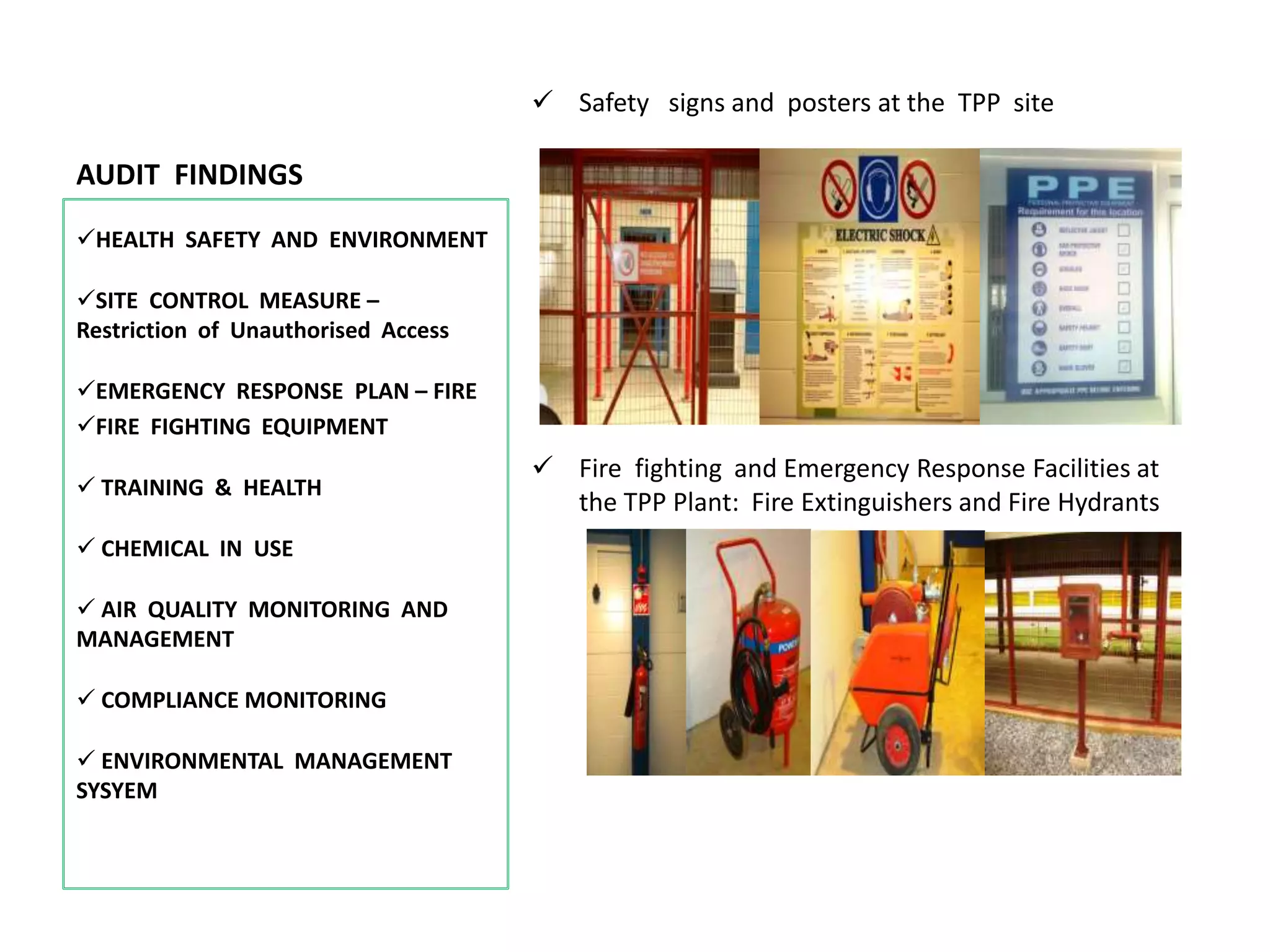
AUDIT FINDINGS
 Safety signs and posters at the TPP site
 Fire fighting and Emergency Response Facilities at
the TPP Plant: Fire Extinguishers and Fire Hydrants
HEALTH SAFETY AND ENVIRONMENT
SITE CONTROL MEASURE –
Restriction of Unauthorised Access
EMERGENCY RESPONSE PLAN – FIRE
FIRE FIGHTING EQUIPMENT
 TRAINING & HEALTH
 CHEMICAL IN USE
 AIR QUALITY MONITORING AND
MANAGEMENT
 COMPLIANCE MONITORING
 ENVIRONMENTAL MANAGEMENT
SYSYEM
DESCRIPTION OF THE
PLANT ENVIRONMENT
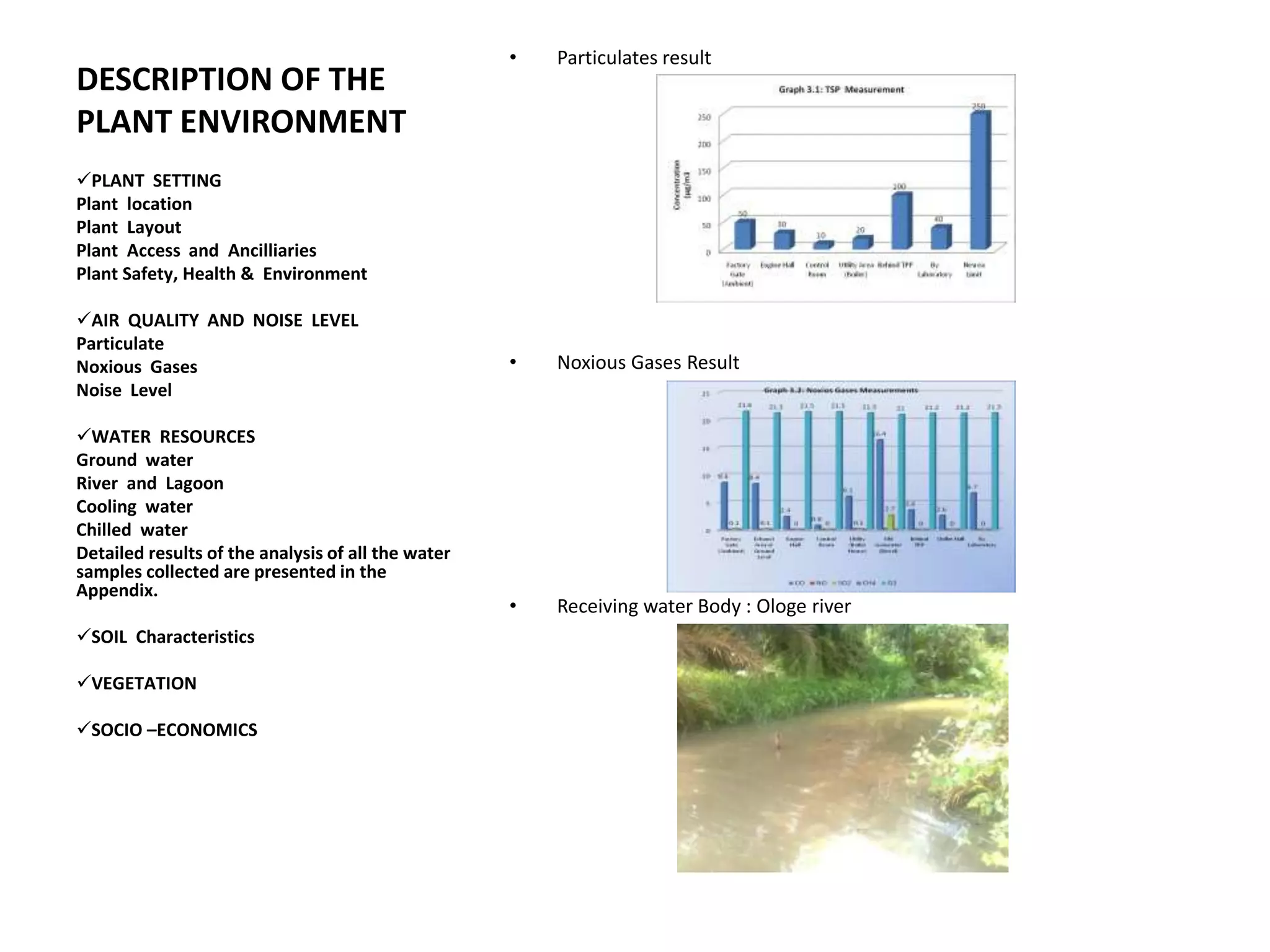
• Particulates result
• Noxious Gases Result
• Receiving water Body : Ologe river
PLANT SETTING
Plant location
Plant Layout
Plant Access and Ancilliaries
Plant Safety, Health & Environment
AIR QUALITY AND NOISE LEVEL
Particulate
Noxious Gases
Noise Level
WATER RESOURCES
Ground water
River and Lagoon
Cooling water
Chilled water
Detailed results of the analysis of all the water
samples collected are presented in the
Appendix.
SOIL Characteristics
VEGETATION
SOCIO –ECONOMICS
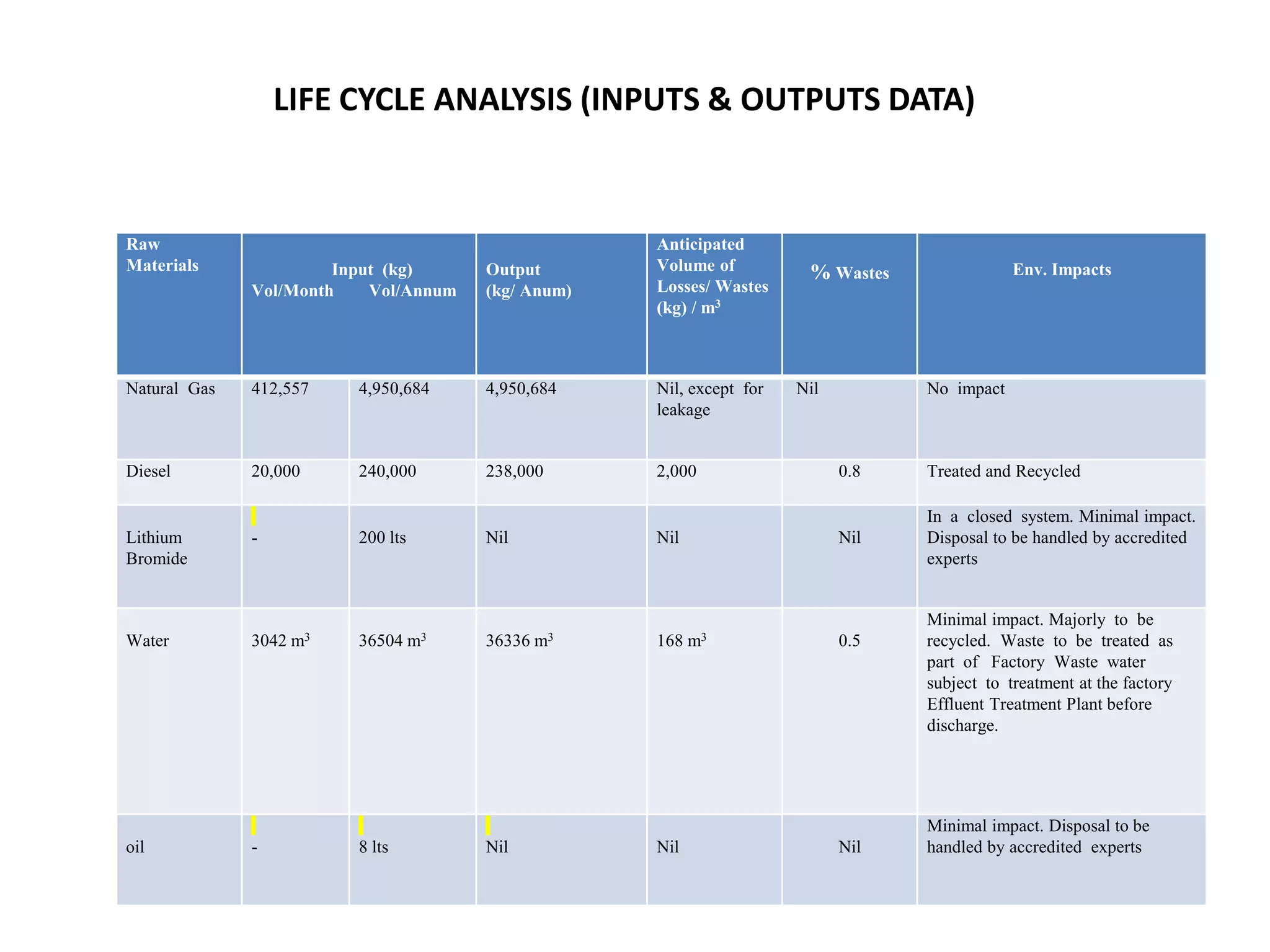
LIFE CYCLE ANALYSIS (INPUTS & OUTPUTS DATA)
Raw
Materials Input (kg)
Vol/Month Vol/Annum
Output
(kg/ Anum)
Anticipated
Volume of
Losses/ Wastes
(kg) / m3
% Wastes Env. Impacts
Natural Gas 412,557 4,950,684 4,950,684 Nil, except for
leakage
Nil No impact
Diesel 20,000 240,000 238,000 2,000 0.8 Treated and Recycled
Lithium
Bromide
- 200 lts Nil Nil Nil
In a closed system. Minimal impact.
Disposal to be handled by accredited
experts
Water 3042 m3 36504 m3 36336 m3 168 m3 0.5
Minimal impact. Majorly to be
recycled. Waste to be treated as
part of Factory Waste water
subject to treatment at the factory
Effluent Treatment Plant before
discharge.
oil - 8 lts Nil Nil Nil
Minimal impact. Disposal to be
handled by accredited experts
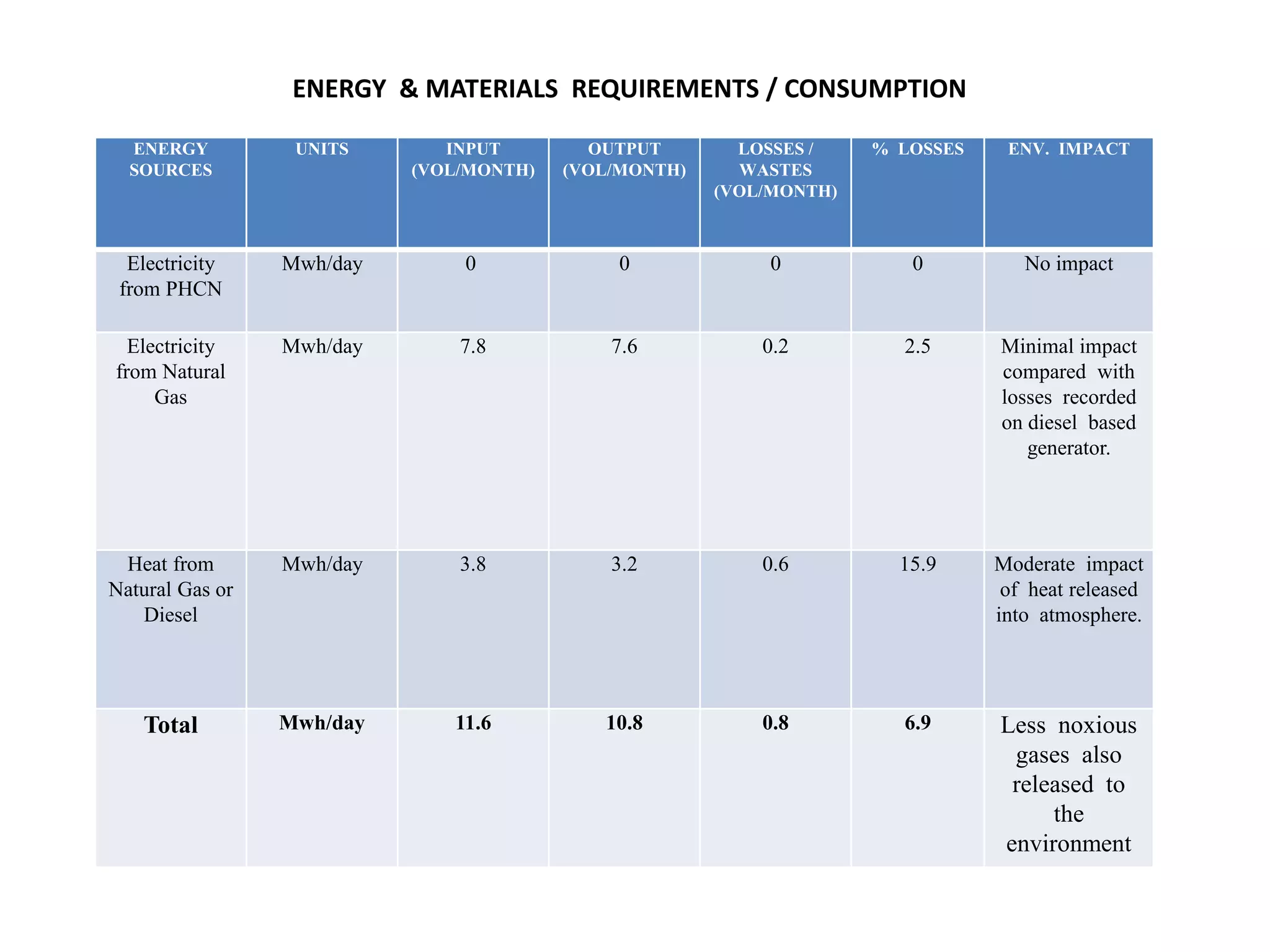
ENERGY & MATERIALS REQUIREMENTS / CONSUMPTION
ENERGY
SOURCES
UNITS INPUT
(VOL/MONTH)
OUTPUT
(VOL/MONTH)
LOSSES /
WASTES
(VOL/MONTH)
% LOSSES ENV. IMPACT
Electricity
from PHCN
Mwh/day 0 0 0 0 No impact
Electricity
from Natural
Gas
Mwh/day 7.8 7.6 0.2 2.5 Minimal impact
compared with
losses recorded
on diesel based
generator.
Heat from
Natural Gas or
Diesel
Mwh/day 3.8 3.2 0.6 15.9 Moderate impact
of heat released
into atmosphere.
Total Mwh/day 11.6 10.8 0.8 6.9 Less noxious
gases also
released to
the
environment
CHAPTER FOUR
ASSOCIATED AND POTENTIAL ENVIRONMENTAL IMPACTS
Aspect of the TPP Project’s activities that
would be of interest include : -
• Power Generation / Distribution
• Waste Generation
• Chemical handling
• Maintenance and General Services
Power Generation / Distribution
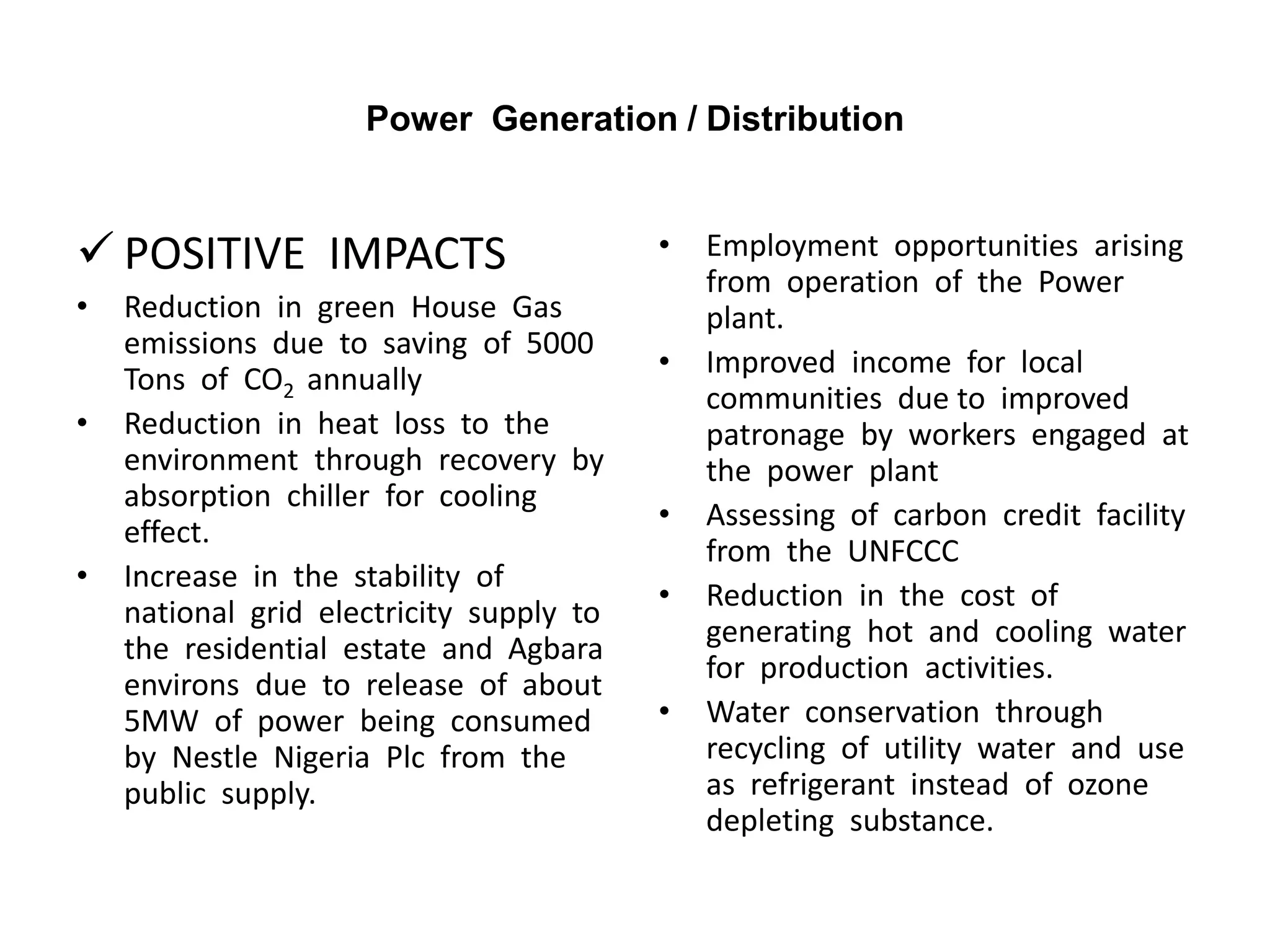
 POSITIVE IMPACTS
• Reduction in green House Gas
emissions due to saving of 5000
Tons of CO2 annually
• Reduction in heat loss to the
environment through recovery by
absorption chiller for cooling
effect.
• Increase in the stability of
national grid electricity supply to
the residential estate and Agbara
environs due to release of about
5MW of power being consumed
by Nestle Nigeria Plc from the
public supply.
• Employment opportunities arising
from operation of the Power
plant.
• Improved income for local
communities due to improved
patronage by workers engaged at
the power plant
• Assessing of carbon credit facility
from the UNFCCC
• Reduction in the cost of
generating hot and cooling water
for production activities.
• Water conservation through
recycling of utility water and use
as refrigerant instead of ozone
depleting substance.
Waste Generation
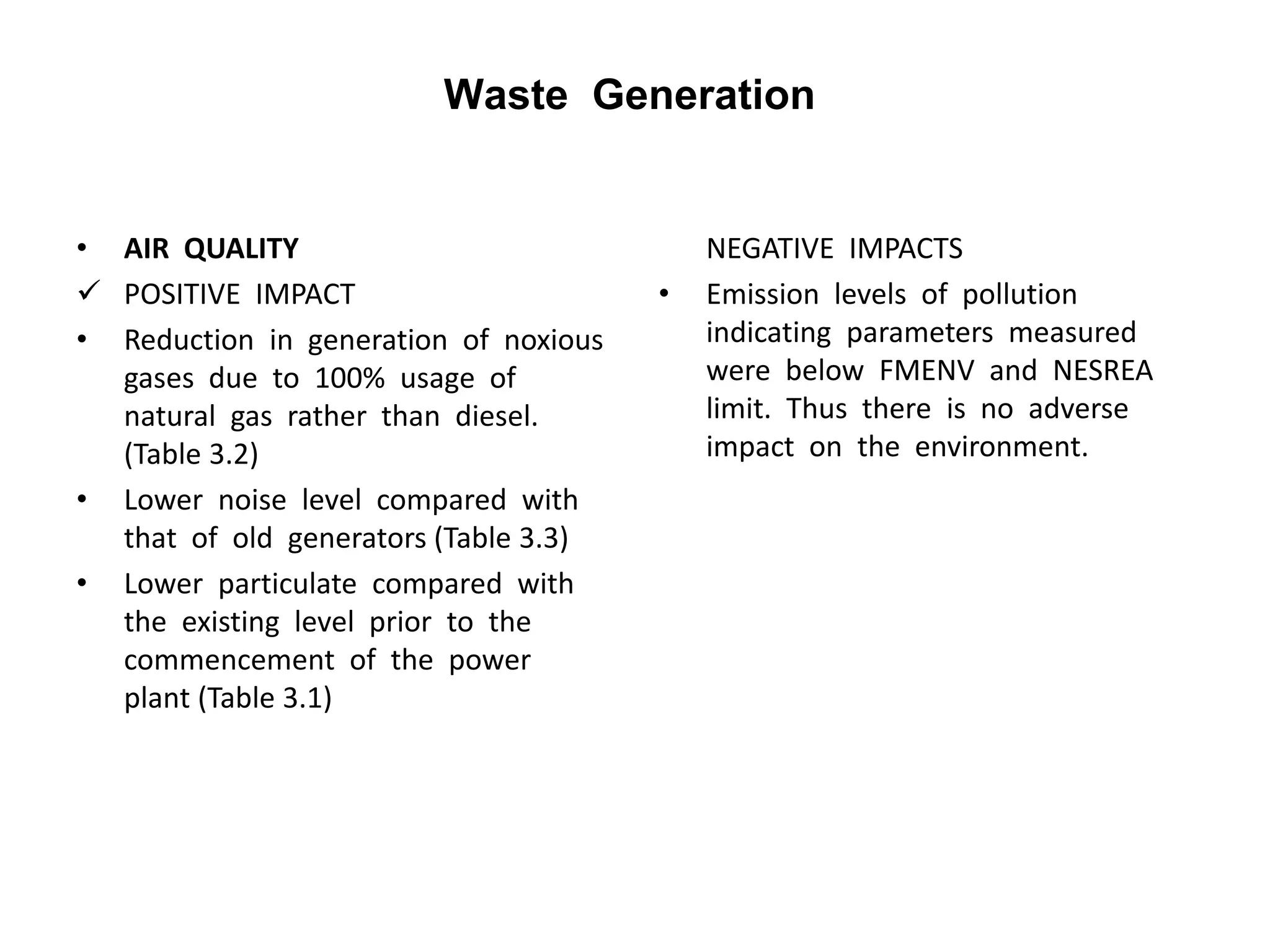
• AIR QUALITY
 POSITIVE IMPACT
• Reduction in generation of noxious
gases due to 100% usage of
natural gas rather than diesel.
(Table 3.2)
• Lower noise level compared with
that of old generators (Table 3.3)
• Lower particulate compared with
the existing level prior to the
commencement of the power
plant (Table 3.1)
NEGATIVE IMPACTS
• Emission levels of pollution
indicating parameters measured
were below FMENV and NESREA
limit. Thus there is no adverse
impact on the environment.
Waste Generation Cont.
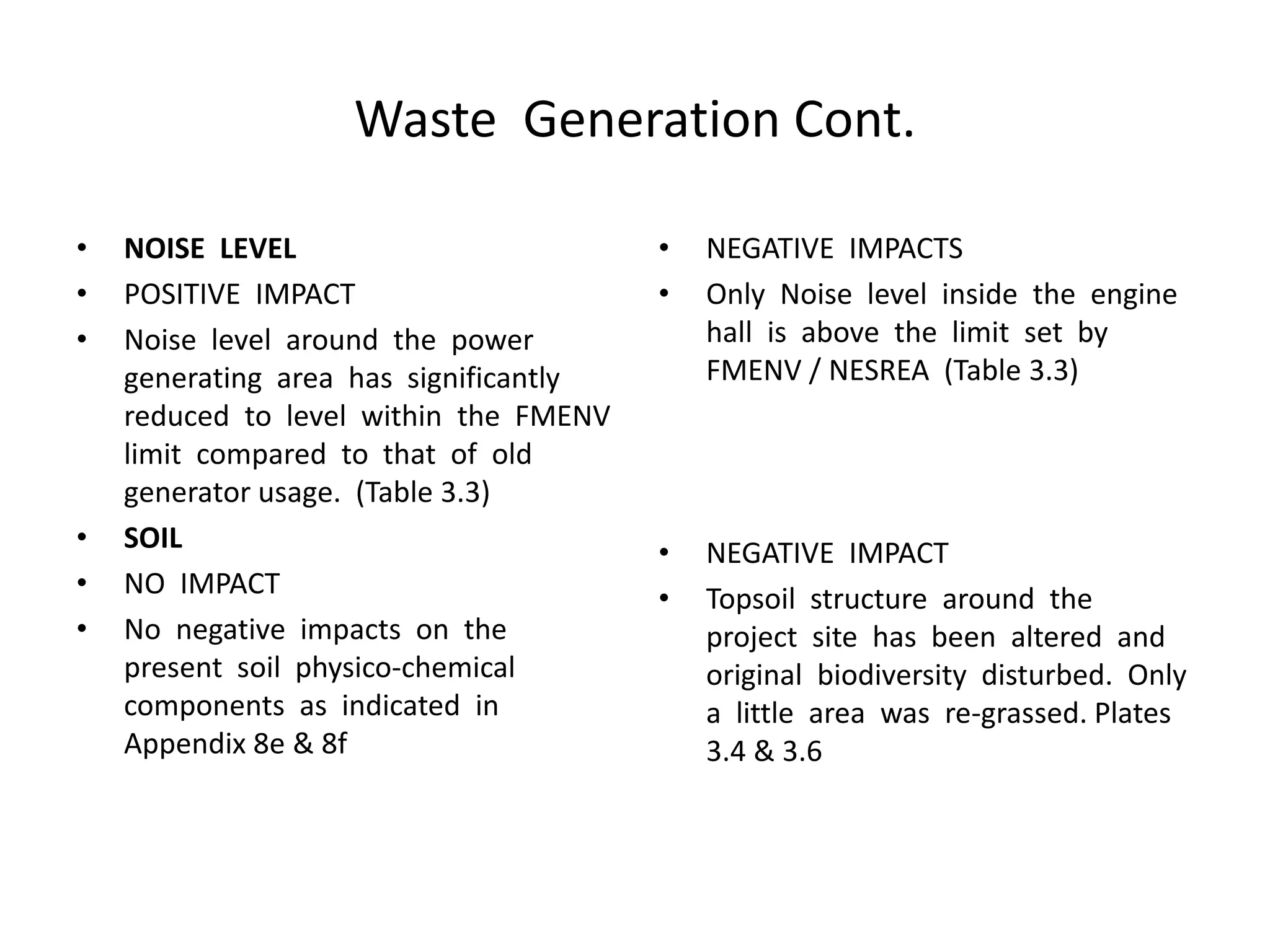
• NOISE LEVEL
• POSITIVE IMPACT
• Noise level around the power
generating area has significantly
reduced to level within the FMENV
limit compared to that of old
generator usage. (Table 3.3)
• SOIL
• NO IMPACT
• No negative impacts on the
present soil physico-chemical
components as indicated in
Appendix 8e & 8f
• NEGATIVE IMPACTS
• Only Noise level inside the engine
hall is above the limit set by
FMENV / NESREA (Table 3.3)
• NEGATIVE IMPACT
• Topsoil structure around the
project site has been altered and
original biodiversity disturbed. Only
a little area was re-grassed. Plates
3.4 & 3.6
Waste Generation Cont.
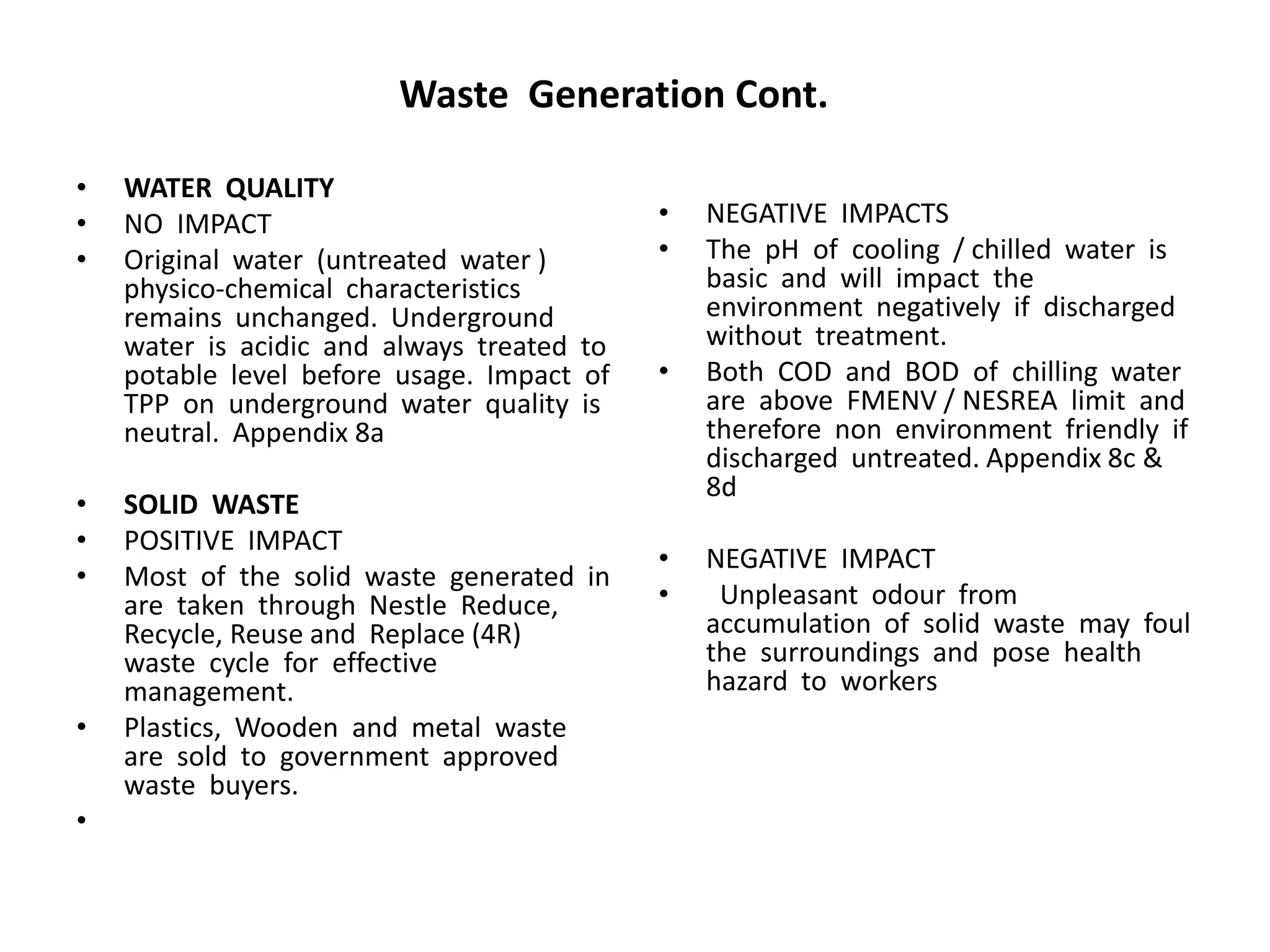
• WATER QUALITY
• NO IMPACT
• Original water (untreated water )
physico-chemical characteristics
remains unchanged. Underground
water is acidic and always treated to
potable level before usage. Impact of
TPP on underground water quality is
neutral. Appendix 8a
• SOLID WASTE
• POSITIVE IMPACT
• Most of the solid waste generated in
are taken through Nestle Reduce,
Recycle, Reuse and Replace (4R)
waste cycle for effective
management.
• Plastics, Wooden and metal waste
are sold to government approved
waste buyers.
•
• NEGATIVE IMPACTS
• The pH of cooling / chilled water is
basic and will impact the
environment negatively if discharged
without treatment.
• Both COD and BOD of chilling water
are above FMENV / NESREA limit and
therefore non environment friendly if
discharged untreated. Appendix 8c &
8d
• NEGATIVE IMPACT
• Unpleasant odour from
accumulation of solid waste may foul
the surroundings and pose health
hazard to workers
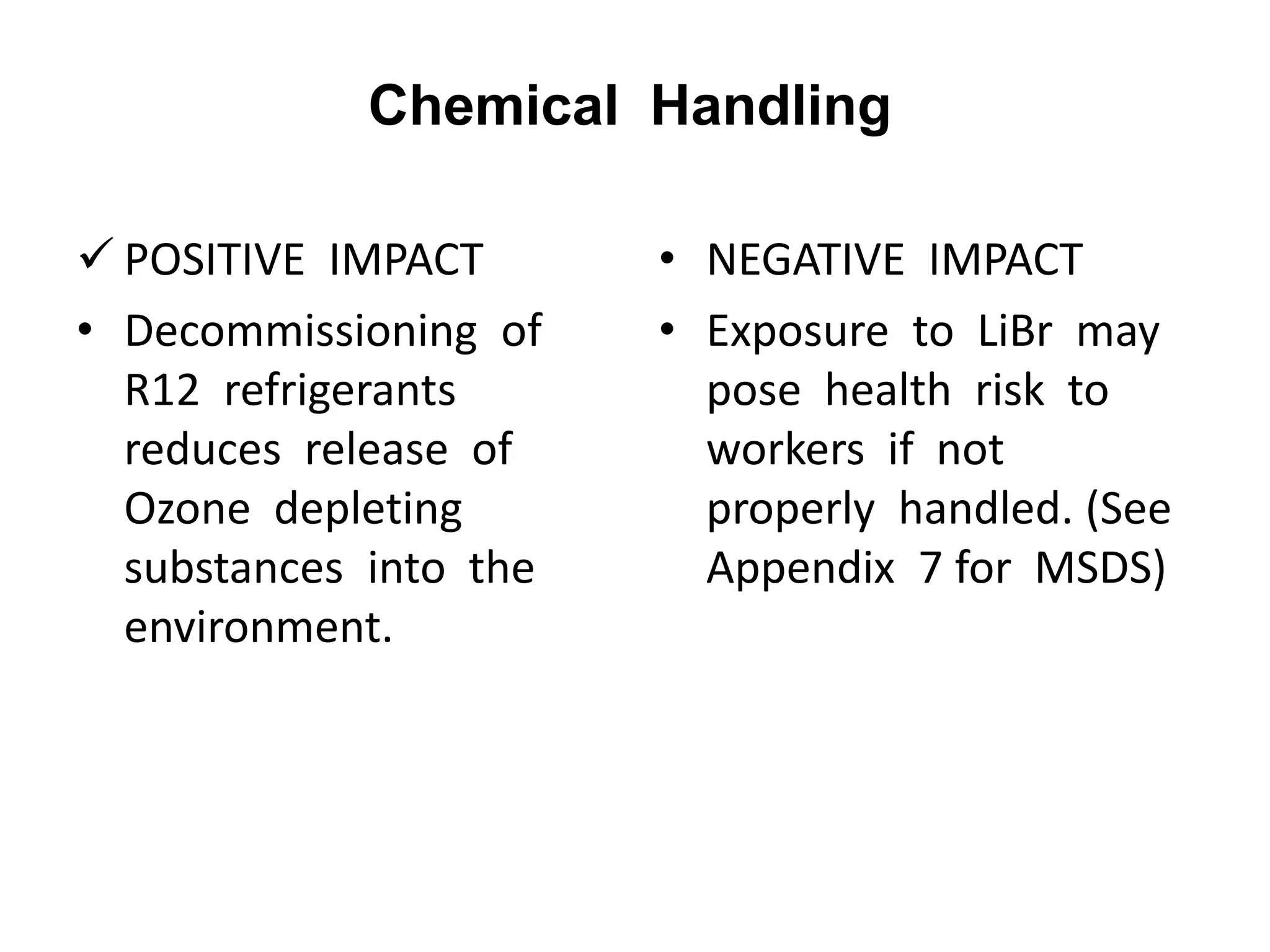
Chemical Handling
 POSITIVE IMPACT
• Decommissioning of
R12 refrigerants
reduces release of
Ozone depleting
substances into the
environment.
• NEGATIVE IMPACT
• Exposure to LiBr may
pose health risk to
workers if not
properly handled. (See
Appendix 7 for MSDS)
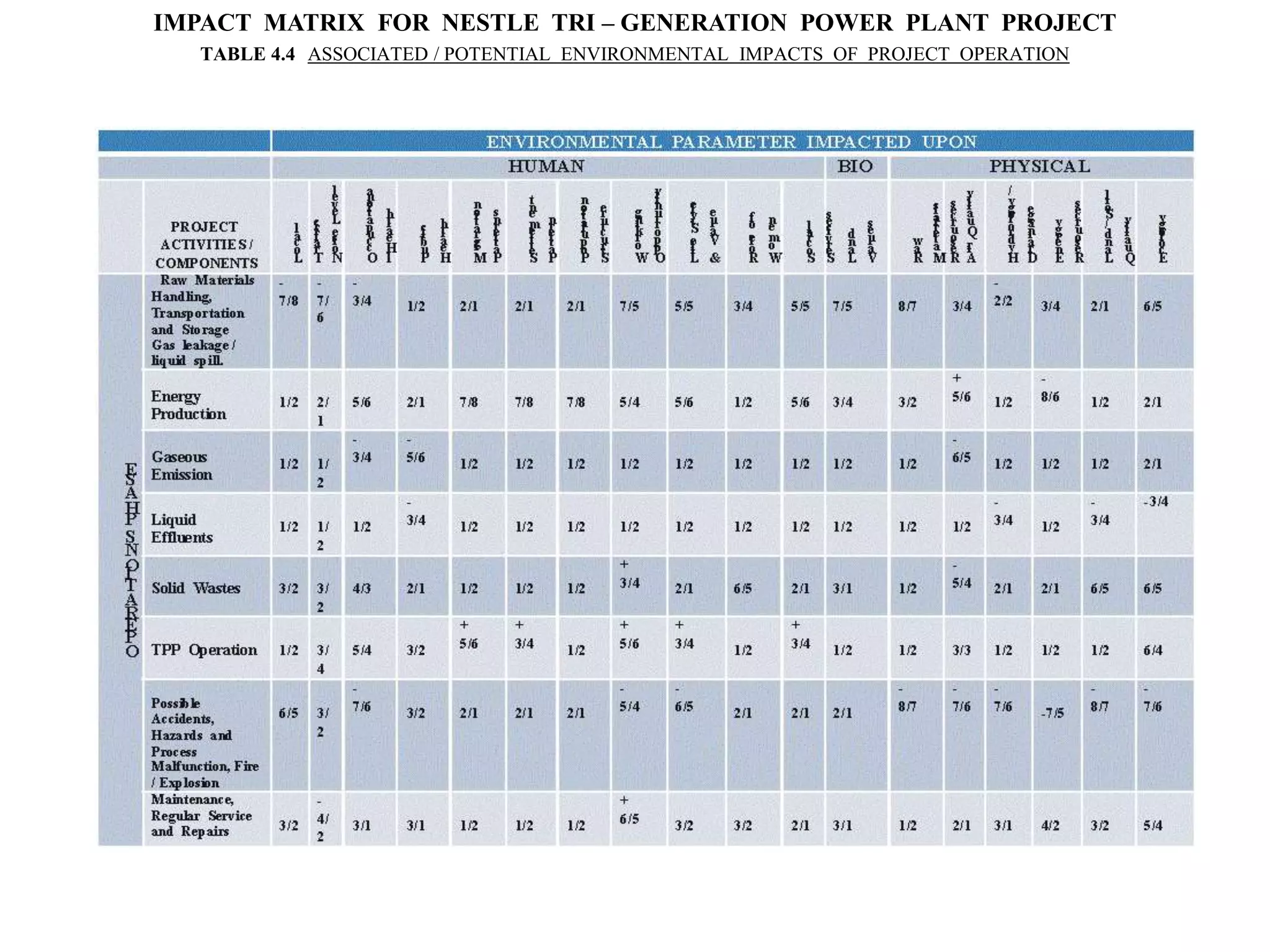
IMPACT MATRIX FOR NESTLE TRI – GENERATION POWER PLANT PROJECT
TABLE 4.4 ASSOCIATED / POTENTIAL ENVIRONMENTAL IMPACTS OF PROJECT OPERATION
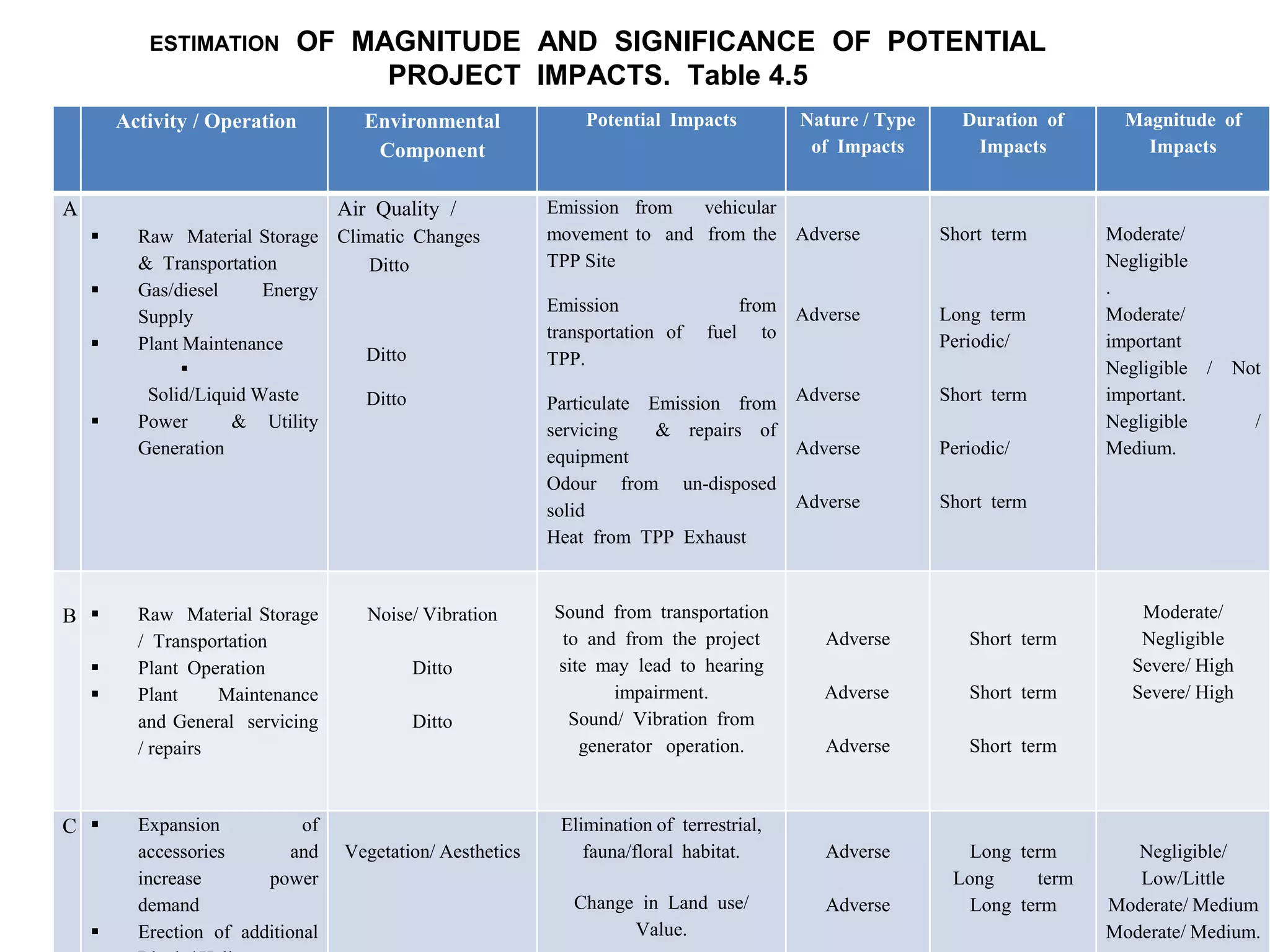
ESTIMATION OF MAGNITUDE AND SIGNIFICANCE OF POTENTIAL
PROJECT IMPACTS. Table 4.5
Activity / Operation Environmental
Component
Potential Impacts Nature / Type
of Impacts
Duration of
Impacts
Magnitude of
Impacts
A
 Raw Material Storage
& Transportation
 Gas/diesel Energy
Supply
 Plant Maintenance

Solid/Liquid Waste
 Power & Utility
Generation
Air Quality /
Climatic Changes
Ditto
Ditto
Ditto
Emission from vehicular
movement to and from the
TPP Site
Emission from
transportation of fuel to
TPP.
Particulate Emission from
servicing & repairs of
equipment
Odour from un-disposed
solid
Heat from TPP Exhaust
Adverse
Adverse
Adverse
Adverse
Adverse
Short term
Long term
Periodic/
Short term
Periodic/
Short term
Moderate/
Negligible
.
Moderate/
important
Negligible / Not
important.
Negligible /
Medium.
B  Raw Material Storage
/ Transportation
 Plant Operation
 Plant Maintenance
and General servicing
/ repairs
Noise/ Vibration
Ditto
Ditto
Sound from transportation
to and from the project
site may lead to hearing
impairment.
Sound/ Vibration from
generator operation.
Adverse
Adverse
Adverse
Short term
Short term
Short term
Moderate/
Negligible
Severe/ High
Severe/ High
C  Expansion of
accessories and
increase power
demand
 Erection of additional
Vegetation/ Aesthetics
Elimination of terrestrial,
fauna/floral habitat.
Change in Land use/
Value.
Adverse
Adverse
Long term
Long term
Long term
Negligible/
Low/Little
Moderate/ Medium
Moderate/ Medium.
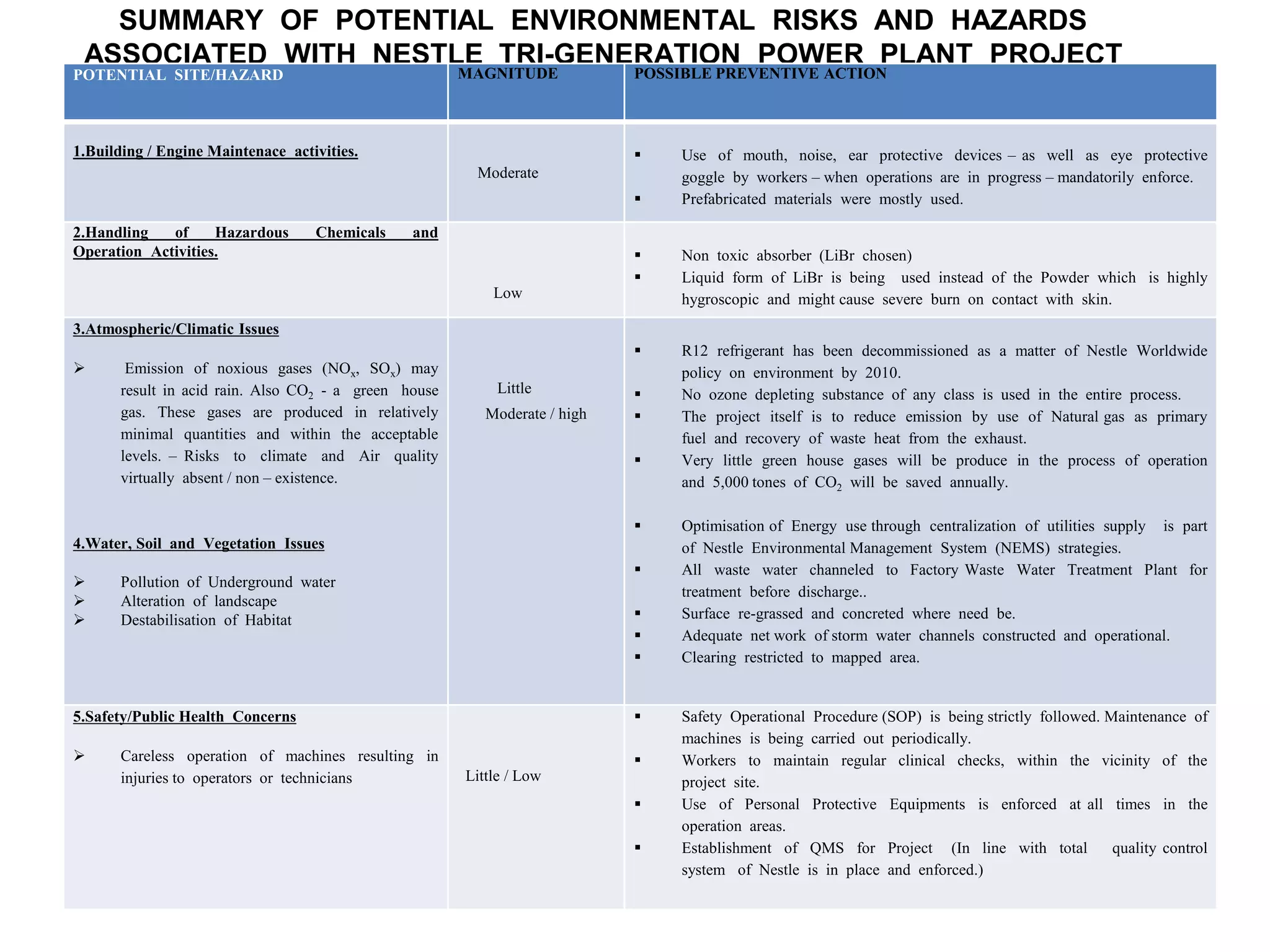
SUMMARY OF POTENTIAL ENVIRONMENTAL RISKS AND HAZARDS
ASSOCIATED WITH NESTLE TRI-GENERATION POWER PLANT PROJECT
OPERATIONS. Table 4.8
POTENTIAL SITE/HAZARD MAGNITUDE POSSIBLE PREVENTIVE ACTION
1.Building / Engine Maintenace activities.
Moderate
 Use of mouth, noise, ear protective devices – as well as eye protective
goggle by workers – when operations are in progress – mandatorily enforce.
 Prefabricated materials were mostly used.
2.Handling of Hazardous Chemicals and
Operation Activities.
Low
 Non toxic absorber (LiBr chosen)
 Liquid form of LiBr is being used instead of the Powder which is highly
hygroscopic and might cause severe burn on contact with skin.
3.Atmospheric/Climatic Issues
 Emission of noxious gases (NOx, SOx) may
result in acid rain. Also CO2 - a green house
gas. These gases are produced in relatively
minimal quantities and within the acceptable
levels. – Risks to climate and Air quality
virtually absent / non – existence.
4.Water, Soil and Vegetation Issues
 Pollution of Underground water
 Alteration of landscape
 Destabilisation of Habitat
Little
Moderate / high
 R12 refrigerant has been decommissioned as a matter of Nestle Worldwide
policy on environment by 2010.
 No ozone depleting substance of any class is used in the entire process.
 The project itself is to reduce emission by use of Natural gas as primary
fuel and recovery of waste heat from the exhaust.
 Very little green house gases will be produce in the process of operation
and 5,000 tones of CO2 will be saved annually.
 Optimisation of Energy use through centralization of utilities supply is part
of Nestle Environmental Management System (NEMS) strategies.
 All waste water channeled to Factory Waste Water Treatment Plant for
treatment before discharge..
 Surface re-grassed and concreted where need be.
 Adequate net work of storm water channels constructed and operational.
 Clearing restricted to mapped area.
5.Safety/Public Health Concerns
 Careless operation of machines resulting in
injuries to operators or technicians Little / Low
 Safety Operational Procedure (SOP) is being strictly followed. Maintenance of
machines is being carried out periodically.
 Workers to maintain regular clinical checks, within the vicinity of the
project site.
 Use of Personal Protective Equipments is enforced at all times in the
operation areas.
 Establishment of QMS for Project (In line with total quality control
system of Nestle is in place and enforced.)
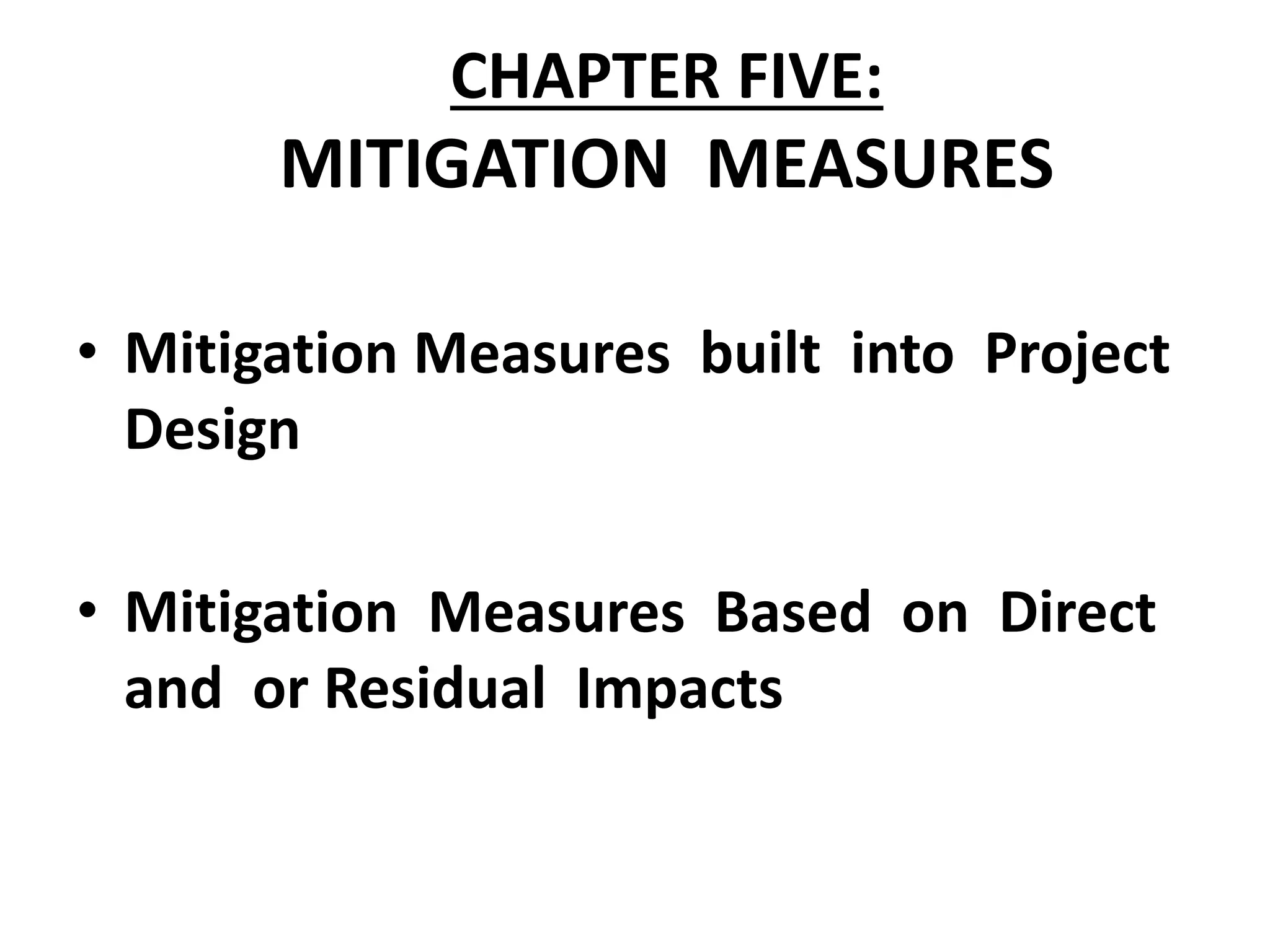
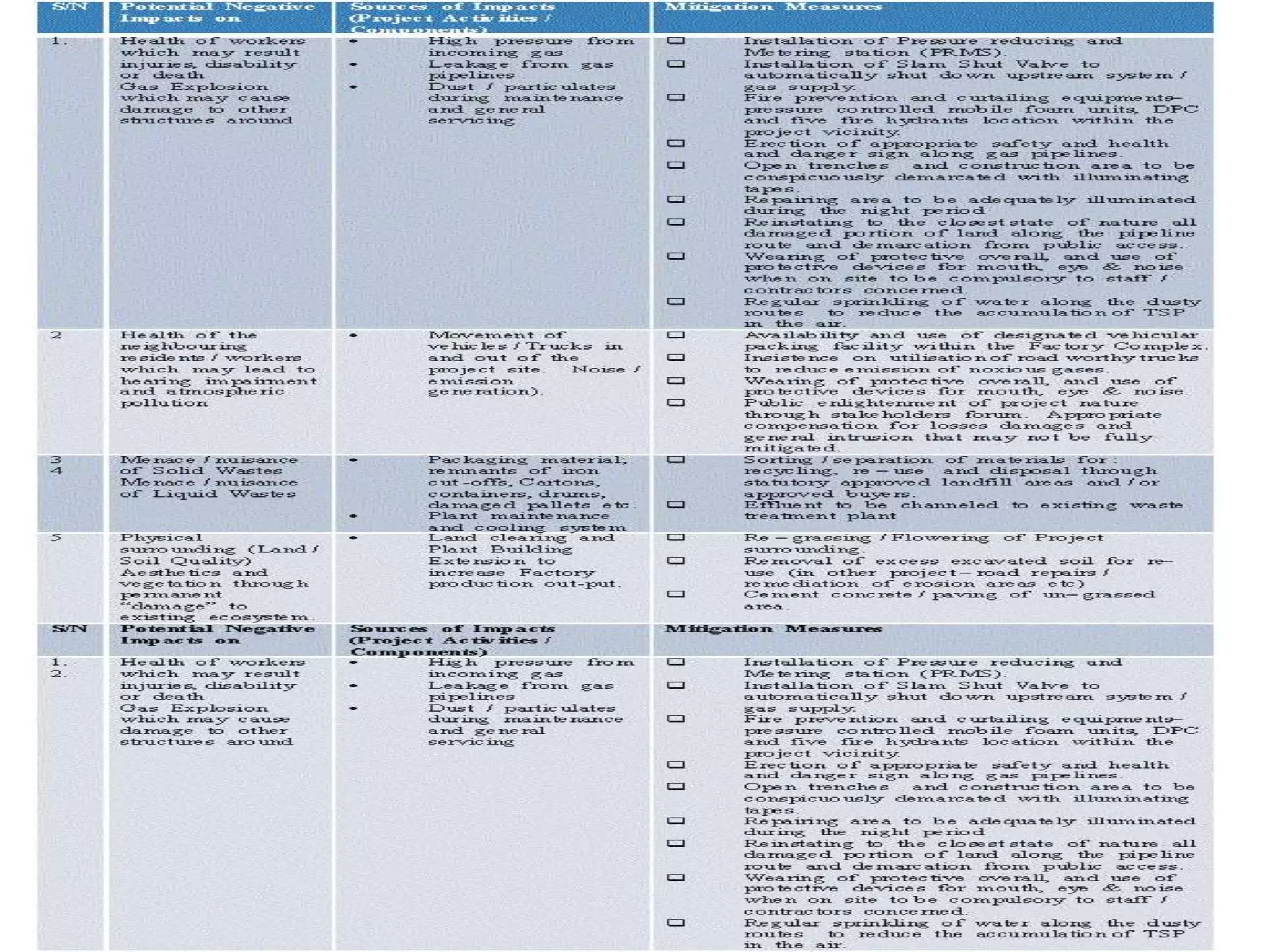
CHAPTER FIVE:
MITIGATION MEASURES
• Mitigation Measures built into Project
Design
• Mitigation Measures Based on Direct
and or Residual Impacts
CHAPTER SIX
ENVIRONMENTAL MANAGEMENT PLAN
• A project specific EMP which is different from the
Factory EMP has been designed for the NTPP
Project: This consist of three sections namely:
Environmental Management Programme.
 Environmental Contingency Plan
 Waste Management Plan
Environmental Management Programme.
Specific Function Impact indicator Action required Frequency Action by whom
Air Quality
Management
TSP, CO, NOx, VOCs  Monitoring of atmosphere/
surrounding air for major noxious
gases and particulates.
Quarterly
 Company Staff
(Laboratory)
 Consultants &.
OGEPA/FMEnv
Noise level
Monitoring.
Noise Level (dBA)  Measuring of noise levels in and
around the project facilities and
surrounding
Quarterly
 Company Laboratory Staff
 Consultants & OGEPA/NESREA
Water Quality
Monitoring
Oil and Grease, TDS,
COD, TSS, BOD,
Turbidity, pH, Temp,
Heavy metals
 Checking of effluent quality,
 Ground / borehole water
Quality
(Physico – chemical & Microbiological
Analysis)
Quarterly
weekly
 Company Laboratory Staff.
 Consultants &.
OGEPA / FMEnv / NESREA
Soil Quality
Monitoring
pH, Heavy matals,
Organic Matter.
 Soil test ( around the Gas /Fuel
pipeline route ) to verify project
operational impact
Half yearly for 2 years after
commissioning.
 Consultants & OGEPA / NESREA
Environmental
Awareness
Programme
 Safety, Health & Environmental
(SHE) activities involving all
workers, major suppliers /
distributors / contractors – spanning
1week.
Annually
 Company Managers / Consultants.
Documentation &
Information
Dissemination
Programme.
 Keeping records of all
environmentally related
compliances, Audit / monitoring
Reports, log sheets, Accidents and
recommendations.
Routinely / Daily / Periodically  Factory Environmental Manager /
Project SHE officer
 Factory Information / Systems
Manager
Disposal of used
Chemicals
 Safe handling and disposal of
expired / Chemicals
Annually / Quarterly  Consultants
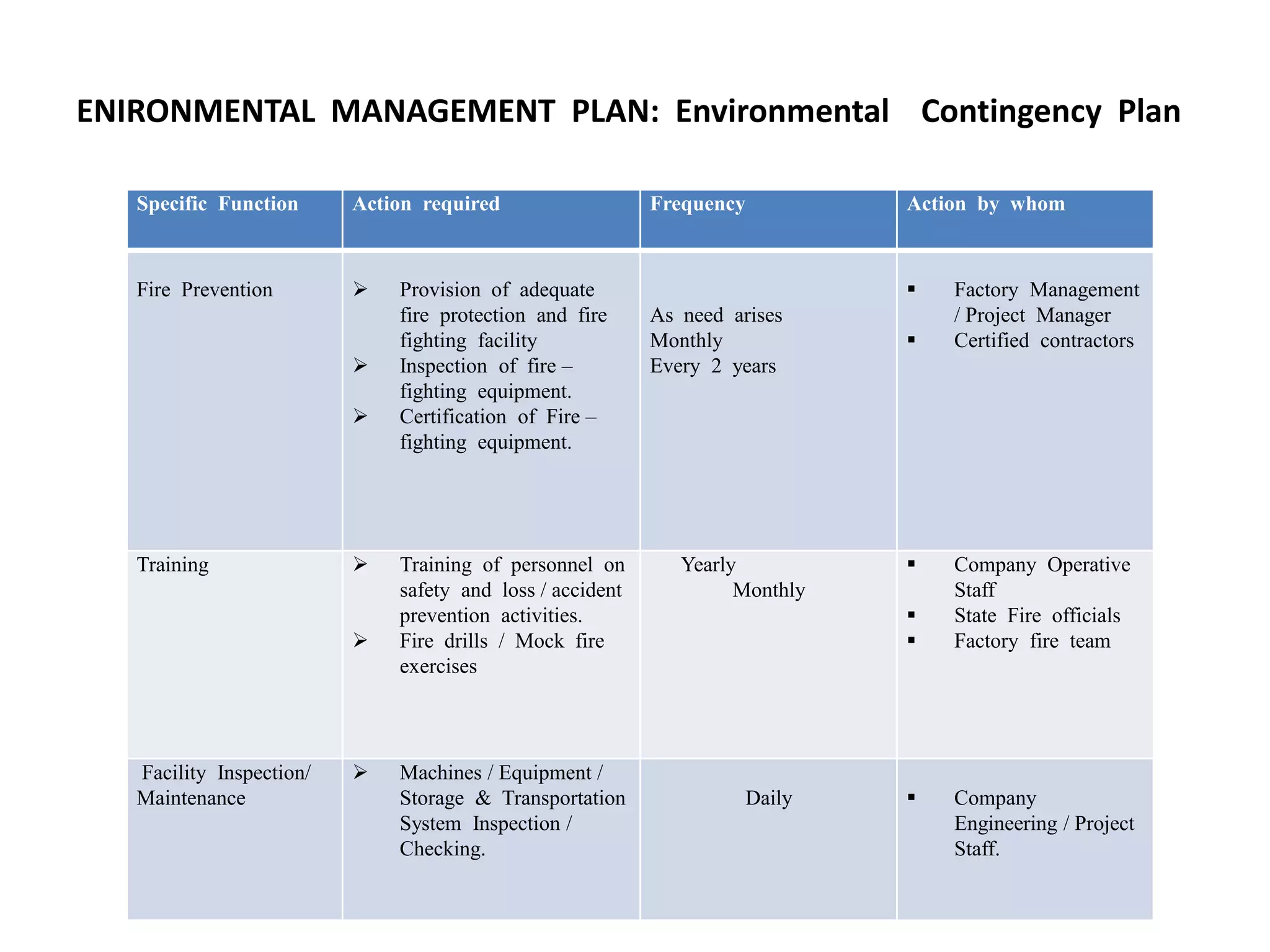
ENIRONMENTAL MANAGEMENT PLAN: Environmental Contingency Plan
Specific Function Action required Frequency Action by whom
Fire Prevention  Provision of adequate
fire protection and fire
fighting facility
 Inspection of fire –
fighting equipment.
 Certification of Fire –
fighting equipment.
As need arises
Monthly
Every 2 years
 Factory Management
/ Project Manager
 Certified contractors
Training  Training of personnel on
safety and loss / accident
prevention activities.
 Fire drills / Mock fire
exercises
Yearly
Monthly
 Company Operative
Staff
 State Fire officials
 Factory fire team
Facility Inspection/
Maintenance
 Machines / Equipment /
Storage & Transportation
System Inspection /
Checking.
Daily  Company
Engineering / Project
Staff.
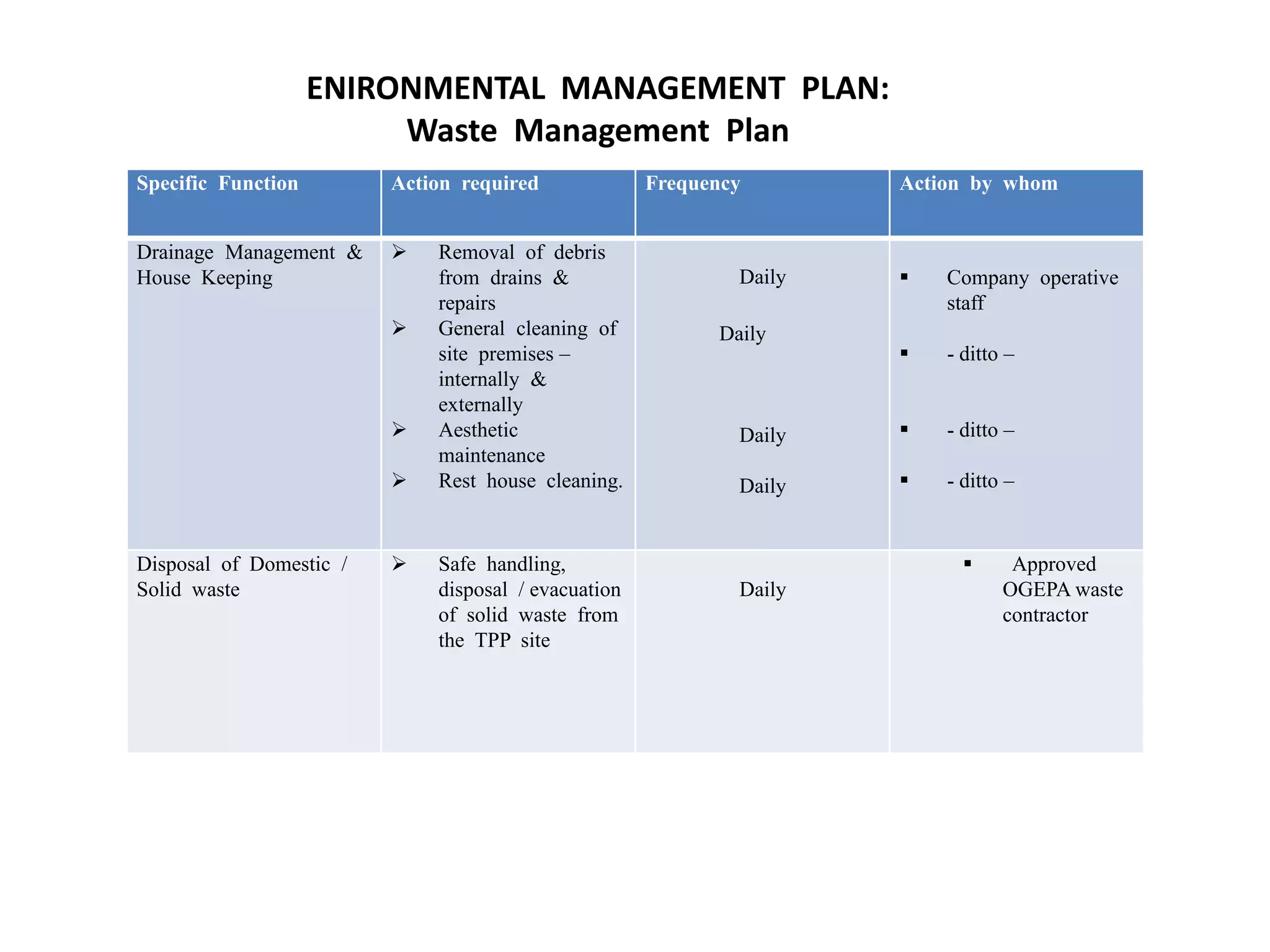
ENIRONMENTAL MANAGEMENT PLAN:
Waste Management Plan
Specific Function Action required Frequency Action by whom
Drainage Management &
House Keeping
 Removal of debris
from drains &
repairs
 General cleaning of
site premises –
internally &
externally
 Aesthetic
maintenance
 Rest house cleaning.
Daily
Daily
Daily
Daily
 Company operative
staff
 - ditto –
 - ditto –
 - ditto –
Disposal of Domestic /
Solid waste
 Safe handling,
disposal / evacuation
of solid waste from
the TPP site
Daily
 Approved
OGEPA waste
contractor
CHAPTER SEVEN
CONCLUSION AND RECOMMENDATIONS
• Conclusions
•
• The TPP area operates under good supervision and control. Standard of Good House Keeping (GHK)
was relatively satisfactory.
•
• The site is well marked out from the other factory facilities and demarcated by a wire mesh fence
with appropriate safety and warning signs.
•
• The operation of the TPP is under strict regulation and control i.e unauthorized personnel are not
allowed within the area.
•
• An emergency response and Fire plan tailored to the level of risk of the TPP is in place.
•
• Waste generated from the TPP are safely handled in line with Nestle Waste Management
Programme. Effluent are treated in the Waste Water Treatment plant and solid waste disposed
properly after sorting for recycle and reuse.
•
• The TPP operation rather than to add to the Pollution load of the factory actually ensures the
reduction in the over all pollution by reduction of CO2, NOx and SO2 emitted.
•
Conclusion
• Noise level around the TPP project is lower compared with the old diesel based
generators previously used.
•
• The operation has not had any negative impact on groundwater, soil quality and health
of workers.
•
• Health facility provided for emergency seem adequate and the Factory Clinic is well
equipped and professionally manned.
•
• Safety and environmental concerns have been largely built into the construction of the
TPP.
•
• The major area of impact is the removal of natural vegetation of the area but open
spaces have been well covered with gravel while other parts re-grassed.
•
• The project has provided both indirect and direct economic and social benefits to the
surrounding communities in particular and the country in general.
•
RECOMMENDATIONS
• The established EMP should be strictly implemented.
•
• Quarterly and half yearly assessment / monitoring activities should be conducted with proper
documentation.
•
• The Federal Ministry of Environment and other stakeholders (OGEPA and NESREA) should be
regularly briefed through regular reports submission on the TPP operation as at when due.
•
• In- house staff charged with environmental responsibilities should be periodically re-trained for
upgrading and personal development.
•
• Enforcement of use of PPE (personal Protective Equipment ) in areas of exposure with moderate to
high risks should be monitored.
•
• Incentives for compliance to Environmental requirements should be re-introduced by the relevant
Authorities (Company & Government).
•
• The Alert system of the TPP should be communicated to all Categories of Staff because of the
nature of its operation / risk and all personnel in the factory to be properly educated on the
danger of non-compliance.
•
FINAL CONCLUSION
• We conclude, from the available data
presented in the preceding chapters, that
the Operation of the Nestle Tri-generation
Power Plant can be conducted without any
major permanent adverse effect on the
environment, assuming the few additional
mitigation measures suggested are adhered
to.

PIA REPORT PRESENTATION

  • 1.
    REPORT ON POST IMPACT ASSESSMENT(PIA) STUDIES FOR NESTLE TRI – GENERATION POWER PLANT FEB, 2012
  • 2.
    PIA CONTENT /OUTLINE • Outside View of The TPP Prior to Final Completion and CommissioningTABLE OF CONTENTS CHAPTER 1 INTRODUCTION CHAPTER 2 PLANT DESCRIPTION CHAPTER 3 DESCRIPTION OF THE PLANT ENVIRONMENT CHAPTER 4 ASSOCIATED AND POTENTIAL ENVIRONMENTAL IMPACTS CHAPTER 5 MITIGATION MEASURES CHAPTER 6 ENVIRONMENTAL MANAGEMENT PLAN CHAPTER 7 CONCLUSION AND RECOMMENDATION BIBLIOGRAPHY / REFERENCES AND APPENDIX
  • 3.
    CHAPTER ONE APPLICANT ANDBACKGROUND INFORMATION • Nestle Nigeria Plc, Agbara Factory, a leading Food & Beverages company and popularly known for its range of high quality products like Milo, Maggi, Golden Morn, Cerelac etc • NEED FOR THE PROJECT • The worsening state of Public power supply • Anticipated factory energy requirement by 2018
  • 4.
    Figure 1.1: AnticipatedEnergy requirements between 2008 – 2018
  • 5.
    LEGAL AND ADMINISTRATIVEFRAMEWORK Applicable laws and guidelines relevant to the execution of this audit and sighted in the report are as follows: • Environmental Impact Assessment (EIA) (Decree 86, 1992). • National Environmental Standards and Regulations Enforcement Agency Act, 2007 And National Environmental (Food, Beverages and Tobacco Sector) Regulations 2008. • National Environmental Standards and Regulations Enforcement Agency Act, 2007 And National Environmental (Electrical / Electronic Sector) Regulations S.I. 23 of 2011 (Federal Government Gazette 50, Vol. 98 25/05/2011) • Electric Power Sector Reform Act 2005 • Nigeria Electricity Regulatory Commission (Application For Licences, Generation, Transmission, System Operations, Distribution And Trading) Regulations, 2006 • Nigeria Electricity Regulatory Commission (Licence and Operating Fees) Regulations, 2006 • Ogun State Environmental Protection Agency (OGEPA) Edict No.1 of 1995 And Environmental (Miscellaneous Provision) Regulations 2005 (Section 10 (1) ).
  • 6.
    OBJECTIVES & TERMSof REFRENCE THE OF THE PIA Studies OBJECTIVES • Provision of instrument for establishing any activity that may likely or to a significant extent affect the environment adversely by the New Project. • to promote the implementation of appropriate mitigation measures / policy that would lead to reduction of the negative environmental impacts. • To encourage the development of procedures for information exchange, notification and consultation between the Company, NESTLE and other stakeholders wherever the New Project operations are / may likely to have significant adverse effects on the neighbouring establishments, towns and villages. • To assist the company, NESTLE, in the establishment and achievement of long term management objectives of minimizing environmental risks and associated financial losses. • To ensure that the New Project does not lead to non – compliance of the existing internal, NESTLE (where available), and statutory environmental laws and regulations. TERMS OF REFERENCE – Measurement of the air quality and noise level within the TPP area. – Collection and analysis of liquid effluent, gaseous emissions from the TPP plant. – Establishment of compliance of the TPP with the standard limits set by FMENV / NESREA for gaseous emission, liquid effluent and noise level. – Assessment of the Safety, Health and Environmental (SHE) policy of Nestle as it relates to the TPP operation.. – Assessment of the plant’s internal environmental management system to implement the above policies. – Examining the sanitary and aesthetic conditions of the TPP – Examination of sources of waste, existing waste disposal methods and waste reduction options available in the plant and specifically for the TPP. – Proposing appropriate and practicable recommendation on i - vii – Preparation of Post - Impact Assessment Studies Report for the TPP operation and submission to the appropriate Regulatory Authority
  • 7.
    • SCOPE OFSTUDY As Outlined in the Report includes among others : • Review of the Nestle / TPP’s environmental policy and set objectives. • Tri-generation Power Plant operations / management • TPP Environmental Management System (EMS) • air pollution levels and control • water pollution potential and spill prevention • solid and hazardous waste disposal • noise level measurement and abatement • handling and storage of chemicals • occupational health • PERIOD OF STUDY • The study was undertaken between December 2011 and February 2012. Both the Consultants team and the Project’s team were involved in preparing the report to ensure the necessary auditing expertise and inputs. • METHODOLOGY Details in the report
  • 8.
    CHAPTER TWO PLANT DESCRIPTION NATURE OF PLANT • Tri-generation Power Plant (TPP) is an integrated power (Electricity), Hot water (Heat) and Chilled water (Cooling) System facility.  THE PLANT LOCATION • The Trigeneration Power Plant is located inside the Nestle Agbara Factory Complex which has been in existence for over thirty years. It occupies approximately 2,713m2 of land, which is just about 1.4 % of the total area 192,500 m2 occupied by the factory. – Main Entrance to Nestle Agbara Factory Arial View of the TPP Location inside The Factory
  • 9.
    THE PLANT LAYOUT •Engine Hall & Utility Block. • Chiller Hall • Mechanical Utility Area The Tri- generation Power Plant project layout (see appendices 1 & 2) consist of three main sections namely:  Engine Hall & Utility Block.  Chiller Hall Mechanical Utility Area
  • 10.
    THE PROCESS DESCRIPTION Naturalgas or diesel is feed into the two (2) dual fuel Wartsila Reciprocator Engines. The gas or diesel is processed and converted by the engine to generate electricity as the main output. The heat generated as a bye – product is circulated via a heat exchanger in jacketed pipes to supply hot water. The waste heat from the system exhaust is recovered to feed the absorption chiller to produce chilled water. Schematic Diagram of the Tri - generation Plant is shown below.
  • 11.
    PLANT OPERATION ANDPERSONNEL • The TPP is managed by the Agbara Factory Project Department headed by the Project Manager. • A model shift on duty consists of a control room operator, a mechanical technician, an Electrical technician. In addition there is always a mechanical and an Electrical team on general day duty.
  • 12.
    AUDIT FINDINGS  Safetysigns and posters at the TPP site  Fire fighting and Emergency Response Facilities at the TPP Plant: Fire Extinguishers and Fire Hydrants HEALTH SAFETY AND ENVIRONMENT SITE CONTROL MEASURE – Restriction of Unauthorised Access EMERGENCY RESPONSE PLAN – FIRE FIRE FIGHTING EQUIPMENT  TRAINING & HEALTH  CHEMICAL IN USE  AIR QUALITY MONITORING AND MANAGEMENT  COMPLIANCE MONITORING  ENVIRONMENTAL MANAGEMENT SYSYEM
  • 13.
    DESCRIPTION OF THE PLANTENVIRONMENT • Particulates result • Noxious Gases Result • Receiving water Body : Ologe river PLANT SETTING Plant location Plant Layout Plant Access and Ancilliaries Plant Safety, Health & Environment AIR QUALITY AND NOISE LEVEL Particulate Noxious Gases Noise Level WATER RESOURCES Ground water River and Lagoon Cooling water Chilled water Detailed results of the analysis of all the water samples collected are presented in the Appendix. SOIL Characteristics VEGETATION SOCIO –ECONOMICS
  • 14.
    LIFE CYCLE ANALYSIS(INPUTS & OUTPUTS DATA) Raw Materials Input (kg) Vol/Month Vol/Annum Output (kg/ Anum) Anticipated Volume of Losses/ Wastes (kg) / m3 % Wastes Env. Impacts Natural Gas 412,557 4,950,684 4,950,684 Nil, except for leakage Nil No impact Diesel 20,000 240,000 238,000 2,000 0.8 Treated and Recycled Lithium Bromide - 200 lts Nil Nil Nil In a closed system. Minimal impact. Disposal to be handled by accredited experts Water 3042 m3 36504 m3 36336 m3 168 m3 0.5 Minimal impact. Majorly to be recycled. Waste to be treated as part of Factory Waste water subject to treatment at the factory Effluent Treatment Plant before discharge. oil - 8 lts Nil Nil Nil Minimal impact. Disposal to be handled by accredited experts
  • 15.
    ENERGY & MATERIALSREQUIREMENTS / CONSUMPTION ENERGY SOURCES UNITS INPUT (VOL/MONTH) OUTPUT (VOL/MONTH) LOSSES / WASTES (VOL/MONTH) % LOSSES ENV. IMPACT Electricity from PHCN Mwh/day 0 0 0 0 No impact Electricity from Natural Gas Mwh/day 7.8 7.6 0.2 2.5 Minimal impact compared with losses recorded on diesel based generator. Heat from Natural Gas or Diesel Mwh/day 3.8 3.2 0.6 15.9 Moderate impact of heat released into atmosphere. Total Mwh/day 11.6 10.8 0.8 6.9 Less noxious gases also released to the environment
  • 16.
    CHAPTER FOUR ASSOCIATED ANDPOTENTIAL ENVIRONMENTAL IMPACTS Aspect of the TPP Project’s activities that would be of interest include : - • Power Generation / Distribution • Waste Generation • Chemical handling • Maintenance and General Services
  • 17.
    Power Generation /Distribution  POSITIVE IMPACTS • Reduction in green House Gas emissions due to saving of 5000 Tons of CO2 annually • Reduction in heat loss to the environment through recovery by absorption chiller for cooling effect. • Increase in the stability of national grid electricity supply to the residential estate and Agbara environs due to release of about 5MW of power being consumed by Nestle Nigeria Plc from the public supply. • Employment opportunities arising from operation of the Power plant. • Improved income for local communities due to improved patronage by workers engaged at the power plant • Assessing of carbon credit facility from the UNFCCC • Reduction in the cost of generating hot and cooling water for production activities. • Water conservation through recycling of utility water and use as refrigerant instead of ozone depleting substance.
  • 18.
    Waste Generation • AIRQUALITY  POSITIVE IMPACT • Reduction in generation of noxious gases due to 100% usage of natural gas rather than diesel. (Table 3.2) • Lower noise level compared with that of old generators (Table 3.3) • Lower particulate compared with the existing level prior to the commencement of the power plant (Table 3.1) NEGATIVE IMPACTS • Emission levels of pollution indicating parameters measured were below FMENV and NESREA limit. Thus there is no adverse impact on the environment.
  • 19.
    Waste Generation Cont. •NOISE LEVEL • POSITIVE IMPACT • Noise level around the power generating area has significantly reduced to level within the FMENV limit compared to that of old generator usage. (Table 3.3) • SOIL • NO IMPACT • No negative impacts on the present soil physico-chemical components as indicated in Appendix 8e & 8f • NEGATIVE IMPACTS • Only Noise level inside the engine hall is above the limit set by FMENV / NESREA (Table 3.3) • NEGATIVE IMPACT • Topsoil structure around the project site has been altered and original biodiversity disturbed. Only a little area was re-grassed. Plates 3.4 & 3.6
  • 20.
    Waste Generation Cont. •WATER QUALITY • NO IMPACT • Original water (untreated water ) physico-chemical characteristics remains unchanged. Underground water is acidic and always treated to potable level before usage. Impact of TPP on underground water quality is neutral. Appendix 8a • SOLID WASTE • POSITIVE IMPACT • Most of the solid waste generated in are taken through Nestle Reduce, Recycle, Reuse and Replace (4R) waste cycle for effective management. • Plastics, Wooden and metal waste are sold to government approved waste buyers. • • NEGATIVE IMPACTS • The pH of cooling / chilled water is basic and will impact the environment negatively if discharged without treatment. • Both COD and BOD of chilling water are above FMENV / NESREA limit and therefore non environment friendly if discharged untreated. Appendix 8c & 8d • NEGATIVE IMPACT • Unpleasant odour from accumulation of solid waste may foul the surroundings and pose health hazard to workers
  • 21.
    Chemical Handling  POSITIVEIMPACT • Decommissioning of R12 refrigerants reduces release of Ozone depleting substances into the environment. • NEGATIVE IMPACT • Exposure to LiBr may pose health risk to workers if not properly handled. (See Appendix 7 for MSDS)
  • 22.
    IMPACT MATRIX FORNESTLE TRI – GENERATION POWER PLANT PROJECT TABLE 4.4 ASSOCIATED / POTENTIAL ENVIRONMENTAL IMPACTS OF PROJECT OPERATION
  • 23.
    ESTIMATION OF MAGNITUDEAND SIGNIFICANCE OF POTENTIAL PROJECT IMPACTS. Table 4.5 Activity / Operation Environmental Component Potential Impacts Nature / Type of Impacts Duration of Impacts Magnitude of Impacts A  Raw Material Storage & Transportation  Gas/diesel Energy Supply  Plant Maintenance  Solid/Liquid Waste  Power & Utility Generation Air Quality / Climatic Changes Ditto Ditto Ditto Emission from vehicular movement to and from the TPP Site Emission from transportation of fuel to TPP. Particulate Emission from servicing & repairs of equipment Odour from un-disposed solid Heat from TPP Exhaust Adverse Adverse Adverse Adverse Adverse Short term Long term Periodic/ Short term Periodic/ Short term Moderate/ Negligible . Moderate/ important Negligible / Not important. Negligible / Medium. B  Raw Material Storage / Transportation  Plant Operation  Plant Maintenance and General servicing / repairs Noise/ Vibration Ditto Ditto Sound from transportation to and from the project site may lead to hearing impairment. Sound/ Vibration from generator operation. Adverse Adverse Adverse Short term Short term Short term Moderate/ Negligible Severe/ High Severe/ High C  Expansion of accessories and increase power demand  Erection of additional Vegetation/ Aesthetics Elimination of terrestrial, fauna/floral habitat. Change in Land use/ Value. Adverse Adverse Long term Long term Long term Negligible/ Low/Little Moderate/ Medium Moderate/ Medium.
  • 24.
    SUMMARY OF POTENTIALENVIRONMENTAL RISKS AND HAZARDS ASSOCIATED WITH NESTLE TRI-GENERATION POWER PLANT PROJECT OPERATIONS. Table 4.8 POTENTIAL SITE/HAZARD MAGNITUDE POSSIBLE PREVENTIVE ACTION 1.Building / Engine Maintenace activities. Moderate  Use of mouth, noise, ear protective devices – as well as eye protective goggle by workers – when operations are in progress – mandatorily enforce.  Prefabricated materials were mostly used. 2.Handling of Hazardous Chemicals and Operation Activities. Low  Non toxic absorber (LiBr chosen)  Liquid form of LiBr is being used instead of the Powder which is highly hygroscopic and might cause severe burn on contact with skin. 3.Atmospheric/Climatic Issues  Emission of noxious gases (NOx, SOx) may result in acid rain. Also CO2 - a green house gas. These gases are produced in relatively minimal quantities and within the acceptable levels. – Risks to climate and Air quality virtually absent / non – existence. 4.Water, Soil and Vegetation Issues  Pollution of Underground water  Alteration of landscape  Destabilisation of Habitat Little Moderate / high  R12 refrigerant has been decommissioned as a matter of Nestle Worldwide policy on environment by 2010.  No ozone depleting substance of any class is used in the entire process.  The project itself is to reduce emission by use of Natural gas as primary fuel and recovery of waste heat from the exhaust.  Very little green house gases will be produce in the process of operation and 5,000 tones of CO2 will be saved annually.  Optimisation of Energy use through centralization of utilities supply is part of Nestle Environmental Management System (NEMS) strategies.  All waste water channeled to Factory Waste Water Treatment Plant for treatment before discharge..  Surface re-grassed and concreted where need be.  Adequate net work of storm water channels constructed and operational.  Clearing restricted to mapped area. 5.Safety/Public Health Concerns  Careless operation of machines resulting in injuries to operators or technicians Little / Low  Safety Operational Procedure (SOP) is being strictly followed. Maintenance of machines is being carried out periodically.  Workers to maintain regular clinical checks, within the vicinity of the project site.  Use of Personal Protective Equipments is enforced at all times in the operation areas.  Establishment of QMS for Project (In line with total quality control system of Nestle is in place and enforced.)
  • 25.
    CHAPTER FIVE: MITIGATION MEASURES •Mitigation Measures built into Project Design • Mitigation Measures Based on Direct and or Residual Impacts
  • 27.
    CHAPTER SIX ENVIRONMENTAL MANAGEMENTPLAN • A project specific EMP which is different from the Factory EMP has been designed for the NTPP Project: This consist of three sections namely: Environmental Management Programme.  Environmental Contingency Plan  Waste Management Plan
  • 28.
    Environmental Management Programme. SpecificFunction Impact indicator Action required Frequency Action by whom Air Quality Management TSP, CO, NOx, VOCs  Monitoring of atmosphere/ surrounding air for major noxious gases and particulates. Quarterly  Company Staff (Laboratory)  Consultants &. OGEPA/FMEnv Noise level Monitoring. Noise Level (dBA)  Measuring of noise levels in and around the project facilities and surrounding Quarterly  Company Laboratory Staff  Consultants & OGEPA/NESREA Water Quality Monitoring Oil and Grease, TDS, COD, TSS, BOD, Turbidity, pH, Temp, Heavy metals  Checking of effluent quality,  Ground / borehole water Quality (Physico – chemical & Microbiological Analysis) Quarterly weekly  Company Laboratory Staff.  Consultants &. OGEPA / FMEnv / NESREA Soil Quality Monitoring pH, Heavy matals, Organic Matter.  Soil test ( around the Gas /Fuel pipeline route ) to verify project operational impact Half yearly for 2 years after commissioning.  Consultants & OGEPA / NESREA Environmental Awareness Programme  Safety, Health & Environmental (SHE) activities involving all workers, major suppliers / distributors / contractors – spanning 1week. Annually  Company Managers / Consultants. Documentation & Information Dissemination Programme.  Keeping records of all environmentally related compliances, Audit / monitoring Reports, log sheets, Accidents and recommendations. Routinely / Daily / Periodically  Factory Environmental Manager / Project SHE officer  Factory Information / Systems Manager Disposal of used Chemicals  Safe handling and disposal of expired / Chemicals Annually / Quarterly  Consultants
  • 29.
    ENIRONMENTAL MANAGEMENT PLAN:Environmental Contingency Plan Specific Function Action required Frequency Action by whom Fire Prevention  Provision of adequate fire protection and fire fighting facility  Inspection of fire – fighting equipment.  Certification of Fire – fighting equipment. As need arises Monthly Every 2 years  Factory Management / Project Manager  Certified contractors Training  Training of personnel on safety and loss / accident prevention activities.  Fire drills / Mock fire exercises Yearly Monthly  Company Operative Staff  State Fire officials  Factory fire team Facility Inspection/ Maintenance  Machines / Equipment / Storage & Transportation System Inspection / Checking. Daily  Company Engineering / Project Staff.
  • 30.
    ENIRONMENTAL MANAGEMENT PLAN: WasteManagement Plan Specific Function Action required Frequency Action by whom Drainage Management & House Keeping  Removal of debris from drains & repairs  General cleaning of site premises – internally & externally  Aesthetic maintenance  Rest house cleaning. Daily Daily Daily Daily  Company operative staff  - ditto –  - ditto –  - ditto – Disposal of Domestic / Solid waste  Safe handling, disposal / evacuation of solid waste from the TPP site Daily  Approved OGEPA waste contractor
  • 31.
    CHAPTER SEVEN CONCLUSION ANDRECOMMENDATIONS • Conclusions • • The TPP area operates under good supervision and control. Standard of Good House Keeping (GHK) was relatively satisfactory. • • The site is well marked out from the other factory facilities and demarcated by a wire mesh fence with appropriate safety and warning signs. • • The operation of the TPP is under strict regulation and control i.e unauthorized personnel are not allowed within the area. • • An emergency response and Fire plan tailored to the level of risk of the TPP is in place. • • Waste generated from the TPP are safely handled in line with Nestle Waste Management Programme. Effluent are treated in the Waste Water Treatment plant and solid waste disposed properly after sorting for recycle and reuse. • • The TPP operation rather than to add to the Pollution load of the factory actually ensures the reduction in the over all pollution by reduction of CO2, NOx and SO2 emitted. •
  • 32.
    Conclusion • Noise levelaround the TPP project is lower compared with the old diesel based generators previously used. • • The operation has not had any negative impact on groundwater, soil quality and health of workers. • • Health facility provided for emergency seem adequate and the Factory Clinic is well equipped and professionally manned. • • Safety and environmental concerns have been largely built into the construction of the TPP. • • The major area of impact is the removal of natural vegetation of the area but open spaces have been well covered with gravel while other parts re-grassed. • • The project has provided both indirect and direct economic and social benefits to the surrounding communities in particular and the country in general. •
  • 33.
    RECOMMENDATIONS • The establishedEMP should be strictly implemented. • • Quarterly and half yearly assessment / monitoring activities should be conducted with proper documentation. • • The Federal Ministry of Environment and other stakeholders (OGEPA and NESREA) should be regularly briefed through regular reports submission on the TPP operation as at when due. • • In- house staff charged with environmental responsibilities should be periodically re-trained for upgrading and personal development. • • Enforcement of use of PPE (personal Protective Equipment ) in areas of exposure with moderate to high risks should be monitored. • • Incentives for compliance to Environmental requirements should be re-introduced by the relevant Authorities (Company & Government). • • The Alert system of the TPP should be communicated to all Categories of Staff because of the nature of its operation / risk and all personnel in the factory to be properly educated on the danger of non-compliance. •
  • 34.
    FINAL CONCLUSION • Weconclude, from the available data presented in the preceding chapters, that the Operation of the Nestle Tri-generation Power Plant can be conducted without any major permanent adverse effect on the environment, assuming the few additional mitigation measures suggested are adhered to.