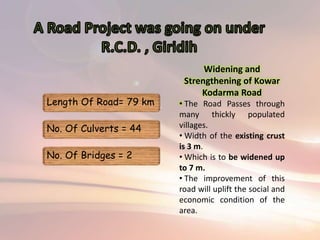
Length Of Road= 79 km
No. Of Culverts = 44
No. Of Bridges = 2
Widening and
Strengthening of Kowar
Kodarma Road
• The Road Passes through
many thickly populated
villages.
• Width of the existing crust
is 3 m.
• Which is to be widened up
to 7 m.
• The improvement of this
road will uplift the social and
economic condition of the
area.
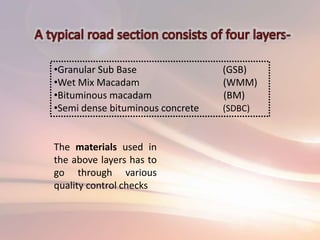
The materials used in
the above layers has to
go through various
quality control checks
•Granular Sub Base (GSB)
•Wet Mix Macadam (WMM)
•Bituminous macadam (BM)
•Semi dense bituminous concrete (SDBC)
Water Absorption test
Aggregate Impact test
Flakiness Index
Sieve analysis
Bitumen content test
A traffic census had been conducted previously at three points on the
road continuously for 7 days to get average daily traffic. Number of CV/day
is obtained from it, denoted by ‘P’
Cumulative Traffic is
found out as given in IRC
37 -2001.
From the Cumulative
Traffic, and known CBR
value ; we use the
Pavement design
Catalogue and obtain
thickness of all the layers
required in the Road.
N = {365*(1+r)^n -1} *D*F*P(1+r)^x
r
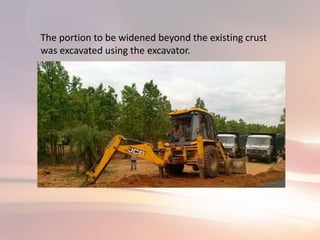
The portion to be widened beyond the existing crust
was excavated using the excavator.
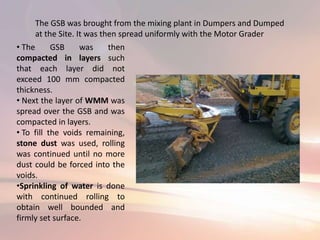
The GSB was brought from the mixing plant in Dumpers and Dumped
at the Site. It was then spread uniformly with the Motor Grader
• The GSB was then
compacted in layers such
that each layer did not
exceed 100 mm compacted
thickness.
• Next the layer of WMM was
spread over the GSB and was
compacted in layers.
• To fill the voids remaining,
stone dust was used, rolling
was continued until no more
dust could be forced into the
voids.
•Sprinkling of water is done
with continued rolling to
obtain well bounded and
firmly set surface.
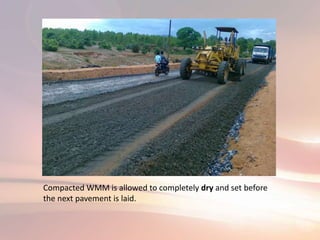
Compacted WMM is allowed to completely dry and set before
the next pavement is laid.
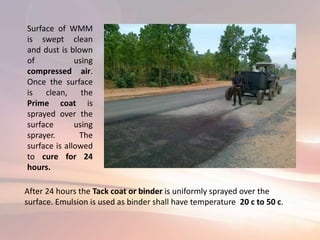
Surface of WMM
is swept clean
and dust is blown
of using
compressed air.
Once the surface
is clean, the
Prime coat is
sprayed over the
surface using
sprayer. The
surface is allowed
to cure for 24
hours.
After 24 hours the Tack coat or binder is uniformly sprayed over the
surface. Emulsion is used as binder shall have temperature 20 c to 50 c.
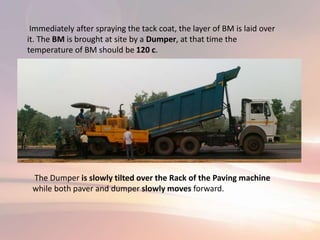
Immediately after spraying the tack coat, the layer of BM is laid over
it. The BM is brought at site by a Dumper, at that time the
temperature of BM should be 120 c.
The Dumper is slowly tilted over the Rack of the Paving machine
while both paver and dumper slowly moves forward.
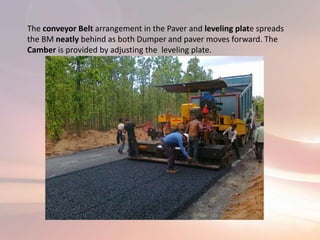
The conveyor Belt arrangement in the Paver and leveling plate spreads
the BM neatly behind as both Dumper and paver moves forward. The
Camber is provided by adjusting the leveling plate.
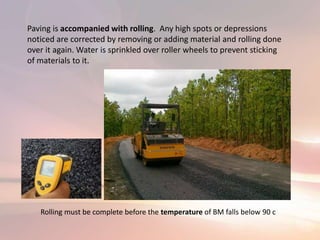
Paving is accompanied with rolling. Any high spots or depressions
noticed are corrected by removing or adding material and rolling done
over it again. Water is sprinkled over roller wheels to prevent sticking
of materials to it.
Rolling must be complete before the temperature of BM falls below 90 c
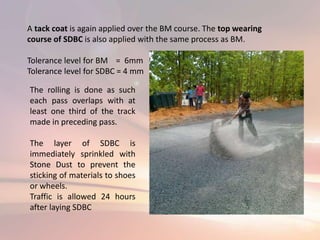
A tack coat is again applied over the BM course. The top wearing
course of SDBC is also applied with the same process as BM.
Tolerance level for BM = 6mm
Tolerance level for SDBC = 4 mm
The rolling is done as such
each pass overlaps with at
least one third of the track
made in preceding pass.
The layer of SDBC is
immediately sprinkled with
Stone Dust to prevent the
sticking of materials to shoes
or wheels.
Traffic is allowed 24 hours
after laying SDBC
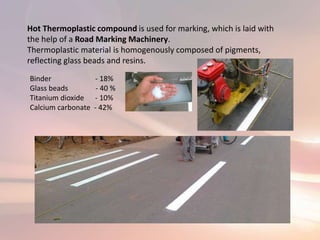
Hot Thermoplastic compound is used for marking, which is laid with
the help of a Road Marking Machinery.
Thermoplastic material is homogenously composed of pigments,
reflecting glass beads and resins.
Binder - 18%
Glass beads - 40 %
Titanium dioxide - 10%
Calcium carbonate - 42%
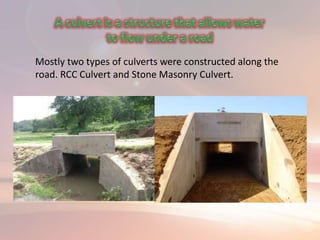
Mostly two types of culverts were constructed along the
road. RCC Culvert and Stone Masonry Culvert.
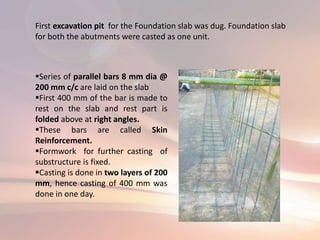
First excavation pit for the Foundation slab was dug. Foundation slab
for both the abutments were casted as one unit.
Series of parallel bars 8 mm dia @
200 mm c/c are laid on the slab
First 400 mm of the bar is made to
rest on the slab and rest part is
folded above at right angles.
These bars are called Skin
Reinforcement.
Formwork for further casting of
substructure is fixed.
Casting is done in two layers of 200
mm, hence casting of 400 mm was
done in one day.
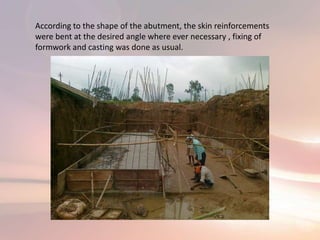
According to the shape of the abutment, the skin reinforcements
were bent at the desired angle where ever necessary , fixing of
formwork and casting was done as usual.
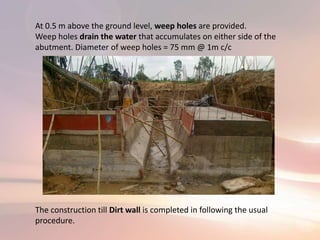
At 0.5 m above the ground level, weep holes are provided.
Weep holes drain the water that accumulates on either side of the
abutment. Diameter of weep holes = 75 mm @ 1m c/c
The construction till Dirt wall is completed in following the usual
procedure.
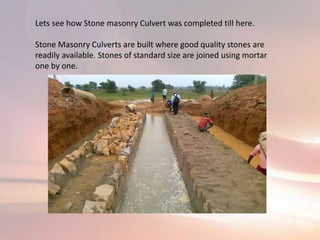
Lets see how Stone masonry Culvert was completed till here.
Stone Masonry Culverts are built where good quality stones are
readily available. Stones of standard size are joined using mortar
one by one.
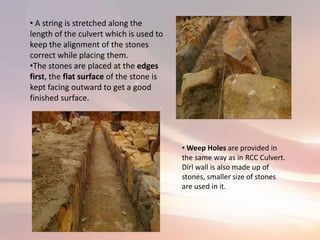
• A string is stretched along the
length of the culvert which is used to
keep the alignment of the stones
correct while placing them.
•The stones are placed at the edges
first, the flat surface of the stone is
kept facing outward to get a good
finished surface.
• Weep Holes are provided in
the same way as in RCC Culvert.
Dirl wall is also made up of
stones, smaller size of stones
are used in it.
After construction till dirt wall is complete, the process for further
construction in both types of Culvert is same.
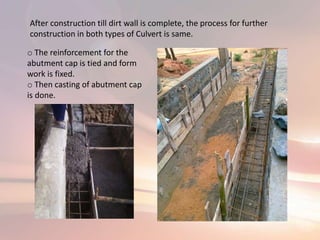
o The reinforcement for the
abutment cap is tied and form
work is fixed.
o Then casting of abutment cap
is done.
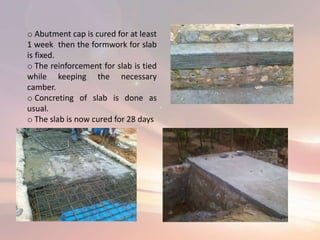
o Abutment cap is cured for at least
1 week then the formwork for slab
is fixed.
o The reinforcement for slab is tied
while keeping the necessary
camber.
o Concreting of slab is done as
usual.
o The slab is now cured for 28 days
• The old bridge was narrow,
damaged and insufficient to
carry present traffic load.
• It was a five span bridge with
total length 123 m.
• Hard strata was found at a
depth of 20 m
• The construction was just
started and the location of first
pile was well marked.
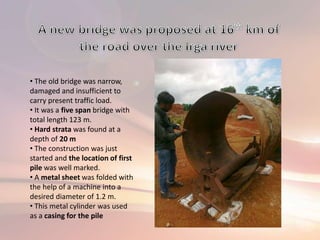
• A metal sheet was folded with
the help of a machine into a
desired diameter of 1.2 m.
• This metal cylinder was used
as a casing for the pile
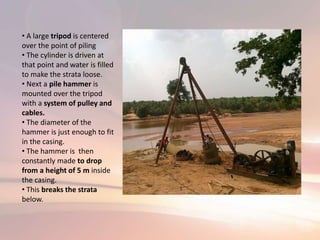
• A large tripod is centered
over the point of piling
• The cylinder is driven at
that point and water is filled
to make the strata loose.
• Next a pile hammer is
mounted over the tripod
with a system of pulley and
cables.
• The diameter of the
hammer is just enough to fit
in the casing.
• The hammer is then
constantly made to drop
from a height of 5 m inside
the casing.
• This breaks the strata
below.
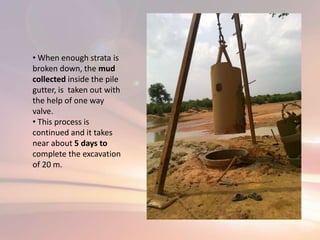
• When enough strata is
broken down, the mud
collected inside the pile
gutter, is taken out with
the help of one way
valve.
• This process is
continued and it takes
near about 5 days to
complete the excavation
of 20 m.
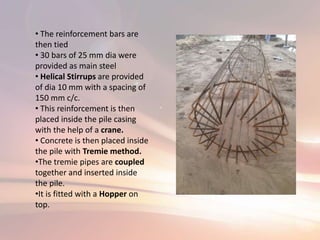
• The reinforcement bars are
then tied
• 30 bars of 25 mm dia were
provided as main steel
• Helical Stirrups are provided
of dia 10 mm with a spacing of
150 mm c/c.
• This reinforcement is then
placed inside the pile casing
with the help of a crane.
• Concrete is then placed inside
the pile with Tremie method.
•The tremie pipes are coupled
together and inserted inside
the pile.
•It is fitted with a Hopper on
top.
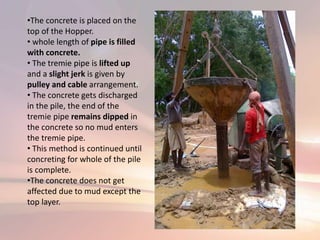
•The concrete is placed on the
top of the Hopper.
• whole length of pipe is filled
with concrete.
• The tremie pipe is lifted up
and a slight jerk is given by
pulley and cable arrangement.
• The concrete gets discharged
in the pile, the end of the
tremie pipe remains dipped in
the concrete so no mud enters
the tremie pipe.
• This method is continued until
concreting for whole of the pile
is complete.
•The concrete does not get
affected due to mud except the
top layer.
Road, Culvert & Bridge Training

Road, Culvert & Bridge Training

  • 2.
    Length Of Road=79 km No. Of Culverts = 44 No. Of Bridges = 2 Widening and Strengthening of Kowar Kodarma Road • The Road Passes through many thickly populated villages. • Width of the existing crust is 3 m. • Which is to be widened up to 7 m. • The improvement of this road will uplift the social and economic condition of the area.
  • 3.
    The materials usedin the above layers has to go through various quality control checks •Granular Sub Base (GSB) •Wet Mix Macadam (WMM) •Bituminous macadam (BM) •Semi dense bituminous concrete (SDBC)
  • 4.
    Water Absorption test AggregateImpact test Flakiness Index Sieve analysis Bitumen content test
  • 5.
    A traffic censushad been conducted previously at three points on the road continuously for 7 days to get average daily traffic. Number of CV/day is obtained from it, denoted by ‘P’ Cumulative Traffic is found out as given in IRC 37 -2001. From the Cumulative Traffic, and known CBR value ; we use the Pavement design Catalogue and obtain thickness of all the layers required in the Road. N = {365*(1+r)^n -1} *D*F*P(1+r)^x r
  • 6.
    The portion tobe widened beyond the existing crust was excavated using the excavator.
  • 7.
    The GSB wasbrought from the mixing plant in Dumpers and Dumped at the Site. It was then spread uniformly with the Motor Grader • The GSB was then compacted in layers such that each layer did not exceed 100 mm compacted thickness. • Next the layer of WMM was spread over the GSB and was compacted in layers. • To fill the voids remaining, stone dust was used, rolling was continued until no more dust could be forced into the voids. •Sprinkling of water is done with continued rolling to obtain well bounded and firmly set surface.
  • 8.
    Compacted WMM isallowed to completely dry and set before the next pavement is laid.
  • 9.
    Surface of WMM isswept clean and dust is blown of using compressed air. Once the surface is clean, the Prime coat is sprayed over the surface using sprayer. The surface is allowed to cure for 24 hours. After 24 hours the Tack coat or binder is uniformly sprayed over the surface. Emulsion is used as binder shall have temperature 20 c to 50 c.
  • 10.
    Immediately after sprayingthe tack coat, the layer of BM is laid over it. The BM is brought at site by a Dumper, at that time the temperature of BM should be 120 c. The Dumper is slowly tilted over the Rack of the Paving machine while both paver and dumper slowly moves forward.
  • 11.
    The conveyor Beltarrangement in the Paver and leveling plate spreads the BM neatly behind as both Dumper and paver moves forward. The Camber is provided by adjusting the leveling plate.
  • 12.
    Paving is accompaniedwith rolling. Any high spots or depressions noticed are corrected by removing or adding material and rolling done over it again. Water is sprinkled over roller wheels to prevent sticking of materials to it. Rolling must be complete before the temperature of BM falls below 90 c
  • 13.
    A tack coatis again applied over the BM course. The top wearing course of SDBC is also applied with the same process as BM. Tolerance level for BM = 6mm Tolerance level for SDBC = 4 mm The rolling is done as such each pass overlaps with at least one third of the track made in preceding pass. The layer of SDBC is immediately sprinkled with Stone Dust to prevent the sticking of materials to shoes or wheels. Traffic is allowed 24 hours after laying SDBC
  • 14.
    Hot Thermoplastic compoundis used for marking, which is laid with the help of a Road Marking Machinery. Thermoplastic material is homogenously composed of pigments, reflecting glass beads and resins. Binder - 18% Glass beads - 40 % Titanium dioxide - 10% Calcium carbonate - 42%
  • 15.
    Mostly two typesof culverts were constructed along the road. RCC Culvert and Stone Masonry Culvert.
  • 16.
    First excavation pitfor the Foundation slab was dug. Foundation slab for both the abutments were casted as one unit. Series of parallel bars 8 mm dia @ 200 mm c/c are laid on the slab First 400 mm of the bar is made to rest on the slab and rest part is folded above at right angles. These bars are called Skin Reinforcement. Formwork for further casting of substructure is fixed. Casting is done in two layers of 200 mm, hence casting of 400 mm was done in one day.
  • 17.
    According to theshape of the abutment, the skin reinforcements were bent at the desired angle where ever necessary , fixing of formwork and casting was done as usual.
  • 18.
    At 0.5 mabove the ground level, weep holes are provided. Weep holes drain the water that accumulates on either side of the abutment. Diameter of weep holes = 75 mm @ 1m c/c The construction till Dirt wall is completed in following the usual procedure.
  • 19.
    Lets see howStone masonry Culvert was completed till here. Stone Masonry Culverts are built where good quality stones are readily available. Stones of standard size are joined using mortar one by one.
  • 20.
    • A stringis stretched along the length of the culvert which is used to keep the alignment of the stones correct while placing them. •The stones are placed at the edges first, the flat surface of the stone is kept facing outward to get a good finished surface. • Weep Holes are provided in the same way as in RCC Culvert. Dirl wall is also made up of stones, smaller size of stones are used in it.
  • 21.
    After construction tilldirt wall is complete, the process for further construction in both types of Culvert is same. o The reinforcement for the abutment cap is tied and form work is fixed. o Then casting of abutment cap is done.
  • 22.
    o Abutment capis cured for at least 1 week then the formwork for slab is fixed. o The reinforcement for slab is tied while keeping the necessary camber. o Concreting of slab is done as usual. o The slab is now cured for 28 days
  • 23.
    • The oldbridge was narrow, damaged and insufficient to carry present traffic load. • It was a five span bridge with total length 123 m. • Hard strata was found at a depth of 20 m • The construction was just started and the location of first pile was well marked. • A metal sheet was folded with the help of a machine into a desired diameter of 1.2 m. • This metal cylinder was used as a casing for the pile
  • 24.
    • A largetripod is centered over the point of piling • The cylinder is driven at that point and water is filled to make the strata loose. • Next a pile hammer is mounted over the tripod with a system of pulley and cables. • The diameter of the hammer is just enough to fit in the casing. • The hammer is then constantly made to drop from a height of 5 m inside the casing. • This breaks the strata below.
  • 25.
    • When enoughstrata is broken down, the mud collected inside the pile gutter, is taken out with the help of one way valve. • This process is continued and it takes near about 5 days to complete the excavation of 20 m.
  • 26.
    • The reinforcementbars are then tied • 30 bars of 25 mm dia were provided as main steel • Helical Stirrups are provided of dia 10 mm with a spacing of 150 mm c/c. • This reinforcement is then placed inside the pile casing with the help of a crane. • Concrete is then placed inside the pile with Tremie method. •The tremie pipes are coupled together and inserted inside the pile. •It is fitted with a Hopper on top.
  • 27.
    •The concrete isplaced on the top of the Hopper. • whole length of pipe is filled with concrete. • The tremie pipe is lifted up and a slight jerk is given by pulley and cable arrangement. • The concrete gets discharged in the pile, the end of the tremie pipe remains dipped in the concrete so no mud enters the tremie pipe. • This method is continued until concreting for whole of the pile is complete. •The concrete does not get affected due to mud except the top layer.