Unit 1
BONDS
BONDS
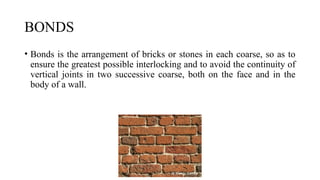
• Bonds is the arrangement of bricks or stones in each coarse, so as to
ensure the greatest possible interlocking and to avoid the continuity of
vertical joints in two successive coarse, both on the face and in the
body of a wall.
OBJECTIVES OF BOND
• To ensure longitudinal and lateral strength of the structure.
• To provide pleasing appearance by laying bricks symmetrically.
• To do masonry work quickly by engaging more masons on a job at a
time
TYPES OF BOND
• Header Bond
• Stretcher Bond
• English Bond
• Flemish Bond
• Double Flemish Bond
• Single Flemish Bond
• Raking Bond
• Herring bone Bond
• Diagonal bond
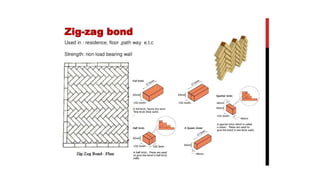
• Zig – Zag Bond
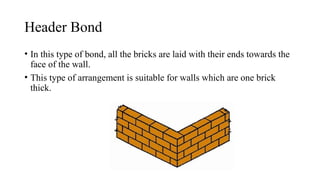
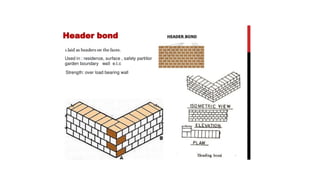
Header Bond
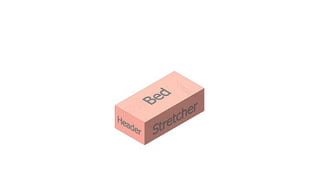
• In this type of bond, all the bricks are laid with their ends towards the
face of the wall.
• This type of arrangement is suitable for walls which are one brick
thick.
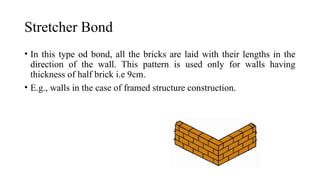
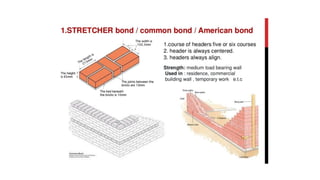
Stretcher Bond
• In this type od bond, all the bricks are laid with their lengths in the
direction of the wall. This pattern is used only for walls having
thickness of half brick i.e 9cm.
• E.g., walls in the case of framed structure construction.
English Bond
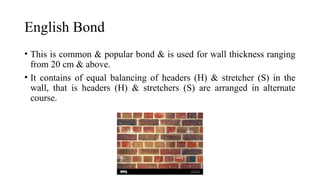
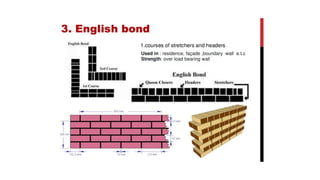
• This is common & popular bond & is used for wall thickness ranging
from 20 cm & above.
• It contains of equal balancing of headers (H) & stretcher (S) in the
wall, that is headers (H) & stretchers (S) are arranged in alternate
course.
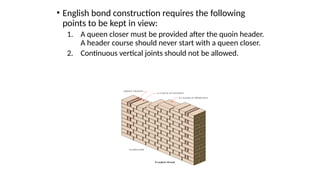
• English bond construction requires the following
points to be kept in view:
1. A queen closer must be provided after the quoin header.
A header course should never start with a queen closer.
2. Continuous vertical joints should not be allowed.
• The joints in the header course should be made
thinner than those in the stretcher course. This is
because of the fact that the number of vertical joints
in the stretcher course is half of the number of joints
in the header course.
• In this stretcher course, the stretchers should have a
minimum lap of 1/4th
their length over the headers.
Flemish Bond
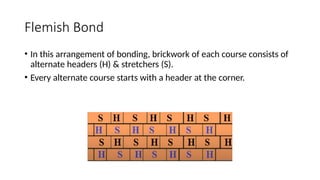
• In this arrangement of bonding, brickwork of each course consists of
alternate headers (H) & stretchers (S).
• Every alternate course starts with a header at the corner.
• There are mainly two types of Flemish Bond:
• Single Flemish Bond
• Double Flemish Bond
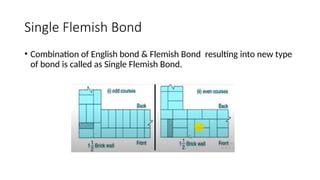
Single Flemish Bond
• Combination of English bond & Flemish Bond resulting into new type
of bond is called as Single Flemish Bond.
• For the purpose of attractive appearance of wall, this bond is mainly
adopted. The drawback of this bond us that it cannot be used for
walls less than one & a half brick in thickness.
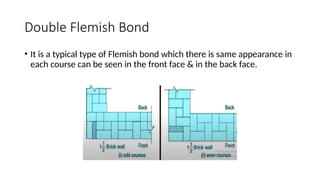
Double Flemish Bond
• It is a typical type of Flemish bond which there is same appearance in
each course can be seen in the front face & in the back face.
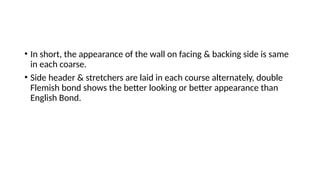
• In short, the appearance of the wall on facing & backing side is same
in each coarse.
• Side header & stretchers are laid in each course alternately, double
Flemish bond shows the better looking or better appearance than
English Bond.
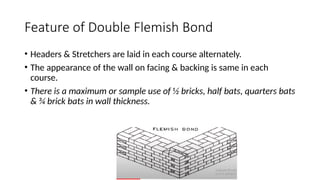
Feature of Double Flemish Bond
• Headers & Stretchers are laid in each course alternately.
• The appearance of the wall on facing & backing is same in each
course.
• There is a maximum or sample use of ½ bricks, half bats, quarters bats
& ¾ brick bats in wall thickness.
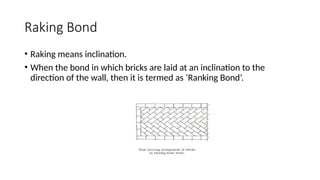
Raking Bond
• Raking means inclination.
• When the bond in which bricks are laid at an inclination to the
direction of the wall, then it is termed as ‘Ranking Bond’.
• Longitudinal stability of wall in case of ranking bond & hence it’s such
type of bond is provided in thick wall of English bond, the longitudinal
stability of English bond gets increased.
• There are two types,
• Herring – bone bond
• Diagonal bond
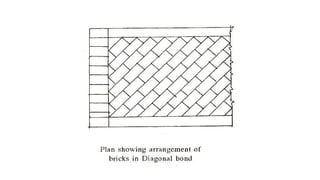
Diagonal Bond
• In such type of raking bond, the bricks are laid at an inclination of 45
degree in such a way that the extreme end corners of diagonal course
remains in contact with the external line of stretchers.
• At the ends of diagonal course, bricks are cut in triangular shape &
suitable sizes by mason with the help of steel trawled & these bricks
are packed at the ends of the diagonal course.
• When the walls are two to four bricks thick, then diagonal bond is
suitable.
• The bond is introduced in the masonry work at regular vertical
internal normally at fifth or seventh coarse.
• Note that the directions of bricks are reversed in the every alternate
course of the bond.
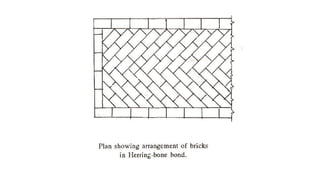
Herring – Bone Bond
• It is a type of raking bond in which bricks are arranged at 45 degree in
the opposite direction from the centre of the wall thickness.
• Note that the bricks are changed in every alternate course & the bond
is introduced at regular internal in the wall.
Unit 2
TUNNELING TECHNIQUES
Various types of tunneling techniques
• Drill jumbo
• Loading and firing
• Drilling
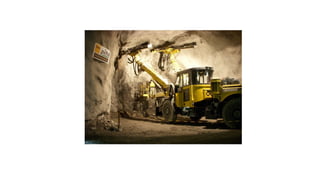
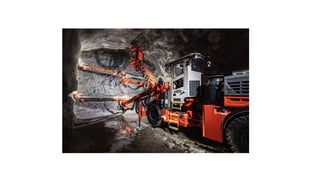
Drill Jumbo
• An underground drill rig for tunnelling excavation.
• The rig includes an ergonomic vibration-dampened cabin designed for
all-round visibility, low noise levels and minimised dust levels.
Types of well point systems
1. Pumping from open sumps
2. Pumping from well points
• Well point systems are installed in two ways:
a) Line system
b) Ring system
3. Pumping from bored wells
Types of piles
a) Driven piles – Timber, recast concrete, Pre-stressed concrete , steel
H-section, Box and tube
b) Driven and cast-in place piles
c) Bored piles
d) Composite piles
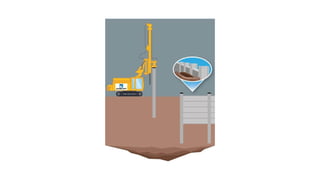
Use of H – piles
• H-Piles are used in construction of bridges where they can be driven
through existing construction in small spaces
• They are used useful for driving close to existing structures since they
cause little displacement of soil. It can be withstand large lateral
forces.
• They require less space for shipping and storing than wood, pipe or
precast concrete piles.
• They do not require special slings or special care in handling.
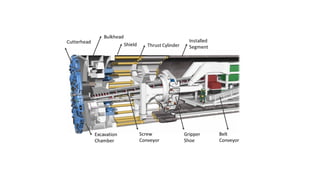
Tunnel boring machine
• Tunnel boring machine (TBM) as mole recent developments in the
tunnel driving technique. The function of TBM is to loosen the earth
or break the rock continuously in the entire section of the tunnel, in
to cuttings and convey to the rear of the machine, where it can be
loaded into muck cars or dumpers or on to conveyor belts for the
transportation to the ultimate disposal site.
Methods of TBM
• The basic principle of this TBM is to maintain the face pressure
during the excavation phase by filling the working chamber, located
behind the cutter head, with slurry. Limits ground settlement and
produces a smooth tunnel wall.
Advantages of tunnel boring machines
• There is very less danger of fall outs in machine bored tunnels, since
adjacent or surrounding rocks are undistributed as no blasting is
done.
• Higher speed of excavation.
• Reduction in the tunnel supports requirement.
• Less manpower requirement.
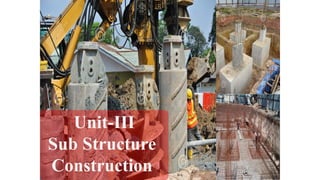
Unit-III
Sub Structure
Construction
 Techniques of
a. Box Jacking
b. Pipe Jacking
 Underwater construction of
a. Diaphragm walls
b. Basement
 Tunneling Techniques
 Piling Techniques
 Driving well
 Caisson
 Sinking Cofferdam
 Cable Anchoring
 Cable Anchoring
 Grouting
 Driving Diaphragm Walls.
 Sheet Piles
 Shoring for deep cutting
 Large reservoir construction with
membranes and earth system.
 Well Points
 Dewatering and stand by plant
equipment for underground open
excavation.
SYNOPSIS
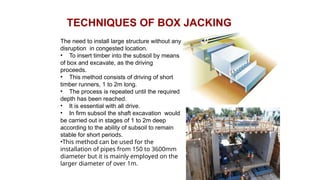
TECHNIQUES OF BOX JACKING
The need to install large structure without any
disruption in congested location.
• To insert timber into the subsoil by means
of box and excavate, as the driving
proceeds.
• This method consists of driving of short
timber runners, 1 to 2m long.
• The process is repeated until the required
depth has been reached.
• It is essential with all drive.
• In firm subsoil the shaft excavation would
be carried out in stages of 1 to 2m deep
according to the ability of subsoil to remain
stable for short periods.
•This method can be used for the
installation of pipes from 150 to 3600mm
diameter but it is mainly employed on the
larger diameter of over 1m.
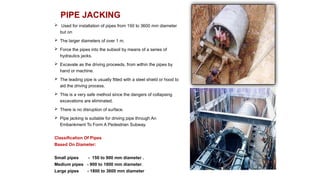
PIPE JACKING
 Used for installation of pipes from 150 to 3600 mm diameter
but on
 The larger diameters of over 1 m.
 Force the pipes into the subsoil by means of a series of
hydraulics jacks.
 Excavate as the driving proceeds, from within the pipes by
hand or machine.
 The leading pipe is usually fitted with a steel shield or hood to
aid the driving process.
 This is a very safe method since the dangers of collapsing
excavations are eliminated.
 There is no disruption of surface.
 Pipe jacking is suitable for driving pipe through An
Embankment To Form A Pedestrian Subway.
Classification Of Pipes
Based On Diameter:
Small pipes - 150 to 900 mm diameter .
Medium pipes - 900 to 1800 mm diameter.
Large pipes - 1800 to 3600 mm diameter
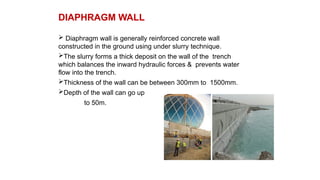
DIAPHRAGM WALL
 Diaphragm wall is generally reinforced concrete wall
constructed in the ground using under slurry technique.
The slurry forms a thick deposit on the wall of the trench
which balances the inward hydraulic forces & prevents water
flow into the trench.
Thickness of the wall can be between 300mm to 1500mm.
Depth of the wall can go up
to 50m.
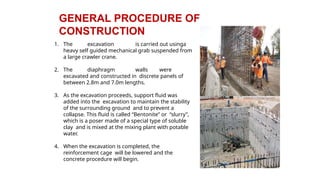
GENERAL PROCEDURE OF
CONSTRUCTION
1. The excavation is carried out usinga
heavy self guided mechanical grab suspended from
a large crawler crane.
2. The diaphragm walls were
excavated and constructed in discrete panels of
between 2.8m and 7.0m lengths.
3. As the excavation proceeds, support fluid was
added into the excavation to maintain the stability
of the surrounding ground and to prevent a
collapse. This fluid is called “Bentonite” or “slurry”,
which is a poser made of a special type of soluble
clay and is mixed at the mixing plant with potable
water.
4. When the excavation is completed, the
reinforcement cage will be lowered and the
concrete procedure will begin.
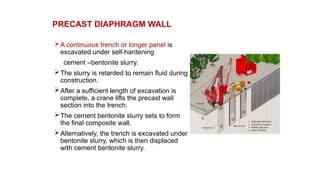
PRECAST DIAPHRAGM WALL
A continuous trench or longer panel is
excavated under self-hardening
cement –bentonite slurry.
The slurry is retarded to remain fluid during
construction.
After a sufficient length of excavation is
complete, a crane lifts the precast wall
section into the trench.
The cement bentonite slurry sets to form
the final composite wall.
Alternatively, the trench is excavated under
bentonite slurry, which is then displaced
with cement bentonite slurry.
Advantages of Diaphragm Wall
 Suitable for unstable soil profiles below water
table.
 Limited construction time.
 Where deeper than normal cantilever support
may needed.
 Designable to carry vertical loads.
 Construction time of basement can be lower.
 Minimize the settlement of adjacent building.
 Provides strong & water tight walls.
 No vibration during installation.
 Noise level limits to engine noise only.
 Can be used for seepage control in dams.
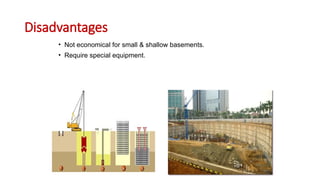
Disadvantages
• Not economical for small & shallow basements.
• Require special equipment.
• Structural Diaphragm walls: they are used as retaining
walls for the perimeter walls of deep basements and
underground parking facilities and subways.
• Load bearing walls: they are used in place of drilled piers
in foundation of tall buildings, bridge and pier
• Cutoff walls: in hydraulic structures diaphragm walls are
used as impermeable cutoffs to prevent seepage below
earth dams and weirs
Types of Diaphragm Walls
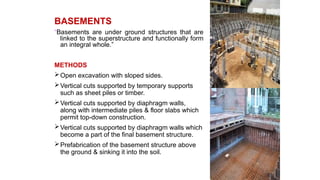
BASEMENTS
“Basements are under ground structures that are
linked to the superstructure and functionally form
an integral whole.”
METHODS
Open excavation with sloped sides.
Vertical cuts supported by temporary supports
such as sheet piles or timber.
Vertical cuts supported by diaphragm walls,
along with intermediate piles & floor slabs which
permit top-down construction.
Vertical cuts supported by diaphragm walls which
become a part of the final basement structure.
Prefabrication of the basement structure above
the ground & sinking it into the soil.
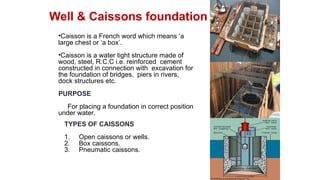
•Caisson is a French word which means ‘a
large chest or ‘a box’.
•Caisson is a water tight structure made of
wood, steel, R.C.C i.e. reinforced cement
constructed in connection with excavation for
the foundation of bridges, piers in rivers,
dock structures etc.
PURPOSE
For placing a foundation in correct position
under water.
Well & Caissons foundation
TYPES OF CAISSONS
1. Open caissons or wells.
2. Box caissons.
3. Pneumatic caissons.
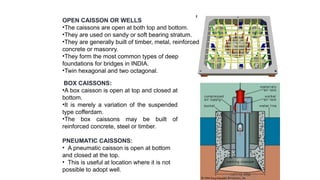
BOX CAISSONS:
•A box caisson is open at top and closed at
bottom.
•It is merely a variation of the suspended
type cofferdam.
•The box caissons may be built of
reinforced concrete, steel or timber.
PNEUMATIC CAISSONS:
• A pneumatic caisson is open at bottom
and closed at the top.
• This is useful at location where it is not
possible to adopt well.
OPEN CAISSON OR WELLS
•The caissons are open at both top and bottom.
•They are used on sandy or soft bearing stratum.
•They are generally built of timber, metal, reinforced
concrete or masonry.
•They form the most common types of deep
foundations for bridges in INDIA.
•Twin hexagonal and two octagonal.
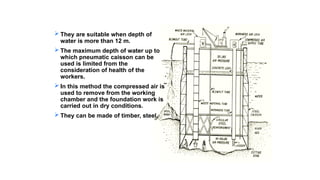
 They are suitable when depth of
water is more than 12 m.
 The maximum depth of water up to
which pneumatic caisson can be
used is limited from the
consideration of health of the
workers.
 In this method the compressed air is
used to remove from the working
chamber and the foundation work is
carried out in dry conditions.
 They can be made of timber, steel.
Shapes Of Caisson
Circular
Rectangular
Double-D
Rectangular with D-shaped ends
Twin hexagonal and two octagonal.
Materials Used For Caisson Construction
Steel
Timber
Cast iron
Twin hexagonal and two octagonal.
USES OF CAISSON
•Caissons are more suitable for the deep foundation under water
where the foundation should be extended up to or below the
river bed so as to obtain the proper stability.
•Caissons as type of well foundation is constructed in rivers and
lake, bridges, break water dock structures for the point of view
of shore protection.
•When depth of water in river, lake, or sea etc. are more, then
caisson structure is used.
•It is also used for pump house which are subjected to huge
vertical as well as horizontal forces.
•It is also occasionally used for large and multi- storey building
and other structures.
ADVANTAGES
• The caisson can be extended up to large depths.
• Caissons are more suitable for the deep foundation under water
where the foundation should be extended up to or below the
river bed so as to obtain the proper stability.
• Cost of Construction is relatively less on bedlevel or lower
side.
• Quality control of pneumatic caisson is good because work is
done in dry conditions. Concrete gain more strength due to dry
conditions.
• In-situ soil tests are possible to determine the bearing capacity
of pneumatic caisson.
• There is direct and easy passage to reach the bottom of
caisson, hence any obstruction can easily be removed
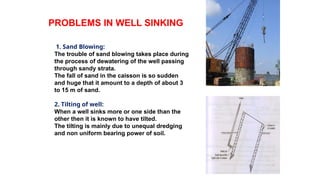
PROBLEMS IN WELL SINKING
1. Sand Blowing:
The trouble of sand blowing takes place during
the process of dewatering of the well passing
through sandy strata.
The fall of sand in the caisson is so sudden
and huge that it amount to a depth of about 3
to 15 m of sand.
2. Tilting of well:
When a well sinks more or one side than the
other then it is known to have tilted.
The tilting is mainly due to unequal dredging
and non uniform bearing power of soil.
PREVENTIONS
 Control of tilting.
 Eccentric loading.
Pushing the caisson.
 Pulling the caisson.
 Strutting the caisson
CAISSON DISEASES
1. Workmen may suffer from giddiness.
2. There is pains in ears of workmen.
3. There is breaking of ear drums of workmen.
4. There is bursting of blood vessels in the nose or ears
of workmen.
5. It may cause paralytic death.
6. If the bubbles are developed in spinal cord, it causes
paralysis and if the bubble are developed in heart, it
causes heart attack.
7. Caisson diseases can be controlled by recompression
followed by slow decompression.
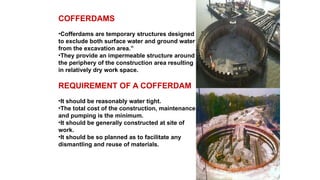
COFFERDAMS
•Cofferdams are temporary structures designed
to exclude both surface water and ground water
from the excavation area.”
•They provide an impermeable structure around
the periphery of the construction area resulting
in relatively dry work space.
REQUIREMENT OF A COFFERDAM
•It should be reasonably water tight.
•The total cost of the construction, maintenance
and pumping is the minimum.
•It should be generally constructed at site of
work.
•It should be so planned as to facilitate any
dismantling and reuse of materials.
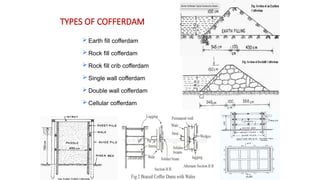
 Earth fill cofferdam
 Rock fill cofferdam
 Rock fill crib cofferdam
 Single wall cofferdam
 Double wall cofferdam
 Cellular cofferdam
TYPES OF COFFERDAM
1. Extent of area to be protected by a cofferdam.
2. The depth of water to be dealt with.
3. Velocity of flowing water.
4. Nature of bed on which cofferdam is to rest.
5. Availability of construction materials in the
vicinity of site of work.
6. Transportation facilities available.
SELECTION OF COFFERDAM
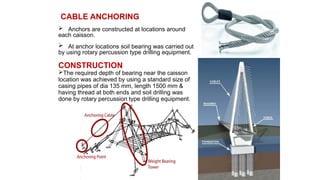
CABLE ANCHORING
 Anchors are constructed at locations around
each caisson.
 At anchor locations soil bearing was carried out
by using rotary percussion type drilling equipment.
CONSTRUCTION
The required depth of bearing near the caisson
location was achieved by using a standard size of
casing pipes of dia 135 mm, length 1500 mm &
having thread at both ends and soil drilling was
done by rotary percussion type drilling equipment.
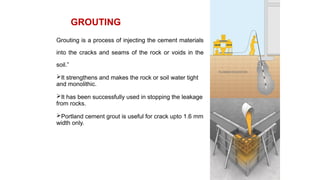
Grouting is a process of injecting the cement materials
into the cracks and seams of the rock or voids in the
soil.”
It strengthens and makes the rock or soil water tight
and monolithic.
It has been successfully used in stopping the leakage
from rocks.
Portland cement grout is useful for crack upto 1.6 mm
width only.
GROUTING
METHODS
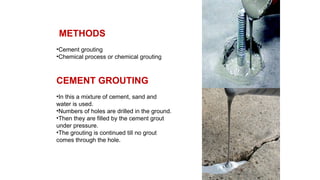
•Cement grouting
•Chemical process or chemical grouting
CEMENT GROUTING
•In this a mixture of cement, sand and
water is used.
•Numbers of holes are drilled in the ground.
•Then they are filled by the cement grout
under pressure.
•The grouting is continued till no grout
comes through the hole.
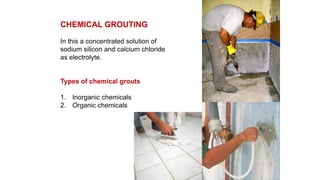
CHEMICAL GROUTING
In this a concentrated solution of
sodium silicon and calcium chloride
as electrolyte.
Types of chemical grouts
1. Inorganic chemicals
2. Organic chemicals
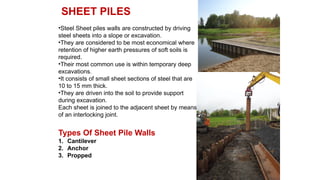
SHEET PILES
•Steel Sheet piles walls are constructed by driving
steel sheets into a slope or excavation.
•They are considered to be most economical where
retention of higher earth pressures of soft soils is
required.
•Their most common use is within temporary deep
excavations.
•It consists of small sheet sections of steel that are
10 to 15 mm thick.
•They are driven into the soil to provide support
during excavation.
Each sheet is joined to the adjacent sheet by means
of an interlocking joint.
Types Of Sheet Pile Walls
1. Cantilever
2. Anchor
3. Propped
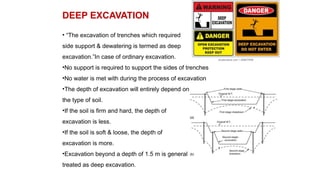
DEEP EXCAVATION
• “The excavation of trenches which required
side support & dewatering is termed as deep
excavation.”In case of ordinary excavation.
•No support is required to support the sides of trenches
•No water is met with during the process of excavation
•The depth of excavation will entirely depend on
the type of soil.
•If the soil is firm and hard, the depth of
excavation is less.
•If the soil is soft & loose, the depth of
excavation is more.
•Excavation beyond a depth of 1.5 m is general
treated as deep excavation.
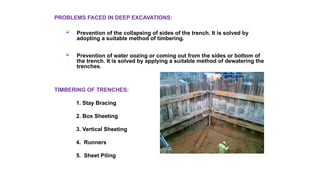
PROBLEMS FACED IN DEEP EXCAVATIONS:
 Prevention of the collapsing of sides of the trench. It is solved by
adopting a suitable method of timbering.
 Prevention of water oozing or coming out from the sides or bottom of
the trench. It is solved by applying a suitable method of dewatering the
trenches.
TIMBERING OF TRENCHES:
1. Stay Bracing
2. Box Sheeting
3. Vertical Sheeting
4. Runners
5. Sheet Piling
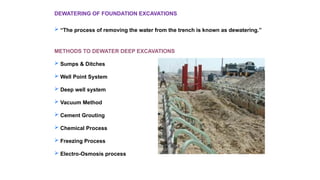
DEWATERING OF FOUNDATION EXCAVATIONS
 “The process of removing the water from the trench is known as dewatering.”
METHODS TO DEWATER DEEP EXCAVATIONS
 Sumps & Ditches
 Well Point System
 Deep well system
 Vacuum Method
 Cement Grouting
 Chemical Process
 Freezing Process
 Electro-Osmosis process
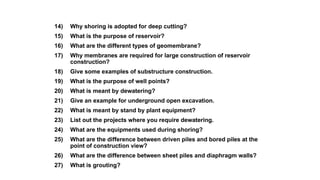
Important Questions
1) what is meant by jacking (Box & Pipe)?
2) What is meant by trenchless technology?
3) At what conditions, we are going for under water construction?
4) What is the purpose of diaphragm wall?
5) What are the different types of tunneling techniques?
6) Define pile and list out its types.
7) What is the purpose of pile cap?
8) What are the equipments used during tunnel techniques?
9) Define caisson.
10) Define cofferdam.
11) What are the sequential activities that will be carried out during driving well
and caisson at the construction pile?
12) What is the function of sheet piles?
13) Define shoring.
14) Why shoring is adopted for deep cutting?
15) What is the purpose of reservoir?
16) What are the different types of geomembrane?
17) Why membranes are required for large construction of reservoir
construction?
18) Give some examples of substructure construction.
19) What is the purpose of well points?
20) What is meant by dewatering?
21) Give an example for underground open excavation.
22) What is meant by stand by plant equipment?
23) List out the projects where you require dewatering.
24) What are the equipments used during shoring?
25) What are the difference between driven piles and bored piles at the
point of construction view?
26) What are the difference between sheet piles and diaphragm walls?
27) What is grouting?
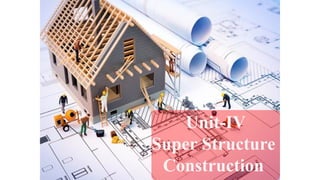
Unit-IV
Super Structure
Construction
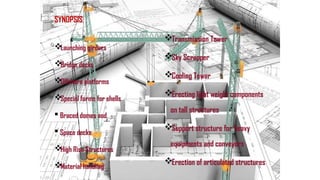
SYNOPSIS:
Launching girders
Bridge decks
Offshore platforms
Special forms for shells
 Braced domes and
 Space decks
High Rise Structures
Material handling
Transmission Tower
Sky Scrapper
Cooling Tower
Erecting light weight components
on tall structures
Support structure for heavy
equipments and conveyors
Erection of articulated structures
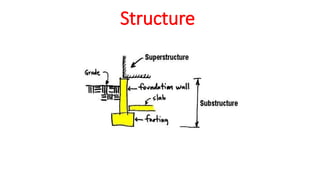
Structure
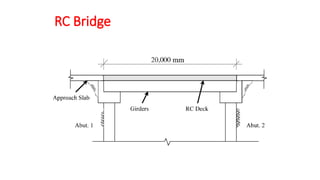
RC Bridge
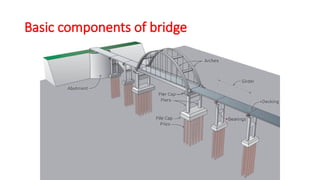
Basic components of bridge
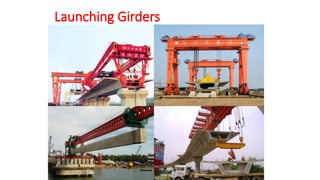
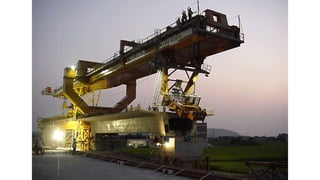
Launching Girders
SITE ERECTION METHODS
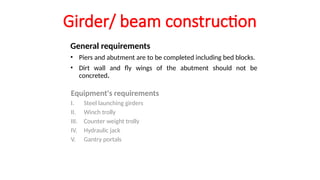
Girder/ beam construction
General requirements
• Piers and abutment are to be completed including bed blocks.
• Dirt wall and fly wings of the abutment should not be
concreted.
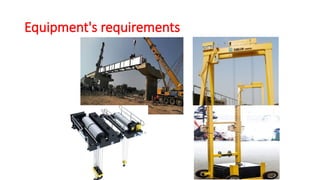
Equipment's requirements
I. Steel launching girders
II. Winch trolly
III. Counter weight trolly
IV. Hydraulic jack
V. Gantry portals
Equipment's requirements
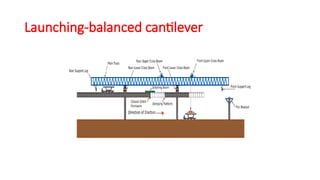
Launching-balanced cantilever
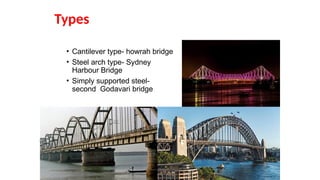
Types
• Cantilever type- howrah bridge
• Steel arch type- Sydney
Harbour Bridge
• Simply supported steel-
second Godavari bridge
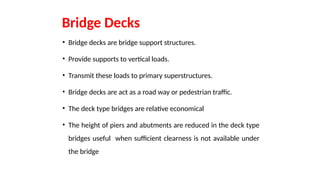
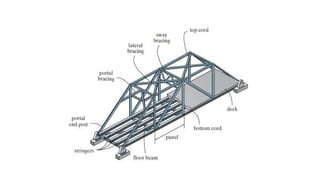
Bridge Decks
• Bridge decks are bridge support structures.
• Provide supports to vertical loads.
• Transmit these loads to primary superstructures.
• Bridge decks are act as a road way or pedestrian traffic.
• The deck type bridges are relative economical
• The height of piers and abutments are reduced in the deck type
bridges useful when sufficient clearness is not available under
the bridge
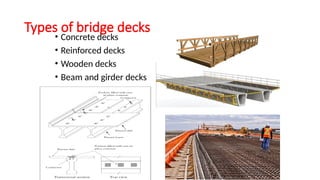
Types of bridge decks
• Concrete decks
• Reinforced decks
• Wooden decks
• Beam and girder decks
Offshore platform
• Offshore platform are self-contained platform used for the
exploration of oil gas from sea bed.
• Adequate facilities are provided to this platform ( drilling,
electric cranes mud drilling, oil rig and living places helipad).
• In concrete construction platform are called gravity tower.
Necessity of offshore platforms
• offshore platforms are huge structures equipped with resources.
• Provide storage facilities for crude and gas till they transported to refineries.
• Provide accommodation to the workforce
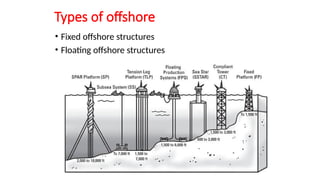
Types of offshore
• Fixed offshore structures
• Floating offshore structures
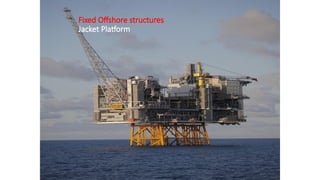
Fixed Offshore structures
Jacket Platform
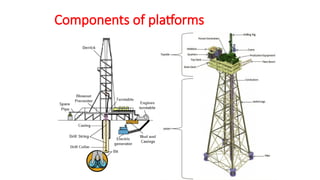
Components of platforms
1
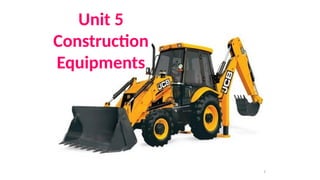
Unit 5
Construction
Equipments
Introduction
CONSTRUCTION EQUIPMENT 97
 In the case of huge construction projects;
 Proper use of the appropriate equipment contributes to
economy, quality, safety, speed and timely completion of a
project.
 Equipment are use for highway projects,
irrigation,
buildings, power projects etc.
 15-30% of total project cost has been accounted towards
equipment and machinery.
Classification of Construction Equipment
CONSTRUCTION EQUIPMENT 98
1. Earth-moving equipment
2. Hauling equipment
3. Hoisting equipment
4. Conveying equipment
5. Aggregate and concrete production equipment
6. Pile-driving equipment
7. Tunneling and rock drilling equipment
8. Pumping and dewatering equipment
Operations involved in
construction of any project
CONSTRUCTION EQUIPMENT 99
 Excavation
 Digging of large quantities of earth
 Moving them to distances which are sometimes fairly long
 Placement
 Compacting
 Leveling
 Dozing
 Grading
 Hauling
EXCAVATING AND EARTH MOVING EQUIPMENT
CONSTRUCTION EQUIPMENT 10
0
 Power shovel
 Back hoe
 Drag line
 Clam shell
 Scrapers
 Bull dozer
POWER SHOVEL
CONSTRUCTION EQUIPMENT 10
1
 To excavate the earth and to load the trucks
 capable of excavating all types of earth
except hard rock
 size varies from 0.375m3 to 5m3 .
 Basics parts of power shovel including the track
system, cabin, cables, rack, stick, boom foot-pin,
saddle block, boom, boom point sheaves and
bucket.
APPLICATIONS
CONSTRUCTION EQUIPMENT 10
2
• Suitable for close range of work
• Capable of digging very hard materials,
• can remove big sized boulders.
• It is used in various types of jobs such as digging
in gravel banks, clay pits, digging cuts in road
works, road-side berms, etc.
Factors affecting output of power shovel
CONSTRUCTION EQUIPMENT 10
3
• Class of material
• Depth of cutting
• Angle of swing
• Job condition
• Management condition
• Size of hauling units
• Skill of the operator
• Physical condition of the shovel
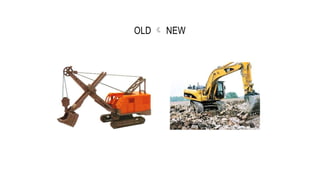
OLD  NEW
CONSTRUCTION EQUIPMENT 10
4
BACK HOE
CONSTRUCTION EQUIPMENT 10
5
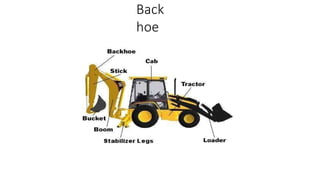
• Also known as hoe, back shovel and pull shovel
• It is used to excavate below the natural surface on which it
• rests.
• Generally used to excavate trenches, pits for basements and also for gra
works, which requires precise control of depths.
• The basic parts are boom, Jack boom, Boom foot drum, Boom sheave,
sheave, Stick, Bucket and Bucket sheave
Back
hoe
CONSTRUCTION EQUIPMENT 10
6
Application
CONSTRUCTION EQUIPMENT 10
7
• It is the most suitable machine for digging below the
machine level, such as, trenches, footings, basements etc.
• It can be efficiently used to dress or trim the surface
avoiding the use of manual effort for dressing the
excavated the surface.
Drag line
CONSTRUCTION EQUIPMENT 10
8
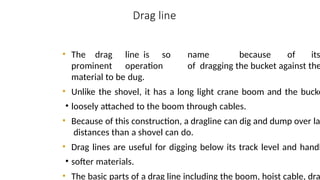
• The drag line is so name because of its
prominent operation of dragging the bucket against the
material to be dug.
• Unlike the shovel, it has a long light crane boom and the bucke
• loosely attached to the boom through cables.
• Because of this construction, a dragline can dig and dump over la
distances than a shovel can do.
• Drag lines are useful for digging below its track level and handl
• softer materials.
• The basic parts of a drag line including the boom, hoist cable, dra
Application
CONSTRUCTION EQUIPMENT 10
9
• It is the most suitable machine for dragging softer material
and below its track level
• It is very useful for excavating trenches when the sides are
permitted to establish their angle of repose without
shoring.
• It has long reaches.
• It is mostly used in the excavation for canals and
depositing on the embankment without hauling units.

Construction Techniques Equipment Practice.pptx unit 1,2,3,4 & 5

  • 1.
  • 2.
    BONDS • Bonds isthe arrangement of bricks or stones in each coarse, so as to ensure the greatest possible interlocking and to avoid the continuity of vertical joints in two successive coarse, both on the face and in the body of a wall.
  • 3.
    OBJECTIVES OF BOND •To ensure longitudinal and lateral strength of the structure. • To provide pleasing appearance by laying bricks symmetrically. • To do masonry work quickly by engaging more masons on a job at a time
  • 5.
    TYPES OF BOND •Header Bond • Stretcher Bond • English Bond • Flemish Bond • Double Flemish Bond • Single Flemish Bond • Raking Bond • Herring bone Bond • Diagonal bond • Zig – Zag Bond
  • 6.
    Header Bond • Inthis type of bond, all the bricks are laid with their ends towards the face of the wall. • This type of arrangement is suitable for walls which are one brick thick.
  • 8.
    Stretcher Bond • Inthis type od bond, all the bricks are laid with their lengths in the direction of the wall. This pattern is used only for walls having thickness of half brick i.e 9cm. • E.g., walls in the case of framed structure construction.
  • 10.
    English Bond • Thisis common & popular bond & is used for wall thickness ranging from 20 cm & above. • It contains of equal balancing of headers (H) & stretcher (S) in the wall, that is headers (H) & stretchers (S) are arranged in alternate course.
  • 11.
    • English bondconstruction requires the following points to be kept in view: 1. A queen closer must be provided after the quoin header. A header course should never start with a queen closer. 2. Continuous vertical joints should not be allowed.
  • 12.
    • The jointsin the header course should be made thinner than those in the stretcher course. This is because of the fact that the number of vertical joints in the stretcher course is half of the number of joints in the header course. • In this stretcher course, the stretchers should have a minimum lap of 1/4th their length over the headers.
  • 14.
    Flemish Bond • Inthis arrangement of bonding, brickwork of each course consists of alternate headers (H) & stretchers (S). • Every alternate course starts with a header at the corner.
  • 15.
    • There aremainly two types of Flemish Bond: • Single Flemish Bond • Double Flemish Bond
  • 16.
    Single Flemish Bond •Combination of English bond & Flemish Bond resulting into new type of bond is called as Single Flemish Bond.
  • 17.
    • For thepurpose of attractive appearance of wall, this bond is mainly adopted. The drawback of this bond us that it cannot be used for walls less than one & a half brick in thickness.
  • 18.
    Double Flemish Bond •It is a typical type of Flemish bond which there is same appearance in each course can be seen in the front face & in the back face.
  • 19.
    • In short,the appearance of the wall on facing & backing side is same in each coarse. • Side header & stretchers are laid in each course alternately, double Flemish bond shows the better looking or better appearance than English Bond.
  • 20.
    Feature of DoubleFlemish Bond • Headers & Stretchers are laid in each course alternately. • The appearance of the wall on facing & backing is same in each course. • There is a maximum or sample use of ½ bricks, half bats, quarters bats & ¾ brick bats in wall thickness.
  • 21.
    Raking Bond • Rakingmeans inclination. • When the bond in which bricks are laid at an inclination to the direction of the wall, then it is termed as ‘Ranking Bond’.
  • 22.
    • Longitudinal stabilityof wall in case of ranking bond & hence it’s such type of bond is provided in thick wall of English bond, the longitudinal stability of English bond gets increased. • There are two types, • Herring – bone bond • Diagonal bond
  • 23.
    Diagonal Bond • Insuch type of raking bond, the bricks are laid at an inclination of 45 degree in such a way that the extreme end corners of diagonal course remains in contact with the external line of stretchers. • At the ends of diagonal course, bricks are cut in triangular shape & suitable sizes by mason with the help of steel trawled & these bricks are packed at the ends of the diagonal course.
  • 25.
    • When thewalls are two to four bricks thick, then diagonal bond is suitable. • The bond is introduced in the masonry work at regular vertical internal normally at fifth or seventh coarse. • Note that the directions of bricks are reversed in the every alternate course of the bond.
  • 26.
    Herring – BoneBond • It is a type of raking bond in which bricks are arranged at 45 degree in the opposite direction from the centre of the wall thickness. • Note that the bricks are changed in every alternate course & the bond is introduced at regular internal in the wall.
  • 29.
  • 30.
    Various types oftunneling techniques • Drill jumbo • Loading and firing • Drilling
  • 31.
    Drill Jumbo • Anunderground drill rig for tunnelling excavation. • The rig includes an ergonomic vibration-dampened cabin designed for all-round visibility, low noise levels and minimised dust levels.
  • 34.
    Types of wellpoint systems 1. Pumping from open sumps 2. Pumping from well points • Well point systems are installed in two ways: a) Line system b) Ring system 3. Pumping from bored wells
  • 35.
    Types of piles a)Driven piles – Timber, recast concrete, Pre-stressed concrete , steel H-section, Box and tube b) Driven and cast-in place piles c) Bored piles d) Composite piles
  • 36.
    Use of H– piles • H-Piles are used in construction of bridges where they can be driven through existing construction in small spaces • They are used useful for driving close to existing structures since they cause little displacement of soil. It can be withstand large lateral forces. • They require less space for shipping and storing than wood, pipe or precast concrete piles. • They do not require special slings or special care in handling.
  • 38.
    Tunnel boring machine •Tunnel boring machine (TBM) as mole recent developments in the tunnel driving technique. The function of TBM is to loosen the earth or break the rock continuously in the entire section of the tunnel, in to cuttings and convey to the rear of the machine, where it can be loaded into muck cars or dumpers or on to conveyor belts for the transportation to the ultimate disposal site.
  • 39.
    Methods of TBM •The basic principle of this TBM is to maintain the face pressure during the excavation phase by filling the working chamber, located behind the cutter head, with slurry. Limits ground settlement and produces a smooth tunnel wall.
  • 41.
    Advantages of tunnelboring machines • There is very less danger of fall outs in machine bored tunnels, since adjacent or surrounding rocks are undistributed as no blasting is done. • Higher speed of excavation. • Reduction in the tunnel supports requirement. • Less manpower requirement.
  • 42.
  • 43.
     Techniques of a.Box Jacking b. Pipe Jacking  Underwater construction of a. Diaphragm walls b. Basement  Tunneling Techniques  Piling Techniques  Driving well  Caisson  Sinking Cofferdam  Cable Anchoring  Cable Anchoring  Grouting  Driving Diaphragm Walls.  Sheet Piles  Shoring for deep cutting  Large reservoir construction with membranes and earth system.  Well Points  Dewatering and stand by plant equipment for underground open excavation. SYNOPSIS
  • 44.
    TECHNIQUES OF BOXJACKING The need to install large structure without any disruption in congested location. • To insert timber into the subsoil by means of box and excavate, as the driving proceeds. • This method consists of driving of short timber runners, 1 to 2m long. • The process is repeated until the required depth has been reached. • It is essential with all drive. • In firm subsoil the shaft excavation would be carried out in stages of 1 to 2m deep according to the ability of subsoil to remain stable for short periods. •This method can be used for the installation of pipes from 150 to 3600mm diameter but it is mainly employed on the larger diameter of over 1m.
  • 45.
    PIPE JACKING  Usedfor installation of pipes from 150 to 3600 mm diameter but on  The larger diameters of over 1 m.  Force the pipes into the subsoil by means of a series of hydraulics jacks.  Excavate as the driving proceeds, from within the pipes by hand or machine.  The leading pipe is usually fitted with a steel shield or hood to aid the driving process.  This is a very safe method since the dangers of collapsing excavations are eliminated.  There is no disruption of surface.  Pipe jacking is suitable for driving pipe through An Embankment To Form A Pedestrian Subway. Classification Of Pipes Based On Diameter: Small pipes - 150 to 900 mm diameter . Medium pipes - 900 to 1800 mm diameter. Large pipes - 1800 to 3600 mm diameter
  • 46.
    DIAPHRAGM WALL  Diaphragmwall is generally reinforced concrete wall constructed in the ground using under slurry technique. The slurry forms a thick deposit on the wall of the trench which balances the inward hydraulic forces & prevents water flow into the trench. Thickness of the wall can be between 300mm to 1500mm. Depth of the wall can go up to 50m.
  • 47.
    GENERAL PROCEDURE OF CONSTRUCTION 1.The excavation is carried out usinga heavy self guided mechanical grab suspended from a large crawler crane. 2. The diaphragm walls were excavated and constructed in discrete panels of between 2.8m and 7.0m lengths. 3. As the excavation proceeds, support fluid was added into the excavation to maintain the stability of the surrounding ground and to prevent a collapse. This fluid is called “Bentonite” or “slurry”, which is a poser made of a special type of soluble clay and is mixed at the mixing plant with potable water. 4. When the excavation is completed, the reinforcement cage will be lowered and the concrete procedure will begin.
  • 48.
    PRECAST DIAPHRAGM WALL Acontinuous trench or longer panel is excavated under self-hardening cement –bentonite slurry. The slurry is retarded to remain fluid during construction. After a sufficient length of excavation is complete, a crane lifts the precast wall section into the trench. The cement bentonite slurry sets to form the final composite wall. Alternatively, the trench is excavated under bentonite slurry, which is then displaced with cement bentonite slurry.
  • 49.
    Advantages of DiaphragmWall  Suitable for unstable soil profiles below water table.  Limited construction time.  Where deeper than normal cantilever support may needed.  Designable to carry vertical loads.  Construction time of basement can be lower.  Minimize the settlement of adjacent building.  Provides strong & water tight walls.  No vibration during installation.  Noise level limits to engine noise only.  Can be used for seepage control in dams.
  • 50.
    Disadvantages • Not economicalfor small & shallow basements. • Require special equipment.
  • 51.
    • Structural Diaphragmwalls: they are used as retaining walls for the perimeter walls of deep basements and underground parking facilities and subways. • Load bearing walls: they are used in place of drilled piers in foundation of tall buildings, bridge and pier • Cutoff walls: in hydraulic structures diaphragm walls are used as impermeable cutoffs to prevent seepage below earth dams and weirs Types of Diaphragm Walls
  • 52.
    BASEMENTS “Basements are underground structures that are linked to the superstructure and functionally form an integral whole.” METHODS Open excavation with sloped sides. Vertical cuts supported by temporary supports such as sheet piles or timber. Vertical cuts supported by diaphragm walls, along with intermediate piles & floor slabs which permit top-down construction. Vertical cuts supported by diaphragm walls which become a part of the final basement structure. Prefabrication of the basement structure above the ground & sinking it into the soil.
  • 53.
    •Caisson is aFrench word which means ‘a large chest or ‘a box’. •Caisson is a water tight structure made of wood, steel, R.C.C i.e. reinforced cement constructed in connection with excavation for the foundation of bridges, piers in rivers, dock structures etc. PURPOSE For placing a foundation in correct position under water. Well & Caissons foundation TYPES OF CAISSONS 1. Open caissons or wells. 2. Box caissons. 3. Pneumatic caissons.
  • 54.
    BOX CAISSONS: •A boxcaisson is open at top and closed at bottom. •It is merely a variation of the suspended type cofferdam. •The box caissons may be built of reinforced concrete, steel or timber. PNEUMATIC CAISSONS: • A pneumatic caisson is open at bottom and closed at the top. • This is useful at location where it is not possible to adopt well. OPEN CAISSON OR WELLS •The caissons are open at both top and bottom. •They are used on sandy or soft bearing stratum. •They are generally built of timber, metal, reinforced concrete or masonry. •They form the most common types of deep foundations for bridges in INDIA. •Twin hexagonal and two octagonal.
  • 55.
     They aresuitable when depth of water is more than 12 m.  The maximum depth of water up to which pneumatic caisson can be used is limited from the consideration of health of the workers.  In this method the compressed air is used to remove from the working chamber and the foundation work is carried out in dry conditions.  They can be made of timber, steel.
  • 56.
    Shapes Of Caisson Circular Rectangular Double-D Rectangularwith D-shaped ends Twin hexagonal and two octagonal. Materials Used For Caisson Construction Steel Timber Cast iron Twin hexagonal and two octagonal.
  • 57.
    USES OF CAISSON •Caissonsare more suitable for the deep foundation under water where the foundation should be extended up to or below the river bed so as to obtain the proper stability. •Caissons as type of well foundation is constructed in rivers and lake, bridges, break water dock structures for the point of view of shore protection. •When depth of water in river, lake, or sea etc. are more, then caisson structure is used. •It is also used for pump house which are subjected to huge vertical as well as horizontal forces. •It is also occasionally used for large and multi- storey building and other structures.
  • 58.
    ADVANTAGES • The caissoncan be extended up to large depths. • Caissons are more suitable for the deep foundation under water where the foundation should be extended up to or below the river bed so as to obtain the proper stability. • Cost of Construction is relatively less on bedlevel or lower side. • Quality control of pneumatic caisson is good because work is done in dry conditions. Concrete gain more strength due to dry conditions. • In-situ soil tests are possible to determine the bearing capacity of pneumatic caisson. • There is direct and easy passage to reach the bottom of caisson, hence any obstruction can easily be removed
  • 59.
    PROBLEMS IN WELLSINKING 1. Sand Blowing: The trouble of sand blowing takes place during the process of dewatering of the well passing through sandy strata. The fall of sand in the caisson is so sudden and huge that it amount to a depth of about 3 to 15 m of sand. 2. Tilting of well: When a well sinks more or one side than the other then it is known to have tilted. The tilting is mainly due to unequal dredging and non uniform bearing power of soil.
  • 60.
    PREVENTIONS  Control oftilting.  Eccentric loading. Pushing the caisson.  Pulling the caisson.  Strutting the caisson
  • 61.
    CAISSON DISEASES 1. Workmenmay suffer from giddiness. 2. There is pains in ears of workmen. 3. There is breaking of ear drums of workmen. 4. There is bursting of blood vessels in the nose or ears of workmen. 5. It may cause paralytic death. 6. If the bubbles are developed in spinal cord, it causes paralysis and if the bubble are developed in heart, it causes heart attack. 7. Caisson diseases can be controlled by recompression followed by slow decompression.
  • 62.
    COFFERDAMS •Cofferdams are temporarystructures designed to exclude both surface water and ground water from the excavation area.” •They provide an impermeable structure around the periphery of the construction area resulting in relatively dry work space. REQUIREMENT OF A COFFERDAM •It should be reasonably water tight. •The total cost of the construction, maintenance and pumping is the minimum. •It should be generally constructed at site of work. •It should be so planned as to facilitate any dismantling and reuse of materials.
  • 63.
     Earth fillcofferdam  Rock fill cofferdam  Rock fill crib cofferdam  Single wall cofferdam  Double wall cofferdam  Cellular cofferdam TYPES OF COFFERDAM
  • 64.
    1. Extent ofarea to be protected by a cofferdam. 2. The depth of water to be dealt with. 3. Velocity of flowing water. 4. Nature of bed on which cofferdam is to rest. 5. Availability of construction materials in the vicinity of site of work. 6. Transportation facilities available. SELECTION OF COFFERDAM
  • 65.
    CABLE ANCHORING  Anchorsare constructed at locations around each caisson.  At anchor locations soil bearing was carried out by using rotary percussion type drilling equipment. CONSTRUCTION The required depth of bearing near the caisson location was achieved by using a standard size of casing pipes of dia 135 mm, length 1500 mm & having thread at both ends and soil drilling was done by rotary percussion type drilling equipment.
  • 67.
    Grouting is aprocess of injecting the cement materials into the cracks and seams of the rock or voids in the soil.” It strengthens and makes the rock or soil water tight and monolithic. It has been successfully used in stopping the leakage from rocks. Portland cement grout is useful for crack upto 1.6 mm width only. GROUTING
  • 68.
    METHODS •Cement grouting •Chemical processor chemical grouting CEMENT GROUTING •In this a mixture of cement, sand and water is used. •Numbers of holes are drilled in the ground. •Then they are filled by the cement grout under pressure. •The grouting is continued till no grout comes through the hole.
  • 69.
    CHEMICAL GROUTING In thisa concentrated solution of sodium silicon and calcium chloride as electrolyte. Types of chemical grouts 1. Inorganic chemicals 2. Organic chemicals
  • 70.
    SHEET PILES •Steel Sheetpiles walls are constructed by driving steel sheets into a slope or excavation. •They are considered to be most economical where retention of higher earth pressures of soft soils is required. •Their most common use is within temporary deep excavations. •It consists of small sheet sections of steel that are 10 to 15 mm thick. •They are driven into the soil to provide support during excavation. Each sheet is joined to the adjacent sheet by means of an interlocking joint. Types Of Sheet Pile Walls 1. Cantilever 2. Anchor 3. Propped
  • 71.
    DEEP EXCAVATION • “Theexcavation of trenches which required side support & dewatering is termed as deep excavation.”In case of ordinary excavation. •No support is required to support the sides of trenches •No water is met with during the process of excavation •The depth of excavation will entirely depend on the type of soil. •If the soil is firm and hard, the depth of excavation is less. •If the soil is soft & loose, the depth of excavation is more. •Excavation beyond a depth of 1.5 m is general treated as deep excavation.
  • 72.
    PROBLEMS FACED INDEEP EXCAVATIONS:  Prevention of the collapsing of sides of the trench. It is solved by adopting a suitable method of timbering.  Prevention of water oozing or coming out from the sides or bottom of the trench. It is solved by applying a suitable method of dewatering the trenches. TIMBERING OF TRENCHES: 1. Stay Bracing 2. Box Sheeting 3. Vertical Sheeting 4. Runners 5. Sheet Piling
  • 73.
    DEWATERING OF FOUNDATIONEXCAVATIONS  “The process of removing the water from the trench is known as dewatering.” METHODS TO DEWATER DEEP EXCAVATIONS  Sumps & Ditches  Well Point System  Deep well system  Vacuum Method  Cement Grouting  Chemical Process  Freezing Process  Electro-Osmosis process
  • 74.
    Important Questions 1) whatis meant by jacking (Box & Pipe)? 2) What is meant by trenchless technology? 3) At what conditions, we are going for under water construction? 4) What is the purpose of diaphragm wall? 5) What are the different types of tunneling techniques? 6) Define pile and list out its types. 7) What is the purpose of pile cap? 8) What are the equipments used during tunnel techniques? 9) Define caisson. 10) Define cofferdam. 11) What are the sequential activities that will be carried out during driving well and caisson at the construction pile? 12) What is the function of sheet piles? 13) Define shoring.
  • 75.
    14) Why shoringis adopted for deep cutting? 15) What is the purpose of reservoir? 16) What are the different types of geomembrane? 17) Why membranes are required for large construction of reservoir construction? 18) Give some examples of substructure construction. 19) What is the purpose of well points? 20) What is meant by dewatering? 21) Give an example for underground open excavation. 22) What is meant by stand by plant equipment? 23) List out the projects where you require dewatering. 24) What are the equipments used during shoring? 25) What are the difference between driven piles and bored piles at the point of construction view? 26) What are the difference between sheet piles and diaphragm walls? 27) What is grouting?
  • 77.
  • 78.
    SYNOPSIS: Launching girders Bridge decks Offshoreplatforms Special forms for shells  Braced domes and  Space decks High Rise Structures Material handling Transmission Tower Sky Scrapper Cooling Tower Erecting light weight components on tall structures Support structure for heavy equipments and conveyors Erection of articulated structures
  • 79.
  • 80.
  • 81.
  • 82.
  • 83.
  • 84.
    Girder/ beam construction Generalrequirements • Piers and abutment are to be completed including bed blocks. • Dirt wall and fly wings of the abutment should not be concreted. Equipment's requirements I. Steel launching girders II. Winch trolly III. Counter weight trolly IV. Hydraulic jack V. Gantry portals
  • 85.
  • 86.
  • 87.
    Types • Cantilever type-howrah bridge • Steel arch type- Sydney Harbour Bridge • Simply supported steel- second Godavari bridge
  • 88.
    Bridge Decks • Bridgedecks are bridge support structures. • Provide supports to vertical loads. • Transmit these loads to primary superstructures. • Bridge decks are act as a road way or pedestrian traffic. • The deck type bridges are relative economical • The height of piers and abutments are reduced in the deck type bridges useful when sufficient clearness is not available under the bridge
  • 89.
    Types of bridgedecks • Concrete decks • Reinforced decks • Wooden decks • Beam and girder decks
  • 91.
    Offshore platform • Offshoreplatform are self-contained platform used for the exploration of oil gas from sea bed. • Adequate facilities are provided to this platform ( drilling, electric cranes mud drilling, oil rig and living places helipad). • In concrete construction platform are called gravity tower.
  • 92.
    Necessity of offshoreplatforms • offshore platforms are huge structures equipped with resources. • Provide storage facilities for crude and gas till they transported to refineries. • Provide accommodation to the workforce
  • 93.
    Types of offshore •Fixed offshore structures • Floating offshore structures
  • 94.
  • 95.
  • 96.
  • 97.
    Introduction CONSTRUCTION EQUIPMENT 97 In the case of huge construction projects;  Proper use of the appropriate equipment contributes to economy, quality, safety, speed and timely completion of a project.  Equipment are use for highway projects, irrigation, buildings, power projects etc.  15-30% of total project cost has been accounted towards equipment and machinery.
  • 98.
    Classification of ConstructionEquipment CONSTRUCTION EQUIPMENT 98 1. Earth-moving equipment 2. Hauling equipment 3. Hoisting equipment 4. Conveying equipment 5. Aggregate and concrete production equipment 6. Pile-driving equipment 7. Tunneling and rock drilling equipment 8. Pumping and dewatering equipment
  • 99.
    Operations involved in constructionof any project CONSTRUCTION EQUIPMENT 99  Excavation  Digging of large quantities of earth  Moving them to distances which are sometimes fairly long  Placement  Compacting  Leveling  Dozing  Grading  Hauling
  • 100.
    EXCAVATING AND EARTHMOVING EQUIPMENT CONSTRUCTION EQUIPMENT 10 0  Power shovel  Back hoe  Drag line  Clam shell  Scrapers  Bull dozer
  • 101.
    POWER SHOVEL CONSTRUCTION EQUIPMENT10 1  To excavate the earth and to load the trucks  capable of excavating all types of earth except hard rock  size varies from 0.375m3 to 5m3 .  Basics parts of power shovel including the track system, cabin, cables, rack, stick, boom foot-pin, saddle block, boom, boom point sheaves and bucket.
  • 102.
    APPLICATIONS CONSTRUCTION EQUIPMENT 10 2 •Suitable for close range of work • Capable of digging very hard materials, • can remove big sized boulders. • It is used in various types of jobs such as digging in gravel banks, clay pits, digging cuts in road works, road-side berms, etc.
  • 103.
    Factors affecting outputof power shovel CONSTRUCTION EQUIPMENT 10 3 • Class of material • Depth of cutting • Angle of swing • Job condition • Management condition • Size of hauling units • Skill of the operator • Physical condition of the shovel
  • 104.
  • 105.
    BACK HOE CONSTRUCTION EQUIPMENT10 5 • Also known as hoe, back shovel and pull shovel • It is used to excavate below the natural surface on which it • rests. • Generally used to excavate trenches, pits for basements and also for gra works, which requires precise control of depths. • The basic parts are boom, Jack boom, Boom foot drum, Boom sheave, sheave, Stick, Bucket and Bucket sheave
  • 106.
  • 107.
    Application CONSTRUCTION EQUIPMENT 10 7 •It is the most suitable machine for digging below the machine level, such as, trenches, footings, basements etc. • It can be efficiently used to dress or trim the surface avoiding the use of manual effort for dressing the excavated the surface.
  • 108.
    Drag line CONSTRUCTION EQUIPMENT10 8 • The drag line is so name because of its prominent operation of dragging the bucket against the material to be dug. • Unlike the shovel, it has a long light crane boom and the bucke • loosely attached to the boom through cables. • Because of this construction, a dragline can dig and dump over la distances than a shovel can do. • Drag lines are useful for digging below its track level and handl • softer materials. • The basic parts of a drag line including the boom, hoist cable, dra
  • 109.
    Application CONSTRUCTION EQUIPMENT 10 9 •It is the most suitable machine for dragging softer material and below its track level • It is very useful for excavating trenches when the sides are permitted to establish their angle of repose without shoring. • It has long reaches. • It is mostly used in the excavation for canals and depositing on the embankment without hauling units.