On the causes of the financial crisis Michael Brandl, PhD   Distinguished Visiting Professor Lecture The University of Texas at Austin     Johnson & Wales University Xavier Auditorium   McCombs School of Business   Providence, RI   April 22, 2010
Overview The causes of the crisis – not merely the symptoms. Understanding how we got here. Understanding this isn’t a “recent” problem” What we can learn from the crisis What economists should do
The Popular Press 7 seconds view The Federal Reserve lowered interest rates too low in 2003 and kept them too low through 2004. Homebuyers were  duped by mortgage lenders. Unregulated financial markets lent money too freely.
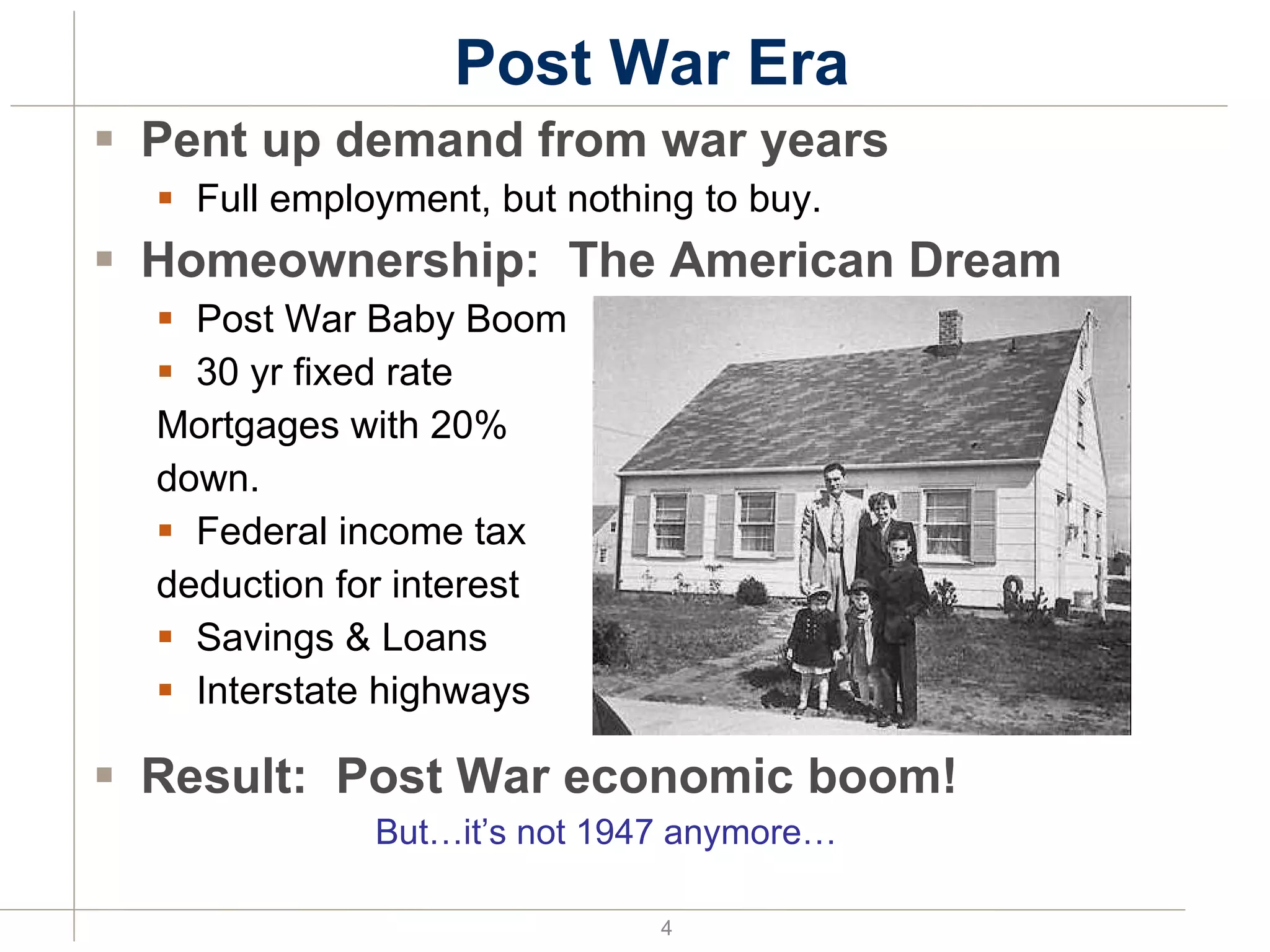
Post War Era Pent up demand from war years Full employment, but nothing to buy. Homeownership:  The American Dream Post War Baby Boom 30 yr fixed rate  Mortgages with 20%  down. Federal income tax deduction for interest Savings & Loans Interstate highways Result:  Post War economic boom! But…it’s not 1947 anymore…
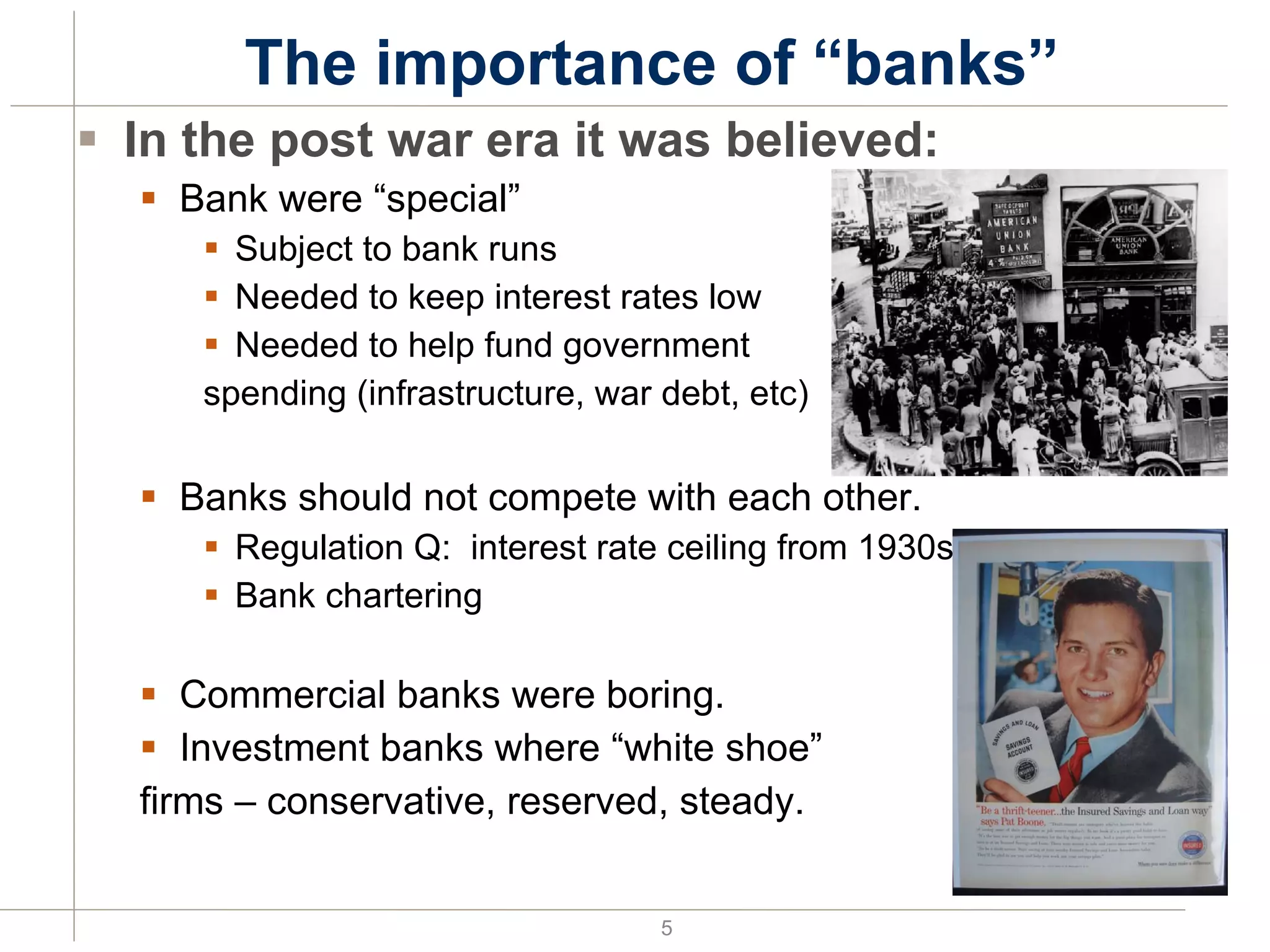
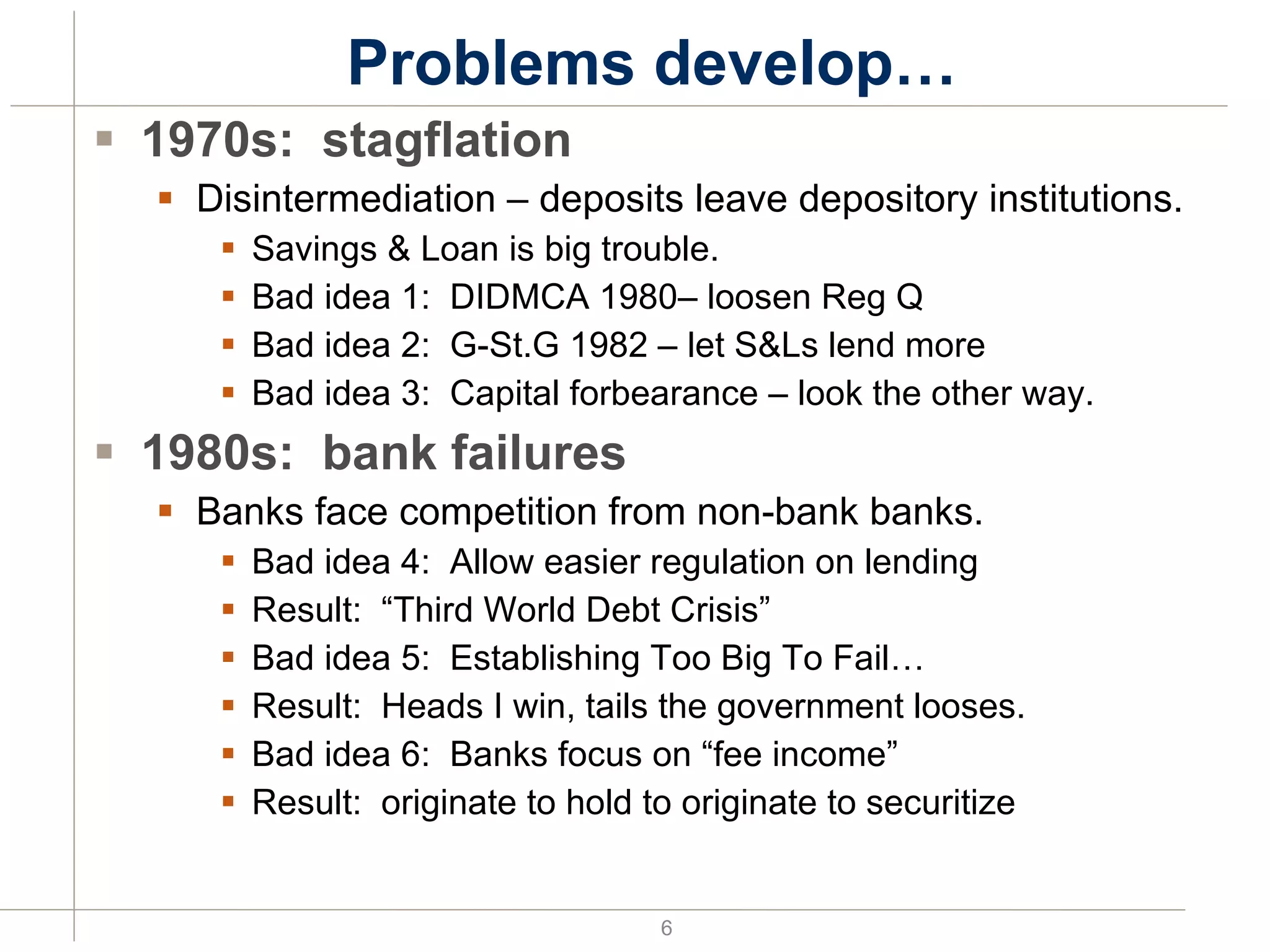
The importance of “banks” In the post war era it was believed: Bank were “special” Subject to bank runs Needed to keep interest rates low Needed to help fund government spending (infrastructure, war debt, etc) Banks should not compete with each other. Regulation Q:  interest rate ceiling from 1930s Bank chartering Commercial banks were boring. Investment banks where “white shoe”  firms – conservative, reserved, steady.
Problems develop… 1970s:  stagflation Disintermediation – deposits leave depository institutions. Savings & Loan is big trouble. Bad idea 1:  DIDMCA 1980– loosen Reg Q Bad idea 2:  G-St.G 1982 – let S&Ls lend more Bad idea 3:  Capital forbearance – look the other way. 1980s:  bank failures Banks face competition from non-bank banks. Bad idea 4:  Allow easier regulation on lending Result:  “Third World Debt Crisis” Bad idea 5:  Establishing Too Big To Fail… Result:  Heads I win, tails the government looses. Bad idea 6:  Banks focus on “fee income” Result:  originate to hold to originate to securitize
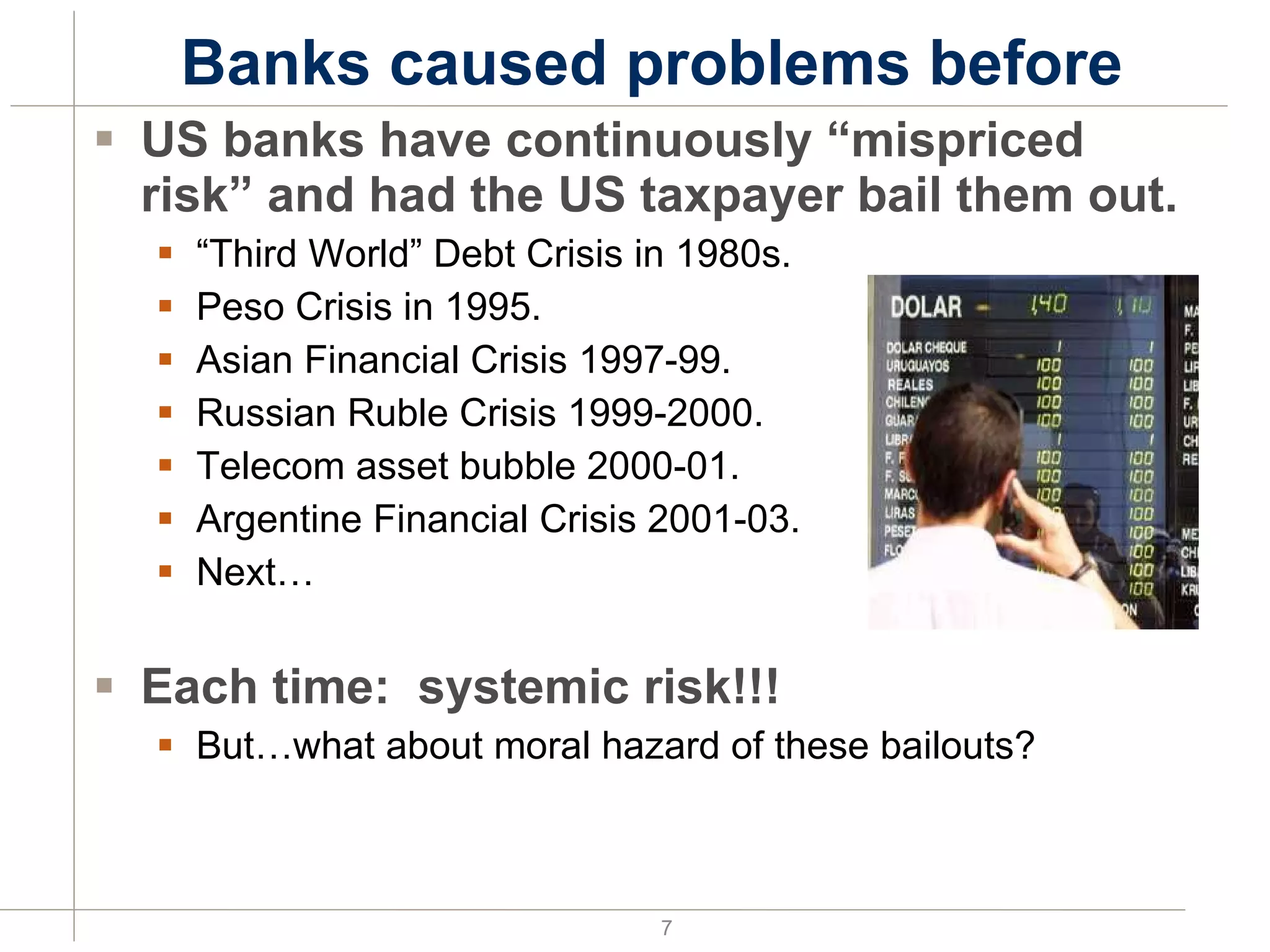
Banks caused problems before US banks have continuously “mispriced risk” and had the US taxpayer bail them out. “ Third World” Debt Crisis in 1980s. Peso Crisis in 1995. Asian Financial Crisis 1997-99. Russian Ruble Crisis 1999-2000. Telecom asset bubble 2000-01. Argentine Financial Crisis 2001-03. Next… Each time:  systemic risk!!! But…what about moral hazard of these bailouts?
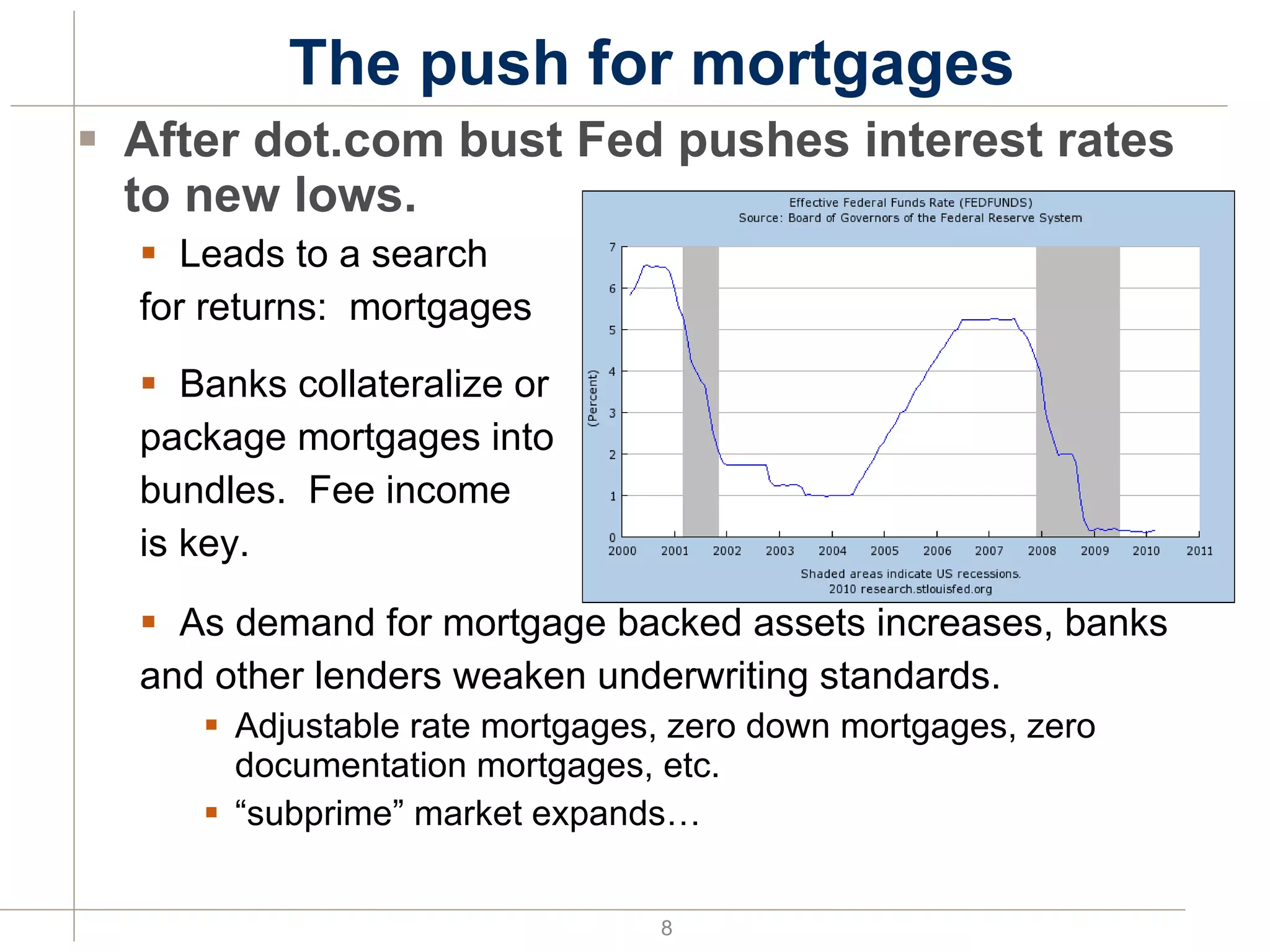
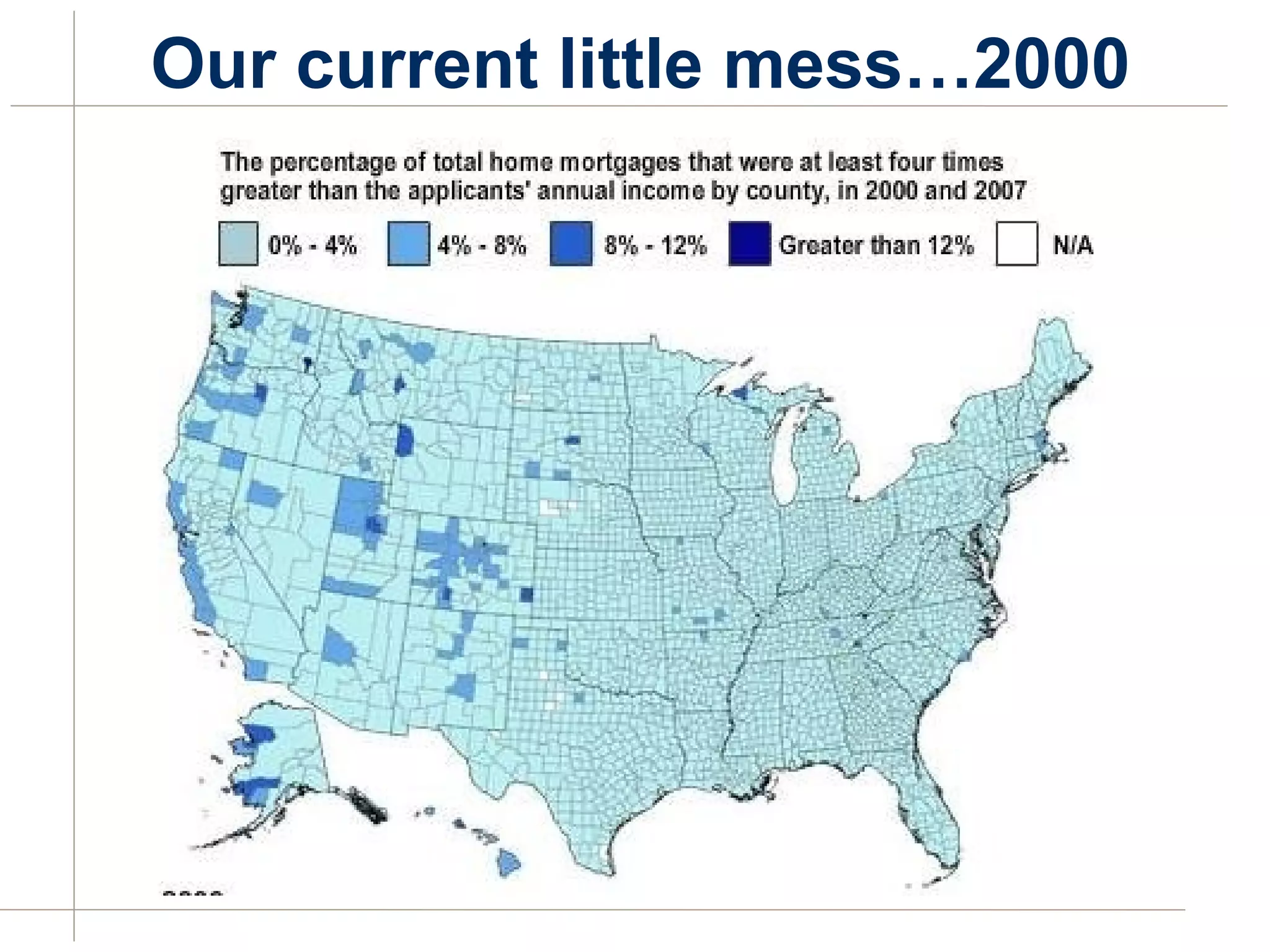
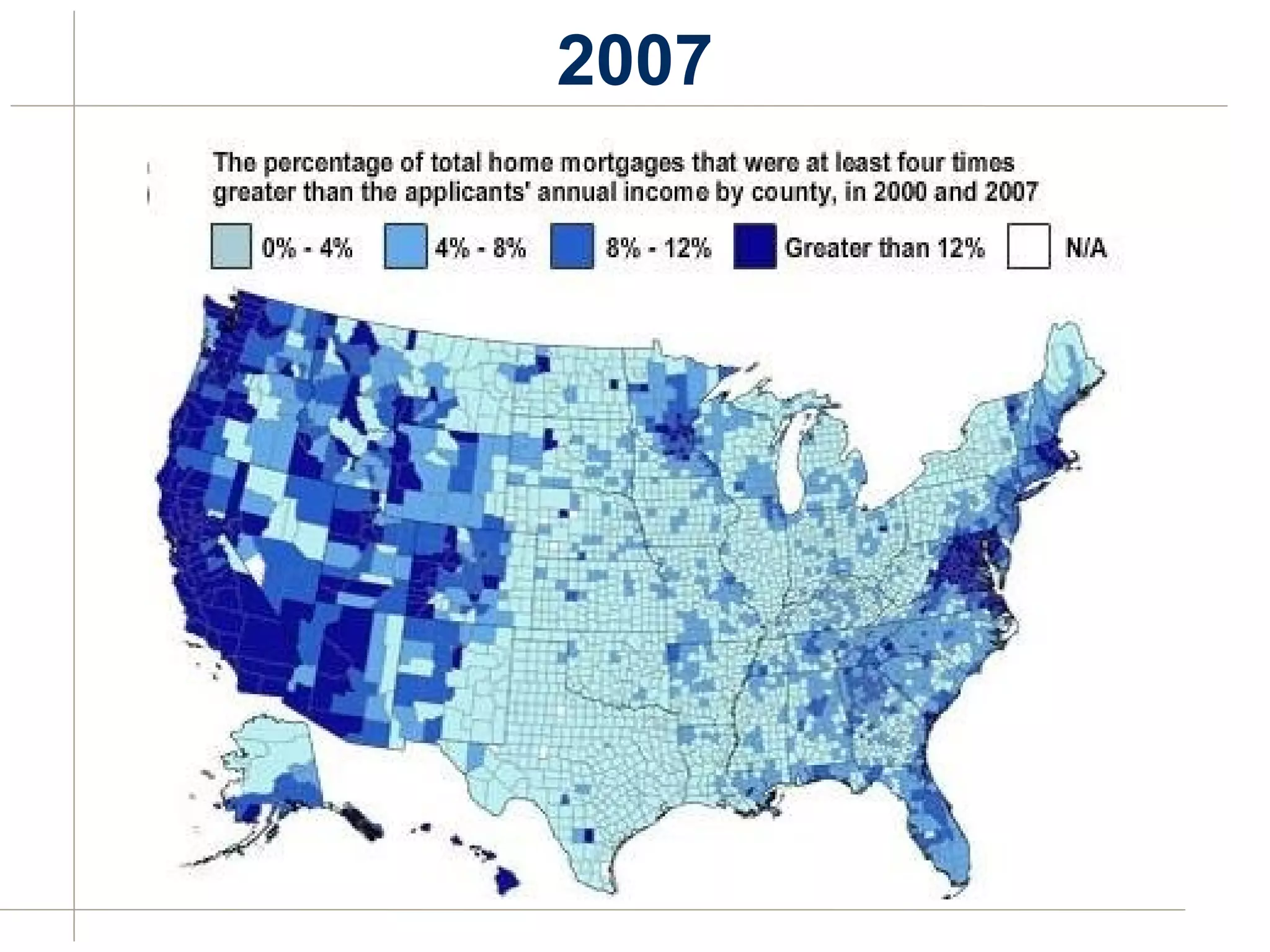
The push for mortgages After dot.com bust Fed pushes interest rates to new lows. Leads to a search for returns:  mortgages Banks collateralize or  package mortgages into  bundles.  Fee income  is key. As demand for mortgage backed assets increases, banks  and other lenders weaken underwriting standards. Adjustable rate mortgages, zero down mortgages, zero documentation mortgages, etc. “ subprime” market expands…
Our current little mess…2000
2007
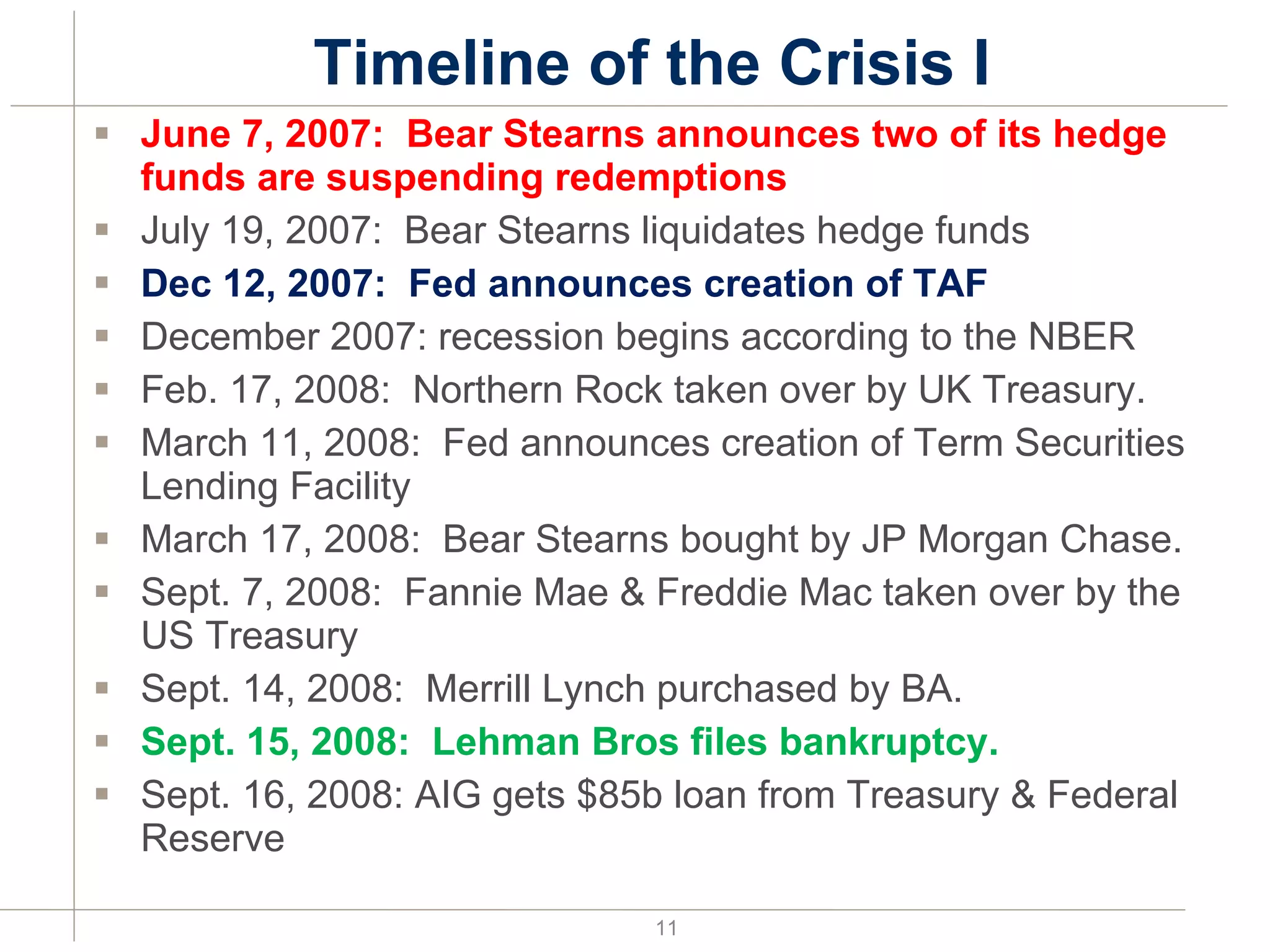
Timeline of the Crisis I June 7, 2007:  Bear Stearns announces two of its hedge funds are suspending redemptions July 19, 2007:  Bear Stearns liquidates hedge funds Dec 12, 2007:  Fed announces creation of TAF  December 2007: recession begins according to the NBER Feb. 17, 2008:  Northern Rock taken over by UK Treasury. March 11, 2008:  Fed announces creation of Term Securities Lending Facility March 17, 2008:  Bear Stearns bought by JP Morgan Chase. Sept. 7, 2008:  Fannie Mae & Freddie Mac taken over by the US Treasury Sept. 14, 2008:  Merrill Lynch purchased by BA. Sept. 15, 2008:  Lehman Bros files bankruptcy. Sept. 16, 2008: AIG gets $85b loan from Treasury & Federal Reserve
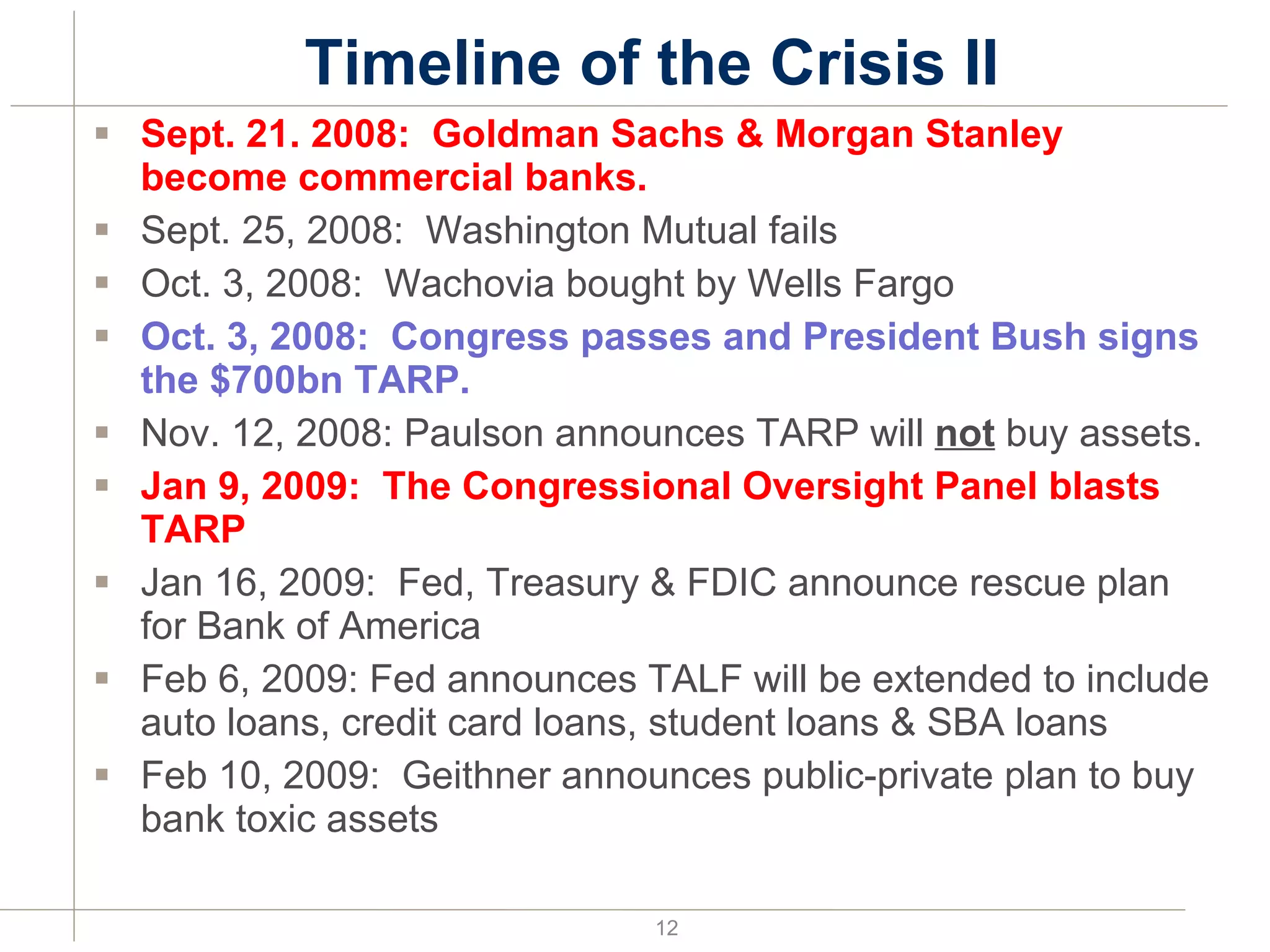
Timeline of the Crisis II Sept. 21. 2008:  Goldman Sachs & Morgan Stanley become commercial banks. Sept. 25, 2008:  Washington Mutual fails Oct. 3, 2008:  Wachovia bought by Wells Fargo Oct. 3, 2008:  Congress passes and President Bush signs the $700bn TARP. Nov. 12, 2008: Paulson announces TARP will  not  buy assets. Jan 9, 2009:  The Congressional Oversight Panel blasts TARP Jan 16, 2009:  Fed, Treasury & FDIC announce rescue plan for Bank of America Feb 6, 2009: Fed announces TALF will be extended to include auto loans, credit card loans, student loans & SBA loans Feb 10, 2009:  Geithner announces public-private plan to buy bank toxic assets
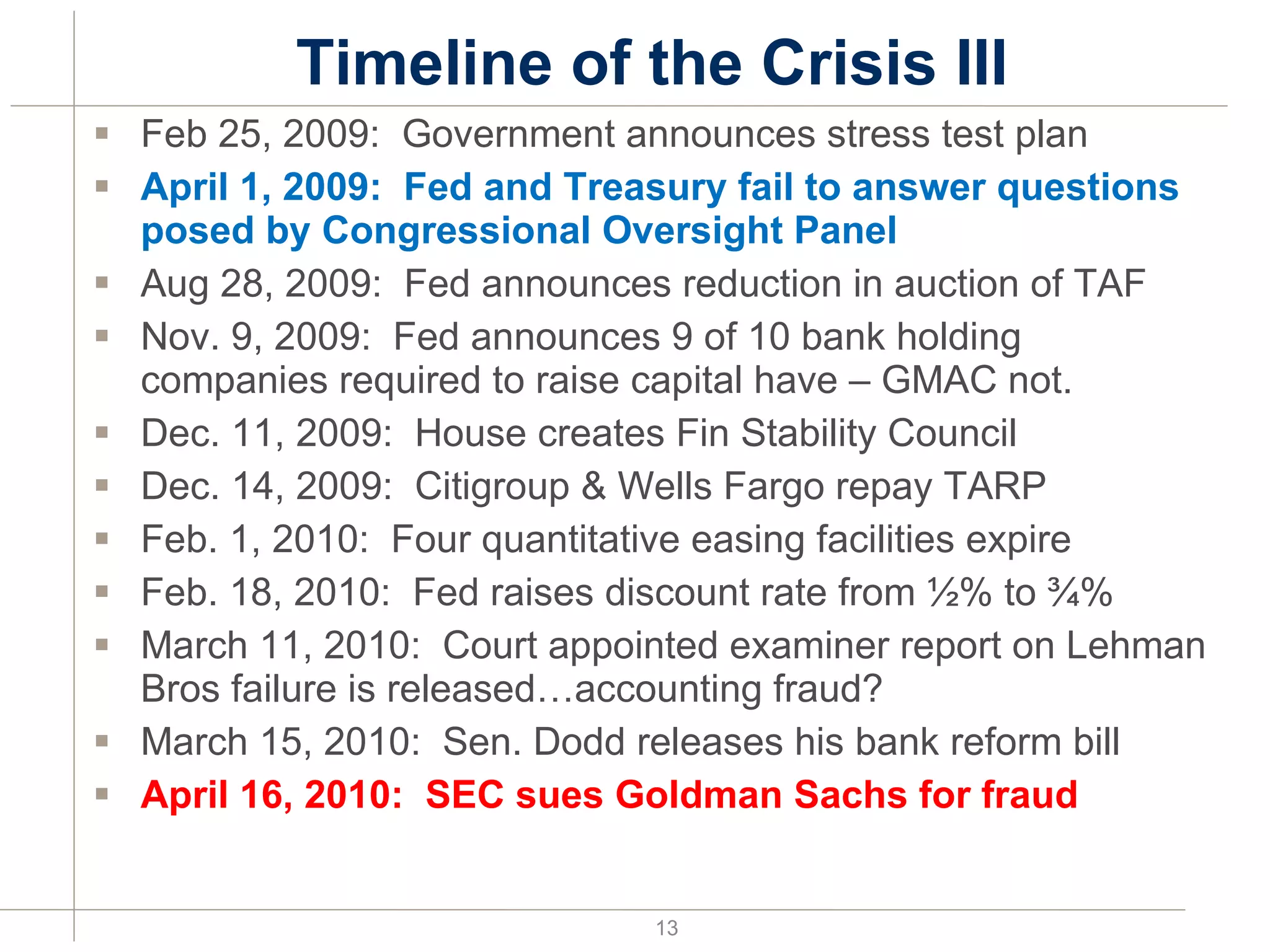
Timeline of the Crisis III Feb 25, 2009:  Government announces stress test plan April 1, 2009:  Fed and Treasury fail to answer questions posed by Congressional Oversight Panel Aug 28, 2009:  Fed announces reduction in auction of TAF Nov. 9, 2009:  Fed announces 9 of 10 bank holding companies required to raise capital have – GMAC not. Dec. 11, 2009:  House creates Fin Stability Council Dec. 14, 2009:  Citigroup & Wells Fargo repay TARP Feb. 1, 2010:  Four quantitative easing facilities expire Feb. 18, 2010:  Fed raises discount rate from ½% to ¾% March 11, 2010:  Court appointed examiner report on Lehman Bros failure is released…accounting fraud? March 15, 2010:  Sen. Dodd releases his bank reform bill  April 16, 2010:  SEC sues Goldman Sachs for fraud
What we can learn from the crisis
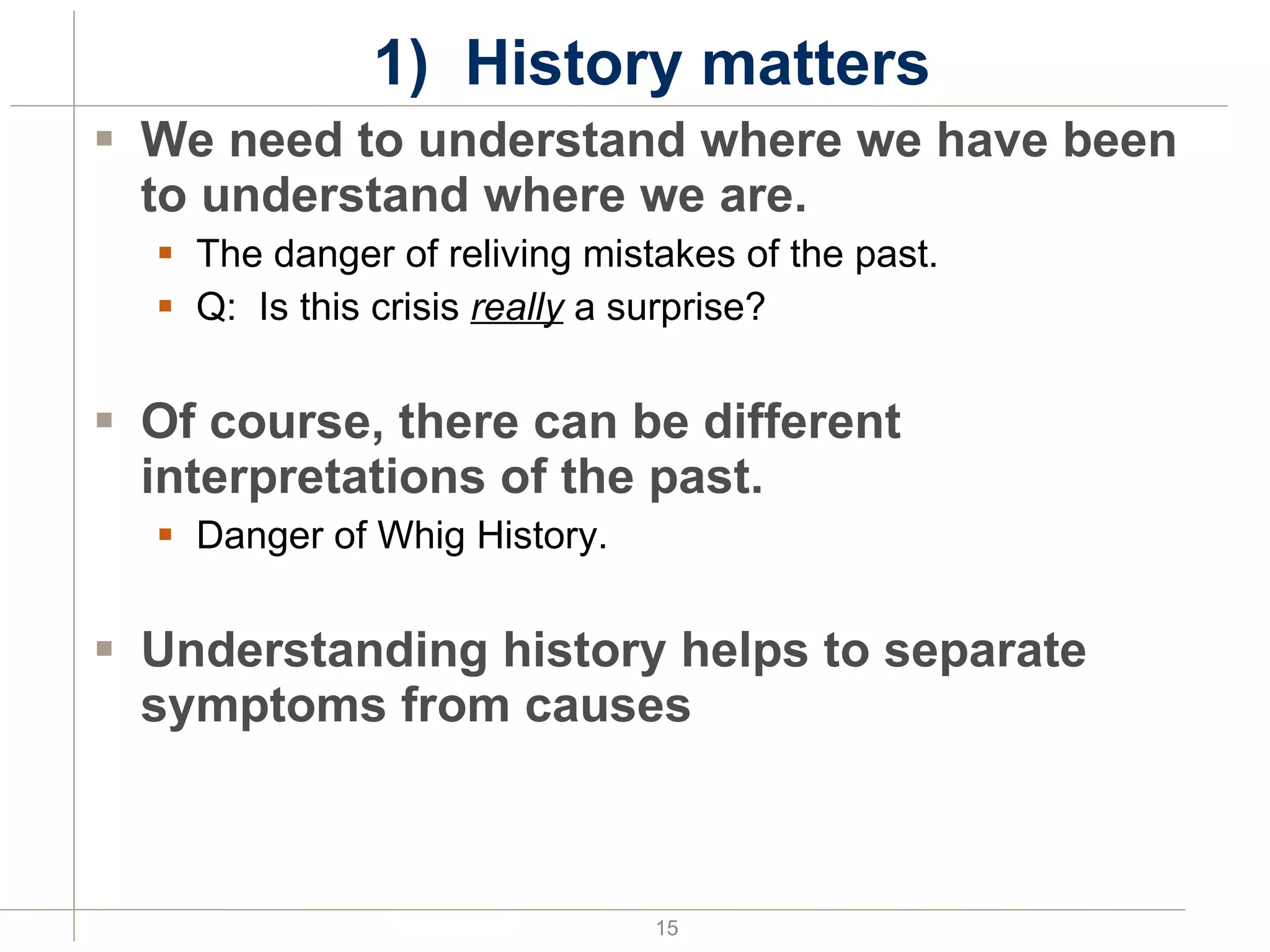
1)  History matters We need to understand where we have been to understand where we are. The danger of reliving mistakes of the past. Q:  Is this crisis  really  a surprise? Of course, there can be different interpretations of the past. Danger of Whig History. Understanding history helps to separate symptoms from causes
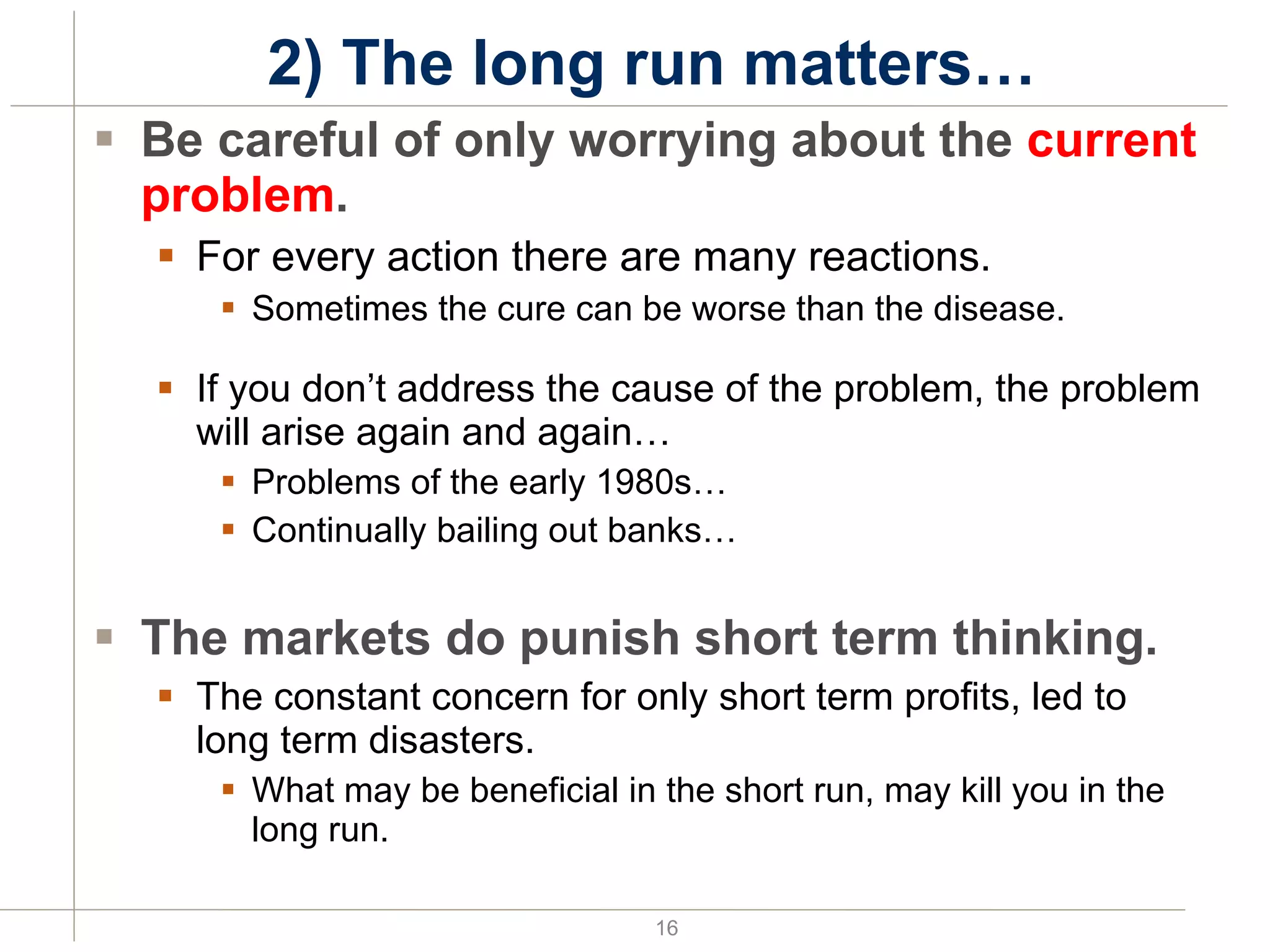
2) The long run matters… Be careful of only worrying about the  current problem . For every action there are many reactions. Sometimes the cure can be worse than the disease. If you don’t address the cause of the problem, the problem will arise again and again… Problems of the early 1980s… Continually bailing out banks… The markets do punish short term thinking. The constant concern for only short term profits, led to long term disasters. What may be beneficial in the short run, may kill you in the long run.
3) Finance is  not  just numbers  Markets and societies change over time. As they change financial markets change. This change may not show up in Excel spreadsheets. Example:  the assumption that 2% of mortgages fail. Rules and regulations overseeing the markets need to change. But often they don’t… Misalignment of incentives can develop. Financial markets are based on trust. Contracts are used when markets fail. Ethical behavior – often determined by institutions – is key to financial market success.
4)  The regulators can’t save us… Financial markets were not unregulated. FDIC deposit insurance, Federal Reserve, insurance market regulation, etc. Should this be streamlined?  Maybe/maybe not. Regulators can not mandate ethical behavior. It’s up to the financial market participants to do that. And…customers need to punish the unethical. Customers need to demand better run financial institutions. A better educated public would help. Business leaders need to take the lead…
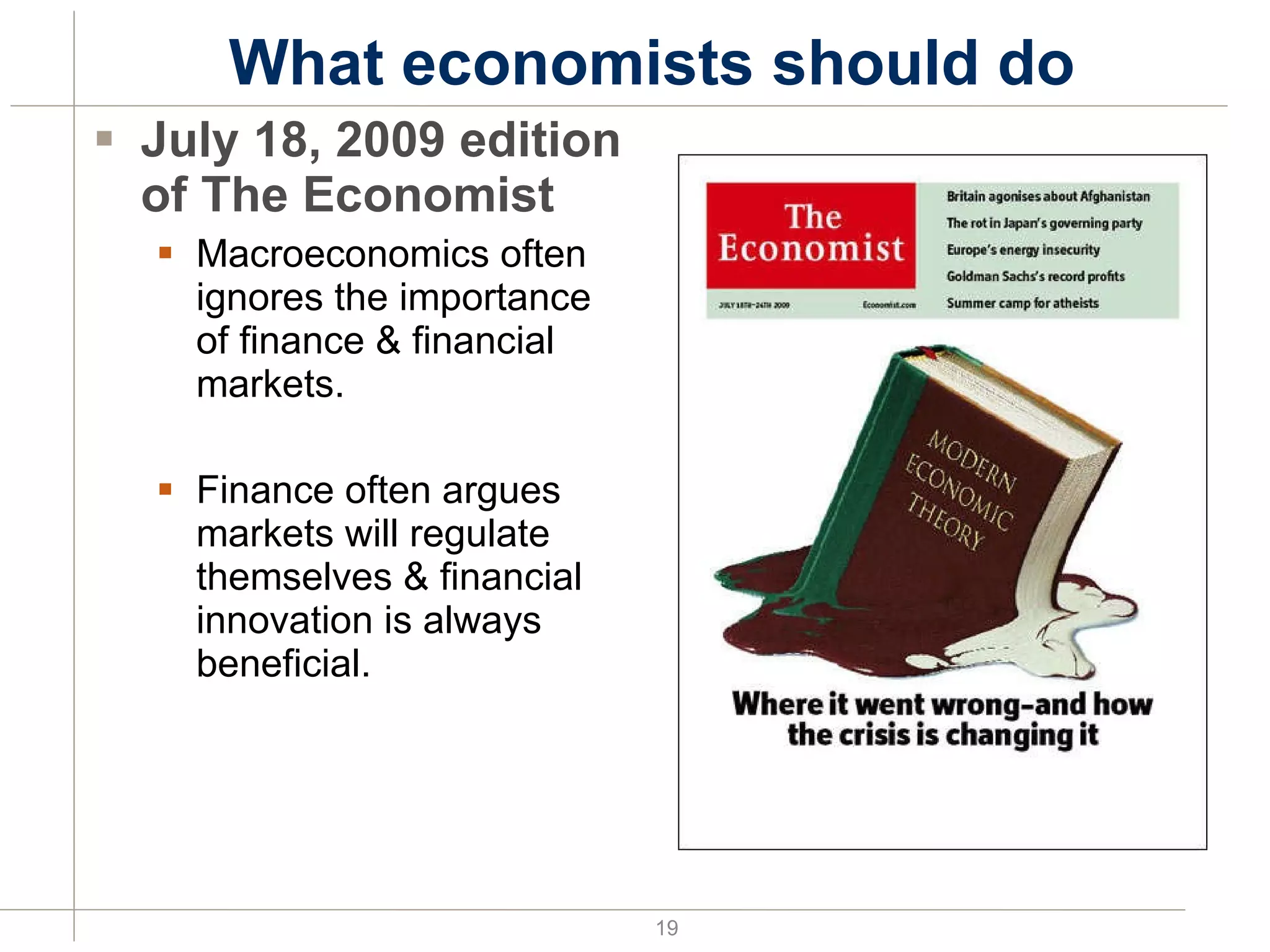
What economists should do July 18, 2009 edition of The Economist Macroeconomics often ignores the importance of finance & financial markets. Finance often argues markets will regulate themselves & financial innovation is always beneficial.
The Economist  July 18, 2009 “ Economists need to reach out from their specialized silos: macroeconomists must understand finance, and finance professors need to think harder about the context within which markets work.  And everybody needs to work harder on understanding asset bubbles and what happens when they burst. For in the end economists are social scientists, trying to understand the real world. And the financial crisis has changed that world.”
Q & A ask about anything… [email_address] http://blogs.mccombs.utexas.edu/brandl Twitter:  MichaelBrandl Facebook:  Michael.Brandl

JWU April 2010 speech

  • 1.
    On the causesof the financial crisis Michael Brandl, PhD Distinguished Visiting Professor Lecture The University of Texas at Austin Johnson & Wales University Xavier Auditorium McCombs School of Business Providence, RI April 22, 2010
  • 2.
    Overview The causesof the crisis – not merely the symptoms. Understanding how we got here. Understanding this isn’t a “recent” problem” What we can learn from the crisis What economists should do
  • 3.
    The Popular Press7 seconds view The Federal Reserve lowered interest rates too low in 2003 and kept them too low through 2004. Homebuyers were duped by mortgage lenders. Unregulated financial markets lent money too freely.
  • 4.
    Post War EraPent up demand from war years Full employment, but nothing to buy. Homeownership: The American Dream Post War Baby Boom 30 yr fixed rate Mortgages with 20% down. Federal income tax deduction for interest Savings & Loans Interstate highways Result: Post War economic boom! But…it’s not 1947 anymore…
  • 5.
    The importance of“banks” In the post war era it was believed: Bank were “special” Subject to bank runs Needed to keep interest rates low Needed to help fund government spending (infrastructure, war debt, etc) Banks should not compete with each other. Regulation Q: interest rate ceiling from 1930s Bank chartering Commercial banks were boring. Investment banks where “white shoe” firms – conservative, reserved, steady.
  • 6.
    Problems develop… 1970s: stagflation Disintermediation – deposits leave depository institutions. Savings & Loan is big trouble. Bad idea 1: DIDMCA 1980– loosen Reg Q Bad idea 2: G-St.G 1982 – let S&Ls lend more Bad idea 3: Capital forbearance – look the other way. 1980s: bank failures Banks face competition from non-bank banks. Bad idea 4: Allow easier regulation on lending Result: “Third World Debt Crisis” Bad idea 5: Establishing Too Big To Fail… Result: Heads I win, tails the government looses. Bad idea 6: Banks focus on “fee income” Result: originate to hold to originate to securitize
  • 7.
    Banks caused problemsbefore US banks have continuously “mispriced risk” and had the US taxpayer bail them out. “ Third World” Debt Crisis in 1980s. Peso Crisis in 1995. Asian Financial Crisis 1997-99. Russian Ruble Crisis 1999-2000. Telecom asset bubble 2000-01. Argentine Financial Crisis 2001-03. Next… Each time: systemic risk!!! But…what about moral hazard of these bailouts?
  • 8.
    The push formortgages After dot.com bust Fed pushes interest rates to new lows. Leads to a search for returns: mortgages Banks collateralize or package mortgages into bundles. Fee income is key. As demand for mortgage backed assets increases, banks and other lenders weaken underwriting standards. Adjustable rate mortgages, zero down mortgages, zero documentation mortgages, etc. “ subprime” market expands…
  • 9.
    Our current littlemess…2000
  • 10.
  • 11.
    Timeline of theCrisis I June 7, 2007: Bear Stearns announces two of its hedge funds are suspending redemptions July 19, 2007: Bear Stearns liquidates hedge funds Dec 12, 2007: Fed announces creation of TAF December 2007: recession begins according to the NBER Feb. 17, 2008: Northern Rock taken over by UK Treasury. March 11, 2008: Fed announces creation of Term Securities Lending Facility March 17, 2008: Bear Stearns bought by JP Morgan Chase. Sept. 7, 2008: Fannie Mae & Freddie Mac taken over by the US Treasury Sept. 14, 2008: Merrill Lynch purchased by BA. Sept. 15, 2008: Lehman Bros files bankruptcy. Sept. 16, 2008: AIG gets $85b loan from Treasury & Federal Reserve
  • 12.
    Timeline of theCrisis II Sept. 21. 2008: Goldman Sachs & Morgan Stanley become commercial banks. Sept. 25, 2008: Washington Mutual fails Oct. 3, 2008: Wachovia bought by Wells Fargo Oct. 3, 2008: Congress passes and President Bush signs the $700bn TARP. Nov. 12, 2008: Paulson announces TARP will not buy assets. Jan 9, 2009: The Congressional Oversight Panel blasts TARP Jan 16, 2009: Fed, Treasury & FDIC announce rescue plan for Bank of America Feb 6, 2009: Fed announces TALF will be extended to include auto loans, credit card loans, student loans & SBA loans Feb 10, 2009: Geithner announces public-private plan to buy bank toxic assets
  • 13.
    Timeline of theCrisis III Feb 25, 2009: Government announces stress test plan April 1, 2009: Fed and Treasury fail to answer questions posed by Congressional Oversight Panel Aug 28, 2009: Fed announces reduction in auction of TAF Nov. 9, 2009: Fed announces 9 of 10 bank holding companies required to raise capital have – GMAC not. Dec. 11, 2009: House creates Fin Stability Council Dec. 14, 2009: Citigroup & Wells Fargo repay TARP Feb. 1, 2010: Four quantitative easing facilities expire Feb. 18, 2010: Fed raises discount rate from ½% to ¾% March 11, 2010: Court appointed examiner report on Lehman Bros failure is released…accounting fraud? March 15, 2010: Sen. Dodd releases his bank reform bill April 16, 2010: SEC sues Goldman Sachs for fraud
  • 14.
    What we canlearn from the crisis
  • 15.
    1) Historymatters We need to understand where we have been to understand where we are. The danger of reliving mistakes of the past. Q: Is this crisis really a surprise? Of course, there can be different interpretations of the past. Danger of Whig History. Understanding history helps to separate symptoms from causes
  • 16.
    2) The longrun matters… Be careful of only worrying about the current problem . For every action there are many reactions. Sometimes the cure can be worse than the disease. If you don’t address the cause of the problem, the problem will arise again and again… Problems of the early 1980s… Continually bailing out banks… The markets do punish short term thinking. The constant concern for only short term profits, led to long term disasters. What may be beneficial in the short run, may kill you in the long run.
  • 17.
    3) Finance is not just numbers Markets and societies change over time. As they change financial markets change. This change may not show up in Excel spreadsheets. Example: the assumption that 2% of mortgages fail. Rules and regulations overseeing the markets need to change. But often they don’t… Misalignment of incentives can develop. Financial markets are based on trust. Contracts are used when markets fail. Ethical behavior – often determined by institutions – is key to financial market success.
  • 18.
    4) Theregulators can’t save us… Financial markets were not unregulated. FDIC deposit insurance, Federal Reserve, insurance market regulation, etc. Should this be streamlined? Maybe/maybe not. Regulators can not mandate ethical behavior. It’s up to the financial market participants to do that. And…customers need to punish the unethical. Customers need to demand better run financial institutions. A better educated public would help. Business leaders need to take the lead…
  • 19.
    What economists shoulddo July 18, 2009 edition of The Economist Macroeconomics often ignores the importance of finance & financial markets. Finance often argues markets will regulate themselves & financial innovation is always beneficial.
  • 20.
    The Economist July 18, 2009 “ Economists need to reach out from their specialized silos: macroeconomists must understand finance, and finance professors need to think harder about the context within which markets work. And everybody needs to work harder on understanding asset bubbles and what happens when they burst. For in the end economists are social scientists, trying to understand the real world. And the financial crisis has changed that world.”
  • 21.
    Q & Aask about anything… [email_address] http://blogs.mccombs.utexas.edu/brandl Twitter: MichaelBrandl Facebook: Michael.Brandl