RISK & RETURN
INTRODUCTION
Security analysts and portfolio managers are concerned about an investment’s return, its
risk, and whether it is priced correctly by the market. If markets are efficient, the price
reflects available information quickly. A basic tenet of valuation is that the greater the
investment’s risk, the greater the return needed to compensate investors for that risk. Risk
and return are most important concepts in finance. In fact, they are the foundation of the
modern finance theory. What is risk? How is it measured? What is return? How is it
measured? We attempt to answer these questions through these notes.
We must begin with a clear understanding of what risk and return are!
RISK
A. CONCEPT OF RISK
• an unwanted event which may or may not occur.
• the cause of an unwanted event which may or may not occur.
• the probability of an unwanted event which may or may not occur.
• the statistical expectation value of unwanted events which may or may not occur.
• the fact that a decision is made under conditions of known probabilities (“decision
under risk”)
For most investors, however, the prime interest in investments is largely to earn a
return on their money. However, selecting stocks exclusively on the basis of
maximization of return is not enough. The most investors do not place available funds
into the one, two, or even three stocks promising the greatest returns suggests that
other factors must be considered besides return in the selection process. Investors not
only like return, they dislike risk.
B. DEFINING RISK
Given the ubiquity of risk in almost every human activity, it is surprising how little consensus
there is about how to define risk. The early discussion centered on the distinction between risk
that could be quantified objectively and subjective risk.
In 1921, Frank Knight summarized the difference between risk and uncertainty thus3:
"… Uncertainty must be taken in a sense radically distinct from the familiar notion of Risk, from
which it has never been properly separated. … The essential fact is that "risk" means in some
cases a quantity susceptible of measurement, while at other times it is something distinctly not
of this character; and there are far-reaching and crucial differences in the bearings of the
phenomena depending on which of the two is really present and operating. … It will appear that
a measurable uncertainty, or "risk" proper, as we shall use the term, is so far different from an
un-measurable one that it is not in effect an uncertainty at all."
Risk is incorporated into so many different disciplines from insurance to engineering to
portfolio theory that it should come as no surprise that it is defined in different ways by each
one.
FIRST MYTH OF RISK
“Risk” must have a single, well defined meaning.
IT IS WORTH LOOKING AT SOME OF THE DISTINCTIONS:
a. Risk versus Probability: While some definitions of risk focus only on the probability of an
event occurring, more comprehensive definitions incorporate both the probability of the event
occurring and the consequences of the event. Thus, the probability of a severe earthquake may
be very small but the consequences are so catastrophic that it would be categorized as a high-
risk event.
b. Risk versus Threat: In some disciplines, a contrast is drawn between risk and a threat. A
threat is a low probability event with very large negative consequences, where analysts may be
unable to assess the probability. A risk, on the other hand, is defined to be a higher probability
event, where there is enough information to make assessments of both the probability and the
consequences.
c. All outcomes versus Negative outcomes: Some definitions of risk tend to focus only on the
downside scenarios, whereas others are more expansive and consider all variability as risk. The
engineering definition of risk is defined as the product of the probability of an event occurring, that
is viewed as undesirable, and an assessment of the expected harm from the event occurring.
The Chinese symbol for risk best captures this duality:
风险
This Chinese symbol for risk is a combination of danger (crisis) and opportunity, representing the
downside and the upside of risk.
C. TYPES OF RISK
"[Risk is] A probability or threat of damage, injury, loss, or any other negative occurrence that is
caused by external or internal vulnerabilities, and that may be avoided through preemptive
action."
Dynamic risks are those resulting from the changes in the economy or the environment. These
risk factors mainly refer to the macro economic variables like inflation, income and output
levels, and technology changes.
“ An ongoing or upcoming concern that has a significant probability of adversely affecting the success of
major milestones”
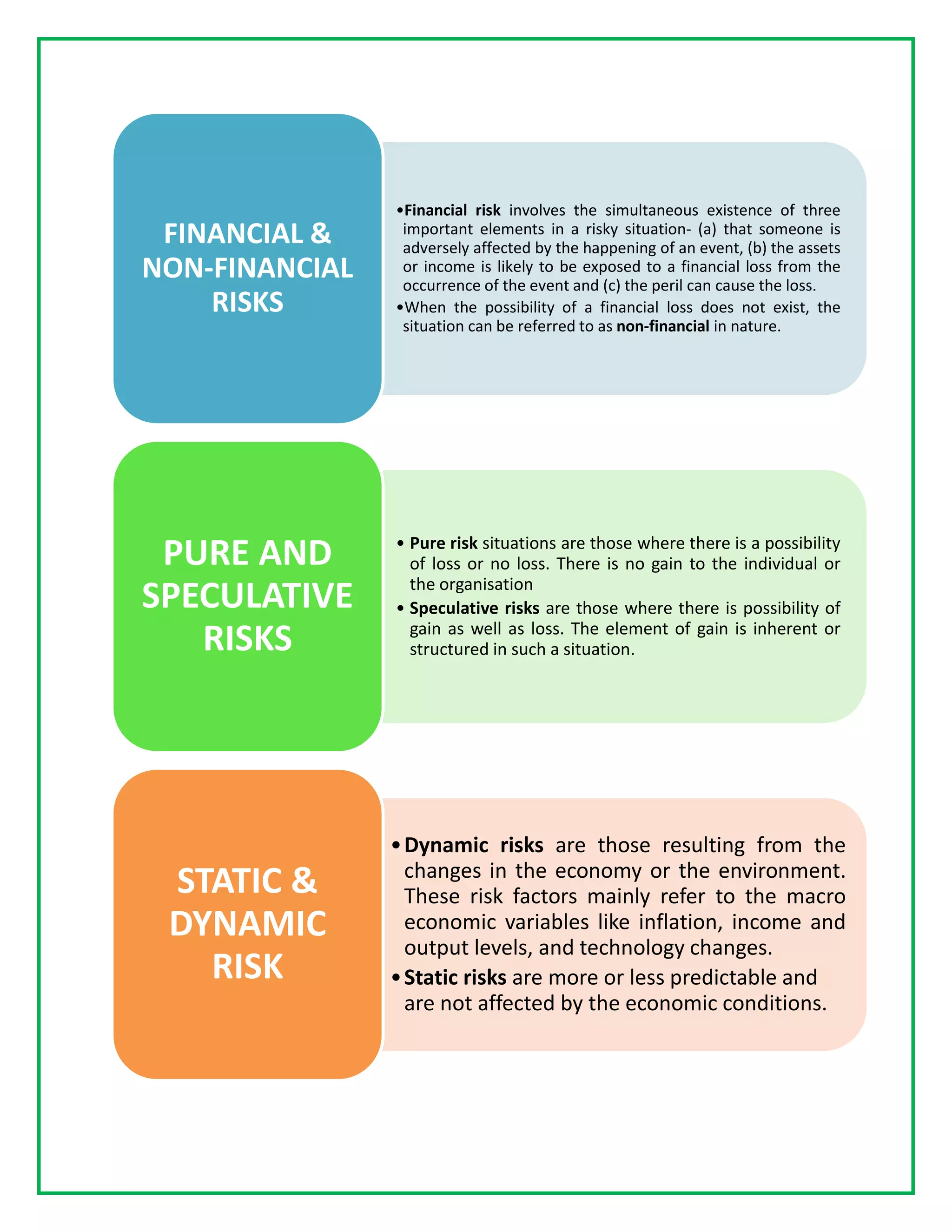
•Financial risk involves the simultaneous existence of three
important elements in a risky situation- (a) that someone is
adversely affected by the happening of an event, (b) the assets
or income is likely to be exposed to a financial loss from the
occurrence of the event and (c) the peril can cause the loss.
•When the possibility of a financial loss does not exist, the
situation can be referred to as non-financial in nature.
FINANCIAL &
NON-FINANCIAL
RISKS
• Pure risk situations are those where there is a possibility
of loss or no loss. There is no gain to the individual or
the organisation
• Speculative risks are those where there is possibility of
gain as well as loss. The element of gain is inherent or
structured in such a situation.
PURE AND
SPECULATIVE
RISKS
•Dynamic risks are those resulting from the
changes in the economy or the environment.
These risk factors mainly refer to the macro
economic variables like inflation, income and
output levels, and technology changes.
•Static risks are more or less predictable and
are not affected by the economic conditions.
STATIC &
DYNAMIC
RISK
D. SYSTEMATIC VS UNSYSTEMATIC RISK
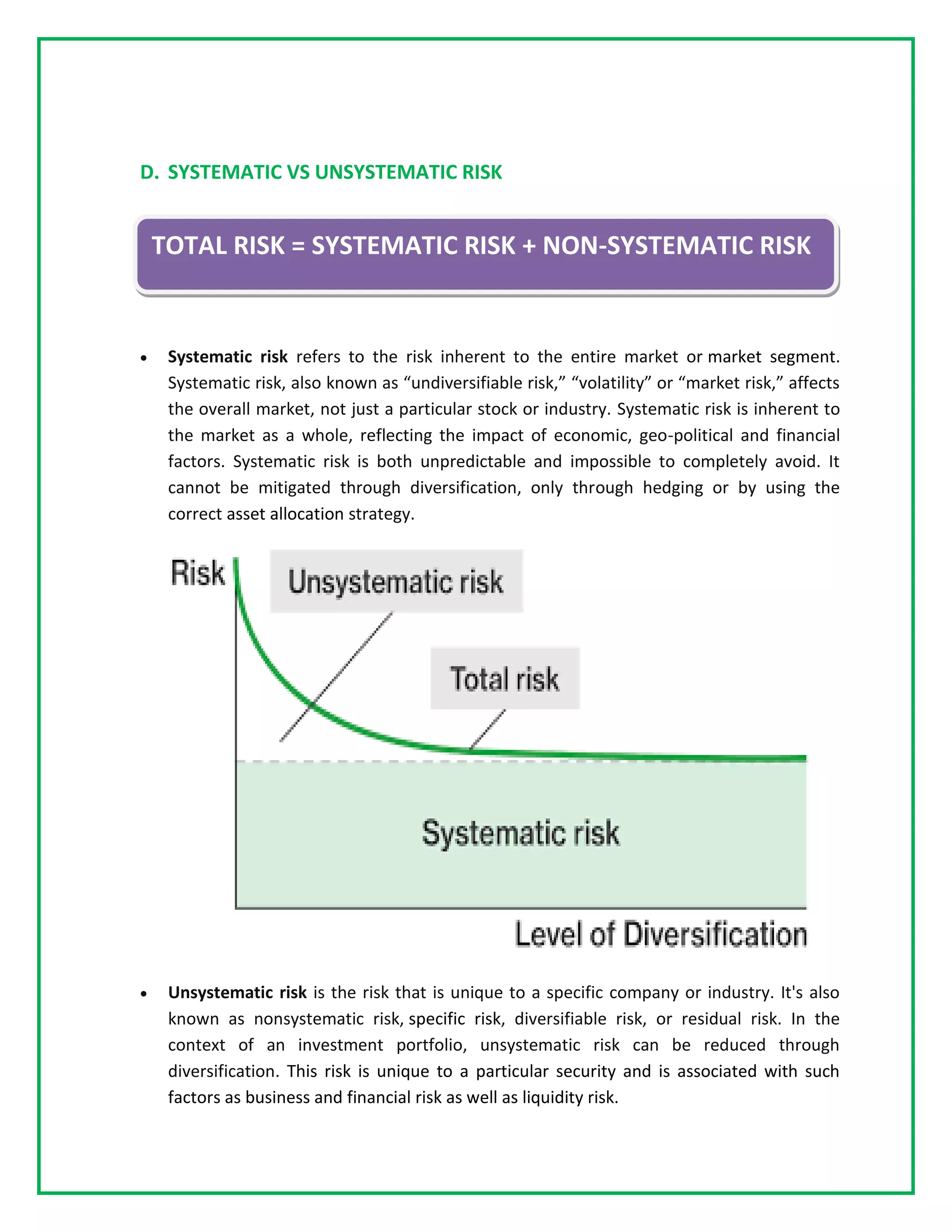
• Systematic risk refers to the risk inherent to the entire market or market segment.
Systematic risk, also known as “undiversifiable risk,” “volatility” or “market risk,” affects
the overall market, not just a particular stock or industry. Systematic risk is inherent to
the market as a whole, reflecting the impact of economic, geo-political and financial
factors. Systematic risk is both unpredictable and impossible to completely avoid. It
cannot be mitigated through diversification, only through hedging or by using the
correct asset allocation strategy.
• Unsystematic risk is the risk that is unique to a specific company or industry. It's also
known as nonsystematic risk, specific risk, diversifiable risk, or residual risk. In the
context of an investment portfolio, unsystematic risk can be reduced through
diversification. This risk is unique to a particular security and is associated with such
factors as business and financial risk as well as liquidity risk.
TOTAL RISK = SYSTEMATIC RISK + NON-SYSTEMATIC RISK
TYPES OF SYSTEMATIC RISKS
INTEREST RATE RISK
Such kind of risk is the result of a change in the market interest rate. It mainly impacts the fixed
income securities as bond prices are inversely related to the interest rate.
Market Risk
It is the result of the general tendency of the investors to move with the market. So, it is
basically the tendency of security prices to move collectively. For instance, in the falling market,
the stock price of even the best performing company’s drop. Usually, market risk accounts for
about two-thirds of total systematic risk.
PURCHASING POWER RISK
Also called the Inflation Risk occurs due to the erosion in the purchasing power of money.
Inflation is the rise in the general price level, meaning the same amount of money buys fewer
goods and services. So, if the income of the investor fails to keep pace with the rising inflation,
then in the real term, he is earning less than before. Similar to the interest rate risk, purchasing
power risk also mainly affects the fixed income securities because the income from such
securities is fixed.
EXCHANGE RATE RISK
This risk stems from the uncertainty in the changes in the value of the currencies. So, it affects
only the companies doing foreign exchange transactions, like export and import companies.
OPPORTUNITY COST AND SYSTEMATIC RISK
Since systematic risk is non-diversifiable, investors demand a premium to make up for this risk
factor. For instance, if a risk-free govt. security is giving a 5% return, then an investor expects to
make more than that from the equity investment, like 8%. This difference of 3% (or a premium
of 3%) is for assuming the systematic risk.
So, systematic risk can also be viewed as the opportunity cost for selecting one security over
another.
USING BETA TO SYSTEMATIC RISK
Another name of systematic risk is volatility risk. And, we can measure volatility in security by
the sensitivity of a security’s return with respect to the market return. This sensitivity is
captured by, which is calculated by regressing a security’s return against the market return.
TYPES OF UNSYSTEMATIC RISK
So, a beta of stock tells how risky a particular stock or portfolio is when we
compare it to the market. Like, if the calculated beta is zero, it means
portfolio/stock is uncorrelated to the market return; if beta is greater than zero but
less than one, it means portfolio/stock return has a positive correlation with the
market return, but the volatility is lower; if beta is greater than one, then the
portfolio/stock has a positive correlation with the market, but volatility is higher. In
this case, if a stock’s beta is 1.2, then it is 20% more volatile than the market.
Unsystematic risk can be divided into:
HOW UNSYSTEMATIC RISK CAN BE MANAGED?
All kind of unsystematic risk can be diversified. Industry specific risk or company specific risk are
diversified with the help of strong portfolio and we can manage the effects of losses and risks
due to unsystematic reasons.
There are different sectors which are most affected by unsystematic risk that are banking,
aviation, FMCG, insurance and real estate. And a proper portfolio can deal with this risks
UNSYSTEMATIC RISK
BUSINESS RISK
The risk of doing business in a particular
industry or environment is called business risk.
For example, as one of the largest steel
producers, U.S. Steel faces unique problems.
FINANCIAL RISK
This type of risk is applied to individual,
business, and government entities and
relates to the fact that there is a chance
that stakeholders can lose their money. It
actually relates to the capital structure of
an organization. The manner in which a
company raises required funds for its
growth has a direct impact on future
earnings and stability of a business entity.
MEASUREMENT OF RISK
Understanding the nature and types of risk is not adequate unless the investor or analyst is
capable of measuring it in some quantitative terms. The quantitative expression of the risk of a
stock would make it comparable with other stocks. Risk is measured by the variability of
returns.
THERE ARE DIFFERENT WAYS TO MEASURE RISK, THESE ARE AS FOLLOWS:-
1. STANDARD DEVIATION
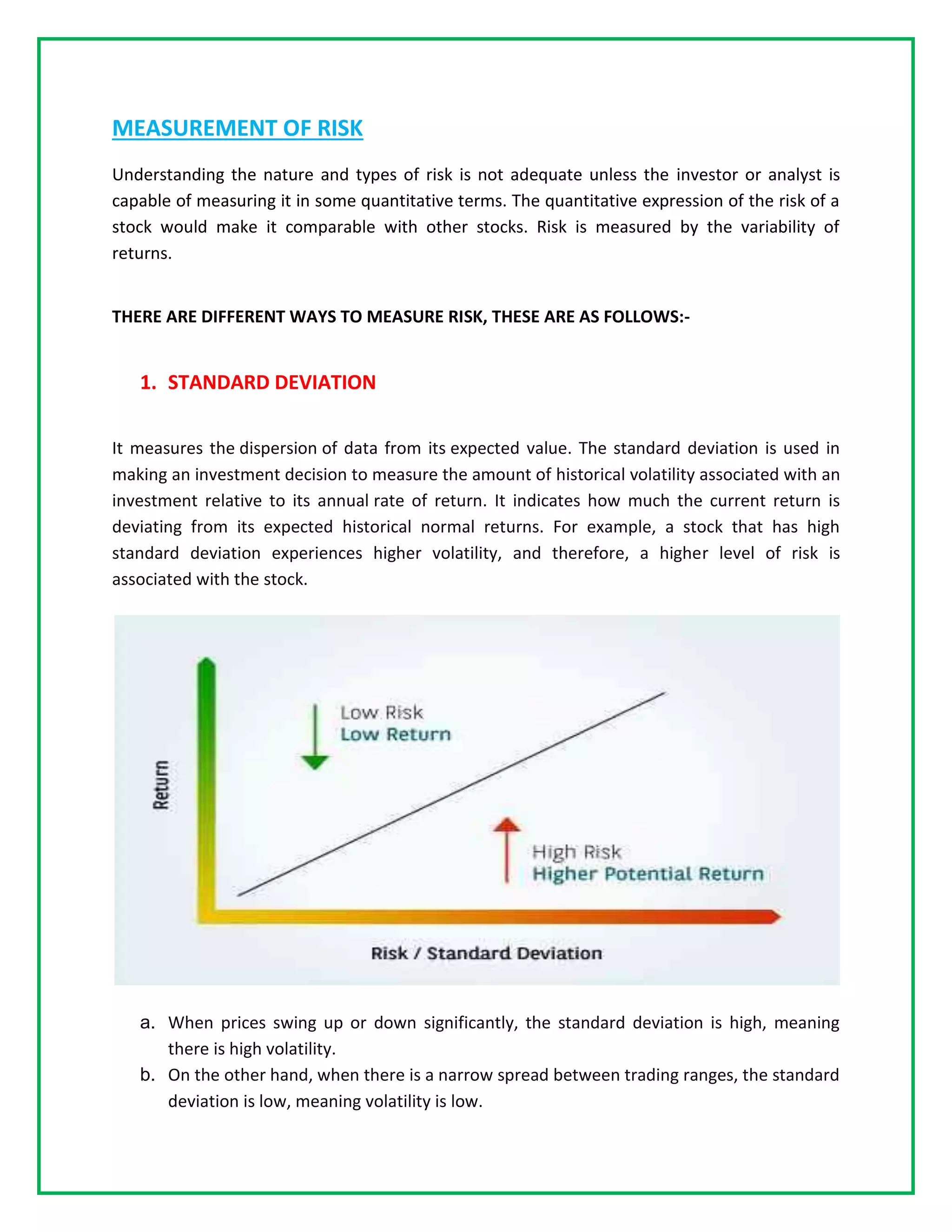
It measures the dispersion of data from its expected value. The standard deviation is used in
making an investment decision to measure the amount of historical volatility associated with an
investment relative to its annual rate of return. It indicates how much the current return is
deviating from its expected historical normal returns. For example, a stock that has high
standard deviation experiences higher volatility, and therefore, a higher level of risk is
associated with the stock.
a. When prices swing up or down significantly, the standard deviation is high, meaning
there is high volatility.
b. On the other hand, when there is a narrow spread between trading ranges, the standard
deviation is low, meaning volatility is low.
2. BETA
Beta is a measure of the volatility—or systematic risk—of a security or portfolio compared to
the market as a whole. Beta is used in the capital asset pricing model(CAPM), which describes
the relationship between systematic risk and expected return for assets (usually stocks). CAPM
is widely used as a method for pricing risky securities and for generating estimates of the
expected returns of assets, considering both the risk of those assets and the cost of capital.
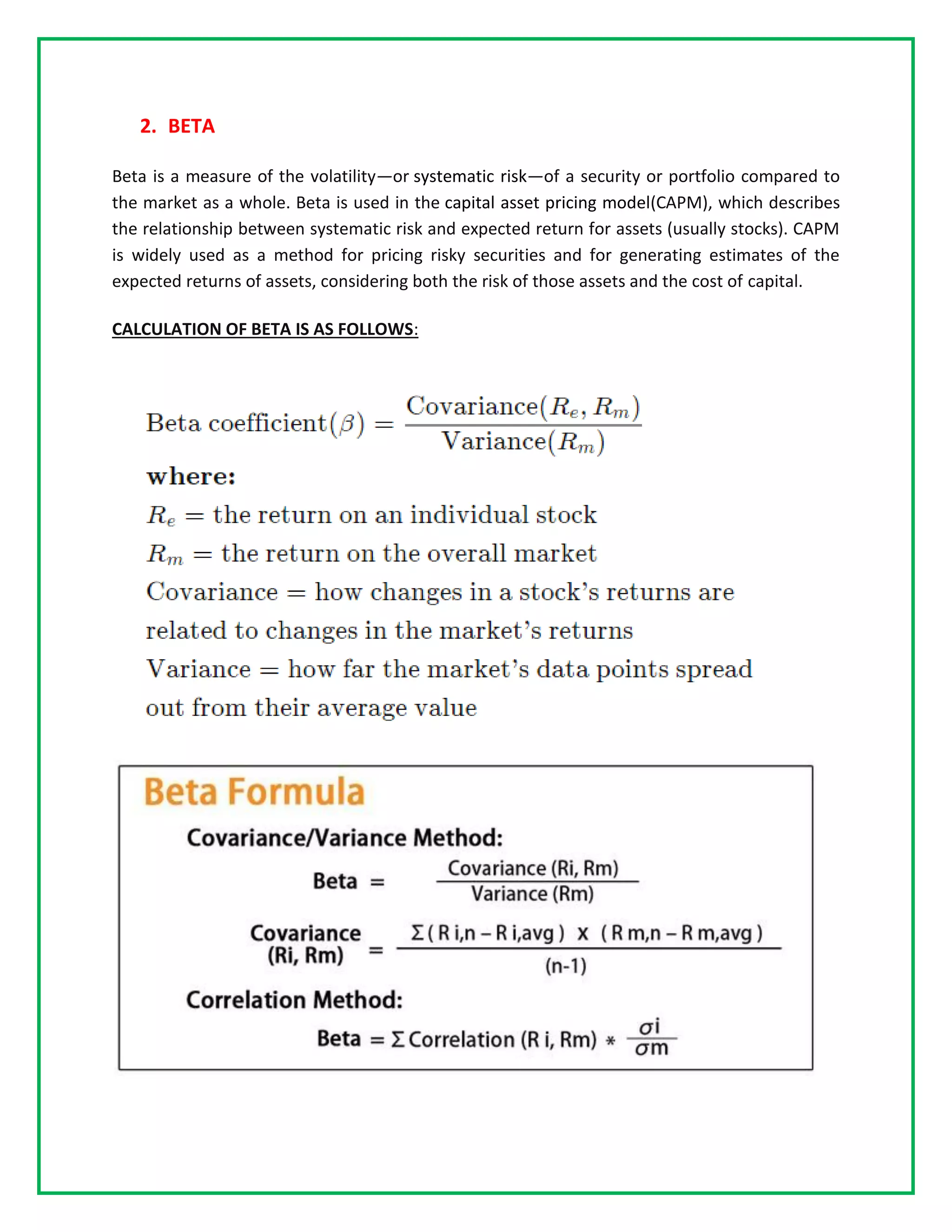
CALCULATION OF BETA IS AS FOLLOWS:
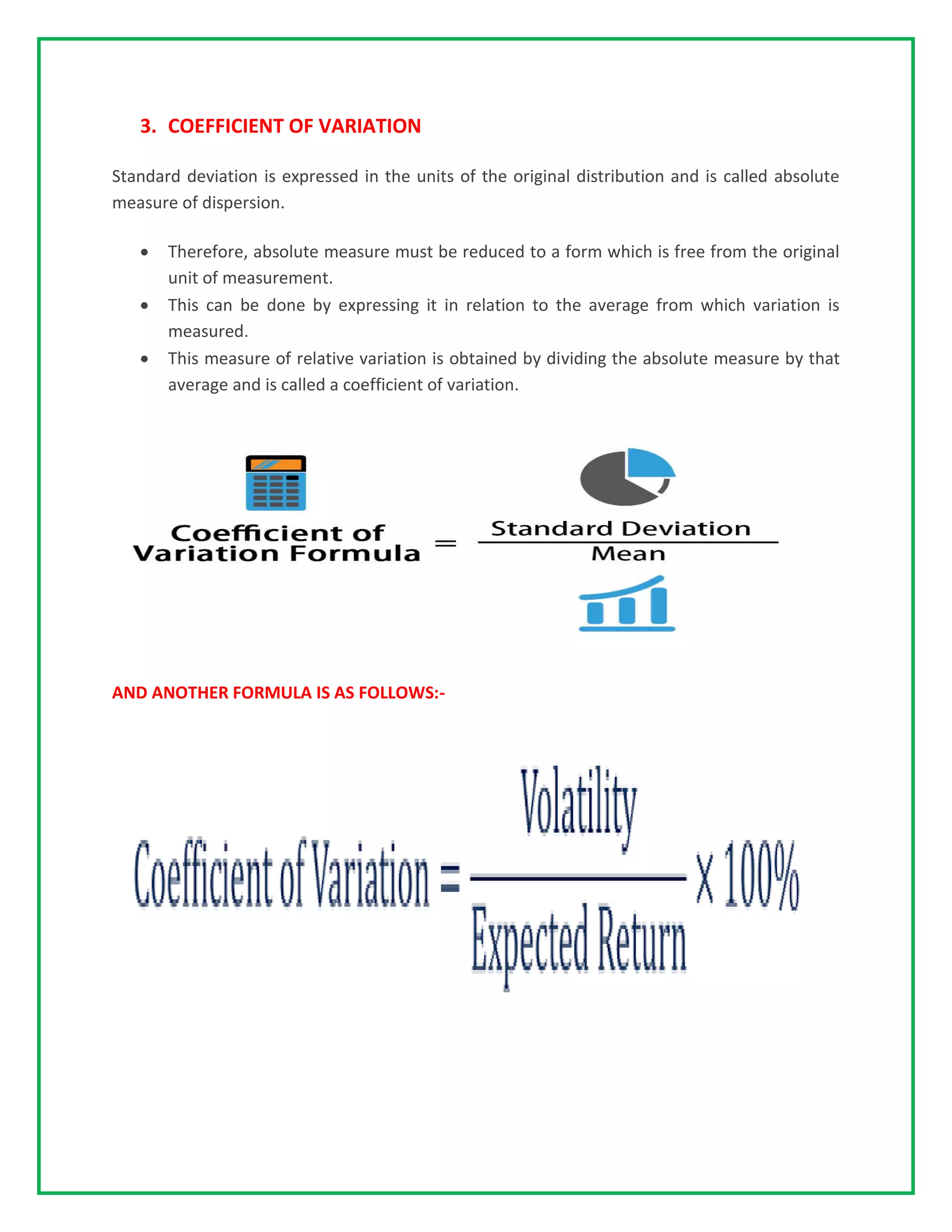
3. COEFFICIENT OF VARIATION
Standard deviation is expressed in the units of the original distribution and is called absolute
measure of dispersion.
• Therefore, absolute measure must be reduced to a form which is free from the original
unit of measurement.
• This can be done by expressing it in relation to the average from which variation is
measured.
• This measure of relative variation is obtained by dividing the absolute measure by that
average and is called a coefficient of variation.
AND ANOTHER FORMULA IS AS FOLLOWS:-
4. VALUE AT RISK (VAR)
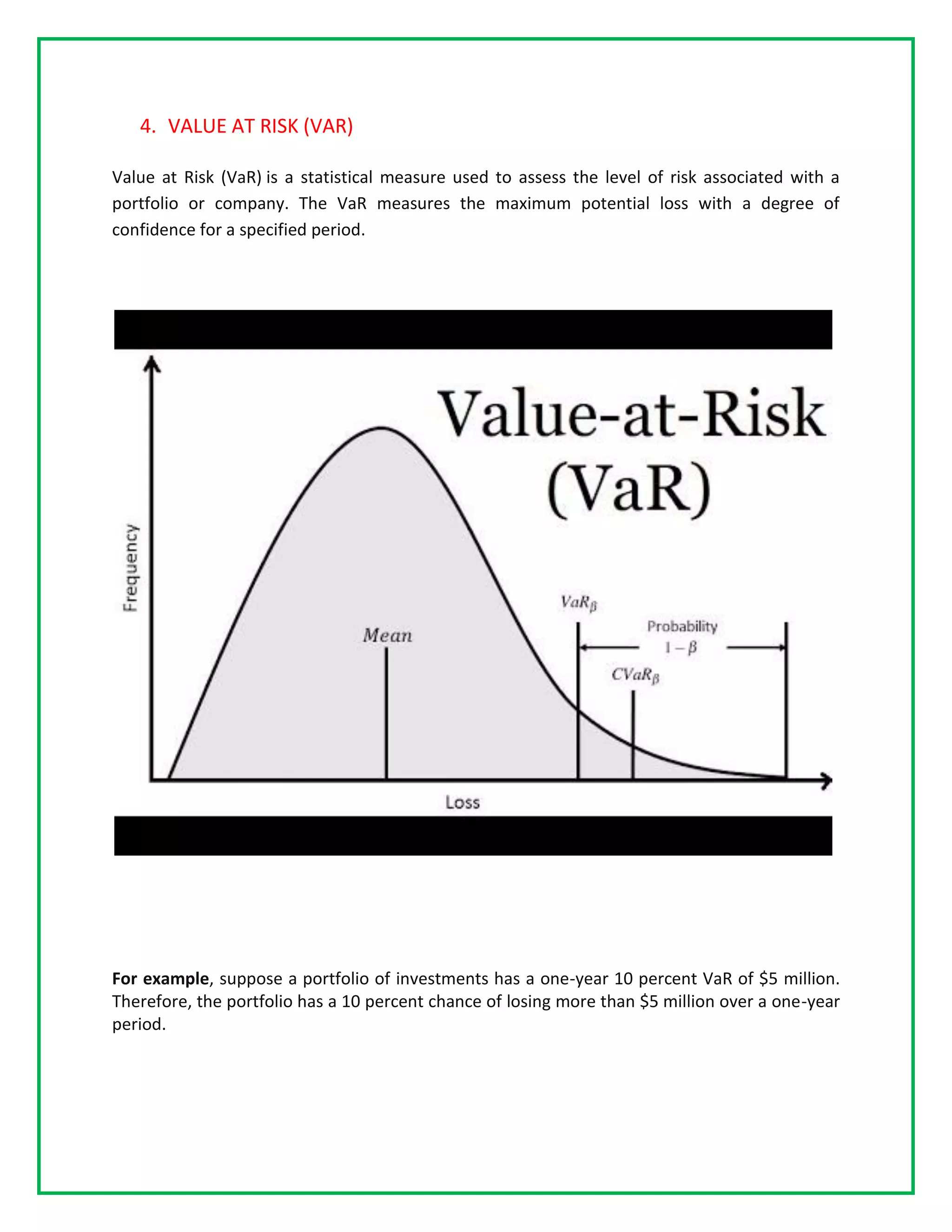
Value at Risk (VaR) is a statistical measure used to assess the level of risk associated with a
portfolio or company. The VaR measures the maximum potential loss with a degree of
confidence for a specified period.
For example, suppose a portfolio of investments has a one-year 10 percent VaR of $5 million.
Therefore, the portfolio has a 10 percent chance of losing more than $5 million over a one-year
period.
RETURN
The typical object of investment is to make current income from investments in the form of
dividends and interest income. The investments should earn reasonable and expected rate of
return on investments.
Certain investments like
• bank deposits,
• public deposits,
• Debentures, bonds etc. will carry a fixed rate of return payable periodically.
In case of investments in shares of companies, the periodical payments in the form of dividends
are not assured, but it may ensure higher returns than fixed income investments. But the
investments in equity shares of companies carry higher risk than fixed income instruments.
The rate of return of a particular investment is calculated as follows:
A. ANNUAL RATE OF RETURN
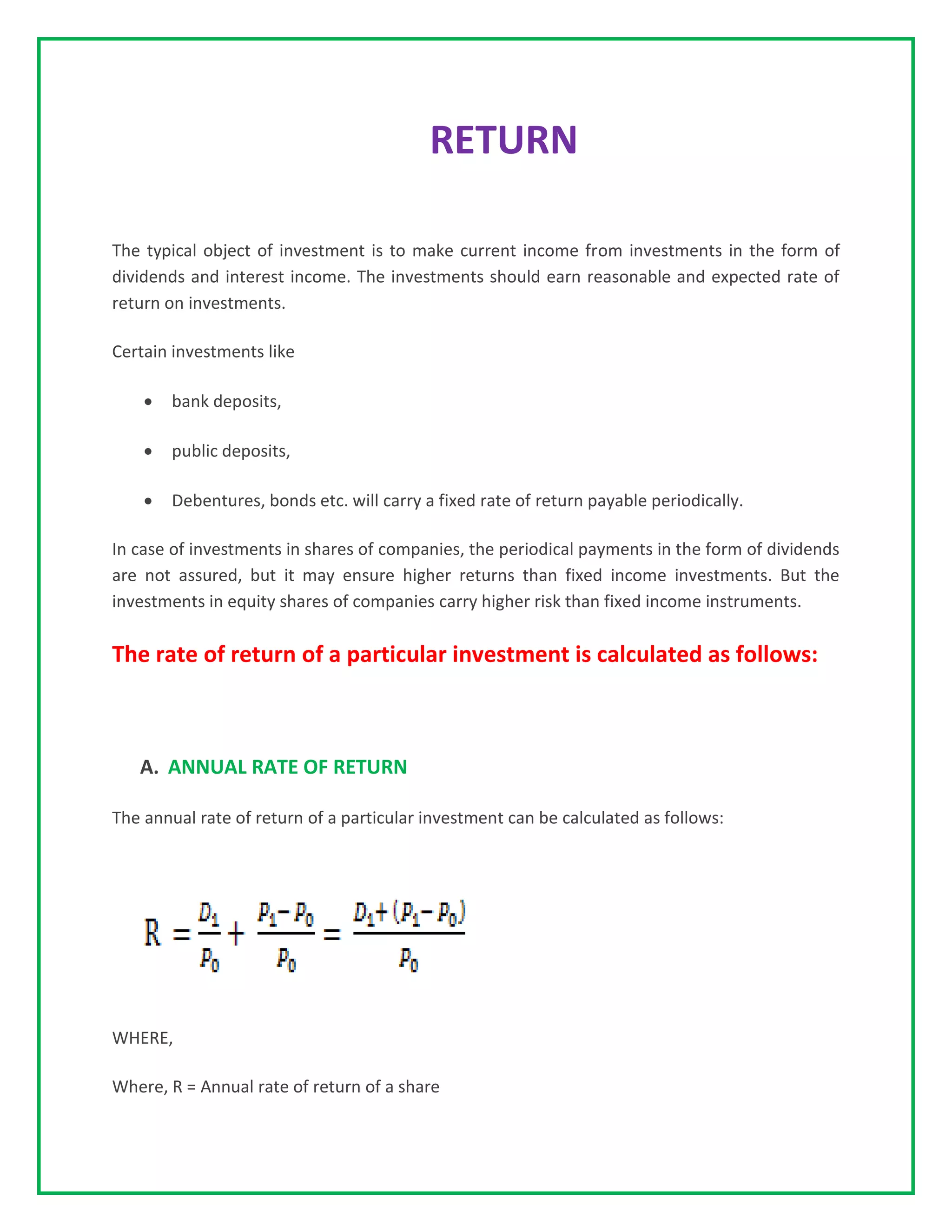
The annual rate of return of a particular investment can be calculated as follows:
WHERE,
Where, R = Annual rate of return of a share
D1 = Dividend paid at the end of the year
P0 = Market price of share at the beginning of the year
P1 = Market price of share at the end of the year
The above formula is used for calculation of annual return of an investment in shares. In the
above formula, D1/P0 represents dividend yield and (P1 – P0)/P0 represents capital gain or loss.
B. RATE OF RETURN
A rate of return (RoR) is the net gain or loss of an investment over a specified time period,
expressed as a percentage of the investment’s initial cost. When calculating the rate of return,
you are determining the percentage change from the beginning of the period until the end.
• The rate of return (RoR) is used to measure the profit or loss of an investment over
time.
• The metric of RoR can be used on a variety of assets, from stocks to bonds, real estate,
and art.
C. EXPECTED RETURN
The expected return is the profit or loss that an investor anticipates on an investment that has
known historical rates of return (RoR). It is calculated by multiplying potential outcomes by the
chances of them occurring and then totaling these results.
RELATIONSHIP BETWEEN RISK & EXPECTED RETURN
• There is a positive relationship between the amount of
risk assumed and the amount of expected return.
• Greater the risk, the larger the expected return and the
larger the chances of substantial loss.
• Investments which carry low risks such as high grade
bonds will offer a lower expected rate of return than
those which carry high risk such as equity stock of a new
company.
• A rational investor would have some degree of risk
aversion, he would accept the risk only if he is
adequately compensated for it.
• Risk is measured along the x-axis and
• Return is measured along vertical axis.
Risk increases from left to right and return rises from bottom to top. The line from O to R(f)
indicates the rate of return on risk less investments.
RISK & RETURN RELATIONSHIP
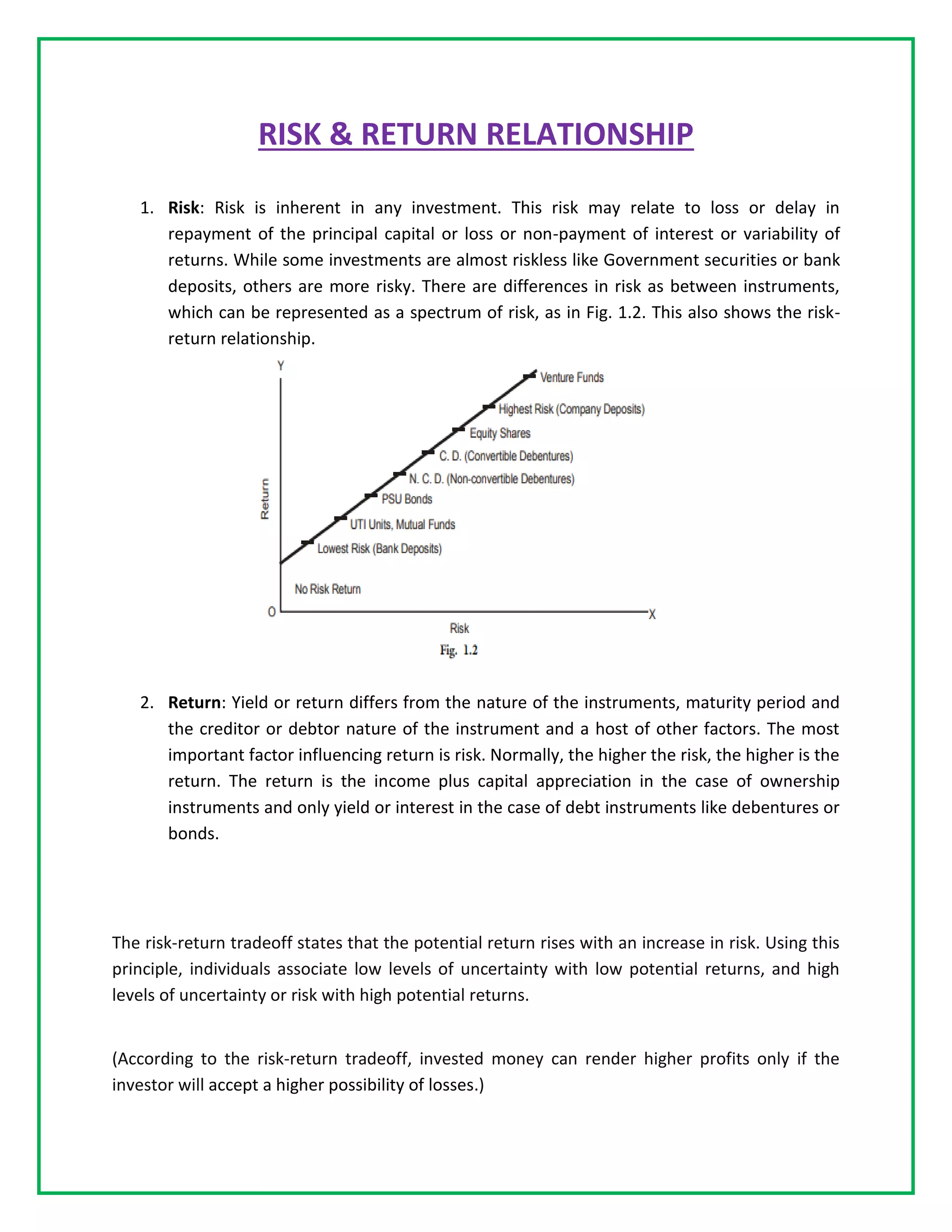
1. Risk: Risk is inherent in any investment. This risk may relate to loss or delay in
repayment of the principal capital or loss or non-payment of interest or variability of
returns. While some investments are almost riskless like Government securities or bank
deposits, others are more risky. There are differences in risk as between instruments,
which can be represented as a spectrum of risk, as in Fig. 1.2. This also shows the risk-
return relationship.
2. Return: Yield or return differs from the nature of the instruments, maturity period and
the creditor or debtor nature of the instrument and a host of other factors. The most
important factor influencing return is risk. Normally, the higher the risk, the higher is the
return. The return is the income plus capital appreciation in the case of ownership
instruments and only yield or interest in the case of debt instruments like debentures or
bonds.
The risk-return tradeoff states that the potential return rises with an increase in risk. Using this
principle, individuals associate low levels of uncertainty with low potential returns, and high
levels of uncertainty or risk with high potential returns.
(According to the risk-return tradeoff, invested money can render higher profits only if the
investor will accept a higher possibility of losses.)
• The risk-return tradeoff is the trading principle that links high risk with high reward. T
• he appropriate risk-return tradeoff depends on a variety of factors including an
investor’s risk tolerance, the investor’s years to retirement and the potential to replace
lost funds.
• Time also plays an essential role in determining a portfolio with the appropriate levels of
risk and reward.
For example, if an investor has the ability to invest in equities over the long term, that provides
the investor with the potential to recover from the risks of bear markets and participate in bull
markets, while if an investor can only invest in a short time frame, the same equities have a
higher risk proposition.
Investors use the risk-return tradeoff as one of the essential components of each investment
decision, as well as to assess their portfolios as a whole. At the portfolio level, the risk-return
tradeoff can include assessments of the concentration or the diversity of holdings and whether
the mix presents too much risk or a lower-than-desired potential for returns.
A. MEASURING SINGULAR RISK IN CONTEXT
When an investor considers high-risk-high-return investments, the investor can apply the risk-
return tradeoff to the vehicle on a singular basis as well as within the context of the portfolio as
a whole.
Examples of high-risk-high return investments include options, penny stocks and leveraged
exchange-traded funds (ETFs). Generally speaking, a diversified portfolio reduces the risks
presented by individual investment positions. For example, a penny stock position may have a
high risk on a singular basis, but if it is the only position of its kind in a larger portfolio, the risk
incurred by holding the stock is minimal.
B. RISK-RETURN TRADEOFF AT THE PORTFOLIO LEVEL
That said the risk-return tradeoff also exists at the portfolio level. For example, a portfolio
composed of all equities presents both higher risk and higher potential returns. Within an all-
equity portfolio, risk and reward can be increased by concentrating investments in
specific sectors or by taking on single positions that represent a large percentage of holdings.
For investors, assessing the cumulative risk-return tradeoff of all positions can provide insight
on whether a portfolio assumes enough risk to achieve long-term return objectives or if the risk
levels are too high with the existing mix of holdings.
RISK RETURN TRADEOFF
SINGULAR
RISK
PORTFOLIO
LEVEL
INVESTMENT RISK PYRAMID
SAFETY VS RISKINESS
Safety is another feature which the investor desires for investments. Normally, savers invest
only in safe or riskfree investments. Only a few opt for risky investments for which the returns
would also be higher.
Thus, a higher return of 14% or more is available for three-year deposits of companies which
are most risky. Besides, there are debentures of companies whose yield may be more than
11%, if they are purchased at a discount in the market.
But debentures and bonds carry a coupon rate of 10%-12%. Some of the equity shares might
give a better return but the general average yield rate on equities is lower than on other types
of securities available for investment.
But equities are chosen more for their capital appreciation rather than dividend yield. The
maturity period of the instrument, the creditworthiness of the issuer and the nature of the
instrument, whether debt or ownership instrument would all influence the risk, return and
other features of the instrument. The Government policy or tax treatment of the instrument,
etc., would also determine the yield on the instruments.
SUMMARY
• Risk can be defined as the probability that the expected return from the security will not
materialize.
• Every investment involves uncertainties that make future investment returns risk-prone.
• Uncertainties could be due to the political, economic and industry factors.
• Risk could be systematic in future, depending upon its source.
• Systematic risk is for the market as a whole, while unsystematic risk is specific to an industry or
the company individually.
• Political risk could be categorized depending upon whether it affects the market as whole or just
a particular industry.
• Beta is a measure of the systematic risk of a security that cannot be avoided through
diversification.
• Beta is a relative measure of risk - the risk of an individual stock relative to the market portfolio
of all stocks.
• If the security's returns move more (less) than the market's returns as the latter changes, the
security's returns have more (less) volatility (fluctuations in price) than those of the market.
• Beta measures a security's volatility, or fluctuations in price, relative to a benchmark, the market
portfolio of all stocks.
• The risk/return trade-off could easily be called the "ability-to-sleep-at-night test." While some
people can handle the equivalent of financial skydiving without batting an eye, others are
terrified to climb the financial ladder without a secure harness.
• Deciding what amount of risk you can take while remaining comfortable with your investments
is very important.

RISK & RETURN

  • 1.
    RISK & RETURN INTRODUCTION Securityanalysts and portfolio managers are concerned about an investment’s return, its risk, and whether it is priced correctly by the market. If markets are efficient, the price reflects available information quickly. A basic tenet of valuation is that the greater the investment’s risk, the greater the return needed to compensate investors for that risk. Risk and return are most important concepts in finance. In fact, they are the foundation of the modern finance theory. What is risk? How is it measured? What is return? How is it measured? We attempt to answer these questions through these notes. We must begin with a clear understanding of what risk and return are! RISK A. CONCEPT OF RISK • an unwanted event which may or may not occur. • the cause of an unwanted event which may or may not occur. • the probability of an unwanted event which may or may not occur. • the statistical expectation value of unwanted events which may or may not occur. • the fact that a decision is made under conditions of known probabilities (“decision under risk”) For most investors, however, the prime interest in investments is largely to earn a return on their money. However, selecting stocks exclusively on the basis of maximization of return is not enough. The most investors do not place available funds into the one, two, or even three stocks promising the greatest returns suggests that other factors must be considered besides return in the selection process. Investors not only like return, they dislike risk.
  • 2.
    B. DEFINING RISK Giventhe ubiquity of risk in almost every human activity, it is surprising how little consensus there is about how to define risk. The early discussion centered on the distinction between risk that could be quantified objectively and subjective risk. In 1921, Frank Knight summarized the difference between risk and uncertainty thus3: "… Uncertainty must be taken in a sense radically distinct from the familiar notion of Risk, from which it has never been properly separated. … The essential fact is that "risk" means in some cases a quantity susceptible of measurement, while at other times it is something distinctly not of this character; and there are far-reaching and crucial differences in the bearings of the phenomena depending on which of the two is really present and operating. … It will appear that a measurable uncertainty, or "risk" proper, as we shall use the term, is so far different from an un-measurable one that it is not in effect an uncertainty at all." Risk is incorporated into so many different disciplines from insurance to engineering to portfolio theory that it should come as no surprise that it is defined in different ways by each one. FIRST MYTH OF RISK “Risk” must have a single, well defined meaning.
  • 3.
    IT IS WORTHLOOKING AT SOME OF THE DISTINCTIONS: a. Risk versus Probability: While some definitions of risk focus only on the probability of an event occurring, more comprehensive definitions incorporate both the probability of the event occurring and the consequences of the event. Thus, the probability of a severe earthquake may be very small but the consequences are so catastrophic that it would be categorized as a high- risk event. b. Risk versus Threat: In some disciplines, a contrast is drawn between risk and a threat. A threat is a low probability event with very large negative consequences, where analysts may be unable to assess the probability. A risk, on the other hand, is defined to be a higher probability event, where there is enough information to make assessments of both the probability and the consequences. c. All outcomes versus Negative outcomes: Some definitions of risk tend to focus only on the downside scenarios, whereas others are more expansive and consider all variability as risk. The engineering definition of risk is defined as the product of the probability of an event occurring, that is viewed as undesirable, and an assessment of the expected harm from the event occurring. The Chinese symbol for risk best captures this duality: 风险 This Chinese symbol for risk is a combination of danger (crisis) and opportunity, representing the downside and the upside of risk. C. TYPES OF RISK "[Risk is] A probability or threat of damage, injury, loss, or any other negative occurrence that is caused by external or internal vulnerabilities, and that may be avoided through preemptive action." Dynamic risks are those resulting from the changes in the economy or the environment. These risk factors mainly refer to the macro economic variables like inflation, income and output levels, and technology changes. “ An ongoing or upcoming concern that has a significant probability of adversely affecting the success of major milestones”
  • 4.
    •Financial risk involvesthe simultaneous existence of three important elements in a risky situation- (a) that someone is adversely affected by the happening of an event, (b) the assets or income is likely to be exposed to a financial loss from the occurrence of the event and (c) the peril can cause the loss. •When the possibility of a financial loss does not exist, the situation can be referred to as non-financial in nature. FINANCIAL & NON-FINANCIAL RISKS • Pure risk situations are those where there is a possibility of loss or no loss. There is no gain to the individual or the organisation • Speculative risks are those where there is possibility of gain as well as loss. The element of gain is inherent or structured in such a situation. PURE AND SPECULATIVE RISKS •Dynamic risks are those resulting from the changes in the economy or the environment. These risk factors mainly refer to the macro economic variables like inflation, income and output levels, and technology changes. •Static risks are more or less predictable and are not affected by the economic conditions. STATIC & DYNAMIC RISK
  • 5.
    D. SYSTEMATIC VSUNSYSTEMATIC RISK • Systematic risk refers to the risk inherent to the entire market or market segment. Systematic risk, also known as “undiversifiable risk,” “volatility” or “market risk,” affects the overall market, not just a particular stock or industry. Systematic risk is inherent to the market as a whole, reflecting the impact of economic, geo-political and financial factors. Systematic risk is both unpredictable and impossible to completely avoid. It cannot be mitigated through diversification, only through hedging or by using the correct asset allocation strategy. • Unsystematic risk is the risk that is unique to a specific company or industry. It's also known as nonsystematic risk, specific risk, diversifiable risk, or residual risk. In the context of an investment portfolio, unsystematic risk can be reduced through diversification. This risk is unique to a particular security and is associated with such factors as business and financial risk as well as liquidity risk. TOTAL RISK = SYSTEMATIC RISK + NON-SYSTEMATIC RISK
  • 6.
    TYPES OF SYSTEMATICRISKS INTEREST RATE RISK Such kind of risk is the result of a change in the market interest rate. It mainly impacts the fixed income securities as bond prices are inversely related to the interest rate. Market Risk It is the result of the general tendency of the investors to move with the market. So, it is basically the tendency of security prices to move collectively. For instance, in the falling market, the stock price of even the best performing company’s drop. Usually, market risk accounts for about two-thirds of total systematic risk. PURCHASING POWER RISK Also called the Inflation Risk occurs due to the erosion in the purchasing power of money. Inflation is the rise in the general price level, meaning the same amount of money buys fewer goods and services. So, if the income of the investor fails to keep pace with the rising inflation, then in the real term, he is earning less than before. Similar to the interest rate risk, purchasing power risk also mainly affects the fixed income securities because the income from such securities is fixed. EXCHANGE RATE RISK This risk stems from the uncertainty in the changes in the value of the currencies. So, it affects only the companies doing foreign exchange transactions, like export and import companies.
  • 7.
    OPPORTUNITY COST ANDSYSTEMATIC RISK Since systematic risk is non-diversifiable, investors demand a premium to make up for this risk factor. For instance, if a risk-free govt. security is giving a 5% return, then an investor expects to make more than that from the equity investment, like 8%. This difference of 3% (or a premium of 3%) is for assuming the systematic risk. So, systematic risk can also be viewed as the opportunity cost for selecting one security over another. USING BETA TO SYSTEMATIC RISK Another name of systematic risk is volatility risk. And, we can measure volatility in security by the sensitivity of a security’s return with respect to the market return. This sensitivity is captured by, which is calculated by regressing a security’s return against the market return. TYPES OF UNSYSTEMATIC RISK So, a beta of stock tells how risky a particular stock or portfolio is when we compare it to the market. Like, if the calculated beta is zero, it means portfolio/stock is uncorrelated to the market return; if beta is greater than zero but less than one, it means portfolio/stock return has a positive correlation with the market return, but the volatility is lower; if beta is greater than one, then the portfolio/stock has a positive correlation with the market, but volatility is higher. In this case, if a stock’s beta is 1.2, then it is 20% more volatile than the market.
  • 8.
    Unsystematic risk canbe divided into: HOW UNSYSTEMATIC RISK CAN BE MANAGED? All kind of unsystematic risk can be diversified. Industry specific risk or company specific risk are diversified with the help of strong portfolio and we can manage the effects of losses and risks due to unsystematic reasons. There are different sectors which are most affected by unsystematic risk that are banking, aviation, FMCG, insurance and real estate. And a proper portfolio can deal with this risks UNSYSTEMATIC RISK BUSINESS RISK The risk of doing business in a particular industry or environment is called business risk. For example, as one of the largest steel producers, U.S. Steel faces unique problems. FINANCIAL RISK This type of risk is applied to individual, business, and government entities and relates to the fact that there is a chance that stakeholders can lose their money. It actually relates to the capital structure of an organization. The manner in which a company raises required funds for its growth has a direct impact on future earnings and stability of a business entity.
  • 9.
    MEASUREMENT OF RISK Understandingthe nature and types of risk is not adequate unless the investor or analyst is capable of measuring it in some quantitative terms. The quantitative expression of the risk of a stock would make it comparable with other stocks. Risk is measured by the variability of returns. THERE ARE DIFFERENT WAYS TO MEASURE RISK, THESE ARE AS FOLLOWS:- 1. STANDARD DEVIATION It measures the dispersion of data from its expected value. The standard deviation is used in making an investment decision to measure the amount of historical volatility associated with an investment relative to its annual rate of return. It indicates how much the current return is deviating from its expected historical normal returns. For example, a stock that has high standard deviation experiences higher volatility, and therefore, a higher level of risk is associated with the stock. a. When prices swing up or down significantly, the standard deviation is high, meaning there is high volatility. b. On the other hand, when there is a narrow spread between trading ranges, the standard deviation is low, meaning volatility is low.
  • 10.
    2. BETA Beta isa measure of the volatility—or systematic risk—of a security or portfolio compared to the market as a whole. Beta is used in the capital asset pricing model(CAPM), which describes the relationship between systematic risk and expected return for assets (usually stocks). CAPM is widely used as a method for pricing risky securities and for generating estimates of the expected returns of assets, considering both the risk of those assets and the cost of capital. CALCULATION OF BETA IS AS FOLLOWS:
  • 11.
    3. COEFFICIENT OFVARIATION Standard deviation is expressed in the units of the original distribution and is called absolute measure of dispersion. • Therefore, absolute measure must be reduced to a form which is free from the original unit of measurement. • This can be done by expressing it in relation to the average from which variation is measured. • This measure of relative variation is obtained by dividing the absolute measure by that average and is called a coefficient of variation. AND ANOTHER FORMULA IS AS FOLLOWS:-
  • 12.
    4. VALUE ATRISK (VAR) Value at Risk (VaR) is a statistical measure used to assess the level of risk associated with a portfolio or company. The VaR measures the maximum potential loss with a degree of confidence for a specified period. For example, suppose a portfolio of investments has a one-year 10 percent VaR of $5 million. Therefore, the portfolio has a 10 percent chance of losing more than $5 million over a one-year period.
  • 13.
    RETURN The typical objectof investment is to make current income from investments in the form of dividends and interest income. The investments should earn reasonable and expected rate of return on investments. Certain investments like • bank deposits, • public deposits, • Debentures, bonds etc. will carry a fixed rate of return payable periodically. In case of investments in shares of companies, the periodical payments in the form of dividends are not assured, but it may ensure higher returns than fixed income investments. But the investments in equity shares of companies carry higher risk than fixed income instruments. The rate of return of a particular investment is calculated as follows: A. ANNUAL RATE OF RETURN The annual rate of return of a particular investment can be calculated as follows: WHERE, Where, R = Annual rate of return of a share
  • 14.
    D1 = Dividendpaid at the end of the year P0 = Market price of share at the beginning of the year P1 = Market price of share at the end of the year The above formula is used for calculation of annual return of an investment in shares. In the above formula, D1/P0 represents dividend yield and (P1 – P0)/P0 represents capital gain or loss. B. RATE OF RETURN A rate of return (RoR) is the net gain or loss of an investment over a specified time period, expressed as a percentage of the investment’s initial cost. When calculating the rate of return, you are determining the percentage change from the beginning of the period until the end. • The rate of return (RoR) is used to measure the profit or loss of an investment over time. • The metric of RoR can be used on a variety of assets, from stocks to bonds, real estate, and art. C. EXPECTED RETURN The expected return is the profit or loss that an investor anticipates on an investment that has known historical rates of return (RoR). It is calculated by multiplying potential outcomes by the chances of them occurring and then totaling these results.
  • 15.
    RELATIONSHIP BETWEEN RISK& EXPECTED RETURN • There is a positive relationship between the amount of risk assumed and the amount of expected return. • Greater the risk, the larger the expected return and the larger the chances of substantial loss. • Investments which carry low risks such as high grade bonds will offer a lower expected rate of return than those which carry high risk such as equity stock of a new company. • A rational investor would have some degree of risk aversion, he would accept the risk only if he is adequately compensated for it.
  • 16.
    • Risk ismeasured along the x-axis and • Return is measured along vertical axis. Risk increases from left to right and return rises from bottom to top. The line from O to R(f) indicates the rate of return on risk less investments.
  • 17.
    RISK & RETURNRELATIONSHIP 1. Risk: Risk is inherent in any investment. This risk may relate to loss or delay in repayment of the principal capital or loss or non-payment of interest or variability of returns. While some investments are almost riskless like Government securities or bank deposits, others are more risky. There are differences in risk as between instruments, which can be represented as a spectrum of risk, as in Fig. 1.2. This also shows the risk- return relationship. 2. Return: Yield or return differs from the nature of the instruments, maturity period and the creditor or debtor nature of the instrument and a host of other factors. The most important factor influencing return is risk. Normally, the higher the risk, the higher is the return. The return is the income plus capital appreciation in the case of ownership instruments and only yield or interest in the case of debt instruments like debentures or bonds. The risk-return tradeoff states that the potential return rises with an increase in risk. Using this principle, individuals associate low levels of uncertainty with low potential returns, and high levels of uncertainty or risk with high potential returns. (According to the risk-return tradeoff, invested money can render higher profits only if the investor will accept a higher possibility of losses.)
  • 18.
    • The risk-returntradeoff is the trading principle that links high risk with high reward. T • he appropriate risk-return tradeoff depends on a variety of factors including an investor’s risk tolerance, the investor’s years to retirement and the potential to replace lost funds. • Time also plays an essential role in determining a portfolio with the appropriate levels of risk and reward. For example, if an investor has the ability to invest in equities over the long term, that provides the investor with the potential to recover from the risks of bear markets and participate in bull markets, while if an investor can only invest in a short time frame, the same equities have a higher risk proposition. Investors use the risk-return tradeoff as one of the essential components of each investment decision, as well as to assess their portfolios as a whole. At the portfolio level, the risk-return tradeoff can include assessments of the concentration or the diversity of holdings and whether the mix presents too much risk or a lower-than-desired potential for returns.
  • 19.
    A. MEASURING SINGULARRISK IN CONTEXT When an investor considers high-risk-high-return investments, the investor can apply the risk- return tradeoff to the vehicle on a singular basis as well as within the context of the portfolio as a whole. Examples of high-risk-high return investments include options, penny stocks and leveraged exchange-traded funds (ETFs). Generally speaking, a diversified portfolio reduces the risks presented by individual investment positions. For example, a penny stock position may have a high risk on a singular basis, but if it is the only position of its kind in a larger portfolio, the risk incurred by holding the stock is minimal. B. RISK-RETURN TRADEOFF AT THE PORTFOLIO LEVEL That said the risk-return tradeoff also exists at the portfolio level. For example, a portfolio composed of all equities presents both higher risk and higher potential returns. Within an all- equity portfolio, risk and reward can be increased by concentrating investments in specific sectors or by taking on single positions that represent a large percentage of holdings. For investors, assessing the cumulative risk-return tradeoff of all positions can provide insight on whether a portfolio assumes enough risk to achieve long-term return objectives or if the risk levels are too high with the existing mix of holdings. RISK RETURN TRADEOFF SINGULAR RISK PORTFOLIO LEVEL
  • 20.
    INVESTMENT RISK PYRAMID SAFETYVS RISKINESS Safety is another feature which the investor desires for investments. Normally, savers invest only in safe or riskfree investments. Only a few opt for risky investments for which the returns would also be higher. Thus, a higher return of 14% or more is available for three-year deposits of companies which are most risky. Besides, there are debentures of companies whose yield may be more than 11%, if they are purchased at a discount in the market. But debentures and bonds carry a coupon rate of 10%-12%. Some of the equity shares might give a better return but the general average yield rate on equities is lower than on other types of securities available for investment. But equities are chosen more for their capital appreciation rather than dividend yield. The maturity period of the instrument, the creditworthiness of the issuer and the nature of the instrument, whether debt or ownership instrument would all influence the risk, return and other features of the instrument. The Government policy or tax treatment of the instrument, etc., would also determine the yield on the instruments.
  • 21.
    SUMMARY • Risk canbe defined as the probability that the expected return from the security will not materialize. • Every investment involves uncertainties that make future investment returns risk-prone. • Uncertainties could be due to the political, economic and industry factors. • Risk could be systematic in future, depending upon its source. • Systematic risk is for the market as a whole, while unsystematic risk is specific to an industry or the company individually. • Political risk could be categorized depending upon whether it affects the market as whole or just a particular industry. • Beta is a measure of the systematic risk of a security that cannot be avoided through diversification. • Beta is a relative measure of risk - the risk of an individual stock relative to the market portfolio of all stocks. • If the security's returns move more (less) than the market's returns as the latter changes, the security's returns have more (less) volatility (fluctuations in price) than those of the market. • Beta measures a security's volatility, or fluctuations in price, relative to a benchmark, the market portfolio of all stocks. • The risk/return trade-off could easily be called the "ability-to-sleep-at-night test." While some people can handle the equivalent of financial skydiving without batting an eye, others are terrified to climb the financial ladder without a secure harness. • Deciding what amount of risk you can take while remaining comfortable with your investments is very important.