Risk 
Management 
is 
How 
Adults 
Manage 
Projects 
March 
2008 
Risk 
management 
is 
essential 
for 
the 
success 
of 
any 
significant 
project. 
1 
Niwot 
Ridge 
Consulting, 
LLC 
1 
Information 
about 
key 
project 
cost, 
performance, 
and 
schedule 
attributes 
is 
often 
unknown 
until 
the 
project 
is 
underway. 
Risks 
that 
can 
be 
identified 
early 
in 
the 
project 
that 
impacts 
the 
project 
later 
are 
often 
termed 
“known 
unknowns.” 
These 
risks 
can 
be 
mitigated, 
reduced, 
or 
retired 
with 
a 
comprehensive 
risk 
management 
process. 
For 
risks 
that 
are 
beyond 
the 
vision 
of 
the 
project 
team 
a 
properly 
implemented 
risk 
management 
process 
can 
be 
used 
to 
rapidly 
quantify 
the 
risks 
impact 
and 
provide 
sound 
plans 
for 
mitigating 
its 
affect. 
Risk 
management 
is 
concerned 
with 
the 
outcomes 
of 
a 
future 
event, 
whose 
exact 
impacts 
are 
unknown, 
and 
with 
how 
to 
deal 
with 
this 
uncertainty. 
Outcomes 
are 
categorized 
as 
favorable 
or 
unfavorable. 
Risk 
management 
is 
the 
art 
and 
science 
of 
planning, 
assessing, 
handling, 
and 
monitoring 
future 
events 
to 
ensure 
favorable 
outcomes. 
A 
good 
risk 
management 
process 
is 
proactive 
and 
fundamentally 
different 
than 
reactive 
issue 
management 
or 
problem 
solving. 
This 
paper 
describes 
the 
fundamentals 
of 
Risk 
Management 
with 
5 
simple 
concepts: 
1. Hope 
is 
not 
a 
strategy 
– 
Hoping 
that 
something 
positive 
happens 
will 
not 
lead 
to 
success. 
Preparing 
for 
success 
is 
the 
basis 
of 
success. 
2. All 
single 
point 
estimates 
are 
wrong 
– 
Single 
point 
estimates 
of 
cost, 
schedule 
and 
technical 
performance 
are 
no 
better 
than 
50/50 
guesses 
in 
the 
absence 
of 
knowledge 
about 
the 
variances 
of 
the 
underlying 
distribution. 
3. Without 
integrating 
Cost, 
Schedule 
and 
Technical 
Performance 
you 
are 
driving 
in 
the 
rearview 
mirror. 
The 
effort 
to 
produce 
the 
product 
or 
service 
and 
the 
resulting 
value 
cannot 
be 
made 
without 
making 
these 
connections. 
4. Without 
a 
model 
for 
risk 
management, 
you 
are 
driving 
in 
the 
dark 
with 
the 
headlights 
turned 
off 
– 
Risk 
management 
is 
not 
an 
ad 
hoc 
process 
that 
you 
can 
make 
up 
as 
you 
go. 
A 
formal 
foundation 
for 
risk 
management 
is 
needed. 
Choose 
one 
that 
has 
worked 
in 
high-­‐risk 
domains 
– 
defense, 
nuclear 
power, 
manned 
spaceflight. 
5. Risk 
Communication 
is 
everything 
– 
Identifying 
risks 
without 
communicating 
them 
is 
a 
waste 
of 
time. 
Risk 
management 
is 
an 
important 
skill 
that 
can 
be 
applied 
to 
a 
wide 
variety 
of 
projects. 
In 
an 
era 
of 
downsizing, 
consolidation, 
shrinking 
budgets, 
increasing 
technological 
sophistication, 
and 
shorter 
development 
times, 
risk 
management 
provides 
valuable 
insights 
to 
help 
key 
project 
personnel 
plan 
for 
risks. 
It 
alerts 
them 
of 
potential 
risk 
issues, 
which 
can 
then 
be 
analyzed, 
and 
plans 
developed, 
implemented, 
and 
monitored 
to 
address 
risks 
before 
they 
surface 
as 
issues 
and 
adversely 
affect 
project 
cost, 
performance, 
and 
schedule. 
Hope 
is 
Not 
a 
Strategy 
Hoping 
that 
the 
project 
will 
proceed 
as 
planned 
is 
naïve 
at 
best 
and 
poor 
management 
at 
worse. 
These 
same 
naïve 
project 
managers 
constantly 
seek 
ways 
to 
eliminate 
or 
control 
risk, 
variance 
and 
uncertainly. 
This 
is 
a 
hopeless 
pursuit. 
Managing 
“in 
the 
presence” 
of 
risk, 
variance 
and 
uncertainty 
is 
the 
key 
to 
success. 
Some 
projects 
have 
few 
uncertainties 
–only 
the 
complexity 
of 
tasks 
and 
relationships 
is 
important 
– 
but 
most 
projects 
are 
characterized 
by 
several 
types 
of 
uncertainty. 
Although 
each 
uncertainty 
type 
is 
distinct, 
a 
single 
project 
may 
encounter 
some 
combination 
of 
four 
types: 
2 
1. Variation 
– 
comes 
from 
many 
small 
influences 
and 
yields 
a 
range 
of 
values 
on 
a 
particular 
activity. 
Attempting 
to 
control 
these 
variances 
outside 
their 
natural 
boundaries 
is 
a 
waste 
of 
time. 
2. Foreseen 
Uncertainty 
– 
are 
uncertainties 
identifiable 
and 
understood 
influences 
that 
the 
team 
cannot 
be 
sure 
will 
occur. 
There 
needs 
to 
be 
a 
mitigation 
plan 
for 
these 
foreseen 
uncertainties. 
3. Unforeseen 
Uncertainty 
– 
is 
uncertainty 
that 
can’t 
be 
identified 
during 
project 
planning. 
When 
these 
occur, 
a 
new 
plan 
is 
needed. 
4. Chaos 
– 
appears 
in 
the 
presence 
of 
“unknown 
unknowns” 
1 
“Risk 
Management 
during 
Requirements,” 
Tom 
DeMarco 
and 
Tim 
Lister, 
IEEE 
Software, 
September/October, 
2003 
2 
“Managing 
Project 
Uncertainty: 
From 
Variation 
to 
Chaos,” 
Arnoud 
De 
Meyer, 
Christoph 
H. 
Loch 
and 
Michael 
T. 
Pich, 
MIT 
Sloan 
Management 
Review, 
Winter 
2002
Risk 
Management 
is 
How 
Adults 
Manage 
Projects 
March 
2008 
Plans 
are 
strategies 
for 
the 
successful 
completion 
of 
the 
project. 
Plans 
are 
different 
than 
schedules. 
Schedules 
show 
“how” 
the 
project 
will 
be 
executed. 
Plans 
show 
“what” 
accomplishments 
must 
be 
performed 
and 
the 
success 
criteria 
for 
these 
accomplishments 
along 
the 
way 
to 
completion. 
The 
Plan 
describes 
the 
increasing 
maturity 
of 
the 
project 
through 
“maturity 
assessment” 
points. 
The 
unit 
of 
measure 
for 
this 
maturity 
must 
be 
meaningful 
to 
the 
stakeholders. 
Something 
that 
can 
be 
connected 
to 
the 
investment 
they 
have 
made 
in 
the 
project. 
When 
we 
speak 
the 
word 
“Hope,” 
it 
lays 
the 
foundation 
for 
failure. 
In 
the 
use 
of 
Hope 
we 
really 
mean 
“success 
is 
possible 
but 
not 
probable.” 
When 
we 
speak 
the 
word 
“Plan,” 
it 
does 
not 
assure 
success, 
but 
success 
is 
a 
probable 
outcome. 
It 
is 
the 
definition 
of 
the 
probability 
of 
success 
P(s), 
that 
is 
the 
foundation 
of 
the 
Plan. 
Having 
a 
Plan–A, 
Plan–B 
and 
possibly 
a 
Plan–C 
exposes 
risk, 
assigns 
mitigations 
and 
measures 
the 
probability 
of 
success. 
The 
idea 
of 
a 
Plan 
as 
a 
Strategy 
is 
critical 
to 
making 
changes 
in 
the 
behavior 
of 
project 
teams 
that 
can 
then 
lead 
to 
“risk 
adjusted 
project 
management.” 
Without 
a 
Plan, 
the 
schedule 
is 
just 
a 
list 
of 
activities 
to 
be 
performed. 
The 
reason 
for 
their 
performance 
may 
be 
understood, 
but 
it 
is 
unlikely 
these 
activities 
fit 
in 
any 
cohesive 
Strategy. 
Strategies 
have 
goals, 
critical 
success 
factors, 
and 
key 
performance 
indicators. 
No 
Single 
Point 
Estimate 
of 
Cost, 
Schedule 
or 
Technical 
Performance 
Can 
Correct 
How 
long 
will 
this 
take? 
How 
much 
is 
it 
going 
to 
cost? 
What 
is 
the 
confidence 
in 
those 
two 
numbers? 
These 
are 
three 
questions 
that 
must 
be 
answered 
for 
the 
project 
team 
to 
have 
a 
credible 
discussion 
with 
the 
stakeholders 
about 
success. 
Deciding 
what 
accuracy 
is 
needed 
to 
provide 
a 
credible 
answer 
is 
a 
starting 
point. 
But 
that 
does 
not 
address 
the 
question 
– 
“how 
can 
that 
accuracy 
be 
obtained.” 
There 
are 
many 
check 
lists 
for 
estimating 
cost 
and 
schedule, 
with 
simple 
guidance 
on 
how 
to 
build 
estimates. 
Most 
of 
this 
advice 
is 
wrong 
in 
a 
fundamental 
way. 
The 
numbers 
produced 
by 
the 
estimating 
process 
do 
not 
have 
their 
variance 
defined 
in 
any 
statistically 
sound 
manner. 
By 
statistically 
sound 
I 
mean 
that 
the 
underlying 
probability 
distributions 
are 
known. 
If 
they 
are 
unknown, 
then 
some 
form 
of 
estimating 
taking 
this 
unknown 
into 
account 
must 
be 
used. 
The 
PMI 
advice 
of 
producing 
three 
estimates 
– 
optimistic, 
most 
likely, 
pessimistic 
is 
fraught 
with 
error. 
How 
are 
these 
numbers 
arrived 
at? 
Are 
they 
based 
on 
best 
engineering 
judgment? 
Based 
in 
historical 
data? 
What 
is 
the 
variance 
on 
the 
variance 
of 
this 
distribution 
– 
the 
2nd 
standard 
deviation? 
The 
use 
of 
point 
estimates 
for 
duration 
and 
cost 
is 
the 
first 
approach 
in 
an 
organization 
low 
on 
the 
project 
management 
maturity 
scale. 
Understanding 
that 
cost 
and 
durations 
are 
actually 
“random 
variables,” 
drawn 
from 
an 
underlying 
distribution 
of 
possible 
value 
is 
the 
starting 
point 
for 
managing 
in 
the 
presence 
of 
uncertainty. 
In 
probability 
theory, 
every 
random 
variable 
is 
attributed 
to 
a 
probability 
distribution. 
The 
probability 
distribution 
associated 
with 
cost 
or 
duration 
describes 
the 
variance 
of 
these 
random 
variables. 
A 
common 
distribution 
of 
probabilistic 
estimates 
for 
cost 
and 
schedule 
is 
the 
Triangle 
Distribution. 
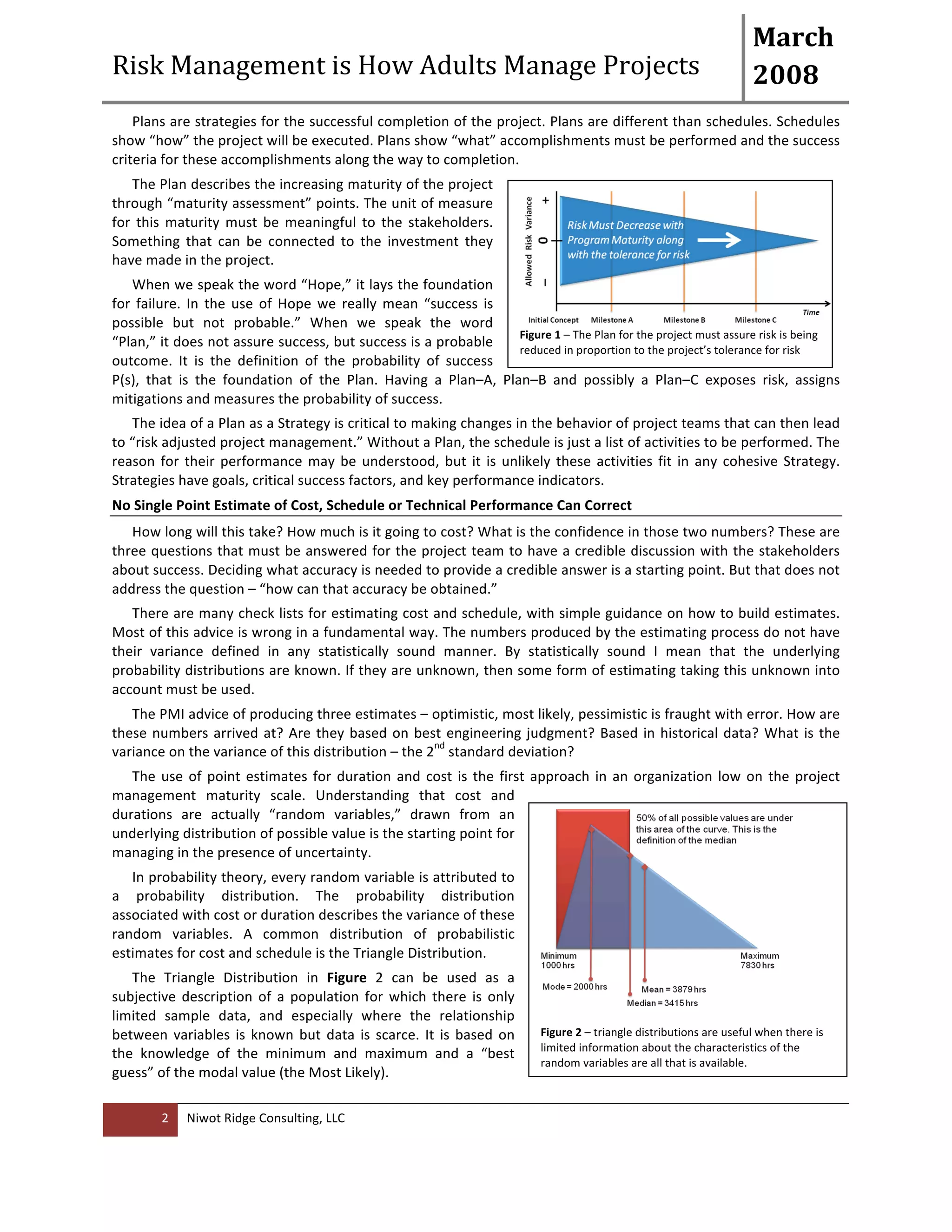
The 
Triangle 
Distribution 
in 
Figure 
2 
Niwot 
Ridge 
Consulting, 
LLC 
2 
can 
be 
used 
as 
a 
subjective 
description 
of 
a 
population 
for 
which 
there 
is 
only 
limited 
sample 
data, 
and 
especially 
where 
the 
relationship 
between 
variables 
is 
known 
but 
data 
is 
scarce. 
It 
is 
based 
on 
the 
knowledge 
of 
the 
minimum 
and 
maximum 
and 
a 
“best 
guess” 
of 
the 
modal 
value 
(the 
Most 
Likely). 
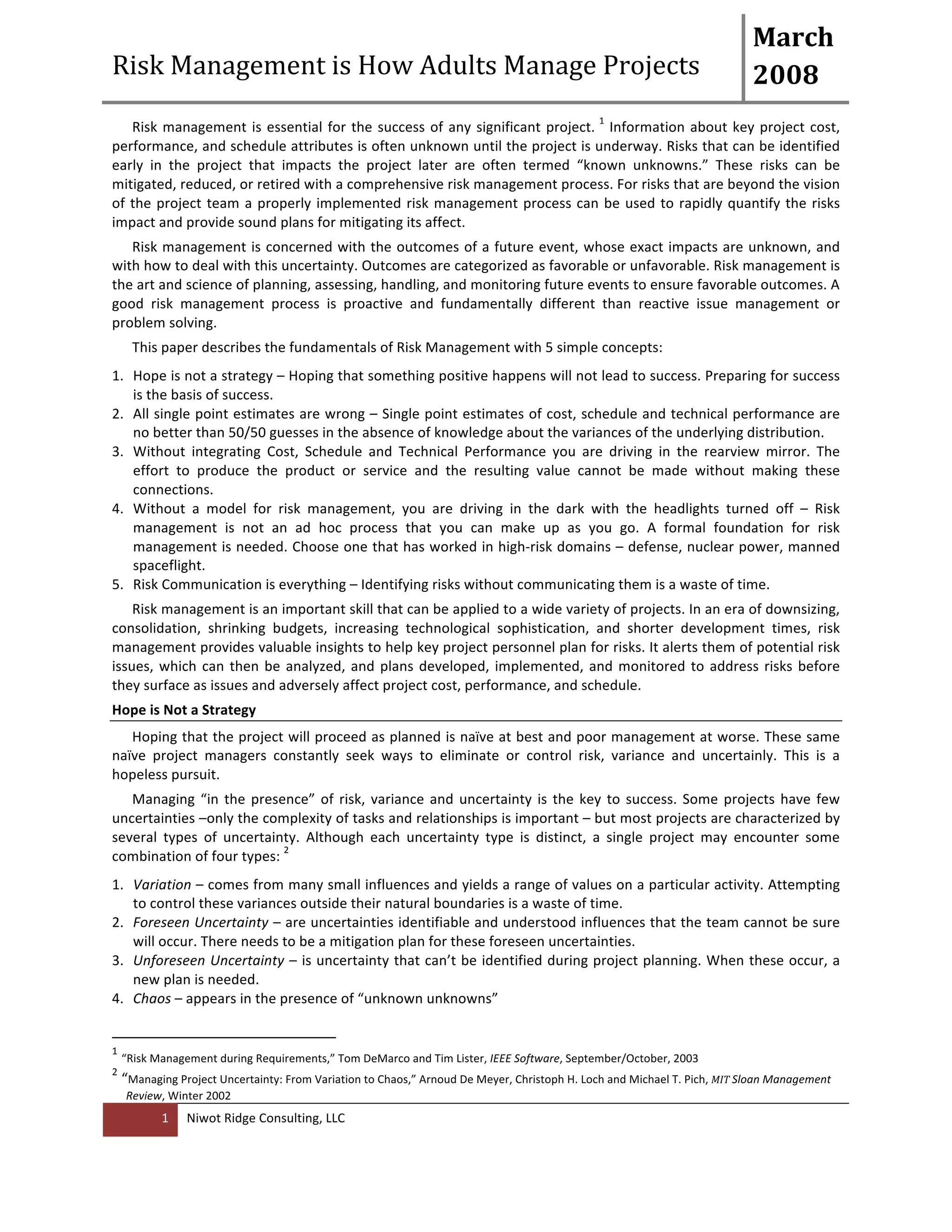
Figure 
1 
– 
The 
Plan 
for 
the 
project 
must 
assure 
risk 
is 
being 
reduced 
in 
proportion 
to 
the 
project’s 
tolerance 
for 
risk 
Figure 
2 
– 
triangle 
distributions 
are 
useful 
when 
there 
is 
limited 
information 
about 
the 
characteristics 
of 
the 
random 
variables 
are 
all 
that 
is 
available.
Risk 
Management 
is 
How 
Adults 
Manage 
Projects 
March 
2008 
Using 
the 
Triangle 
Distribution 
for 
cost 
and 
duration, 
a 
Monte 
Carlo 
simulation 
of 
the 
network 
of 
activities 
and 
their 
costs 
can 
be 
performed. 
In 
technical 
terms, 
Monte 
Carlo 
methods 
numerically 
transform 
and 
integrate 
the 
posterior 
quantitative 
risk 
assessment 
into 
a 
confidence 
interval. 
The 
result 
is 
a 
“confidence” 
model 
for 
the 
cost 
and 
completion 
times 
for 
the 
project 
based 
on 
the 
upper 
and 
lower 
bounds 
of 
each 
distribution 
assigned 
to 
the 
duration 
and 
cost. 
Integrating 
Cost, 
Schedule, 
and 
Technical 
Performance 
In 
many 
project 
management 
methods 
– 
cost, 
schedule 
and 
quality 
are 
described 
as 
an 
“Iron 
Triangle.” 
Change 
one 
and 
the 
other 
two 
must 
change. 
This 
is 
too 
narrow 
a 
view 
of 
what's 
happening 
on 
a 
project. 
It’s 
the 
Technical 
Performance 
Measurement 
that 
replaces 
Quality. 
Quality 
is 
one 
Technical 
Performance 
measure. 
Cost 
and 
Schedule 
are 
obvious 
elements 
of 
the 
project. 
Technical 
Performance 
Measures 
(TPM) 
describes 
the 
status 
of 
technical 
achievement 
of 
the 
project 
at 
any 
point 
in 
time. 
The 
planned 
technical 
achievement 
is 
part 
of 
the 
Performance 
Measurement 
Baseline 
(PMB). 
The 
Technical 
Performance 
Measurement 
System 
(TPMS) 
uses 
the 
techniques 
of 
risk 
analysis 
and 
probability 
to 
provide 
project 
managers 
with 
the 
early 
warnings 
needed 
to 
avoid 
unplanned 
costs 
and 
slippage 
in 
schedules. 
Systems 
engineering 
uses 
technical 
performance 
measurements 
to 
balance 
cost, 
schedule, 
and 
performance 
throughout 
the 
project 
life 
cycle. 
Connecting 
Cost, 
Schedule, 
and 
Technical 
Performance 
Measures 
closes 
the 
loop 
on 
how 
well 
a 
project 
is 
achieving 
its 
technical 
performance 
requirements 
while 
maintaining 
its 
cost 
and 
schedule 
goals. 
IEEE 
1220, 
EIA 
632 
and 
"A 
Guide 
to 
the 
Project 
Management 
Body 
of 
Knowledge“all 
provide 
guidance 
for 
TPM 
planning 
and 
measurement 
and 
for 
integrating 
TPM 
with 
cost 
and 
schedule 
performance 
measures 
(Earned 
Value). 
3 
Niwot 
Ridge 
Consulting, 
LLC 
3 
Technical 
performance 
measurements 
compare 
actual 
versus 
planned 
technical 
development 
and 
design. 
They 
report 
the 
degree 
to 
which 
system 
requirements 
are 
met 
in 
terms 
of 
performance, 
cost, 
schedule, 
and 
progress 
in 
implementing 
risk 
retirement. 
Technical 
Performance 
Measures 
are 
traceable 
to 
user–defined 
capabilities. 
Integrating 
these 
three 
attributes 
produces 
a 
Performance 
Measurement 
Baseline 
that: 
! Is 
a 
plan 
driven 
by 
product 
quality 
requirements 
rather 
than 
a 
description 
of 
the 
labor 
and 
tasks. 
The 
PMB 
focuses 
on 
technical 
maturity 
and 
quality, 
in 
addition 
to 
cost 
and 
schedule. 
! Focuses 
on 
progress 
toward 
meeting 
success 
criteria 
of 
technical 
reviews. 
! Enables 
insightful 
variance 
analysis. 
! Ensures 
a 
lean 
and 
cost–effective 
approach 
to 
project 
planning 
and 
controls. 
! Enables 
scalable 
scope 
and 
complexity 
depending 
on 
risk. 
! Integrates 
risk 
management 
activities 
with 
the 
performance 
measurement 
baseline. 
! Integrates 
risk 
management 
outcomes 
into 
the 
Estimate 
at 
Completion. 
The 
Cost 
and 
Schedule 
“measures” 
are 
straightforward 
in 
most 
cases. 
The 
measures 
of 
Technical 
Performance 
involve 
measures 
Effectiveness 
and 
Performance. 
Measures 
of 
Effectiveness 
(MOE) 
are 
the 
operational 
mission 
success 
factor 
defined 
by 
the 
customer. 
These 
are: 
1. Stated 
from 
the 
customer 
point 
of 
view 
2. Focused 
on 
the 
most 
critical 
mission 
performance 
needs 
3. Independent 
of 
any 
particular 
solution 
4. Actual 
measures 
at 
the 
end 
of 
development 
3 
Performance 
Based 
Earned 
Value, 
Paul 
Solomon 
and 
Ralph 
Young, 
John 
Wiley 
& 
Sons, 
2006. 
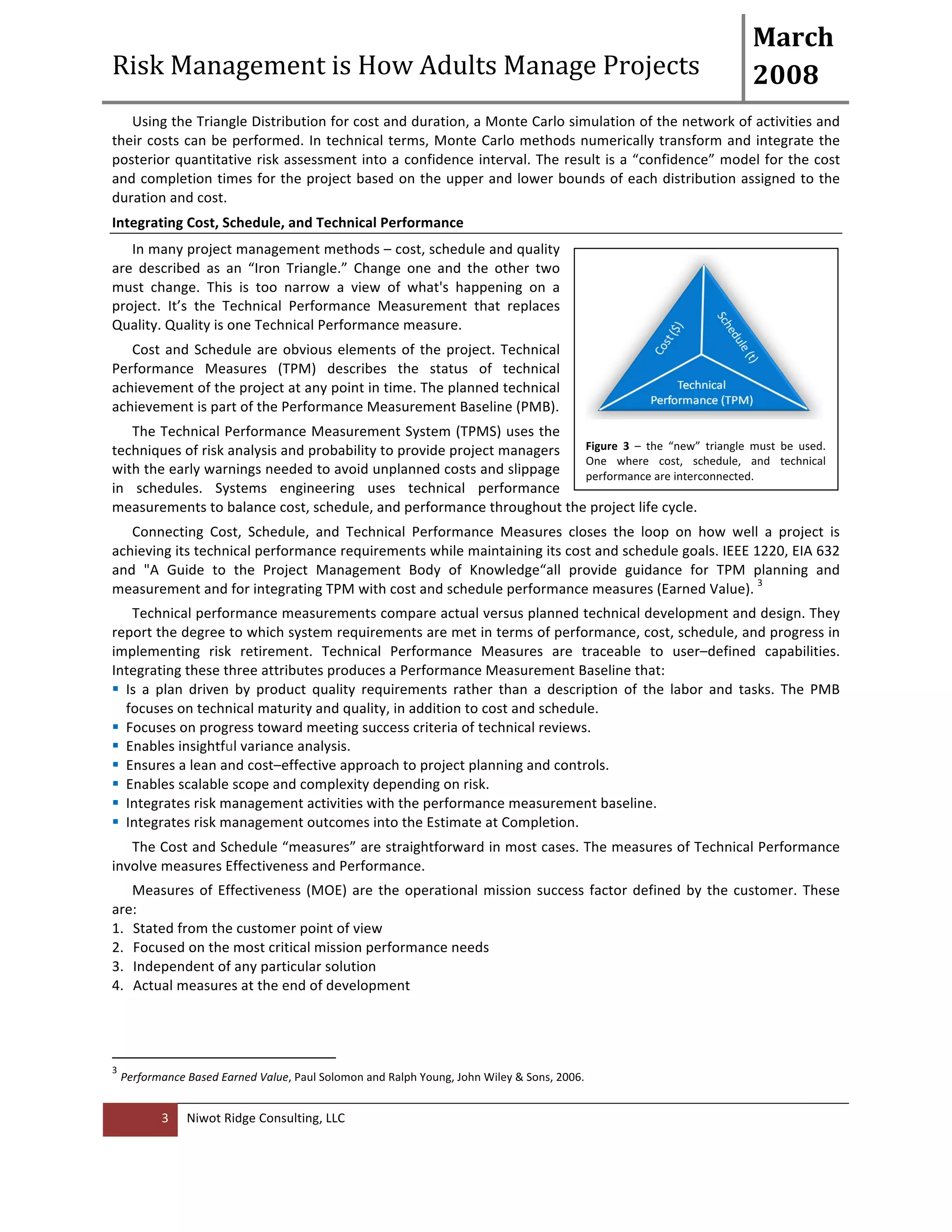
Figure 
3 
– 
the 
“new” 
triangle 
must 
be 
used. 
One 
where 
cost, 
schedule, 
and 
technical 
performance 
are 
interconnected.
Risk 
Management 
is 
How 
Adults 
Manage 
Projects 
March 
2008 
Measures 
of 
Performance 
(MOP) 
characterize 
physical 
or 
functional 
attributes 
relating 
to 
the 
system 
operation: 
5. Supplier’s 
point 
of 
view 
6. Measured 
under 
specified 
testing 
or 
operational 
conditions 
7. Assesses 
delivered 
solution 
performance 
against 
critical 
system 
level 
specified 
requirements 
8. Risk 
indicators 
that 
are 
monitored 
progressively 
Programmatic 
Risk 
Must 
Follow 
a 
Well 
Defined 
Process 
Using 
an 
ad 
hoc 
risk 
management 
process 
is 
its 
self 
risky. 
The 
first 
place 
to 
start 
to 
look 
for 
risk 
management 
processes 
is 
where 
managing 
risk 
is 
mandatory 
– 
aerospace, 
defense, 
and 
mission 
critical 
projects 
and 
projects. 
These 
also 
include 
ERP 
and 
Enterprise 
IT 
projects. 
Technical 
performance 
is 
a 
concept 
absent 
from 
the 
traditional 
approaches 
to 
risk 
management. 
Yet 
it 
is 
the 
primary 
driver 
of 
risk 
in 
many 
technology 
intensive 
projects. 
Cost 
growth 
and 
schedule 
slippage 
often 
occur 
when 
unrealistically 
high 
levels 
of 
performance 
are 
required 
and 
little 
flexibility 
is 
provided 
to 
degrade 
performance 
during 
the 
course 
of 
the 
project. 
Quality 
is 
often 
a 
cause 
rather 
than 
an 
impact 
to 
the 
project 
and 
can 
generally 
be 
broken 
down 
into 
Cost, 
Performance, 
and 
Schedule 
components. 
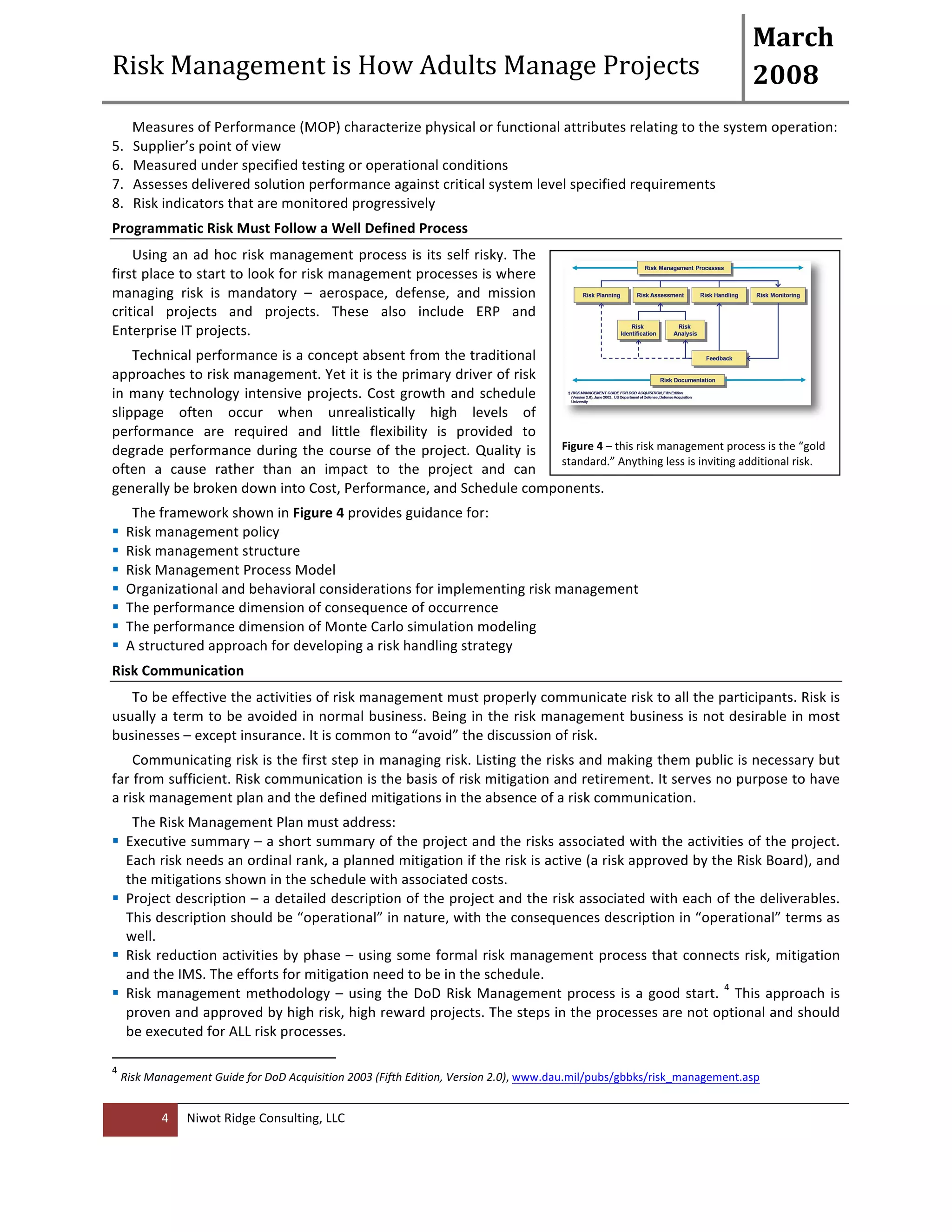
The 
framework 
shown 
in 
Figure 
4 
4 
Niwot 
Ridge 
Consulting, 
LLC 
provides 
guidance 
for: 
Figure 
4 
– 
this 
risk 
management 
process 
is 
the 
“gold 
standard.” 
Anything 
less 
is 
inviting 
additional 
risk. 
! Risk 
management 
policy 
! Risk 
management 
structure 
! Risk 
Management 
Process 
Model 
! Organizational 
and 
behavioral 
considerations 
for 
implementing 
risk 
management 
! The 
performance 
dimension 
of 
consequence 
of 
occurrence 
! The 
performance 
dimension 
of 
Monte 
Carlo 
simulation 
modeling 
! A 
structured 
approach 
for 
developing 
a 
risk 
handling 
strategy 
Risk 
Communication 
To 
be 
effective 
the 
activities 
of 
risk 
management 
must 
properly 
communicate 
risk 
to 
all 
the 
participants. 
Risk 
is 
usually 
a 
term 
to 
be 
avoided 
in 
normal 
business. 
Being 
in 
the 
risk 
management 
business 
is 
not 
desirable 
in 
most 
businesses 
– 
except 
insurance. 
It 
is 
common 
to 
“avoid” 
the 
discussion 
of 
risk. 
Communicating 
risk 
is 
the 
first 
step 
in 
managing 
risk. 
Listing 
the 
risks 
and 
making 
them 
public 
is 
necessary 
but 
far 
from 
sufficient. 
Risk 
communication 
is 
the 
basis 
of 
risk 
mitigation 
and 
retirement. 
It 
serves 
no 
purpose 
to 
have 
a 
risk 
management 
plan 
and 
the 
defined 
mitigations 
in 
the 
absence 
of 
a 
risk 
communication. 
The 
Risk 
Management 
Plan 
must 
address: 
! Executive 
summary 
– 
a 
short 
summary 
of 
the 
project 
and 
the 
risks 
associated 
with 
the 
activities 
of 
the 
project. 
Each 
risk 
needs 
an 
ordinal 
rank, 
a 
planned 
mitigation 
if 
the 
risk 
is 
active 
(a 
risk 
approved 
by 
the 
Risk 
Board), 
and 
the 
mitigations 
shown 
in 
the 
schedule 
with 
associated 
costs. 
! Project 
description 
– 
a 
detailed 
description 
of 
the 
project 
and 
the 
risk 
associated 
with 
each 
of 
the 
deliverables. 
This 
description 
should 
be 
“operational” 
in 
nature, 
with 
the 
consequences 
description 
in 
“operational” 
terms 
as 
well. 
! Risk 
reduction 
activities 
by 
phase 
– 
using 
some 
formal 
risk 
management 
process 
that 
connects 
risk, 
mitigation 
and 
the 
IMS. 
The 
efforts 
for 
mitigation 
need 
to 
be 
in 
the 
schedule. 
! Risk 
management 
methodology 
– 
using 
the 
DoD 
Risk 
Management 
process 
is 
a 
good 
start. 
4 
This 
approach 
is 
proven 
and 
approved 
by 
high 
risk, 
high 
reward 
projects. 
The 
steps 
in 
the 
processes 
are 
not 
optional 
and 
should 
be 
executed 
for 
ALL 
risk 
processes. 
4 
Risk 
Management 
Guide 
for 
DoD 
Acquisition 
2003 
(Fifth 
Edition, 
Version 
2.0), 
www.dau.mil/pubs/gbbks/risk_management.asp
Risk 
Management 
is 
How 
Adults 
Manage 
Projects 
March 
2008 
In 
order 
to 
communicate 
risk, 
a 
clear 
and 
concise 
language 
is 
needed. 
English 
is 
not 
the 
best 
choice. 
Ambiguity 
and 
interpretation 
are 
two 
issues. 
Communicating 
in 
mathematical 
terms 
is 
also 
a 
problem, 
since 
the 
symbols 
and 
units 
of 
measure 
may 
be 
confusing 
and 
foreign 
to 
some 
audiences. 
Figure 
5 
is 
from 
the 
Active 
Risk 
Manager 
5 
Niwot 
Ridge 
Consulting, 
LLC 
5 
tool 
that 
connects 
risk 
management 
with 
the 
scheduling 
system. 
ARM 
is 
a 
proprietary 
risk 
management 
system, 
but 
illustrates 
how 
risk 
is 
retired 
over 
time 
in 
accordance 
with 
a 
plan. 
The 
concept 
shows 
explicitly 
when 
each 
risk 
will 
be 
“bought 
down” 
or 
“retired” 
during 
the 
project 
execution. 
The 
Risk 
Registry 
and 
the 
Integrated 
Master 
Schedule 
must 
be 
connected 
in 
some 
way. 
Without 
this 
connection, 
there 
is 
no 
Risk 
Management 
process 
that 
can 
be 
used 
to 
forecast 
impacts 
on 
cost 
or 
schedule. 
At 
each 
project 
maturity 
point, 
current 
risks, 
the 
planned 
retirements 
of 
these 
risks, 
and 
the 
impact 
of 
the 
project 
must 
be 
visible 
in 
the 
schedule. 
With 
these 
connections, 
project 
managers 
can 
then 
answer 
the 
questions: 
! What 
happens 
if 
this 
risk 
is 
not 
mitigated? 
! What 
effort 
is 
needed 
to 
retire 
this 
risk 
before 
a 
specific 
point 
in 
time? 
! If 
this 
risk 
becomes 
an 
issue, 
what 
is 
Plan-­‐B? 
How 
much 
will 
Plan-­‐B 
cost? 
What 
is 
the 
impact 
of 
Plan-­‐B 
on 
the 
deliverables? 
! What 
cost 
and 
schedule 
reserve 
is 
needed 
to 
cover 
all 
the 
currently 
active 
risks? 
Wrap 
Up 
Once 
cost, 
schedule, 
and 
techncial 
performance 
are 
integrated 
into 
the 
Performance 
Measurement 
Baseline, 
risk 
management 
can 
be 
applied 
to 
all 
three 
elements. 
With 
these 
connections 
in 
place, 
the 
project 
management 
team 
can 
say 
with 
confidence 
– 
“we 
are 
doing 
risk 
management 
on 
this 
project.” 
The 
final 
reminder 
is 
to 
make 
sure 
that 
all 
five 
elements 
of 
risk 
management 
are 
present. 
Leaving 
one 
out 
not 
only 
reduces 
the 
effectiveness 
of 
the 
risk 
management 
process, 
but 
increases 
the 
risk 
to 
the 
project. 
Project 
risk 
management 
is 
a 
Practice. 
The 
theory 
of 
Project 
Risk 
Management 
is 
important, 
but 
the 
Practice 
is 
how 
project 
risk 
gets 
managed. 
5 
www.strategicthought.com 
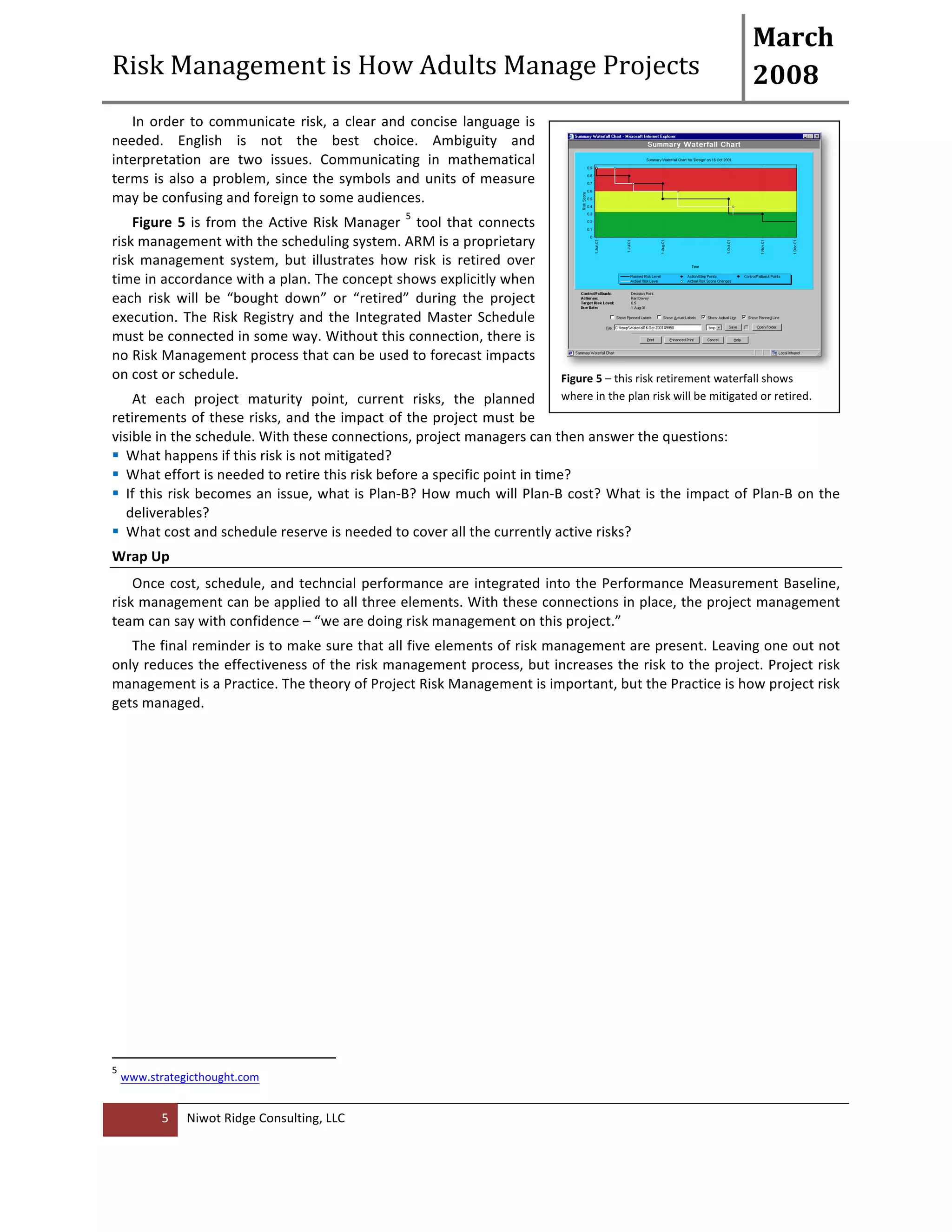
Figure 
5 
– 
this 
risk 
retirement 
waterfall 
shows 
where 
in 
the 
plan 
risk 
will 
be 
mitigated 
or 
retired.

Risk management (final review)

  • 1.
    Risk Management is How Adults Manage Projects March 2008 Risk management is essential for the success of any significant project. 1 Niwot Ridge Consulting, LLC 1 Information about key project cost, performance, and schedule attributes is often unknown until the project is underway. Risks that can be identified early in the project that impacts the project later are often termed “known unknowns.” These risks can be mitigated, reduced, or retired with a comprehensive risk management process. For risks that are beyond the vision of the project team a properly implemented risk management process can be used to rapidly quantify the risks impact and provide sound plans for mitigating its affect. Risk management is concerned with the outcomes of a future event, whose exact impacts are unknown, and with how to deal with this uncertainty. Outcomes are categorized as favorable or unfavorable. Risk management is the art and science of planning, assessing, handling, and monitoring future events to ensure favorable outcomes. A good risk management process is proactive and fundamentally different than reactive issue management or problem solving. This paper describes the fundamentals of Risk Management with 5 simple concepts: 1. Hope is not a strategy – Hoping that something positive happens will not lead to success. Preparing for success is the basis of success. 2. All single point estimates are wrong – Single point estimates of cost, schedule and technical performance are no better than 50/50 guesses in the absence of knowledge about the variances of the underlying distribution. 3. Without integrating Cost, Schedule and Technical Performance you are driving in the rearview mirror. The effort to produce the product or service and the resulting value cannot be made without making these connections. 4. Without a model for risk management, you are driving in the dark with the headlights turned off – Risk management is not an ad hoc process that you can make up as you go. A formal foundation for risk management is needed. Choose one that has worked in high-­‐risk domains – defense, nuclear power, manned spaceflight. 5. Risk Communication is everything – Identifying risks without communicating them is a waste of time. Risk management is an important skill that can be applied to a wide variety of projects. In an era of downsizing, consolidation, shrinking budgets, increasing technological sophistication, and shorter development times, risk management provides valuable insights to help key project personnel plan for risks. It alerts them of potential risk issues, which can then be analyzed, and plans developed, implemented, and monitored to address risks before they surface as issues and adversely affect project cost, performance, and schedule. Hope is Not a Strategy Hoping that the project will proceed as planned is naïve at best and poor management at worse. These same naïve project managers constantly seek ways to eliminate or control risk, variance and uncertainly. This is a hopeless pursuit. Managing “in the presence” of risk, variance and uncertainty is the key to success. Some projects have few uncertainties –only the complexity of tasks and relationships is important – but most projects are characterized by several types of uncertainty. Although each uncertainty type is distinct, a single project may encounter some combination of four types: 2 1. Variation – comes from many small influences and yields a range of values on a particular activity. Attempting to control these variances outside their natural boundaries is a waste of time. 2. Foreseen Uncertainty – are uncertainties identifiable and understood influences that the team cannot be sure will occur. There needs to be a mitigation plan for these foreseen uncertainties. 3. Unforeseen Uncertainty – is uncertainty that can’t be identified during project planning. When these occur, a new plan is needed. 4. Chaos – appears in the presence of “unknown unknowns” 1 “Risk Management during Requirements,” Tom DeMarco and Tim Lister, IEEE Software, September/October, 2003 2 “Managing Project Uncertainty: From Variation to Chaos,” Arnoud De Meyer, Christoph H. Loch and Michael T. Pich, MIT Sloan Management Review, Winter 2002
  • 2.
    Risk Management is How Adults Manage Projects March 2008 Plans are strategies for the successful completion of the project. Plans are different than schedules. Schedules show “how” the project will be executed. Plans show “what” accomplishments must be performed and the success criteria for these accomplishments along the way to completion. The Plan describes the increasing maturity of the project through “maturity assessment” points. The unit of measure for this maturity must be meaningful to the stakeholders. Something that can be connected to the investment they have made in the project. When we speak the word “Hope,” it lays the foundation for failure. In the use of Hope we really mean “success is possible but not probable.” When we speak the word “Plan,” it does not assure success, but success is a probable outcome. It is the definition of the probability of success P(s), that is the foundation of the Plan. Having a Plan–A, Plan–B and possibly a Plan–C exposes risk, assigns mitigations and measures the probability of success. The idea of a Plan as a Strategy is critical to making changes in the behavior of project teams that can then lead to “risk adjusted project management.” Without a Plan, the schedule is just a list of activities to be performed. The reason for their performance may be understood, but it is unlikely these activities fit in any cohesive Strategy. Strategies have goals, critical success factors, and key performance indicators. No Single Point Estimate of Cost, Schedule or Technical Performance Can Correct How long will this take? How much is it going to cost? What is the confidence in those two numbers? These are three questions that must be answered for the project team to have a credible discussion with the stakeholders about success. Deciding what accuracy is needed to provide a credible answer is a starting point. But that does not address the question – “how can that accuracy be obtained.” There are many check lists for estimating cost and schedule, with simple guidance on how to build estimates. Most of this advice is wrong in a fundamental way. The numbers produced by the estimating process do not have their variance defined in any statistically sound manner. By statistically sound I mean that the underlying probability distributions are known. If they are unknown, then some form of estimating taking this unknown into account must be used. The PMI advice of producing three estimates – optimistic, most likely, pessimistic is fraught with error. How are these numbers arrived at? Are they based on best engineering judgment? Based in historical data? What is the variance on the variance of this distribution – the 2nd standard deviation? The use of point estimates for duration and cost is the first approach in an organization low on the project management maturity scale. Understanding that cost and durations are actually “random variables,” drawn from an underlying distribution of possible value is the starting point for managing in the presence of uncertainty. In probability theory, every random variable is attributed to a probability distribution. The probability distribution associated with cost or duration describes the variance of these random variables. A common distribution of probabilistic estimates for cost and schedule is the Triangle Distribution. The Triangle Distribution in Figure 2 Niwot Ridge Consulting, LLC 2 can be used as a subjective description of a population for which there is only limited sample data, and especially where the relationship between variables is known but data is scarce. It is based on the knowledge of the minimum and maximum and a “best guess” of the modal value (the Most Likely). Figure 1 – The Plan for the project must assure risk is being reduced in proportion to the project’s tolerance for risk Figure 2 – triangle distributions are useful when there is limited information about the characteristics of the random variables are all that is available.
  • 3.
    Risk Management is How Adults Manage Projects March 2008 Using the Triangle Distribution for cost and duration, a Monte Carlo simulation of the network of activities and their costs can be performed. In technical terms, Monte Carlo methods numerically transform and integrate the posterior quantitative risk assessment into a confidence interval. The result is a “confidence” model for the cost and completion times for the project based on the upper and lower bounds of each distribution assigned to the duration and cost. Integrating Cost, Schedule, and Technical Performance In many project management methods – cost, schedule and quality are described as an “Iron Triangle.” Change one and the other two must change. This is too narrow a view of what's happening on a project. It’s the Technical Performance Measurement that replaces Quality. Quality is one Technical Performance measure. Cost and Schedule are obvious elements of the project. Technical Performance Measures (TPM) describes the status of technical achievement of the project at any point in time. The planned technical achievement is part of the Performance Measurement Baseline (PMB). The Technical Performance Measurement System (TPMS) uses the techniques of risk analysis and probability to provide project managers with the early warnings needed to avoid unplanned costs and slippage in schedules. Systems engineering uses technical performance measurements to balance cost, schedule, and performance throughout the project life cycle. Connecting Cost, Schedule, and Technical Performance Measures closes the loop on how well a project is achieving its technical performance requirements while maintaining its cost and schedule goals. IEEE 1220, EIA 632 and "A Guide to the Project Management Body of Knowledge“all provide guidance for TPM planning and measurement and for integrating TPM with cost and schedule performance measures (Earned Value). 3 Niwot Ridge Consulting, LLC 3 Technical performance measurements compare actual versus planned technical development and design. They report the degree to which system requirements are met in terms of performance, cost, schedule, and progress in implementing risk retirement. Technical Performance Measures are traceable to user–defined capabilities. Integrating these three attributes produces a Performance Measurement Baseline that: ! Is a plan driven by product quality requirements rather than a description of the labor and tasks. The PMB focuses on technical maturity and quality, in addition to cost and schedule. ! Focuses on progress toward meeting success criteria of technical reviews. ! Enables insightful variance analysis. ! Ensures a lean and cost–effective approach to project planning and controls. ! Enables scalable scope and complexity depending on risk. ! Integrates risk management activities with the performance measurement baseline. ! Integrates risk management outcomes into the Estimate at Completion. The Cost and Schedule “measures” are straightforward in most cases. The measures of Technical Performance involve measures Effectiveness and Performance. Measures of Effectiveness (MOE) are the operational mission success factor defined by the customer. These are: 1. Stated from the customer point of view 2. Focused on the most critical mission performance needs 3. Independent of any particular solution 4. Actual measures at the end of development 3 Performance Based Earned Value, Paul Solomon and Ralph Young, John Wiley & Sons, 2006. Figure 3 – the “new” triangle must be used. One where cost, schedule, and technical performance are interconnected.
  • 4.
    Risk Management is How Adults Manage Projects March 2008 Measures of Performance (MOP) characterize physical or functional attributes relating to the system operation: 5. Supplier’s point of view 6. Measured under specified testing or operational conditions 7. Assesses delivered solution performance against critical system level specified requirements 8. Risk indicators that are monitored progressively Programmatic Risk Must Follow a Well Defined Process Using an ad hoc risk management process is its self risky. The first place to start to look for risk management processes is where managing risk is mandatory – aerospace, defense, and mission critical projects and projects. These also include ERP and Enterprise IT projects. Technical performance is a concept absent from the traditional approaches to risk management. Yet it is the primary driver of risk in many technology intensive projects. Cost growth and schedule slippage often occur when unrealistically high levels of performance are required and little flexibility is provided to degrade performance during the course of the project. Quality is often a cause rather than an impact to the project and can generally be broken down into Cost, Performance, and Schedule components. The framework shown in Figure 4 4 Niwot Ridge Consulting, LLC provides guidance for: Figure 4 – this risk management process is the “gold standard.” Anything less is inviting additional risk. ! Risk management policy ! Risk management structure ! Risk Management Process Model ! Organizational and behavioral considerations for implementing risk management ! The performance dimension of consequence of occurrence ! The performance dimension of Monte Carlo simulation modeling ! A structured approach for developing a risk handling strategy Risk Communication To be effective the activities of risk management must properly communicate risk to all the participants. Risk is usually a term to be avoided in normal business. Being in the risk management business is not desirable in most businesses – except insurance. It is common to “avoid” the discussion of risk. Communicating risk is the first step in managing risk. Listing the risks and making them public is necessary but far from sufficient. Risk communication is the basis of risk mitigation and retirement. It serves no purpose to have a risk management plan and the defined mitigations in the absence of a risk communication. The Risk Management Plan must address: ! Executive summary – a short summary of the project and the risks associated with the activities of the project. Each risk needs an ordinal rank, a planned mitigation if the risk is active (a risk approved by the Risk Board), and the mitigations shown in the schedule with associated costs. ! Project description – a detailed description of the project and the risk associated with each of the deliverables. This description should be “operational” in nature, with the consequences description in “operational” terms as well. ! Risk reduction activities by phase – using some formal risk management process that connects risk, mitigation and the IMS. The efforts for mitigation need to be in the schedule. ! Risk management methodology – using the DoD Risk Management process is a good start. 4 This approach is proven and approved by high risk, high reward projects. The steps in the processes are not optional and should be executed for ALL risk processes. 4 Risk Management Guide for DoD Acquisition 2003 (Fifth Edition, Version 2.0), www.dau.mil/pubs/gbbks/risk_management.asp
  • 5.
    Risk Management is How Adults Manage Projects March 2008 In order to communicate risk, a clear and concise language is needed. English is not the best choice. Ambiguity and interpretation are two issues. Communicating in mathematical terms is also a problem, since the symbols and units of measure may be confusing and foreign to some audiences. Figure 5 is from the Active Risk Manager 5 Niwot Ridge Consulting, LLC 5 tool that connects risk management with the scheduling system. ARM is a proprietary risk management system, but illustrates how risk is retired over time in accordance with a plan. The concept shows explicitly when each risk will be “bought down” or “retired” during the project execution. The Risk Registry and the Integrated Master Schedule must be connected in some way. Without this connection, there is no Risk Management process that can be used to forecast impacts on cost or schedule. At each project maturity point, current risks, the planned retirements of these risks, and the impact of the project must be visible in the schedule. With these connections, project managers can then answer the questions: ! What happens if this risk is not mitigated? ! What effort is needed to retire this risk before a specific point in time? ! If this risk becomes an issue, what is Plan-­‐B? How much will Plan-­‐B cost? What is the impact of Plan-­‐B on the deliverables? ! What cost and schedule reserve is needed to cover all the currently active risks? Wrap Up Once cost, schedule, and techncial performance are integrated into the Performance Measurement Baseline, risk management can be applied to all three elements. With these connections in place, the project management team can say with confidence – “we are doing risk management on this project.” The final reminder is to make sure that all five elements of risk management are present. Leaving one out not only reduces the effectiveness of the risk management process, but increases the risk to the project. Project risk management is a Practice. The theory of Project Risk Management is important, but the Practice is how project risk gets managed. 5 www.strategicthought.com Figure 5 – this risk retirement waterfall shows where in the plan risk will be mitigated or retired.