
CAUSES OF DELAY IN
LARGE CONSTRUCTION
PROJECTS
PRESENTED BY : NASHAT AL-GHRAIRI
SUBJECT : SELECTED TOPICS IN CONSTRUCTION
MANAGEMENT
SUPERVISOR : YRD. DOÇ. DR. ASLI PELIN GURGUN
DATE : 19, APRIL 2016
INTRODUCTION
What is Project Risk?
Project risk :is defined here as an unexpected event or
circumstance that has a chance of occurring and that may
prevent a project from meeting its schedule and cost estimate.
PROJECT
• A temporary endeavour undertaken to create a
unique product or service
• A series of activities designed to achieve a specific
outcome within a set budget and timescale
PROJECT AIMS
The clearly defined deliverables, which have to
be met to fulfil a specific requirement
PROJECT MANAGEMENT
The application of knowledge, skills tools and
techniques to project activities in order to meet or
exceed stakeholder needs and expectations from a
project
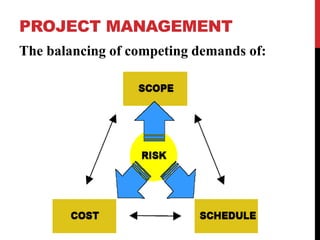
PROJECT MANAGEMENT
The balancing of competing demands of:
RISK DEFINITIONS
Risk – an uncertain event or condition that, if it
occurs, has a positive or negative affect on a project
objective
A risk has a cause and, if it occurs, has an effect.
RISK MANAGEMENT METHODOLOGY
 Risk Management Plan
 İdentification
 prioritization, assessment
 Analysis
 response planning
 tracking and control
tracking and control
There is two types of risk under tracking
and control :
 Controllable risk
 Non Controllable risk
NON CONTROLLABLE RISK
 Political risk . Due to the alterations in the laws and uncooperative
policies of the government. The important risk factors acquired from
this group are change in law and poor public decision making. The
condition of change in law occurs when the local governments are
unreliable for the application of new rules and regulations.
 Legal risk . Mainly due to the rules of the government. The significant
risk factors include changes in tax regulation. Change in tax regulation
is a situation when the local government is unreliable while applying
the tax regulation.
 Economic Risk. This risk mostly refers to the facility’s operation
which comprises of the materials supply, labor supply, equipment
availability, inflations, tariffs, fiscal policies and exchange rates. The
significant risk factor are interest rate volatility and poor finance
market. It happens when the local interest rate is unsuspected due to
the immature local economic and banking system.
NON CONTROLLABLE RISK (CON.)
 Market risk . They occur due to the demand or price for a service
which vary from the forecast levels, producing lower revenue than the
expectations of the users. The important factor is market demand. Two
possible changes may occur in the market volume: real consumer
demand may be less than the anticipated or higher consumption than
the anticipated calling for an additional capacity.
 Relationship risk .It mainly happens due to the organization,
synchronization, duties and commitment. The associated risk is a third
party tort liability. This risk factor is due to lack of experienced authority
to resolve the disputes between the public and the private partners.
NON CONTROLLABLE RISK (CON.)
 Construction risk . Due to, Unknown ground conditions, delay in the
procuring of the construction materials, and the increase in the price of
the raw materials for construction such as an increment in the price of
steel are the hitches related to the construction risk which occur during
the phase of construction, besides that construction cost overrun is also
one of the significant factors.
 Operational risk. Operation cost overrun and maintenance cost higher
than expected are significant risks in this group. It occurs due to the
higher operating and maintenance cost. During this phase there are
several associated risks. Operation cost overrun and maintenance cost
which is higher than the expected one are the significant factors in this
group.
 Climate change risk : Risks associated such as with weather
conditions can affect in project negatively and cause increase in cost
and time
CONTROLLABLE RISK
Construction delays
Design risk
New technology implementation
Poor safety procedures
Inadequate managerial skills
Improper coordination between teams
Resource risk (lack of availability of resources)
CONSTRUCTION DELAYS
Delay
Is the time overrun either beyond completion date specified in a
contract, or beyond the date that the parties agreed upon for delivery
of a project.
Delay means :
 a project slipping over its planned schedule and is considered as
common problem in construction projects.
 To the owner, loss of revenue through lack of production facilities
and rent-able space or a dependence on present facilities.
 In some cases, to the contractor, higher overhead costs because
of longer work period, higher material costs through inflation, and
due to labor cost increases.
CONSTRUCTION DELAYS(CON.)
Completing projects on time is an indicator of
efficiency, but the construction process is subject to
many variables and unpredictable factors, which result
from many sources:-
 the performance of parties
 resources availability
 environmental conditions
 involvement of other parties
 contractual relations
However, it is rarely happen that a project is completed
within the specified time.
LITERATURE REVIEW
Many articles and studies conducted on causes of delay
in construction projects and they concluded the
following:
 the delay occurred frequently in medium and large size
projects, and considered severe in small projects
 There are many important causes of delay related to
owner involvement, contractor performance, and the
early planning and design of the project
 Important causes are financial problems, changes in
the design and scope, delay in making decisions and
approvals by owner, difficulties in obtaining work
permit, and coordination and communication problems
OBJECTIVES OF THE STUDY
The main objectives of this study include
the following:
 To identify the causes of delays in construction
 To test the importance of the causes of delay
between each two groups of parties.
 To study the differences in perceptions of the
three major parties in any constructions,
namely, owners, contractors and consultants
LITERATURE REVIEW
 In Hong Kong construction projects they found
 five principal factors: poor risk management and
supervision, unforeseen site conditions, slow decision
making, client-initiated variations, and work variations.
 there was a difference in perceptions as to causes of
delays by different groups of participants in building
and civil engineering works and They suggested that
biases of different industry groups might direct blame
for delays to other groups.
LITERATURE REVIEW
 In high-rise projects in Indonesia the researchers
found out :
• that cost overruns occur more frequently and are
more severe problem than time overruns.
• the major factors influencing cost overrun are
material cost increase due to inflation, inaccurate
material estimation and degree of complexity
• While in time overrun, the most important factors
causing delays are design changes, poor labor
productivity, inadequate planning, and resource
shortages
LITERATURE REVIEW
delays in highway construction in Thailand cusses by
 all parties involved in projects; however, main causes
come from inadequacy of sub-contractors, organization
that lacks of sufficient resources, incomplete and
unclear drawings and deficiencies between consultants
and contractors
 The study suggested that delay can be minimized by
discussions that lead to understanding.
 In Jordan. The main causes of delay were related to
designer, user changes, weather, site conditions, late
deliveries, economic conditions and increase in
quantity
 on time performance of different types of construction projects in
Saudi Arabia was conducted to determine the causes of delay
and their importance according to each of the project
participants, i.e., the owner, consultant and the contractor.
 The field survey conducted included 23 contractors, 19
consultants, and 15 owners. Seventy-three causes of delay were
identified during the research.
 76% of the contractors and 56% of the consultants indicated that
average of time overrun is between 10% and 30% of the original
duration.
 The most common cause of delay identified by all the three
parties is “change order”.
 Surveys concluded that 70% of projects experienced time
overrun and found that 45 out of 76 projects considered were
delayed.
LITERATURE REVIEW
LITERATURE REVIEW
From all of this we can obtain
 the performance of contractors as one of the major
causes of delay.
 Thirteen (13) major measures were considered ,These
measures are related to contractor resources and
capabilities
 the main causes of failure in Construction industry in
Saudi Arabia by surveying 68 contractors and about
34 different causes of failure.
 The study concluded that lack of experience, poor
estimation practices, bad decisions in regulating
company’s policy, and national slump in the economy
are the severe factors
LITERATURE REVIEW
 Delays have strong relationship with failure and
ineffective performance of contractors.
 The study suggested that special attention to factors
will help industry practitioners in minimizing contract
disputes.
RESEARCH METHODOLOGY
The research methodology contained:
 Seventy-three (73) causes of delay were identified
through literature review and discussion with some
parties involved in construction industry
 A questionnaire was developed in order to evaluate the
frequency of occurrence, severity and importance of
the identified causes
 Contractors information was collected from Chamber
of Commerce and from the lists of contractors from
literature
 information about consultants and design engineers
were collected from lists of consultants found in
literature, as well as from Building & Engineering
Consultation Directory published by Engineering
Committee in the Ministry of Commerce of Saudi Arabia
RESEARCH METHODOLOGY
 Data were gathered through a survey, analyzed by
using frequency, severity and importance indices,
taking in view owners, contractors and consultants
 Agreement on the ranking of the importance of the
causes of delay between each two groups of parties
was also tested
 Recommendations for minimizing delay in construction
projects were emphasized in view of the results of the
study
QUESTIONNAIRE DESIGN
The questionnaire is divided into two main parts
 is related to general information for both the company and
respondent.
 Both contractors and consultants were further requested to
answer questions pertaining to their experience in the
construction industry and their opinions about the
percentage average time delay in projects they experienced
 Part II includes the list of the identified causes of delay in
construction project
 These causes are classified into nine (9) groups according to
the sources of delay: Factors related to project, owner,
contractor, consultant, design-team, materials, equipment,
manpower (labor), and external factors.
QUESTIONNAIRE DESIGN
For each cause/factor two questions were asked
 : What is the frequency of occurrence for this
cause?
 what is the degree of severity of this cause on
project delay
Both frequency of occurrence and severity were
categorized on a four-point scale.
Frequency of occurrence is categorized as follows:
always, often, sometimes and rarely (on 4 to 1 point
scale). Similarly, degree of severity was categorized
as follows: extreme, great, moderate and little (on 4 to
l point scale)
DATA ANALYSIS APPROACH
The collected data were analyzed through the following
statistical techniques and indices:
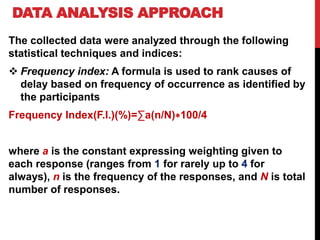
 Frequency index: A formula is used to rank causes of
delay based on frequency of occurrence as identified by
the participants
Frequency Index(F.I.)(%)=∑a(n/N)∗100/4
where a is the constant expressing weighting given to
each response (ranges from 1 for rarely up to 4 for
always), n is the frequency of the responses, and N is total
number of responses.
DATA ANALYSIS APPROACH
 Severity index: A formula is used to rank causes of delay based
on severity as indicated by the participants.
Severity Index (S.I.)(%)=∑a(n/N)∗100/4
where a is the constant expressing weighting given to each
response (ranges from I for little up to 4 for severe), n is the
frequency of the responses, and N is total number of responses.
 Importance index: The importance index of each cause is
calculated as a function of both frequency and severity indices,
as follows:
Importance Index(IMP.I.)(%)=[F.I.(%)∗S.I.(%)]/100
SPEARMAN’S RANK CORRELATION
The Spearman’s rank correlation coefficient r is used
to measure and compare the association between the
rankings of two parties for a single cause of delay,
while ignoring the ranking of the third party. And it is
calculated by the following formula
rs′=1-[(6∑d2)/(n3-n)]
where r is the Spearman rank correlation coefficient between
two parties, d is the difference between ranks assigned to
variables for each cause, and n is the number of pairs of rank
SPEARMAN’S RANK CORRELATION
Spearman’s rank correlation is a non-parametric
test.
 Non-parametric tests are also referred to as
distribution-free tests
tests have the obvious advantage of not
requiring the assumption of normality or the
assumption of homogeneity of variance
compare medians rather than means and, as a
result, if the data have one or two outliers, their
influence is negated
SPEARMAN’S RANK CORRELATION
Correlation is a relationship measure among different
parties or factors and the strength and direction of the
relationship
In this research it is used to show
 the degree of agreement between the different parties
 The correlation coefficient varies between +1 and −1,
where +1 implies a perfect positive relationship
(agreement), while −1 results from a perfect negative
relationship (disagreement)
 the sample estimates of correlation close to unity in
magnitude imply good correlation, while values near
zero indicate little or no correlation
RESEARCH FINDINGS AND RESULTS
 General characteristics of respondents
 Respondents included 23 contractors, 19 consultants and 15
owners out of 66, 51 and 27 distributed questionnaires,
respectively
 The contractors surveyed are categorized as grade 2 or above
and they have an average of experience of about 23 years,
while, participated consultants have an average of about 21
years of experience
 Simple random sampling was used to select the participants
from an available list.
 About 76% of the participating contractors specified
indicated that the average time overrun for the projects they
have experienced is between 10% and 30% of the original
project duration
RESEARCH FINDINGS AND RESULTS
 About 56% of the participated consultants specified the
same percentage
 About 25% of the consultants indicated 30–50% time overrun
compared to the original specified duration
 Neither consultants nor contractors indicated any time delay of
greater than 100% of the original contract duration
 This study covers both private and public projects and has
been chosen to be just or almost completed
 Owners who have experience with more than one
project are surveyed. The participated owners included
government departments
RESEARCH FINDINGS AND RESULTS
 Ranking of delay causes
 The three ranking indices explained earlier were used to rank
delay causes from viewpoints of the three parties (owners,
contractors and consultants).
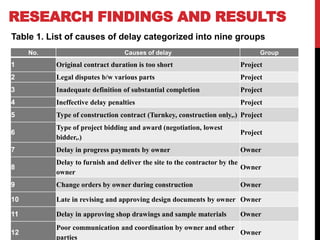
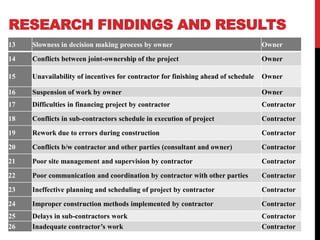
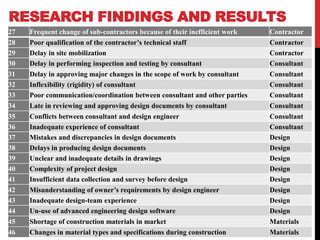
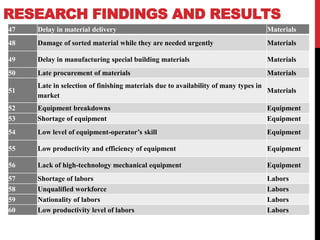
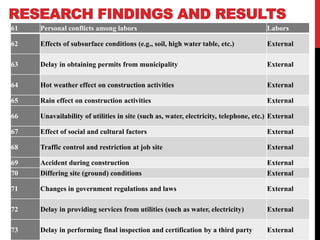
 Table 1 shows a list of causes of delay categorized into the
mentioned nine groups.
RESEARCH FINDINGS AND RESULTS
Table 1. List of causes of delay categorized into nine groups
No. Causes of delay Group
1 Original contract duration is too short Project
2 Legal disputes b/w various parts Project
3 Inadequate definition of substantial completion Project
4 Ineffective delay penalties Project
5 Type of construction contract (Turnkey, construction only,.) Project
6
Type of project bidding and award (negotiation, lowest
bidder,.)
Project
7 Delay in progress payments by owner Owner
8
Delay to furnish and deliver the site to the contractor by the
owner
Owner
9 Change orders by owner during construction Owner
10 Late in revising and approving design documents by owner Owner
11 Delay in approving shop drawings and sample materials Owner
12
Poor communication and coordination by owner and other
parties
Owner
RESEARCH FINDINGS AND RESULTS
13 Slowness in decision making process by owner Owner
14 Conflicts between joint-ownership of the project Owner
15 Unavailability of incentives for contractor for finishing ahead of schedule Owner
16 Suspension of work by owner Owner
17 Difficulties in financing project by contractor Contractor
18 Conflicts in sub-contractors schedule in execution of project Contractor
19 Rework due to errors during construction Contractor
20 Conflicts b/w contractor and other parties (consultant and owner) Contractor
21 Poor site management and supervision by contractor Contractor
22 Poor communication and coordination by contractor with other parties Contractor
23 Ineffective planning and scheduling of project by contractor Contractor
24 Improper construction methods implemented by contractor Contractor
25 Delays in sub-contractors work Contractor
26 Inadequate contractor’s work Contractor
RESEARCH FINDINGS AND RESULTS
27 Frequent change of sub-contractors because of their inefficient work Contractor
28 Poor qualification of the contractor’s technical staff Contractor
29 Delay in site mobilization Contractor
30 Delay in performing inspection and testing by consultant Consultant
31 Delay in approving major changes in the scope of work by consultant Consultant
32 Inflexibility (rigidity) of consultant Consultant
33 Poor communication/coordination between consultant and other parties Consultant
34 Late in reviewing and approving design documents by consultant Consultant
35 Conflicts between consultant and design engineer Consultant
36 Inadequate experience of consultant Consultant
37 Mistakes and discrepancies in design documents Design
38 Delays in producing design documents Design
39 Unclear and inadequate details in drawings Design
40 Complexity of project design Design
41 Insufficient data collection and survey before design Design
42 Misunderstanding of owner’s requirements by design engineer Design
43 Inadequate design-team experience Design
44 Un-use of advanced engineering design software Design
45 Shortage of construction materials in market Materials
46 Changes in material types and specifications during construction Materials
RESEARCH FINDINGS AND RESULTS
47 Delay in material delivery Materials
48 Damage of sorted material while they are needed urgently Materials
49 Delay in manufacturing special building materials Materials
50 Late procurement of materials Materials
51
Late in selection of finishing materials due to availability of many types in
market
Materials
52 Equipment breakdowns Equipment
53 Shortage of equipment Equipment
54 Low level of equipment-operator’s skill Equipment
55 Low productivity and efficiency of equipment Equipment
56 Lack of high-technology mechanical equipment Equipment
57 Shortage of labors Labors
58 Unqualified workforce Labors
59 Nationality of labors Labors
60 Low productivity level of labors Labors
RESEARCH FINDINGS AND RESULTS
61 Personal conflicts among labors Labors
62 Effects of subsurface conditions (e.g., soil, high water table, etc.) External
63 Delay in obtaining permits from municipality External
64 Hot weather effect on construction activities External
65 Rain effect on construction activities External
66 Unavailability of utilities in site (such as, water, electricity, telephone, etc.) External
67 Effect of social and cultural factors External
68 Traffic control and restriction at job site External
69 Accident during construction External
70 Differing site (ground) conditions External
71 Changes in government regulations and laws External
72 Delay in providing services from utilities (such as water, electricity) External
73 Delay in performing final inspection and certification by a third party External
RESEARCH FINDINGS AND RESULTS
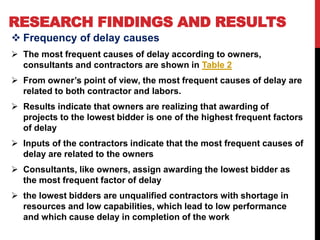
 Frequency of delay causes
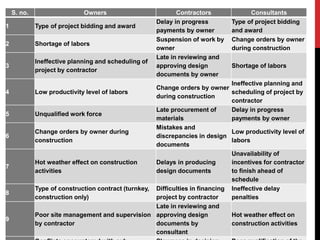
 The most frequent causes of delay according to owners,
consultants and contractors are shown in Table 2
 From owner’s point of view, the most frequent causes of delay are
related to both contractor and labors.
 Results indicate that owners are realizing that awarding of
projects to the lowest bidder is one of the highest frequent factors
of delay
 Inputs of the contractors indicate that the most frequent causes of
delay are related to the owners
 Consultants, like owners, assign awarding the lowest bidder as
the most frequent factor of delay
 the lowest bidders are unqualified contractors with shortage in
resources and low capabilities, which lead to low performance
and which cause delay in completion of the work
S. no. Owners Contractors Consultants
1 Type of project bidding and award
Delay in progress
payments by owner
Type of project bidding
and award
2 Shortage of labors
Suspension of work by
owner
Change orders by owner
during construction
3
Ineffective planning and scheduling of
project by contractor
Late in reviewing and
approving design
documents by owner
Shortage of labors
4 Low productivity level of labors
Change orders by owner
during construction
Ineffective planning and
scheduling of project by
contractor
5 Unqualified work force
Late procurement of
materials
Delay in progress
payments by owner
6
Change orders by owner during
construction
Mistakes and
discrepancies in design
documents
Low productivity level of
labors
7
Hot weather effect on construction
activities
Delays in producing
design documents
Unavailability of
incentives for contractor
to finish ahead of
schedule
8
Type of construction contract (turnkey,
construction only)
Difficulties in financing
project by contractor
Ineffective delay
penalties
9
Poor site management and supervision
by contractor
Late in reviewing and
approving design
documents by
consultant
Hot weather effect on
construction activities
RESEARCH FINDINGS AND RESULTS
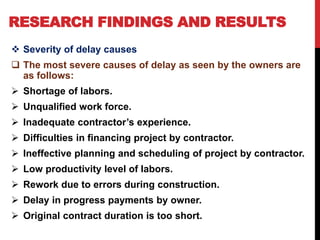
 Severity of delay causes
 The most severe causes of delay as seen by the owners are
as follows:
 Shortage of labors.
 Unqualified work force.
 Inadequate contractor’s experience.
 Difficulties in financing project by contractor.
 Ineffective planning and scheduling of project by contractor.
 Low productivity level of labors.
 Rework due to errors during construction.
 Delay in progress payments by owner.
 Original contract duration is too short.
RESEARCH FINDINGS AND RESULTS
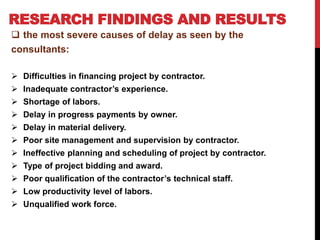
 the most severe causes of delay as seen by the
consultants:
 Difficulties in financing project by contractor.
 Inadequate contractor’s experience.
 Shortage of labors.
 Delay in progress payments by owner.
 Delay in material delivery.
 Poor site management and supervision by contractor.
 Ineffective planning and scheduling of project by contractor.
 Type of project bidding and award.
 Poor qualification of the contractor’s technical staff.
 Low productivity level of labors.
 Unqualified work force.
RESEARCH FINDINGS AND RESULTS
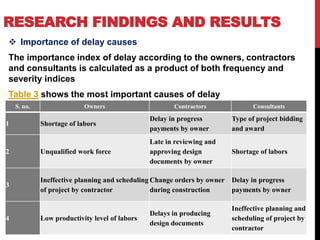
 Importance of delay causes
The importance index of delay according to the owners, contractors
and consultants is calculated as a product of both frequency and
severity indices
Table 3 shows the most important causes of delay
S. no. Owners Contractors Consultants
1 Shortage of labors
Delay in progress
payments by owner
Type of project bidding
and award
2 Unqualified work force
Late in reviewing and
approving design
documents by owner
Shortage of labors
3
Ineffective planning and scheduling
of project by contractor
Change orders by owner
during construction
Delay in progress
payments by owner
4 Low productivity level of labors
Delays in producing
design documents
Ineffective planning and
scheduling of project by
contractor
RESEARCH FINDINGS AND RESULTS
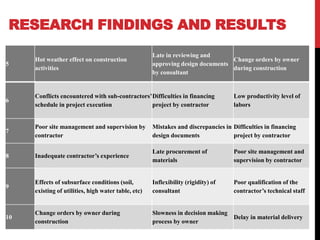
5
Hot weather effect on construction
activities
Late in reviewing and
approving design documents
by consultant
Change orders by owner
during construction
6
Conflicts encountered with sub-contractors’
schedule in project execution
Difficulties in financing
project by contractor
Low productivity level of
labors
7
Poor site management and supervision by
contractor
Mistakes and discrepancies in
design documents
Difficulties in financing
project by contractor
8 Inadequate contractor’s experience
Late procurement of
materials
Poor site management and
supervision by contractor
9
Effects of subsurface conditions (soil,
existing of utilities, high water table, etc)
Inflexibility (rigidity) of
consultant
Poor qualification of the
contractor’s technical staff
10
Change orders by owner during
construction
Slowness in decision making
process by owner
Delay in material delivery
RESEARCH FINDINGS AND RESULTS
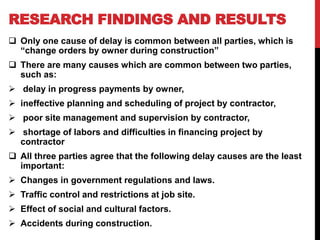
 Only one cause of delay is common between all parties, which is
“change orders by owner during construction”
 There are many causes which are common between two parties,
such as:
 delay in progress payments by owner,
 ineffective planning and scheduling of project by contractor,
 poor site management and supervision by contractor,
 shortage of labors and difficulties in financing project by
contractor
 All three parties agree that the following delay causes are the least
important:
 Changes in government regulations and laws.
 Traffic control and restrictions at job site.
 Effect of social and cultural factors.
 Accidents during construction.
RESEARCH FINDINGS AND RESULTS
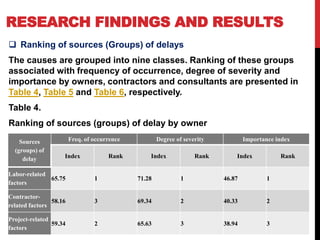
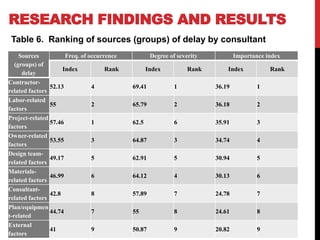
 Ranking of sources (Groups) of delays
The causes are grouped into nine classes. Ranking of these groups
associated with frequency of occurrence, degree of severity and
importance by owners, contractors and consultants are presented in
Table 4, Table 5 and Table 6, respectively.
Table 4.
Ranking of sources (groups) of delay by owner
Sources
(groups) of
delay
Freq. of occurrence Degree of severity Importance index
Index Rank Index Rank Index Rank
Labor-related
factors
65.75 1 71.28 1 46.87 1
Contractor-
related factors
58.16 3 69.34 2 40.33 2
Project-related
factors
59.34 2 65.63 3 38.94 3
RESEARCH FINDINGS AND RESULTS
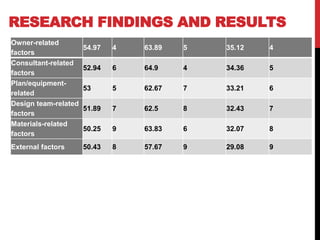
Owner-related
factors
54.97 4 63.89 5 35.12 4
Consultant-related
factors
52.94 6 64.9 4 34.36 5
Plan/equipment-
related
53 5 62.67 7 33.21 6
Design team-related
factors
51.89 7 62.5 8 32.43 7
Materials-related
factors
50.25 9 63.83 6 32.07 8
External factors 50.43 8 57.67 9 29.08 9
RESEARCH FINDINGS AND RESULTS
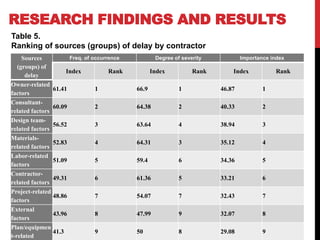
Sources
(groups) of
delay
Freq. of occurrence Degree of severity Importance index
Index Rank Index Rank Index Rank
Owner-related
factors
61.41 1 66.9 1 46.87 1
Consultant-
related factors
60.09 2 64.38 2 40.33 2
Design team-
related factors
56.52 3 63.64 4 38.94 3
Materials-
related factors
52.83 4 64.31 3 35.12 4
Labor-related
factors
51.09 5 59.4 6 34.36 5
Contractor-
related factors
49.31 6 61.36 5 33.21 6
Project-related
factors
48.86 7 54.07 7 32.43 7
External
factors
43.96 8 47.99 9 32.07 8
Plan/equipmen
t-related
41.3 9 50 8 29.08 9
Table 5.
Ranking of sources (groups) of delay by contractor
RESEARCH FINDINGS AND RESULTS
Table 6. Ranking of sources (groups) of delay by consultant
Sources
(groups) of
delay
Freq. of occurrence Degree of severity Importance index
Index Rank Index Rank Index Rank
Contractor-
related factors
52.13 4 69.41 1 36.19 1
Labor-related
factors
55 2 65.79 2 36.18 2
Project-related
factors
57.46 1 62.5 6 35.91 3
Owner-related
factors
53.55 3 64.87 3 34.74 4
Design team-
related factors
49.17 5 62.91 5 30.94 5
Materials-
related factors
46.99 6 64.12 4 30.13 6
Consultant-
related factors
42.8 8 57.89 7 24.78 7
Plan/equipmen
t-related
44.74 7 55 8 24.61 8
External
factors
41 9 50.87 9 20.82 9
RESEARCH FINDINGS AND RESULTS
 Table 4 and Table 6 show that owners and consultants
specify labor, contractor, and project related causes as
sources of delay While, contractors indicate that
sources of delay in construction projects are owners
and consultants
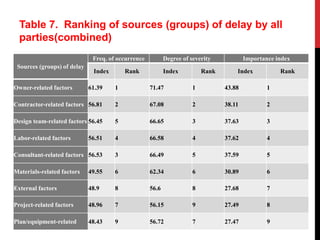
 The combined results that are presented in Table 7 show
that delay in construction projects is mostly originated
by the owner, followed by the contractor. Design, labor
and consultant related factors are less importance.
Table 7. Ranking of sources (groups) of delay by all
parties(combined)
Sources (groups) of delay
Freq. of occurrence Degree of severity Importance index
Index Rank Index Rank Index Rank
Owner-related factors 61.39 1 71.47 1 43.88 1
Contractor-related factors 56.81 2 67.08 2 38.11 2
Design team-related factors 56.45 5 66.65 3 37.63 3
Labor-related factors 56.51 4 66.58 4 37.62 4
Consultant-related factors 56.53 3 66.49 5 37.59 5
Materials-related factors 49.55 6 62.34 6 30.89 6
External factors 48.9 8 56.6 8 27.68 7
Project-related factors 48.96 7 56.15 9 27.49 8
Plan/equipment-related 48.43 9 56.72 7 27.47 9
RESEARCH FINDINGS AND RESULTS
 Importance rank correlation
 The Spearman’s rank correlation coefficient is used to
measure the degree of agreement or disagreement
associated with the importance ranking of each two parties
while ignoring the ranking of the third party
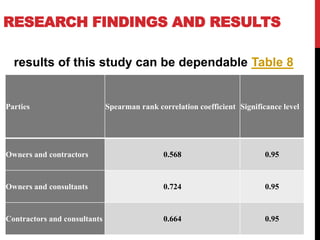
 Results show that there is relatively good agreement
between each two groups of parties in ranking delay
causes
 the highest degree of agreement (about 72.4%) between
owners and consultants,
 the lowest degree of agreement is between owners and
consultants of about 56.8%. Due to relative agreement
between each group of parties in ranking causes
RESEARCH FINDINGS AND RESULTS
results of this study can be dependable Table 8
Parties Spearman rank correlation coefficient Significance level
Owners and contractors 0.568 0.95
Owners and consultants 0.724 0.95
Contractors and consultants 0.664 0.95
SUMMARY
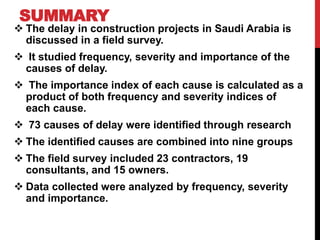
 The delay in construction projects in Saudi Arabia is
discussed in a field survey.
 It studied frequency, severity and importance of the
causes of delay.
 The importance index of each cause is calculated as a
product of both frequency and severity indices of
each cause.
 73 causes of delay were identified through research
 The identified causes are combined into nine groups
 The field survey included 23 contractors, 19
consultants, and 15 owners.
 Data collected were analyzed by frequency, severity
and importance.
CONCLUSION
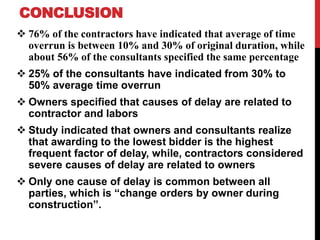
 76% of the contractors have indicated that average of time
overrun is between 10% and 30% of original duration, while
about 56% of the consultants specified the same percentage
 25% of the consultants have indicated from 30% to
50% average time overrun
 Owners specified that causes of delay are related to
contractor and labors
 Study indicated that owners and consultants realize
that awarding to the lowest bidder is the highest
frequent factor of delay, while, contractors considered
severe causes of delay are related to owners
 Only one cause of delay is common between all
parties, which is “change orders by owner during
construction”.
CONCLUSION
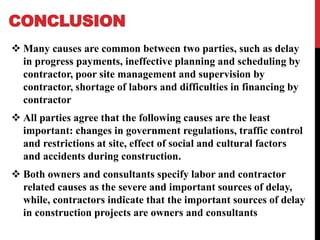
 Many causes are common between two parties, such as delay
in progress payments, ineffective planning and scheduling by
contractor, poor site management and supervision by
contractor, shortage of labors and difficulties in financing by
contractor
 All parties agree that the following causes are the least
important: changes in government regulations, traffic control
and restrictions at site, effect of social and cultural factors
and accidents during construction.
 Both owners and consultants specify labor and contractor
related causes as the severe and important sources of delay,
while, contractors indicate that the important sources of delay
in construction projects are owners and consultants
CONCLUSION
 The values of the Spearman’s rank correlation coefficients
show that there is relative good agreement between each two
groups of parties in ranking of the importance of delay causes
 The highest degree of agreement is 72.4% between owners
and consultants, while the lowest is 56.8% between owners
and contractors.
RECOMMENDATIONS
 General recommendation
The following points can be recommended by all parties in order to
minimize and control delays in construction projects:
 Owners should give special attention to the following factors:
 Pay progress payment to the contractor on time because it
impairs the contractors ability to finance the work.
 Minimize change orders during construction to avoid delays.
 Avoid delay in reviewing and approving of design documents
than the anticipated.
 Check for resources and capabilities, before awarding the
contract to the lowest bidder.
RECOMMENDATIONS
 Contractors should consider the following factors:
 Shortage and low productivity of labor: enough number of labors
should be assigned and be motivated to improve productivity.
 Financial and cash flow problems: contractor should manage his
financial resources and plan cash flow by utilizing progress
payment.
 Planning and scheduling: they are continuing processes during
construction and match with the resources and time to develop
the work to avoid cost overrun and disputes.
 Site management and supervision: administrative and technical
staff should be assigned as soon as project is awarded to make
arrangements to achieve completion within specified time with the
required quality, and estimated cost.
RECOMMENDATIONS
 Consultants should look to the following points:
 Reviewing and approving design documents: any delay caused
by the consultant engineer in checking, reviewing and
approving the design submittals prior to construction phase,
could delay the progress of the work;
 Inflexibility: Consultants should be flexible in evaluating
contractor works. Compromising between the cost and high
quality should be considered.
 Architect/design engineer should focus on the following issues:
 Producing design documents on time: A/E should set a
schedule to complete design documents on time, otherwise
result in a delay of work completion.
 Mistakes and discrepancies in design documents: They are
common reasons for redoing designs and drawings and may
take a long time to make necessary corrections.
RECOMMENDATIONS
 Recommendations for future studies
 Similar study can be performed in other provinces/cities of Saudi
Arabia
 Another study can be done for a specific type of construction
projects, such as utility projects, highways construction project,
dam construction projects, etc
 Detail studies can be done to evaluate the involvement and
effect of a specific party or resource of construction project to
the time overrun in construction projects
 A research can be carried out to investigate the effect of
financing and cash flow problems on delays in construction
projects.
REFERENCES
1- Al-Barak AA. Causes of contractors failures in Saudi Arabia. Master
thesis, CEM Dept., KFUPM. Dhahran, Saudi Arabia, 1993.
2- Al-Ghafly MA. Delays in the construction of public utility projects in
Saudi Arabia. Master thesis, CEM Dept., KFUPM, Dhahran, Saudi
Arabia, 1995.
3- Al-Momani AH. Construction delay: a quantitative analysis.
International
Journal of Project Management 2000;18(1):51–9.
4-Assaf SA, Al-Khalil M, Al-Hazmi M. Causes of delays in large
building construction projects. ASCE J Manage Eng 1995;11(2:)
45-50
5-Chan DW, Kumaraswamy MM. A comparative study of causes of
time overruns in Hong Kong construction projects. Int J Project
Manage 1997;15(1):55–63.
6-Kaming P, Olomolaiye P, Holt G, Harris F. Factors influencing
construction time and cost overruns on high-rise projects in Indonesia.
Construct Manage Econom 1997;15:83–94.
7-Kumaraswamy M, Chan D. Contributors to construction delay.
Construct Manage Econom 1998;16(1):17–29.
8-Ministry of Commerce, Building & Engineering Consultation Directory,
Issue (2000–2001), Published by Engineering Committee in the
Ministry of Commerce, Saudi Arabia.
9-Noulmanee A, Wachirathamrojn J, Tantichattanont P, Sittivijan P.
Internal causes of delays in highway construction projects in
Thailand. www.ait.c1et.com, July, 1999.
10-Ubaid AG. Factors affecting contractor performance. Master thesis,
CEM Dept., KFUPM, Dhahran, Saudi Arabia, 1991.
REFERENCES
Grimsey, D., & Lewis, M. K. (2002). “Evaluating the risks of public private
partnerships for infrastructure projects”. International Journal of Project
Management, 20(2), 107-118.
Handley-Schachler, M., & Gao,S. S.,(2003). “Can the private finance initiative
be used in emerging economies?–lessons from the UK’s successes and
failures”. ManagerialFinance, 29(5/6), 36-51.
Ibrahim, A. D., Price, A. D. F., &Dainty, A. R. J. (2006). “The analysis and
allocation of risks in public private partnerships in infrastructure projects in
Nigeria”. Journal of Financial Management of Property and Construction,
11(3), 149-164.
Jin, X. H., & Zhang, G. (2011). “Modelling optimal risk allocation in PPP
projects using artificial neural networks”.International journal of project
management, 29(5), 591-603.
Khan, A. H., Jamil, M., & Sattar, M. (2008). “The trend of build operate and
transfer (BOT) projects in Pakistan”. Construction in Developing Countries,
88.
Kangari .B. (1995), “Risk perception and tendering in construction project”, Journal of
Construction Engineering and Management, 121(4), 422–429.
Ke, Y., Wang, S., Chan, A. P., & Lam, P. T. (2010). “Preferred risk allocation in China’s public–
private partnership (PPP) projects”. International Journal of Project Management, 28(5), 482-
492.
Li .J.Zou, Cheng .H.& Dai .Z.H. (2007), “Contract conditionsof BOTprojects in China.” Proc. of
CRIOCM 2007 International Re-search Symp. OnAdvancement of Construction Management,
Sydney, Australia, 966–979.
Mahalingam, A. (2009). “PPP experiences in Indian cities: barriers, enablers, and the way
forward”. Journal of Construction Engineering and Management, 136(4), 419-429.
Santoso,D. S. &Joewono,T. B. & Wibowo A. & HarlanP.A. Sinaga4 and Santosa, W. (2012).
“Public-Private Partnerships for Tollway Construction and Operation: Risk Assessment and
Allocation from the Perspective of Investors”.Journal of Construction in Developing Countries,
17(2), 45–66.
Shen, L. Y., Platten, A., & Deng, X. P. (2006). “Role of public private partnerships to manage
risks in public sector projects in Hong Kong”. International Journal of Project Management,
24(7), 587-594.
[Xu, Y., Chan, A. P., & Yeung, J. F. (2010). “Developing a fuzzy risk allocation model for PPP
projects in China”. Journal of construction engineering and management, 136(8), 894-903.
Yelin X.,Cheng. H., &Chan P.C. (2009), “Risk Factors for Running Public Private Partnerships
(PPP)–An Empirical”, IEEE.
Zhang, X. (2005). “Paving the way for public–private partnerships in infrastructure
development”. Journal of Construction Engineering and Management,
Thank you

Risk management

  • 1.
    CAUSES OF DELAYIN LARGE CONSTRUCTION PROJECTS PRESENTED BY : NASHAT AL-GHRAIRI SUBJECT : SELECTED TOPICS IN CONSTRUCTION MANAGEMENT SUPERVISOR : YRD. DOÇ. DR. ASLI PELIN GURGUN DATE : 19, APRIL 2016
  • 2.
    INTRODUCTION What is ProjectRisk? Project risk :is defined here as an unexpected event or circumstance that has a chance of occurring and that may prevent a project from meeting its schedule and cost estimate.
  • 3.
    PROJECT • A temporaryendeavour undertaken to create a unique product or service • A series of activities designed to achieve a specific outcome within a set budget and timescale
  • 4.
    PROJECT AIMS The clearlydefined deliverables, which have to be met to fulfil a specific requirement
  • 5.
    PROJECT MANAGEMENT The applicationof knowledge, skills tools and techniques to project activities in order to meet or exceed stakeholder needs and expectations from a project
  • 6.
    PROJECT MANAGEMENT The balancingof competing demands of:
  • 7.
    RISK DEFINITIONS Risk –an uncertain event or condition that, if it occurs, has a positive or negative affect on a project objective A risk has a cause and, if it occurs, has an effect.
  • 8.
    RISK MANAGEMENT METHODOLOGY Risk Management Plan  İdentification  prioritization, assessment  Analysis  response planning  tracking and control
  • 9.
  • 10.
    tracking and control Thereis two types of risk under tracking and control :  Controllable risk  Non Controllable risk
  • 11.
    NON CONTROLLABLE RISK Political risk . Due to the alterations in the laws and uncooperative policies of the government. The important risk factors acquired from this group are change in law and poor public decision making. The condition of change in law occurs when the local governments are unreliable for the application of new rules and regulations.  Legal risk . Mainly due to the rules of the government. The significant risk factors include changes in tax regulation. Change in tax regulation is a situation when the local government is unreliable while applying the tax regulation.  Economic Risk. This risk mostly refers to the facility’s operation which comprises of the materials supply, labor supply, equipment availability, inflations, tariffs, fiscal policies and exchange rates. The significant risk factor are interest rate volatility and poor finance market. It happens when the local interest rate is unsuspected due to the immature local economic and banking system.
  • 12.
    NON CONTROLLABLE RISK(CON.)  Market risk . They occur due to the demand or price for a service which vary from the forecast levels, producing lower revenue than the expectations of the users. The important factor is market demand. Two possible changes may occur in the market volume: real consumer demand may be less than the anticipated or higher consumption than the anticipated calling for an additional capacity.  Relationship risk .It mainly happens due to the organization, synchronization, duties and commitment. The associated risk is a third party tort liability. This risk factor is due to lack of experienced authority to resolve the disputes between the public and the private partners.
  • 13.
    NON CONTROLLABLE RISK(CON.)  Construction risk . Due to, Unknown ground conditions, delay in the procuring of the construction materials, and the increase in the price of the raw materials for construction such as an increment in the price of steel are the hitches related to the construction risk which occur during the phase of construction, besides that construction cost overrun is also one of the significant factors.  Operational risk. Operation cost overrun and maintenance cost higher than expected are significant risks in this group. It occurs due to the higher operating and maintenance cost. During this phase there are several associated risks. Operation cost overrun and maintenance cost which is higher than the expected one are the significant factors in this group.  Climate change risk : Risks associated such as with weather conditions can affect in project negatively and cause increase in cost and time
  • 14.
    CONTROLLABLE RISK Construction delays Designrisk New technology implementation Poor safety procedures Inadequate managerial skills Improper coordination between teams Resource risk (lack of availability of resources)
  • 15.
    CONSTRUCTION DELAYS Delay Is thetime overrun either beyond completion date specified in a contract, or beyond the date that the parties agreed upon for delivery of a project. Delay means :  a project slipping over its planned schedule and is considered as common problem in construction projects.  To the owner, loss of revenue through lack of production facilities and rent-able space or a dependence on present facilities.  In some cases, to the contractor, higher overhead costs because of longer work period, higher material costs through inflation, and due to labor cost increases.
  • 16.
    CONSTRUCTION DELAYS(CON.) Completing projectson time is an indicator of efficiency, but the construction process is subject to many variables and unpredictable factors, which result from many sources:-  the performance of parties  resources availability  environmental conditions  involvement of other parties  contractual relations However, it is rarely happen that a project is completed within the specified time.
  • 17.
    LITERATURE REVIEW Many articlesand studies conducted on causes of delay in construction projects and they concluded the following:  the delay occurred frequently in medium and large size projects, and considered severe in small projects  There are many important causes of delay related to owner involvement, contractor performance, and the early planning and design of the project  Important causes are financial problems, changes in the design and scope, delay in making decisions and approvals by owner, difficulties in obtaining work permit, and coordination and communication problems
  • 18.
    OBJECTIVES OF THESTUDY The main objectives of this study include the following:  To identify the causes of delays in construction  To test the importance of the causes of delay between each two groups of parties.  To study the differences in perceptions of the three major parties in any constructions, namely, owners, contractors and consultants
  • 19.
    LITERATURE REVIEW  InHong Kong construction projects they found  five principal factors: poor risk management and supervision, unforeseen site conditions, slow decision making, client-initiated variations, and work variations.  there was a difference in perceptions as to causes of delays by different groups of participants in building and civil engineering works and They suggested that biases of different industry groups might direct blame for delays to other groups.
  • 20.
    LITERATURE REVIEW  Inhigh-rise projects in Indonesia the researchers found out : • that cost overruns occur more frequently and are more severe problem than time overruns. • the major factors influencing cost overrun are material cost increase due to inflation, inaccurate material estimation and degree of complexity • While in time overrun, the most important factors causing delays are design changes, poor labor productivity, inadequate planning, and resource shortages
  • 21.
    LITERATURE REVIEW delays inhighway construction in Thailand cusses by  all parties involved in projects; however, main causes come from inadequacy of sub-contractors, organization that lacks of sufficient resources, incomplete and unclear drawings and deficiencies between consultants and contractors  The study suggested that delay can be minimized by discussions that lead to understanding.  In Jordan. The main causes of delay were related to designer, user changes, weather, site conditions, late deliveries, economic conditions and increase in quantity
  • 22.
     on timeperformance of different types of construction projects in Saudi Arabia was conducted to determine the causes of delay and their importance according to each of the project participants, i.e., the owner, consultant and the contractor.  The field survey conducted included 23 contractors, 19 consultants, and 15 owners. Seventy-three causes of delay were identified during the research.  76% of the contractors and 56% of the consultants indicated that average of time overrun is between 10% and 30% of the original duration.  The most common cause of delay identified by all the three parties is “change order”.  Surveys concluded that 70% of projects experienced time overrun and found that 45 out of 76 projects considered were delayed. LITERATURE REVIEW
  • 23.
    LITERATURE REVIEW From allof this we can obtain  the performance of contractors as one of the major causes of delay.  Thirteen (13) major measures were considered ,These measures are related to contractor resources and capabilities  the main causes of failure in Construction industry in Saudi Arabia by surveying 68 contractors and about 34 different causes of failure.  The study concluded that lack of experience, poor estimation practices, bad decisions in regulating company’s policy, and national slump in the economy are the severe factors
  • 24.
    LITERATURE REVIEW  Delayshave strong relationship with failure and ineffective performance of contractors.  The study suggested that special attention to factors will help industry practitioners in minimizing contract disputes.
  • 25.
    RESEARCH METHODOLOGY The researchmethodology contained:  Seventy-three (73) causes of delay were identified through literature review and discussion with some parties involved in construction industry  A questionnaire was developed in order to evaluate the frequency of occurrence, severity and importance of the identified causes  Contractors information was collected from Chamber of Commerce and from the lists of contractors from literature  information about consultants and design engineers were collected from lists of consultants found in literature, as well as from Building & Engineering Consultation Directory published by Engineering Committee in the Ministry of Commerce of Saudi Arabia
  • 26.
    RESEARCH METHODOLOGY  Datawere gathered through a survey, analyzed by using frequency, severity and importance indices, taking in view owners, contractors and consultants  Agreement on the ranking of the importance of the causes of delay between each two groups of parties was also tested  Recommendations for minimizing delay in construction projects were emphasized in view of the results of the study
  • 27.
    QUESTIONNAIRE DESIGN The questionnaireis divided into two main parts  is related to general information for both the company and respondent.  Both contractors and consultants were further requested to answer questions pertaining to their experience in the construction industry and their opinions about the percentage average time delay in projects they experienced  Part II includes the list of the identified causes of delay in construction project  These causes are classified into nine (9) groups according to the sources of delay: Factors related to project, owner, contractor, consultant, design-team, materials, equipment, manpower (labor), and external factors.
  • 28.
    QUESTIONNAIRE DESIGN For eachcause/factor two questions were asked  : What is the frequency of occurrence for this cause?  what is the degree of severity of this cause on project delay Both frequency of occurrence and severity were categorized on a four-point scale. Frequency of occurrence is categorized as follows: always, often, sometimes and rarely (on 4 to 1 point scale). Similarly, degree of severity was categorized as follows: extreme, great, moderate and little (on 4 to l point scale)
  • 29.
    DATA ANALYSIS APPROACH Thecollected data were analyzed through the following statistical techniques and indices:  Frequency index: A formula is used to rank causes of delay based on frequency of occurrence as identified by the participants Frequency Index(F.I.)(%)=∑a(n/N)∗100/4 where a is the constant expressing weighting given to each response (ranges from 1 for rarely up to 4 for always), n is the frequency of the responses, and N is total number of responses.
  • 30.
    DATA ANALYSIS APPROACH Severity index: A formula is used to rank causes of delay based on severity as indicated by the participants. Severity Index (S.I.)(%)=∑a(n/N)∗100/4 where a is the constant expressing weighting given to each response (ranges from I for little up to 4 for severe), n is the frequency of the responses, and N is total number of responses.  Importance index: The importance index of each cause is calculated as a function of both frequency and severity indices, as follows: Importance Index(IMP.I.)(%)=[F.I.(%)∗S.I.(%)]/100
  • 31.
    SPEARMAN’S RANK CORRELATION TheSpearman’s rank correlation coefficient r is used to measure and compare the association between the rankings of two parties for a single cause of delay, while ignoring the ranking of the third party. And it is calculated by the following formula rs′=1-[(6∑d2)/(n3-n)] where r is the Spearman rank correlation coefficient between two parties, d is the difference between ranks assigned to variables for each cause, and n is the number of pairs of rank
  • 32.
    SPEARMAN’S RANK CORRELATION Spearman’srank correlation is a non-parametric test.  Non-parametric tests are also referred to as distribution-free tests tests have the obvious advantage of not requiring the assumption of normality or the assumption of homogeneity of variance compare medians rather than means and, as a result, if the data have one or two outliers, their influence is negated
  • 33.
    SPEARMAN’S RANK CORRELATION Correlationis a relationship measure among different parties or factors and the strength and direction of the relationship In this research it is used to show  the degree of agreement between the different parties  The correlation coefficient varies between +1 and −1, where +1 implies a perfect positive relationship (agreement), while −1 results from a perfect negative relationship (disagreement)  the sample estimates of correlation close to unity in magnitude imply good correlation, while values near zero indicate little or no correlation
  • 34.
    RESEARCH FINDINGS ANDRESULTS  General characteristics of respondents  Respondents included 23 contractors, 19 consultants and 15 owners out of 66, 51 and 27 distributed questionnaires, respectively  The contractors surveyed are categorized as grade 2 or above and they have an average of experience of about 23 years, while, participated consultants have an average of about 21 years of experience  Simple random sampling was used to select the participants from an available list.  About 76% of the participating contractors specified indicated that the average time overrun for the projects they have experienced is between 10% and 30% of the original project duration
  • 35.
    RESEARCH FINDINGS ANDRESULTS  About 56% of the participated consultants specified the same percentage  About 25% of the consultants indicated 30–50% time overrun compared to the original specified duration  Neither consultants nor contractors indicated any time delay of greater than 100% of the original contract duration  This study covers both private and public projects and has been chosen to be just or almost completed  Owners who have experience with more than one project are surveyed. The participated owners included government departments
  • 36.
    RESEARCH FINDINGS ANDRESULTS  Ranking of delay causes  The three ranking indices explained earlier were used to rank delay causes from viewpoints of the three parties (owners, contractors and consultants).  Table 1 shows a list of causes of delay categorized into the mentioned nine groups.
  • 37.
    RESEARCH FINDINGS ANDRESULTS Table 1. List of causes of delay categorized into nine groups No. Causes of delay Group 1 Original contract duration is too short Project 2 Legal disputes b/w various parts Project 3 Inadequate definition of substantial completion Project 4 Ineffective delay penalties Project 5 Type of construction contract (Turnkey, construction only,.) Project 6 Type of project bidding and award (negotiation, lowest bidder,.) Project 7 Delay in progress payments by owner Owner 8 Delay to furnish and deliver the site to the contractor by the owner Owner 9 Change orders by owner during construction Owner 10 Late in revising and approving design documents by owner Owner 11 Delay in approving shop drawings and sample materials Owner 12 Poor communication and coordination by owner and other parties Owner
  • 38.
    RESEARCH FINDINGS ANDRESULTS 13 Slowness in decision making process by owner Owner 14 Conflicts between joint-ownership of the project Owner 15 Unavailability of incentives for contractor for finishing ahead of schedule Owner 16 Suspension of work by owner Owner 17 Difficulties in financing project by contractor Contractor 18 Conflicts in sub-contractors schedule in execution of project Contractor 19 Rework due to errors during construction Contractor 20 Conflicts b/w contractor and other parties (consultant and owner) Contractor 21 Poor site management and supervision by contractor Contractor 22 Poor communication and coordination by contractor with other parties Contractor 23 Ineffective planning and scheduling of project by contractor Contractor 24 Improper construction methods implemented by contractor Contractor 25 Delays in sub-contractors work Contractor 26 Inadequate contractor’s work Contractor
  • 39.
    RESEARCH FINDINGS ANDRESULTS 27 Frequent change of sub-contractors because of their inefficient work Contractor 28 Poor qualification of the contractor’s technical staff Contractor 29 Delay in site mobilization Contractor 30 Delay in performing inspection and testing by consultant Consultant 31 Delay in approving major changes in the scope of work by consultant Consultant 32 Inflexibility (rigidity) of consultant Consultant 33 Poor communication/coordination between consultant and other parties Consultant 34 Late in reviewing and approving design documents by consultant Consultant 35 Conflicts between consultant and design engineer Consultant 36 Inadequate experience of consultant Consultant 37 Mistakes and discrepancies in design documents Design 38 Delays in producing design documents Design 39 Unclear and inadequate details in drawings Design 40 Complexity of project design Design 41 Insufficient data collection and survey before design Design 42 Misunderstanding of owner’s requirements by design engineer Design 43 Inadequate design-team experience Design 44 Un-use of advanced engineering design software Design 45 Shortage of construction materials in market Materials 46 Changes in material types and specifications during construction Materials
  • 40.
    RESEARCH FINDINGS ANDRESULTS 47 Delay in material delivery Materials 48 Damage of sorted material while they are needed urgently Materials 49 Delay in manufacturing special building materials Materials 50 Late procurement of materials Materials 51 Late in selection of finishing materials due to availability of many types in market Materials 52 Equipment breakdowns Equipment 53 Shortage of equipment Equipment 54 Low level of equipment-operator’s skill Equipment 55 Low productivity and efficiency of equipment Equipment 56 Lack of high-technology mechanical equipment Equipment 57 Shortage of labors Labors 58 Unqualified workforce Labors 59 Nationality of labors Labors 60 Low productivity level of labors Labors
  • 41.
    RESEARCH FINDINGS ANDRESULTS 61 Personal conflicts among labors Labors 62 Effects of subsurface conditions (e.g., soil, high water table, etc.) External 63 Delay in obtaining permits from municipality External 64 Hot weather effect on construction activities External 65 Rain effect on construction activities External 66 Unavailability of utilities in site (such as, water, electricity, telephone, etc.) External 67 Effect of social and cultural factors External 68 Traffic control and restriction at job site External 69 Accident during construction External 70 Differing site (ground) conditions External 71 Changes in government regulations and laws External 72 Delay in providing services from utilities (such as water, electricity) External 73 Delay in performing final inspection and certification by a third party External
  • 42.
    RESEARCH FINDINGS ANDRESULTS  Frequency of delay causes  The most frequent causes of delay according to owners, consultants and contractors are shown in Table 2  From owner’s point of view, the most frequent causes of delay are related to both contractor and labors.  Results indicate that owners are realizing that awarding of projects to the lowest bidder is one of the highest frequent factors of delay  Inputs of the contractors indicate that the most frequent causes of delay are related to the owners  Consultants, like owners, assign awarding the lowest bidder as the most frequent factor of delay  the lowest bidders are unqualified contractors with shortage in resources and low capabilities, which lead to low performance and which cause delay in completion of the work
  • 43.
    S. no. OwnersContractors Consultants 1 Type of project bidding and award Delay in progress payments by owner Type of project bidding and award 2 Shortage of labors Suspension of work by owner Change orders by owner during construction 3 Ineffective planning and scheduling of project by contractor Late in reviewing and approving design documents by owner Shortage of labors 4 Low productivity level of labors Change orders by owner during construction Ineffective planning and scheduling of project by contractor 5 Unqualified work force Late procurement of materials Delay in progress payments by owner 6 Change orders by owner during construction Mistakes and discrepancies in design documents Low productivity level of labors 7 Hot weather effect on construction activities Delays in producing design documents Unavailability of incentives for contractor to finish ahead of schedule 8 Type of construction contract (turnkey, construction only) Difficulties in financing project by contractor Ineffective delay penalties 9 Poor site management and supervision by contractor Late in reviewing and approving design documents by consultant Hot weather effect on construction activities
  • 44.
    RESEARCH FINDINGS ANDRESULTS  Severity of delay causes  The most severe causes of delay as seen by the owners are as follows:  Shortage of labors.  Unqualified work force.  Inadequate contractor’s experience.  Difficulties in financing project by contractor.  Ineffective planning and scheduling of project by contractor.  Low productivity level of labors.  Rework due to errors during construction.  Delay in progress payments by owner.  Original contract duration is too short.
  • 45.
    RESEARCH FINDINGS ANDRESULTS  the most severe causes of delay as seen by the consultants:  Difficulties in financing project by contractor.  Inadequate contractor’s experience.  Shortage of labors.  Delay in progress payments by owner.  Delay in material delivery.  Poor site management and supervision by contractor.  Ineffective planning and scheduling of project by contractor.  Type of project bidding and award.  Poor qualification of the contractor’s technical staff.  Low productivity level of labors.  Unqualified work force.
  • 46.
    RESEARCH FINDINGS ANDRESULTS  Importance of delay causes The importance index of delay according to the owners, contractors and consultants is calculated as a product of both frequency and severity indices Table 3 shows the most important causes of delay S. no. Owners Contractors Consultants 1 Shortage of labors Delay in progress payments by owner Type of project bidding and award 2 Unqualified work force Late in reviewing and approving design documents by owner Shortage of labors 3 Ineffective planning and scheduling of project by contractor Change orders by owner during construction Delay in progress payments by owner 4 Low productivity level of labors Delays in producing design documents Ineffective planning and scheduling of project by contractor
  • 47.
    RESEARCH FINDINGS ANDRESULTS 5 Hot weather effect on construction activities Late in reviewing and approving design documents by consultant Change orders by owner during construction 6 Conflicts encountered with sub-contractors’ schedule in project execution Difficulties in financing project by contractor Low productivity level of labors 7 Poor site management and supervision by contractor Mistakes and discrepancies in design documents Difficulties in financing project by contractor 8 Inadequate contractor’s experience Late procurement of materials Poor site management and supervision by contractor 9 Effects of subsurface conditions (soil, existing of utilities, high water table, etc) Inflexibility (rigidity) of consultant Poor qualification of the contractor’s technical staff 10 Change orders by owner during construction Slowness in decision making process by owner Delay in material delivery
  • 48.
    RESEARCH FINDINGS ANDRESULTS  Only one cause of delay is common between all parties, which is “change orders by owner during construction”  There are many causes which are common between two parties, such as:  delay in progress payments by owner,  ineffective planning and scheduling of project by contractor,  poor site management and supervision by contractor,  shortage of labors and difficulties in financing project by contractor  All three parties agree that the following delay causes are the least important:  Changes in government regulations and laws.  Traffic control and restrictions at job site.  Effect of social and cultural factors.  Accidents during construction.
  • 49.
    RESEARCH FINDINGS ANDRESULTS  Ranking of sources (Groups) of delays The causes are grouped into nine classes. Ranking of these groups associated with frequency of occurrence, degree of severity and importance by owners, contractors and consultants are presented in Table 4, Table 5 and Table 6, respectively. Table 4. Ranking of sources (groups) of delay by owner Sources (groups) of delay Freq. of occurrence Degree of severity Importance index Index Rank Index Rank Index Rank Labor-related factors 65.75 1 71.28 1 46.87 1 Contractor- related factors 58.16 3 69.34 2 40.33 2 Project-related factors 59.34 2 65.63 3 38.94 3
  • 50.
    RESEARCH FINDINGS ANDRESULTS Owner-related factors 54.97 4 63.89 5 35.12 4 Consultant-related factors 52.94 6 64.9 4 34.36 5 Plan/equipment- related 53 5 62.67 7 33.21 6 Design team-related factors 51.89 7 62.5 8 32.43 7 Materials-related factors 50.25 9 63.83 6 32.07 8 External factors 50.43 8 57.67 9 29.08 9
  • 51.
    RESEARCH FINDINGS ANDRESULTS Sources (groups) of delay Freq. of occurrence Degree of severity Importance index Index Rank Index Rank Index Rank Owner-related factors 61.41 1 66.9 1 46.87 1 Consultant- related factors 60.09 2 64.38 2 40.33 2 Design team- related factors 56.52 3 63.64 4 38.94 3 Materials- related factors 52.83 4 64.31 3 35.12 4 Labor-related factors 51.09 5 59.4 6 34.36 5 Contractor- related factors 49.31 6 61.36 5 33.21 6 Project-related factors 48.86 7 54.07 7 32.43 7 External factors 43.96 8 47.99 9 32.07 8 Plan/equipmen t-related 41.3 9 50 8 29.08 9 Table 5. Ranking of sources (groups) of delay by contractor
  • 52.
    RESEARCH FINDINGS ANDRESULTS Table 6. Ranking of sources (groups) of delay by consultant Sources (groups) of delay Freq. of occurrence Degree of severity Importance index Index Rank Index Rank Index Rank Contractor- related factors 52.13 4 69.41 1 36.19 1 Labor-related factors 55 2 65.79 2 36.18 2 Project-related factors 57.46 1 62.5 6 35.91 3 Owner-related factors 53.55 3 64.87 3 34.74 4 Design team- related factors 49.17 5 62.91 5 30.94 5 Materials- related factors 46.99 6 64.12 4 30.13 6 Consultant- related factors 42.8 8 57.89 7 24.78 7 Plan/equipmen t-related 44.74 7 55 8 24.61 8 External factors 41 9 50.87 9 20.82 9
  • 53.
    RESEARCH FINDINGS ANDRESULTS  Table 4 and Table 6 show that owners and consultants specify labor, contractor, and project related causes as sources of delay While, contractors indicate that sources of delay in construction projects are owners and consultants  The combined results that are presented in Table 7 show that delay in construction projects is mostly originated by the owner, followed by the contractor. Design, labor and consultant related factors are less importance.
  • 54.
    Table 7. Rankingof sources (groups) of delay by all parties(combined) Sources (groups) of delay Freq. of occurrence Degree of severity Importance index Index Rank Index Rank Index Rank Owner-related factors 61.39 1 71.47 1 43.88 1 Contractor-related factors 56.81 2 67.08 2 38.11 2 Design team-related factors 56.45 5 66.65 3 37.63 3 Labor-related factors 56.51 4 66.58 4 37.62 4 Consultant-related factors 56.53 3 66.49 5 37.59 5 Materials-related factors 49.55 6 62.34 6 30.89 6 External factors 48.9 8 56.6 8 27.68 7 Project-related factors 48.96 7 56.15 9 27.49 8 Plan/equipment-related 48.43 9 56.72 7 27.47 9
  • 55.
    RESEARCH FINDINGS ANDRESULTS  Importance rank correlation  The Spearman’s rank correlation coefficient is used to measure the degree of agreement or disagreement associated with the importance ranking of each two parties while ignoring the ranking of the third party  Results show that there is relatively good agreement between each two groups of parties in ranking delay causes  the highest degree of agreement (about 72.4%) between owners and consultants,  the lowest degree of agreement is between owners and consultants of about 56.8%. Due to relative agreement between each group of parties in ranking causes
  • 56.
    RESEARCH FINDINGS ANDRESULTS results of this study can be dependable Table 8 Parties Spearman rank correlation coefficient Significance level Owners and contractors 0.568 0.95 Owners and consultants 0.724 0.95 Contractors and consultants 0.664 0.95
  • 57.
    SUMMARY  The delayin construction projects in Saudi Arabia is discussed in a field survey.  It studied frequency, severity and importance of the causes of delay.  The importance index of each cause is calculated as a product of both frequency and severity indices of each cause.  73 causes of delay were identified through research  The identified causes are combined into nine groups  The field survey included 23 contractors, 19 consultants, and 15 owners.  Data collected were analyzed by frequency, severity and importance.
  • 58.
    CONCLUSION  76% ofthe contractors have indicated that average of time overrun is between 10% and 30% of original duration, while about 56% of the consultants specified the same percentage  25% of the consultants have indicated from 30% to 50% average time overrun  Owners specified that causes of delay are related to contractor and labors  Study indicated that owners and consultants realize that awarding to the lowest bidder is the highest frequent factor of delay, while, contractors considered severe causes of delay are related to owners  Only one cause of delay is common between all parties, which is “change orders by owner during construction”.
  • 59.
    CONCLUSION  Many causesare common between two parties, such as delay in progress payments, ineffective planning and scheduling by contractor, poor site management and supervision by contractor, shortage of labors and difficulties in financing by contractor  All parties agree that the following causes are the least important: changes in government regulations, traffic control and restrictions at site, effect of social and cultural factors and accidents during construction.  Both owners and consultants specify labor and contractor related causes as the severe and important sources of delay, while, contractors indicate that the important sources of delay in construction projects are owners and consultants
  • 60.
    CONCLUSION  The valuesof the Spearman’s rank correlation coefficients show that there is relative good agreement between each two groups of parties in ranking of the importance of delay causes  The highest degree of agreement is 72.4% between owners and consultants, while the lowest is 56.8% between owners and contractors.
  • 61.
    RECOMMENDATIONS  General recommendation Thefollowing points can be recommended by all parties in order to minimize and control delays in construction projects:  Owners should give special attention to the following factors:  Pay progress payment to the contractor on time because it impairs the contractors ability to finance the work.  Minimize change orders during construction to avoid delays.  Avoid delay in reviewing and approving of design documents than the anticipated.  Check for resources and capabilities, before awarding the contract to the lowest bidder.
  • 62.
    RECOMMENDATIONS  Contractors shouldconsider the following factors:  Shortage and low productivity of labor: enough number of labors should be assigned and be motivated to improve productivity.  Financial and cash flow problems: contractor should manage his financial resources and plan cash flow by utilizing progress payment.  Planning and scheduling: they are continuing processes during construction and match with the resources and time to develop the work to avoid cost overrun and disputes.  Site management and supervision: administrative and technical staff should be assigned as soon as project is awarded to make arrangements to achieve completion within specified time with the required quality, and estimated cost.
  • 63.
    RECOMMENDATIONS  Consultants shouldlook to the following points:  Reviewing and approving design documents: any delay caused by the consultant engineer in checking, reviewing and approving the design submittals prior to construction phase, could delay the progress of the work;  Inflexibility: Consultants should be flexible in evaluating contractor works. Compromising between the cost and high quality should be considered.  Architect/design engineer should focus on the following issues:  Producing design documents on time: A/E should set a schedule to complete design documents on time, otherwise result in a delay of work completion.  Mistakes and discrepancies in design documents: They are common reasons for redoing designs and drawings and may take a long time to make necessary corrections.
  • 64.
    RECOMMENDATIONS  Recommendations forfuture studies  Similar study can be performed in other provinces/cities of Saudi Arabia  Another study can be done for a specific type of construction projects, such as utility projects, highways construction project, dam construction projects, etc  Detail studies can be done to evaluate the involvement and effect of a specific party or resource of construction project to the time overrun in construction projects  A research can be carried out to investigate the effect of financing and cash flow problems on delays in construction projects.
  • 65.
    REFERENCES 1- Al-Barak AA.Causes of contractors failures in Saudi Arabia. Master thesis, CEM Dept., KFUPM. Dhahran, Saudi Arabia, 1993. 2- Al-Ghafly MA. Delays in the construction of public utility projects in Saudi Arabia. Master thesis, CEM Dept., KFUPM, Dhahran, Saudi Arabia, 1995. 3- Al-Momani AH. Construction delay: a quantitative analysis. International Journal of Project Management 2000;18(1):51–9. 4-Assaf SA, Al-Khalil M, Al-Hazmi M. Causes of delays in large building construction projects. ASCE J Manage Eng 1995;11(2:) 45-50 5-Chan DW, Kumaraswamy MM. A comparative study of causes of time overruns in Hong Kong construction projects. Int J Project Manage 1997;15(1):55–63.
  • 66.
    6-Kaming P, OlomolaiyeP, Holt G, Harris F. Factors influencing construction time and cost overruns on high-rise projects in Indonesia. Construct Manage Econom 1997;15:83–94. 7-Kumaraswamy M, Chan D. Contributors to construction delay. Construct Manage Econom 1998;16(1):17–29. 8-Ministry of Commerce, Building & Engineering Consultation Directory, Issue (2000–2001), Published by Engineering Committee in the Ministry of Commerce, Saudi Arabia. 9-Noulmanee A, Wachirathamrojn J, Tantichattanont P, Sittivijan P. Internal causes of delays in highway construction projects in Thailand. www.ait.c1et.com, July, 1999. 10-Ubaid AG. Factors affecting contractor performance. Master thesis, CEM Dept., KFUPM, Dhahran, Saudi Arabia, 1991. REFERENCES
  • 67.
    Grimsey, D., &Lewis, M. K. (2002). “Evaluating the risks of public private partnerships for infrastructure projects”. International Journal of Project Management, 20(2), 107-118. Handley-Schachler, M., & Gao,S. S.,(2003). “Can the private finance initiative be used in emerging economies?–lessons from the UK’s successes and failures”. ManagerialFinance, 29(5/6), 36-51. Ibrahim, A. D., Price, A. D. F., &Dainty, A. R. J. (2006). “The analysis and allocation of risks in public private partnerships in infrastructure projects in Nigeria”. Journal of Financial Management of Property and Construction, 11(3), 149-164. Jin, X. H., & Zhang, G. (2011). “Modelling optimal risk allocation in PPP projects using artificial neural networks”.International journal of project management, 29(5), 591-603. Khan, A. H., Jamil, M., & Sattar, M. (2008). “The trend of build operate and transfer (BOT) projects in Pakistan”. Construction in Developing Countries, 88.
  • 68.
    Kangari .B. (1995),“Risk perception and tendering in construction project”, Journal of Construction Engineering and Management, 121(4), 422–429. Ke, Y., Wang, S., Chan, A. P., & Lam, P. T. (2010). “Preferred risk allocation in China’s public– private partnership (PPP) projects”. International Journal of Project Management, 28(5), 482- 492. Li .J.Zou, Cheng .H.& Dai .Z.H. (2007), “Contract conditionsof BOTprojects in China.” Proc. of CRIOCM 2007 International Re-search Symp. OnAdvancement of Construction Management, Sydney, Australia, 966–979. Mahalingam, A. (2009). “PPP experiences in Indian cities: barriers, enablers, and the way forward”. Journal of Construction Engineering and Management, 136(4), 419-429. Santoso,D. S. &Joewono,T. B. & Wibowo A. & HarlanP.A. Sinaga4 and Santosa, W. (2012). “Public-Private Partnerships for Tollway Construction and Operation: Risk Assessment and Allocation from the Perspective of Investors”.Journal of Construction in Developing Countries, 17(2), 45–66. Shen, L. Y., Platten, A., & Deng, X. P. (2006). “Role of public private partnerships to manage risks in public sector projects in Hong Kong”. International Journal of Project Management, 24(7), 587-594. [Xu, Y., Chan, A. P., & Yeung, J. F. (2010). “Developing a fuzzy risk allocation model for PPP projects in China”. Journal of construction engineering and management, 136(8), 894-903. Yelin X.,Cheng. H., &Chan P.C. (2009), “Risk Factors for Running Public Private Partnerships (PPP)–An Empirical”, IEEE. Zhang, X. (2005). “Paving the way for public–private partnerships in infrastructure development”. Journal of Construction Engineering and Management,
  • 69.