Risk Management as an
enabler for project success
1
Edwina Hayward
BMT Hi-Q Sigma Ltd
Presentation Agenda
2
 The Risk Management Process
 The Benefits
 Summary
Risk Management Definition
 What is Risk Management
– Risk Management is a process that allows individual risk events and
over all risk to be understood and managed proactively, optimising
success by minimizing threats and maximising opportunities
APM BoK
 What is a risk?
– An uncertain event or condition that, if it occurs, has a positive
(opportunity) or negative (threat) effect on a project objective.
3
What is needed to deliver the benefits
 Decide the approach
 Integrating the process into the project environment
– Including within the controls framework
 Selecting the right tools and techniques
 Considering roles & responsibilities
 Embed in to the culture
 Monitor progress and forecast the future
 Inform and assist decision making
 Monitor effectiveness of the risk process
What is required?
5
Before starting ANY risk management activity you need to have a clear
understanding of the following:
• What is the aim of the project?
• It’s objectives
• What Assumptions have been made about the project?
• What dependencies does the project have?
• What is the deterministic schedule?
It is a cyclical process as risks and assumptions become better understood
they are used to inform the deterministic baseline
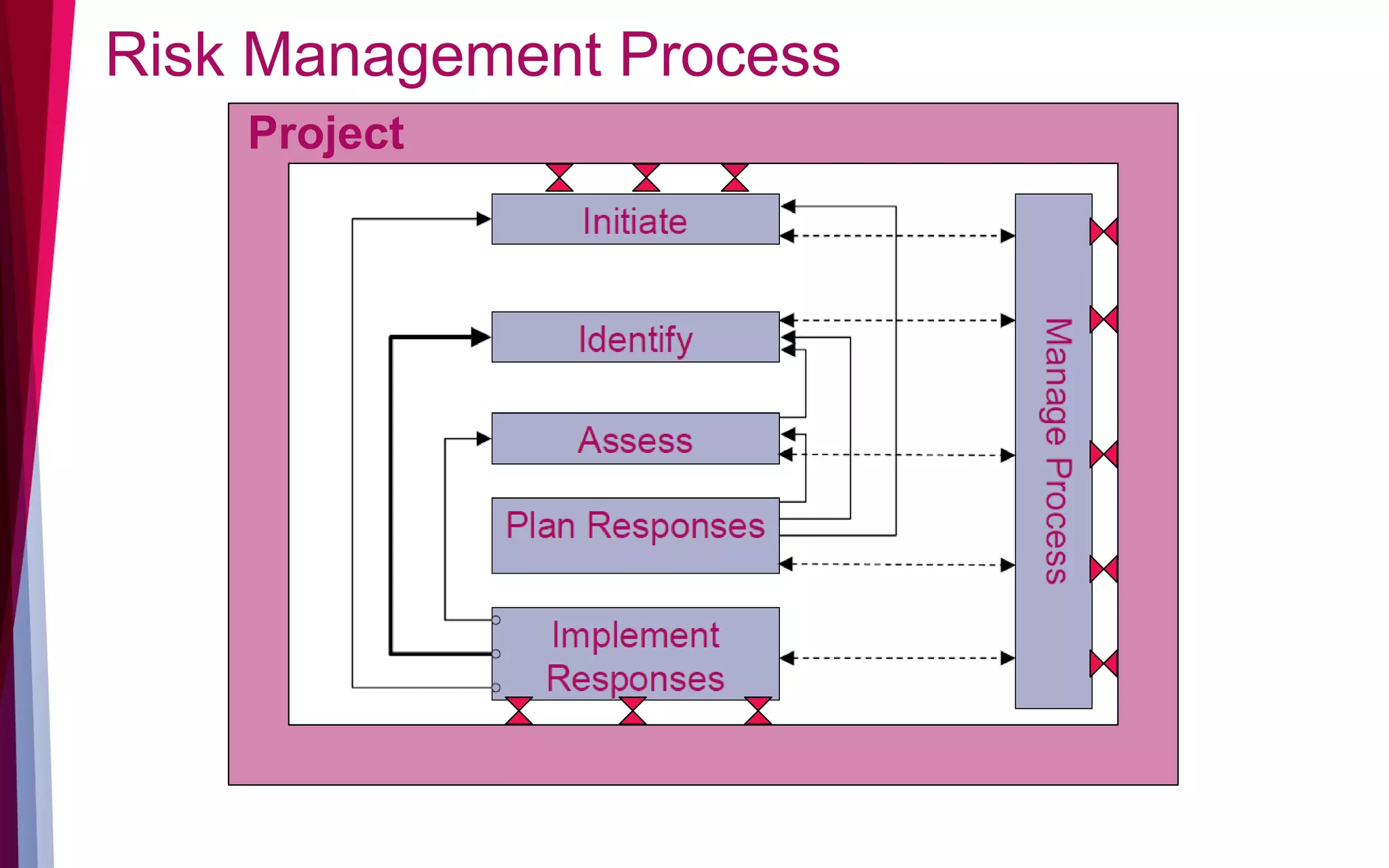
Project
Risk Management Process
Identify
When you have a clear understanding of the certainties and uncertainties of
your project ask yourself:
1. What might cause a delay?
2. What might cost more?
3. What could cause performance to be compromised?
7
Is my risk really a risk?
It’s easy to lose genuine risks in amongst these:
 Descriptions of estimating uncertainty – “this activity may take longer
than planned, we just aren’t sure”
 Events which are already issues – “this has happened or will definitely
happen, we need to manage the impact”
 Activities which should be normal business – “there is a risk that we
don’t undertake an activity adequately”
Is my risk really a risk?
It’s also easy to get the components of a risk in the wrong boxes –
“there is a risk that Contract Placement will be delayed”
this is the impact, what are the underlying circumstances and risk events
which lead to this?
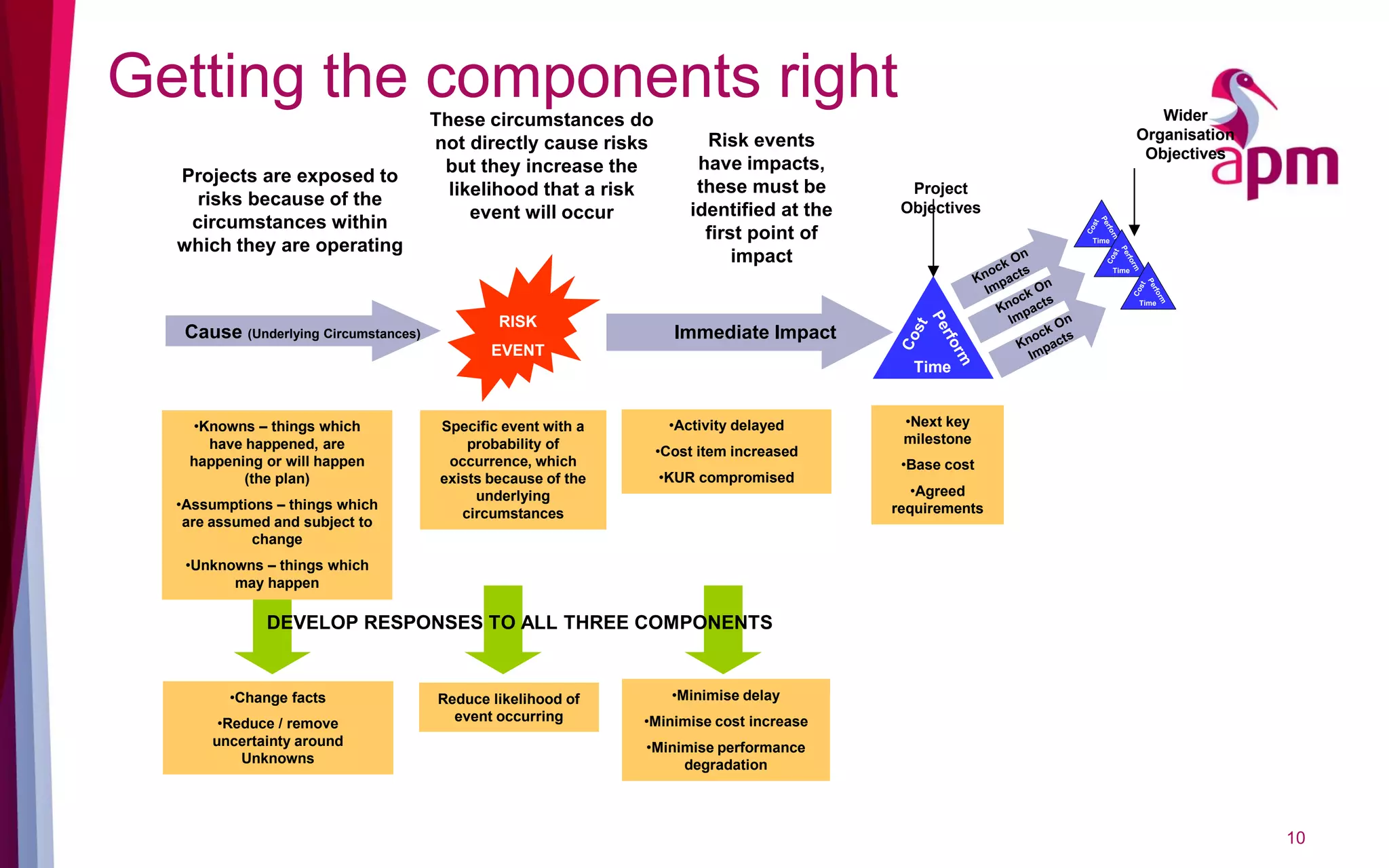
Getting the components right
10
Cost
Time
PerformCost
Time
Perform
Cost
Time
Perform
Wider
Organisation
Objectives
Time
Project
Objectives
•Next key
milestone
•Base cost
•Agreed
requirements
•Change facts
•Reduce / remove
uncertainty around
Unknowns
Reduce likelihood of
event occurring
•Minimise delay
•Minimise cost increase
•Minimise performance
degradation
DEVELOP RESPONSES TO ALL THREE COMPONENTS
Cause (Underlying Circumstances)
•Knowns – things which
have happened, are
happening or will happen
(the plan)
•Assumptions – things which
are assumed and subject to
change
•Unknowns – things which
may happen
Projects are exposed to
risks because of the
circumstances within
which they are operating
RISK
EVENT
Specific event with a
probability of
occurrence, which
exists because of the
underlying
circumstances
These circumstances do
not directly cause risks
but they increase the
likelihood that a risk
event will occur
Immediate Impact
•Activity delayed
•Cost item increased
•KUR compromised
Risk events
have impacts,
these must be
identified at the
first point of
impact
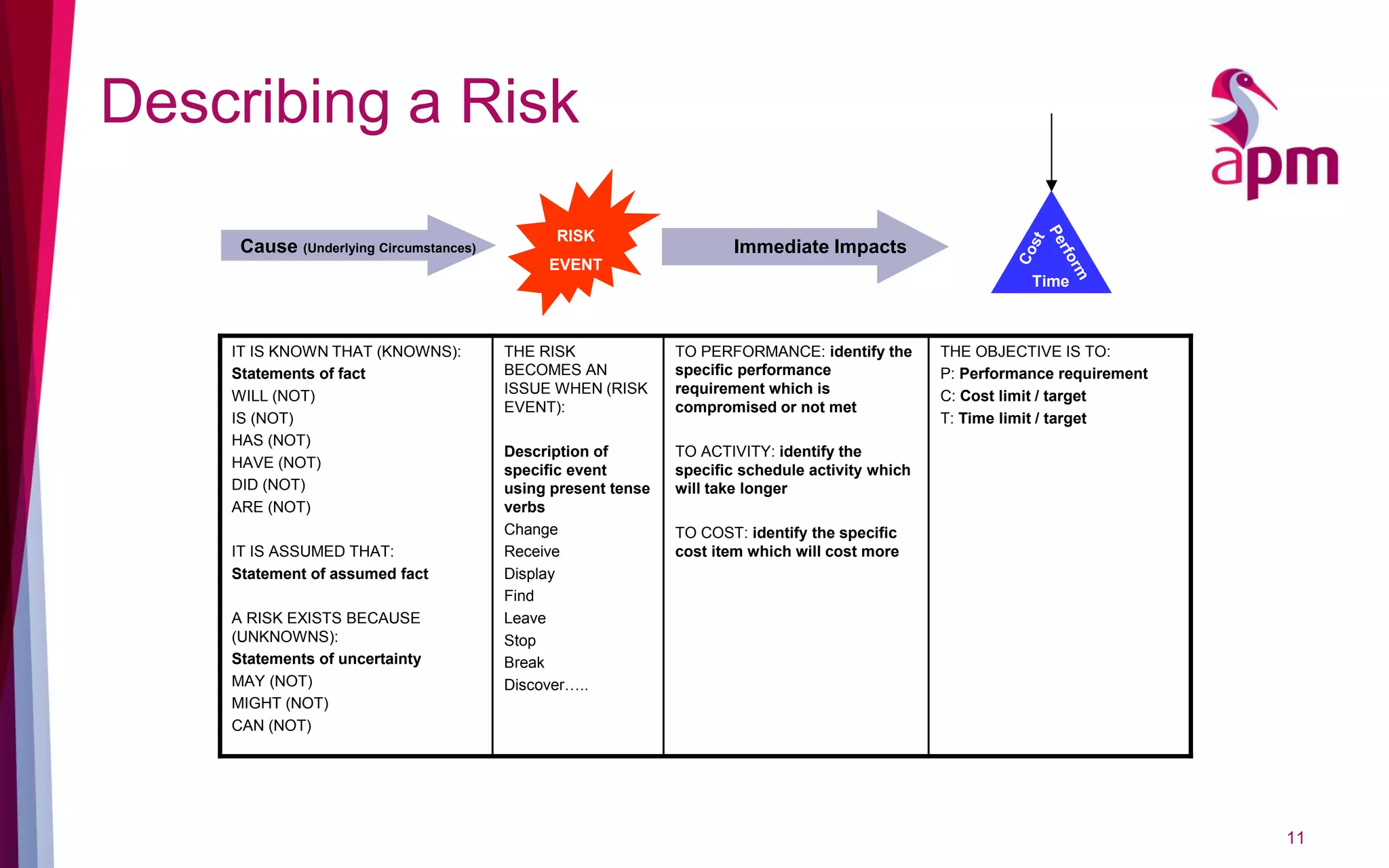
Describing a Risk
11
Time
Cause (Underlying Circumstances)
RISK
EVENT
Immediate Impacts
IT IS KNOWN THAT (KNOWNS):
Statements of fact
WILL (NOT)
IS (NOT)
HAS (NOT)
HAVE (NOT)
DID (NOT)
ARE (NOT)
IT IS ASSUMED THAT:
Statement of assumed fact
A RISK EXISTS BECAUSE
(UNKNOWNS):
Statements of uncertainty
MAY (NOT)
MIGHT (NOT)
CAN (NOT)
THE RISK
BECOMES AN
ISSUE WHEN (RISK
EVENT):
Description of
specific event
using present tense
verbs
Change
Receive
Display
Find
Leave
Stop
Break
Discover…..
TO PERFORMANCE: identify the
specific performance
requirement which is
compromised or not met
TO ACTIVITY: identify the
specific schedule activity which
will take longer
TO COST: identify the specific
cost item which will cost more
THE OBJECTIVE IS TO:
P: Performance requirement
C: Cost limit / target
T: Time limit / target
Assessing a Risk
 Getting the best information
– Getting the right stakeholders involved
– Use historical Information
– Re-assess regularly based on latest
understanding
12
Plan and Implement Responses
 Ensure that responses are identified,
captured and resources
 Regular review to update on progress and
feedback to re-assessment of the risk
 Decisions can be made on effectiveness of
responses
13
Undertake Analysis
 Undertaking Cost and Schedule Analysis
– Helps to identify the likely outcome to the
objectives
 Informs Decision Making
 Manages expectations
14
Manage and monitor progress
 Aim to answer key questions:
– Are the responses being implemented?
– Are they being effective?
– Is the level of risk as expected?
 Control mechanisms:
– Risk documentation and training
– Risk reviews held regularly, with the correct stakeholders and
integrated with project reviews
– Responses are scheduled and are being executed
– Consumption of risk reserve
Reporting and communicating progress
 Why are we communicating?
– Need the right information to the right people at the right time to make
the right decision.
– Pitch at the right level
– Use language everyone will be familiar with.
 What are we Reporting?
– Need to ensure the key messages come across
– Need to understand what the priorities are
– What is urgent and what is important
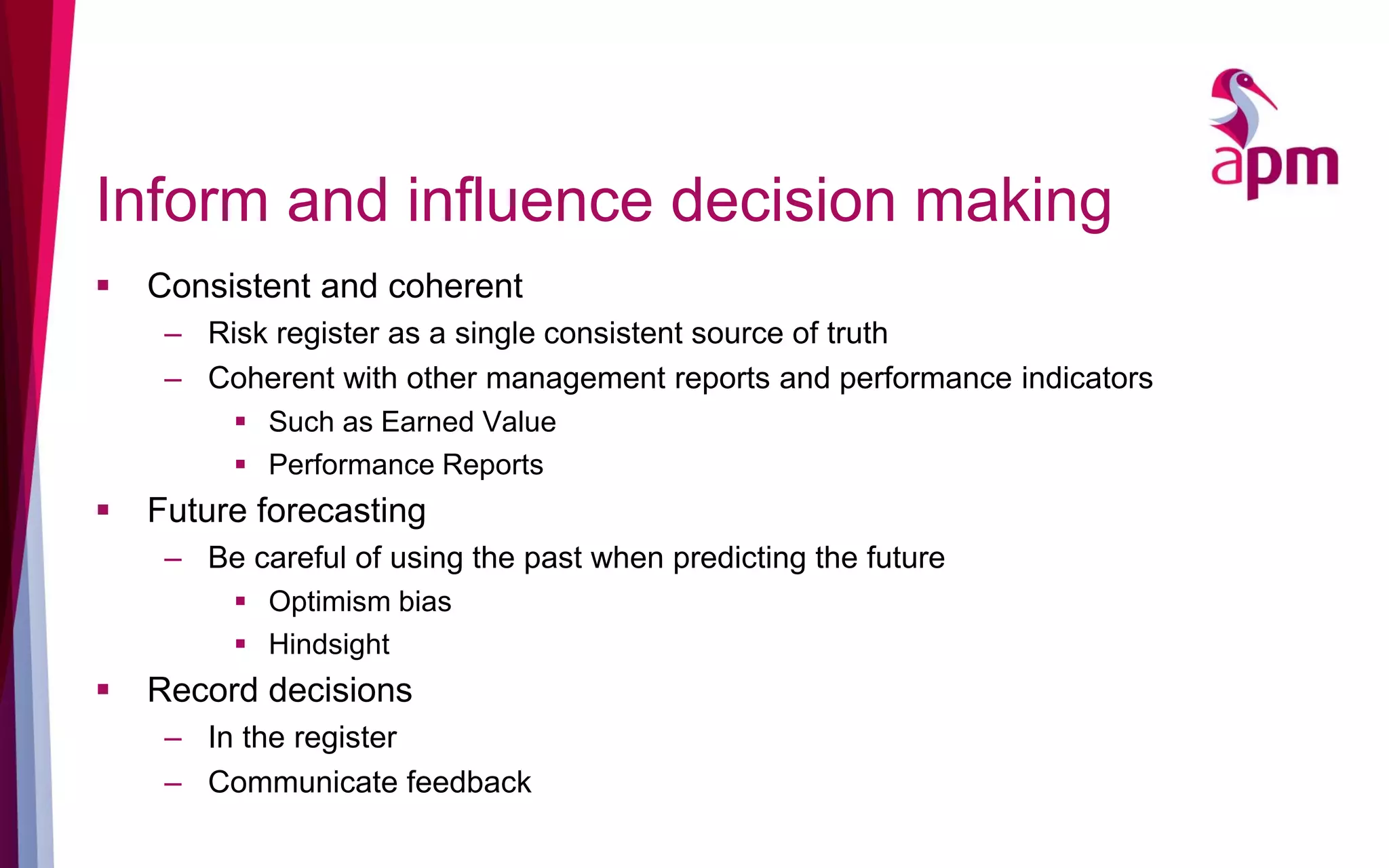
Inform and influence decision making
 Consistent and coherent
– Risk register as a single consistent source of truth
– Coherent with other management reports and performance indicators
 Such as Earned Value
 Performance Reports
 Future forecasting
– Be careful of using the past when predicting the future
 Optimism bias
 Hindsight
 Record decisions
– In the register
– Communicate feedback
Quiz Q1
 What is a risk?
 (A) – Something which may cause the project to be delayed, to
cost more and / or deliver less
 (B) – An uncertain event or condition that, if it occurs, has a
positive or negative effect on an objective
 (C) – An event which has happened, or is very likely to happen
which will have a negative effect on an objective
18
A1
 What is a risk?
 (A) – Something which may cause the project to be delayed, to cost
more and / or deliver less
 (B) – An uncertain event or condition that, if it occurs, has a
positive or negative effect on an objective
 (C) – An event which has happened, or is very likely to happen
which will have a negative effect on an objective
 (A) is too broad a definition and could cover other sources of estimating uncertainty, it
also focuses on the negative effects of risk
 (C) is describing an ISSUE
19
Q2
 How does an opportunity differ from a risk?
 (A) – Opportunities result in a positive outcome for the project,
risks result in a negative outcome
 (B) – Opportunities result in a positive outcome for the project,
they are a type of risk
20
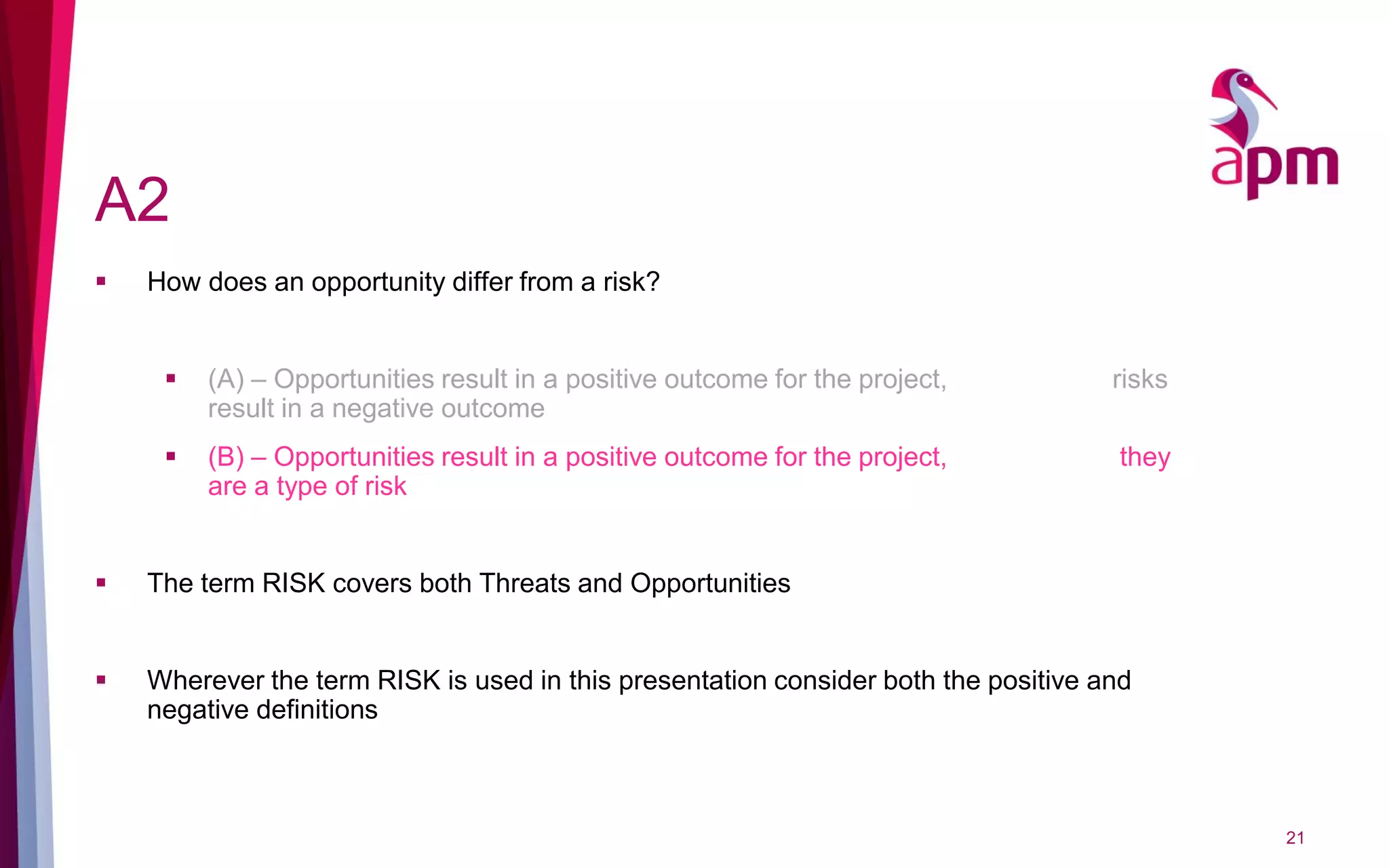
A2
 How does an opportunity differ from a risk?
 (A) – Opportunities result in a positive outcome for the project, risks
result in a negative outcome
 (B) – Opportunities result in a positive outcome for the project, they
are a type of risk
 The term RISK covers both Threats and Opportunities
 Wherever the term RISK is used in this presentation consider both the positive and
negative definitions
21
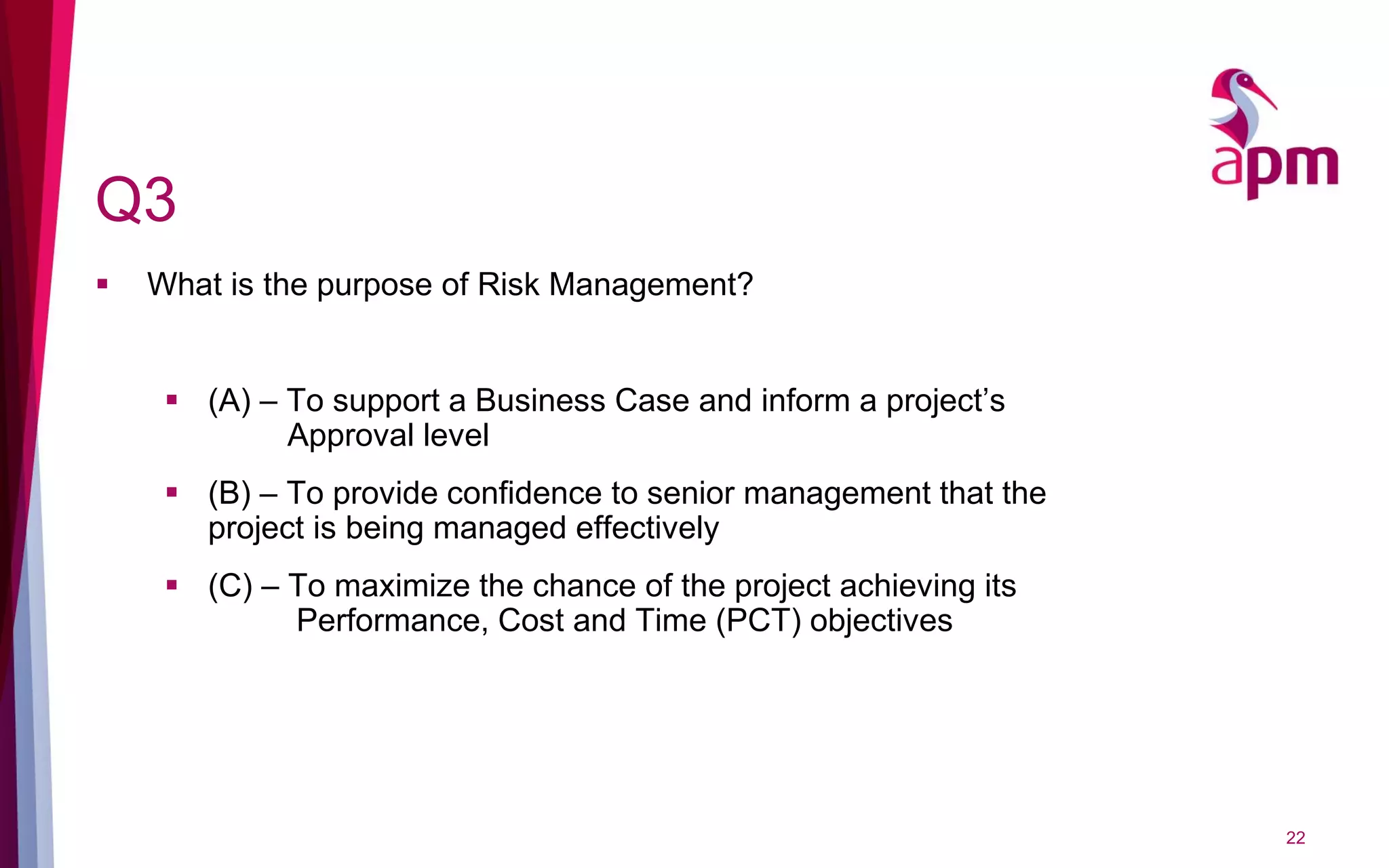
Q3
 What is the purpose of Risk Management?
 (A) – To support a Business Case and inform a project’s
Approval level
 (B) – To provide confidence to senior management that the
project is being managed effectively
 (C) – To maximize the chance of the project achieving its
Performance, Cost and Time (PCT) objectives
22
A3
 What is the purpose of Risk Management?
 (A) – To support a Business Case and inform a project’s
Approval level
 (B) – To provide confidence to senior management that the project is being
managed effectively
 (C) – To maximize the chance of the project achieving its
Performance, Cost and Time (PCT) objectives
 (A) and (B) are important but do not describe the overarching purpose of risk
management
 Having an awareness of the factors which increase the riskiness of your project;
factors which reduce your confidence in project delivery
 Identifying the things that may happen in the future and doing something about them
today 23
Q4
 “There is a risk that it will take longer than planned to achieve Business
Case Approval” – is this a risk?
 (A) – Yes
 (B) – Possibly
 (C) – No
24
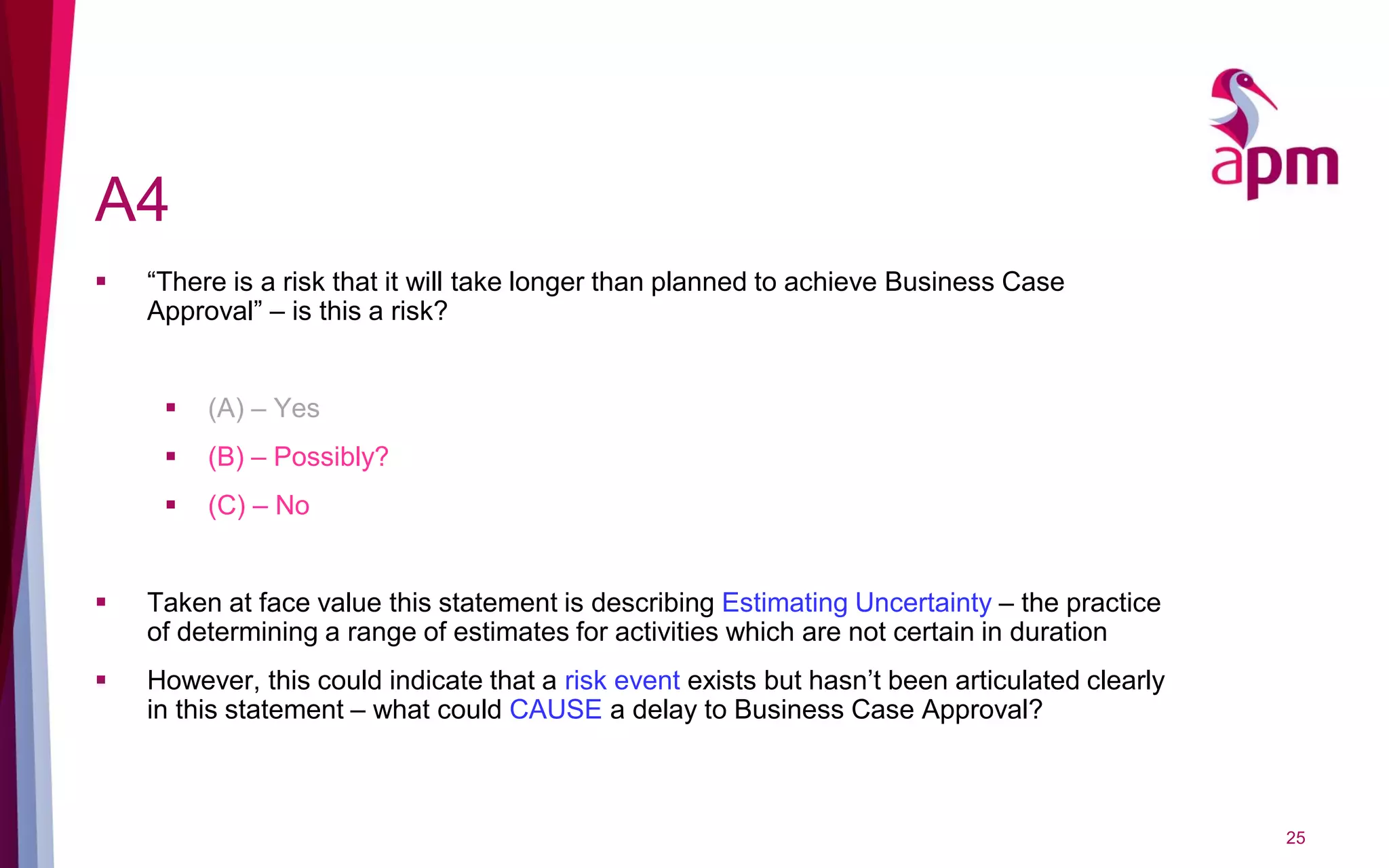
A4
 “There is a risk that it will take longer than planned to achieve Business Case
Approval” – is this a risk?
 (A) – Yes
 (B) – Possibly?
 (C) – No
 Taken at face value this statement is describing Estimating Uncertainty – the practice
of determining a range of estimates for activities which are not certain in duration
 However, this could indicate that a risk event exists but hasn’t been articulated clearly
in this statement – what could CAUSE a delay to Business Case Approval?
25
Summary
 Why undertake Risk Management
– Aid decision making
– Effectively manage risks
 Leads to project success
26
Thank you
Edwina Hayward
BMT Hi-Q Sigma Ltd
Berkeley House
The Square
Lower Bristol Road
Bath, BA2 3BH
United Kingdom
Edwina.hayward@hiqsigma.com
www.hiqsigma.com
Tel: +44 (0) 1225 820980
Fax: +44 (0) 1225 820981
Mob: +44 (0) 7834 254297
Questions?
28

Risk Management as an enabler for project success

  • 1.
    Risk Management asan enabler for project success 1 Edwina Hayward BMT Hi-Q Sigma Ltd
  • 2.
    Presentation Agenda 2  TheRisk Management Process  The Benefits  Summary
  • 3.
    Risk Management Definition What is Risk Management – Risk Management is a process that allows individual risk events and over all risk to be understood and managed proactively, optimising success by minimizing threats and maximising opportunities APM BoK  What is a risk? – An uncertain event or condition that, if it occurs, has a positive (opportunity) or negative (threat) effect on a project objective. 3
  • 4.
    What is neededto deliver the benefits  Decide the approach  Integrating the process into the project environment – Including within the controls framework  Selecting the right tools and techniques  Considering roles & responsibilities  Embed in to the culture  Monitor progress and forecast the future  Inform and assist decision making  Monitor effectiveness of the risk process
  • 5.
    What is required? 5 Beforestarting ANY risk management activity you need to have a clear understanding of the following: • What is the aim of the project? • It’s objectives • What Assumptions have been made about the project? • What dependencies does the project have? • What is the deterministic schedule? It is a cyclical process as risks and assumptions become better understood they are used to inform the deterministic baseline
  • 6.
  • 7.
    Identify When you havea clear understanding of the certainties and uncertainties of your project ask yourself: 1. What might cause a delay? 2. What might cost more? 3. What could cause performance to be compromised? 7
  • 8.
    Is my riskreally a risk? It’s easy to lose genuine risks in amongst these:  Descriptions of estimating uncertainty – “this activity may take longer than planned, we just aren’t sure”  Events which are already issues – “this has happened or will definitely happen, we need to manage the impact”  Activities which should be normal business – “there is a risk that we don’t undertake an activity adequately”
  • 9.
    Is my riskreally a risk? It’s also easy to get the components of a risk in the wrong boxes – “there is a risk that Contract Placement will be delayed” this is the impact, what are the underlying circumstances and risk events which lead to this?
  • 10.
    Getting the componentsright 10 Cost Time PerformCost Time Perform Cost Time Perform Wider Organisation Objectives Time Project Objectives •Next key milestone •Base cost •Agreed requirements •Change facts •Reduce / remove uncertainty around Unknowns Reduce likelihood of event occurring •Minimise delay •Minimise cost increase •Minimise performance degradation DEVELOP RESPONSES TO ALL THREE COMPONENTS Cause (Underlying Circumstances) •Knowns – things which have happened, are happening or will happen (the plan) •Assumptions – things which are assumed and subject to change •Unknowns – things which may happen Projects are exposed to risks because of the circumstances within which they are operating RISK EVENT Specific event with a probability of occurrence, which exists because of the underlying circumstances These circumstances do not directly cause risks but they increase the likelihood that a risk event will occur Immediate Impact •Activity delayed •Cost item increased •KUR compromised Risk events have impacts, these must be identified at the first point of impact
  • 11.
    Describing a Risk 11 Time Cause(Underlying Circumstances) RISK EVENT Immediate Impacts IT IS KNOWN THAT (KNOWNS): Statements of fact WILL (NOT) IS (NOT) HAS (NOT) HAVE (NOT) DID (NOT) ARE (NOT) IT IS ASSUMED THAT: Statement of assumed fact A RISK EXISTS BECAUSE (UNKNOWNS): Statements of uncertainty MAY (NOT) MIGHT (NOT) CAN (NOT) THE RISK BECOMES AN ISSUE WHEN (RISK EVENT): Description of specific event using present tense verbs Change Receive Display Find Leave Stop Break Discover….. TO PERFORMANCE: identify the specific performance requirement which is compromised or not met TO ACTIVITY: identify the specific schedule activity which will take longer TO COST: identify the specific cost item which will cost more THE OBJECTIVE IS TO: P: Performance requirement C: Cost limit / target T: Time limit / target
  • 12.
    Assessing a Risk Getting the best information – Getting the right stakeholders involved – Use historical Information – Re-assess regularly based on latest understanding 12
  • 13.
    Plan and ImplementResponses  Ensure that responses are identified, captured and resources  Regular review to update on progress and feedback to re-assessment of the risk  Decisions can be made on effectiveness of responses 13
  • 14.
    Undertake Analysis  UndertakingCost and Schedule Analysis – Helps to identify the likely outcome to the objectives  Informs Decision Making  Manages expectations 14
  • 15.
    Manage and monitorprogress  Aim to answer key questions: – Are the responses being implemented? – Are they being effective? – Is the level of risk as expected?  Control mechanisms: – Risk documentation and training – Risk reviews held regularly, with the correct stakeholders and integrated with project reviews – Responses are scheduled and are being executed – Consumption of risk reserve
  • 16.
    Reporting and communicatingprogress  Why are we communicating? – Need the right information to the right people at the right time to make the right decision. – Pitch at the right level – Use language everyone will be familiar with.  What are we Reporting? – Need to ensure the key messages come across – Need to understand what the priorities are – What is urgent and what is important
  • 17.
    Inform and influencedecision making  Consistent and coherent – Risk register as a single consistent source of truth – Coherent with other management reports and performance indicators  Such as Earned Value  Performance Reports  Future forecasting – Be careful of using the past when predicting the future  Optimism bias  Hindsight  Record decisions – In the register – Communicate feedback
  • 18.
    Quiz Q1  Whatis a risk?  (A) – Something which may cause the project to be delayed, to cost more and / or deliver less  (B) – An uncertain event or condition that, if it occurs, has a positive or negative effect on an objective  (C) – An event which has happened, or is very likely to happen which will have a negative effect on an objective 18
  • 19.
    A1  What isa risk?  (A) – Something which may cause the project to be delayed, to cost more and / or deliver less  (B) – An uncertain event or condition that, if it occurs, has a positive or negative effect on an objective  (C) – An event which has happened, or is very likely to happen which will have a negative effect on an objective  (A) is too broad a definition and could cover other sources of estimating uncertainty, it also focuses on the negative effects of risk  (C) is describing an ISSUE 19
  • 20.
    Q2  How doesan opportunity differ from a risk?  (A) – Opportunities result in a positive outcome for the project, risks result in a negative outcome  (B) – Opportunities result in a positive outcome for the project, they are a type of risk 20
  • 21.
    A2  How doesan opportunity differ from a risk?  (A) – Opportunities result in a positive outcome for the project, risks result in a negative outcome  (B) – Opportunities result in a positive outcome for the project, they are a type of risk  The term RISK covers both Threats and Opportunities  Wherever the term RISK is used in this presentation consider both the positive and negative definitions 21
  • 22.
    Q3  What isthe purpose of Risk Management?  (A) – To support a Business Case and inform a project’s Approval level  (B) – To provide confidence to senior management that the project is being managed effectively  (C) – To maximize the chance of the project achieving its Performance, Cost and Time (PCT) objectives 22
  • 23.
    A3  What isthe purpose of Risk Management?  (A) – To support a Business Case and inform a project’s Approval level  (B) – To provide confidence to senior management that the project is being managed effectively  (C) – To maximize the chance of the project achieving its Performance, Cost and Time (PCT) objectives  (A) and (B) are important but do not describe the overarching purpose of risk management  Having an awareness of the factors which increase the riskiness of your project; factors which reduce your confidence in project delivery  Identifying the things that may happen in the future and doing something about them today 23
  • 24.
    Q4  “There isa risk that it will take longer than planned to achieve Business Case Approval” – is this a risk?  (A) – Yes  (B) – Possibly  (C) – No 24
  • 25.
    A4  “There isa risk that it will take longer than planned to achieve Business Case Approval” – is this a risk?  (A) – Yes  (B) – Possibly?  (C) – No  Taken at face value this statement is describing Estimating Uncertainty – the practice of determining a range of estimates for activities which are not certain in duration  However, this could indicate that a risk event exists but hasn’t been articulated clearly in this statement – what could CAUSE a delay to Business Case Approval? 25
  • 26.
    Summary  Why undertakeRisk Management – Aid decision making – Effectively manage risks  Leads to project success 26
  • 27.
    Thank you Edwina Hayward BMTHi-Q Sigma Ltd Berkeley House The Square Lower Bristol Road Bath, BA2 3BH United Kingdom Edwina.hayward@hiqsigma.com www.hiqsigma.com Tel: +44 (0) 1225 820980 Fax: +44 (0) 1225 820981 Mob: +44 (0) 7834 254297
  • 28.