2013

WWW.DIRECTSURETY.COM

CONSTRUCTION ENTERPRISE
RISK MANAGEMENT
01. DEFINITIONS
In business terms . . .
R

I
S
K

WWW.DIRECTSURETY.COM

A Risk Factor is something
that can cause harm. It is a
poor business condition or
practice that can negatively
impact a company.
CHARACTERISTICS OF RISK FACTORS
Vary by industry and importance . . .

FOOD

WWW.DIRECTSURETY.COM

CONSTRUCTION
CHARACTERISTICS OF RISK FACTORS
Applicable by type of contractor . . .

WWW.DIRECTSURETY.COM
02. DEFINITIONS
Again, in business terms . . .
R

I
S
K

WWW.DIRECTSURETY.COM

Risk is the likelihood of
harm. The likelihood that
profitability and shareholder
value will be negatively
impacted.
ENTERPRISE RISK MANAGEMENT (ERM)

WHAT IS IT?

ERM is a business
management
process . . .

WWW.DIRECTSURETY.COM
ENTERPRISE RISK MANAGEMENT (ERM)
01. ERM
Is not a project, but a process
that develops within an
organization, driven and
supported by senior
management
02. ERM
Becomes part of the
operational culture of the
organization with process
owners and drivers

03. ERM
Is not an off-the-shelf
product that works for
everyone

WWW.DIRECTSURETY.COM

ERM begins with the development of a risk strategy
that is linked to and supportive of the overall
business imperatives of the corporation.
ERM SPEAK
TO THE TECHNICIAN
• A holistic risk management
process
• An integrated risk management
process
TO THE LAYMAN

• A way of managing my
business

WWW.DIRECTSURETY.COM
ERM: WHAT KIND OF RISK IS ADDRESSED?
Quantitative Risk
Data

Actuarial
Analysis

+

= Risk Profile
The Complete

Qualitative Risk
Data

Observational
Analysis

RISK ASSOCIATED WITH CONDITIONS AND PRACTICES
WWW.DIRECTSURETY.COM
ERM

WHAT’S ITS PURPOSE?

WWW.DIRECTSURETY.COM
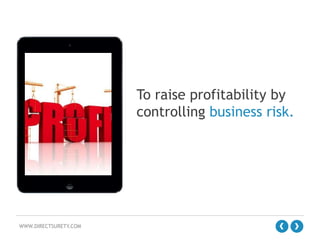
To raise profitability by
controlling business risk.

WWW.DIRECTSURETY.COM
ENTERPRISE RISK MANAGEMENT (ERM)
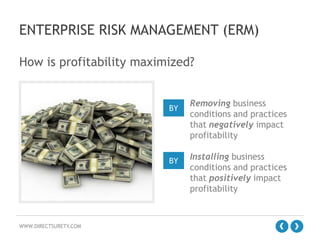
How is profitability maximized?

BY

BY

WWW.DIRECTSURETY.COM

Removing business
conditions and practices
that negatively impact
profitability
Installing business
conditions and practices
that positively impact
profitability
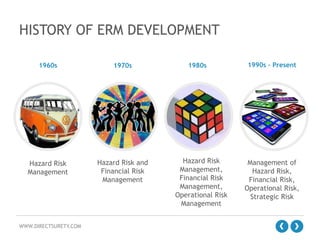
HISTORY OF ERM DEVELOPMENT
1960s

1970s

Hazard Risk
Management

Hazard Risk and
Financial Risk
Management

WWW.DIRECTSURETY.COM

1980s

Hazard Risk
Management,
Financial Risk
Management,
Operational Risk
Management

1990s - Present

Management of
Hazard Risk,
Financial Risk,
Operational Risk,
Strategic Risk
TRADITIONAL RISK MANAGEMENT

1

WWW.DIRECTSURETY.COM
ENTERPRISE RISK MANAGEMENT (ERM)
4

WWW.DIRECTSURETY.COM
RISK MANAGEMENT THINKING HAS EVOLVED
•
•
•

•

Analysis in silos

•

Inspect, detect,
react

•

Correlation among
risks not
understood

•

Continuous,
systematic process
with integration

Risks not owned

•

OLD THINKING

Limited to certain
areas

Risk culture
created throughout
the enterprise

No strategy

•

Risk strategy linked
to business strategy

Responsibilities
clearly defined

•

Anticipate,
manage, optimize,
monitor

•

Quantified, aggregated, studied for
interrelationships

•

WWW.DIRECTSURETY.COM

•

Risk is a key
consideration for
financial decision
making

NEW THINKING
INDUSTRIES THAT HAVE ADOPTED ERM
Newcomers:
Construction &
Mining

65% of Public Firms

Financial
Services

Energy
Sector

Health
Care

Source: Excellence in Risk Management VI, Marsh | RIMS
WWW.DIRECTSURETY.COM

Transportation

Education
ERM IMPLEMENTATION DRIVERS

Public Companies

01

COMPLIANCE

02

TRANSPARENCY

04

TECHNOLOGY

Public and Private
Companies
03

COMPETITION

WWW.DIRECTSURETY.COM
SUPPORTING ORGANIZATIONS OF THE
ERM FRAMEWORK
COSO:
PRMIA:

Committee of Sponsoring
Organizations
Professional Risk Manager’s
International Association

IRMI:

International Risk
Management Institute

CAS:

Casualty Actuarial Society

ERM-II:

WWW.DIRECTSURETY.COM

Enterprise Risk Management
International Institute
BENEFITS OF CONTROLLING
STRATEGIC RISKS
ENSURES SOUND DECISION
MAKING

How: By adjusting
managerial business
approach and
policies

WWW.DIRECTSURETY.COM
BENEFITS OF CONTROLLING
OPERATIONAL RISKS
IMPROVES OPERATIONAL
EFFICIENCIES

How: By installing
more cost effective
and accurate
internal systems

WWW.DIRECTSURETY.COM
BENEFITS OF CONTROLLING
FINANCIAL RISKS
MAINTAINS AVAILABILITY
OF CREDIT & MANAGES
COST OF FUNDS

How: By improving
outside relationships
and considering all
“what if” scenarios

WWW.DIRECTSURETY.COM
BENEFITS OF CONTROLLING
HAZARD RISKS
REDUCES THE
CONSEQUENCES OF
UNCONTROLLABLE LOSSES

How: By
increasing safety
and obtaining
adequate coverage
for potential losses

WWW.DIRECTSURETY.COM
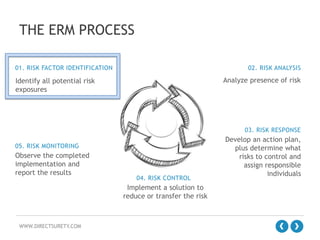
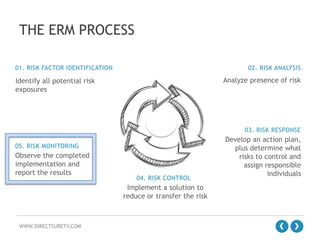
THE ERM PROCESS
01. RISK FACTOR IDENTIFICATION

02. RISK ANALYSIS

Analyze presence of risk

Identify all potential risk
exposures

03. RISK RESPONSE
05. RISK MONITORING

Observe the completed
implementation and
report the results

04. RISK CONTROL

Implement a solution to
reduce or transfer the risk

WWW.DIRECTSURETY.COM

Develop an action plan,
plus determine what
risks to control and
assign responsible
individuals
THE ERM PROCESS
01. RISK FACTOR IDENTIFICATION

02. RISK ANALYSIS

Analyze presence of risk

Identify all potential risk
exposures

03. RISK RESPONSE
05. RISK MONITORING

Observe the completed
implementation and
report the results

04. RISK CONTROL

Implement a solution to
reduce or transfer the risk

WWW.DIRECTSURETY.COM

Develop an action plan,
plus determine what
risks to control and
assign responsible
individuals
IDENTIFYING RISK FACTORS

01

UNCONTROLLED RISK

02

UNDER PERFORMANCE

04

MAXIMUM PERFORMANCE

VS.

03

CONTROLLED RISK

WWW.DIRECTSURETY.COM
CATEGORIZING RISKS MAKES IT SIMPLE

Business
Approach

Credit
Status

Bid Process

Sales
Methodology

WWW.DIRECTSURETY.COM

Information
Transfer

Construction
Management

Accounting
Procedures

Insurance
Coverage

Safety
Practices
WWW.DIRECTSURETY.COM
THE ERM PROCESS
02. RISK ANALYSIS

Analyze presence of risk:
01. RISK FACTOR IDENTIFICATION

•
•
•
•

Identify all potential risk
exposures

Assess the level of risk
Quantify the results
Report the findings
Recommend action

03. RISK RESPONSE
05. RISK MONITORING

Observe the
completed
implementation and
report the results

WWW.DIRECTSURETY.COM

04. RISK CONTROL

Implement a solution to
reduce or transfer the risk

Develop an action plan,
plus determine what
risks to control and
assign responsible
individuals
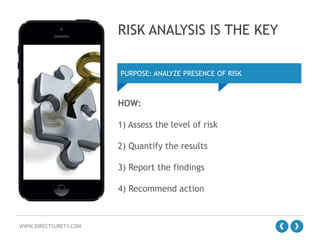
RISK ANALYSIS IS THE KEY
PURPOSE: ANALYZE PRESENCE OF RISK

HOW:
1) Assess the level of risk
2) Quantify the results
3) Report the findings

4) Recommend action

WWW.DIRECTSURETY.COM
RISK ASSESSOR IS THE KEY
HOLDER
PURPOSE: ANALYZE PRESENCE OF RISK

HOW:
1) Assess the level of risk
2) Quantify the results
3) Report the findings

4) Recommend action

WWW.DIRECTSURETY.COM
KEYHOLDER’S
RESPONSIBILITY
PURPOSE: ASSESS THE PROBABILITY OF HARM

HOW:
1) Develop an understanding of the in-place
Risk Controls associated with a specific
Risk Factor
2) Determine the likelihood (probability)
that the status of the existing risk
controls will cause harm

WWW.DIRECTSURETY.COM
MAKING THE RISK ASSESSMENT

+

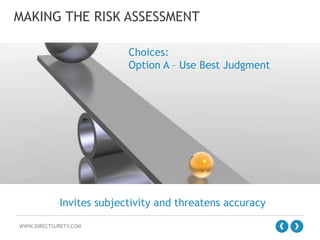
Choices:
Option A – Use Best Judgment

Invites subjectivity and threatens accuracy
WWW.DIRECTSURETY.COM
MAKING THE RISK ASSESSMENT

+

Choices:
Option B – Use a Measurement Guide

Removes subjectivity and promotes accuracy
WWW.DIRECTSURETY.COM
WHAT SCALE SHOULD BE USED?
1) MANY LEVELS
• Lower probability of a match

2) A FEW LEVELS

• Higher probability of a match

WWW.DIRECTSURETY.COM
DETERMINING CONTROLS PRESENT
ASK QUESTIONS

WWW.DIRECTSURETY.COM

LOOK AT EVIDENCE

VERIFY FUNCTIONALITY
HOW IS A GOOD ASSESSMENT PERFORMED?

Simple

01.
Meet the Right
People

WWW.DIRECTSURETY.COM

02.
Ask the Right
Questions

03.
Collect Pertinent
Evidence
TYPES OF ASSESSMENT
1) IN-HOUSE PERSONNEL

2) OUTSIDE INDEPENDENT

WWW.DIRECTSURETY.COM
RISK ANALYSIS IS THE KEY
PURPOSE: ANALYZE PRESENCE OF RISK

HOW:
1) Assess the level of risk
2) Quantify the results
3) Report the findings

4) Recommend action

WWW.DIRECTSURETY.COM
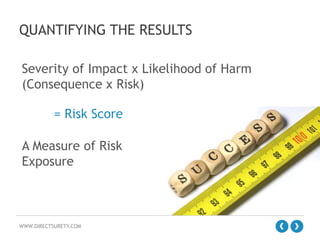
QUANTIFYING THE RESULTS
Severity of Impact x Likelihood of Harm
(Consequence x Risk)
= Risk Score
A Measure of Risk
Exposure

WWW.DIRECTSURETY.COM
RISK ANALYSIS IS THE KEY
PURPOSE: ANALYZE PRESENCE OF RISK

HOW:
1) Assess the level of risk
2) Quantify the results
3) Report the findings

4) Recommend action

WWW.DIRECTSURETY.COM
REPORTING THE
FINDINGS
Typical Report Contents:
Overview of Risk Analysis
Performed
Summary of Risk Factors
Reviewed
Explanation of Risk
Assessment Technique

Results of the Risk Assessment
• Risk Map
• Scoring Summary
High Risk Categories,
Conditions & Practices
WWW.DIRECTSURETY.COM
RISK ANALYSIS IS THE KEY
PURPOSE: ANALYZE PRESENCE OF RISK

HOW:
1) Assess the level of risk
2) Quantify the results
3) Report the findings

4) Recommend action

WWW.DIRECTSURETY.COM
RECOMMEND CONTROLS

CONTROLS NECESSARY TO
MITIGATE RISK

Practices:
• Change or install policies
• Implement new procedures
• Improve existing procedures
Conditions:
• Change the environment
• Revise decision making
WWW.DIRECTSURETY.COM
THE ERM PROCESS
01. RISK FACTOR IDENTIFICATION

02. RISK ANALYSIS

Analyze presence of risk

Identify all potential risk
exposures

03. RISK RESPONSE

Develop an action plan:
determine what risks
to control and assign
responsible individuals

05. RISK MONITORING

Observe the completed
implementation and
report the results

04. RISK CONTROL

Implement a solution to
reduce or transfer the risk

WWW.DIRECTSURETY.COM
RISK PRIORITIZATION MAP
High

Severity

Control Now
Control Soon
Control

Low

High

Likelihood
WWW.DIRECTSURETY.COM
RESPONDING TO RISK – OPTIONS
Possible responses to risk
Options available:
• Accept = monitor
• Avoid = eliminate (get out of the
situation)
• Reduce = institute controls
• Transfer = move risk elsewhere
(e.g., insurance)

WWW.DIRECTSURETY.COM
RESPONDING TO RISK PRIORITIES
KEY QUESTIONS

1) What risks will the organization not
accept? (e.g., fraud, errors, quality
comprises)
2) What risks will the organization take on
as new initiatives? (e.g., new types of
work, geographies or difficulties)
3) What risks will the organization accept
for competing objectives? (e.g., light on
working capital, exhausted resources)
WWW.DIRECTSURETY.COM
RESPONDING TO RISK – APPETITE
Risk appetite: The amount of risk – on a broad level –
an entity is willing to accept in pursuit of value.

Projected Earnings at Risk
versus
Financial Gains to be Realized

WWW.DIRECTSURETY.COM
RESPONDING TO RISK – EVALUATE OPTIONS
Evaluate options in relation to risk appetite.
1.

Consider the degree to which a response
will reduce likelihood of harm

2.

Examine cost versus benefit of potential
risk responses

3.

Select response based on evaluation

4.

Fully understand residual risk
(unmitigated risk)

WWW.DIRECTSURETY.COM
THE ERM PROCESS
01. RISK FACTOR IDENTIFICATION

02. RISK ANALYSIS

Analyze presence of risk

Identify all potential risk
exposures

03. RISK RESPONSE
05. RISK MONITORING

Observe the completed
implementation and
report the results

04. RISK CONTROL

Implement a solution to
reduce or transfer the risk

WWW.DIRECTSURETY.COM

Develop an action plan,
plus determine what
risks to control and
assign responsible
individuals
Implementing Risk Controls
Implementation is driven by ERM policies and procedures
that help ensure that the risk responses are carried out
Occurs throughout the
organization
Occurs at all levels in
all functions

Typically assignable to risk owners, not risk managers
WWW.DIRECTSURETY.COM
STEPS TO SUCCESSFUL
IMPLEMENTATION
•
•
•
•
•
•

WWW.DIRECTSURETY.COM

Identify objectives
Assign responsibilities
Set deadlines
Track progress
Complete installation
Test the control
THE ERM PROCESS
01. RISK FACTOR IDENTIFICATION

02. RISK ANALYSIS

Analyze presence of risk

Identify all potential risk
exposures

03. RISK RESPONSE
05. RISK MONITORING

Observe the completed
implementation and
report the results

04. RISK CONTROL

Implement a solution to
reduce or transfer the risk

WWW.DIRECTSURETY.COM

Develop an action plan,
plus determine what
risks to control and
assign responsible
individuals
TRACKING AND VERIFYING CONTROLS
TRACKING TO BE DONE:
• Track the performance of new or
improved controls

VERIFICATIONS TO OBTAIN:
• Verify that the controls remain
intact and functional

WWW.DIRECTSURETY.COM
ERM

FINAL RESULT

WWW.DIRECTSURETY.COM
ERM IMPROVEMENT CYCLE

WWW.DIRECTSURETY.COM
IMPLEMENTATION – NO FREE LUNCH
TIME

WWW.DIRECTSURETY.COM

RESOURCES

COMMITMENT
IMPLEMENTATION – ROI
A simple calculation
Cost of Labor for
Running ERM
vs
Savings from
Avoidance, Transfer,
or Mitigation of Risk

WWW.DIRECTSURETY.COM
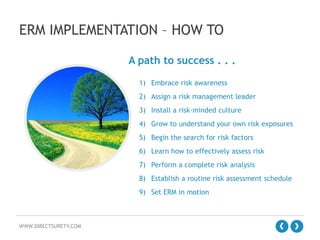
ERM IMPLEMENTATION – HOW TO
A path to success . . .
1) Embrace risk awareness
2) Assign a risk management leader
3) Install a risk-minded culture
4) Grow to understand your own risk exposures

5) Begin the search for risk factors
6) Learn how to effectively assess risk
7) Perform a complete risk analysis
8) Establish a routine risk assessment schedule

9) Set ERM in motion

WWW.DIRECTSURETY.COM
ERM

THANK YOU FOR
YOUR TIME

WWW.DIRECTSURETY.COM

ERM_Presentation_SuretyCredit_111413

  • 1.
  • 2.
    01. DEFINITIONS In businessterms . . . R I S K WWW.DIRECTSURETY.COM A Risk Factor is something that can cause harm. It is a poor business condition or practice that can negatively impact a company.
  • 3.
    CHARACTERISTICS OF RISKFACTORS Vary by industry and importance . . . FOOD WWW.DIRECTSURETY.COM CONSTRUCTION
  • 4.
    CHARACTERISTICS OF RISKFACTORS Applicable by type of contractor . . . WWW.DIRECTSURETY.COM
  • 5.
    02. DEFINITIONS Again, inbusiness terms . . . R I S K WWW.DIRECTSURETY.COM Risk is the likelihood of harm. The likelihood that profitability and shareholder value will be negatively impacted.
  • 6.
    ENTERPRISE RISK MANAGEMENT(ERM) WHAT IS IT? ERM is a business management process . . . WWW.DIRECTSURETY.COM
  • 7.
    ENTERPRISE RISK MANAGEMENT(ERM) 01. ERM Is not a project, but a process that develops within an organization, driven and supported by senior management 02. ERM Becomes part of the operational culture of the organization with process owners and drivers 03. ERM Is not an off-the-shelf product that works for everyone WWW.DIRECTSURETY.COM ERM begins with the development of a risk strategy that is linked to and supportive of the overall business imperatives of the corporation.
  • 8.
    ERM SPEAK TO THETECHNICIAN • A holistic risk management process • An integrated risk management process TO THE LAYMAN • A way of managing my business WWW.DIRECTSURETY.COM
  • 9.
    ERM: WHAT KINDOF RISK IS ADDRESSED? Quantitative Risk Data Actuarial Analysis + = Risk Profile The Complete Qualitative Risk Data Observational Analysis RISK ASSOCIATED WITH CONDITIONS AND PRACTICES WWW.DIRECTSURETY.COM
  • 10.
  • 11.
    To raise profitabilityby controlling business risk. WWW.DIRECTSURETY.COM
  • 12.
    ENTERPRISE RISK MANAGEMENT(ERM) How is profitability maximized? BY BY WWW.DIRECTSURETY.COM Removing business conditions and practices that negatively impact profitability Installing business conditions and practices that positively impact profitability
  • 13.
    HISTORY OF ERMDEVELOPMENT 1960s 1970s Hazard Risk Management Hazard Risk and Financial Risk Management WWW.DIRECTSURETY.COM 1980s Hazard Risk Management, Financial Risk Management, Operational Risk Management 1990s - Present Management of Hazard Risk, Financial Risk, Operational Risk, Strategic Risk
  • 14.
  • 15.
    ENTERPRISE RISK MANAGEMENT(ERM) 4 WWW.DIRECTSURETY.COM
  • 16.
    RISK MANAGEMENT THINKINGHAS EVOLVED • • • • Analysis in silos • Inspect, detect, react • Correlation among risks not understood • Continuous, systematic process with integration Risks not owned • OLD THINKING Limited to certain areas Risk culture created throughout the enterprise No strategy • Risk strategy linked to business strategy Responsibilities clearly defined • Anticipate, manage, optimize, monitor • Quantified, aggregated, studied for interrelationships • WWW.DIRECTSURETY.COM • Risk is a key consideration for financial decision making NEW THINKING
  • 17.
    INDUSTRIES THAT HAVEADOPTED ERM Newcomers: Construction & Mining 65% of Public Firms Financial Services Energy Sector Health Care Source: Excellence in Risk Management VI, Marsh | RIMS WWW.DIRECTSURETY.COM Transportation Education
  • 18.
    ERM IMPLEMENTATION DRIVERS PublicCompanies 01 COMPLIANCE 02 TRANSPARENCY 04 TECHNOLOGY Public and Private Companies 03 COMPETITION WWW.DIRECTSURETY.COM
  • 19.
    SUPPORTING ORGANIZATIONS OFTHE ERM FRAMEWORK COSO: PRMIA: Committee of Sponsoring Organizations Professional Risk Manager’s International Association IRMI: International Risk Management Institute CAS: Casualty Actuarial Society ERM-II: WWW.DIRECTSURETY.COM Enterprise Risk Management International Institute
  • 20.
    BENEFITS OF CONTROLLING STRATEGICRISKS ENSURES SOUND DECISION MAKING How: By adjusting managerial business approach and policies WWW.DIRECTSURETY.COM
  • 21.
    BENEFITS OF CONTROLLING OPERATIONALRISKS IMPROVES OPERATIONAL EFFICIENCIES How: By installing more cost effective and accurate internal systems WWW.DIRECTSURETY.COM
  • 22.
    BENEFITS OF CONTROLLING FINANCIALRISKS MAINTAINS AVAILABILITY OF CREDIT & MANAGES COST OF FUNDS How: By improving outside relationships and considering all “what if” scenarios WWW.DIRECTSURETY.COM
  • 23.
    BENEFITS OF CONTROLLING HAZARDRISKS REDUCES THE CONSEQUENCES OF UNCONTROLLABLE LOSSES How: By increasing safety and obtaining adequate coverage for potential losses WWW.DIRECTSURETY.COM
  • 24.
    THE ERM PROCESS 01.RISK FACTOR IDENTIFICATION 02. RISK ANALYSIS Analyze presence of risk Identify all potential risk exposures 03. RISK RESPONSE 05. RISK MONITORING Observe the completed implementation and report the results 04. RISK CONTROL Implement a solution to reduce or transfer the risk WWW.DIRECTSURETY.COM Develop an action plan, plus determine what risks to control and assign responsible individuals
  • 25.
    THE ERM PROCESS 01.RISK FACTOR IDENTIFICATION 02. RISK ANALYSIS Analyze presence of risk Identify all potential risk exposures 03. RISK RESPONSE 05. RISK MONITORING Observe the completed implementation and report the results 04. RISK CONTROL Implement a solution to reduce or transfer the risk WWW.DIRECTSURETY.COM Develop an action plan, plus determine what risks to control and assign responsible individuals
  • 26.
    IDENTIFYING RISK FACTORS 01 UNCONTROLLEDRISK 02 UNDER PERFORMANCE 04 MAXIMUM PERFORMANCE VS. 03 CONTROLLED RISK WWW.DIRECTSURETY.COM
  • 27.
    CATEGORIZING RISKS MAKESIT SIMPLE Business Approach Credit Status Bid Process Sales Methodology WWW.DIRECTSURETY.COM Information Transfer Construction Management Accounting Procedures Insurance Coverage Safety Practices
  • 28.
  • 29.
    THE ERM PROCESS 02.RISK ANALYSIS Analyze presence of risk: 01. RISK FACTOR IDENTIFICATION • • • • Identify all potential risk exposures Assess the level of risk Quantify the results Report the findings Recommend action 03. RISK RESPONSE 05. RISK MONITORING Observe the completed implementation and report the results WWW.DIRECTSURETY.COM 04. RISK CONTROL Implement a solution to reduce or transfer the risk Develop an action plan, plus determine what risks to control and assign responsible individuals
  • 30.
    RISK ANALYSIS ISTHE KEY PURPOSE: ANALYZE PRESENCE OF RISK HOW: 1) Assess the level of risk 2) Quantify the results 3) Report the findings 4) Recommend action WWW.DIRECTSURETY.COM
  • 31.
    RISK ASSESSOR ISTHE KEY HOLDER PURPOSE: ANALYZE PRESENCE OF RISK HOW: 1) Assess the level of risk 2) Quantify the results 3) Report the findings 4) Recommend action WWW.DIRECTSURETY.COM
  • 32.
    KEYHOLDER’S RESPONSIBILITY PURPOSE: ASSESS THEPROBABILITY OF HARM HOW: 1) Develop an understanding of the in-place Risk Controls associated with a specific Risk Factor 2) Determine the likelihood (probability) that the status of the existing risk controls will cause harm WWW.DIRECTSURETY.COM
  • 33.
    MAKING THE RISKASSESSMENT + Choices: Option A – Use Best Judgment Invites subjectivity and threatens accuracy WWW.DIRECTSURETY.COM
  • 34.
    MAKING THE RISKASSESSMENT + Choices: Option B – Use a Measurement Guide Removes subjectivity and promotes accuracy WWW.DIRECTSURETY.COM
  • 35.
    WHAT SCALE SHOULDBE USED? 1) MANY LEVELS • Lower probability of a match 2) A FEW LEVELS • Higher probability of a match WWW.DIRECTSURETY.COM
  • 36.
    DETERMINING CONTROLS PRESENT ASKQUESTIONS WWW.DIRECTSURETY.COM LOOK AT EVIDENCE VERIFY FUNCTIONALITY
  • 37.
    HOW IS AGOOD ASSESSMENT PERFORMED? Simple 01. Meet the Right People WWW.DIRECTSURETY.COM 02. Ask the Right Questions 03. Collect Pertinent Evidence
  • 38.
    TYPES OF ASSESSMENT 1)IN-HOUSE PERSONNEL 2) OUTSIDE INDEPENDENT WWW.DIRECTSURETY.COM
  • 39.
    RISK ANALYSIS ISTHE KEY PURPOSE: ANALYZE PRESENCE OF RISK HOW: 1) Assess the level of risk 2) Quantify the results 3) Report the findings 4) Recommend action WWW.DIRECTSURETY.COM
  • 40.
    QUANTIFYING THE RESULTS Severityof Impact x Likelihood of Harm (Consequence x Risk) = Risk Score A Measure of Risk Exposure WWW.DIRECTSURETY.COM
  • 41.
    RISK ANALYSIS ISTHE KEY PURPOSE: ANALYZE PRESENCE OF RISK HOW: 1) Assess the level of risk 2) Quantify the results 3) Report the findings 4) Recommend action WWW.DIRECTSURETY.COM
  • 42.
    REPORTING THE FINDINGS Typical ReportContents: Overview of Risk Analysis Performed Summary of Risk Factors Reviewed Explanation of Risk Assessment Technique Results of the Risk Assessment • Risk Map • Scoring Summary High Risk Categories, Conditions & Practices WWW.DIRECTSURETY.COM
  • 43.
    RISK ANALYSIS ISTHE KEY PURPOSE: ANALYZE PRESENCE OF RISK HOW: 1) Assess the level of risk 2) Quantify the results 3) Report the findings 4) Recommend action WWW.DIRECTSURETY.COM
  • 44.
    RECOMMEND CONTROLS CONTROLS NECESSARYTO MITIGATE RISK Practices: • Change or install policies • Implement new procedures • Improve existing procedures Conditions: • Change the environment • Revise decision making WWW.DIRECTSURETY.COM
  • 45.
    THE ERM PROCESS 01.RISK FACTOR IDENTIFICATION 02. RISK ANALYSIS Analyze presence of risk Identify all potential risk exposures 03. RISK RESPONSE Develop an action plan: determine what risks to control and assign responsible individuals 05. RISK MONITORING Observe the completed implementation and report the results 04. RISK CONTROL Implement a solution to reduce or transfer the risk WWW.DIRECTSURETY.COM
  • 46.
    RISK PRIORITIZATION MAP High Severity ControlNow Control Soon Control Low High Likelihood WWW.DIRECTSURETY.COM
  • 47.
    RESPONDING TO RISK– OPTIONS Possible responses to risk Options available: • Accept = monitor • Avoid = eliminate (get out of the situation) • Reduce = institute controls • Transfer = move risk elsewhere (e.g., insurance) WWW.DIRECTSURETY.COM
  • 48.
    RESPONDING TO RISKPRIORITIES KEY QUESTIONS 1) What risks will the organization not accept? (e.g., fraud, errors, quality comprises) 2) What risks will the organization take on as new initiatives? (e.g., new types of work, geographies or difficulties) 3) What risks will the organization accept for competing objectives? (e.g., light on working capital, exhausted resources) WWW.DIRECTSURETY.COM
  • 49.
    RESPONDING TO RISK– APPETITE Risk appetite: The amount of risk – on a broad level – an entity is willing to accept in pursuit of value. Projected Earnings at Risk versus Financial Gains to be Realized WWW.DIRECTSURETY.COM
  • 50.
    RESPONDING TO RISK– EVALUATE OPTIONS Evaluate options in relation to risk appetite. 1. Consider the degree to which a response will reduce likelihood of harm 2. Examine cost versus benefit of potential risk responses 3. Select response based on evaluation 4. Fully understand residual risk (unmitigated risk) WWW.DIRECTSURETY.COM
  • 51.
    THE ERM PROCESS 01.RISK FACTOR IDENTIFICATION 02. RISK ANALYSIS Analyze presence of risk Identify all potential risk exposures 03. RISK RESPONSE 05. RISK MONITORING Observe the completed implementation and report the results 04. RISK CONTROL Implement a solution to reduce or transfer the risk WWW.DIRECTSURETY.COM Develop an action plan, plus determine what risks to control and assign responsible individuals
  • 52.
    Implementing Risk Controls Implementationis driven by ERM policies and procedures that help ensure that the risk responses are carried out Occurs throughout the organization Occurs at all levels in all functions Typically assignable to risk owners, not risk managers WWW.DIRECTSURETY.COM
  • 53.
    STEPS TO SUCCESSFUL IMPLEMENTATION • • • • • • WWW.DIRECTSURETY.COM Identifyobjectives Assign responsibilities Set deadlines Track progress Complete installation Test the control
  • 54.
    THE ERM PROCESS 01.RISK FACTOR IDENTIFICATION 02. RISK ANALYSIS Analyze presence of risk Identify all potential risk exposures 03. RISK RESPONSE 05. RISK MONITORING Observe the completed implementation and report the results 04. RISK CONTROL Implement a solution to reduce or transfer the risk WWW.DIRECTSURETY.COM Develop an action plan, plus determine what risks to control and assign responsible individuals
  • 55.
    TRACKING AND VERIFYINGCONTROLS TRACKING TO BE DONE: • Track the performance of new or improved controls VERIFICATIONS TO OBTAIN: • Verify that the controls remain intact and functional WWW.DIRECTSURETY.COM
  • 56.
  • 57.
  • 58.
    IMPLEMENTATION – NOFREE LUNCH TIME WWW.DIRECTSURETY.COM RESOURCES COMMITMENT
  • 59.
    IMPLEMENTATION – ROI Asimple calculation Cost of Labor for Running ERM vs Savings from Avoidance, Transfer, or Mitigation of Risk WWW.DIRECTSURETY.COM
  • 60.
    ERM IMPLEMENTATION –HOW TO A path to success . . . 1) Embrace risk awareness 2) Assign a risk management leader 3) Install a risk-minded culture 4) Grow to understand your own risk exposures 5) Begin the search for risk factors 6) Learn how to effectively assess risk 7) Perform a complete risk analysis 8) Establish a routine risk assessment schedule 9) Set ERM in motion WWW.DIRECTSURETY.COM
  • 61.
    ERM THANK YOU FOR YOURTIME WWW.DIRECTSURETY.COM