1.2 Understanding Risks and uncertainty
5/26/2023 Prepared by Garedew D. 1
1.1 Definition of Risk
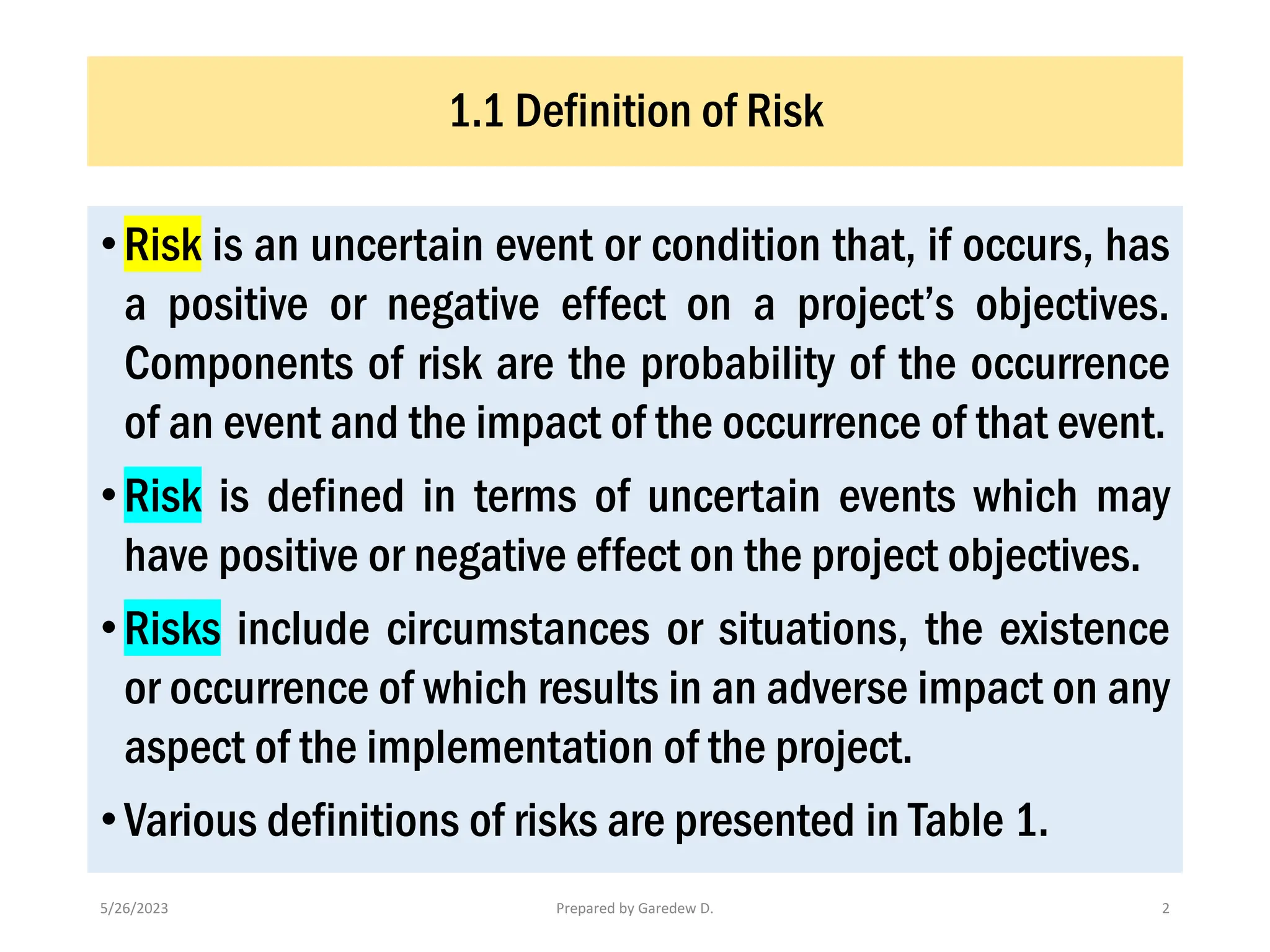
•Risk is an uncertain event or condition that, if occurs, has
a positive or negative effect on a project’s objectives.
Components of risk are the probability of the occurrence
of an event and the impact of the occurrence of that event.
•Risk is defined in terms of uncertain events which may
have positive or negative effect on the project objectives.
•Risks include circumstances or situations, the existence
or occurrence of which results in an adverse impact on any
aspect of the implementation of the project.
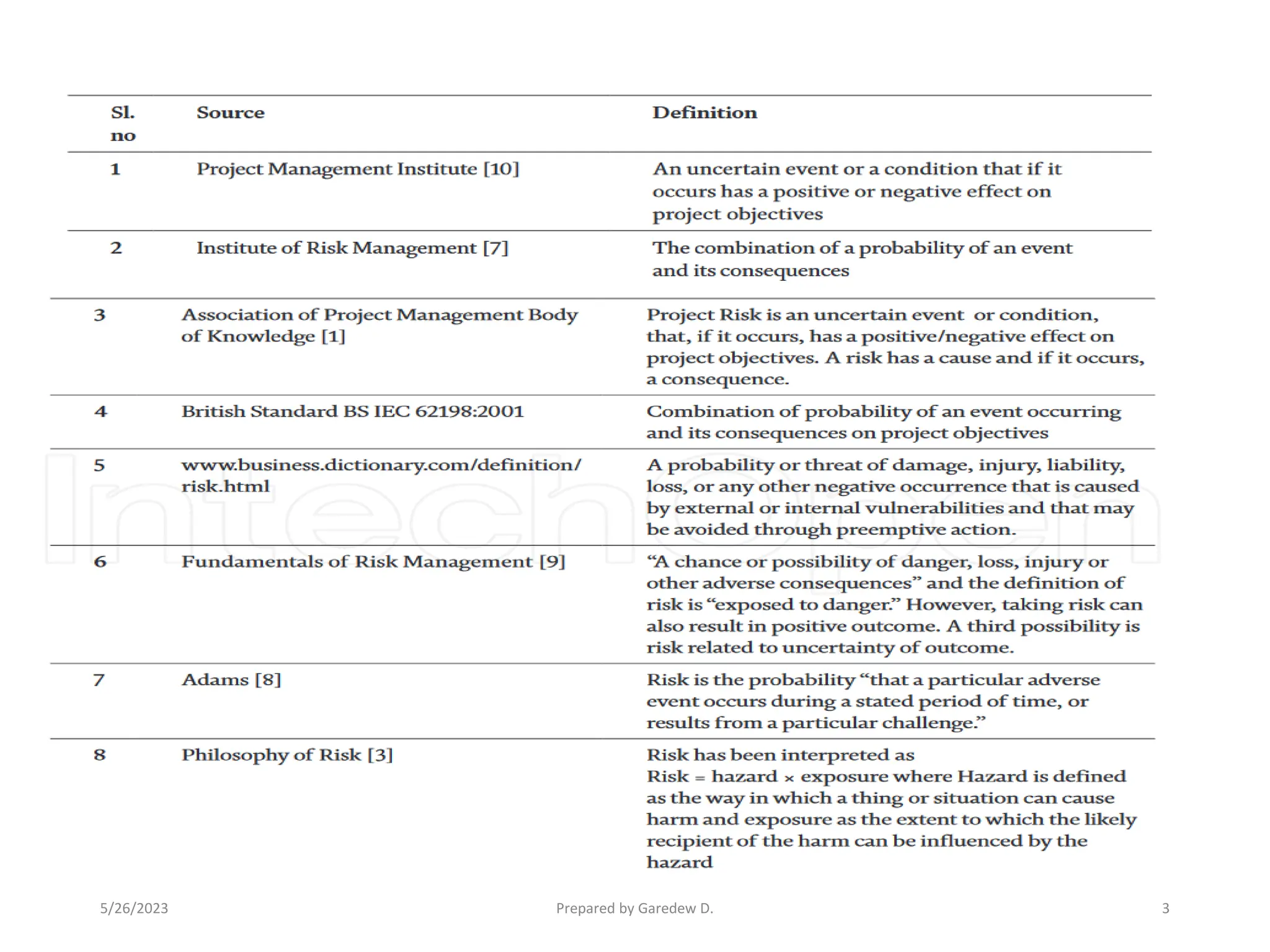
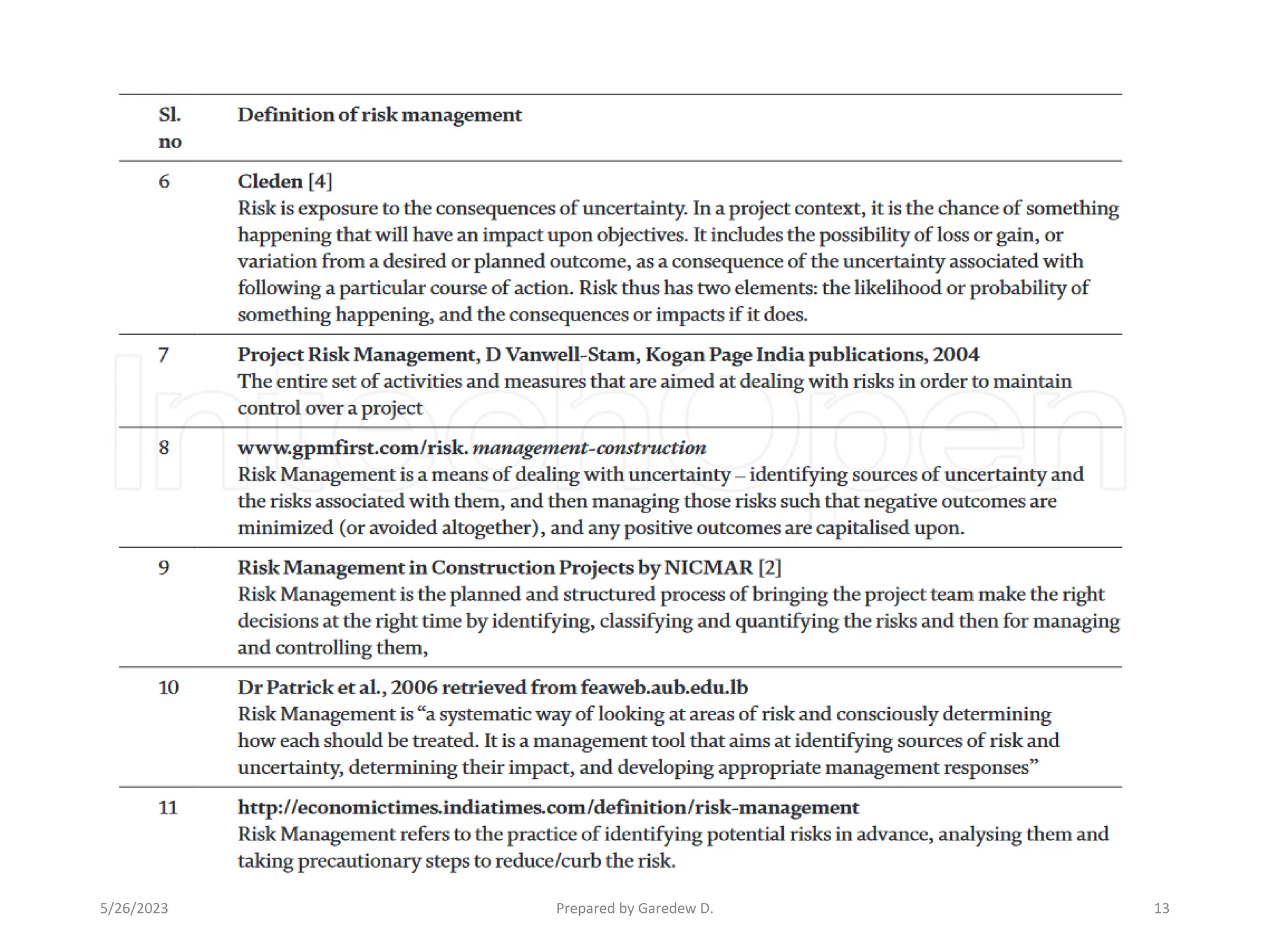
•Various definitions of risks are presented in Table 1.
5/26/2023 Prepared by Garedew D. 2
5/26/2023 Prepared by Garedew D. 3
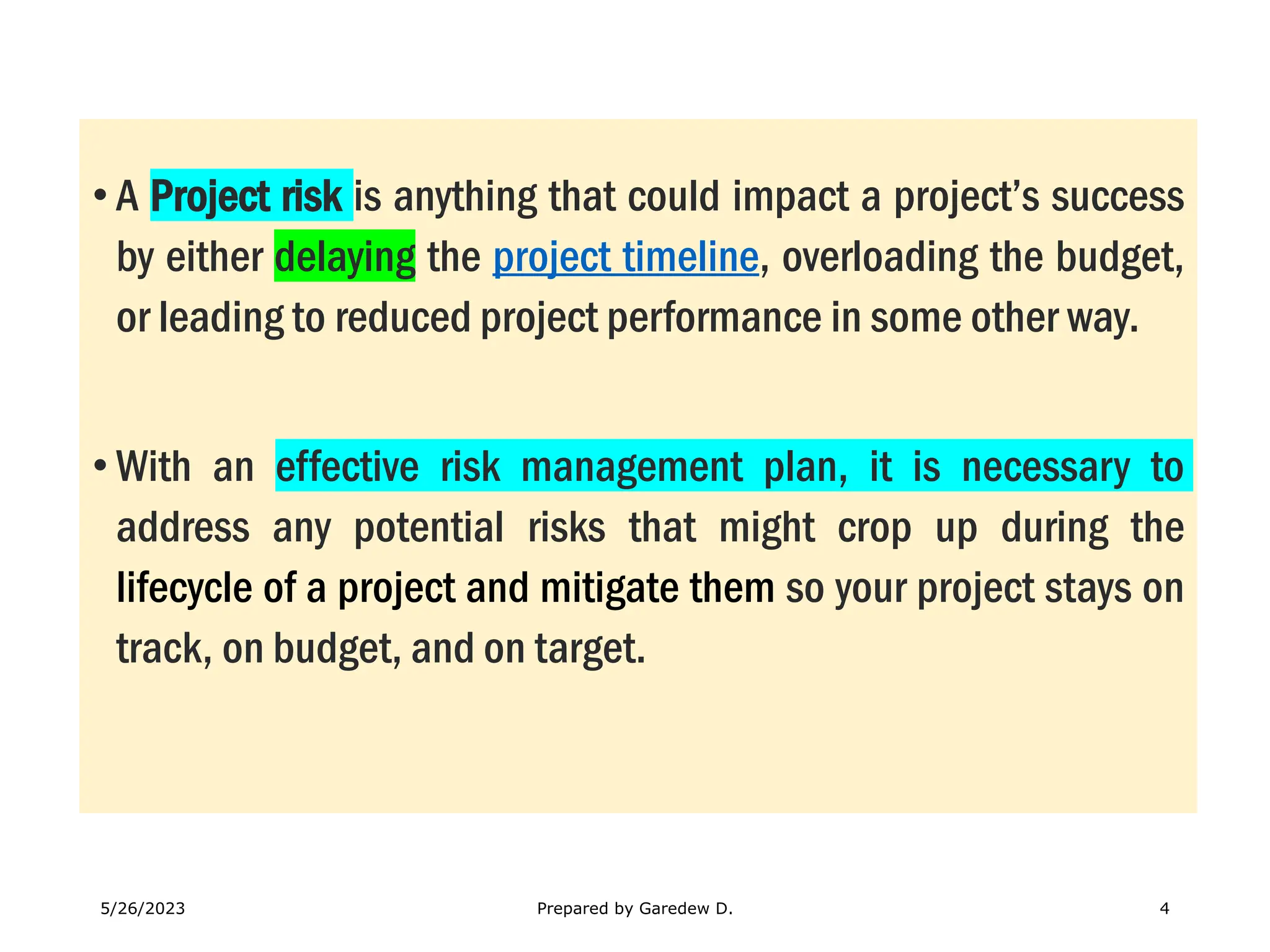
• A Project risk is anything that could impact a project’s success
by either delaying the project timeline, overloading the budget,
or leading to reduced project performance in some other way.
• With an effective risk management plan, it is necessary to
address any potential risks that might crop up during the
lifecycle of a project and mitigate them so your project stays on
track, on budget, and on target.
5/26/2023 Prepared by Garedew D. 4
5/26/2023 Prepared by Garedew D. 5
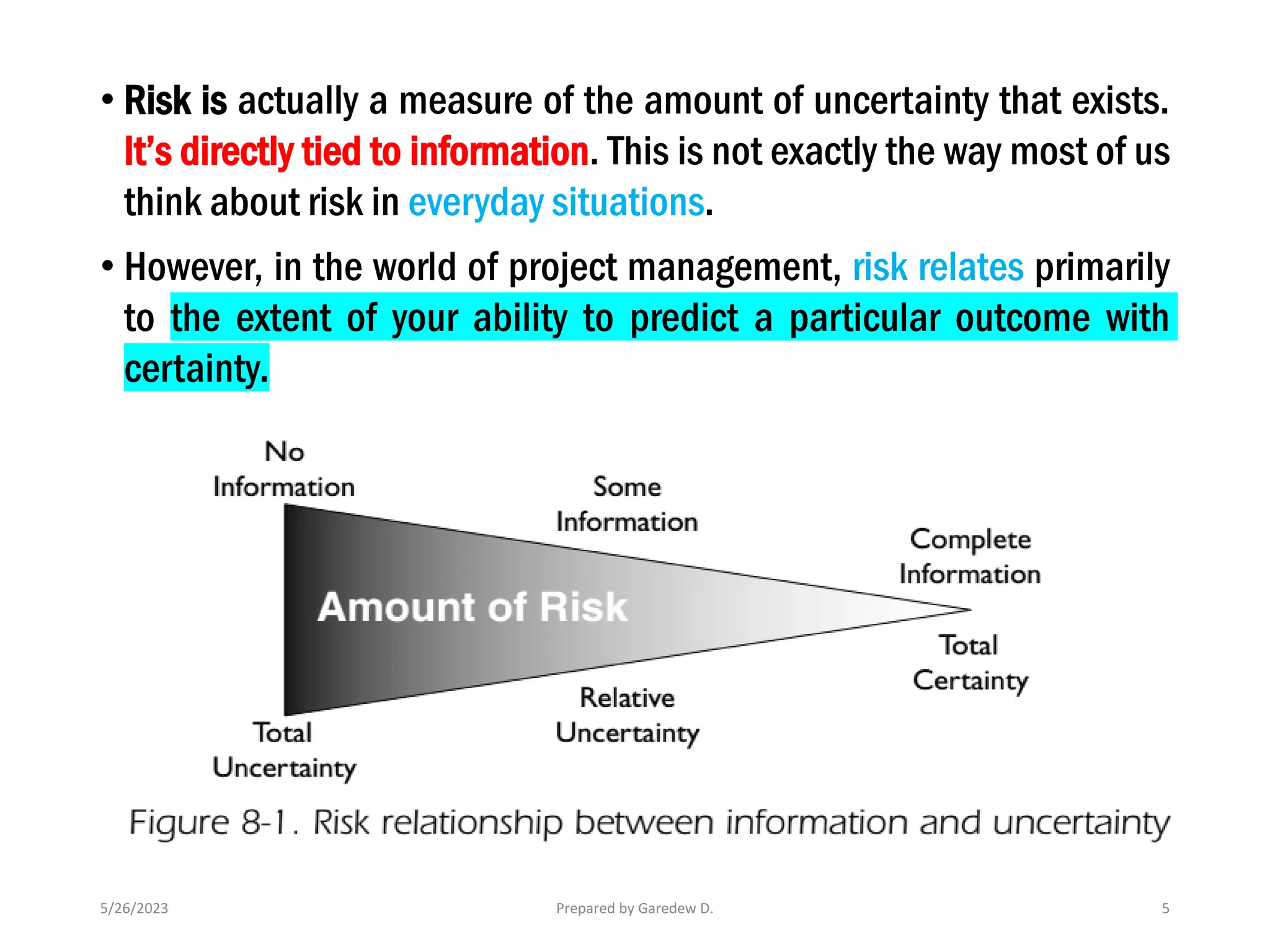
• Risk is actually a measure of the amount of uncertainty that exists.
It’s directly tied to information. This is not exactly the way most of us
think about risk in everyday situations.
• However, in the world of project management, risk relates primarily
to the extent of your ability to predict a particular outcome with
certainty.
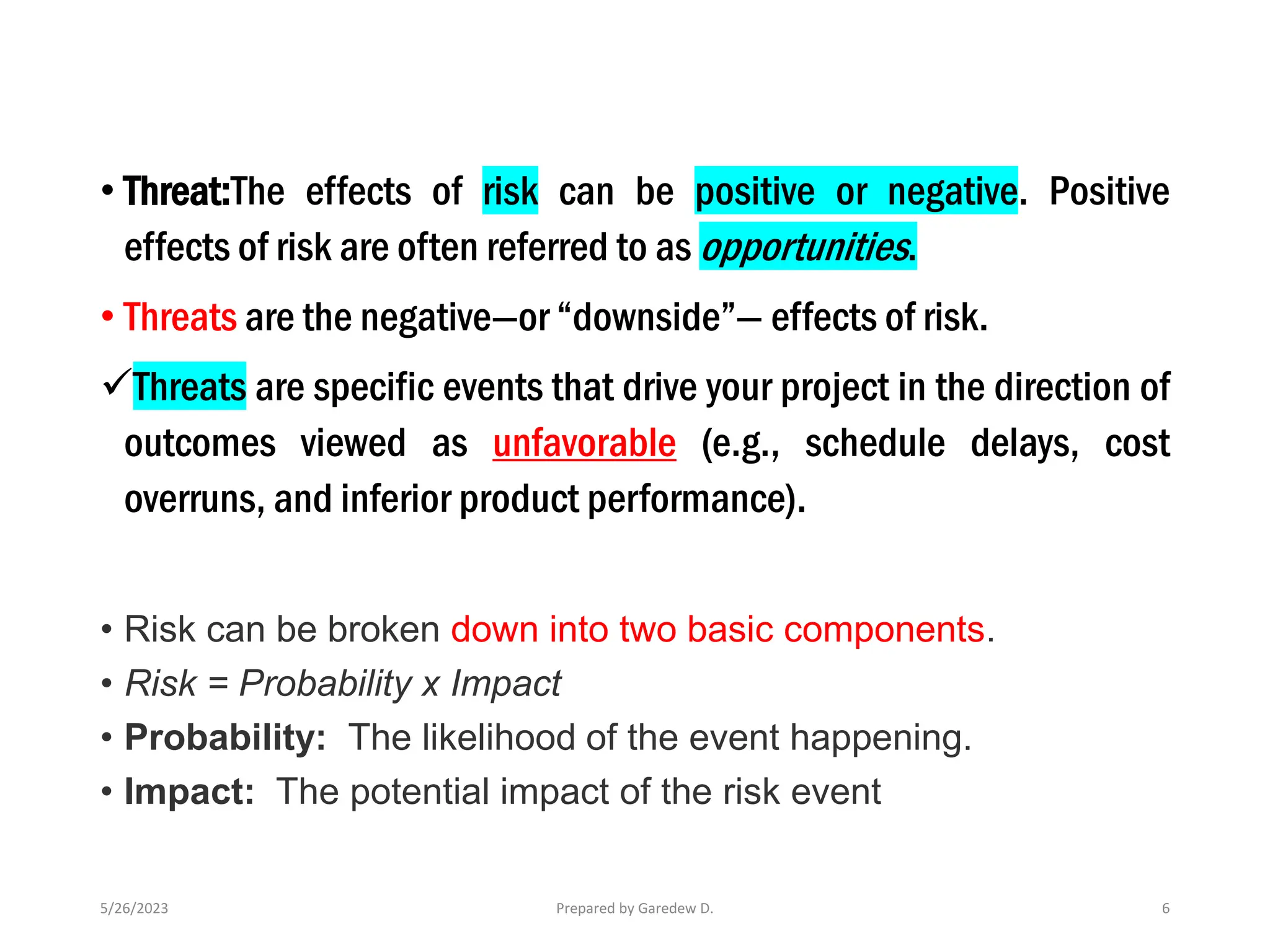
• Threat:The effects of risk can be positive or negative. Positive
effects of risk are often referred to as opportunities.
• Threats are the negative—or “downside”— effects of risk.
✓Threats are specific events that drive your project in the direction of
outcomes viewed as unfavorable (e.g., schedule delays, cost
overruns, and inferior product performance).
• Risk can be broken down into two basic components.
• Risk = Probability x Impact
• Probability: The likelihood of the event happening.
• Impact: The potential impact of the risk event
5/26/2023 Prepared by Garedew D. 6
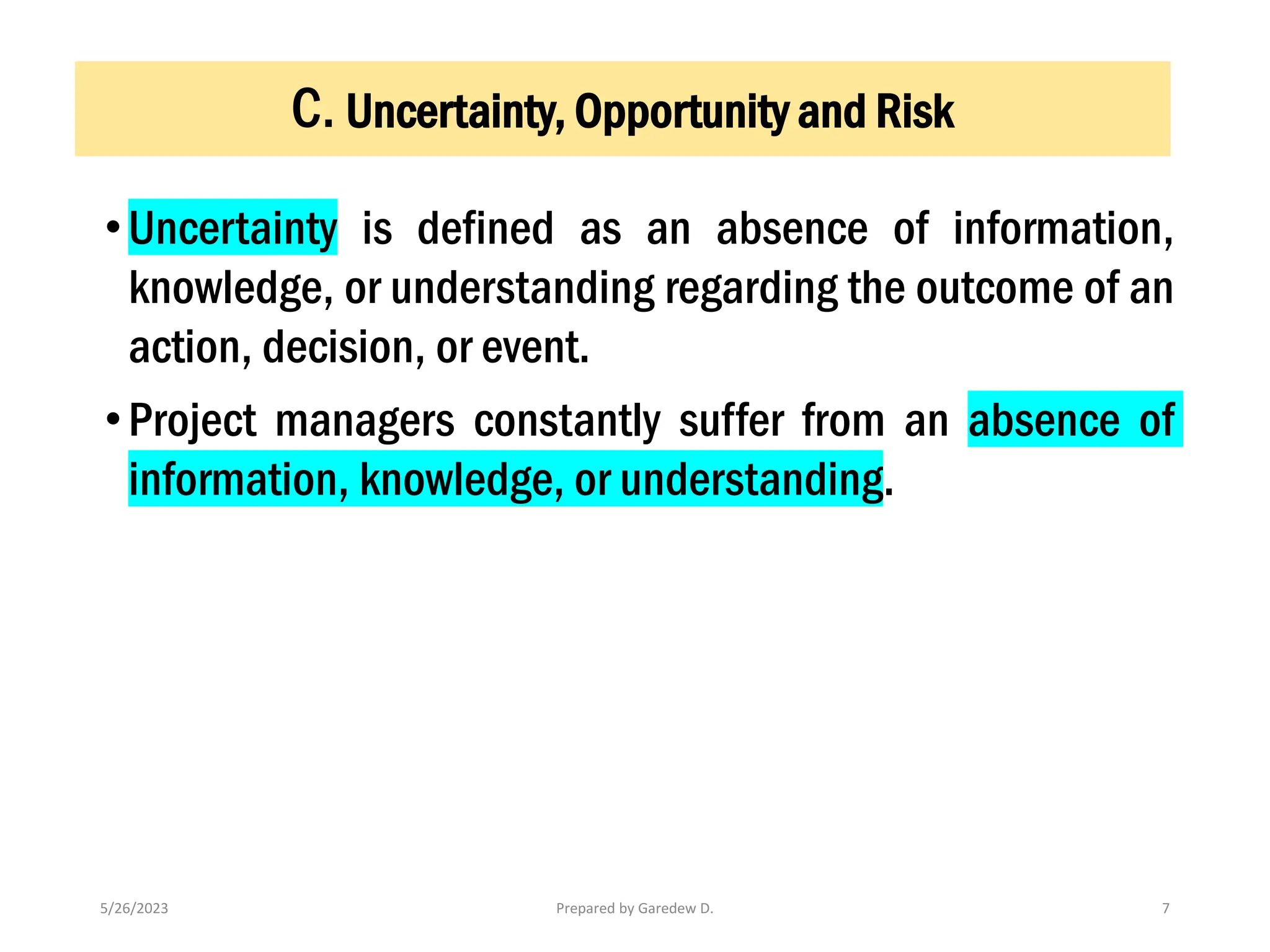
•Uncertainty is defined as an absence of information,
knowledge, or understanding regarding the outcome of an
action, decision, or event.
•Project managers constantly suffer from an absence of
information, knowledge, or understanding.
5/26/2023 Prepared by Garedew D. 7
C. Uncertainty, Opportunity and Risk
5/26/2023 Prepared by Garedew D. 8
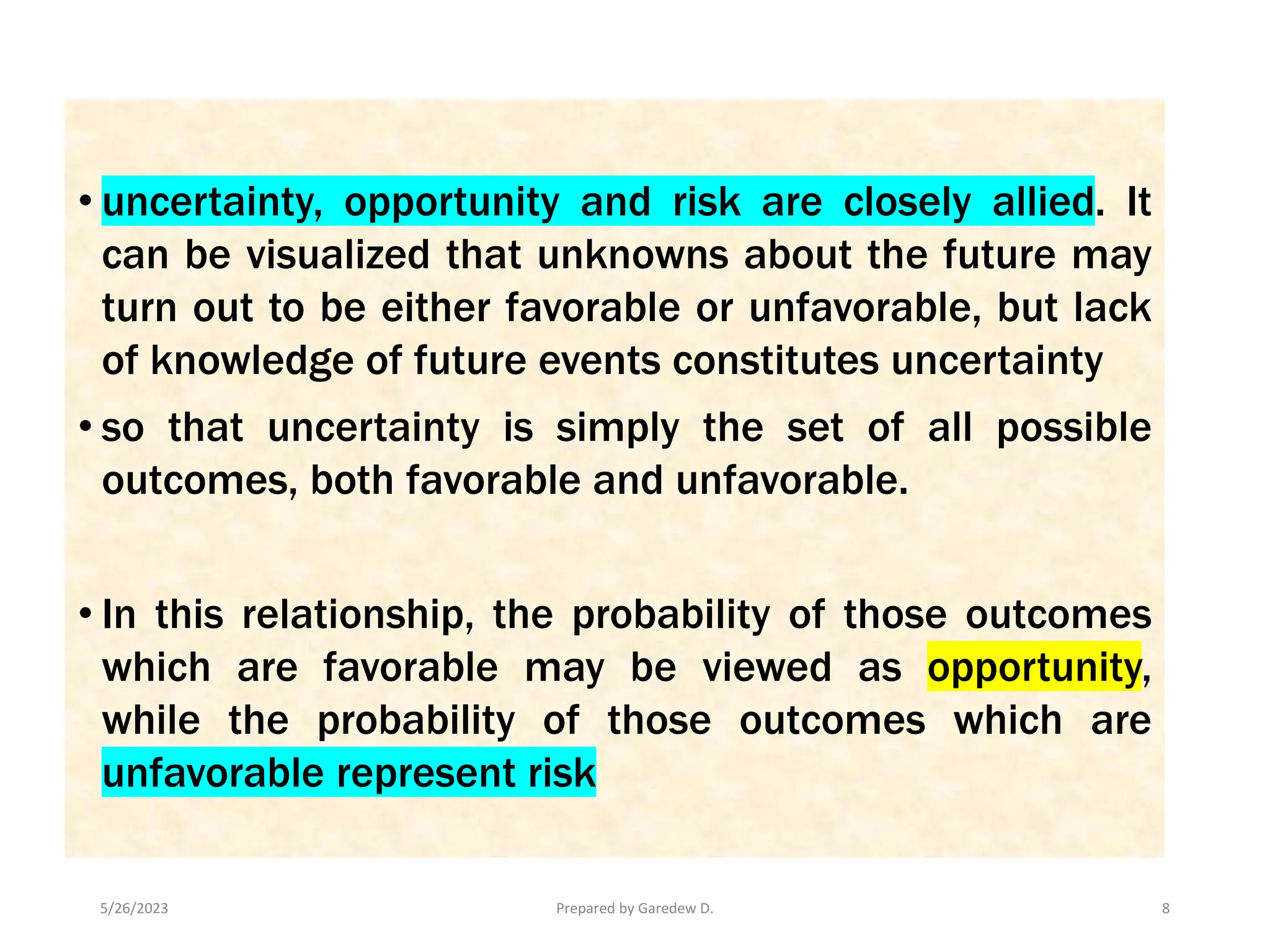
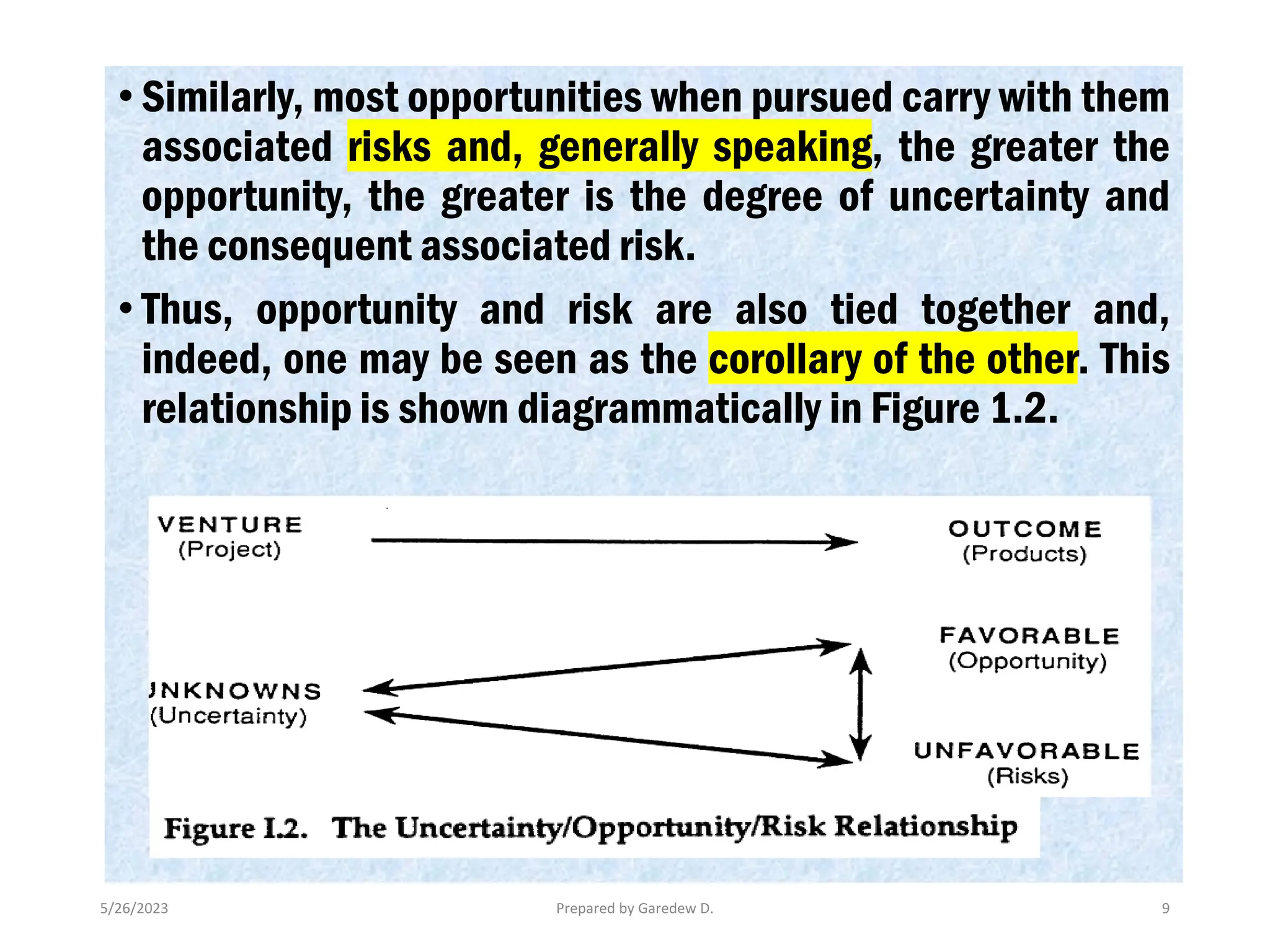
• uncertainty, opportunity and risk are closely allied. It
can be visualized that unknowns about the future may
turn out to be either favorable or unfavorable, but lack
of knowledge of future events constitutes uncertainty
• so that uncertainty is simply the set of all possible
outcomes, both favorable and unfavorable.
• In this relationship, the probability of those outcomes
which are favorable may be viewed as opportunity,
while the probability of those outcomes which are
unfavorable represent risk
• Similarly, most opportunities when pursued carry with them
associated risks and, generally speaking, the greater the
opportunity, the greater is the degree of uncertainty and
the consequent associated risk.
• Thus, opportunity and risk are also tied together and,
indeed, one may be seen as the corollary of the other. This
relationship is shown diagrammatically in Figure 1.2.
5/26/2023 Prepared by Garedew D. 9
Types And Elements Of Risks
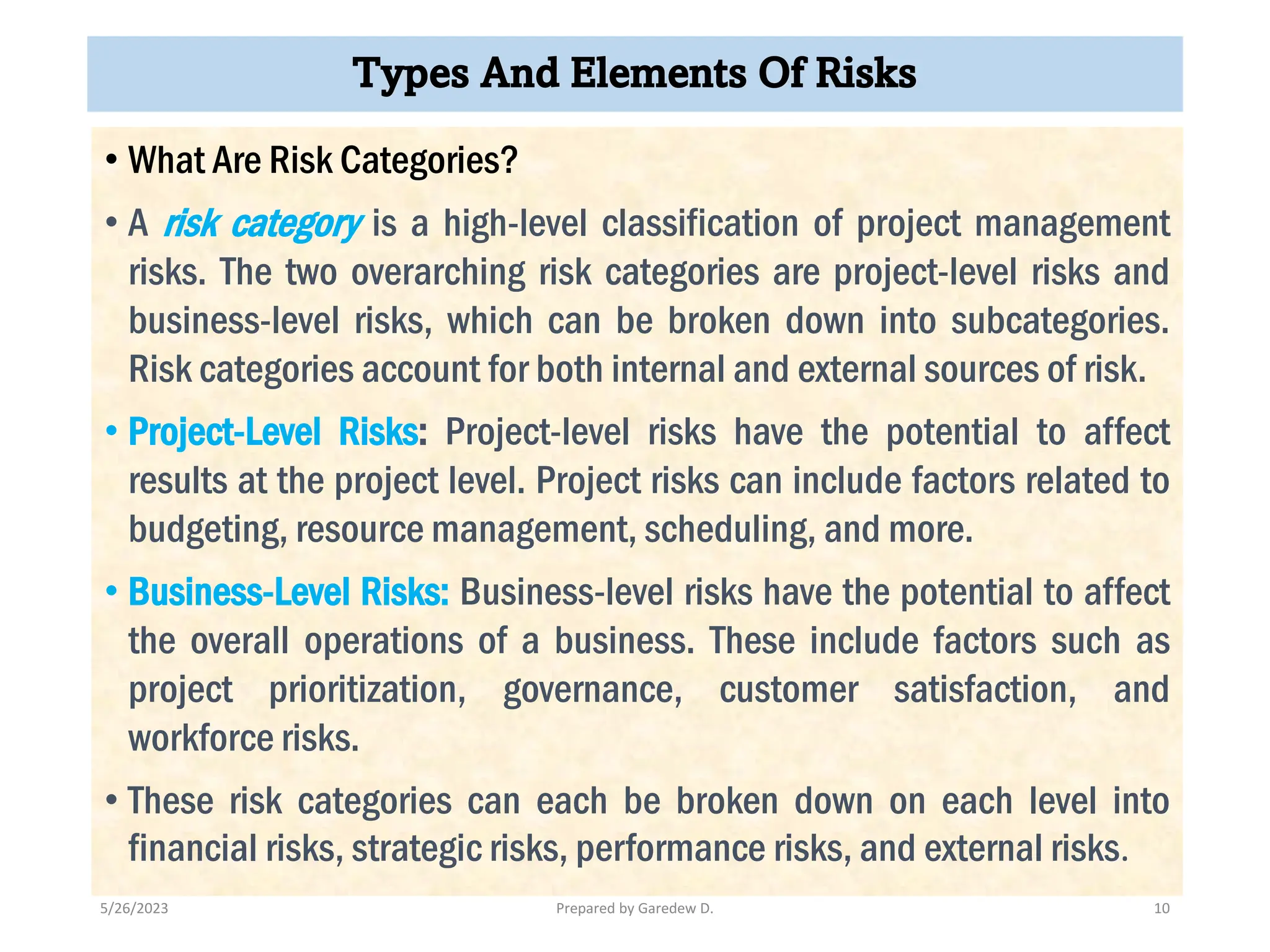
• What Are Risk Categories?
• A risk category is a high-level classification of project management
risks. The two overarching risk categories are project-level risks and
business-level risks, which can be broken down into subcategories.
Risk categories account for both internal and external sources of risk.
• Project-Level Risks: Project-level risks have the potential to affect
results at the project level. Project risks can include factors related to
budgeting, resource management, scheduling, and more.
• Business-Level Risks: Business-level risks have the potential to affect
the overall operations of a business. These include factors such as
project prioritization, governance, customer satisfaction, and
workforce risks.
• These risk categories can each be broken down on each level into
financial risks, strategic risks, performance risks, and external risks.
5/26/2023 Prepared by Garedew D. 10
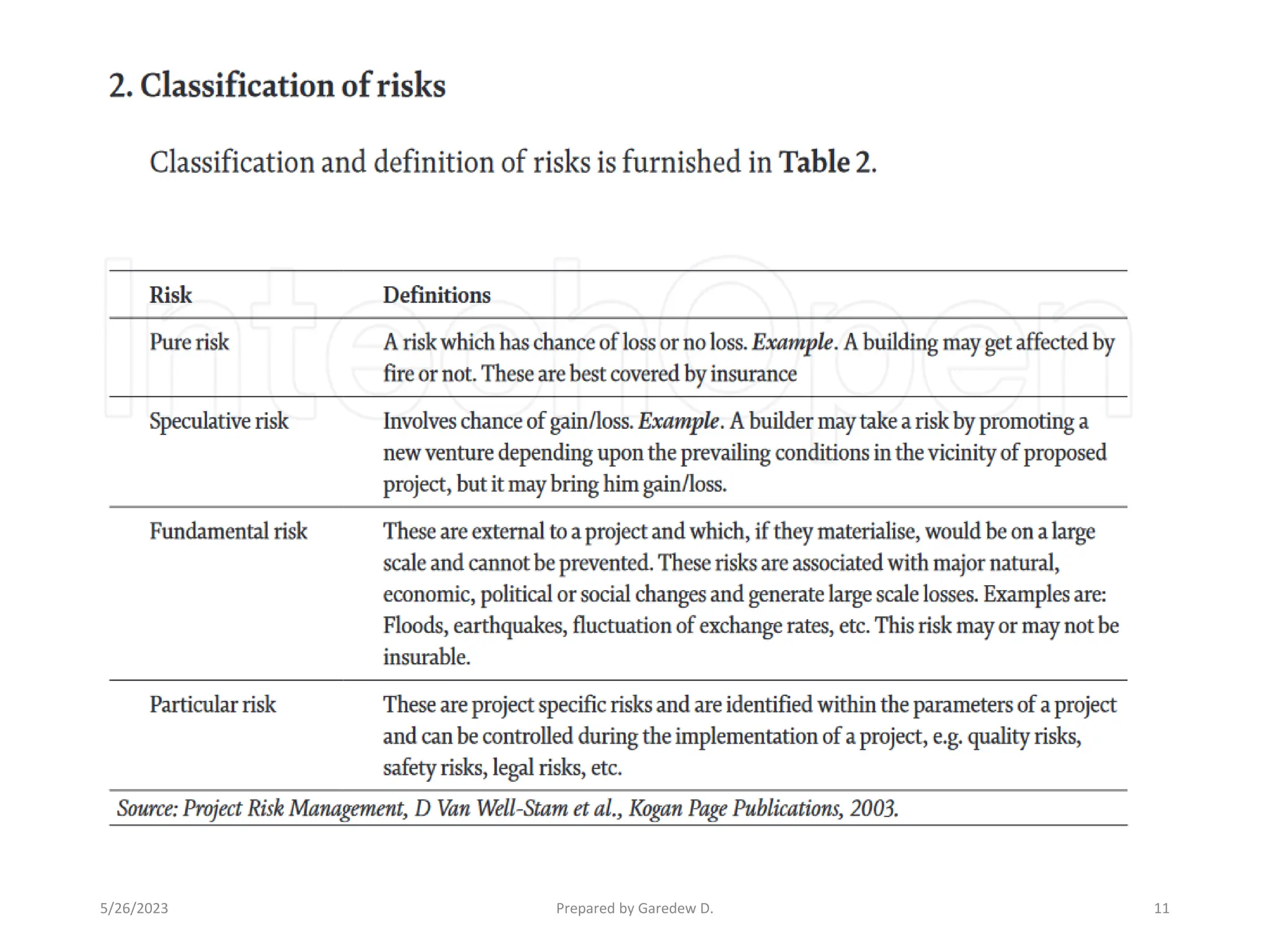
5/26/2023 Prepared by Garedew D. 11
1.3 Risk Management: Definitions, Purpose and scope
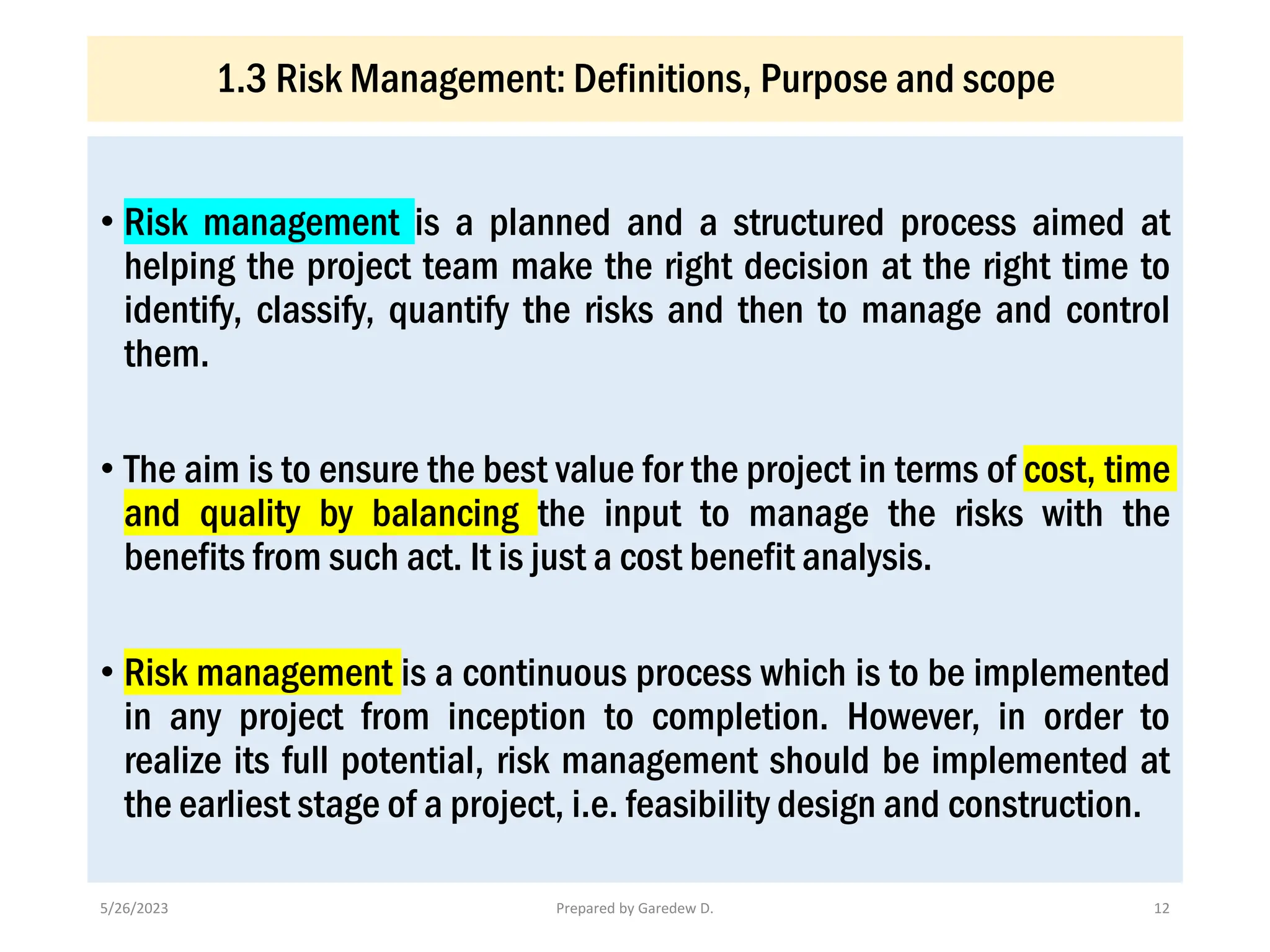
• Risk management is a planned and a structured process aimed at
helping the project team make the right decision at the right time to
identify, classify, quantify the risks and then to manage and control
them.
• The aim is to ensure the best value for the project in terms of cost, time
and quality by balancing the input to manage the risks with the
benefits from such act. It is just a cost benefit analysis.
• Risk management is a continuous process which is to be implemented
in any project from inception to completion. However, in order to
realize its full potential, risk management should be implemented at
the earliest stage of a project, i.e. feasibility design and construction.
5/26/2023 Prepared by Garedew D. 12
5/26/2023 Prepared by Garedew D. 13
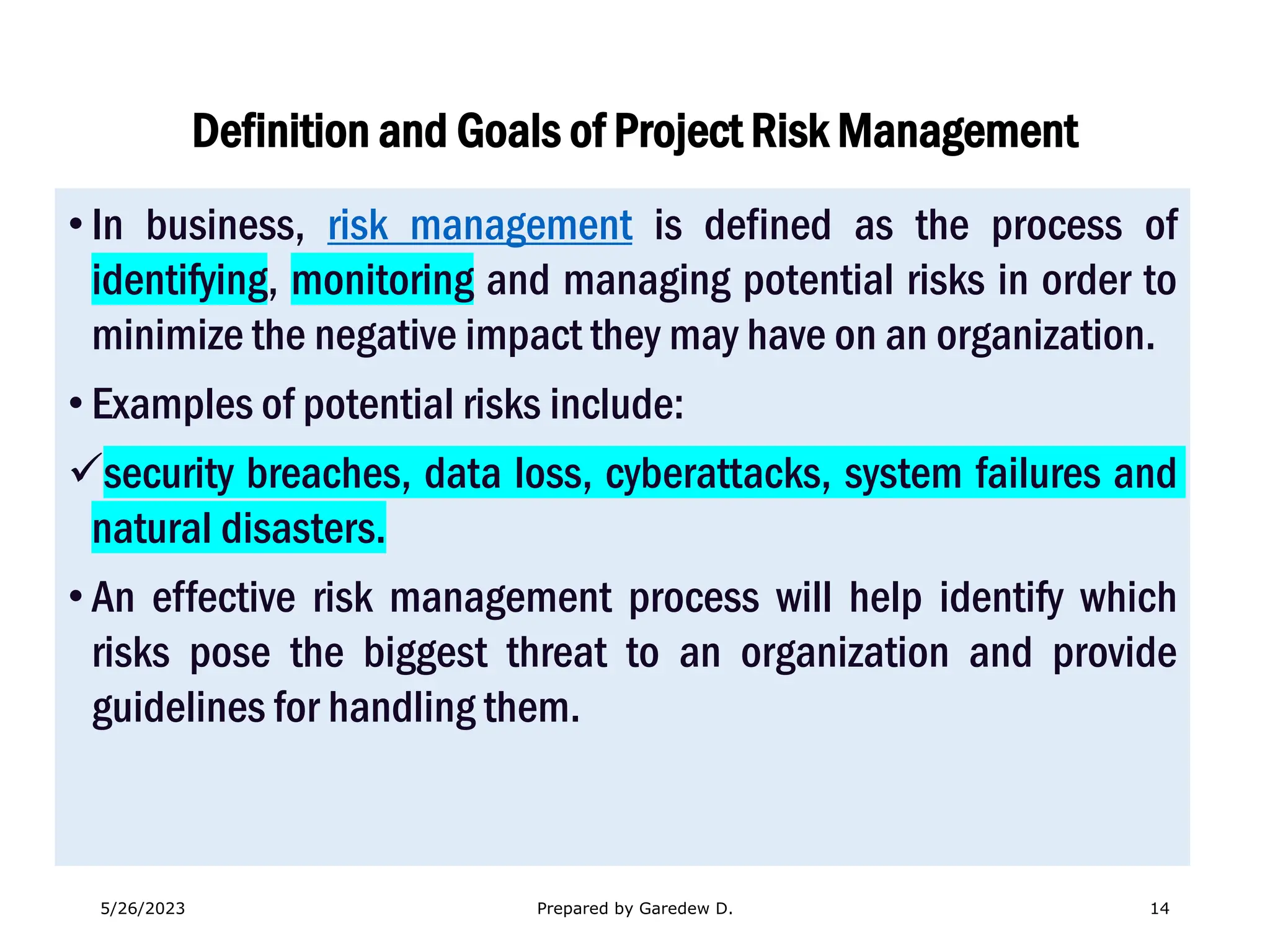
Definition and Goals of Project Risk Management
• In business, risk management is defined as the process of
identifying, monitoring and managing potential risks in order to
minimize the negative impact they may have on an organization.
• Examples of potential risks include:
✓security breaches, data loss, cyberattacks, system failures and
natural disasters.
• An effective risk management process will help identify which
risks pose the biggest threat to an organization and provide
guidelines for handling them.
5/26/2023 Prepared by Garedew D. 14
5/26/2023 Prepared by Garedew D. 15
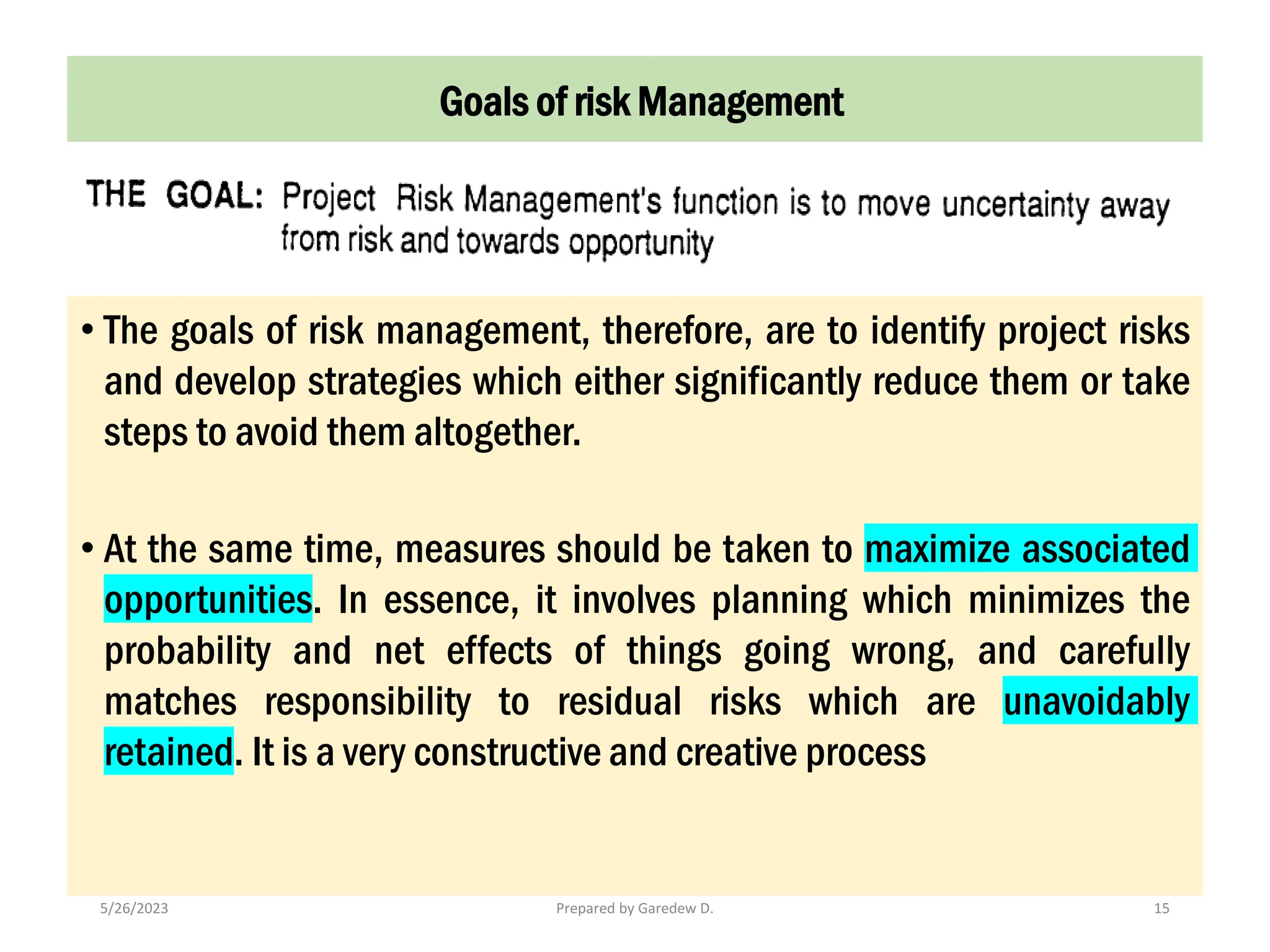
• The goals of risk management, therefore, are to identify project risks
and develop strategies which either significantly reduce them or take
steps to avoid them altogether.
• At the same time, measures should be taken to maximize associated
opportunities. In essence, it involves planning which minimizes the
probability and net effects of things going wrong, and carefully
matches responsibility to residual risks which are unavoidably
retained. It is a very constructive and creative process
Goals of risk Management
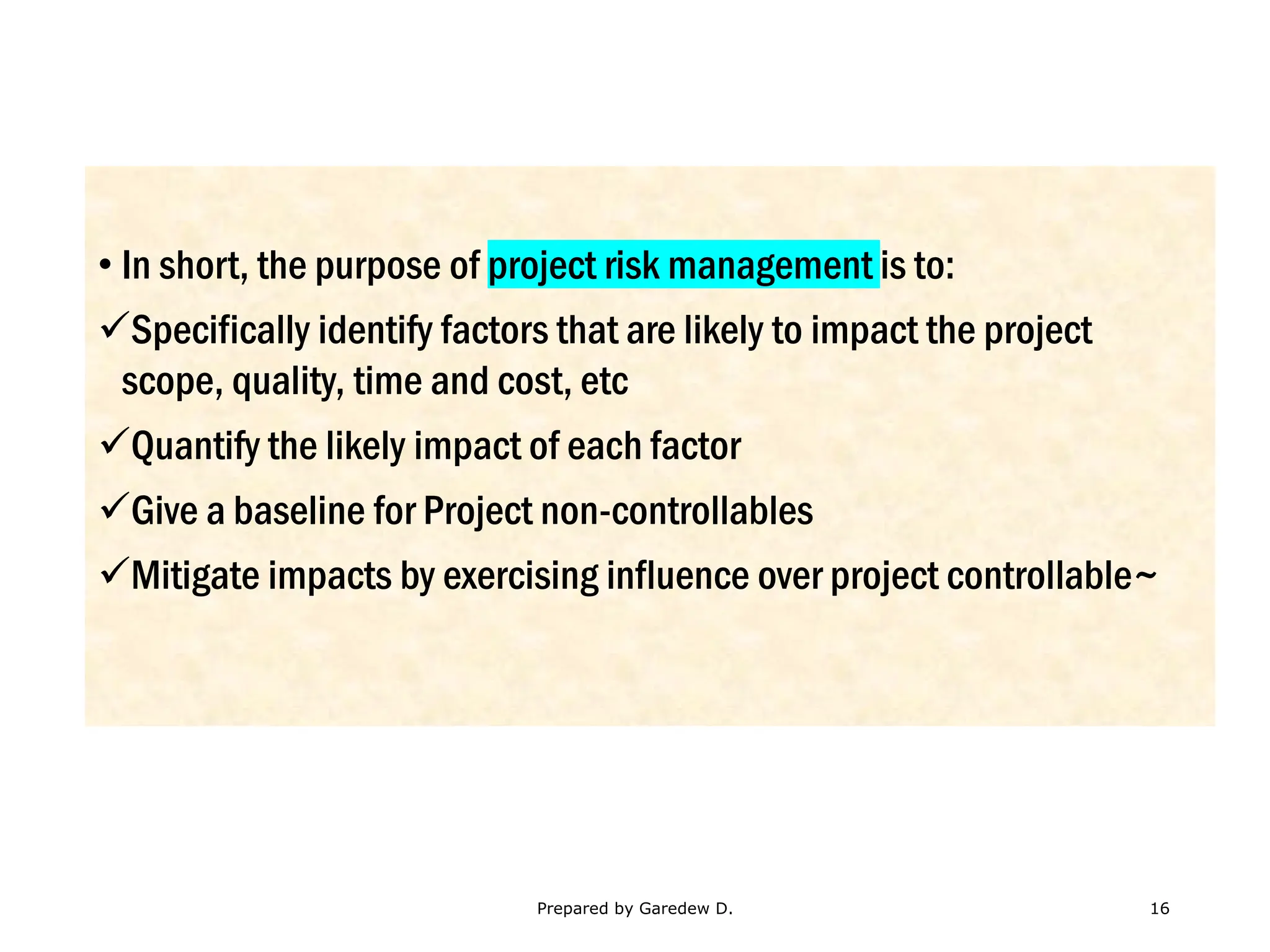
• In short, the purpose of project risk management is to:
✓Specifically identify factors that are likely to impact the project
scope, quality, time and cost, etc
✓Quantify the likely impact of each factor
✓Give a baseline for Project non-controllables
✓Mitigate impacts by exercising influence over project controllable~
Prepared by Garedew D. 16
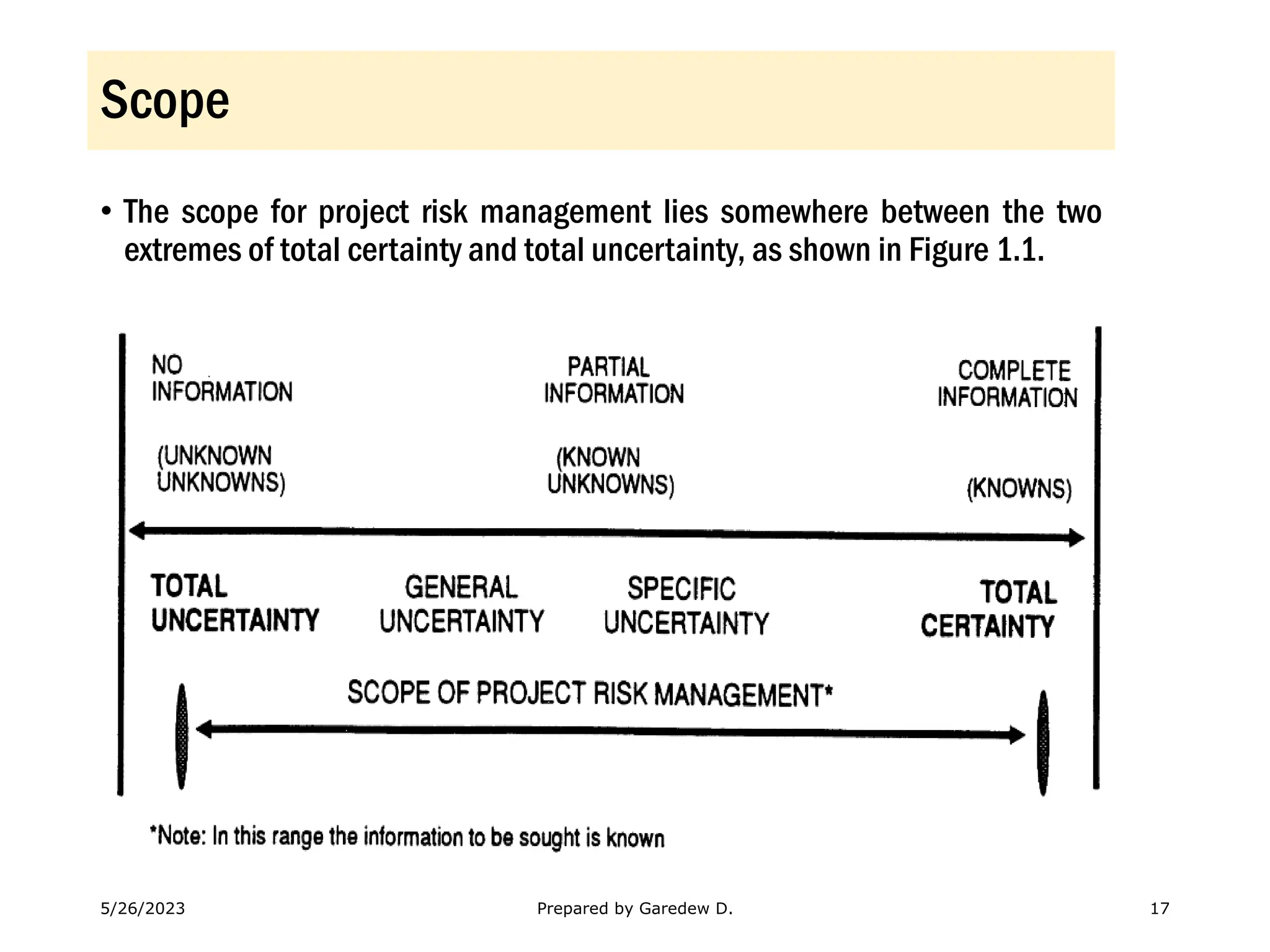
Scope
• The scope for project risk management lies somewhere between the two
extremes of total certainty and total uncertainty, as shown in Figure 1.1.
5/26/2023 Prepared by Garedew D. 17
•The constant goal of project risk management should be to
move uncertainty away from risk and towards opportunity.
•Consequently, when assessing overall impacts of
uncertainty on a project, it is the net project risk which
should be determined, i.e., the cumulative net effects of the
chances of both adverse and favorable consequences
affecting project objectives.
5/26/2023 Prepared by Garedew D. 18

1.1 Understanding Risks and Uncertainity.pdf

  • 1.
    1.2 Understanding Risksand uncertainty 5/26/2023 Prepared by Garedew D. 1
  • 2.
    1.1 Definition ofRisk •Risk is an uncertain event or condition that, if occurs, has a positive or negative effect on a project’s objectives. Components of risk are the probability of the occurrence of an event and the impact of the occurrence of that event. •Risk is defined in terms of uncertain events which may have positive or negative effect on the project objectives. •Risks include circumstances or situations, the existence or occurrence of which results in an adverse impact on any aspect of the implementation of the project. •Various definitions of risks are presented in Table 1. 5/26/2023 Prepared by Garedew D. 2
  • 3.
  • 4.
    • A Projectrisk is anything that could impact a project’s success by either delaying the project timeline, overloading the budget, or leading to reduced project performance in some other way. • With an effective risk management plan, it is necessary to address any potential risks that might crop up during the lifecycle of a project and mitigate them so your project stays on track, on budget, and on target. 5/26/2023 Prepared by Garedew D. 4
  • 5.
    5/26/2023 Prepared byGaredew D. 5 • Risk is actually a measure of the amount of uncertainty that exists. It’s directly tied to information. This is not exactly the way most of us think about risk in everyday situations. • However, in the world of project management, risk relates primarily to the extent of your ability to predict a particular outcome with certainty.
  • 6.
    • Threat:The effectsof risk can be positive or negative. Positive effects of risk are often referred to as opportunities. • Threats are the negative—or “downside”— effects of risk. ✓Threats are specific events that drive your project in the direction of outcomes viewed as unfavorable (e.g., schedule delays, cost overruns, and inferior product performance). • Risk can be broken down into two basic components. • Risk = Probability x Impact • Probability: The likelihood of the event happening. • Impact: The potential impact of the risk event 5/26/2023 Prepared by Garedew D. 6
  • 7.
    •Uncertainty is definedas an absence of information, knowledge, or understanding regarding the outcome of an action, decision, or event. •Project managers constantly suffer from an absence of information, knowledge, or understanding. 5/26/2023 Prepared by Garedew D. 7 C. Uncertainty, Opportunity and Risk
  • 8.
    5/26/2023 Prepared byGaredew D. 8 • uncertainty, opportunity and risk are closely allied. It can be visualized that unknowns about the future may turn out to be either favorable or unfavorable, but lack of knowledge of future events constitutes uncertainty • so that uncertainty is simply the set of all possible outcomes, both favorable and unfavorable. • In this relationship, the probability of those outcomes which are favorable may be viewed as opportunity, while the probability of those outcomes which are unfavorable represent risk
  • 9.
    • Similarly, mostopportunities when pursued carry with them associated risks and, generally speaking, the greater the opportunity, the greater is the degree of uncertainty and the consequent associated risk. • Thus, opportunity and risk are also tied together and, indeed, one may be seen as the corollary of the other. This relationship is shown diagrammatically in Figure 1.2. 5/26/2023 Prepared by Garedew D. 9
  • 10.
    Types And ElementsOf Risks • What Are Risk Categories? • A risk category is a high-level classification of project management risks. The two overarching risk categories are project-level risks and business-level risks, which can be broken down into subcategories. Risk categories account for both internal and external sources of risk. • Project-Level Risks: Project-level risks have the potential to affect results at the project level. Project risks can include factors related to budgeting, resource management, scheduling, and more. • Business-Level Risks: Business-level risks have the potential to affect the overall operations of a business. These include factors such as project prioritization, governance, customer satisfaction, and workforce risks. • These risk categories can each be broken down on each level into financial risks, strategic risks, performance risks, and external risks. 5/26/2023 Prepared by Garedew D. 10
  • 11.
    5/26/2023 Prepared byGaredew D. 11
  • 12.
    1.3 Risk Management:Definitions, Purpose and scope • Risk management is a planned and a structured process aimed at helping the project team make the right decision at the right time to identify, classify, quantify the risks and then to manage and control them. • The aim is to ensure the best value for the project in terms of cost, time and quality by balancing the input to manage the risks with the benefits from such act. It is just a cost benefit analysis. • Risk management is a continuous process which is to be implemented in any project from inception to completion. However, in order to realize its full potential, risk management should be implemented at the earliest stage of a project, i.e. feasibility design and construction. 5/26/2023 Prepared by Garedew D. 12
  • 13.
    5/26/2023 Prepared byGaredew D. 13
  • 14.
    Definition and Goalsof Project Risk Management • In business, risk management is defined as the process of identifying, monitoring and managing potential risks in order to minimize the negative impact they may have on an organization. • Examples of potential risks include: ✓security breaches, data loss, cyberattacks, system failures and natural disasters. • An effective risk management process will help identify which risks pose the biggest threat to an organization and provide guidelines for handling them. 5/26/2023 Prepared by Garedew D. 14
  • 15.
    5/26/2023 Prepared byGaredew D. 15 • The goals of risk management, therefore, are to identify project risks and develop strategies which either significantly reduce them or take steps to avoid them altogether. • At the same time, measures should be taken to maximize associated opportunities. In essence, it involves planning which minimizes the probability and net effects of things going wrong, and carefully matches responsibility to residual risks which are unavoidably retained. It is a very constructive and creative process Goals of risk Management
  • 16.
    • In short,the purpose of project risk management is to: ✓Specifically identify factors that are likely to impact the project scope, quality, time and cost, etc ✓Quantify the likely impact of each factor ✓Give a baseline for Project non-controllables ✓Mitigate impacts by exercising influence over project controllable~ Prepared by Garedew D. 16
  • 17.
    Scope • The scopefor project risk management lies somewhere between the two extremes of total certainty and total uncertainty, as shown in Figure 1.1. 5/26/2023 Prepared by Garedew D. 17
  • 18.
    •The constant goalof project risk management should be to move uncertainty away from risk and towards opportunity. •Consequently, when assessing overall impacts of uncertainty on a project, it is the net project risk which should be determined, i.e., the cumulative net effects of the chances of both adverse and favorable consequences affecting project objectives. 5/26/2023 Prepared by Garedew D. 18