OUR TOPIC IS
 RIghT TO
eqUalITy....
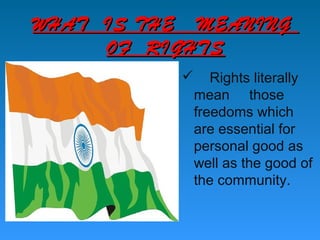
WHAT IS THE MEANING
     OF RIGHTS
                 Rights literally
               mean those
               freedoms which
               are essential for
               personal good as
               well as the good of
               the community.
THE RIGHTS OF AN
           INDIAN
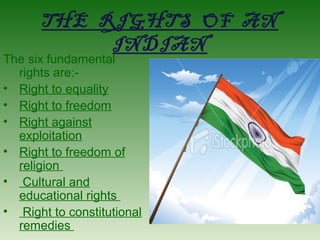
The six fundamental
  rights are:-
• Right to equality
• Right to freedom
• Right against
  exploitation
• Right to freedom of
  religion
• Cultural and
  educational rights
• Right to constitutional
  remedies
RIghT TO
FReedOm
RIGHT
   AGAINST
EXPLIOTATION
The RIghT TO
 FReedOm OF
  RelIgION
CUL URAL AND
   T
EDUCATIONAL
   RIGH S
       T
Right To
Constitutional
  Remedies
Right To
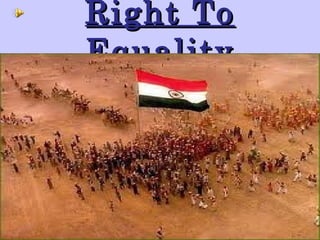
Equality
RULE OF LAW
o The laws apply in the same manner to all regardless of a
  person’s status this is called rule of law.
o The rule of law respects us as equals. It allows us to
  organize our lives, plan our futures, and resolve disputes in a
  rational way.
o It means that no person is above the law,there is no
  distinction between a political leader , government official
  and an ordinary citizen.
o Every citizen , from the prime minister to a small farmer in a
  remote village , is subjected to the same laws .
o No person can legally claim any special treatment or
  privilage just because he/she happens to be an important
  person.
Implications of right to
             equality
 The government shall discriminate against any citizen
  on grounds only of religion.
 Every citizen shall have access to public places like
  shops,restaurants,hotels and cinema halls.
 There shall be no restriction with regard to the use of
  wells,tanks,bathing ghats,roads,and places of public
  resorts maintained by govt or dedicated to the use of
  general public.
 But traditional caste system didnot allow people from
  some communities to acess all public places.
Equality of job opportunities.
 Equality doesnot mean giving everyone the same
  treatment , no matter what they need .
 Equality means giving everyone an equal opportunity
  to achieve whatever one is capable of .
 All citizens have equality of opportunity in matters
  relating to employment /appointment to any position in
  the government.
 No citizen shall be discriminated against or made
  ineligible for employment on the grounds mentioned
  above .
 The govt has provided reservations for SC and ST and
  OBC.
 But this does not violate the right to equality .
Untouchability (Extreme Form Of Social
            Discrimination)
 The constitution mentions one extreme form of social
  discrimination, the practice of untouchability and clearly directs
  the govt to put an end to it.
 Untouchability is forbidden in any form.
 Untouchability here doesnot mean refusal to touch people
  belonging to certain castes.
 Instead it refers to any belief or social practice which looks
  down on people on account of there birth with certain caste
  labels .
 These type of practice denies them to interact with others or
  acess to public places as equal citizens.
 Our constitution has made untouchability a punishable offense.
Forms Of Untouchability
    In 1999, P.sainath wrote a series of news reports in The Hindu describing
    untouchability and caste discrimination that was still practiced against dalits
    and people belonging to SC . He travelled to various parts of the country
    and found that in many places:-
    tea stalls kept to kinds of cups , one for dalits one for others;
   Barbers refused to serve dalit clients;
   Dalit students were made sit separately in the classroom or drink water from
    separate picher ;
    dalit grooms were not allowed to ride a horse in the wedding procession ;
    and
   Dalits were not allowed to use common hand pump or if they did , the hand
    pump was washed to purify it.

    all these fall under the category of untouchability.
Th
   a
       NK
            yO
              U

Right to equality

  • 2.
    OUR TOPIC IS RIghT TO eqUalITy....
  • 5.
    WHAT IS THEMEANING OF RIGHTS  Rights literally mean those freedoms which are essential for personal good as well as the good of the community.
  • 6.
    THE RIGHTS OFAN INDIAN The six fundamental rights are:- • Right to equality • Right to freedom • Right against exploitation • Right to freedom of religion • Cultural and educational rights • Right to constitutional remedies
  • 7.
  • 8.
    RIGHT AGAINST EXPLIOTATION
  • 9.
    The RIghT TO FReedOm OF RelIgION
  • 10.
    CUL URAL AND T EDUCATIONAL RIGH S T
  • 11.
  • 12.
  • 13.
    RULE OF LAW oThe laws apply in the same manner to all regardless of a person’s status this is called rule of law. o The rule of law respects us as equals. It allows us to organize our lives, plan our futures, and resolve disputes in a rational way. o It means that no person is above the law,there is no distinction between a political leader , government official and an ordinary citizen. o Every citizen , from the prime minister to a small farmer in a remote village , is subjected to the same laws . o No person can legally claim any special treatment or privilage just because he/she happens to be an important person.
  • 14.
    Implications of rightto equality  The government shall discriminate against any citizen on grounds only of religion.  Every citizen shall have access to public places like shops,restaurants,hotels and cinema halls.  There shall be no restriction with regard to the use of wells,tanks,bathing ghats,roads,and places of public resorts maintained by govt or dedicated to the use of general public.  But traditional caste system didnot allow people from some communities to acess all public places.
  • 15.
    Equality of jobopportunities.  Equality doesnot mean giving everyone the same treatment , no matter what they need .  Equality means giving everyone an equal opportunity to achieve whatever one is capable of .  All citizens have equality of opportunity in matters relating to employment /appointment to any position in the government.  No citizen shall be discriminated against or made ineligible for employment on the grounds mentioned above .  The govt has provided reservations for SC and ST and OBC.  But this does not violate the right to equality .
  • 16.
    Untouchability (Extreme FormOf Social Discrimination)  The constitution mentions one extreme form of social discrimination, the practice of untouchability and clearly directs the govt to put an end to it.  Untouchability is forbidden in any form.  Untouchability here doesnot mean refusal to touch people belonging to certain castes.  Instead it refers to any belief or social practice which looks down on people on account of there birth with certain caste labels .  These type of practice denies them to interact with others or acess to public places as equal citizens.  Our constitution has made untouchability a punishable offense.
  • 17.
    Forms Of Untouchability In 1999, P.sainath wrote a series of news reports in The Hindu describing untouchability and caste discrimination that was still practiced against dalits and people belonging to SC . He travelled to various parts of the country and found that in many places:-  tea stalls kept to kinds of cups , one for dalits one for others;  Barbers refused to serve dalit clients;  Dalit students were made sit separately in the classroom or drink water from separate picher ;  dalit grooms were not allowed to ride a horse in the wedding procession ; and  Dalits were not allowed to use common hand pump or if they did , the hand pump was washed to purify it. all these fall under the category of untouchability.
  • 18.
    Th a NK yO U