Philosophical Foundations of the General Right to Equality „ It is thought that justice is equality, and so it is, though not for everybody but only for those who are equals; and it is thought that inequality is just, for so indeed it is, though not for everybody, but for those who are unequal.” Aristotle:  Politics  (1280a)
Overview The doctrinal background and the definition of the General Right to Equality (GRE) Justification of GRE Concluding remarks:  the  broader theoretical context
The General Right to Equality Article 14 . Prohibition of discrimination The enjoyment of the rights and freedoms set forth in this Convention  (the scope of the prohibition) shall be secured without discrimination  (the prohibition of discrimination) on any ground such as sex, race, colour, language, religion, political or other opinion, national or social origin, association with a national minority, property, birth or other status.  (the grounds of discrimination)
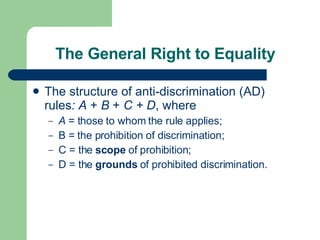
The General Right to Equality The   structure of anti-discrimination (AD) rules : A  +  B  +  C + D , where  A  = those to whom the rule applies; B = the prohibition of discrimination; C = the  scope  of prohibition; D = the  grounds  of prohibited discrimination.
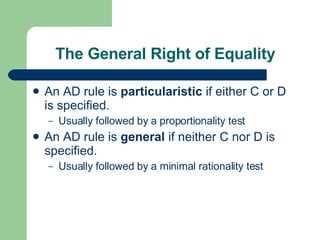
The General Right of Equality An AD rule is  particularistic  if either C or D is specified.  Usually followed by  a  proportionality test An AD rule is  general  if neither C nor D is specified. Usually followed by a minimal rationality test
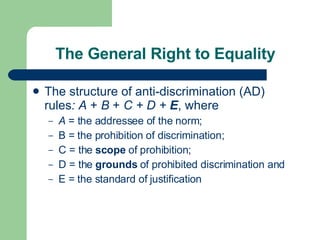
The General Right to Equality The   structure of anti-discrimination (AD) rules : A  +  B  +  C + D +  E , where  A  = the addressee of the norm; B = the prohibition of discrimination; C = the  scope  of prohibition; D = the  grounds  of prohibited discrimination and E = the standard of justification
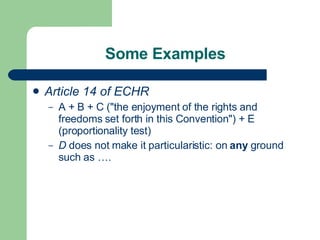
Some Examples Article 14 of ECHR  A + B  + C  ("the enjoyment of the rights and freedoms set forth in this Convention") +  E  (proportionality test) D   does not make it  particularistic: on  any  ground such as ….
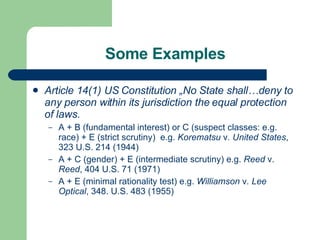
Some Examples Article 14(1) US Constitution  „No State shall…deny to any person within its jurisdiction the equal protection of laws. A + B (fundamental interest) or C (suspect classes: e.g. race) +  E  (strict scrutiny)  e.g.  Korematsu  v . United States , 323 U.S. 214 (1944) A + C ( gender )  + E (intermediate scrutiny) e.g.  Reed  v.  Reed , 404 U.S. 71 (1971) A +  E  (minimal rationality test) e.g.   Williamson  v . Lee Optical , 348. U.S. 483 (1955)
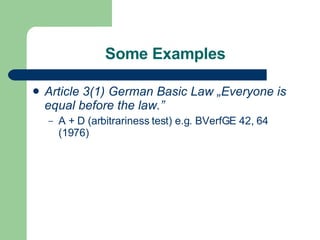
Some Examples Article 3(1) German Basic Law  „ Everyone is equal before the law. ”   A + D (arbitrariness test) e.g. BVerfGE 42, 64 (1976)
The Simple Model: Discrimination as Injustice – a Preliminary Formulation Justice requires treating like cases alike. GRE authorizes constitutional courts to assess whether the legislature treated like cases alike.
An Example: „ The principle of equality is breached, when a persuasive and reasonable ground, arising from the nature of the subject-matter or some other material circumstance, cannot be given for the differentiation or similarity of treatment, in short, when the provision can only be called arbitrary." BVerfGE 1, 14, 52 (1951)
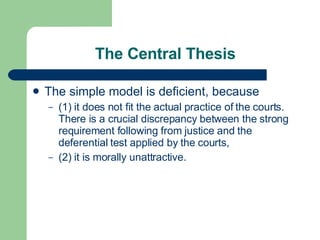
The Central Thesis The simple model is deficient, because (1) it does not fit the actual practice of the courts. There is a crucial discrepancy between the strong requirement following from justice and the deferential test applied by the courts,  (2) it is morally unattractive.
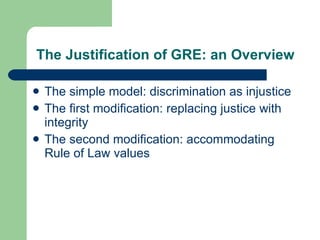
The Justification of GRE: an Overview The simple model: discrimination as injustice The first modification: replacing justice with integrity The second modification: accommodating Rule of Law values
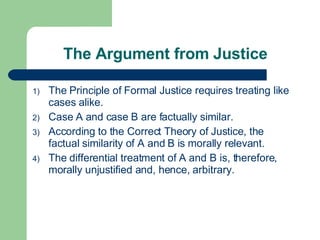
The Argument from Justice The Principle of Formal Justice requires treating like cases alike. Case A and case B are factually similar. According to the Correct Theory of Justice, the factual similarity of A and B is morally relevant. The differential treatment of A and B is, therefore, morally unjustified and, hence, arbitrary.
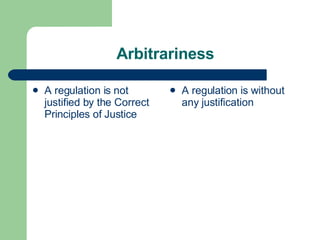
Arbitrariness A regulation is not justified by the Correct Principles of Justice  A regulation is without any justification
Replacing Justice with Integrity First-order and second-order political values First-order values: contribute to the substance of moral debates. Second-order values: help us to cope with moral disagreement  over  first order values.
Replacing Justice with Integrity We need  fairness  to decide which conception of justice we, as a political community, should pursue.  But, we also need  integrity --  that is, the value that guarantees that whichever conception of justice we decide to pursue, we will pursue it coherently.
Replacing Justice with Integrity (1) The Principle of Formal Justice requires treating like cases alike. (2) Case A and case B are factually similar. (3) According to the Correct Theory of Justice, the factual similarity of A and B is morally relevant. (3)  According to the legislature's conception of justice,  the factual similarity of A and B is morally relevant.  (4)The differential treatment of A and B is morally unjustified and, hence, arbitrary.
Comment No.1 „ The principle of equality is breached, when a persuasive and reasonable ground, arising from  the nature of the subject-matter  or some  other material circumstance , cannot be given for the differentiation or similarity of treatment, in short, when the provision can only be called arbitrary." BVerfGE 1, 14, 52 (1951)
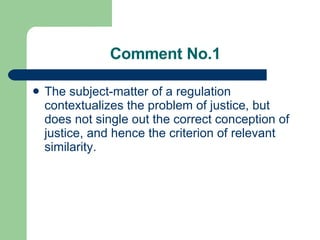
Comment No.1 The subject-matter of a regulation contextualize s  the problem of justice, but does not single out the correct conception of justice, and hence the criterion of relevant similarity.
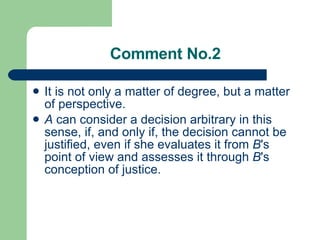
Comment No.2 It is not only a matter of degree, but a matter of perspective. A  can consider a decision arbitrary in this sense, if , and only if,  the decision cannot be justified, even if she evaluates it from  B 's point of view and assesses it through  B 's conception of justice. 
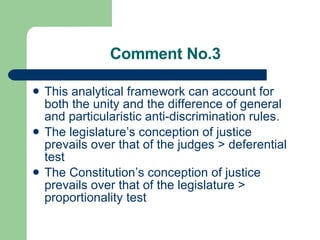
Comment No.3 This analytical framework can account for both the unity and the difference of general and particularistic anti-discrimination rules.  The legislature’s conception of justice prevails over that of the judges > deferential test The Constitution’s conception of justice prevails over that of the legislature > proportionality test
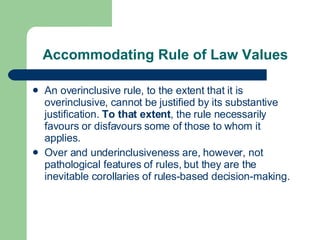
Accommodating Rule of Law Values An overinclusive rule ,  to the extent that it is overinclusive ,  cannot be justified by its substantive justification.  To that extent , the rule necessarily favours or disfavours  some of  those to whom it applies . Over and underinclusiveness are, however, not  pathological features of rules, but they are the inevitable corollaries of rules-based decision-making.
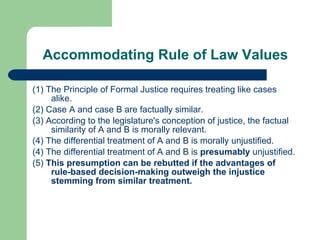
Accommodating Rule of Law Values (1) The Principle of Formal Justice requires treating like cases alike. (2) Case A and case B are factually similar. (3) According to the legislature's conception of justice, the factual similarity of A and B is morally relevant.  (4) The differential treatment of A and B is morally unjustified.  (4) The differential treatment of A and B is  presumably  unjustified. (5)  This presumption can be rebutted if the advantages of rule-based decision - making outweigh the injustice stemming from similar treatment.
The Nature of Law Law is a rule-centred social practice Law is an argumentative practice Law is an authoritative social practice
The Nature of Law and GRE GRE subjects the legislature's reasoning to further scrutiny > law's  arguable character   GRE gives a pre - eminent place to the conception of justice held by the legislature > law’s  authoritative character GRE accommodates Rule of Law values > law’s  rule-based character
References Robert Alexy,  A Theory of Constitutional Rights  (Oxford: Oxford University Press, 2002).  Ronald Dworkin,  Law's Empire  (Cambridge, Mass: Belknap Press, 1986).  Donald P Kommers,  The Constitutional Jurisprudence of the Federal Republic of Germany , 2nd ed., rev. and expanded (Durham, N.C: Duke University Press, 1997).  Neil MacCormick,  Rhetoric and the Rule of Law: A Theory of Legal Reasoning  (Oxford: Oxford University Press, 2005).  Frederick F Schauer,  Playing by the Rules: A Philosophical Examination of Rule-Based Decision-Making in Law and in Life , Clarendon law series (Oxford, England: Clarendon Press, 1991).  Jeremy Waldron,  Law and Disagreement  (Oxford: Clarendon Press, 1999).

equality.ppt

  • 1.
    Philosophical Foundations ofthe General Right to Equality „ It is thought that justice is equality, and so it is, though not for everybody but only for those who are equals; and it is thought that inequality is just, for so indeed it is, though not for everybody, but for those who are unequal.” Aristotle: Politics (1280a)
  • 2.
    Overview The doctrinalbackground and the definition of the General Right to Equality (GRE) Justification of GRE Concluding remarks: the broader theoretical context
  • 3.
    The General Rightto Equality Article 14 . Prohibition of discrimination The enjoyment of the rights and freedoms set forth in this Convention (the scope of the prohibition) shall be secured without discrimination (the prohibition of discrimination) on any ground such as sex, race, colour, language, religion, political or other opinion, national or social origin, association with a national minority, property, birth or other status. (the grounds of discrimination)
  • 4.
    The General Rightto Equality The structure of anti-discrimination (AD) rules : A + B + C + D , where A = those to whom the rule applies; B = the prohibition of discrimination; C = the scope of prohibition; D = the grounds of prohibited discrimination.
  • 5.
    The General Rightof Equality An AD rule is particularistic if either C or D is specified. Usually followed by a proportionality test An AD rule is general if neither C nor D is specified. Usually followed by a minimal rationality test
  • 6.
    The General Rightto Equality The structure of anti-discrimination (AD) rules : A + B + C + D + E , where A = the addressee of the norm; B = the prohibition of discrimination; C = the scope of prohibition; D = the grounds of prohibited discrimination and E = the standard of justification
  • 7.
    Some Examples Article14 of ECHR A + B + C ("the enjoyment of the rights and freedoms set forth in this Convention") + E (proportionality test) D does not make it particularistic: on any ground such as ….
  • 8.
    Some Examples Article14(1) US Constitution „No State shall…deny to any person within its jurisdiction the equal protection of laws. A + B (fundamental interest) or C (suspect classes: e.g. race) + E (strict scrutiny)  e.g. Korematsu v . United States , 323 U.S. 214 (1944) A + C ( gender ) + E (intermediate scrutiny) e.g. Reed v. Reed , 404 U.S. 71 (1971) A + E (minimal rationality test) e.g. Williamson v . Lee Optical , 348. U.S. 483 (1955)
  • 9.
    Some Examples Article3(1) German Basic Law „ Everyone is equal before the law. ” A + D (arbitrariness test) e.g. BVerfGE 42, 64 (1976)
  • 10.
    The Simple Model:Discrimination as Injustice – a Preliminary Formulation Justice requires treating like cases alike. GRE authorizes constitutional courts to assess whether the legislature treated like cases alike.
  • 11.
    An Example: „The principle of equality is breached, when a persuasive and reasonable ground, arising from the nature of the subject-matter or some other material circumstance, cannot be given for the differentiation or similarity of treatment, in short, when the provision can only be called arbitrary." BVerfGE 1, 14, 52 (1951)
  • 12.
    The Central ThesisThe simple model is deficient, because (1) it does not fit the actual practice of the courts. There is a crucial discrepancy between the strong requirement following from justice and the deferential test applied by the courts, (2) it is morally unattractive.
  • 13.
    The Justification ofGRE: an Overview The simple model: discrimination as injustice The first modification: replacing justice with integrity The second modification: accommodating Rule of Law values
  • 14.
    The Argument fromJustice The Principle of Formal Justice requires treating like cases alike. Case A and case B are factually similar. According to the Correct Theory of Justice, the factual similarity of A and B is morally relevant. The differential treatment of A and B is, therefore, morally unjustified and, hence, arbitrary.
  • 15.
    Arbitrariness A regulationis not justified by the Correct Principles of Justice A regulation is without any justification
  • 16.
    Replacing Justice withIntegrity First-order and second-order political values First-order values: contribute to the substance of moral debates. Second-order values: help us to cope with moral disagreement over first order values.
  • 17.
    Replacing Justice withIntegrity We need fairness to decide which conception of justice we, as a political community, should pursue. But, we also need integrity -- that is, the value that guarantees that whichever conception of justice we decide to pursue, we will pursue it coherently.
  • 18.
    Replacing Justice withIntegrity (1) The Principle of Formal Justice requires treating like cases alike. (2) Case A and case B are factually similar. (3) According to the Correct Theory of Justice, the factual similarity of A and B is morally relevant. (3) According to the legislature's conception of justice, the factual similarity of A and B is morally relevant. (4)The differential treatment of A and B is morally unjustified and, hence, arbitrary.
  • 19.
    Comment No.1 „The principle of equality is breached, when a persuasive and reasonable ground, arising from the nature of the subject-matter or some other material circumstance , cannot be given for the differentiation or similarity of treatment, in short, when the provision can only be called arbitrary." BVerfGE 1, 14, 52 (1951)
  • 20.
    Comment No.1 Thesubject-matter of a regulation contextualize s the problem of justice, but does not single out the correct conception of justice, and hence the criterion of relevant similarity.
  • 21.
    Comment No.2 Itis not only a matter of degree, but a matter of perspective. A can consider a decision arbitrary in this sense, if , and only if, the decision cannot be justified, even if she evaluates it from B 's point of view and assesses it through B 's conception of justice. 
  • 22.
    Comment No.3 Thisanalytical framework can account for both the unity and the difference of general and particularistic anti-discrimination rules. The legislature’s conception of justice prevails over that of the judges > deferential test The Constitution’s conception of justice prevails over that of the legislature > proportionality test
  • 23.
    Accommodating Rule ofLaw Values An overinclusive rule , to the extent that it is overinclusive , cannot be justified by its substantive justification. To that extent , the rule necessarily favours or disfavours some of those to whom it applies . Over and underinclusiveness are, however, not pathological features of rules, but they are the inevitable corollaries of rules-based decision-making.
  • 24.
    Accommodating Rule ofLaw Values (1) The Principle of Formal Justice requires treating like cases alike. (2) Case A and case B are factually similar. (3) According to the legislature's conception of justice, the factual similarity of A and B is morally relevant. (4) The differential treatment of A and B is morally unjustified. (4) The differential treatment of A and B is presumably unjustified. (5) This presumption can be rebutted if the advantages of rule-based decision - making outweigh the injustice stemming from similar treatment.
  • 25.
    The Nature ofLaw Law is a rule-centred social practice Law is an argumentative practice Law is an authoritative social practice
  • 26.
    The Nature ofLaw and GRE GRE subjects the legislature's reasoning to further scrutiny > law's arguable character GRE gives a pre - eminent place to the conception of justice held by the legislature > law’s authoritative character GRE accommodates Rule of Law values > law’s rule-based character
  • 27.
    References Robert Alexy, A Theory of Constitutional Rights (Oxford: Oxford University Press, 2002). Ronald Dworkin, Law's Empire (Cambridge, Mass: Belknap Press, 1986). Donald P Kommers, The Constitutional Jurisprudence of the Federal Republic of Germany , 2nd ed., rev. and expanded (Durham, N.C: Duke University Press, 1997). Neil MacCormick, Rhetoric and the Rule of Law: A Theory of Legal Reasoning (Oxford: Oxford University Press, 2005). Frederick F Schauer, Playing by the Rules: A Philosophical Examination of Rule-Based Decision-Making in Law and in Life , Clarendon law series (Oxford, England: Clarendon Press, 1991). Jeremy Waldron, Law and Disagreement (Oxford: Clarendon Press, 1999).