RIGHT AGAINST EXPLOITATION
AND
CULTURAL
AND EDUCATIONAL RIGHTS
-SHIVANI SHARMA
-ASSISTANT PROFESSOR
-SARDAR PATEL SUBHARTI INSTITUTE OF LAW
ARTICLE 23-24
RIGHT AGAINST EXPLOITATION
ARTICLE - 23
• Prohibition of traffic in human beings and forced labour:
(1) Traffic in human beings and begar and other similar forms of
forced labour are prohibited and any contravention of this
provision shall be an offence punishable in accordance with law
(2) Nothing in this article shall prevent the State from imposing
compulsory service for public purpose, and in imposing such
service the State shall not make any discrimination on grounds
only of religion, race, caste or class or any of them
ARTICLE - 24
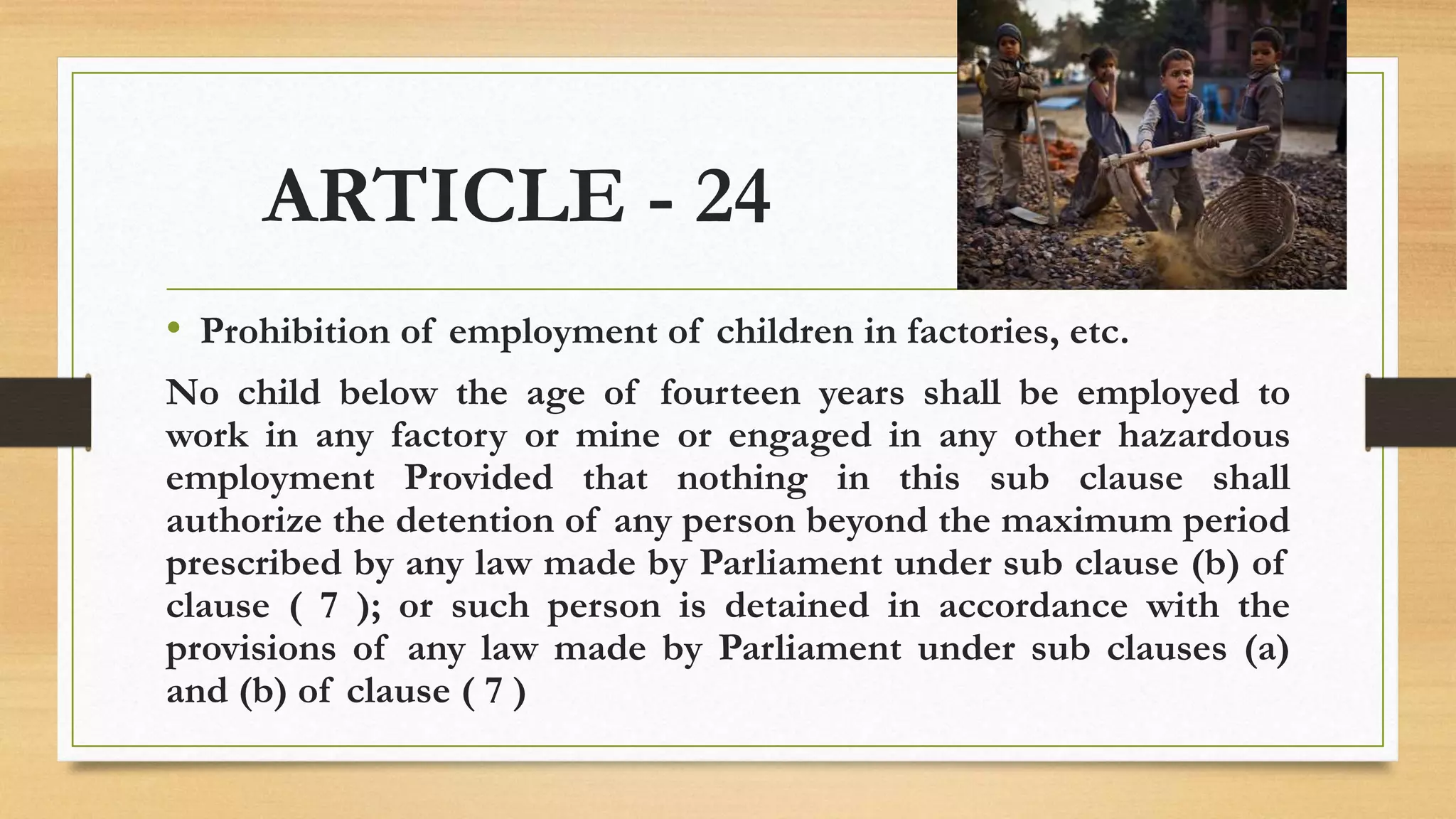
• Prohibition of employment of children in factories, etc.
No child below the age of fourteen years shall be employed to
work in any factory or mine or engaged in any other hazardous
employment Provided that nothing in this sub clause shall
authorize the detention of any person beyond the maximum period
prescribed by any law made by Parliament under sub clause (b) of
clause ( 7 ); or such person is detained in accordance with the
provisions of any law made by Parliament under sub clauses (a)
and (b) of clause ( 7 )
CASE STUDY
• PUDR vs UOI – PIL on Trafficking and Child Labor
• M.C. Mehta vs State of Tamil Nadu- Child Labor in Matchstick Industry
• Bandhua Mukti Morcha vs UOI- Child Labor in Carpet weaving Industry
• Rajangam vs State of Tamil Nadu- Child Labor in Beedi/Cigar Factory
• Gaurav Jain vs UOI – Rights of Children of Prostitutes
ARTICLE 29-30
CULTURAL
AND EDUCATIONAL RIGHTS
MEANING OF MINORITIES
• The Constitution of India used the word ‘minorities’ or its plural form in
some articles 29 to 30 and 350 A to 350 B.
• “But does not define it anywhere,” minister of state in the minority affairs
ministry Ninong Ering said in a written reply to a question in Rajya Sabha
• He said that Article 29 has the word ‘minorities’ in its marginal heading but
speaks of “any section of citizens having a distinct language script and
culture”.
• This may be a whole community generally seen as a minority or group
within a majority community.
CONT…
• 30 speaks specifically of two categories of minorities – religious
and linguistic.
• “As per clause (c) of section 2 of the National Commission for
Minorities Act, 1992, five communities vide Ministry of Welfare
notification dated 23rd October, 1993 are declared as minority
communities viz Muslims, Christians, Sikhs, Buddhists and
Zoroastrians (Parsis),”
MUSLIM
SIKHS CHRISTIAN
BUDDHIST
JAINSPARSIS
CONSTITUTIONAL DEBATES
• The whole debate in the Constituent Assembly on article 23 of the Draft
Constitution which later assumed the shape of the present article 29 and 30, revolve
round this issue: what rights could or should be conceded to minorities? The
reference to minorities was a reference to none other than Indian minorities existing
in India. The original draft of the fundamental rights submitted to the Constituent
assembly on April 16, 1947 by the Sub-Committee on Fundamental Rights did not
contain any provision corresponding to article 30(1) and did not even refer to the
word minority. The letter submitted by K.M. Munshi to the Minorities Sub-
Committee on the same date when, along with some other rights, the rights now
forming part of article 30(1) was proposed, made a reference on the term “national
minorities”.
CONT…
• Ambedkar sought to explain the reason the reason
for substitution in the Draft Constitution of the word
minority by the words "any section" observing:
“It will be noted that the term minority was used therein not in the
technical sense of the word 'minority’………. It will be noted that
the term minority was used therein not in the technical sense of the
word minority”
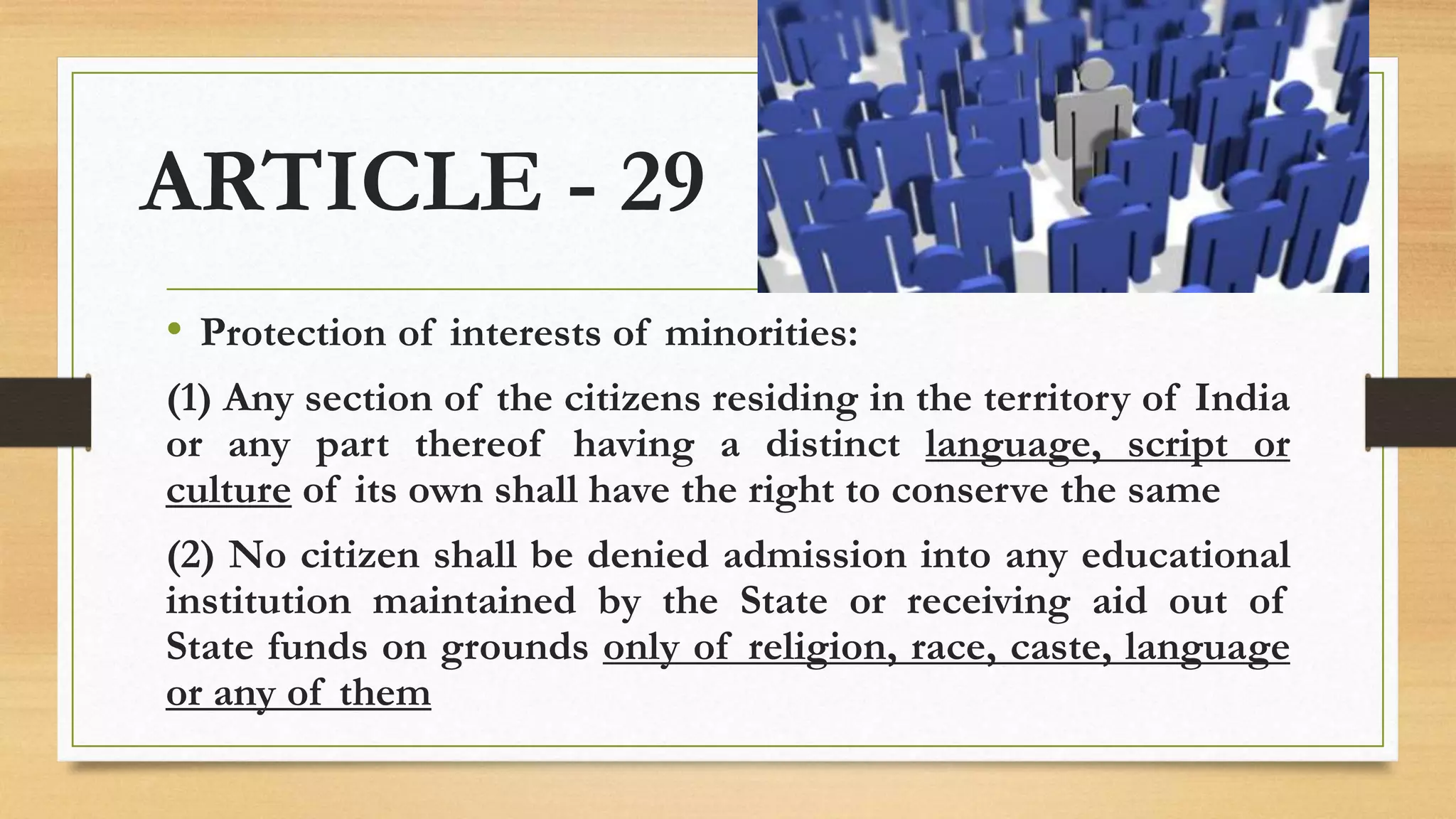
ARTICLE - 29
• Protection of interests of minorities:
(1) Any section of the citizens residing in the territory of India
or any part thereof having a distinct language, script or
culture of its own shall have the right to conserve the same
(2) No citizen shall be denied admission into any educational
institution maintained by the State or receiving aid out of
State funds on grounds only of religion, race, caste, language
or any of them
ARTICLE - 30
• Right of minorities to establish and administer educational institutions
(1) All minorities, whether based on religion or language, shall have the right to
establish and administer educational institutions of their choice
(1A) In making any law providing for the compulsory acquisition of any
property of an educational institution established and administered by a
minority, referred to in clause ( 1 ), the State shall ensure that the amount fixed
by or determined under such law for the acquisition of such property is such as
would not restrict or abrogate the right guaranteed under that clause
(2) The state shall not, in granting aid to educational institutions, discriminate
against any educational institution on the ground that it is under the
management of a minority, whether based on religion or language
RELATION BETWEEN ART. 29 AND 30
Article 29 and 30 are grouped together it will wrong to restrict the rights of minority to
establish and administer educational institution concerned with language script and
culture of the minorities. The reasons are:
• Firstly, article 29 confers the fundamental rights on any section of the citizen which
will include the majority also where as article 30(1) confers all rights on all minorities.
• Secondly, article 29(1) is concerned with language, script or culture, whereas article
30(1) deals with minorities based on religion or language.
• Thirdly, article 29(1) is concern with the right to conserve language, script or culture,
whereas article 30(1) deals with right to establish and administer educational
institutions of the minorities of their choice.
CASE STUDY
• Naresh Agarwal v Bharat (AMU Case)- AMU is
minority Institution
• Re Kerala Education Bill- Rights of minorities
• St. Stephens College vs DU- 50% reservation for minorities
• TMA Pai Foundation case- Relaxed the upper limit and
held reasonable % can be defined by State
CASE STUDY
• Frank Antony Public School Employees Association v UOI-
Increment of Faculty members
• Ahmedabad St. Xavier's College Society vs State of Gujarat-
Provisions of Gujarat University Act regarding compulsory teaching of Gujarati
is not applicable.
• S.P. Mittal vs Union of India- to claim benefit U/A 30 the community:
1. Should be religious or linguistic minority
2. It should be an establisher

Article 23,24,29,30

  • 1.
    RIGHT AGAINST EXPLOITATION AND CULTURAL ANDEDUCATIONAL RIGHTS -SHIVANI SHARMA -ASSISTANT PROFESSOR -SARDAR PATEL SUBHARTI INSTITUTE OF LAW
  • 2.
  • 3.
    ARTICLE - 23 •Prohibition of traffic in human beings and forced labour: (1) Traffic in human beings and begar and other similar forms of forced labour are prohibited and any contravention of this provision shall be an offence punishable in accordance with law (2) Nothing in this article shall prevent the State from imposing compulsory service for public purpose, and in imposing such service the State shall not make any discrimination on grounds only of religion, race, caste or class or any of them
  • 4.
    ARTICLE - 24 •Prohibition of employment of children in factories, etc. No child below the age of fourteen years shall be employed to work in any factory or mine or engaged in any other hazardous employment Provided that nothing in this sub clause shall authorize the detention of any person beyond the maximum period prescribed by any law made by Parliament under sub clause (b) of clause ( 7 ); or such person is detained in accordance with the provisions of any law made by Parliament under sub clauses (a) and (b) of clause ( 7 )
  • 5.
    CASE STUDY • PUDRvs UOI – PIL on Trafficking and Child Labor • M.C. Mehta vs State of Tamil Nadu- Child Labor in Matchstick Industry • Bandhua Mukti Morcha vs UOI- Child Labor in Carpet weaving Industry • Rajangam vs State of Tamil Nadu- Child Labor in Beedi/Cigar Factory • Gaurav Jain vs UOI – Rights of Children of Prostitutes
  • 6.
  • 7.
  • 8.
    MEANING OF MINORITIES •The Constitution of India used the word ‘minorities’ or its plural form in some articles 29 to 30 and 350 A to 350 B. • “But does not define it anywhere,” minister of state in the minority affairs ministry Ninong Ering said in a written reply to a question in Rajya Sabha • He said that Article 29 has the word ‘minorities’ in its marginal heading but speaks of “any section of citizens having a distinct language script and culture”. • This may be a whole community generally seen as a minority or group within a majority community.
  • 9.
    CONT… • 30 speaksspecifically of two categories of minorities – religious and linguistic. • “As per clause (c) of section 2 of the National Commission for Minorities Act, 1992, five communities vide Ministry of Welfare notification dated 23rd October, 1993 are declared as minority communities viz Muslims, Christians, Sikhs, Buddhists and Zoroastrians (Parsis),”
  • 10.
  • 11.
    CONSTITUTIONAL DEBATES • Thewhole debate in the Constituent Assembly on article 23 of the Draft Constitution which later assumed the shape of the present article 29 and 30, revolve round this issue: what rights could or should be conceded to minorities? The reference to minorities was a reference to none other than Indian minorities existing in India. The original draft of the fundamental rights submitted to the Constituent assembly on April 16, 1947 by the Sub-Committee on Fundamental Rights did not contain any provision corresponding to article 30(1) and did not even refer to the word minority. The letter submitted by K.M. Munshi to the Minorities Sub- Committee on the same date when, along with some other rights, the rights now forming part of article 30(1) was proposed, made a reference on the term “national minorities”.
  • 12.
    CONT… • Ambedkar soughtto explain the reason the reason for substitution in the Draft Constitution of the word minority by the words "any section" observing: “It will be noted that the term minority was used therein not in the technical sense of the word 'minority’………. It will be noted that the term minority was used therein not in the technical sense of the word minority”
  • 13.
    ARTICLE - 29 •Protection of interests of minorities: (1) Any section of the citizens residing in the territory of India or any part thereof having a distinct language, script or culture of its own shall have the right to conserve the same (2) No citizen shall be denied admission into any educational institution maintained by the State or receiving aid out of State funds on grounds only of religion, race, caste, language or any of them
  • 14.
    ARTICLE - 30 •Right of minorities to establish and administer educational institutions (1) All minorities, whether based on religion or language, shall have the right to establish and administer educational institutions of their choice (1A) In making any law providing for the compulsory acquisition of any property of an educational institution established and administered by a minority, referred to in clause ( 1 ), the State shall ensure that the amount fixed by or determined under such law for the acquisition of such property is such as would not restrict or abrogate the right guaranteed under that clause (2) The state shall not, in granting aid to educational institutions, discriminate against any educational institution on the ground that it is under the management of a minority, whether based on religion or language
  • 15.
    RELATION BETWEEN ART.29 AND 30 Article 29 and 30 are grouped together it will wrong to restrict the rights of minority to establish and administer educational institution concerned with language script and culture of the minorities. The reasons are: • Firstly, article 29 confers the fundamental rights on any section of the citizen which will include the majority also where as article 30(1) confers all rights on all minorities. • Secondly, article 29(1) is concerned with language, script or culture, whereas article 30(1) deals with minorities based on religion or language. • Thirdly, article 29(1) is concern with the right to conserve language, script or culture, whereas article 30(1) deals with right to establish and administer educational institutions of the minorities of their choice.
  • 16.
    CASE STUDY • NareshAgarwal v Bharat (AMU Case)- AMU is minority Institution • Re Kerala Education Bill- Rights of minorities • St. Stephens College vs DU- 50% reservation for minorities • TMA Pai Foundation case- Relaxed the upper limit and held reasonable % can be defined by State
  • 17.
    CASE STUDY • FrankAntony Public School Employees Association v UOI- Increment of Faculty members • Ahmedabad St. Xavier's College Society vs State of Gujarat- Provisions of Gujarat University Act regarding compulsory teaching of Gujarati is not applicable. • S.P. Mittal vs Union of India- to claim benefit U/A 30 the community: 1. Should be religious or linguistic minority 2. It should be an establisher