Fundamental Rights – Part II
(Articles 19-24)
CA Divakar Vijayasarathy
Research Credits
Deepika S
CA Jugal Gala
2
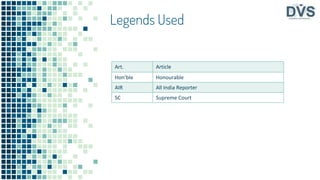
Legends Used
Art. Article
Hon’ble Honourable
AIR All India Reporter
SC Supreme Court
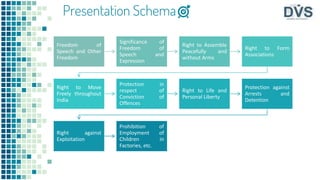
Presentation Schema
4
Freedom of
Speech and Other
Freedom
Significance of
Freedom of
Speech and
Expression
Right to Assemble
Peacefully and
without Arms
Right to Form
Associations
Right to Move
Freely throughout
India
Protection in
respect of
Conviction of
Offences
Right to Life and
Personal Liberty
Protection against
Arrests and
Detention
Right against
Exploitation
Prohibition of
Employment of
Children in
Factories, etc.
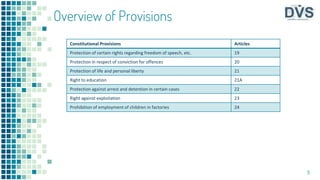
Overview of Provisions
5
Constitutional Provisions Articles
Protection of certain rights regarding freedom of speech, etc. 19
Protection in respect of conviction for offences 20
Protection of life and personal liberty 21
Right to education 21A
Protection against arrest and detention in certain cases 22
Right against exploitation 23
Prohibition of employment of children in factories 24
6
Right to Freedom
(Articles 19 to 22)
Freedom of Speech and Other Freedoms –
Article 19▪ Protection of certain rights regarding freedom of speech etc
▪ Although Article 19 guarantees all the seven freedoms to the citizens, such guarantee does
not confer any absolute or unconditional right. It is subject to reasonable restriction which
the Legislature may impose in public interest which has been enabled by Article 19(2).
7
“(1) All citizens shall have the right -
(a) to freedom of speech and expression;
(b) to assemble peacefully and without arena;
(c) to form associations or unions;
(d) to move freely throughout the territory of India;
(e) to reside and settle in any part of the territory of India and
(f) omitted;
(g) to practice any profession, or to carry on any occupation,
trade or
business”.
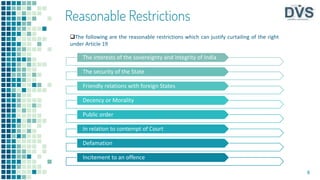
The interests of the sovereignty and integrity of India
The security of the State
Friendly relations with foreign States
Decency or Morality
Public order
In relation to contempt of Court
Defamation
Incitement to an offence
8
The following are the reasonable restrictions which can justify curtailing of the right
under Article 19
Reasonable Restrictions
Significance of Freedom of Speech and
Expression
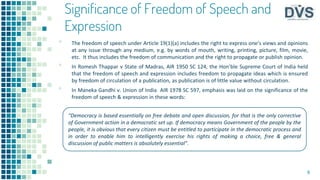
▪ The freedom of speech under Article 19(1)(a) includes the right to express one’s views and opinions
at any issue through any medium, e.g. by words of mouth, writing, printing, picture, film, movie,
etc. It thus includes the freedom of communication and the right to propagate or publish opinion.
▪ In Romesh Thappar v State of Madras, AIR 1950 SC 124, the Hon’ble Supreme Court of India held
that the freedom of speech and expression includes freedom to propagate ideas which is ensured
by freedom of circulation of a publication, as publication is of little value without circulation.
▪ In Maneka Gandhi v. Union of India AIR 1978 SC 597, emphasis was laid on the significance of the
freedom of speech & expression in these words:
9
“Democracy is based essentially on free debate and open discussion, for that is the only corrective
of Government action in a democratic set up. If democracy means Government of the people by the
people, it is obvious that every citizen must be entitled to participate in the democratic process and
in order to enable him to intelligently exercise his rights of making a choice, free & general
discussion of public matters is absolutely essential”.
Right to Assemble Peacefully and Without
Arms
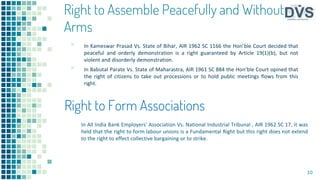
▪ In Kameswar Prasad Vs. State of Bihar, AIR 1962 SC 1166 the Hon’ble Court decided that
peaceful and orderly demonstration is a right guaranteed by Article 19(1)(b), but not
violent and disorderly demonstration.
▪ In Babutal Parate Vs. State of Maharastra, AIR 1961 SC 884 the Hon’ble Court opined that
the right of citizens to take out processions or to hold public meetings flows from this
right.
10
Right to Form Associations
In All India Bank Employers' Association Vs. National Industrial Tribunal , AIR 1962 SC 17, it was
held that the right to form labour unions is a Fundamental Right but this right does not extend
to the right to effect collective bargaining or to strike.
Right to Practice any Profession and Carry
Business
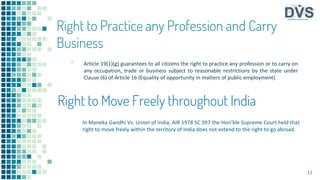
▪ Article 19(1)(g) guarantees to all citizens the right to practice any profession or to carry on
any occupation, trade or business subject to reasonable restrictions by the state under
Clause (6) of Article 16 (Equality of opportunity in matters of public employment).
11
Right to Move Freely throughout India
In Maneka Gandhi Vs. Union of lndia, AIR 1978 SC 597 the Hon’ble Supreme Court held that
right to move freely within the territory of India does not extend to the right to go abroad.
Illustration
12
Illustration Whether it violates Article 19 or not?
A man organizes a peaceful protest after
obtaining due permission.
No
An author publishes an article in a magazine
defaming a renowned political leader.
Whether the article can be claimed as an
exercise of Freedom of Speech and
Expression of the author?
Yes. It would have not violated Article 19 if
the publication was based on proper
investigation and not upon hearsay.
A company is incorporated whose business
motive is to hold online gambling
competitions and sell lottery tickets.
Whether this business can be claimed as an
exercise of Freedom to Trade?
The company is in violation of Article 19.
Gambling and selling of lottery tickets is
against Public Policy. This can be used to
restrict the right under Article 19.
Protection in respect of Conviction of
Offences - Article 20
▪ This Constitutional provision assures protection against arbitrary arrest and excessive
punishment to any person who is alleged to have committed an offence.
▪ It is popularly known as Rights of the accused person and it is vital in Criminal law.
The three substantial rights guaranteed under this article are :
13
“(1) No person shall be convicted of any offence except for violation of a law in force at the time of
the commission of the Act charged as an offence, nor be subjected to a penalty greater than that
which might have been inflicted under the law in force at the time of the commission of the offence.
(2) No person shall be prosecuted and punished for the same offence more than once (in his/her
lifetime).
(3) No person accused of any offence shall be compelled to be a witness against himself”.
14
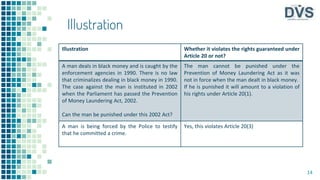
Illustration Whether it violates the rights guaranteed under
Article 20 or not?
A man deals in black money and is caught by the
enforcement agencies in 1990. There is no law
that criminalizes dealing in black money in 1990.
The case against the man is instituted in 2002
when the Parliament has passed the Prevention
of Money Laundering Act, 2002.
Can the man be punished under this 2002 Act?
The man cannot be punished under the
Prevention of Money Laundering Act as it was
not in force when the man dealt in black money.
If he is punished it will amount to a violation of
his rights under Article 20(1).
A man is being forced by the Police to testify
that he committed a crime.
Yes, this violates Article 20(3)
Illustration
Right to Life and Personal Liberty – Article 21
▪ Article 21 is often regarded as the heart and soul of Fundamental Rights and the most
important of the Fundamental Rights – Hon’ble Supreme Court in Bandhua Mukti Morcha v.
Union of India, 1984 AIR 802.
▪ It is available to citizens as well as non-citizens.
▪ This article provides two main rights – The Right to Life and Right to Personal liberty.
▪ The scope of Right to Life and Personal Liberty has been vastly widened by several judicial
precedents.
15
Article 21 of the Indian Constitution reads as follows –
“No person shall be deprived of his life or personal liberty except according to procedure established by law”.
Meaning and Concept of Right to Life
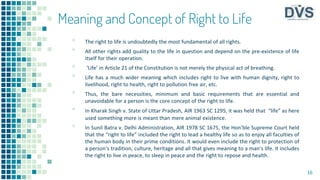
▪ The right to life is undoubtedly the most fundamental of all rights.
▪ All other rights add quality to the life in question and depend on the pre-existence of life
itself for their operation.
▪ ‘Life’ in Article 21 of the Constitution is not merely the physical act of breathing.
▪ Life has a much wider meaning which includes right to live with human dignity, right to
livelihood, right to health, right to pollution free air, etc.
▪ Thus, the bare necessities, minimum and basic requirements that are essential and
unavoidable for a person is the core concept of the right to life.
▪ In Kharak Singh v. State of Uttar Pradesh, AIR 1963 SC 1295, it was held that “life” as here
used something more is meant than mere animal existence.
▪ In Sunil Batra v. Delhi Administration, AIR 1978 SC 1675, the Hon’ble Supreme Court held
that the “right to life” included the right to lead a healthy life so as to enjoy all faculties of
the human body in their prime conditions. It would even include the right to protection of
a person’s tradition, culture, heritage and all that gives meaning to a man’s life. It includes
the right to live in peace, to sleep in peace and the right to repose and health.
16
Components of Right to Life – as Evolved in
Judicial Precedents
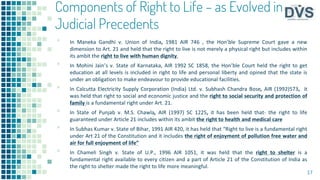
▪ In Maneka Gandhi v. Union of India, 1981 AIR 746 , the Hon’ble Supreme Court gave a new
dimension to Art. 21 and held that the right to live is not merely a physical right but includes within
its ambit the right to live with human dignity.
▪ In Mohini Jain’s v. State of Karnataka, AIR 1992 SC 1858, the Hon’ble Court held the right to get
education at all levels is included in right to life and personal liberty and opined that the state is
under an obligation to make endeavour to provide educational facilities.
▪ In Calcutta Electricity Supply Corporation (India) Ltd. v. Subhash Chandra Bose, AIR (1992)573, it
was held that right to social and economic justice and the right to social security and protection of
family is a fundamental right under Art. 21.
▪ In State of Punjab v. M.S. Chawla, AIR (1997) SC 1225, it has been held that- the right to life
guaranteed under Article 21 includes within its ambit the right to health and medical care
▪ In Subhas Kumar v. State of Bihar, 1991 AIR 420, it has held that “Right to live is a fundamental right
under Art 21 of the Constitution and it includes the right of enjoyment of pollution free water and
air for full enjoyment of life”
▪ In Chameli Singh v. State of U.P., 1996 AIR 1051, it was held that the right to shelter is a
fundamental right available to every citizen and a part of Article 21 of the Constitution of India as
the right to shelter made the right to life more meaningful.
17
Procedure Established by Law
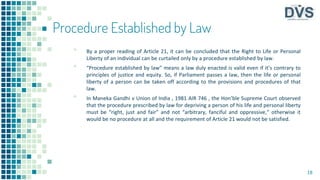
▪ By a proper reading of Article 21, it can be concluded that the Right to Life or Personal
Liberty of an individual can be curtailed only by a procedure established by law.
▪ “Procedure established by law” means a law duly enacted is valid even if it’s contrary to
principles of justice and equity. So, if Parliament passes a law, then the life or personal
liberty of a person can be taken off according to the provisions and procedures of that
law.
▪ In Maneka Gandhi v Union of India , 1981 AIR 746 , the Hon’ble Supreme Court observed
that the procedure prescribed by law for depriving a person of his life and personal liberty
must be “right, just and fair” and not “arbitrary, fanciful and oppressive,” otherwise it
would be no procedure at all and the requirement of Article 21 would not be satisfied.
18
Protection against Arrests and Detention –
Article 22
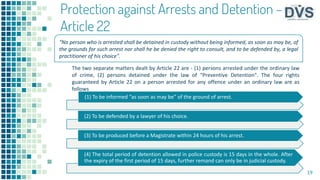
The two separate matters dealt by Article 22 are - (1) persons arrested under the ordinary law
of crime, (2) persons detained under the law of “Preventive Detention". The four rights
guaranteed by Article 22 on a person arrested for any offence under an ordinary law are as
follows
19
(1) To be informed “as soon as may be” of the ground of arrest.
(2) To be defended by a lawyer of his choice.
(3) To be produced before a Magistrate within 24 hours of his arrest.
(4) The total period of detention allowed in police custody is 15 days in the whole. After
the expiry of the first period of 15 days, further remand can only be in judicial custody.
“No person who is arrested shall be detained in custody without being informed, as soon as may be, of
the grounds for such arrest nor shall he be denied the right to consult, and to be defended by, a legal
practitioner of his choice”.
For persons detained (Detenue) under the
law of “Preventive Detention"
The detenue must be informed about the ground on which detention order has
been made as soon as possible.
He/she must be given the earliest opportunity of making representation against
the order of detention.
The detaining authority must afford a reasonable opportunity to the detenue to
make such representation.
Such representation has to be dealt with as early as possible.
20
21
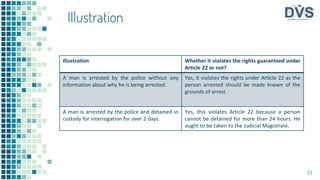
Illustration Whether it violates the rights guaranteed under
Article 22 or not?
A man is arrested by the police without any
information about why he is being arrested.
Yes, it violates the rights under Article 22 as the
person arrested should be made known of the
grounds of arrest.
A man is arrested by the police and detained in
custody for interrogation for over 2 days.
Yes, this violates Article 22 because a person
cannot be detained for more than 24 hours. He
ought to be taken to the Judicial Magistrate.
Illustration
22
Right against Exploitation
Arts.23, 24
23
Right against Exploitation – Article 23
•It protects both the citizens and the non-citizens against exploitation.
•It protects individuals against the State as well as private citizens.
•This article imposes a positive obligation on the State to abolish immoral practices of
exploitation like human trafficking and other forms of forced labour (workers forced to
work in mines and quarries).
“(1)Traffic in human beings and beggar and other similar forms of forced labour are prohibited and
any contravention of this provision shall be an offence punishable in accordance with law
(2)Nothing in this article shall prevent the State from imposing compulsory service for public purpose,
and in imposing such service the State shall not make any discrimination on grounds only of religion,
race, caste or class or any of them”.
Features of Article 23
▪ Article 23 explicitly prohibits the following discussed practices:
▪ Begar: This is a form of forced labour where a person is compelled to work against his will without
being paid for it.
▪ Bonded Labour/ Debt Bondage: This is a practice under which a person is forced to work to pay
off his debt. The money they get is very little and the work they do gets doubled. Often these
debts get passed over to the next generations. Hence, it is known as a form of forced labour.
▪ Human trafficking: It means selling and buying of a human being like goods and includes immoral
trafficking of women and children. Although, slavery is not expressly mentioned under Article 23
but it is included within the meaning of ‘traffic in human beings’. In pursuance of Article 23,
Parliament has passed the Suppression of Immoral Traffic in Women and Girls Act, 1956, for
punishing human trafficking.
▪ Other forms of forced labour: Any other practice which comes under Article 23 is also prohibited
by this Article.
▪ Under clause (2) of Article 23, the State is allowed to impose compulsory services for public
purposes like national defense (South Korea, Israel, etc.), removal of illiteracy and other public
utility services (electricity, water, air and rail services, postal services, etc.).
▪ However, in making any such service compulsory for public purposes, the State cannot make
discrimination on the basis of religion, race, caste or class or any of them.
24
Exception to Article 23
Illustration
25
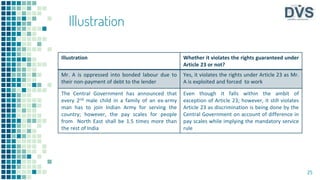
Illustration Whether it violates the rights guaranteed under
Article 23 or not?
Mr. A is oppressed into bonded labour due to
their non-payment of debt to the lender
Yes, it violates the rights under Article 23 as Mr.
A is exploited and forced to work
The Central Government has announced that
every 2nd male child in a family of an ex-army
man has to join Indian Army for serving the
country; however, the pay scales for people
from North East shall be 1.5 times more than
the rest of India
Even though it falls within the ambit of
exception of Article 23; however, it still violates
Article 23 as discrimination is being done by the
Central Government on account of difference in
pay scales while implying the mandatory service
rule
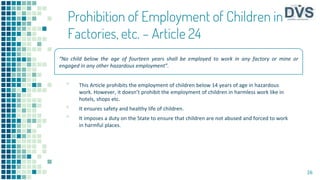
Prohibition of Employment of Children in
Factories, etc. – Article 24
▪ This Article prohibits the employment of children below 14 years of age in hazardous
work. However, it doesn’t prohibit the employment of children in harmless work like in
hotels, shops etc.
▪ It ensures safety and healthy life of children.
▪ It imposes a duty on the State to ensure that children are not abused and forced to work
in harmful places.
26
“No child below the age of fourteen years shall be employed to work in any factory or mine or
engaged in any other hazardous employment”.
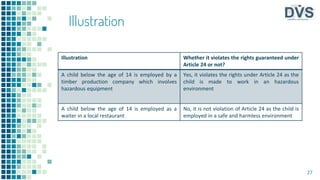
Illustration
27
Illustration Whether it violates the rights guaranteed under
Article 24 or not?
A child below the age of 14 is employed by a
timber production company which involves
hazardous equipment
Yes, it violates the rights under Article 24 as the
child is made to work in an hazardous
environment
A child below the age of 14 is employed as a
waiter in a local restaurant
No, it is not violation of Article 24 as the child is
employed in a safe and harmless environment
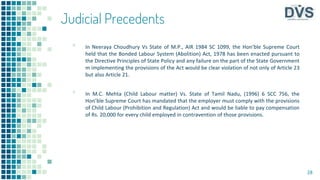
Judicial Precedents
▪ In Neeraya Choudhury Vs State of M.P., AIR 1984 SC 1099, the Hon’ble Supreme Court
held that the Bonded Labour System (Abolition) Act, 1978 has been enacted pursuant to
the Directive Principles of State Policy and any failure on the part of the State Government
m implementing the provisions of the Act would be clear violation of not only of Article 23
but also Article 21.
▪ In M.C. Mehta (Child Labour matter) Vs. State of Tamil Nadu, (1996) 6 SCC 756, the
Hon’ble Supreme Court has mandated that the employer must comply with the provisions
of Child Labour (Prohibition and Regulation) Act and would be liable to pay compensation
of Rs. 20,000 for every child employed in contravention of those provisions.
28
Thank You!
29
Scan the QR Code to Join our
Research Group on WhatsApp
Scan the QR Code to explore more
Research from our Website
DVS Advisors LLP
India-Singapore-London-Dubai-Malaysia-Africa
www.dvsca.com
Copyrights © 2020 DVS Advisors LLP

Fundamental Rights (Article 19-24)

  • 1.
    Fundamental Rights –Part II (Articles 19-24) CA Divakar Vijayasarathy
  • 2.
  • 3.
    Legends Used Art. Article Hon’bleHonourable AIR All India Reporter SC Supreme Court
  • 4.
    Presentation Schema 4 Freedom of Speechand Other Freedom Significance of Freedom of Speech and Expression Right to Assemble Peacefully and without Arms Right to Form Associations Right to Move Freely throughout India Protection in respect of Conviction of Offences Right to Life and Personal Liberty Protection against Arrests and Detention Right against Exploitation Prohibition of Employment of Children in Factories, etc.
  • 5.
    Overview of Provisions 5 ConstitutionalProvisions Articles Protection of certain rights regarding freedom of speech, etc. 19 Protection in respect of conviction for offences 20 Protection of life and personal liberty 21 Right to education 21A Protection against arrest and detention in certain cases 22 Right against exploitation 23 Prohibition of employment of children in factories 24
  • 6.
  • 7.
    Freedom of Speechand Other Freedoms – Article 19▪ Protection of certain rights regarding freedom of speech etc ▪ Although Article 19 guarantees all the seven freedoms to the citizens, such guarantee does not confer any absolute or unconditional right. It is subject to reasonable restriction which the Legislature may impose in public interest which has been enabled by Article 19(2). 7 “(1) All citizens shall have the right - (a) to freedom of speech and expression; (b) to assemble peacefully and without arena; (c) to form associations or unions; (d) to move freely throughout the territory of India; (e) to reside and settle in any part of the territory of India and (f) omitted; (g) to practice any profession, or to carry on any occupation, trade or business”.
  • 8.
    The interests ofthe sovereignty and integrity of India The security of the State Friendly relations with foreign States Decency or Morality Public order In relation to contempt of Court Defamation Incitement to an offence 8 The following are the reasonable restrictions which can justify curtailing of the right under Article 19 Reasonable Restrictions
  • 9.
    Significance of Freedomof Speech and Expression ▪ The freedom of speech under Article 19(1)(a) includes the right to express one’s views and opinions at any issue through any medium, e.g. by words of mouth, writing, printing, picture, film, movie, etc. It thus includes the freedom of communication and the right to propagate or publish opinion. ▪ In Romesh Thappar v State of Madras, AIR 1950 SC 124, the Hon’ble Supreme Court of India held that the freedom of speech and expression includes freedom to propagate ideas which is ensured by freedom of circulation of a publication, as publication is of little value without circulation. ▪ In Maneka Gandhi v. Union of India AIR 1978 SC 597, emphasis was laid on the significance of the freedom of speech & expression in these words: 9 “Democracy is based essentially on free debate and open discussion, for that is the only corrective of Government action in a democratic set up. If democracy means Government of the people by the people, it is obvious that every citizen must be entitled to participate in the democratic process and in order to enable him to intelligently exercise his rights of making a choice, free & general discussion of public matters is absolutely essential”.
  • 10.
    Right to AssemblePeacefully and Without Arms ▪ In Kameswar Prasad Vs. State of Bihar, AIR 1962 SC 1166 the Hon’ble Court decided that peaceful and orderly demonstration is a right guaranteed by Article 19(1)(b), but not violent and disorderly demonstration. ▪ In Babutal Parate Vs. State of Maharastra, AIR 1961 SC 884 the Hon’ble Court opined that the right of citizens to take out processions or to hold public meetings flows from this right. 10 Right to Form Associations In All India Bank Employers' Association Vs. National Industrial Tribunal , AIR 1962 SC 17, it was held that the right to form labour unions is a Fundamental Right but this right does not extend to the right to effect collective bargaining or to strike.
  • 11.
    Right to Practiceany Profession and Carry Business ▪ Article 19(1)(g) guarantees to all citizens the right to practice any profession or to carry on any occupation, trade or business subject to reasonable restrictions by the state under Clause (6) of Article 16 (Equality of opportunity in matters of public employment). 11 Right to Move Freely throughout India In Maneka Gandhi Vs. Union of lndia, AIR 1978 SC 597 the Hon’ble Supreme Court held that right to move freely within the territory of India does not extend to the right to go abroad.
  • 12.
    Illustration 12 Illustration Whether itviolates Article 19 or not? A man organizes a peaceful protest after obtaining due permission. No An author publishes an article in a magazine defaming a renowned political leader. Whether the article can be claimed as an exercise of Freedom of Speech and Expression of the author? Yes. It would have not violated Article 19 if the publication was based on proper investigation and not upon hearsay. A company is incorporated whose business motive is to hold online gambling competitions and sell lottery tickets. Whether this business can be claimed as an exercise of Freedom to Trade? The company is in violation of Article 19. Gambling and selling of lottery tickets is against Public Policy. This can be used to restrict the right under Article 19.
  • 13.
    Protection in respectof Conviction of Offences - Article 20 ▪ This Constitutional provision assures protection against arbitrary arrest and excessive punishment to any person who is alleged to have committed an offence. ▪ It is popularly known as Rights of the accused person and it is vital in Criminal law. The three substantial rights guaranteed under this article are : 13 “(1) No person shall be convicted of any offence except for violation of a law in force at the time of the commission of the Act charged as an offence, nor be subjected to a penalty greater than that which might have been inflicted under the law in force at the time of the commission of the offence. (2) No person shall be prosecuted and punished for the same offence more than once (in his/her lifetime). (3) No person accused of any offence shall be compelled to be a witness against himself”.
  • 14.
    14 Illustration Whether itviolates the rights guaranteed under Article 20 or not? A man deals in black money and is caught by the enforcement agencies in 1990. There is no law that criminalizes dealing in black money in 1990. The case against the man is instituted in 2002 when the Parliament has passed the Prevention of Money Laundering Act, 2002. Can the man be punished under this 2002 Act? The man cannot be punished under the Prevention of Money Laundering Act as it was not in force when the man dealt in black money. If he is punished it will amount to a violation of his rights under Article 20(1). A man is being forced by the Police to testify that he committed a crime. Yes, this violates Article 20(3) Illustration
  • 15.
    Right to Lifeand Personal Liberty – Article 21 ▪ Article 21 is often regarded as the heart and soul of Fundamental Rights and the most important of the Fundamental Rights – Hon’ble Supreme Court in Bandhua Mukti Morcha v. Union of India, 1984 AIR 802. ▪ It is available to citizens as well as non-citizens. ▪ This article provides two main rights – The Right to Life and Right to Personal liberty. ▪ The scope of Right to Life and Personal Liberty has been vastly widened by several judicial precedents. 15 Article 21 of the Indian Constitution reads as follows – “No person shall be deprived of his life or personal liberty except according to procedure established by law”.
  • 16.
    Meaning and Conceptof Right to Life ▪ The right to life is undoubtedly the most fundamental of all rights. ▪ All other rights add quality to the life in question and depend on the pre-existence of life itself for their operation. ▪ ‘Life’ in Article 21 of the Constitution is not merely the physical act of breathing. ▪ Life has a much wider meaning which includes right to live with human dignity, right to livelihood, right to health, right to pollution free air, etc. ▪ Thus, the bare necessities, minimum and basic requirements that are essential and unavoidable for a person is the core concept of the right to life. ▪ In Kharak Singh v. State of Uttar Pradesh, AIR 1963 SC 1295, it was held that “life” as here used something more is meant than mere animal existence. ▪ In Sunil Batra v. Delhi Administration, AIR 1978 SC 1675, the Hon’ble Supreme Court held that the “right to life” included the right to lead a healthy life so as to enjoy all faculties of the human body in their prime conditions. It would even include the right to protection of a person’s tradition, culture, heritage and all that gives meaning to a man’s life. It includes the right to live in peace, to sleep in peace and the right to repose and health. 16
  • 17.
    Components of Rightto Life – as Evolved in Judicial Precedents ▪ In Maneka Gandhi v. Union of India, 1981 AIR 746 , the Hon’ble Supreme Court gave a new dimension to Art. 21 and held that the right to live is not merely a physical right but includes within its ambit the right to live with human dignity. ▪ In Mohini Jain’s v. State of Karnataka, AIR 1992 SC 1858, the Hon’ble Court held the right to get education at all levels is included in right to life and personal liberty and opined that the state is under an obligation to make endeavour to provide educational facilities. ▪ In Calcutta Electricity Supply Corporation (India) Ltd. v. Subhash Chandra Bose, AIR (1992)573, it was held that right to social and economic justice and the right to social security and protection of family is a fundamental right under Art. 21. ▪ In State of Punjab v. M.S. Chawla, AIR (1997) SC 1225, it has been held that- the right to life guaranteed under Article 21 includes within its ambit the right to health and medical care ▪ In Subhas Kumar v. State of Bihar, 1991 AIR 420, it has held that “Right to live is a fundamental right under Art 21 of the Constitution and it includes the right of enjoyment of pollution free water and air for full enjoyment of life” ▪ In Chameli Singh v. State of U.P., 1996 AIR 1051, it was held that the right to shelter is a fundamental right available to every citizen and a part of Article 21 of the Constitution of India as the right to shelter made the right to life more meaningful. 17
  • 18.
    Procedure Established byLaw ▪ By a proper reading of Article 21, it can be concluded that the Right to Life or Personal Liberty of an individual can be curtailed only by a procedure established by law. ▪ “Procedure established by law” means a law duly enacted is valid even if it’s contrary to principles of justice and equity. So, if Parliament passes a law, then the life or personal liberty of a person can be taken off according to the provisions and procedures of that law. ▪ In Maneka Gandhi v Union of India , 1981 AIR 746 , the Hon’ble Supreme Court observed that the procedure prescribed by law for depriving a person of his life and personal liberty must be “right, just and fair” and not “arbitrary, fanciful and oppressive,” otherwise it would be no procedure at all and the requirement of Article 21 would not be satisfied. 18
  • 19.
    Protection against Arrestsand Detention – Article 22 The two separate matters dealt by Article 22 are - (1) persons arrested under the ordinary law of crime, (2) persons detained under the law of “Preventive Detention". The four rights guaranteed by Article 22 on a person arrested for any offence under an ordinary law are as follows 19 (1) To be informed “as soon as may be” of the ground of arrest. (2) To be defended by a lawyer of his choice. (3) To be produced before a Magistrate within 24 hours of his arrest. (4) The total period of detention allowed in police custody is 15 days in the whole. After the expiry of the first period of 15 days, further remand can only be in judicial custody. “No person who is arrested shall be detained in custody without being informed, as soon as may be, of the grounds for such arrest nor shall he be denied the right to consult, and to be defended by, a legal practitioner of his choice”.
  • 20.
    For persons detained(Detenue) under the law of “Preventive Detention" The detenue must be informed about the ground on which detention order has been made as soon as possible. He/she must be given the earliest opportunity of making representation against the order of detention. The detaining authority must afford a reasonable opportunity to the detenue to make such representation. Such representation has to be dealt with as early as possible. 20
  • 21.
    21 Illustration Whether itviolates the rights guaranteed under Article 22 or not? A man is arrested by the police without any information about why he is being arrested. Yes, it violates the rights under Article 22 as the person arrested should be made known of the grounds of arrest. A man is arrested by the police and detained in custody for interrogation for over 2 days. Yes, this violates Article 22 because a person cannot be detained for more than 24 hours. He ought to be taken to the Judicial Magistrate. Illustration
  • 22.
  • 23.
    23 Right against Exploitation– Article 23 •It protects both the citizens and the non-citizens against exploitation. •It protects individuals against the State as well as private citizens. •This article imposes a positive obligation on the State to abolish immoral practices of exploitation like human trafficking and other forms of forced labour (workers forced to work in mines and quarries). “(1)Traffic in human beings and beggar and other similar forms of forced labour are prohibited and any contravention of this provision shall be an offence punishable in accordance with law (2)Nothing in this article shall prevent the State from imposing compulsory service for public purpose, and in imposing such service the State shall not make any discrimination on grounds only of religion, race, caste or class or any of them”.
  • 24.
    Features of Article23 ▪ Article 23 explicitly prohibits the following discussed practices: ▪ Begar: This is a form of forced labour where a person is compelled to work against his will without being paid for it. ▪ Bonded Labour/ Debt Bondage: This is a practice under which a person is forced to work to pay off his debt. The money they get is very little and the work they do gets doubled. Often these debts get passed over to the next generations. Hence, it is known as a form of forced labour. ▪ Human trafficking: It means selling and buying of a human being like goods and includes immoral trafficking of women and children. Although, slavery is not expressly mentioned under Article 23 but it is included within the meaning of ‘traffic in human beings’. In pursuance of Article 23, Parliament has passed the Suppression of Immoral Traffic in Women and Girls Act, 1956, for punishing human trafficking. ▪ Other forms of forced labour: Any other practice which comes under Article 23 is also prohibited by this Article. ▪ Under clause (2) of Article 23, the State is allowed to impose compulsory services for public purposes like national defense (South Korea, Israel, etc.), removal of illiteracy and other public utility services (electricity, water, air and rail services, postal services, etc.). ▪ However, in making any such service compulsory for public purposes, the State cannot make discrimination on the basis of religion, race, caste or class or any of them. 24 Exception to Article 23
  • 25.
    Illustration 25 Illustration Whether itviolates the rights guaranteed under Article 23 or not? Mr. A is oppressed into bonded labour due to their non-payment of debt to the lender Yes, it violates the rights under Article 23 as Mr. A is exploited and forced to work The Central Government has announced that every 2nd male child in a family of an ex-army man has to join Indian Army for serving the country; however, the pay scales for people from North East shall be 1.5 times more than the rest of India Even though it falls within the ambit of exception of Article 23; however, it still violates Article 23 as discrimination is being done by the Central Government on account of difference in pay scales while implying the mandatory service rule
  • 26.
    Prohibition of Employmentof Children in Factories, etc. – Article 24 ▪ This Article prohibits the employment of children below 14 years of age in hazardous work. However, it doesn’t prohibit the employment of children in harmless work like in hotels, shops etc. ▪ It ensures safety and healthy life of children. ▪ It imposes a duty on the State to ensure that children are not abused and forced to work in harmful places. 26 “No child below the age of fourteen years shall be employed to work in any factory or mine or engaged in any other hazardous employment”.
  • 27.
    Illustration 27 Illustration Whether itviolates the rights guaranteed under Article 24 or not? A child below the age of 14 is employed by a timber production company which involves hazardous equipment Yes, it violates the rights under Article 24 as the child is made to work in an hazardous environment A child below the age of 14 is employed as a waiter in a local restaurant No, it is not violation of Article 24 as the child is employed in a safe and harmless environment
  • 28.
    Judicial Precedents ▪ InNeeraya Choudhury Vs State of M.P., AIR 1984 SC 1099, the Hon’ble Supreme Court held that the Bonded Labour System (Abolition) Act, 1978 has been enacted pursuant to the Directive Principles of State Policy and any failure on the part of the State Government m implementing the provisions of the Act would be clear violation of not only of Article 23 but also Article 21. ▪ In M.C. Mehta (Child Labour matter) Vs. State of Tamil Nadu, (1996) 6 SCC 756, the Hon’ble Supreme Court has mandated that the employer must comply with the provisions of Child Labour (Prohibition and Regulation) Act and would be liable to pay compensation of Rs. 20,000 for every child employed in contravention of those provisions. 28
  • 29.
    Thank You! 29 Scan theQR Code to Join our Research Group on WhatsApp Scan the QR Code to explore more Research from our Website DVS Advisors LLP India-Singapore-London-Dubai-Malaysia-Africa www.dvsca.com Copyrights © 2020 DVS Advisors LLP