Fundamental Rights
BY HARSHAL TAPRE
FIRST YEAR
GUIDED BY SHEENAM KHAN
WHY FUNDAMENTAL
RIGHTS ARE
FUNDAMENTAL?
• In order to Develop his personality and to
establish his dignity in the social and
political life, a citizen must have these right.
• According to article 13(2) of the
Constitution ,the state can not make any
law, rule ,regulation or issue an order in
violation of any of the fundamental rights.
• fundamental rights can never be
suspended in normal circumstances. They
can be suspended only in extraordinary
situation when emergency proclaimed
under Article 352. 2
FUNDAMENTAL
RIGHTS
3
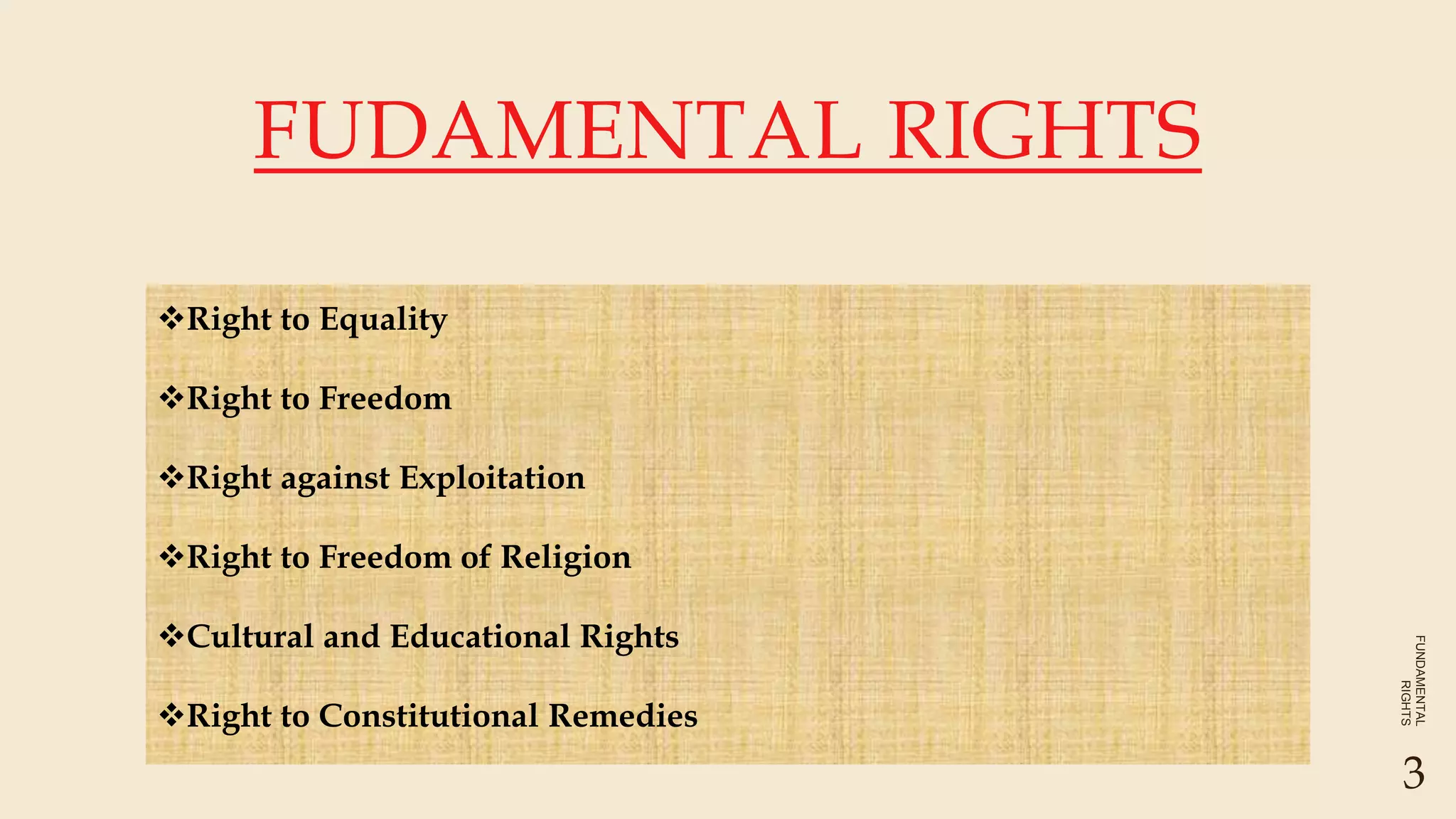
Right to Equality
Right to Freedom
Right against Exploitation
Right to Freedom of Religion
Cultural and Educational Rights
Right to Constitutional Remedies
FUDAMENTAL RIGHTS
RIGHT TO
EQUALITY
FUNDAMRNTAL
RIGHTS
4
RIGHT TO EQUALITY
Right to equality means that all the citizen are equal to in the
eye of the law
* EQUALITY BEFORE LAW
Article 14 of Indian constitution gaurentees that all citizens shall
be by the law of the country
SOCIAL EQUALITY & EQUAL ACCESS TO PUBLIC AREAS
article 15 of the Indian constitution states that no person shall be
discriminated on the basis of caste , colour , language , etc. every
person shall have equal access to public places like public parks ,
museums , wells , temples , etc. however the state can make any
special provision for women & children
FUNDAMRNTAL
RIGHTS
5
FUNDAMRNTAL
RIGHTS
6
14) EQUALITY BEFORE LAW AND
EQUAL PROTECTION OF LAWS
(ARTICLE
Equality Before Law:
• It ensures that every citizen shall be likewise protected by the laws of the country.
• The State will not distinguish any of the Indian citizens on the basis of their
gender, caste, creed, religion or even the place of birth.
• “equality before the law” implies that all are equal in the eyes of law and all will be
tried by the same law and will be given the same punishment for same crime.
FUNDAMRNTAL
RIGHTS
7
MEME ON
EQUALITY
RIGHT TO FREEDOM
SOME POINTS UNDER RIGHT TO FREEDOM
Freedom of speech & expression
* Freedom to assemble peacefully without arms
* Freedom to reside
FUNDAMRNTAL
RIGHTS
8
The Constitution of India contains the Right to Freedom
given in artcle 19 , 20 , 21 & 22 with the view of
guaranteeing individual rights that were considered vital
by the framers of the constitution .
the right to freedom in article 19 guarantees the
following freedom
* Freedom of speech & expression
* Freedom to assemble peacefully without arms
* Freedom to form association / unions
* Freedom to move freely throughout the geographical
boundary of the country
* Freedom to reside & resettle in any parts of the territary
of India
FUNDAMRNTAL
RIGHTS
RIGHT AGAINST
EXPLOITATION
CLASSICAL
LITERATURE
10
Prohibition of traffic in human beings and forced labour.
Article 23
 Prohibition of compulsary services Article-23 : under this
article the state can not force people to do compulsory service
for public purposes.
Prohibition of Child Labour Article-24: Children below the age
of forteen years will not be allowed to work in factories, mines
or in other dangerous places so that their health is not adversely
affected.
.
RIGHT TO
FREEDOM OF
RELIGION
CLASSICAL
LITERATURE
13
• WHAT ARE
YOUR
THOUGHTS
REGARDING
TO RELIGION ?
RIGHT TO FREEDOM OF
RELIGION
• Freedom of Religion in India is a fundamental rights guaranteed by
the country’s constitution. modern India came into existence in 1947 as
a secular nation & the Indian constitution preamble states that the India
is a secular state . every citizen of India has a right to promote ,
practise their religion peacefully.
• According to the constitution all religion are equal before the state &
no religion shall be given preference over the other . citizens are free to
preach , practise , & propagate any religion of their choice
• The objectives of this right is to sustain the principle of Secularisam in
India.
• In secular state the state is only concerned with the relation between
man & man , but not with relation of man with god
CLASSICAL
LITERATURE
14
CULTURAL AND
EDUCATIONAL
RIGHTS
Protection against interest of minorities,Article-29(1)
Freedom to get admission in educational
institutions,Article-29(2)
Right to minorities to establish educational
institutions,Article-30(1)
No discrimination while giving grants-Article-30(2)
CLASSICAL
LITERATURE
15
CLASSICAL
LITERATURE
16
RIGHT TO
CONSTITUTIONAL
REMEDIES
FUNDAMRNTAL
RIGHTS
17
Right to Constitutional Remedies was regarded as heart and soul of our
constitution becausethis 'right ' makes other 'rights ' effective. if sometimes our
rights are violated by fellowcitizens, private bodies or by the government, we
can seek remedy through courts. if it is afundamental right we can directly
approach the supreme court or the high court of a state.
that is why Dr. Ambedkar called it "the heart and soul" of our constitution.
1> If the citizens can violated the fundamental rights he can approach a court of
law & can restore
2>In case of imprisonment , the citizens can ask the court to see if its according
to the provision of law of the country
3>If the court is satisfied that his arrest is unlawful , the person is freed.
4> The court can issue different writs to protect citizen right. the supreme court
& high court can issue the following writs
THANK
YOU

Fundamental_Rights by harshal.pptx

  • 1.
    Fundamental Rights BY HARSHALTAPRE FIRST YEAR GUIDED BY SHEENAM KHAN
  • 2.
    WHY FUNDAMENTAL RIGHTS ARE FUNDAMENTAL? •In order to Develop his personality and to establish his dignity in the social and political life, a citizen must have these right. • According to article 13(2) of the Constitution ,the state can not make any law, rule ,regulation or issue an order in violation of any of the fundamental rights. • fundamental rights can never be suspended in normal circumstances. They can be suspended only in extraordinary situation when emergency proclaimed under Article 352. 2
  • 3.
    FUNDAMENTAL RIGHTS 3 Right to Equality Rightto Freedom Right against Exploitation Right to Freedom of Religion Cultural and Educational Rights Right to Constitutional Remedies FUDAMENTAL RIGHTS
  • 4.
  • 5.
    RIGHT TO EQUALITY Rightto equality means that all the citizen are equal to in the eye of the law * EQUALITY BEFORE LAW Article 14 of Indian constitution gaurentees that all citizens shall be by the law of the country SOCIAL EQUALITY & EQUAL ACCESS TO PUBLIC AREAS article 15 of the Indian constitution states that no person shall be discriminated on the basis of caste , colour , language , etc. every person shall have equal access to public places like public parks , museums , wells , temples , etc. however the state can make any special provision for women & children FUNDAMRNTAL RIGHTS 5
  • 6.
    FUNDAMRNTAL RIGHTS 6 14) EQUALITY BEFORELAW AND EQUAL PROTECTION OF LAWS (ARTICLE Equality Before Law: • It ensures that every citizen shall be likewise protected by the laws of the country. • The State will not distinguish any of the Indian citizens on the basis of their gender, caste, creed, religion or even the place of birth. • “equality before the law” implies that all are equal in the eyes of law and all will be tried by the same law and will be given the same punishment for same crime.
  • 7.
  • 8.
    RIGHT TO FREEDOM SOMEPOINTS UNDER RIGHT TO FREEDOM Freedom of speech & expression * Freedom to assemble peacefully without arms * Freedom to reside FUNDAMRNTAL RIGHTS 8
  • 9.
    The Constitution ofIndia contains the Right to Freedom given in artcle 19 , 20 , 21 & 22 with the view of guaranteeing individual rights that were considered vital by the framers of the constitution . the right to freedom in article 19 guarantees the following freedom * Freedom of speech & expression * Freedom to assemble peacefully without arms * Freedom to form association / unions * Freedom to move freely throughout the geographical boundary of the country * Freedom to reside & resettle in any parts of the territary of India FUNDAMRNTAL RIGHTS
  • 10.
  • 11.
    Prohibition of trafficin human beings and forced labour. Article 23  Prohibition of compulsary services Article-23 : under this article the state can not force people to do compulsory service for public purposes. Prohibition of Child Labour Article-24: Children below the age of forteen years will not be allowed to work in factories, mines or in other dangerous places so that their health is not adversely affected. .
  • 12.
  • 13.
    CLASSICAL LITERATURE 13 • WHAT ARE YOUR THOUGHTS REGARDING TORELIGION ? RIGHT TO FREEDOM OF RELIGION • Freedom of Religion in India is a fundamental rights guaranteed by the country’s constitution. modern India came into existence in 1947 as a secular nation & the Indian constitution preamble states that the India is a secular state . every citizen of India has a right to promote , practise their religion peacefully. • According to the constitution all religion are equal before the state & no religion shall be given preference over the other . citizens are free to preach , practise , & propagate any religion of their choice • The objectives of this right is to sustain the principle of Secularisam in India. • In secular state the state is only concerned with the relation between man & man , but not with relation of man with god
  • 14.
  • 15.
    Protection against interestof minorities,Article-29(1) Freedom to get admission in educational institutions,Article-29(2) Right to minorities to establish educational institutions,Article-30(1) No discrimination while giving grants-Article-30(2) CLASSICAL LITERATURE 15
  • 16.
  • 17.
    FUNDAMRNTAL RIGHTS 17 Right to ConstitutionalRemedies was regarded as heart and soul of our constitution becausethis 'right ' makes other 'rights ' effective. if sometimes our rights are violated by fellowcitizens, private bodies or by the government, we can seek remedy through courts. if it is afundamental right we can directly approach the supreme court or the high court of a state. that is why Dr. Ambedkar called it "the heart and soul" of our constitution. 1> If the citizens can violated the fundamental rights he can approach a court of law & can restore 2>In case of imprisonment , the citizens can ask the court to see if its according to the provision of law of the country 3>If the court is satisfied that his arrest is unlawful , the person is freed. 4> The court can issue different writs to protect citizen right. the supreme court & high court can issue the following writs
  • 18.