Art.15
Vaibhav Sonule
Asst.Prof, School of Law
Alliance University
Bangalore
• NEED
History (social condition)
Caste and Gender based Standard of Life
Custom Ruled Society
• Protective Discrimination
• To create class less society
• No merely discrimination allowed on the basis
of Art.15 (1).
• Legislature can discriminated on any one of
these ground when no other factor could
possibly present.
• American Constitution
13th Amendment – Abolition of slavery
Civil Right Act,1964 –
“No person in U.S. shall on ground of race,
colour, National origin to be excluded from
participation under any programme or
activity.”
• Art 15 (1) – Bars the State from discriminating
against any citizen of India on grounds only of
religion, race, caste, sex, place of birth or any
of them.
State under obligation
Discrimination – to make an adverse or
favourable distinction.
• Only – specific grounds for discrimination but
If the other qualifications are equal caste,
religion, sex should not be ground for
preference.
• Art 15 (1) covers the entire range of State
activities.
• No non citizen can claim right under Art 15.
• D.P.Joshi v/s State of Madhya Bharta
AIR 1955 SC 334
“Art 15 (1) prohibits discrimination on the basis
of place of birth but not residence.
Education is State subject. So therefore nothing
wrong to ensure some advantage for the
benefit of State.
• Yusuf Abdul Aziz v/s State of Bombay
AIR 1954 SC 321
There can be no discrimination about gender
in general because the Constitution itself
provides special provision in case of women
and children considering the weaker section of
society.
• Nainsukh v/s State of Uttar Pradesh
AIR 1953 SC 384
“Elections of municipalities by creating
separate electorates on the basis of caste is
violation of Art 15 (1).”
R.C.Poudyal v/s UOI AIR 1993 SC 1807
The Majority View
To give Reservation in the Legislative
Assembly when the institution/nomination
associated with social and political
developments of State is not violation of Art
15 (1).
Merely Religious institution
Historical Consideration
Minority View
Such reservation in favour of Religious
institution can not be justified on the basis of
Historical consideration and such act is
violation of Art 15 (1).
ART 15(2)
• No citizen shall, on grounds only of religion,
caste, sex, place of birth or any one of them,
be subject to any disability, liability, restriction
or condition with regard to
(a) Access to shop, public restaurants, hotels and places of
public entertainment
(b) the use of wells, tanks, bathing ghats, roads and places of
public resort maintained wholly or partly out of State
funds or dedicated to the use of general public.
• Prohibition of General nature
• Exclusive Rights available subject to condition
Art 15 (3)
Nothing in the article shall prevent the State
for making any special provision women and
children.
Whether Art. 15 (3) constitute exception to Art.
15 (1) and 15 (2) ?
Historical Perspective
No participation in Nation
To eliminate socio-economic backwardness
To improve the status of women
• Raghubans Singh v/s State of Punjab
AIR 1972 P & H 117
“No reasonable nexus for the object of
classification is exercised by Government. So
such act amounts to violation of Art 15 (3).”
• State of Andhra Pradesh v/s Vijay Kumar
AIR 1995 SC 1648
S.C. Ruled
The posts can be reserved for women under
Article 15 (3) as it is much wider in scope.
Making special provision for women in respect
of employment is integral part of Art. 15 (3)
and its not violation of Art. 16 (2).
• Union of India v/s Parmanand Singh
AIR 1999 SC 625
• S. Renuka v/s State of A.P. AIR 2002 SC 1523
“No reservation can be made exclusively for
women. There could not be 100% reservation
for women when the rules do not provide for
the same.”
Art 15 (4)
• Art 15 (4)
Nothing in this Article or Art. 29 (2) shall prevent
the State from making
 any special provision for the advancement of any
socially and educationally backward classes of
citizen or
 the Scheduled Caste and Scheduled Tribes.
[ Added by First Amnd,1951]
CLASS
• A homogeneous section of people
• Associated with religion ,occupation,
residence
• Who bear a common and exclusive
designation
• Who are sufficient in numbers (Single
Community )
Socially and Educationally backward
class
• No specific criteria/ definition
• Positive Discrimination in favour of weaker
• The criteria to decide ‘Backward’ class is not
solely based on religion
History of First Amendment.
• State of Madras v/s Champakam
AIR 1951 SC 226
S.C. struck down as classification is mere based
on caste.
“ Constitution did not intend to protect the
interest of the backward class in the matter of
admission into educational institution.”
• Object of Amendment is to override the
judgment.
• To promote special care of the weaker section
of society (Art. 46 )
RESERVATION
1. By Legislature
2. By Judiciary
Kalelkar Commission (1953)
• To determine the test for Backward
[traditional occupation and the percentage of literacy ]
• To prepare the list of such communities
• To examine the difficulties of Backward
Classes
Vague and wide recommendations
• No meaningful action was taken after 1956 either for
constituting another Commission or for evolving a
better criteria.
• on August 14, 1961, the Central Government wrote
to the State Governments that "while the State
Governments have the discretion to choose their
own criteria for defining backwardness, in the view
of the Government of India it would be better to
apply economic tests than to go by caste."
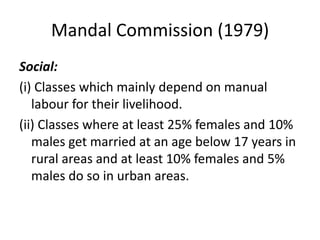
Mandal Commission (1979)
Social:
(i) Classes which mainly depend on manual
labour for their livelihood.
(ii) Classes where at least 25% females and 10%
males get married at an age below 17 years in
rural areas and at least 10% females and 5%
males do so in urban areas.
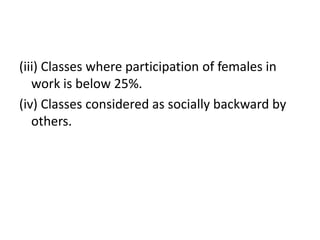
(iii) Classes where participation of females in
work is below 25%.
(iv) Classes considered as socially backward by
others.
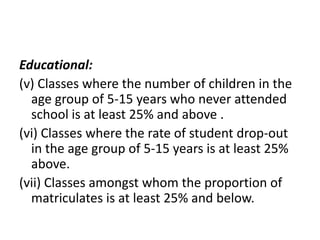
Educational:
(v) Classes where the number of children in the
age group of 5-15 years who never attended
school is at least 25% and above .
(vi) Classes where the rate of student drop-out
in the age group of 5-15 years is at least 25%
above.
(vii) Classes amongst whom the proportion of
matriculates is at least 25% and below.
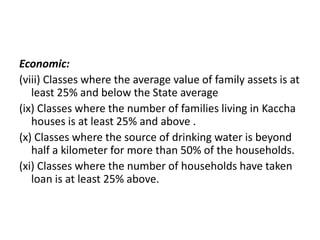
Economic:
(viii) Classes where the average value of family assets is at
least 25% and below the State average
(ix) Classes where the number of families living in Kaccha
houses is at least 25% and above .
(x) Classes where the source of drinking water is beyond
half a kilometer for more than 50% of the households.
(xi) Classes where the number of households have taken
loan is at least 25% above.
If a caste had a score of 11 points (50% of
total) and below that, it will be considered as
socially and economically backward and the
rest will be treated as ‘advanced’.
Major Recommendation
27% reservation for ‘Other Backward Class’
which constitute 52 % population.
• No action taken for long
• Janta Dal Government in 1990 accepted
Mandal Commission and announces 27%
reservation for socially and educationally
backward classes.
• The Congress Govt. in 1991 made two
classification
1) The poorer sections among backward class
will get preference.
2) 10% vacancies reserved for Economically
Backward class.
The Constitunality of this memorandum
questioned by several writ petitions.

Art.15

  • 1.
    Art.15 Vaibhav Sonule Asst.Prof, Schoolof Law Alliance University Bangalore
  • 2.
    • NEED History (socialcondition) Caste and Gender based Standard of Life Custom Ruled Society
  • 3.
    • Protective Discrimination •To create class less society • No merely discrimination allowed on the basis of Art.15 (1). • Legislature can discriminated on any one of these ground when no other factor could possibly present.
  • 4.
    • American Constitution 13thAmendment – Abolition of slavery Civil Right Act,1964 – “No person in U.S. shall on ground of race, colour, National origin to be excluded from participation under any programme or activity.”
  • 5.
    • Art 15(1) – Bars the State from discriminating against any citizen of India on grounds only of religion, race, caste, sex, place of birth or any of them. State under obligation Discrimination – to make an adverse or favourable distinction.
  • 6.
    • Only –specific grounds for discrimination but If the other qualifications are equal caste, religion, sex should not be ground for preference. • Art 15 (1) covers the entire range of State activities. • No non citizen can claim right under Art 15.
  • 7.
    • D.P.Joshi v/sState of Madhya Bharta AIR 1955 SC 334 “Art 15 (1) prohibits discrimination on the basis of place of birth but not residence. Education is State subject. So therefore nothing wrong to ensure some advantage for the benefit of State.
  • 8.
    • Yusuf AbdulAziz v/s State of Bombay AIR 1954 SC 321 There can be no discrimination about gender in general because the Constitution itself provides special provision in case of women and children considering the weaker section of society.
  • 9.
    • Nainsukh v/sState of Uttar Pradesh AIR 1953 SC 384 “Elections of municipalities by creating separate electorates on the basis of caste is violation of Art 15 (1).”
  • 10.
    R.C.Poudyal v/s UOIAIR 1993 SC 1807 The Majority View To give Reservation in the Legislative Assembly when the institution/nomination associated with social and political developments of State is not violation of Art 15 (1). Merely Religious institution Historical Consideration
  • 11.
    Minority View Such reservationin favour of Religious institution can not be justified on the basis of Historical consideration and such act is violation of Art 15 (1).
  • 12.
    ART 15(2) • Nocitizen shall, on grounds only of religion, caste, sex, place of birth or any one of them, be subject to any disability, liability, restriction or condition with regard to
  • 13.
    (a) Access toshop, public restaurants, hotels and places of public entertainment (b) the use of wells, tanks, bathing ghats, roads and places of public resort maintained wholly or partly out of State funds or dedicated to the use of general public. • Prohibition of General nature • Exclusive Rights available subject to condition
  • 14.
    Art 15 (3) Nothingin the article shall prevent the State for making any special provision women and children. Whether Art. 15 (3) constitute exception to Art. 15 (1) and 15 (2) ?
  • 15.
    Historical Perspective No participationin Nation To eliminate socio-economic backwardness To improve the status of women
  • 16.
    • Raghubans Singhv/s State of Punjab AIR 1972 P & H 117 “No reasonable nexus for the object of classification is exercised by Government. So such act amounts to violation of Art 15 (3).”
  • 17.
    • State ofAndhra Pradesh v/s Vijay Kumar AIR 1995 SC 1648 S.C. Ruled The posts can be reserved for women under Article 15 (3) as it is much wider in scope. Making special provision for women in respect of employment is integral part of Art. 15 (3) and its not violation of Art. 16 (2).
  • 18.
    • Union ofIndia v/s Parmanand Singh AIR 1999 SC 625 • S. Renuka v/s State of A.P. AIR 2002 SC 1523 “No reservation can be made exclusively for women. There could not be 100% reservation for women when the rules do not provide for the same.”
  • 19.
    Art 15 (4) •Art 15 (4) Nothing in this Article or Art. 29 (2) shall prevent the State from making  any special provision for the advancement of any socially and educationally backward classes of citizen or  the Scheduled Caste and Scheduled Tribes. [ Added by First Amnd,1951]
  • 20.
    CLASS • A homogeneoussection of people • Associated with religion ,occupation, residence • Who bear a common and exclusive designation • Who are sufficient in numbers (Single Community )
  • 21.
    Socially and Educationallybackward class • No specific criteria/ definition • Positive Discrimination in favour of weaker • The criteria to decide ‘Backward’ class is not solely based on religion
  • 22.
    History of FirstAmendment. • State of Madras v/s Champakam AIR 1951 SC 226 S.C. struck down as classification is mere based on caste. “ Constitution did not intend to protect the interest of the backward class in the matter of admission into educational institution.”
  • 23.
    • Object ofAmendment is to override the judgment. • To promote special care of the weaker section of society (Art. 46 )
  • 24.
  • 25.
    Kalelkar Commission (1953) •To determine the test for Backward [traditional occupation and the percentage of literacy ] • To prepare the list of such communities • To examine the difficulties of Backward Classes Vague and wide recommendations
  • 26.
    • No meaningfulaction was taken after 1956 either for constituting another Commission or for evolving a better criteria. • on August 14, 1961, the Central Government wrote to the State Governments that "while the State Governments have the discretion to choose their own criteria for defining backwardness, in the view of the Government of India it would be better to apply economic tests than to go by caste."
  • 27.
    Mandal Commission (1979) Social: (i)Classes which mainly depend on manual labour for their livelihood. (ii) Classes where at least 25% females and 10% males get married at an age below 17 years in rural areas and at least 10% females and 5% males do so in urban areas.
  • 28.
    (iii) Classes whereparticipation of females in work is below 25%. (iv) Classes considered as socially backward by others.
  • 29.
    Educational: (v) Classes wherethe number of children in the age group of 5-15 years who never attended school is at least 25% and above . (vi) Classes where the rate of student drop-out in the age group of 5-15 years is at least 25% above. (vii) Classes amongst whom the proportion of matriculates is at least 25% and below.
  • 30.
    Economic: (viii) Classes wherethe average value of family assets is at least 25% and below the State average (ix) Classes where the number of families living in Kaccha houses is at least 25% and above . (x) Classes where the source of drinking water is beyond half a kilometer for more than 50% of the households. (xi) Classes where the number of households have taken loan is at least 25% above.
  • 31.
    If a castehad a score of 11 points (50% of total) and below that, it will be considered as socially and economically backward and the rest will be treated as ‘advanced’.
  • 32.
    Major Recommendation 27% reservationfor ‘Other Backward Class’ which constitute 52 % population.
  • 33.
    • No actiontaken for long • Janta Dal Government in 1990 accepted Mandal Commission and announces 27% reservation for socially and educationally backward classes. • The Congress Govt. in 1991 made two classification
  • 34.
    1) The poorersections among backward class will get preference. 2) 10% vacancies reserved for Economically Backward class. The Constitunality of this memorandum questioned by several writ petitions.