PREVENTIVE DETENTION
Article- 22(4)(5)(6)(7) of
Constitution of India
Synopsis
 Introduction
 Difference between arrest and preventive detention
 Art.22 of the Constitution
 Explanation of clauses(4),(5),(6),(7) of Art.22
 Object behind the right
 Case Laws
 Criticism on preventive detention laws
 Recent incidences of Preventive Detention
Introduction
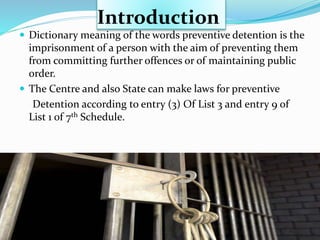
 Dictionary meaning of the words preventive detention is the
imprisonment of a person with the aim of preventing them
from committing further offences or of maintaining public
order.
 The Centre and also State can make laws for preventive
Detention according to entry (3) Of List 3 and entry 9 of
List 1 of 7th Schedule.
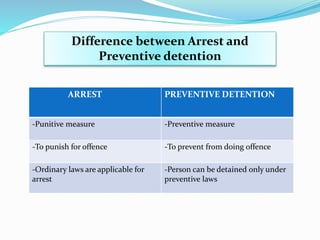
ARREST PREVENTIVE DETENTION
-Punitive measure -Preventive measure
-To punish for offence -To prevent from doing offence
-Ordinary laws are applicable for
arrest
-Person can be detained only under
preventive laws
Difference between Arrest and
Preventive detention
Art.22
 Art.22- Protection against arrest and detention in certain cases-
(1) No person who is arrested shall be detained in custody without being
informed, as soon as may be, of the grounds for such arrest nor shall he be denied
the right to consult, and to be defended by, a legal practitioner of his choice.
(2) Every person who is arrested and detained in custody shall be produced
before the nearest magistrate within a period of twenty-four hours of such arrest
excluding the time necessary for the journey from the place of arrest to the court of
the magistrate and no such person shall be detained in custody beyond the said
period without the authority of a magistrate.
(3) Nothing in clauses (1) and (2) shall apply—
(a) to any person who for the time being is an enemy alien; or
(b) to any person who is arrested or detained under any law providing for
preventive detention.
(4) No law providing for preventive detention shall authorise the detention of a
person for a longer period than three months unless—
(a) an Advisory Board consisting of persons who are, or have been, or are
qualified to be appointed as, Judges of a High Court has reported before the
expiration of the said period of three months that there is in its opinion
sufficient cause for such detention:
Provided that nothing in this sub-clause shall authorise the detention of
any person beyond the maximum period prescribed by any law made by
Parliament under sub-clause (b) of clause (7); or
(b) such person is detained in accordance with the provisions of any law
made by Parliament under sub clauses (a) and (b) of clause (7).
(5) When any person is detained in pursuance of an order made under any law
providing for preventive detention, the authority making the order shall, as soon
as may be, communicate to such person the grounds on which the order has
been made and shall afford him the earliest opportunity of making a
representation against the order.
(6) Nothing in clause (5) shall require the authority making any such order as is
referred to in that clause to disclose facts which such authority considers to be
against the public interest to disclose.
(7) Parliament may by law prescribe—
(a) the circumstances under which, and the class or classes of cases in
which, a person may be detained for a period longer than three months under
any law providing for preventive detention without obtaining the opinion of an
Advisory Board in accordance with the provisions of sub-clause (a) of clause
(4);
(b) the maximum period for which any person may in any class or classes
of cases be detained under any law providing for preventive detention; and
(c) the procedure to be followed by an Advisory Board in an inquiry
under sub-clause (a) of clause (4).
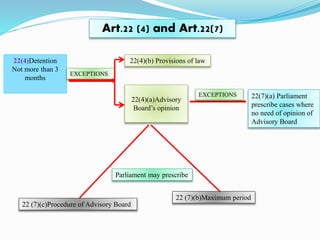
22(4)Detention
Not more than 3
months
22(4)(b) Provisions of law
EXCEPTIONS
22(4)(a)Advisory
Board’s opinion
22(7)(a) Parliament
prescribe cases where
no need of opinion of
Advisory Board
Parliament may prescribe
22 (7)(c)Procedure of Advisory Board
22 (7)(b)Maximum period
EXCEPTIONS
Art.22 (4) and Art.22(7)
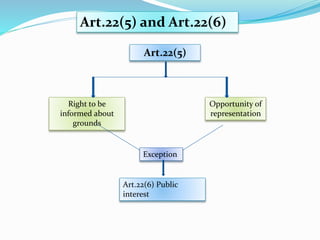
Art.22(5)
Right to be
informed about
grounds
Opportunity of
representation
Exception
Art.22(6) Public
interest
Art.22(5) and Art.22(6)
Object
Article 22 provides procedural safeguards against
arbitrary arrest and detention. It is applicable to all
individuals (Citizens and non-citizens).
It does not confer a Fundamental Right on an individual
against arrest and detention. It only extends certain
procedural safeguards in case of arrest of individual
Thus it comes into play only after a person has been
arrested or detained. Its object is to prevent arbitrary
arrest and detention by the State.
-India is a country having multi-ethnic, multi-religious and
multilingual society. Caste and communal violence is very common
in India. Apart from that the circumstances at the time , when our
constitution came in to force demanded such provisions. This is
evident from following statement of Dr. Bhimrao Ambedkar
“….in the present circumstances of the country, it may be necessary
for the executive to detain a person who is tempering either with the
public order or with the defence services of the country. In such case, I
don’t think that the exigency of the liberty of an individual shall be above
the interest of the state” -Dr. B R Ambedkar.
- So in short PDA is a ‘necessary evil’.
Case Laws
 A.K.Gopalan vs. State of Madras (1950)
- A.K.Gopalan, a communist leader was detained in Madras jail under
Preventive detention Act,1950. He challenged his detention on the
ground of fundamental right and also questioned the law.
-The Court held that Preventive detention does not abridge the
detainee’s right to freedom (Art.19).
-Art.22 empower the Parliament to make laws on preventive detention.
-A law that affected life and personal liberty can not be declared
unconstitutional only on account that it did not follow due process of
natural justice.
-In this way it was narrow interpretation of Art.22 also.
Criticism
 It is worth bearing in mind that no other civilized country, including
Britain which brought Preventive Detention laws here, felt compelled
to introduce such laws during peace time. Even during the last World
War, most European countries and the USA, who were all directly
involved in the war, had no such law.
 lacking clear guidance from the Constitution, courts have applied
vague and toothless standards - such as the subjective "satisfaction" of
the detaining authority test - to govern the implementation of
preventive detention laws.
 Misuse of various preventive laws for political rivalry.
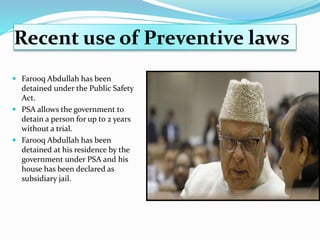
Recent use of Preventive laws
 Farooq Abdullah has been
detained under the Public Safety
Act.
 PSA allows the government to
detain a person for up to 2 years
without a trial.
 Farooq Abdullah has been
detained at his residence by the
government under PSA and his
house has been declared as
subsidiary jail.
Mehbooba Mufti, Omar
Abdullah put under preventive
detention amid possibility of
law and order crisis in J&K
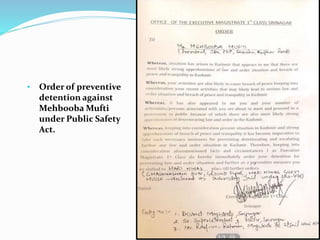
• Order of preventive
detention against
Mehbooba Mufti
under Public Safety
Act.
Preventive detention Art.22

Preventive detention Art.22

  • 1.
  • 2.
    Synopsis  Introduction  Differencebetween arrest and preventive detention  Art.22 of the Constitution  Explanation of clauses(4),(5),(6),(7) of Art.22  Object behind the right  Case Laws  Criticism on preventive detention laws  Recent incidences of Preventive Detention
  • 3.
    Introduction  Dictionary meaningof the words preventive detention is the imprisonment of a person with the aim of preventing them from committing further offences or of maintaining public order.  The Centre and also State can make laws for preventive Detention according to entry (3) Of List 3 and entry 9 of List 1 of 7th Schedule.
  • 4.
    ARREST PREVENTIVE DETENTION -Punitivemeasure -Preventive measure -To punish for offence -To prevent from doing offence -Ordinary laws are applicable for arrest -Person can be detained only under preventive laws Difference between Arrest and Preventive detention
  • 5.
    Art.22  Art.22- Protectionagainst arrest and detention in certain cases- (1) No person who is arrested shall be detained in custody without being informed, as soon as may be, of the grounds for such arrest nor shall he be denied the right to consult, and to be defended by, a legal practitioner of his choice. (2) Every person who is arrested and detained in custody shall be produced before the nearest magistrate within a period of twenty-four hours of such arrest excluding the time necessary for the journey from the place of arrest to the court of the magistrate and no such person shall be detained in custody beyond the said period without the authority of a magistrate. (3) Nothing in clauses (1) and (2) shall apply— (a) to any person who for the time being is an enemy alien; or (b) to any person who is arrested or detained under any law providing for preventive detention.
  • 6.
    (4) No lawproviding for preventive detention shall authorise the detention of a person for a longer period than three months unless— (a) an Advisory Board consisting of persons who are, or have been, or are qualified to be appointed as, Judges of a High Court has reported before the expiration of the said period of three months that there is in its opinion sufficient cause for such detention: Provided that nothing in this sub-clause shall authorise the detention of any person beyond the maximum period prescribed by any law made by Parliament under sub-clause (b) of clause (7); or (b) such person is detained in accordance with the provisions of any law made by Parliament under sub clauses (a) and (b) of clause (7). (5) When any person is detained in pursuance of an order made under any law providing for preventive detention, the authority making the order shall, as soon as may be, communicate to such person the grounds on which the order has been made and shall afford him the earliest opportunity of making a representation against the order.
  • 7.
    (6) Nothing inclause (5) shall require the authority making any such order as is referred to in that clause to disclose facts which such authority considers to be against the public interest to disclose. (7) Parliament may by law prescribe— (a) the circumstances under which, and the class or classes of cases in which, a person may be detained for a period longer than three months under any law providing for preventive detention without obtaining the opinion of an Advisory Board in accordance with the provisions of sub-clause (a) of clause (4); (b) the maximum period for which any person may in any class or classes of cases be detained under any law providing for preventive detention; and (c) the procedure to be followed by an Advisory Board in an inquiry under sub-clause (a) of clause (4).
  • 8.
    22(4)Detention Not more than3 months 22(4)(b) Provisions of law EXCEPTIONS 22(4)(a)Advisory Board’s opinion 22(7)(a) Parliament prescribe cases where no need of opinion of Advisory Board Parliament may prescribe 22 (7)(c)Procedure of Advisory Board 22 (7)(b)Maximum period EXCEPTIONS Art.22 (4) and Art.22(7)
  • 9.
    Art.22(5) Right to be informedabout grounds Opportunity of representation Exception Art.22(6) Public interest Art.22(5) and Art.22(6)
  • 10.
    Object Article 22 providesprocedural safeguards against arbitrary arrest and detention. It is applicable to all individuals (Citizens and non-citizens). It does not confer a Fundamental Right on an individual against arrest and detention. It only extends certain procedural safeguards in case of arrest of individual Thus it comes into play only after a person has been arrested or detained. Its object is to prevent arbitrary arrest and detention by the State.
  • 11.
    -India is acountry having multi-ethnic, multi-religious and multilingual society. Caste and communal violence is very common in India. Apart from that the circumstances at the time , when our constitution came in to force demanded such provisions. This is evident from following statement of Dr. Bhimrao Ambedkar “….in the present circumstances of the country, it may be necessary for the executive to detain a person who is tempering either with the public order or with the defence services of the country. In such case, I don’t think that the exigency of the liberty of an individual shall be above the interest of the state” -Dr. B R Ambedkar. - So in short PDA is a ‘necessary evil’.
  • 12.
    Case Laws  A.K.Gopalanvs. State of Madras (1950) - A.K.Gopalan, a communist leader was detained in Madras jail under Preventive detention Act,1950. He challenged his detention on the ground of fundamental right and also questioned the law. -The Court held that Preventive detention does not abridge the detainee’s right to freedom (Art.19). -Art.22 empower the Parliament to make laws on preventive detention. -A law that affected life and personal liberty can not be declared unconstitutional only on account that it did not follow due process of natural justice. -In this way it was narrow interpretation of Art.22 also.
  • 13.
    Criticism  It isworth bearing in mind that no other civilized country, including Britain which brought Preventive Detention laws here, felt compelled to introduce such laws during peace time. Even during the last World War, most European countries and the USA, who were all directly involved in the war, had no such law.  lacking clear guidance from the Constitution, courts have applied vague and toothless standards - such as the subjective "satisfaction" of the detaining authority test - to govern the implementation of preventive detention laws.  Misuse of various preventive laws for political rivalry.
  • 14.
    Recent use ofPreventive laws  Farooq Abdullah has been detained under the Public Safety Act.  PSA allows the government to detain a person for up to 2 years without a trial.  Farooq Abdullah has been detained at his residence by the government under PSA and his house has been declared as subsidiary jail.
  • 15.
    Mehbooba Mufti, Omar Abdullahput under preventive detention amid possibility of law and order crisis in J&K
  • 16.
    • Order ofpreventive detention against Mehbooba Mufti under Public Safety Act.