The Redesigned Curriculum: a
home for quality teaching and
learning in inclusive classrooms
PLN	
Richmond	
May	1,	2017
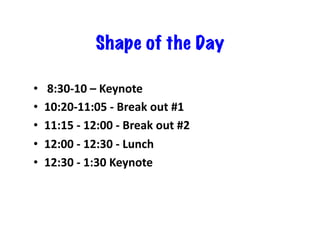
Shape of the Day
•  	8:30-10	–	Keynote										
•  10:20-11:05	-	Break	out	#1									
•  11:15	-	12:00	-	Break	out	#2									
•  12:00	-	12:30	-	Lunch									
•  12:30	-	1:30	Keynote
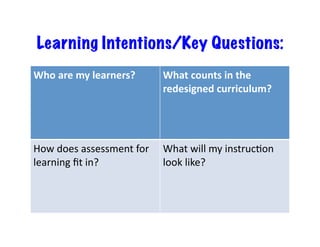
Learning Intentions/Key Questions:
Who	are	my	learners?	 What	counts	in	the	
redesigned	curriculum?	
How	does	assessment	for	
learning	fit	in?	
What	will	my	instrucBon	
look	like?
•  Who	are	my	learners?
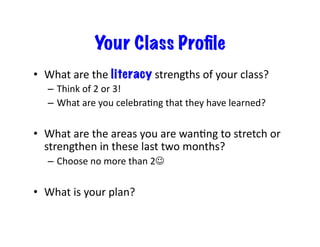
Your Class Profile
•  What	are	the	literacy	strengths	of	your	class?	
–  Think	of	2	or	3!	
–  What	are	you	celebraBng	that	they	have	learned?	
•  What	are	the	areas	you	are	wanBng	to	stretch	or	
strengthen	in	these	last	two	months?	
–  Choose	no	more	than	2☺	
•  What	is	your	plan?
•  What	counts	in	the	redesigned	curriculum?
•  Big	Ideas	
•  LiMing	the	learner	
•  Core	competencies
Reading is understanding.
Reading is thinking.
Reading is making sense in
disciplines.
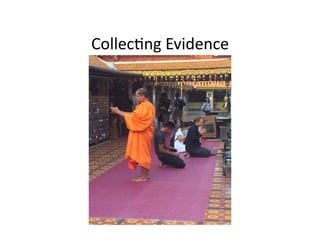
CollecBng	Evidence
Core Competencies
•  CommunicaBon	
•  Thinking	
– CreaBve	
– CriBcal	
•  Personal		
– PosiBve	personal	&	cultural	idenBty	
– Personal	awareness	&	responsibility	
– Social	responsibility
•  While	students	and	teachers	become	familiar	
with	the	self-assessment	of	the	Core	
Competencies	this	year,	it	is	recommended	
that	students	begin	by	self-assessing	on	at	
least	one	of	the	three	broad	Core	
Competencies	on	the	final	report	of	this	
school	year.	
•  SupporBng	the	Self-Assessment	and	ReporBng	
of	Core	Competencies,	Ministry	of	Ed.,	March	
2017
Over time, students:
•  Gain	the	ability	to	assess	their	own	strengths	
•  Create	realisBc	and	achievable	goals	
•  Construct	a	clear	plan	to	reach	their	goals	
•  Provide	examples	and	evidence	of	their	learning	
•  Revisit	previous	documentaBons	of	self-
assessments,	where	applicable,	to	document	
their	growth	
•  Ministry	of	EducaBon,	March	2017,	DraM
Strengths-based!!!
We	are	NOT	searching	for	what	kids	are	NOT	
good	at.	
We	build	on	strengths,	not	fill	in	holes.
•  No	checklists	
•  No	rubrics	
NoBce	–	Name	-	Nurture
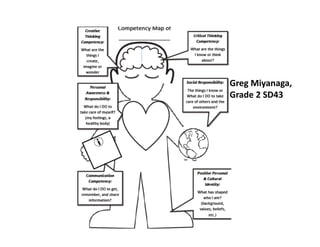
Greg	Miyanaga,		
Grade	2	SD43
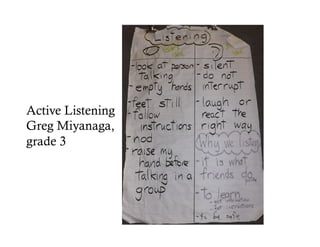
Active Listening
Greg Miyanaga,
grade 3
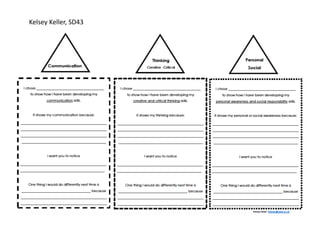
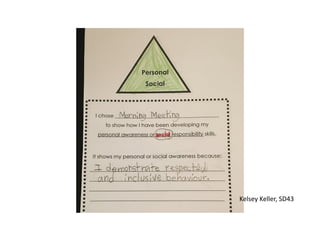
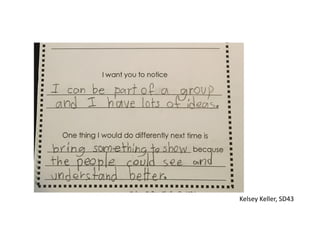
Kelsey	Keller,	SD43
Kelsey	Keller,	SD43
Kelsey	Keller,	SD43
Self-Assessing Personal Awareness
and Responsibility – Judith King, SD 67
•  Place	words	and	phrases	from	the	chosen	core	
competency	on	a	page	
•  Choose	words	and	phrases	that	represent	a	
wide	range	
•  All	words	and	phrases	are	posiBve	
•  Copy	one	page	per	student
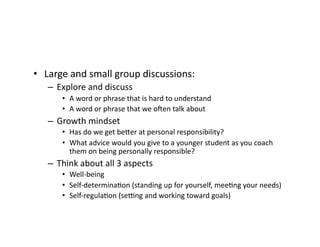
•  Large	and	small	group	discussions:	
–  Explore	and	discuss	
•  A	word	or	phrase	that	is	hard	to	understand	
•  A	word	or	phrase	that	we	oMen	talk	about	
–  Growth	mindset	
•  Has	do	we	get	beer	at	personal	responsibility?	
•  What	advice	would	you	give	to	a	younger	student	as	you	coach	
them	on	being	personally	responsible?	
–  Think	about	all	3	aspects	
•  Well-being	
•  Self-determinaBon	(standing	up	for	yourself,	meeBng	your	needs)	
•  Self-regulaBon	(se_ng	and	working	toward	goals)
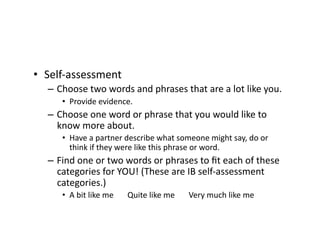
•  Self-assessment	
–  Choose	two	words	and	phrases	that	are	a	lot	like	you.	
•  Provide	evidence.	
–  Choose	one	word	or	phrase	that	you	would	like	to	
know	more	about.	
•  Have	a	partner	describe	what	someone	might	say,	do	or	
think	if	they	were	like	this	phrase	or	word.	
–  Find	one	or	two	words	or	phrases	to	fit	each	of	these	
categories	for	YOU!	(These	are	IB	self-assessment	
categories.)	
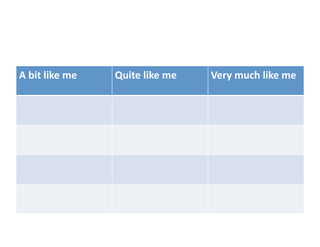
•  A	bit	like	me							Quite	like	me							Very	much	like	me
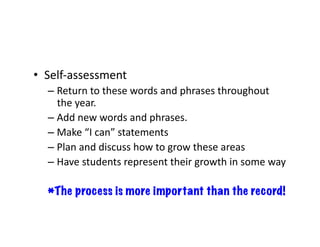
•  Self-assessment	
– Return	to	these	words	and	phrases	throughout	
the	year.	
– Add	new	words	and	phrases.	
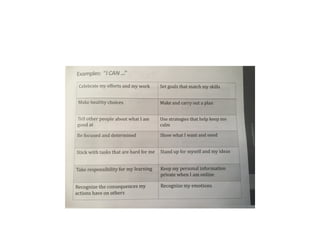
– Make	“I	can”	statements	
– Plan	and	discuss	how	to	grow	these	areas	
– Have	students	represent	their	growth	in	some	way	
*The process is more important than the record!
A	bit	like	me	 Quite	like	me	 Very	much	like	me
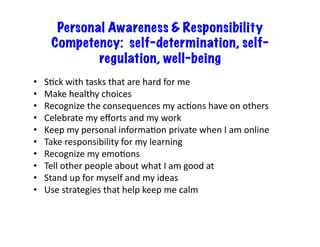
Personal Awareness & Responsibility
Competency: self-determination, self-
regulation, well-being
•  SBck	with	tasks	that	are	hard	for	me	
•  Make	healthy	choices	
•  Recognize	the	consequences	my	acBons	have	on	others	
•  Celebrate	my	efforts	and	my	work	
•  Keep	my	personal	informaBon	private	when	I	am	online	
•  Take	responsibility	for	my	learning	
•  Recognize	my	emoBons	
•  Tell	other	people	about	what	I	am	good	at	
•  Stand	up	for	myself	and	my	ideas	
•  Use	strategies	that	help	keep	me	calm
•  How	does	assessment	for	learning	fit	in?
•  Strengths	and	stretches	
•  Class	plan	
•  More	than	just	a	level	
How does our assessment
information guide our
instruction?
Wendy	Coish,	Grade1	
Walnut	Park,	Bulkley	Valley	
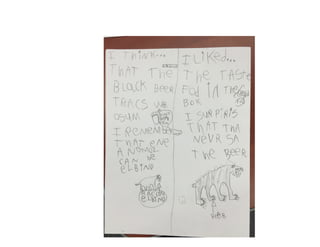
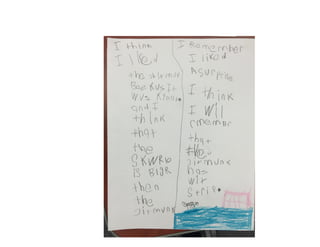
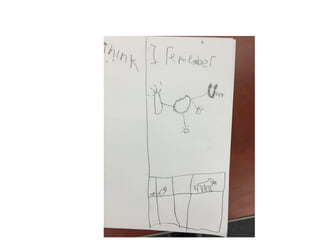
•  Follow	up	from	EPRA,	choice	text	
•  Demo	lesson:		How	do	we	use	what	we	have	
learned	in	the	assessment?	
•  Co-plan,	teach,	reflect	as	a	team	
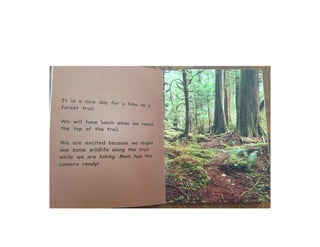
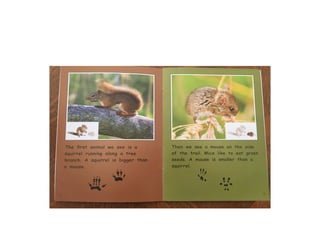
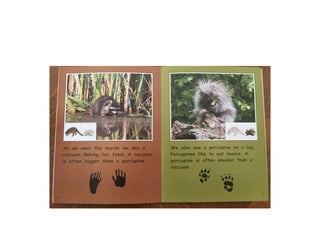
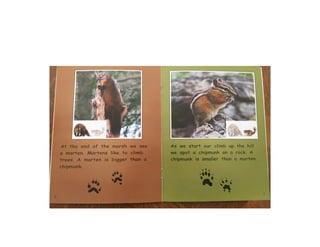
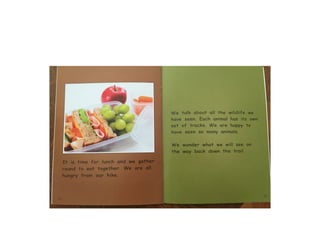
•  Students	keen	on	nonficBon	
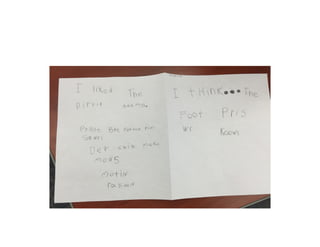
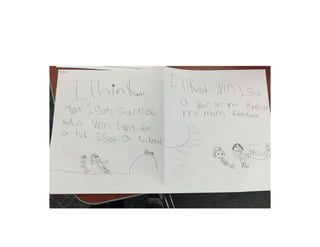
•  Focus:	Develop	difference	between	factual	
informaBon	(remember,	surprise,	interesBng)	
from	response	and	thinking
Strengthening Choice Reading
•  1:1	conferences	
–  Book	chat	–	Tell	me	about	what	you	are	reading.	
–  Read	a	small	secBon	to	me.	
–  Response	has	a	meaning	and	strategy	focus	
–  Extend	the	thinking	
•  Whole	group	response	
–  Model	the	format	you	want	from	the	class	read	aloud	
–  Students	analyze	your	response	
–  Students	complete	their	response	
•  Be	a	photographer	with	2	lenses:		telescopic	and	long	range	
•  Sketch	2	pictures	and	explain	why	each	is	important	in	the	story
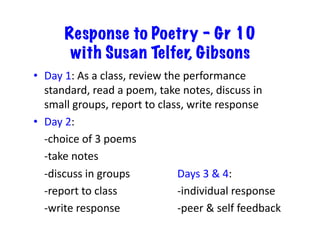
Response to Poetry – Gr 10
with Susan Telfer, Gibsons
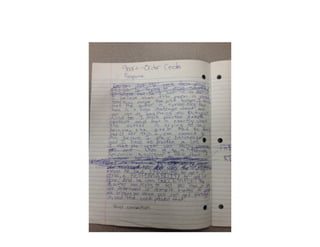
•  Day	1:	As	a	class,	review	the	performance	
standard,	read	a	poem,	take	notes,	discuss	in	
small	groups,	report	to	class,	write	response	
•  Day	2:	
	-choice	of	3	poems	
	-take	notes	
	-discuss	in	groups	 	 	 	Days	3	&	4:	
	-report	to	class	 	 	 	 	-individual	response	
	-write	response 	 	 	 	-peer	&	self	feedback
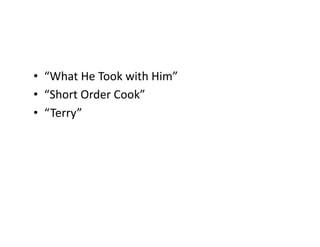
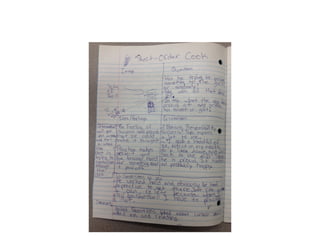
•  “What	He	Took	with	Him”	
•  “Short	Order	Cook”	
•  “Terry”
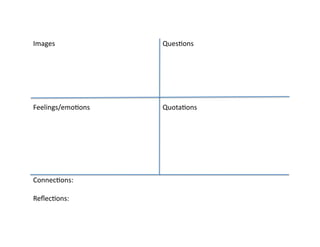
Images 	 	 	 	 	 	 	 	QuesBons	
Feelings/emoBons	 	 	 	 	 	QuotaBons	
ConnecBons:	
ReflecBons:
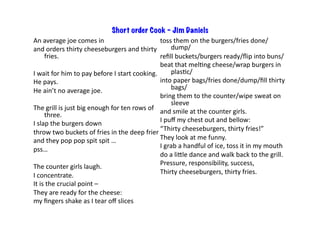
Short order Cook – Jim Daniels
An	average	joe	comes	in	
and	orders	thirty	cheeseburgers	and	thirty	
fries.	
I	wait	for	him	to	pay	before	I	start	cooking.	
He	pays.	
He	ain’t	no	average	joe.	
The	grill	is	just	big	enough	for	ten	rows	of	
three.	
I	slap	the	burgers	down	
throw	two	buckets	of	fries	in	the	deep	frier	
and	they	pop	pop	spit	spit	…	
pss…	
The	counter	girls	laugh.	
I	concentrate.	
It	is	the	crucial	point	–		
They	are	ready	for	the	cheese:		
my	fingers	shake	as	I	tear	off	slices	
toss	them	on	the	burgers/fries	done/
dump/	
refill	buckets/burgers	ready/flip	into	buns/	
beat	that	melBng	cheese/wrap	burgers	in	
plasBc/	
into	paper	bags/fries	done/dump/fill	thirty	
bags/	
bring	them	to	the	counter/wipe	sweat	on	
sleeve	
and	smile	at	the	counter	girls.	
I	puff	my	chest	out	and	bellow:	
“Thirty	cheeseburgers,	thirty	fries!”	
They	look	at	me	funny.	
I	grab	a	handful	of	ice,	toss	it	in	my	mouth	
do	a	lile	dance	and	walk	back	to	the	grill.	
Pressure,	responsibility,	success,	
Thirty	cheeseburgers,	thirty	fries.
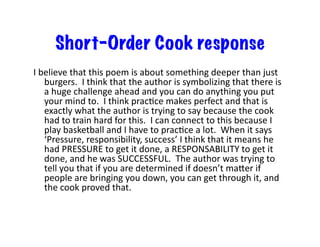
Short-Order Cook response
I	believe	that	this	poem	is	about	something	deeper	than	just	
burgers.		I	think	that	the	author	is	symbolizing	that	there	is	
a	huge	challenge	ahead	and	you	can	do	anything	you	put	
your	mind	to.		I	think	pracBce	makes	perfect	and	that	is	
exactly	what	the	author	is	trying	to	say	because	the	cook	
had	to	train	hard	for	this.		I	can	connect	to	this	because	I	
play	basketball	and	I	have	to	pracBce	a	lot.		When	it	says	
‘Pressure,	responsibility,	success’	I	think	that	it	means	he	
had	PRESSURE	to	get	it	done,	a	RESPONSABILITY	to	get	it	
done,	and	he	was	SUCCESSFUL.		The	author	was	trying	to	
tell	you	that	if	you	are	determined	if	doesn’t	maer	if	
people	are	bringing	you	down,	you	can	get	through	it,	and	
the	cook	proved	that.
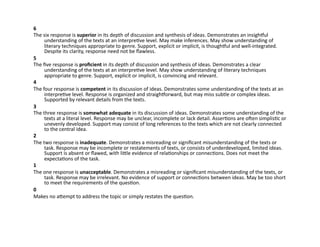
6		
The	six	response	is	superior	in	its	depth	of	discussion	and	synthesis	of	ideas.	Demonstrates	an	insighpul	
understanding	of	the	texts	at	an	interpreBve	level.	May	make	inferences.	May	show	understanding	of	
literary	techniques	appropriate	to	genre.	Support,	explicit	or	implicit,	is	thoughpul	and	well-integrated.	
Despite	its	clarity,	response	need	not	be	flawless.		
5		
The	five	response	is	proficient	in	its	depth	of	discussion	and	synthesis	of	ideas.	Demonstrates	a	clear	
understanding	of	the	texts	at	an	interpreBve	level.	May	show	understanding	of	literary	techniques	
appropriate	to	genre.	Support,	explicit	or	implicit,	is	convincing	and	relevant.		
4		
The	four	response	is	competent	in	its	discussion	of	ideas.	Demonstrates	some	understanding	of	the	texts	at	an	
interpreBve	level.	Response	is	organized	and	straighporward,	but	may	miss	subtle	or	complex	ideas.	
Supported	by	relevant	details	from	the	texts.		
3		
The	three	response	is	somewhat	adequate	in	its	discussion	of	ideas.	Demonstrates	some	understanding	of	the	
texts	at	a	literal	level.	Response	may	be	unclear,	incomplete	or	lack	detail.	AsserBons	are	oMen	simplisBc	or	
unevenly	developed.	Support	may	consist	of	long	references	to	the	texts	which	are	not	clearly	connected	
to	the	central	idea.		
2		
The	two	response	is	inadequate.	Demonstrates	a	misreading	or	significant	misunderstanding	of	the	texts	or	
task.	Response	may	be	incomplete	or	restatements	of	texts,	or	consists	of	underdeveloped,	limited	ideas.	
Support	is	absent	or	flawed,	with	lile	evidence	of	relaBonships	or	connecBons.	Does	not	meet	the	
expectaBons	of	the	task.		
1		
The	one	response	is	unacceptable.	Demonstrates	a	misreading	or	significant	misunderstanding	of	the	texts,	or	
task.	Response	may	be	irrelevant.	No	evidence	of	support	or	connecBons	between	ideas.	May	be	too	short	
to	meet	the	requirements	of	the	quesBon.		
0		
Makes	no	aempt	to	address	the	topic	or	simply	restates	the	quesBon.
Note:	This	is	a	first-draS	response	and	should	be	
assessed	as	such.		
The	response	is	to	be	assessed	holisUcally.		
WriUng	convenUons	are	to	be	considered	only	to	
the	extent	that	they	impede	meaning.		
A	variety	of	types	of	responses	such	as	graphic	
representaUons,	tables	or	lists	are	acceptable	
and	shall	be	assessed	according	to	the	rubric.		
Students	who	do	not	discuss	both	passages	will	
receive	a	maximum	scale	point	of	4.
•  What	does	instrucBon	look	like?
In-class writing, collaboration, core
competencies, gr. 2/3
•  Marnie	Manners	
•  Faye	Brownlie	
•  WriBng	project	in	Burnaby	focusing	on	
infusing	the	PosiBve	Personal	and	Cultural	
IdenBty	Core	Competency	into	WriBng
Narrative Writing – Gr 2/3
with Marnie Manners, Burnaby
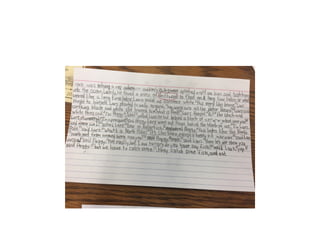
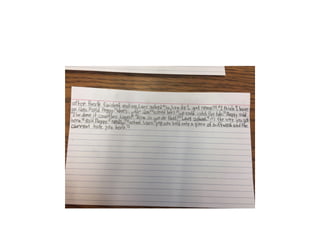
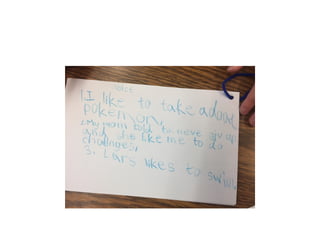
•  Students	have	been	reading	and	retelling	Lars,	the	polar	
bear	stories	by	Hans	de	Beer	
•  The	story	plot	is	that	Lars,	the	polar	bear,	is	bored/lonely	in	
his	home	at	the	North	Pole.	Something	unexpected	
happens	(an	iceberg	floats	away,	he	gets	caught	in	a	fishing	
net/trap	and	travels	by	boat/plane/train)	and	is	taken	to	
another	place	(jungle/city).	He	meets	another	animal	in	the	
new	se_ng.	The	new	friend	takes	him	to	meet	another	
animal	who	helps	him	to	get	home	by	some	sort	of	
transportaBon.	Lars	safely	arrives	home,	is	reunited	with	his	
family	and	tells	them	about	his	adventure.
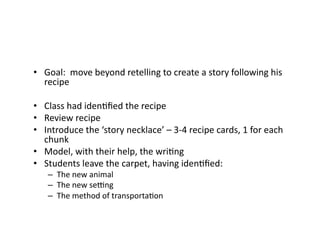
•  Goal:		move	beyond	retelling	to	create	a	story	following	his	
recipe	
•  Class	had	idenBfied	the	recipe	
•  Review	recipe	
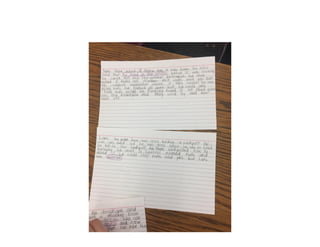
•  Introduce	the	‘story	necklace’	–	3-4	recipe	cards,	1	for	each	
chunk	
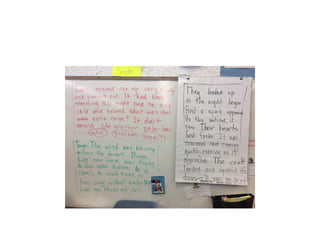
•  Model,	with	their	help,	the	wriBng	
•  Students	leave	the	carpet,	having	idenBfied:	
–  The	new	animal	
–  The	new	se_ng	
–  The	method	of	transportaBon
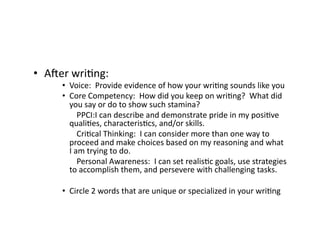
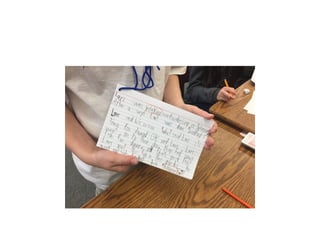
•  AMer	wriBng:	
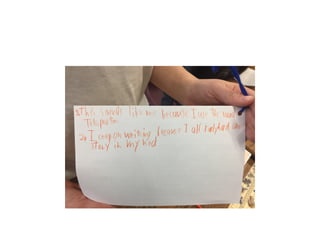
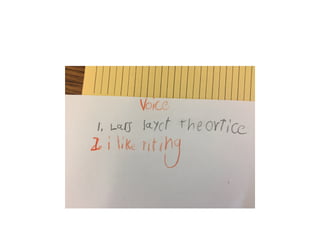
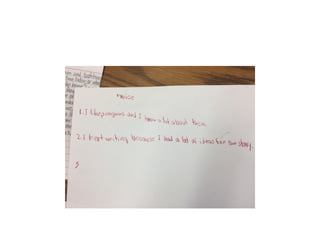
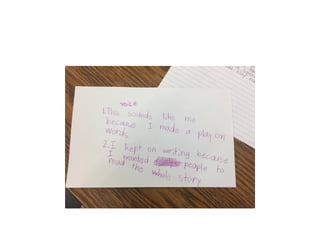
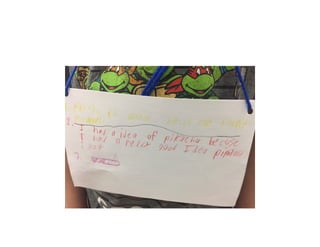
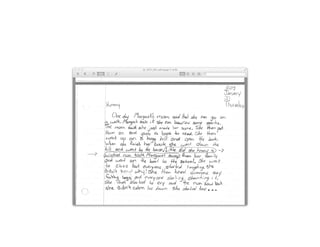
•  Voice:		Provide	evidence	of	how	your	wriBng	sounds	like	you	
•  Core	Competency:		How	did	you	keep	on	wriBng?		What	did	
you	say	or	do	to	show	such	stamina?	
	 	PPCI:I	can	describe	and	demonstrate	pride	in	my	posiBve	
qualiBes,	characterisBcs,	and/or	skills.	
	 	CriBcal	Thinking:		I	can	consider	more	than	one	way	to	
proceed	and	make	choices	based	on	my	reasoning	and	what	
I	am	trying	to	do.	
	 	Personal	Awareness:		I	can	set	realisBc	goals,	use	strategies	
to	accomplish	them,	and	persevere	with	challenging	tasks.		
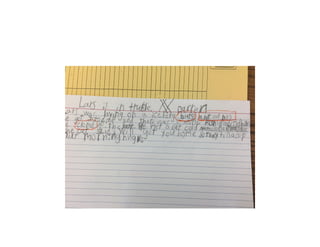
•  Circle	2	words	that	are	unique	or	specialized	in	your	wriBng
Literature Circles: Residential
Schools
•  A	unit	co-developed	by		
– Marla	Gamble,	gr.	6	Classroom	Teacher,	Prince	
Rupert,	BC	
– Marilyn	Bryant,	Aboriginal	EducaBon	Program	
Resource	Teacher	
– Raegan	Sawka,	LUCID	Support	Teacher	(Learning	
for	Understanding	through	Culturally	Inclusive	
ImaginaBve	Development)	
•  Lesson	2:		co-designed	and	co-taught:		Marla	&	Faye
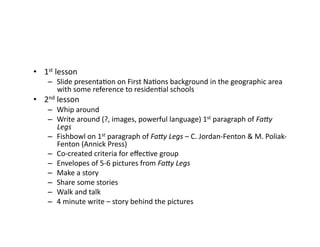
•  1st	lesson	
–  Slide	presentaBon	on	First	NaBons	background	in	the	geographic	area	
with	some	reference	to	residenBal	schools	
•  2nd	lesson	
–  Whip	around	
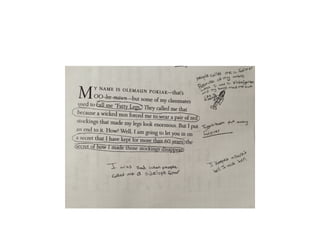
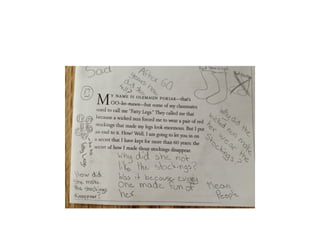
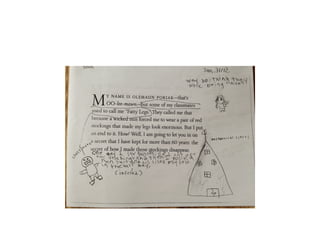
–  Write	around	(?,	images,	powerful	language)	1st	paragraph	of	Fa#y	
Legs	
–  Fishbowl	on	1st	paragraph	of	Fa#y	Legs	–	C.	Jordan-Fenton	&	M.	Poliak-
Fenton	(Annick	Press)	
–  Co-created	criteria	for	effecBve	group	
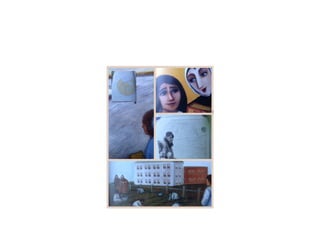
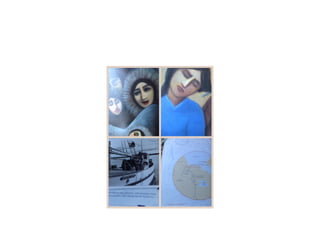
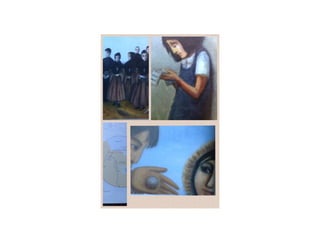
–  Envelopes	of	5-6	pictures	from	Fa#y	Legs	
–  Make	a	story	
–  Share	some	stories	
–  Walk	and	talk	
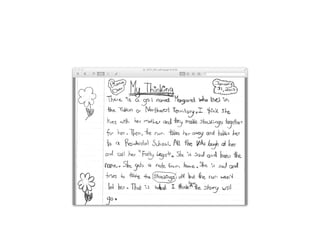
–  4	minute	write	–	story	behind	the	pictures
•  My	name	is	Olemaun	Pokiak	–	that’s	OO-lee-
mawn	-	but	some	of	my	classmates	used	to	
call	me	“Fay	Legs”.		They	called	me	that	
because	a	wicked	nun	forced	me	to	wear	a	
pair	of	red	stockings	that	made	my	legs	look	
enormous.		But	I	put	an	end	to	it.		How?		Well,	
I	am	going	to	let	you	in	on	a	secret	that	I	have	
kept	for	more	than	60	years:	the	secret	of	how	
I	made	those	stockings	disappear.
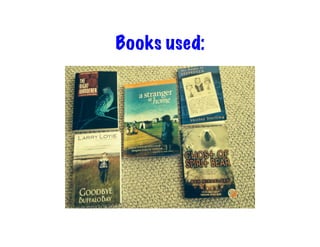
Books used:
•  What	is	something	in	your	pracBce	that	
affirms?		
•  What	is	something	that	you	could	refine?		
•  What	is	something	that	you	could	aspire	to?	
•  What	opportuniBes	are	there	to	let	something	
go?
•  What	is	your	plan?	
•  With	whom	will	you	work?	
•  How	will	it	connect	to	a	big	idea	in	the	
redesigned	curriculum?

Richmond,April PNS 2017