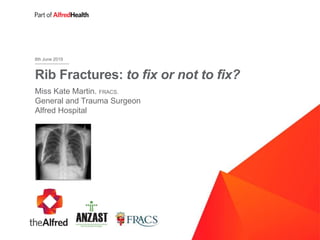
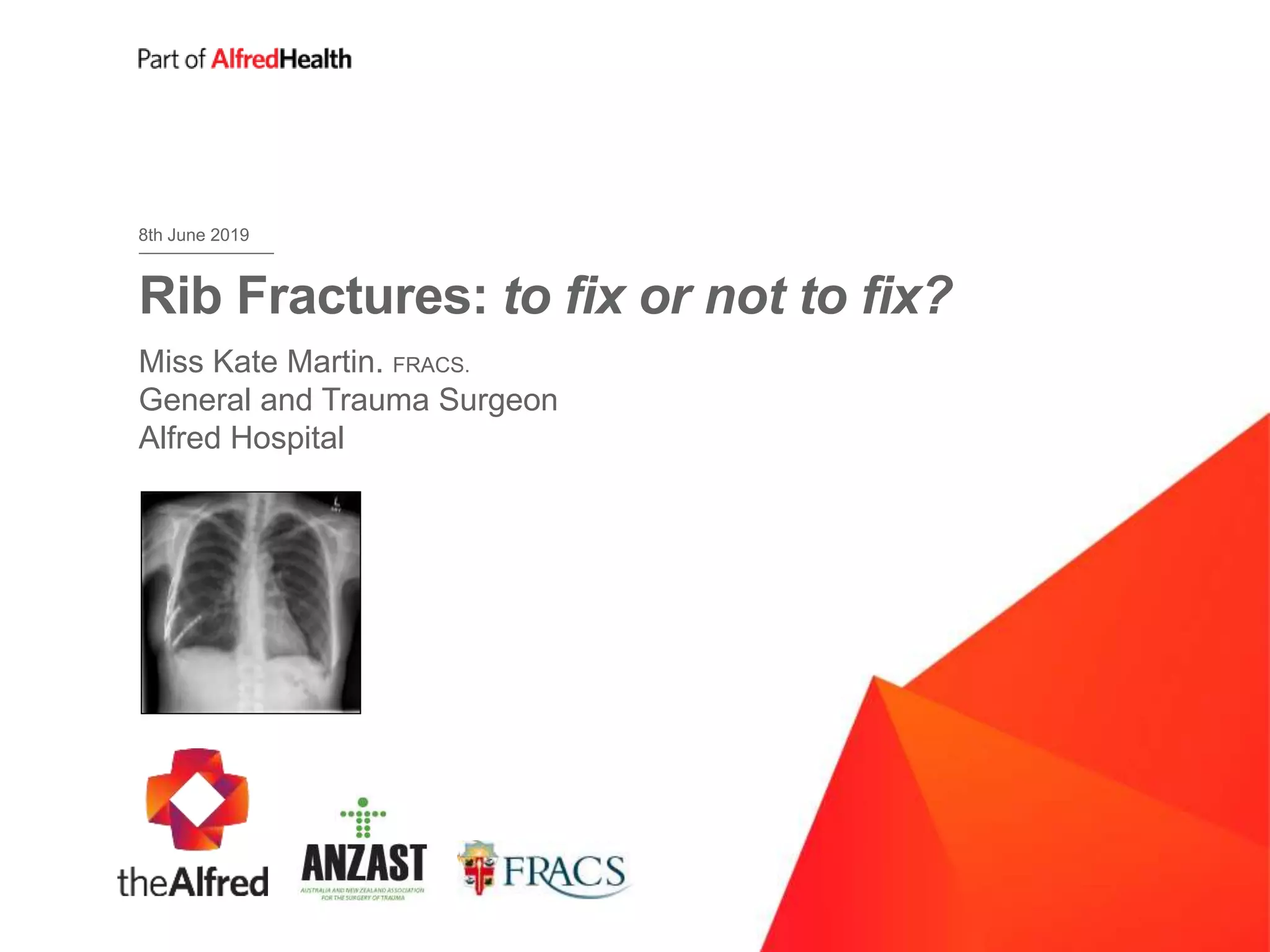


Rib Fractures: to fix or not to fix?
Miss Kate Martin. FRACS.
General and Trauma Surgeon
Alfred Hospital
8th June 2019
Declarations
Nothing to disclose.
2
14 August 2019 3
Overview
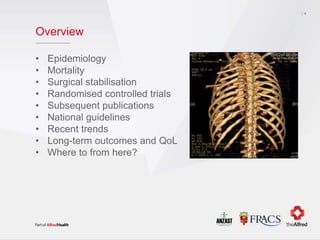
• Epidemiology
• Mortality
• Surgical stabilisation
• Randomised controlled trials
• Subsequent publications
• National guidelines
• Recent trends
• Long-term outcomes and QoL
• Where to from here?
4
Epidemiology
Incidence varies depending on patient population:
• North America (NTDB) 2016: 10% ≥1 rib #
• Major trauma only: 21-39%
Alfred:
• All patients admitted into Trauma Service: 21% ≥1 rib #
Mechanism:
• Motor vehicle-related trauma: 57-79%
• Fall from standing: 16-23%
5
Flagel et al. Surgery. 2005;138(4):717-25 Ziegler, Agarwal. J Trauma. 1994;37(6):975-979.
Cameron et al. Aust NZ J Surg. 1996;66(8):530-534 Sirmali et al. Eur J Cardiothorac Surg. 2003;24(1):133-38
Dehghan et al. J Trauma. 2014;76(2):462-68
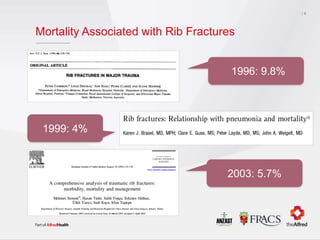
Mortality Associated with Rib Fractures
6
2003: 5.7%
1996: 9.8%
1999: 4%
7
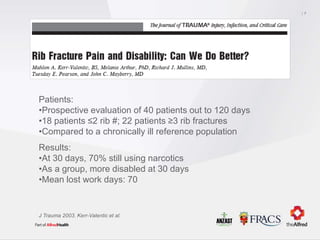
J Trauma 2003. Kerr-Valentic et al.
Patients:
•Prospective evaluation of 40 patients out to 120 days
•18 patients ≤2 rib #; 22 patients ≥3 rib fractures
•Compared to a chronically ill reference population
Results:
•At 30 days, 70% still using narcotics
•As a group, more disabled at 30 days
•Mean lost work days: 70
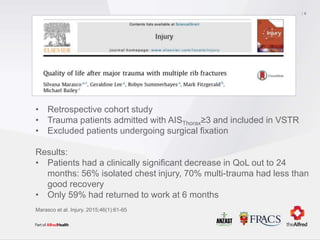
• Retrospective cohort study
• Trauma patients admitted with AISThorax≥3 and included in VSTR
• Excluded patients undergoing surgical fixation
Results:
• Patients had a clinically significant decrease in QoL out to 24
months: 56% isolated chest injury, 70% multi-trauma had less than
good recovery
• Only 59% had returned to work at 6 months
8
Marasco et al. Injury. 2015;46(1):61-65
Mortality Associated with Rib Fractures
Rib fractures occur in isolation in only 6-13% patients
• PTHx, HTHx, H-PTHx: 32-72%
• Pulmonary contusions: 17-26%
Mortality in trauma determined by a number of factors:
• Patient demographics and co-morbidities
• Injuries sustained and severity (ISS)
• Treatment
Correlation between mortality and:
• Number of ribs fractured
• Chest wall stability
9
Flagel et al. Surgery. 2005;138(4):717-25 Cameron et al. Aust NZ J Surg. 1996;66(8):530-534
Barnea et al. Can J Surg. 2002;45(1):43-46 Bulger et al. J Trauma. 2000;48(6):1040-6
Dehghan et al. J Ortho Trauma. 2018;32(1):15-21 Sirmali et al. Eur J Cardiothorac Surg. 2003;24(1):133-38
Ziegler, Agarwal. J Trauma. 1994;37(6):975-979
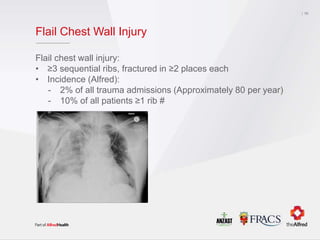
Flail Chest Wall Injury
Flail chest wall injury:
• ≥3 sequential ribs, fractured in ≥2 places each
• Incidence (Alfred):
- 2% of all trauma admissions (Approximately 80 per year)
- 10% of all patients ≥1 rib #
10
Flail Chest Wall Injury and Associated Morbidity
11
3,467 patients with flail chest injury: (2007-2009)
• 54% associated lung contusions
• Intubation and ventilation required in 59% (mean 12.1 days)
• 82% required ICU (mean 11.7 days)
• Mean hospital stay overall: 16.6 days
Dehghan et al. J Trauma. 2014;76(2):462-468
Flail Chest wall Injury and Associated Mortality
Mortality:
• Flail chest wall injury: 9.5%
• Multiple rib fractures without flail: 3.4%
• Single rib or sternal fracture: 1.3%
12
Dehghan et al. J Ortho Trauma. 2018;32(1):15-21
Surgical Stabilisation of Rib Fractures
First described over 50 years ago:
• 1950’s: wire suture fixation and intramedullary wire fixation
Potential use recognised in the setting of:
• Severe chest wall defects and deformity
• Prolonged mechanical ventilation
• Cases where thoracotomy was indicated for other reasons
Increased use over the last 10-15 years associated with:
• Recognition of significant short and longer term complications
of flail chest injury
• Development of rib-specific fixation devices and systems
13
Surgical Stabilisation of Rib Fractures
Aim to:
• Restore mechanical integrity
• Reduce the pain associated with spontaneous ventilation
Resulting in:
• Reduced need for prolonged mechanical ventilation and
tracheostomy
• Reduced incidence of complications associated with flail chest
injury
• Reduced length of stay: ICU, hospital, rehabilitation
• Improved quality of life
• Health system cost savings
14
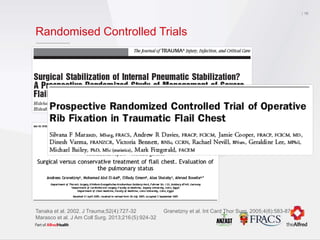
Randomised Controlled Trials
15
Tanaka et al. 2002. J Trauma;52(4):727-32 Granetzny et al. Int Card Thor Surg. 2005;4(6):583-87
Marasco et al. J Am Coll Surg. 2013;216(5):924-32
RCT: Summary of Findings. Tanaka
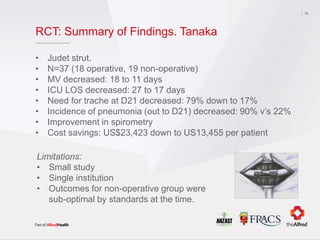
• Judet strut.
• N=37 (18 operative, 19 non-operative)
• MV decreased: 18 to 11 days
• ICU LOS decreased: 27 to 17 days
• Need for trache at D21 decreased: 79% down to 17%
• Incidence of pneumonia (out to D21) decreased: 90% v’s 22%
• Improvement in spirometry
• Cost savings: US$23,423 down to US13,455 per patient
16
Limitations:
• Small study
• Single institution
• Outcomes for non-operative group were
sub-optimal by standards at the time.
RCT: Summary of Findings. Granetzney
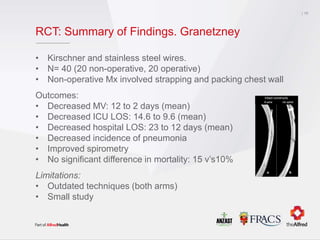
• Kirschner and stainless steel wires.
• N= 40 (20 non-operative, 20 operative)
• Non-operative Mx involved strapping and packing chest wall
Outcomes:
• Decreased MV: 12 to 2 days (mean)
• Decreased ICU LOS: 14.6 to 9.6 (mean)
• Decreased hospital LOS: 23 to 12 days (mean)
• Decreased incidence of pneumonia
• Improved spirometry
• No significant difference in mortality: 15 v’s10%
Limitations:
• Outdated techniques (both arms)
• Small study
17
RCT: Summary of Findings. Marasco
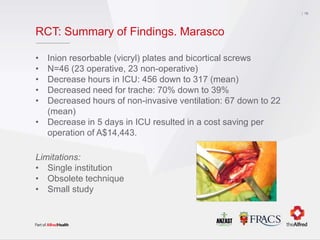
• Inion resorbable (vicryl) plates and bicortical screws
• N=46 (23 operative, 23 non-operative)
• Decrease hours in ICU: 456 down to 317 (mean)
• Decreased need for trache: 70% down to 39%
• Decreased hours of non-invasive ventilation: 67 down to 22
(mean)
• Decrease in 5 days in ICU resulted in a cost saving per
operation of A$14,443.
18
Limitations:
• Single institution
• Obsolete technique
• Small study
RCT: Summary
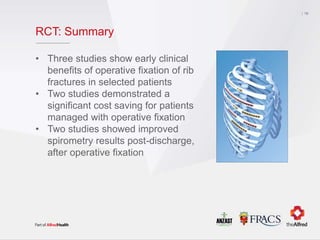
• Three studies show early clinical
benefits of operative fixation of rib
fractures in selected patients
• Two studies demonstrated a
significant cost saving for patients
managed with operative fixation
• Two studies showed improved
spirometry results post-discharge,
after operative fixation
19
Subsequent Publications
20
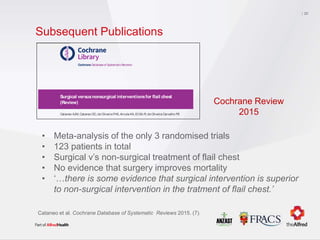
• Meta-analysis of the only 3 randomised trials
• 123 patients in total
• Surgical v’s non-surgical treatment of flail chest
• No evidence that surgery improves mortality
• ‘…there is some evidence that surgical intervention is superior
to non-surgical intervention in the tratment of flail chest.’
Cataneo et al. Cochrane Database of Systematic Reviews 2015. (7).
Cochrane Databaseof SystematicReviews
Surgical versusnonsurgical interventionsfor flail chest
(Review)
Cataneo AJM, Cataneo DC, deOliveiraFHS, Arruda KA, El Dib R, deOliveiraCarvalho PE
Cataneo AJM, Cataneo DC, de Oliveira FHS, Arruda KA, El Dib R, de Oliveira Carvalho PE.
Surgical versusnonsurgical interventionsfor flail chest.
CochraneDatabaseof SystematicReviews 2015, Issue7. Art. No.: CD009919.
DOI: 10.1002/14651858.CD009919.pub2.
www.cochranelibrary.com
Surgical versus nonsurgical interventions for flail chest (Review)
Copyright © 2015The CochraneCollaboration. Published by John Wiley &Sons, Ltd.
Cochrane Review
2015
Subsequent Publications
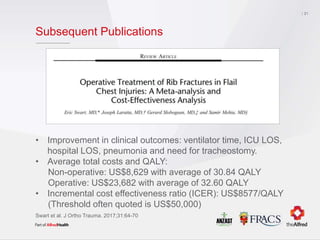
• Improvement in clinical outcomes: ventilator time, ICU LOS,
hospital LOS, pneumonia and need for tracheostomy.
• Average total costs and QALY:
Non-operative: US$8,629 with average of 30.84 QALY
Operative: US$23,682 with average of 32.60 QALY
• Incremental cost effectiveness ratio (ICER): US$8577/QALY
(Threshold often quoted is US$50,000)
21
Swart et al. J Ortho Trauma. 2017;31:64-70
Subsequent Publications
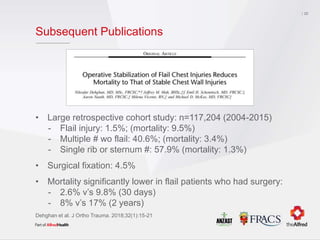
• Large retrospective cohort study: n=117,204 (2004-2015)
- Flail injury: 1.5%; (mortality: 9.5%)
- Multiple # wo flail: 40.6%; (mortality: 3.4%)
- Single rib or sternum #: 57.9% (mortality: 1.3%)
• Surgical fixation: 4.5%
• Mortality significantly lower in flail patients who had surgery:
- 2.6% v’s 9.8% (30 days)
- 8% v’s 17% (2 years)
22
Dehghan et al. J Ortho Trauma. 2018;32(1):15-21
Subsequent Publications
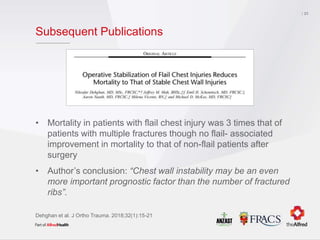
• Mortality in patients with flail chest injury was 3 times that of
patients with multiple fractures though no flail- associated
improvement in mortality to that of non-flail patients after
surgery
• Author’s conclusion: “Chest wall instability may be an even
more important prognostic factor than the number of fractured
ribs”.
23
Dehghan et al. J Ortho Trauma. 2018;32(1):15-21
National Guidelines: NHS 2010
24
‘Current evidence on insertion of metal rib
reinforcements to stabilise a flail chest wall is limited in
quantity but consistently shows efficacy. In addition
there are no major safety concerns….’
National Guidelines: EAST 2016
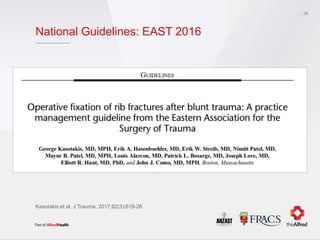
Kasotakis et al. J Trauma. 2017;82(3):618-26
25
National Guidelines: EAST 2016
PICO Question 1:
In adult patients with flail chest after blunt trauma, should rib
ORIF be performed (versus non-operative management) to
decrease mortality, duration of ventilation, ICU and hospital LOS,
incidence of pneumonia and tracheostomy and improve pain
control?
Recommendation:
• In adult patients with flail chest after blunt trauma, conditionally
recommend rib ORIF to decrease mortality, shorten duration of
mechanical ventilation, ICU LOS and hospital LOS, decrease
the incidence of pneumonia and decrease the need for
tracheostomy.
• Cannot offer a recommendation for pain control with current
evidence.
26
National guidelines: EAST 2016
PICO Question 2:
In adult patients with non-flail rib fractures after blunt trauma,
should rib ORIF be performed (versus non-operative
management) to decrease mortality, duration of mechanical
ventilation, ICU and hospital LOS, incidence of pneumonia and
tracheostomy and improve pain control?
Recommendation:
• For patients with non-flail rib fractures after blunt trauma,
cannot offer a recommendation with the currently available
evidence.
27
Recent Trends in Use of Surgical Stabilisation
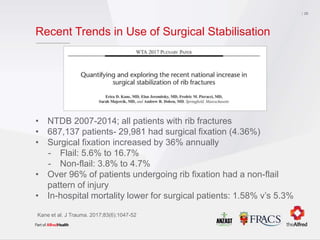
• NTDB 2007-2014; all patients with rib fractures
• 687,137 patients- 29,981 had surgical fixation (4.36%)
• Surgical fixation increased by 36% annually
- Flail: 5.6% to 16.7%
- Non-flail: 3.8% to 4.7%
• Over 96% of patients undergoing rib fixation had a non-flail
pattern of injury
• In-hospital mortality lower for surgical patients: 1.58% v’s 5.3%
28
Kane et al. J Trauma. 2017;83(6):1047-52
Long-Term Outcomes and Quality of Life
29
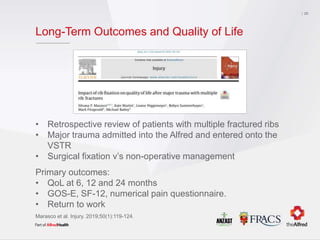
• Retrospective review of patients with multiple fractured ribs
• Major trauma admitted into the Alfred and entered onto the
VSTR
• Surgical fixation v’s non-operative management
Primary outcomes:
• QoL at 6, 12 and 24 months
• GOS-E, SF-12, numerical pain questionnaire.
• Return to work
Marasco et al. Injury. 2019;50(1):119-124.
Long-Term Outcomes and Quality of Life
Results:
• 40 month period 2012-2015
• n=1482; rib fixation=67 (4.5%)
• Mortality 2.1%
• Follow-up: 87%(6); 85%(12); 63%(24)
GOS-E: (whole group)
• Good recovery (7-8): 36%(6); 37%(12); 38%(24)
Any pain:
• 49%(6); 43%(12); 43%(24)
Return to work: 58%
After multi-variable analysis over 24 months, there was no
significant difference in QoL between the operative and
non-operative groups.
30
Patient Selection: where to from here?
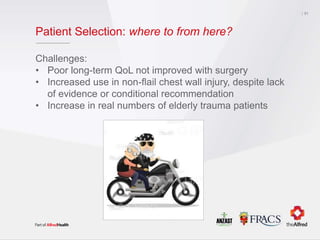
Challenges:
• Poor long-term QoL not improved with surgery
• Increased use in non-flail chest wall injury, despite lack
of evidence or conditional recommendation
• Increase in real numbers of elderly trauma patients
31
Current Randomised Controlled Trial
Operative fixation of displaced, painful rib fractures –
outcomes and quality of life
• Non-ventilated patients
• Randomised & controlled
• Multi-centre
Hypothesis:
• Patients with multiple, painful, displaced fractured ribs
undergoing surgical fixation will have significantly less
acute and chronic pain and significantly improved long
term functional outcomes and quality of life compared to
patients undergoing non-surgical intervention
32
RCT: Non-Ventilated Patients
Primary outcomes:
• Pain and disability at 3 months (SF-12 and McGill pain
questionnaire)
Secondary endpoints:
• Acute pain control and analgesic requirements
• Non-invasive ventilator requirements
• Respiratory complications including requirement for intubation
and MV, ICC insertion, tracheostomy, admission to ICU
• Wound complications
• Hospital LOS
• Mortality
• Discharge destination
• Work or usual activity days lost
• Pain and QoL at 6 and 12 months
33
RCT: Non-Ventilated Patients
Inclusion Criteria:
• Previously functionally independent patients with multiple,
closed fractured ribs between levels 3 to 10, confirmed on
CXR and CT-chest
• Uncontrolled pain from fractured ribs and/or displaced
fractured ribs
Exclusion criteria:
• Age <18 or >85
• Severe TBI
• Invasive MV
• ARDS
• Uncorrected sepsis or coagulopathy
• Open fractures
• Spinal injuries precluding positioning of patient
• Dependency requiring ADL support
• Known opiate dependency
34
Rib Fractures: to fix or not to fix?
Evidence supports the use of surgical fixation in patients
with:
• Flail chest wall injury and
• Severely-displaced fractures or
• Thoracic wall pain not controlled with contemporary
multimodal analgesic techniques or
• Unable to be weaned from mechanical ventilation
To minimise need for ventilation, ICU LOS, hospital LOS
To improve complication rates and
To decrease hospital costs
At this stage, surgical fixation does not convincingly
improve long-term quality of life
35
Rib Fractures: to fix or not to fix?
There are probably benefits from surgical fixation in
selected patients:
• With flail chest who are not ventilator dependent
• With non-flail multiple rib fractures, especially if
displaced and/or painful
Such benefits have only been shown in retrospective
studies.
Patients should ideally be treated within the context of a
clinical trial or by a multi-disciplinary specialised team
36
Thank-you!
ka.martin@alfred.org.au
37

Ribs: To fix or not to fix?

  • 1.
    Rib Fractures: tofix or not to fix? Miss Kate Martin. FRACS. General and Trauma Surgeon Alfred Hospital 8th June 2019
  • 2.
  • 3.
  • 4.
    Overview • Epidemiology • Mortality •Surgical stabilisation • Randomised controlled trials • Subsequent publications • National guidelines • Recent trends • Long-term outcomes and QoL • Where to from here? 4
  • 5.
    Epidemiology Incidence varies dependingon patient population: • North America (NTDB) 2016: 10% ≥1 rib # • Major trauma only: 21-39% Alfred: • All patients admitted into Trauma Service: 21% ≥1 rib # Mechanism: • Motor vehicle-related trauma: 57-79% • Fall from standing: 16-23% 5 Flagel et al. Surgery. 2005;138(4):717-25 Ziegler, Agarwal. J Trauma. 1994;37(6):975-979. Cameron et al. Aust NZ J Surg. 1996;66(8):530-534 Sirmali et al. Eur J Cardiothorac Surg. 2003;24(1):133-38 Dehghan et al. J Trauma. 2014;76(2):462-68
  • 6.
    Mortality Associated withRib Fractures 6 2003: 5.7% 1996: 9.8% 1999: 4%
  • 7.
    7 J Trauma 2003.Kerr-Valentic et al. Patients: •Prospective evaluation of 40 patients out to 120 days •18 patients ≤2 rib #; 22 patients ≥3 rib fractures •Compared to a chronically ill reference population Results: •At 30 days, 70% still using narcotics •As a group, more disabled at 30 days •Mean lost work days: 70
  • 8.
    • Retrospective cohortstudy • Trauma patients admitted with AISThorax≥3 and included in VSTR • Excluded patients undergoing surgical fixation Results: • Patients had a clinically significant decrease in QoL out to 24 months: 56% isolated chest injury, 70% multi-trauma had less than good recovery • Only 59% had returned to work at 6 months 8 Marasco et al. Injury. 2015;46(1):61-65
  • 9.
    Mortality Associated withRib Fractures Rib fractures occur in isolation in only 6-13% patients • PTHx, HTHx, H-PTHx: 32-72% • Pulmonary contusions: 17-26% Mortality in trauma determined by a number of factors: • Patient demographics and co-morbidities • Injuries sustained and severity (ISS) • Treatment Correlation between mortality and: • Number of ribs fractured • Chest wall stability 9 Flagel et al. Surgery. 2005;138(4):717-25 Cameron et al. Aust NZ J Surg. 1996;66(8):530-534 Barnea et al. Can J Surg. 2002;45(1):43-46 Bulger et al. J Trauma. 2000;48(6):1040-6 Dehghan et al. J Ortho Trauma. 2018;32(1):15-21 Sirmali et al. Eur J Cardiothorac Surg. 2003;24(1):133-38 Ziegler, Agarwal. J Trauma. 1994;37(6):975-979
  • 10.
    Flail Chest WallInjury Flail chest wall injury: • ≥3 sequential ribs, fractured in ≥2 places each • Incidence (Alfred): - 2% of all trauma admissions (Approximately 80 per year) - 10% of all patients ≥1 rib # 10
  • 11.
    Flail Chest WallInjury and Associated Morbidity 11 3,467 patients with flail chest injury: (2007-2009) • 54% associated lung contusions • Intubation and ventilation required in 59% (mean 12.1 days) • 82% required ICU (mean 11.7 days) • Mean hospital stay overall: 16.6 days Dehghan et al. J Trauma. 2014;76(2):462-468
  • 12.
    Flail Chest wallInjury and Associated Mortality Mortality: • Flail chest wall injury: 9.5% • Multiple rib fractures without flail: 3.4% • Single rib or sternal fracture: 1.3% 12 Dehghan et al. J Ortho Trauma. 2018;32(1):15-21
  • 13.
    Surgical Stabilisation ofRib Fractures First described over 50 years ago: • 1950’s: wire suture fixation and intramedullary wire fixation Potential use recognised in the setting of: • Severe chest wall defects and deformity • Prolonged mechanical ventilation • Cases where thoracotomy was indicated for other reasons Increased use over the last 10-15 years associated with: • Recognition of significant short and longer term complications of flail chest injury • Development of rib-specific fixation devices and systems 13
  • 14.
    Surgical Stabilisation ofRib Fractures Aim to: • Restore mechanical integrity • Reduce the pain associated with spontaneous ventilation Resulting in: • Reduced need for prolonged mechanical ventilation and tracheostomy • Reduced incidence of complications associated with flail chest injury • Reduced length of stay: ICU, hospital, rehabilitation • Improved quality of life • Health system cost savings 14
  • 15.
    Randomised Controlled Trials 15 Tanakaet al. 2002. J Trauma;52(4):727-32 Granetzny et al. Int Card Thor Surg. 2005;4(6):583-87 Marasco et al. J Am Coll Surg. 2013;216(5):924-32
  • 16.
    RCT: Summary ofFindings. Tanaka • Judet strut. • N=37 (18 operative, 19 non-operative) • MV decreased: 18 to 11 days • ICU LOS decreased: 27 to 17 days • Need for trache at D21 decreased: 79% down to 17% • Incidence of pneumonia (out to D21) decreased: 90% v’s 22% • Improvement in spirometry • Cost savings: US$23,423 down to US13,455 per patient 16 Limitations: • Small study • Single institution • Outcomes for non-operative group were sub-optimal by standards at the time.
  • 17.
    RCT: Summary ofFindings. Granetzney • Kirschner and stainless steel wires. • N= 40 (20 non-operative, 20 operative) • Non-operative Mx involved strapping and packing chest wall Outcomes: • Decreased MV: 12 to 2 days (mean) • Decreased ICU LOS: 14.6 to 9.6 (mean) • Decreased hospital LOS: 23 to 12 days (mean) • Decreased incidence of pneumonia • Improved spirometry • No significant difference in mortality: 15 v’s10% Limitations: • Outdated techniques (both arms) • Small study 17
  • 18.
    RCT: Summary ofFindings. Marasco • Inion resorbable (vicryl) plates and bicortical screws • N=46 (23 operative, 23 non-operative) • Decrease hours in ICU: 456 down to 317 (mean) • Decreased need for trache: 70% down to 39% • Decreased hours of non-invasive ventilation: 67 down to 22 (mean) • Decrease in 5 days in ICU resulted in a cost saving per operation of A$14,443. 18 Limitations: • Single institution • Obsolete technique • Small study
  • 19.
    RCT: Summary • Threestudies show early clinical benefits of operative fixation of rib fractures in selected patients • Two studies demonstrated a significant cost saving for patients managed with operative fixation • Two studies showed improved spirometry results post-discharge, after operative fixation 19
  • 20.
    Subsequent Publications 20 • Meta-analysisof the only 3 randomised trials • 123 patients in total • Surgical v’s non-surgical treatment of flail chest • No evidence that surgery improves mortality • ‘…there is some evidence that surgical intervention is superior to non-surgical intervention in the tratment of flail chest.’ Cataneo et al. Cochrane Database of Systematic Reviews 2015. (7). Cochrane Databaseof SystematicReviews Surgical versusnonsurgical interventionsfor flail chest (Review) Cataneo AJM, Cataneo DC, deOliveiraFHS, Arruda KA, El Dib R, deOliveiraCarvalho PE Cataneo AJM, Cataneo DC, de Oliveira FHS, Arruda KA, El Dib R, de Oliveira Carvalho PE. Surgical versusnonsurgical interventionsfor flail chest. CochraneDatabaseof SystematicReviews 2015, Issue7. Art. No.: CD009919. DOI: 10.1002/14651858.CD009919.pub2. www.cochranelibrary.com Surgical versus nonsurgical interventions for flail chest (Review) Copyright © 2015The CochraneCollaboration. Published by John Wiley &Sons, Ltd. Cochrane Review 2015
  • 21.
    Subsequent Publications • Improvementin clinical outcomes: ventilator time, ICU LOS, hospital LOS, pneumonia and need for tracheostomy. • Average total costs and QALY: Non-operative: US$8,629 with average of 30.84 QALY Operative: US$23,682 with average of 32.60 QALY • Incremental cost effectiveness ratio (ICER): US$8577/QALY (Threshold often quoted is US$50,000) 21 Swart et al. J Ortho Trauma. 2017;31:64-70
  • 22.
    Subsequent Publications • Largeretrospective cohort study: n=117,204 (2004-2015) - Flail injury: 1.5%; (mortality: 9.5%) - Multiple # wo flail: 40.6%; (mortality: 3.4%) - Single rib or sternum #: 57.9% (mortality: 1.3%) • Surgical fixation: 4.5% • Mortality significantly lower in flail patients who had surgery: - 2.6% v’s 9.8% (30 days) - 8% v’s 17% (2 years) 22 Dehghan et al. J Ortho Trauma. 2018;32(1):15-21
  • 23.
    Subsequent Publications • Mortalityin patients with flail chest injury was 3 times that of patients with multiple fractures though no flail- associated improvement in mortality to that of non-flail patients after surgery • Author’s conclusion: “Chest wall instability may be an even more important prognostic factor than the number of fractured ribs”. 23 Dehghan et al. J Ortho Trauma. 2018;32(1):15-21
  • 24.
    National Guidelines: NHS2010 24 ‘Current evidence on insertion of metal rib reinforcements to stabilise a flail chest wall is limited in quantity but consistently shows efficacy. In addition there are no major safety concerns….’
  • 25.
    National Guidelines: EAST2016 Kasotakis et al. J Trauma. 2017;82(3):618-26 25
  • 26.
    National Guidelines: EAST2016 PICO Question 1: In adult patients with flail chest after blunt trauma, should rib ORIF be performed (versus non-operative management) to decrease mortality, duration of ventilation, ICU and hospital LOS, incidence of pneumonia and tracheostomy and improve pain control? Recommendation: • In adult patients with flail chest after blunt trauma, conditionally recommend rib ORIF to decrease mortality, shorten duration of mechanical ventilation, ICU LOS and hospital LOS, decrease the incidence of pneumonia and decrease the need for tracheostomy. • Cannot offer a recommendation for pain control with current evidence. 26
  • 27.
    National guidelines: EAST2016 PICO Question 2: In adult patients with non-flail rib fractures after blunt trauma, should rib ORIF be performed (versus non-operative management) to decrease mortality, duration of mechanical ventilation, ICU and hospital LOS, incidence of pneumonia and tracheostomy and improve pain control? Recommendation: • For patients with non-flail rib fractures after blunt trauma, cannot offer a recommendation with the currently available evidence. 27
  • 28.
    Recent Trends inUse of Surgical Stabilisation • NTDB 2007-2014; all patients with rib fractures • 687,137 patients- 29,981 had surgical fixation (4.36%) • Surgical fixation increased by 36% annually - Flail: 5.6% to 16.7% - Non-flail: 3.8% to 4.7% • Over 96% of patients undergoing rib fixation had a non-flail pattern of injury • In-hospital mortality lower for surgical patients: 1.58% v’s 5.3% 28 Kane et al. J Trauma. 2017;83(6):1047-52
  • 29.
    Long-Term Outcomes andQuality of Life 29 • Retrospective review of patients with multiple fractured ribs • Major trauma admitted into the Alfred and entered onto the VSTR • Surgical fixation v’s non-operative management Primary outcomes: • QoL at 6, 12 and 24 months • GOS-E, SF-12, numerical pain questionnaire. • Return to work Marasco et al. Injury. 2019;50(1):119-124.
  • 30.
    Long-Term Outcomes andQuality of Life Results: • 40 month period 2012-2015 • n=1482; rib fixation=67 (4.5%) • Mortality 2.1% • Follow-up: 87%(6); 85%(12); 63%(24) GOS-E: (whole group) • Good recovery (7-8): 36%(6); 37%(12); 38%(24) Any pain: • 49%(6); 43%(12); 43%(24) Return to work: 58% After multi-variable analysis over 24 months, there was no significant difference in QoL between the operative and non-operative groups. 30
  • 31.
    Patient Selection: whereto from here? Challenges: • Poor long-term QoL not improved with surgery • Increased use in non-flail chest wall injury, despite lack of evidence or conditional recommendation • Increase in real numbers of elderly trauma patients 31
  • 32.
    Current Randomised ControlledTrial Operative fixation of displaced, painful rib fractures – outcomes and quality of life • Non-ventilated patients • Randomised & controlled • Multi-centre Hypothesis: • Patients with multiple, painful, displaced fractured ribs undergoing surgical fixation will have significantly less acute and chronic pain and significantly improved long term functional outcomes and quality of life compared to patients undergoing non-surgical intervention 32
  • 33.
    RCT: Non-Ventilated Patients Primaryoutcomes: • Pain and disability at 3 months (SF-12 and McGill pain questionnaire) Secondary endpoints: • Acute pain control and analgesic requirements • Non-invasive ventilator requirements • Respiratory complications including requirement for intubation and MV, ICC insertion, tracheostomy, admission to ICU • Wound complications • Hospital LOS • Mortality • Discharge destination • Work or usual activity days lost • Pain and QoL at 6 and 12 months 33
  • 34.
    RCT: Non-Ventilated Patients InclusionCriteria: • Previously functionally independent patients with multiple, closed fractured ribs between levels 3 to 10, confirmed on CXR and CT-chest • Uncontrolled pain from fractured ribs and/or displaced fractured ribs Exclusion criteria: • Age <18 or >85 • Severe TBI • Invasive MV • ARDS • Uncorrected sepsis or coagulopathy • Open fractures • Spinal injuries precluding positioning of patient • Dependency requiring ADL support • Known opiate dependency 34
  • 35.
    Rib Fractures: tofix or not to fix? Evidence supports the use of surgical fixation in patients with: • Flail chest wall injury and • Severely-displaced fractures or • Thoracic wall pain not controlled with contemporary multimodal analgesic techniques or • Unable to be weaned from mechanical ventilation To minimise need for ventilation, ICU LOS, hospital LOS To improve complication rates and To decrease hospital costs At this stage, surgical fixation does not convincingly improve long-term quality of life 35
  • 36.
    Rib Fractures: tofix or not to fix? There are probably benefits from surgical fixation in selected patients: • With flail chest who are not ventilator dependent • With non-flail multiple rib fractures, especially if displaced and/or painful Such benefits have only been shown in retrospective studies. Patients should ideally be treated within the context of a clinical trial or by a multi-disciplinary specialised team 36
  • 37.

Editor's Notes

  • #6 A review of the NTDB revealed 10% of patients entered into this North American registry had at least 1 rib fracture. The most common cause of rib fracture is motor vehicle –related trauma, accounting for 57 to 79% of cases. The second most common cause is a fall from standing height or lower.
  • #7 Mortality in patients with rib fractures have improved over the past 2 decades. Recognition of the importance of a multi-disciplinary approach to pain management, mobility and chest physiotherapy, nutrition, trauma care coordination Advances in methods of ventilation and respiratory support along with multi-modal analgesia
  • #12 Mortality: 16%
  • #13 Patients treated between 2004 and 2015. Multi-institutional; Ontario, Canada. Consistent with other published series from the same period: mortality rates of approximately 9%
  • #16 There have been three randomised trials of the operative fixation of rib fractures: The first was published in 2002 by Tanaka and colleagues, from Tokyo, Japan. This was then followed by a publication from Granetzny and colleagues from Germany and Cairo, in 2005. The most recent study was published in 2013, by Marasco and colleagues from the Alfred Hospital, in Melbourne, Australia.
  • #22 ICER: incremental cost divided by incremental gain
  • #31 Rib fixation does not appear to improve QoL out to 24 months. Significant disability exists: only 38% made a good recovery after 24 months. As with the previous study in 2015, the majority of patients scored worse than the Australian norm.