Blast trauma
Michael Reade
MBBS MPH DPhil DMedSc AFRACMA FCCM FANZCA FCICM
Anaesthetist & Intensive Care Physician
ADF Professor of Military Medicine & Surgery
Brigadier. Assistant Surgeon General – Australian Army
Joint Capabilities Group │ Joint Health Command │ Defence Professor of Military Medicine and Surgery
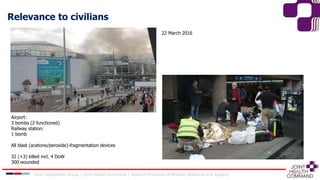
22 March 2016
Airport:
3 bombs (2 functioned)
Railway station:
1 bomb
All blast (acetone/peroxide)-fragmentation devices
32 (+3) killed incl. 4 DoW
300 wounded
Relevance to civilians
Joint Capabilities Group │ Joint Health Command │ Defence Professor of Military Medicine and Surgery
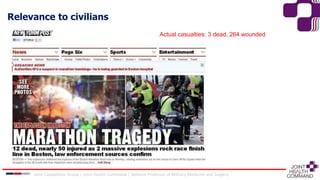
Actual casualties: 3 dead, 264 wounded
Joint Capabilities Group │ Joint Health Command │ Defence Professor of Military Medicine and Surgery
Relevance to civilians
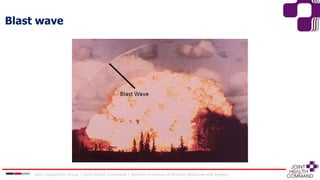
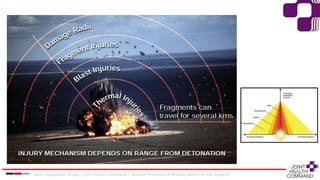
Blast wave
Joint Capabilities Group │ Joint Health Command │ Defence Professor of Military Medicine and Surgery
Blast wave
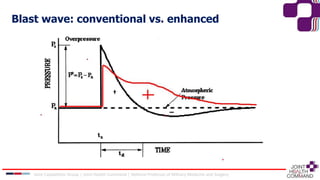
Blast wave: conventional vs. enhanced
Joint Capabilities Group │ Joint Health Command │ Defence Professor of Military Medicine and Surgery
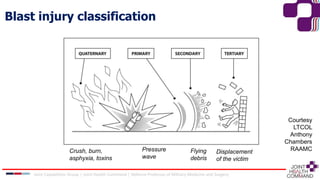
Blast injury classification
Displacement
of the victim
Flying
debris
Pressure
wave
Crush, burn,
asphyxia, toxins
Courtesy
LTCOL
Anthony
Chambers
RAAMC
Joint Capabilities Group │ Joint Health Command │ Defence Professor of Military Medicine and Surgery
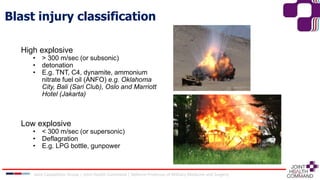
High explosive
• > 300 m/sec (or subsonic)
• detonation
• E.g. TNT, C4, dynamite, ammonium
nitrate fuel oil (ANFO) e.g. Oklahoma
City, Bali (Sari Club), Oslo and Marriott
Hotel (Jakarta)
Low explosive
• < 300 m/sec (or supersonic)
• Deflagration
• E.g. LPG bottle, gunpower
Blast injury classification
Blast trauma
Joint Capabilities Group │ Joint Health Command │ Defence Professor of Military Medicine and Surgery
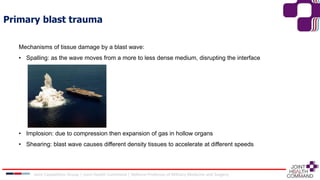
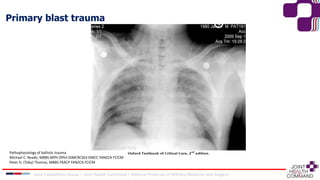
Primary blast trauma
Mechanisms of tissue damage by a blast wave:
• Spalling: as the wave moves from a more to less dense medium, disrupting the interface
• Implosion: due to compression then expansion of gas in hollow organs
• Shearing: blast wave causes different density tissues to accelerate at different speeds
Joint Capabilities Group │ Joint Health Command │ Defence Professor of Military Medicine and Surgery
Primary blast trauma
Joint Capabilities Group │ Joint Health Command │ Defence Professor of Military Medicine and Surgery
Pathophysiology of ballistic trauma
Michael C. Reade, MBBS MPH DPhil DIMCRCSEd DMCC FANZCA FCICM
Peter D. (Toby) Thomas, MBBS FRACP FANZCA FCICM
Joint Capabilities Group │ Joint Health Command │ Defence Professor of Military Medicine and Surgery
Primary blast trauma
Secondary blast trauma
Joint Capabilities Group │ Joint Health Command │ Defence Professor of Military Medicine and Surgery
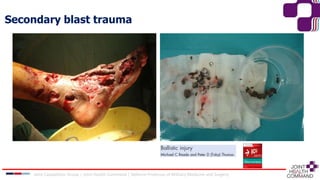
Secondary blast trauma
Ballistic trauma in blast injury
Pathophysiology of ballistic trauma
Michael C. Reade, MBBS MPH DPhil
DIMCRCSEd DMCC FANZCA FCICM
Peter D. (Toby) Thomas, MBBS FRACP
FANZCA FCICM
Joint Capabilities Group │ Joint Health Command │ Defence Professor of Military Medicine and Surgery
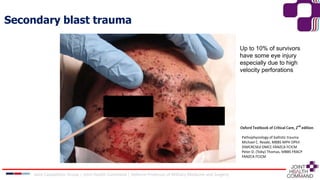
Up to 10% of survivors
have some eye injury
especially due to high
velocity perforations
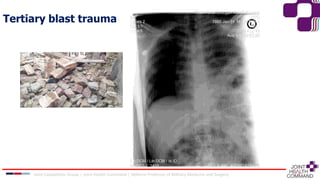
Tertiary blast trauma
Joint Capabilities Group │ Joint Health Command │ Defence Professor of Military Medicine and Surgery
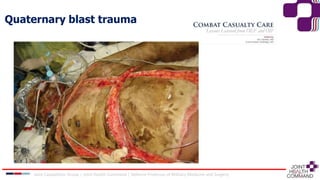
Quaternary blast trauma
Joint Capabilities Group │ Joint Health Command │ Defence Professor of Military Medicine and Surgery
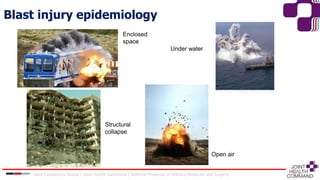
Blast injury epidemiology
Open air
Enclosed
space
Structural
collapse
Under water
Joint Capabilities Group │ Joint Health Command │ Defence Professor of Military Medicine and Surgery
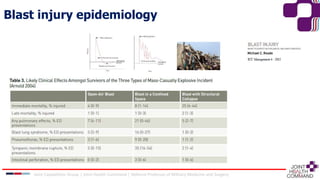
Blast injury epidemiology
Joint Capabilities Group │ Joint Health Command │ Defence Professor of Military Medicine and Surgery
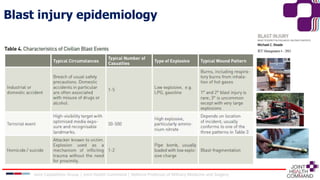
Blast injury epidemiology
Myths & facts
Joint Capabilities Group │ Joint Health Command │ Defence Professor of Military Medicine and Surgery
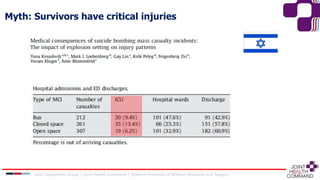
Myth: Survivors have critical injuries
Joint Capabilities Group │ Joint Health Command │ Defence Professor of Military Medicine and Surgery
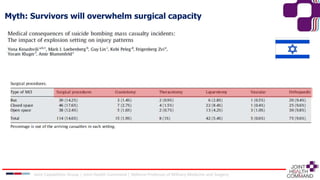
Myth: Survivors will overwhelm surgical capacity
Joint Capabilities Group │ Joint Health Command │ Defence Professor of Military Medicine and Surgery
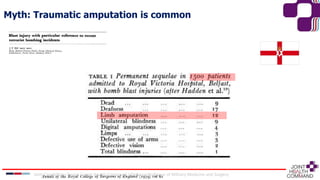
Myth: Traumatic amputation is common
Joint Capabilities Group │ Joint Health Command │ Defence Professor of Military Medicine and Surgery
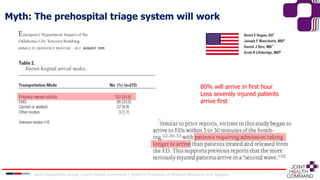
Myth: The prehospital triage system will work
80% will arrive in first hour
Less severely injured patients
arrive first
Joint Capabilities Group │ Joint Health Command │ Defence Professor of Military Medicine and Surgery
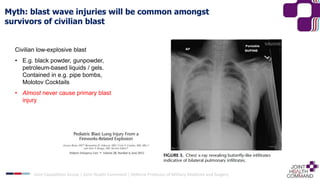
Myth: blast wave injuries will be common amongst
survivors of civilian blast
Civilian low-explosive blast
• E.g. black powder, gunpowder,
petroleum-based liquids / gels.
Contained in e.g. pipe bombs,
Molotov Cocktails
• Almost never cause primary blast
injury
Joint Capabilities Group │ Joint Health Command │ Defence Professor of Military Medicine and Surgery
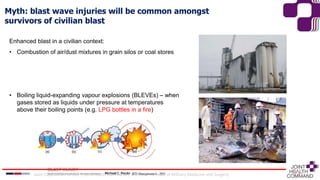
Myth: blast wave injuries will be common amongst
survivors of civilian blast
Enhanced blast in a civilian context:
• Combustion of air/dust mixtures in grain silos or coal stores
• Boiling liquid-expanding vapour explosions (BLEVEs) – when
gases stored as liquids under pressure at temperatures
above their boiling points (e.g. LPG bottles in a fire)
Joint Capabilities Group │ Joint Health Command │ Defence Professor of Military Medicine and Surgery
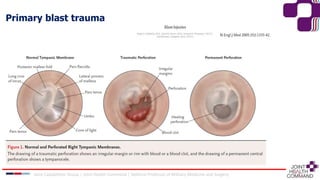
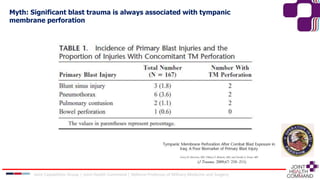
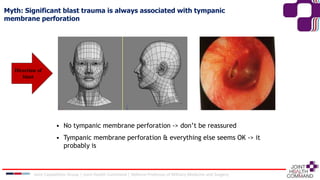
Myth: Significant blast trauma is always associated with tympanic
membrane perforation
Joint Capabilities Group │ Joint Health Command │ Defence Professor of Military Medicine and Surgery
Myth: Significant blast trauma is always associated with tympanic
membrane perforation
• No tympanic membrane perforation -> don’t be reassured
• Tympanic membrane perforation & everything else seems OK -> it
probably is
Direction of
blast
Joint Capabilities Group │ Joint Health Command │ Defence Professor of Military Medicine and Surgery
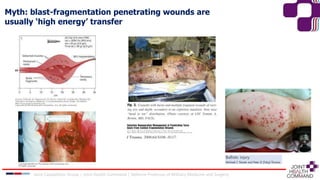
Myth: blast-fragmentation penetrating wounds are
usually ‘high energy’ transfer
Joint Capabilities Group │ Joint Health Command │ Defence Professor of Military Medicine and Surgery
Tips for hospital management
of blast trauma
Joint Capabilities Group │ Joint Health Command │ Defence Professor of Military Medicine and Surgery
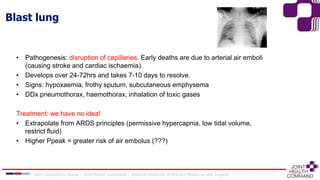
Blast lung
• Pathogenesis: disruption of capillaries. Early deaths are due to arterial air emboli
(causing stroke and cardiac ischaemia).
• Develops over 24-72hrs and takes 7-10 days to resolve.
• Signs: hypoxaemia, frothy sputum, subcutaneous emphysema
• DDx pneumothorax, haemothorax, inhalation of toxic gases
Treatment: we have no idea!
• Extrapolate from ARDS principles (permissive hypercapnia, low tidal volume,
restrict fluid)
• Higher Ppeak = greater risk of air embolus (???)
Joint Capabilities Group │ Joint Health Command │ Defence Professor of Military Medicine and Surgery
Occult abdominal injury
• Uncommon
• Presents late (up to 14 days) with peritoneal irritation
from visceral rupture (esp. colon or multifocal)
• Requires conventional surgical management
Joint Capabilities Group │ Joint Health Command │ Defence Professor of Military Medicine and Surgery
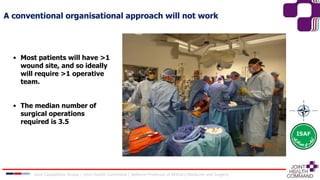
A conventional organisational approach will not work
• Most patients will have >1
wound site, and so ideally
will require >1 operative
team.
• The median number of
surgical operations
required is 3.5
Joint Capabilities Group │ Joint Health Command │ Defence Professor of Military Medicine and Surgery
Triage is important but reverse triage is not
necessarily essential
Joint Capabilities Group │ Joint Health Command │ Defence Professor of Military Medicine and Surgery
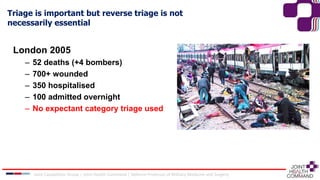
London 2005
– 52 deaths (+4 bombers)
– 700+ wounded
– 350 hospitalised
– 100 admitted overnight
– No expectant category triage used
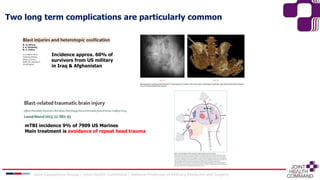
Two long term complications are particularly common
Incidence approx. 60% of
survivors from US military
in Iraq & Afghanistan
mTBI incidence 9% of 7909 US Marines
Main treatment is avoidance of repeat head trauma
Joint Capabilities Group │ Joint Health Command │ Defence Professor of Military Medicine and Surgery
Summary
• Asymmetric warfare arguably makes mass casualty blast events a legitimate tactic
• Low explosive blast (typical of civilian blast events) almost never causes blast wave injury
• High explosive primary blast injury is likely to be present only:
• If very close to the explosion (when mortality is very high);
• With enhanced blast;
• With underwater blast; or
• In a confined space
• Penetrating wounds due to blast are the commonest mechanism in survivors. They are
usually low-energy. Not all require surgical debridement.
• Most blast-related injuries should be managed according to conventional trauma principles.
• Treatment does not end with surviving the initial admission day
Joint Capabilities Group │ Joint Health Command │ Defence Professor of Military Medicine and Surgery
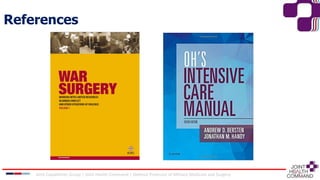
References
Joint Capabilities Group │ Joint Health Command │ Defence Professor of Military Medicine and Surgery

Blasts by Professor Michael Reade

  • 1.
    Blast trauma Michael Reade MBBSMPH DPhil DMedSc AFRACMA FCCM FANZCA FCICM Anaesthetist & Intensive Care Physician ADF Professor of Military Medicine & Surgery Brigadier. Assistant Surgeon General – Australian Army Joint Capabilities Group │ Joint Health Command │ Defence Professor of Military Medicine and Surgery
  • 2.
    Joint Capabilities Group│ Joint Health Command │ Defence Professor of Military Medicine and Surgery
  • 3.
    Joint Capabilities Group│ Joint Health Command │ Defence Professor of Military Medicine and Surgery
  • 4.
    Joint Capabilities Group│ Joint Health Command │ Defence Professor of Military Medicine and Surgery
  • 5.
    22 March 2016 Airport: 3bombs (2 functioned) Railway station: 1 bomb All blast (acetone/peroxide)-fragmentation devices 32 (+3) killed incl. 4 DoW 300 wounded Relevance to civilians Joint Capabilities Group │ Joint Health Command │ Defence Professor of Military Medicine and Surgery
  • 6.
    Actual casualties: 3dead, 264 wounded Joint Capabilities Group │ Joint Health Command │ Defence Professor of Military Medicine and Surgery Relevance to civilians
  • 7.
    Blast wave Joint CapabilitiesGroup │ Joint Health Command │ Defence Professor of Military Medicine and Surgery
  • 8.
    Joint Capabilities Group│ Joint Health Command │ Defence Professor of Military Medicine and Surgery Blast wave
  • 9.
    Blast wave: conventionalvs. enhanced Joint Capabilities Group │ Joint Health Command │ Defence Professor of Military Medicine and Surgery
  • 10.
    Blast injury classification Displacement ofthe victim Flying debris Pressure wave Crush, burn, asphyxia, toxins Courtesy LTCOL Anthony Chambers RAAMC Joint Capabilities Group │ Joint Health Command │ Defence Professor of Military Medicine and Surgery
  • 11.
    Joint Capabilities Group│ Joint Health Command │ Defence Professor of Military Medicine and Surgery High explosive • > 300 m/sec (or subsonic) • detonation • E.g. TNT, C4, dynamite, ammonium nitrate fuel oil (ANFO) e.g. Oklahoma City, Bali (Sari Club), Oslo and Marriott Hotel (Jakarta) Low explosive • < 300 m/sec (or supersonic) • Deflagration • E.g. LPG bottle, gunpower Blast injury classification
  • 12.
    Blast trauma Joint CapabilitiesGroup │ Joint Health Command │ Defence Professor of Military Medicine and Surgery
  • 13.
    Joint Capabilities Group│ Joint Health Command │ Defence Professor of Military Medicine and Surgery
  • 14.
    Primary blast trauma Mechanismsof tissue damage by a blast wave: • Spalling: as the wave moves from a more to less dense medium, disrupting the interface • Implosion: due to compression then expansion of gas in hollow organs • Shearing: blast wave causes different density tissues to accelerate at different speeds Joint Capabilities Group │ Joint Health Command │ Defence Professor of Military Medicine and Surgery
  • 15.
    Primary blast trauma JointCapabilities Group │ Joint Health Command │ Defence Professor of Military Medicine and Surgery
  • 16.
    Pathophysiology of ballistictrauma Michael C. Reade, MBBS MPH DPhil DIMCRCSEd DMCC FANZCA FCICM Peter D. (Toby) Thomas, MBBS FRACP FANZCA FCICM Joint Capabilities Group │ Joint Health Command │ Defence Professor of Military Medicine and Surgery Primary blast trauma
  • 17.
    Secondary blast trauma JointCapabilities Group │ Joint Health Command │ Defence Professor of Military Medicine and Surgery
  • 18.
    Secondary blast trauma Ballistictrauma in blast injury Pathophysiology of ballistic trauma Michael C. Reade, MBBS MPH DPhil DIMCRCSEd DMCC FANZCA FCICM Peter D. (Toby) Thomas, MBBS FRACP FANZCA FCICM Joint Capabilities Group │ Joint Health Command │ Defence Professor of Military Medicine and Surgery Up to 10% of survivors have some eye injury especially due to high velocity perforations
  • 19.
    Tertiary blast trauma JointCapabilities Group │ Joint Health Command │ Defence Professor of Military Medicine and Surgery
  • 20.
    Quaternary blast trauma JointCapabilities Group │ Joint Health Command │ Defence Professor of Military Medicine and Surgery
  • 21.
    Blast injury epidemiology Openair Enclosed space Structural collapse Under water Joint Capabilities Group │ Joint Health Command │ Defence Professor of Military Medicine and Surgery
  • 22.
    Joint Capabilities Group│ Joint Health Command │ Defence Professor of Military Medicine and Surgery Blast injury epidemiology
  • 23.
    Joint Capabilities Group│ Joint Health Command │ Defence Professor of Military Medicine and Surgery Blast injury epidemiology
  • 24.
    Myths & facts JointCapabilities Group │ Joint Health Command │ Defence Professor of Military Medicine and Surgery
  • 25.
    Myth: Survivors havecritical injuries Joint Capabilities Group │ Joint Health Command │ Defence Professor of Military Medicine and Surgery
  • 26.
    Myth: Survivors willoverwhelm surgical capacity Joint Capabilities Group │ Joint Health Command │ Defence Professor of Military Medicine and Surgery
  • 27.
    Myth: Traumatic amputationis common Joint Capabilities Group │ Joint Health Command │ Defence Professor of Military Medicine and Surgery
  • 28.
    Myth: The prehospitaltriage system will work 80% will arrive in first hour Less severely injured patients arrive first Joint Capabilities Group │ Joint Health Command │ Defence Professor of Military Medicine and Surgery
  • 29.
    Myth: blast waveinjuries will be common amongst survivors of civilian blast Civilian low-explosive blast • E.g. black powder, gunpowder, petroleum-based liquids / gels. Contained in e.g. pipe bombs, Molotov Cocktails • Almost never cause primary blast injury Joint Capabilities Group │ Joint Health Command │ Defence Professor of Military Medicine and Surgery
  • 30.
    Myth: blast waveinjuries will be common amongst survivors of civilian blast Enhanced blast in a civilian context: • Combustion of air/dust mixtures in grain silos or coal stores • Boiling liquid-expanding vapour explosions (BLEVEs) – when gases stored as liquids under pressure at temperatures above their boiling points (e.g. LPG bottles in a fire) Joint Capabilities Group │ Joint Health Command │ Defence Professor of Military Medicine and Surgery
  • 31.
    Myth: Significant blasttrauma is always associated with tympanic membrane perforation Joint Capabilities Group │ Joint Health Command │ Defence Professor of Military Medicine and Surgery
  • 32.
    Myth: Significant blasttrauma is always associated with tympanic membrane perforation • No tympanic membrane perforation -> don’t be reassured • Tympanic membrane perforation & everything else seems OK -> it probably is Direction of blast Joint Capabilities Group │ Joint Health Command │ Defence Professor of Military Medicine and Surgery
  • 33.
    Myth: blast-fragmentation penetratingwounds are usually ‘high energy’ transfer Joint Capabilities Group │ Joint Health Command │ Defence Professor of Military Medicine and Surgery
  • 34.
    Tips for hospitalmanagement of blast trauma Joint Capabilities Group │ Joint Health Command │ Defence Professor of Military Medicine and Surgery
  • 35.
    Blast lung • Pathogenesis:disruption of capillaries. Early deaths are due to arterial air emboli (causing stroke and cardiac ischaemia). • Develops over 24-72hrs and takes 7-10 days to resolve. • Signs: hypoxaemia, frothy sputum, subcutaneous emphysema • DDx pneumothorax, haemothorax, inhalation of toxic gases Treatment: we have no idea! • Extrapolate from ARDS principles (permissive hypercapnia, low tidal volume, restrict fluid) • Higher Ppeak = greater risk of air embolus (???) Joint Capabilities Group │ Joint Health Command │ Defence Professor of Military Medicine and Surgery
  • 36.
    Occult abdominal injury •Uncommon • Presents late (up to 14 days) with peritoneal irritation from visceral rupture (esp. colon or multifocal) • Requires conventional surgical management Joint Capabilities Group │ Joint Health Command │ Defence Professor of Military Medicine and Surgery
  • 37.
    A conventional organisationalapproach will not work • Most patients will have >1 wound site, and so ideally will require >1 operative team. • The median number of surgical operations required is 3.5 Joint Capabilities Group │ Joint Health Command │ Defence Professor of Military Medicine and Surgery
  • 38.
    Triage is importantbut reverse triage is not necessarily essential Joint Capabilities Group │ Joint Health Command │ Defence Professor of Military Medicine and Surgery London 2005 – 52 deaths (+4 bombers) – 700+ wounded – 350 hospitalised – 100 admitted overnight – No expectant category triage used
  • 39.
    Two long termcomplications are particularly common Incidence approx. 60% of survivors from US military in Iraq & Afghanistan mTBI incidence 9% of 7909 US Marines Main treatment is avoidance of repeat head trauma Joint Capabilities Group │ Joint Health Command │ Defence Professor of Military Medicine and Surgery
  • 40.
    Summary • Asymmetric warfarearguably makes mass casualty blast events a legitimate tactic • Low explosive blast (typical of civilian blast events) almost never causes blast wave injury • High explosive primary blast injury is likely to be present only: • If very close to the explosion (when mortality is very high); • With enhanced blast; • With underwater blast; or • In a confined space • Penetrating wounds due to blast are the commonest mechanism in survivors. They are usually low-energy. Not all require surgical debridement. • Most blast-related injuries should be managed according to conventional trauma principles. • Treatment does not end with surviving the initial admission day Joint Capabilities Group │ Joint Health Command │ Defence Professor of Military Medicine and Surgery
  • 41.
    Joint Capabilities Group│ Joint Health Command │ Defence Professor of Military Medicine and Surgery References
  • 42.
    Joint Capabilities Group│ Joint Health Command │ Defence Professor of Military Medicine and Surgery

Editor's Notes

  • #2 20 mins
  • #23 Skim over this detail, as much is presented later on