TYPES OF THORACIC INJURIES, ROLE OF ICDT
AND MANAGEMENT OF FLIAL SEGMENT
Dr. K . HEMANTH KUMAR
1 ST YEAR G.S RESIDENT
UNDER GUIDENCE OF
Dr. P. NARESH KUMAR SIR PROFESSOR
Dr. L. SIREESHA ASSISTANT PROFESSOR
Dr. CHAITANYA ASSISTANT POFESSOR
DR. MADHAN SIR CTVS
DR. KIRAN SIR CTVS
TYPES OF THORACIC INJURY
• Blunt
• Penetrating
• Iatrogenic
INITIAL ASSESMENT
• Primary survey with resuscitation of vital functions
• Detailed secondary survey
• Definitive care.
PRIMARY SURVEY
• AIRWAY PROBLEMS- Airway obstruction
Tracheobronchial tree injury
• BREATHING PROBLEMS - Tension pneumothorax
Open pneumothorax
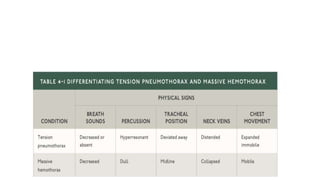
Massive hemothorax
• CIRCULATORY PROBLEMS- Massive hemothorax
Cardiac tamponade
Traumatic circulatory arrest
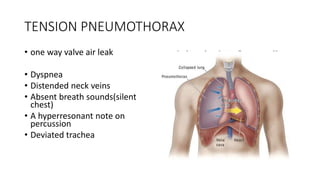
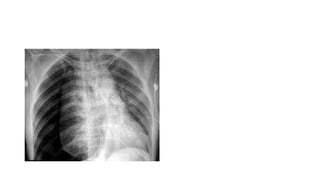
TENSION PNEUMOTHORAX
• one way valve air leak
• Dyspnea
• Distended neck veins
• Absent breath sounds(silent
chest)
• A hyperresonant note on
percussion
• Deviated trachea
TREATMENT
• IMMEDIATE DECOMPRESSION With large wide bore canula
• Followed by insertion of chest tube in safety triangle
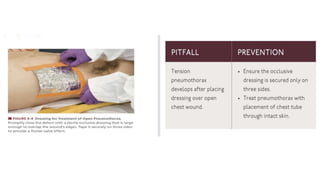
OPEN PNEUMOTHORAX
• Large injuries to the chest wall that remain open can result in an open
pneumothorax, also known as a sucking chest wound’
• The clinical signs and symptoms
• Pain
• Difficulty breathing
• Tachypnea
• Decreased breath sounds on the affected side
• Noisy movement of air through the chest wall injury.
OPEN PNEUMOTHORAX
MASSIVE HEMOTHORAX
• Massive hemothorax results from the rapid accumulation of more
than 1500 mL of blood or one third or more of the patient’s blood
volume in the chest cavity.
• The neck veins may be flat due to severe hypovolemia, or they may
be distended if there is an associated tension pneumothorax.
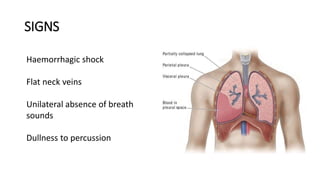
SIGNS
Haemorrhagic shock
Flat neck veins
Unilateral absence of breath
sounds
Dullness to percussion
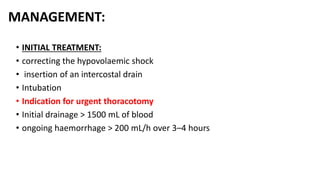
MANAGEMENT:
• INITIAL TREATMENT:
• correcting the hypovolaemic shock
• insertion of an intercostal drain
• Intubation
• Indication for urgent thoracotomy
• Initial drainage > 1500 mL of blood
• ongoing haemorrhage > 200 mL/h over 3–4 hours
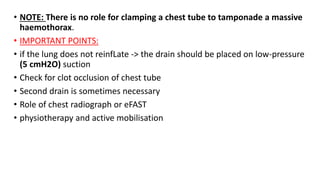
• NOTE: There is no role for clamping a chest tube to tamponade a massive
haemothorax.
• IMPORTANT POINTS:
• if the lung does not reinfLate -> the drain should be placed on low-pressure
(5 cmH2O) suction
• Check for clot occlusion of chest tube
• Second drain is sometimes necessary
• Role of chest radiograph or eFAST
• physiotherapy and active mobilisation
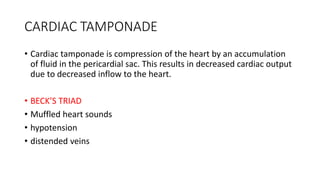
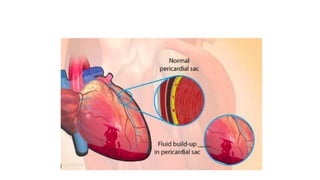
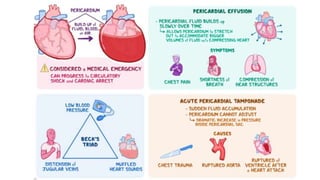
CARDIAC TAMPONADE
• Cardiac tamponade is compression of the heart by an accumulation
of fluid in the pericardial sac. This results in decreased cardiac output
due to decreased inflow to the heart.
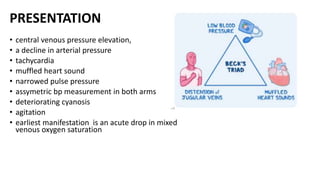
• BECK’S TRIAD
• Muffled heart sounds
• hypotension
• distended veins
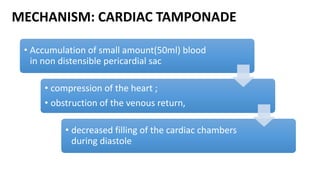
MECHANISM: CARDIAC TAMPONADE
• Accumulation of small amount(50ml) blood
in non distensible pericardial sac
• compression of the heart ;
• obstruction of the venous return,
• decreased filling of the cardiac chambers
during diastole
PRESENTATION
• central venous pressure elevation,
• a decline in arterial pressure
• tachycardia
• muffled heart sound
• narrowed pulse pressure
• assymetric bp measurement in both arms
• deteriorating cyanosis
• agitation
• earliest manifestation is an acute drop in mixed
venous oxygen saturation
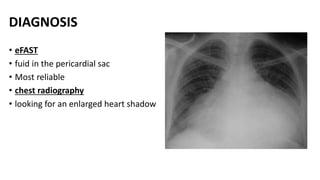
DIAGNOSIS
• eFAST
• fuid in the pericardial sac
• Most reliable
• chest radiography
• looking for an enlarged heart shadow
MANAGEMENT:
• NOTE: Pericardiocentesis has no role in the management of cardiac
tamponade secondary to penetrating myocardial injury
• Immediate treatment: Operative
• subxiphoid window or by open surgery (sternotomy or left
anterolateral thoracotomy)with evacuation of the haematoma and
repair of the myocardium
SECONDARY SURVEY
• In-depth physical examination
• Ongoing ECG and pulse oximetry monitoring
• Arterial blood gas (ABG) measurements
• Chest x-ray
• Chest computed tomography (CT) scan in selected patients with suspected aortic or spinal injury.
• In addition to lung expansion and the presence of fluid, the chest film should be reviewed for
widening of the mediastinum, a shift of the midline, and loss of anatomic detail.
• Extended FAST (eFAST) has been used to detect both pneumothoraces and hemothoraces.
• However, other potentially life-threatening injuries are not well visualized on ultrasound, making
the chest radiograph a necessary part of any evaluation after traumatic injury
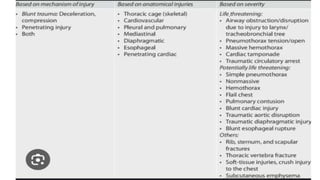
Potentially Life-Threatening Injuries
• Simple pneumothorax
• Hemothorax
• Flail chest
• Pulmonary contusion
• Blunt cardiac injury
• Traumatic aortic disruption
• Traumatic diaphragmatic injury
• Blunt esophageal rupture
CHEST DRAIN: INSERTING AND MANAGING
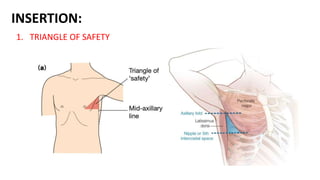
INSERTION:
1. TRIANGLE OF SAFETY
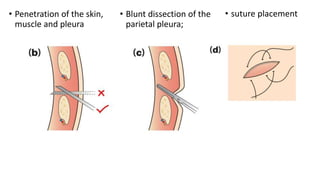
• Penetration of the skin,
muscle and pleura
• Blunt dissection of the
parietal pleura;
• suture placement
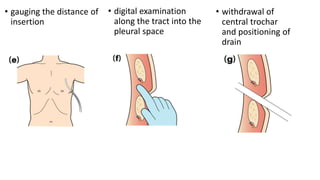
• gauging the distance of
insertion
• digital examination
along the tract into the
pleural space
• withdrawal of
central trochar
and positioning of
drain
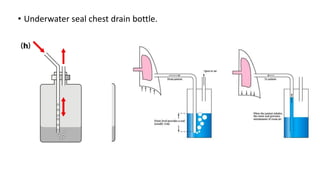
• Underwater seal chest drain bottle.
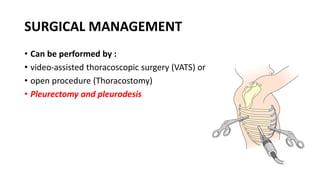
SURGICAL MANAGEMENT
• Can be performed by :
• video-assisted thoracoscopic surgery (VATS) or
• open procedure (Thoracostomy)
• Pleurectomy and pleurodesis
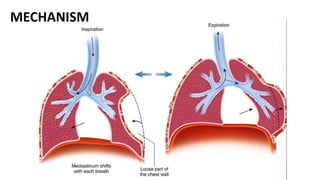
FLAIL CHEST
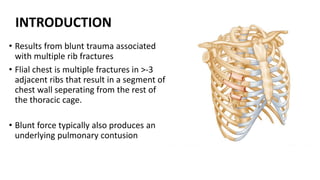
INTRODUCTION
• Results from blunt trauma associated
with multiple rib fractures
• Flial chest is multiple fractures in >-3
adjacent ribs that result in a segment of
chest wall seperating from the rest of
the thoracic cage.
• Blunt force typically also produces an
underlying pulmonary contusion
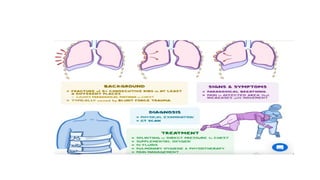
MECHANISM
DIAGNOSIS
• made clinically in patients who are not ventilated,
• not by radiography
• Confirmation: paradoxical motion of a chest wall segment
MANAGEMENT:
• Traditionally, mechanical ventilation was
used to ‘internally splint’
• Disadvantage:
• intensive care unit (ICU) resources
• ventilation-dependent morbidity
• Voluntary splinting of the chest
wall due to:
• Pain
• Mechanically impaired chest wall
movement
• Lung contusion
HYPOXIA
• Currently:
• oxygen administration
• adequate analgesia (including opiates)
• Physiotherapy
• If chest tube is in place: topical intrapleural local analgesia
• Ventilation (respiratory failure )
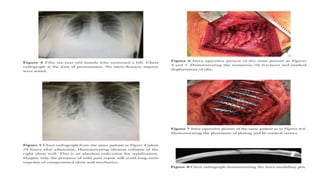
• Surgery :
• stabilise the fail segment using internal fixation of the ribs
• patients with
• isolated or severe chest injury
• pulmonary contusion.
Surgical management of multiple rib
fractures/flail chest
• Abstract: Rib fractures in the setting of trauma carries a high morbidity and mortality. Forty-three percent
of patients presenting with trauma will have rib fractures. Fifty-five percent of patients, greater than 60 years
of age, who die following chest trauma, have isolated rib fractures. Mortality associated with rib fractures
starts to increase from the age of 45. Rib fixation is being utilised more for the management of rib fractures.
Following the review of literature, we propose a pathway for the management of both simple rib fractures
and flail segments. Furthermore, we review the various methods of rib fixation, discussing the advantages and
disadvantages of each.
INTRODUCTION
• (1). Thoracic injury contributes to 25% of the death seen in trauma patients
• (2). This includes those with aortic transection, 85% of whom do not make it to the hospital
• (3). For the remaining the mortality is 10% of which 56% is within the first 24 hours
• (4). Mortality in the elderly population with multiple rib fractures has been quoted as high as 22%
• (5). Fifty-five percent of patients, greater than 60 years of age, who die following chest trauma, have
isolated rib fractures
• (6). The risk of mortality, from rib fractures, in relation to age has been shown to increase from the age of 45
• (7). It is important, however, to note that 33% of patients with thoracic injuries will have injuries outside the
thoracic cavity
• (8). Thus, appropriate clinical assessment and investigations are key within the emergency department and
subsequently on the wards.
The role of surgical fixation in multiple simple rib
fractures
• The majority of patients who require fixation are those with flail segments. They are more likely to have
respiratory compromise and suffer from pain. As discussed, the evidence is in favour for early surgical
stabilisation for
• these patients.
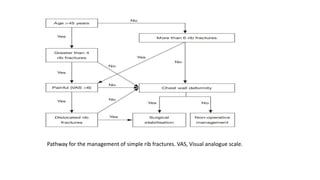
• The evidence for surgical stabilisation in the setting of multiple simple rib fractures is less defined.
• A meta-analysis demonstrated that patients with painful, multiple rib fractures, that were not flail, benefit
from surgical stabilisation with regards to pain, respiratory function and socio-professional disability (17).
• A more recent study corroborated these findings and further demonstrated shorter hospital stay (11.1% vs.
15.9%, P=0.013), fewer respiratory infections (4.6% vs. 17.0%, P=0.025), and an earlier return to work (28 vs.
42 days, P=0.028) (18).
• A further multicentre, randomised control trial of surgical stabilisation of rib fractures in patients with non-
flail fracture patterns is ongoing (19).
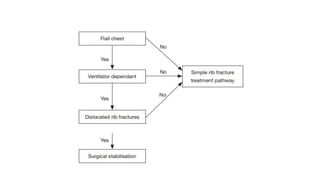
• Given the current evidence an appropriate pathway has been created
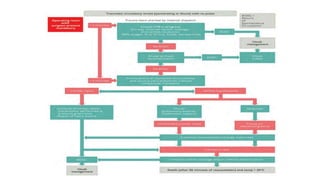
Pathway for the management of simple rib fractures. VAS, Visual analogue scale.
THE OPTIMAL TIME FOR SURGICAL STABILISATION
• Alongside the growth in surgical rib stabilisation, there is a trend
towards early fixation of multiple rib fractures.
• Surgery within the first 48 hours resulted in a shorter stay in the
intensive care unit (P=0.01), shorter invasive ventilatory period
(P=0.03), decreased risk of pneumonia (P=0.001) and shorter overall
hospital stay (11.5 vs. 17.3, P=0.008) (20).
CONCLUSION
• Rib fractures incur a great deal of morbidity and mortality. In addition, this poses a great burden
on healthcare resources. Accurate early diagnosis by clinical examination and radiological
methods can allow for an optimal management plan.
• Early discussion with thoracic surgeons should be carried out to allow for intervention within the
first 72 hours, if deemed appropriate.
• There is good evidence that early rib fixation can facilitate pain management, reduce overall
hospital stay and complications and allow earlier return to daily activities.
• The general consensus is that fixation should take place early, unless there are associated injuries
or severe lung contusion.
• Generally multiple displaced rib fractures require fixation, especially when anterior chest wall
instability is evident.
• There is now a wealth of medical devices available for rib fixation and the best is the one that the
surgeon has experience with and feels comfortable in utilising.

trauma (1).pptx

  • 1.
    TYPES OF THORACICINJURIES, ROLE OF ICDT AND MANAGEMENT OF FLIAL SEGMENT Dr. K . HEMANTH KUMAR 1 ST YEAR G.S RESIDENT UNDER GUIDENCE OF Dr. P. NARESH KUMAR SIR PROFESSOR Dr. L. SIREESHA ASSISTANT PROFESSOR Dr. CHAITANYA ASSISTANT POFESSOR DR. MADHAN SIR CTVS DR. KIRAN SIR CTVS
  • 2.
    TYPES OF THORACICINJURY • Blunt • Penetrating • Iatrogenic
  • 4.
    INITIAL ASSESMENT • Primarysurvey with resuscitation of vital functions • Detailed secondary survey • Definitive care.
  • 5.
    PRIMARY SURVEY • AIRWAYPROBLEMS- Airway obstruction Tracheobronchial tree injury • BREATHING PROBLEMS - Tension pneumothorax Open pneumothorax Massive hemothorax • CIRCULATORY PROBLEMS- Massive hemothorax Cardiac tamponade Traumatic circulatory arrest
  • 6.
    TENSION PNEUMOTHORAX • oneway valve air leak • Dyspnea • Distended neck veins • Absent breath sounds(silent chest) • A hyperresonant note on percussion • Deviated trachea
  • 8.
    TREATMENT • IMMEDIATE DECOMPRESSIONWith large wide bore canula • Followed by insertion of chest tube in safety triangle
  • 9.
    OPEN PNEUMOTHORAX • Largeinjuries to the chest wall that remain open can result in an open pneumothorax, also known as a sucking chest wound’ • The clinical signs and symptoms • Pain • Difficulty breathing • Tachypnea • Decreased breath sounds on the affected side • Noisy movement of air through the chest wall injury.
  • 10.
  • 12.
    MASSIVE HEMOTHORAX • Massivehemothorax results from the rapid accumulation of more than 1500 mL of blood or one third or more of the patient’s blood volume in the chest cavity. • The neck veins may be flat due to severe hypovolemia, or they may be distended if there is an associated tension pneumothorax.
  • 13.
    SIGNS Haemorrhagic shock Flat neckveins Unilateral absence of breath sounds Dullness to percussion
  • 14.
    MANAGEMENT: • INITIAL TREATMENT: •correcting the hypovolaemic shock • insertion of an intercostal drain • Intubation • Indication for urgent thoracotomy • Initial drainage > 1500 mL of blood • ongoing haemorrhage > 200 mL/h over 3–4 hours
  • 15.
    • NOTE: Thereis no role for clamping a chest tube to tamponade a massive haemothorax. • IMPORTANT POINTS: • if the lung does not reinfLate -> the drain should be placed on low-pressure (5 cmH2O) suction • Check for clot occlusion of chest tube • Second drain is sometimes necessary • Role of chest radiograph or eFAST • physiotherapy and active mobilisation
  • 17.
    CARDIAC TAMPONADE • Cardiactamponade is compression of the heart by an accumulation of fluid in the pericardial sac. This results in decreased cardiac output due to decreased inflow to the heart. • BECK’S TRIAD • Muffled heart sounds • hypotension • distended veins
  • 19.
    MECHANISM: CARDIAC TAMPONADE •Accumulation of small amount(50ml) blood in non distensible pericardial sac • compression of the heart ; • obstruction of the venous return, • decreased filling of the cardiac chambers during diastole
  • 20.
    PRESENTATION • central venouspressure elevation, • a decline in arterial pressure • tachycardia • muffled heart sound • narrowed pulse pressure • assymetric bp measurement in both arms • deteriorating cyanosis • agitation • earliest manifestation is an acute drop in mixed venous oxygen saturation
  • 21.
    DIAGNOSIS • eFAST • fuidin the pericardial sac • Most reliable • chest radiography • looking for an enlarged heart shadow
  • 22.
    MANAGEMENT: • NOTE: Pericardiocentesishas no role in the management of cardiac tamponade secondary to penetrating myocardial injury • Immediate treatment: Operative • subxiphoid window or by open surgery (sternotomy or left anterolateral thoracotomy)with evacuation of the haematoma and repair of the myocardium
  • 24.
    SECONDARY SURVEY • In-depthphysical examination • Ongoing ECG and pulse oximetry monitoring • Arterial blood gas (ABG) measurements • Chest x-ray • Chest computed tomography (CT) scan in selected patients with suspected aortic or spinal injury. • In addition to lung expansion and the presence of fluid, the chest film should be reviewed for widening of the mediastinum, a shift of the midline, and loss of anatomic detail. • Extended FAST (eFAST) has been used to detect both pneumothoraces and hemothoraces. • However, other potentially life-threatening injuries are not well visualized on ultrasound, making the chest radiograph a necessary part of any evaluation after traumatic injury
  • 25.
    Potentially Life-Threatening Injuries •Simple pneumothorax • Hemothorax • Flail chest • Pulmonary contusion • Blunt cardiac injury • Traumatic aortic disruption • Traumatic diaphragmatic injury • Blunt esophageal rupture
  • 27.
  • 28.
  • 29.
    • Penetration ofthe skin, muscle and pleura • Blunt dissection of the parietal pleura; • suture placement
  • 30.
    • gauging thedistance of insertion • digital examination along the tract into the pleural space • withdrawal of central trochar and positioning of drain
  • 31.
    • Underwater sealchest drain bottle.
  • 32.
    SURGICAL MANAGEMENT • Canbe performed by : • video-assisted thoracoscopic surgery (VATS) or • open procedure (Thoracostomy) • Pleurectomy and pleurodesis
  • 33.
  • 34.
    INTRODUCTION • Results fromblunt trauma associated with multiple rib fractures • Flial chest is multiple fractures in >-3 adjacent ribs that result in a segment of chest wall seperating from the rest of the thoracic cage. • Blunt force typically also produces an underlying pulmonary contusion
  • 36.
  • 37.
    DIAGNOSIS • made clinicallyin patients who are not ventilated, • not by radiography • Confirmation: paradoxical motion of a chest wall segment
  • 38.
    MANAGEMENT: • Traditionally, mechanicalventilation was used to ‘internally splint’ • Disadvantage: • intensive care unit (ICU) resources • ventilation-dependent morbidity
  • 39.
    • Voluntary splintingof the chest wall due to: • Pain • Mechanically impaired chest wall movement • Lung contusion HYPOXIA
  • 40.
    • Currently: • oxygenadministration • adequate analgesia (including opiates) • Physiotherapy • If chest tube is in place: topical intrapleural local analgesia • Ventilation (respiratory failure ) • Surgery : • stabilise the fail segment using internal fixation of the ribs • patients with • isolated or severe chest injury • pulmonary contusion.
  • 41.
    Surgical management ofmultiple rib fractures/flail chest
  • 42.
    • Abstract: Ribfractures in the setting of trauma carries a high morbidity and mortality. Forty-three percent of patients presenting with trauma will have rib fractures. Fifty-five percent of patients, greater than 60 years of age, who die following chest trauma, have isolated rib fractures. Mortality associated with rib fractures starts to increase from the age of 45. Rib fixation is being utilised more for the management of rib fractures. Following the review of literature, we propose a pathway for the management of both simple rib fractures and flail segments. Furthermore, we review the various methods of rib fixation, discussing the advantages and disadvantages of each.
  • 43.
    INTRODUCTION • (1). Thoracicinjury contributes to 25% of the death seen in trauma patients • (2). This includes those with aortic transection, 85% of whom do not make it to the hospital • (3). For the remaining the mortality is 10% of which 56% is within the first 24 hours • (4). Mortality in the elderly population with multiple rib fractures has been quoted as high as 22% • (5). Fifty-five percent of patients, greater than 60 years of age, who die following chest trauma, have isolated rib fractures • (6). The risk of mortality, from rib fractures, in relation to age has been shown to increase from the age of 45 • (7). It is important, however, to note that 33% of patients with thoracic injuries will have injuries outside the thoracic cavity • (8). Thus, appropriate clinical assessment and investigations are key within the emergency department and subsequently on the wards.
  • 46.
    The role ofsurgical fixation in multiple simple rib fractures • The majority of patients who require fixation are those with flail segments. They are more likely to have respiratory compromise and suffer from pain. As discussed, the evidence is in favour for early surgical stabilisation for • these patients. • The evidence for surgical stabilisation in the setting of multiple simple rib fractures is less defined. • A meta-analysis demonstrated that patients with painful, multiple rib fractures, that were not flail, benefit from surgical stabilisation with regards to pain, respiratory function and socio-professional disability (17). • A more recent study corroborated these findings and further demonstrated shorter hospital stay (11.1% vs. 15.9%, P=0.013), fewer respiratory infections (4.6% vs. 17.0%, P=0.025), and an earlier return to work (28 vs. 42 days, P=0.028) (18). • A further multicentre, randomised control trial of surgical stabilisation of rib fractures in patients with non- flail fracture patterns is ongoing (19). • Given the current evidence an appropriate pathway has been created
  • 47.
    Pathway for themanagement of simple rib fractures. VAS, Visual analogue scale.
  • 48.
    THE OPTIMAL TIMEFOR SURGICAL STABILISATION • Alongside the growth in surgical rib stabilisation, there is a trend towards early fixation of multiple rib fractures. • Surgery within the first 48 hours resulted in a shorter stay in the intensive care unit (P=0.01), shorter invasive ventilatory period (P=0.03), decreased risk of pneumonia (P=0.001) and shorter overall hospital stay (11.5 vs. 17.3, P=0.008) (20).
  • 50.
    CONCLUSION • Rib fracturesincur a great deal of morbidity and mortality. In addition, this poses a great burden on healthcare resources. Accurate early diagnosis by clinical examination and radiological methods can allow for an optimal management plan. • Early discussion with thoracic surgeons should be carried out to allow for intervention within the first 72 hours, if deemed appropriate. • There is good evidence that early rib fixation can facilitate pain management, reduce overall hospital stay and complications and allow earlier return to daily activities. • The general consensus is that fixation should take place early, unless there are associated injuries or severe lung contusion. • Generally multiple displaced rib fractures require fixation, especially when anterior chest wall instability is evident. • There is now a wealth of medical devices available for rib fixation and the best is the one that the surgeon has experience with and feels comfortable in utilising.