INTERNATIONAL ACTIVITY
BUSINESS
CIVIL S
EDUCA
INTER
ANALYSIS
ANDFORECASTING
DIPLOM
L POLITICS
INTERNATIONAL ORGANIZATIONS
DISCUSSIONS
DIALOGUE
DIALOGUE
INTERNATIONAL RELATIONS
NETWORK
PROJECTS
EXPERT COMMENTARIES
CONFERENCES
ROUND
TABLES
SUMMER
SCHOOLS
REPORTSW
LIBRARY
SCENARIOS
SECURITY
MIGRATION
PARTNERSHIP
COMPETITIONS
ANTHOLOGIES
ANTHOLOGIES
REFERENCE BOOKS
REFERENCE BOOKS
WEBSITE
GLOBALSCIENCE
P
CIVIL SOCIETY
SCIENCE
EDUCATION
FOREIGN POLICY
ANALYSIS AND FORECASTING
DIPLOMACY
GLOBAL POLITICS
AL ORGANIZATIONS
POLICY TALENT POOL
TIVITY
INTERNSHIPS
DISCUSSIONS
DIALOGUE
INTERNATIONALRELATIONS
NETWORKPROJECTS
EXPERT COMMENTARIES
LL
CONFERENCES
CONFERENCES
II
ROUNDTABLES
SUMMER
SCHOOLS
REPORTS
WORKINGPAPERS
GUEST LECTURES
LIBRARY
CLUB MEETINGSROADMAPS
SCENARIOS
SECURITY
BILATERALRELATIONS
MIGRATIONPARTNERSHIP
COMPETITIONS
ANTHOLOGIES
REFERENCEBOOKS
WEBSITE
GLOBALSCIENCE
CIVIL SOCIETY
DIPLOMACYOGU
SCIENCE
EDUCATION
FOREIGN POLICY
FOREIGN POLICY
SC
ANALYSIS AND
FORECASTING
DIPLOMACY
DIPLOMACY
GLOBAL POLITICS
INTERNATIONALORGANIZATIONS
FOREIGNPOLICYTALENTPOOL
FOREIGN POLICY TALENT POOL
NTERNSHIPS
DISCUSSIONS
Y
DIALOGUE
INTERNATIONAL RELATIONS
NETWORKPROJECTS
EXPERTCOMMENTARIES
REPOR
CONFERENCES
ROUND TABLES
SUMMER SCHOOLS
REPORTS
WORKING PAPER
GUEST LECTURES
LIBRARY
CLUB MEETINGS
ROADMAPS
SCENARIOS
SECURITY
E
BILATERALRELATIONS
MIGRATION
PARTNERSHIP
COMPETITIONS
Y
ANTHOLOGIES
LECTURES
REFERENCE BOOKS
WEBSITE
GLOBAL
SCIENCE
GLOBAL
D
SCIENCE
EXPERT COMMENTARIES
EDUCATION
CIVIL
SOCIETY
SCIENCE
EDUCATION
FOREIGNPOLICY
ANALYSIS AND FORECASTING
DIPLOMACY
GLOBALPOLITICS
INTERNATIONALORGANIZATIONS
FOREIGNPOLICYTALENTPOOL
AA
C
INTERNSHIPS
DISCUSSIONS
DIALOGUE
S NETWORK
PROJECTS
EXPERTCOMMENTARIES
CONFERENCES
SUMMER SCHOOLS
REPORTS
W
GUESTLECTURES
LIBRARY
CLUBMEETINGS
ROADMAPS
SCENARIOS
SECURITY
ILATERAL
ELATIONS
MIGRATION
PARTNERSHIP
COMPETITIONS
ANTHOLOGIES
REFERENCE BOO
WEBSITE
GLOBAL
SCIENCE
ANALYSIS AND FORECASTING
REFERENCE BOOKS
ANALYSIS
ANTHOLOGIES
AND FORECASTING
SECURITY
MIGRATION
INTERNATIONAL
ORGANIZATIONS
DISCUSSIONS
INTERNSHIPS
SSIONSS
N
CIVILSOCIETY
PARTNERSHIP
AA
INTERNATIONAL
ACTIVITY
CSCS
EXPERT
COMMENTARIES
SUMMER
SCHOOLS
LIBRARY
REPORTS
ROADMAPS
WORKING PAPER
RUSSIAN INTERNATIONAL AFFAIRS COUNCIL (RIAC)
1, B. Yakimanka street, 119180, Moscow, Russia
Tel.: +7 (495) 225 6283
Fax: +7 (495) 225 6284
E–mail: welcome@russiancouncil.ru
www.russiancouncil.ru
RUSSIAN
INTERNATIONAL
AFFAIRS COUNCIL
21 / 2015
SHANGHAI COOPERATION ORGANISATION.
MODEL 2014–2015
Cover-21-engl.indd 1Cover-21-engl.indd 1 20.05.2015 1:19:4820.05.2015 1:19:48
RUSSIAN INTERNATIONAL AFFAIRS COUNCIL
MOSCOW 2015
П78
Russian International Affairs Council
Institute of Far Eastern Studies of the Russian Academy of Sciences
Editorial Board
Editor-in-Chief:
I.S. Ivanov, RAS Corresponding Member, Dr. of History
Authors:
S.G. Luzyanin, Dr. of History (Chairperson, Introduction, Chap. 1, Conclusion);
V.A. Matveev, Ph.D. in Economics (Chap. 2); L.N. Smirnova, Ph.D. in Political Science (Chap. 3)
Executive editors:
I.N. Timofeev, Ph.D. in Political Science; T.A. Makhmutov, Ph.D. in Political Science;
L.V. Filippova; D.O. Kholopova
Shanghai Cooperation Organisation. Model 2014–2015: Working paper 21/2015 / [S.G. Luzyanin et
al.]; [I.S. Ivanov, Editor-in-Chief]; Russian International Affairs Council (RIAC). – M.: Spetskniga,
2015. – 36 pages. – Authors and editors are listed on back of the title page.
ISBN 978-5-91891-444-1
The working paper is devoted to the activities of the Shanghai Cooperation Organisation (SCO), its
influence on the Central Asian region, adjacent areas and states. Its relevance derives from the national
security interests of Russia and the Central Asian region, connected to the need to develop and adopt
a long-term SCO Development Strategy up to 2025. The document provides different scenarios for the
Organisation’s development, its likely reaction to crises in the region, including in Afghanistan, the possibility
of the key players (Russia and China) strengthening its potential, as well as options for increasing the number
of permanent members and collaborating with observer countries (India, Pakistan, Iran and Mongolia).
The possibilities for and impediments to strengthening the geopolitical role of the SCO are analysed and
practical recommendations are given.
The authors express gratitude to Lt. Gen. A.F. Klimenko, Ph.D. in Military Science, Ambassador
M.A. Konarovsky, Ph.D. in History, Dr. A.N. Karneev, Ph.D. in History, Mr. I.E. Denisov, Mr. A.A. Prutskikh,
Dr. A.A. Kireeva, Ph.D. in Political Science, Prof. Wu Dahui, and Prof. Feng Yujun for their comments on
the issues covered in the publication.
RIAC thanks Ms. Ksenia Kuzmina for her help in preparing this publication.
The views and opinions of authors expressed herein do not necessarily state or reflect those of RIAC.
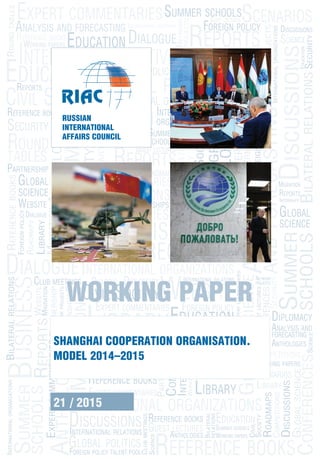
Cover photo credits (top down, left to right): sco-russia.ru, REUTERS / Shamil Zhumatov / Pixstream,
REUTERS / Mikhail Klimentyev / Pixstream
The full text of the working paper is available on RIAC’s website. You can download it and leave your
comments via this direct link – russiancouncil.ru/en/paper21
© Authors, 2015
© Drafting, translation and design. NPMP RIAC, 2015
Introduction 4
1. The SCO within the System of International Organisations and International Relations 6
1.1. Regional and Global Dimension of the SCO. Problems in Expanding the Organisation 6
1.2. SCO and CSTO. Security Agenda, Challenges and Possibilities of the Organisation 8
1.3. Opportunities for Transformation of the SCO Military Component:
Does It Require Strengthening? 9
1.4. Conclusions and Proposals 12
2. The SCO and Trade and Economic Sphere: from Bilateral to Multilateral Collaboration 14
2.1. Overview of the Trade and Investment Cooperation
between the SCO Member Countries 14
2.2. Prospects for Interbank Economic Cooperation within the Scope of the SCO.
From Bilateral to Multilateral 17
2.3. The SCO and Transport and Logistics Cooperation in the Region 19
2.4. Conclusions and Recommendations 21
3. Educational, Scientific, and Cultural Links between the SCO Member Countries 23
3.1. “Soft Power” in the Central Asian Dimension:
Russia’s Competitive Advantages and How to Maintain Them 23
3.2. The SCO University: a Regional Educational Centre
or a “Eurasian Higher Education Zone”? 26
3.3. Conclusions and Recommendations 29
Conclusion. Summary and Scenarios for the Development of the SCO 31
TABLE OF CONTENTS
4 Working Paper 21 / 2015
SHANGHAI COOPERATION ORGANISATION.
MODEL 2014–2015
Introduction
Russia’s chairmanship of the SCO
On 11-12 September 2014, at the Summit of the heads of the Shanghai
Cooperation Organisation (SCO) member states in Dushanbe (Tajikistan), Russia
assumed chairmanship of the Organisation until the next Summit, on 10 July 2015
in Ufa. Which projects and proposals will be presented at the Ufa Summit by the
Russian leadership within the scope of its chairmanship? Which fundamentally
new challenges will face the Organisation this year?
Worth noting that among the relatively new spheres are the following:
1) Completion and official adoption at the Ufa Summit of the long-term SCO
Development Strategy up to 2025;
2) Radical expansion of the Organisation’s borders: India and Pakistan, currently
observers, joining the SCO, raising the status of Belarus from that of dialogue
partner to that of observer;
3) Launch of strategic “convergence” between the three Eurasian projects: the
SCO, the Eurasian Economic Union (EEU) and the Chinese project Silk Road
Economic Belt (SREB).
Still on the agenda are the Organisation’s traditional tasks:
• To seek effective multilateral mechanisms for trade, economic, investment and
transport cooperation differing substantially from the bilateral formats;
• To strengthen cooperation in the area of regional security in light of the Western
Coalition’s withdrawal of its troops from Afghanistan and the growing Afghan
challenge and the threat from the Islamic State of Iraq and the Levant (ISIL);
• To set up an SCO Development Bank and Reserve Fund.
The updated SCO agenda is being implemented against the background of severe
confrontation between Russia and the Western world. For Russia, the SCO is
acquiring particular significance. In fact, it is a matter of large-scale geopolitics,
especially considering the possibility of India and Pakistan joining the SCO as
permanent members. Expansion of the Organisation will undoubtedly strengthen
its openness, increase its international prestige and create new opportinuties in
the economy and security areas.
The updated agenda offers cooperation potential with respect to the restoration
of cooperation with the West. The Organisation’s resources and capabilities,
especially in the security, transport, investment and energy cooperation areas,
create chances of a new dialogue with the Western countries.
Expert discourse
One of the prominent Russian research papers concerning current problems
of the SCO is the book by Prof. S.G. Luzyanin, analysing the traditional areas
5www.russiancouncil.ru
INTRODUCTION
of the Organisation’s activities in the security, economic and soft power areas.1
A number of the RIAC works under the editorship of I. Ivanov, RAS Corresponding
Member, have been published in the recent years. Special researches by the
experts on the regional security in Central Asia of the Institute of Far Eastern
Studies, and by Prof. A. Lukin, Ambassador V. Vorobyev, former Russian national
co-ordinator within the SCO, Ambassador K. Barskiy and others also came out.2
The general line of research by Chinese scholars is to seek possibilities for
harmonious cooperation between the SCO, EEU and SREB “without absorbing or
infringing anyone’s interests”.3
At the same time, the Chinese approaches are also
critical about the current “stagnation” in the activities of the SCO and stress the
need for it to be updated and reformed.4
In the working paper, the authors attempt to:
• determine the correlations (coincidences and discrepancies) of the national
interests of Russia and China in Central Asia and the SCO;
• monitor traditional and new challenges and threats to the SCO and the region
as a whole, including those connected to Afghanistan;
• assess the possibilities for collaboration between the Organisation and
NATO and the CSTO and for radical strengthening of the military and political
components of the SCO activities and structure, including the possibility of the
evolution of its structure;
• study the trade, economic, investment and transport resources of the
Organisation;
• identify the potential of educational, scientific, and cultural cooperation;
• provide general and specific conclusions and recommendations on development
of the SCO.
1
Luzyanin S.G. Shanghai Cooperation Organisation. 2013-2015. Forecasts, Scenarios and Opportunities for
Development. M., 2013 (in Russian).
2
Prospects for Cooperation between Russia and the USA in Central Asia. Joint Assessment / Russian International
Affairs Council, ed. I.S. Ivanov. M., 2014 (in Russian); Russia’s Interests in Central Asia: Content, Prospects,
Restrictions / Russian International Affairs Council, ed. I.S. Ivanov, M., 2013 (in Russian); Luzyanin S.G., Gordienko
D.V. Assessment of the Security Level of the Countries of North-East and Central Asia. M.: IFES RAS, 2013 (in
Russian).
3
Development of the Shanghai Cooperation Organisation. Annual report. 2013 / Ed. Prof. LI Yongquan. Beijing, 2013
(in Chinese).
4
Mechanism for Cooperation in the Integration of Central Asia and its Influence on the Shanghai Cooperation
Organisation // Study by the Institute of Russia, Eastern Europe and Central Asia, CASS. 2013, No. 12. P. 56 –71
(in Chinese).
6 Working Paper 21 / 2015
SHANGHAI COOPERATION ORGANISATION.
MODEL 2014–2015
1.1. Regional and Global Dimension of the SCO.
Problems in Expanding the Organisation
Each passing year sees a strengthening of the role and influence of the Shanghai
Cooperation Organisation at both the regional and the global level. As a result of
institutional, political and economic development, significance of the SCO on the
world arena, including its role in the UN and the collaboration with such structures
as G-20, NATO, ASEAN, BRICS and other organisations. The Organisation is one
of the rapidly developing centres of the multipolar world. Reinforcement of the
institution of observers through inclusion of Afghanistan and creation of a group
of dialogue partners including Turkey, Belarus and Sri Lanka are also boosting the
influence of the Organisation in various parts of the world.5
In the coming two years difficult tests await the Organisation in the Central Asian
security area. Uncertainty and alarm are increasing over the US Administration’s
announcement that, at the end of 2015, the Western coalition is to withdraw
its troops from crisis-ridden Afghanistan and transfer the military and political
responsibility to the Presidential Administration of the Islamic Republic of
Afghanistan.
The growing imbalance between the economies of Central Asia, the exacerbation
of water, environmental and social problems, and the increasing negative influence
of Islamic fundamentalism, particularly the ISIL movement, in the region remain a
negative background for the Organisation.
There are no manifest contradictions between the SCO’s regional and global
positioning as yet. This is especially true considering that the potential conversion
into members of India and Pakistan, now observers, will strengthen both the
global and the regional agenda of the Organisation, taking into account India’s
considerable experience in combating religious extremism and terrorism, as well
as the country’s major investment and technological resources.
India’s participation in the SCO as a full member would provide additional
changes and opportunities for reinforcing the lagging link: multilateral economic
cooperation within the SCO. At the same time, what is in fact happening within
the scope of the Organisation is institutionalization of the “Russia-India-China”
triangle, which has existed as a separate project since 2001. The prospect of
strengthening the trilateral collaboration in the “Russia – Mongolia – China”
format is also being considered.
Updating of the SCO for Russia being under economic and political sanctions
imposed by the West would constitute not only a source of economic (exchange
and finance, trade, investment and others) resources, but also an additional
5
For more detail, see: Luzyanin S.G. The Shanghai Cooperation Organisation. 2013–2015. Forecasts, Scenarios and
Development Opportunities. M., 2013 (in Russian).
1. The SCO within the System of International
Organisations and International Relations
7www.russiancouncil.ru
1. THE SCO WITHIN THE SYSTEM OF INTERNATIONAL ORGANISATIONS
AND INTERNATIONAL RELATIONS
opportunityforrevivingthedialoguewiththeWestanddefusingtheconfrontational
trends. According to the current political logic, it would be appropriate to consider
the possibility of several dialogue partner countries (Belarus, Turkey) joining the
group of observer countries.
The endeavour to bring three neighbouring projects – the EEU, SCO and the
Great Silk Road Economic Belt (SREB) is of fundamental importance from the
perspective of Russian-Chinese coordination of interests in Eurasia. In fact, this
project is directed to shape the long-term Eurasian policy of the SCO. The agenda
of the Ufa summit 2015 must reflect this process.
So far, three projects (the SCO, EEU and SREB) are simultaneously developing
with a certain competition between them in the transport, energy, trade and
economic areas. The expert community is considering different options for the
development of events, in particular:
a) the SREB project proposed by China absorbing the other two and creating a
single integrated zone under the auspices of the PRC;
b) preserving the status-quo;
c) creation of a collaboration structure within which the SCO would play the
central (linking) role of a “Eurasian bridge” between the Silk Road Economic
Belt project and the Eurasian Economic Union.
Analysis of the opportunities for the cooperation between the SCO, EEU and SREB
should evidently take into account two basic proposals. First, there are certain
initial discrepancies between the Russian and Chinese visions for developing
Eurasia. In particular, these concern the rate of regional integration and transport
corridors routes.
A full and complete “Eurasian alliance” between the Russian Federation and
China cannot be achieved by an imposed decision. The basic interests of Russia
and China (transport, energy, investment, etc.) do not always coincide, so the
“Eurasian compromise” between the two countries must be built on convergence,
including mutual concessions in the given spheres.
Second, the nature of integration initiatives – the SCO, EEU and the SREB project
– is not yet fully determined and the prospects for their merger or codevelopment
are also unclear. Yet the very fact that these projects have been put forward
testifies to the existence of several versions of regional integration within the
scope of the SCO and around it.
Some Chinese experts believe that the emergence of the SREB project is a reaction
of the Chinese leadership to the slowliness and ineffectiveness of the SCO and
that the Chinese version of Eurasian integration and development, covering 21
states from Eastern Asia to the Middle East, has much greater scope and is much
more effective. Consequently, all countries, including Russia, should focus their
efforts and resources precisely on this project.
It should be recognised that the SREB project proposed by China is indeed more
global (Eurasian). Yet, for all the significance of Beijing’s proposal, the Silk Road
is still just a concept, whereas the SCO has already undergone the stages of
institutionalisation (since 2001) and has become, de jure and de facto, a fully-
8 Working Paper 21 / 2015
SHANGHAI COOPERATION ORGANISATION.
MODEL 2014–2015
fledged international organisation with six permanent members operating on
terms of complete consensus.
Results of the SCO Summit in Dushanbe (Tajikistan) 11-12 September 2014
On the Summit, the Dushanbe Declaration was adopted6
and fulfilment of the
2013–2017 Action Plan, implementation of the Programme for Multilateral Trade
and Economic Cooperation within the scope of the SCO and List of Measures for
Further Development of Project Activities within the scope of the SCO for 2012-
2016 etc. were all positively appraised.
The support provided by all the SCO members to the “restoration of peace in
Ukraine and continuation of the negotiating process… joint steps towards
implementing the Peace Plan of the President of Ukraine and the initiatives of the
President of Russia” is a new step.7
A procedure for granting SCO membership
status was set forth and the Memorandum “On the obligations of an applicant
state for obtaining SCO membership status” was updated.
An indirect but important result of the Summit was the strengthening of bilateral
and trilateral format for cooperation of SCO members on the margins of the
Summit. The meeting between V. Putin and I. Karimov was of major significance
for both sides. Considering that, on the eve of the Summit, the President of
Uzbekistan visited the PRC, the Uzbek leader is evidently trying to find additional
resources for strengthening regional security.
The new “Uzbek involvement” is based, among other things, on the Uzbek leader’s
refusal to Washington’s request regarding deployment of American troops in the
country and the support provided by Tashkent for the Ukrainian item in the final
Dushanbe Declaration and for other Russian initiatives.
A historic meeting on the margins of the Summit took place between heads
of state: V. Putin (Russian Federation), Xi Jinping (PRC) and T. Elbegdorj
(Mongolia). Theoretically, Mongolia is still able to transfer from observer to full
member status. On the eve of the Summit, in September 2014, PRC Chairman Xi
Jinping and Russian President V. Putin visited Mongolia. The Dushanbe Summit
evidently marked the beginning of shaping of the “Russia–Mongolia–China”
triangle, which might in time, in both economic and regional terms, expand the
frontiers of the Organisation in the direction of Mongolia, despite Ulan Bator’s
foreign policy concept of a “third neighbour” (USA, Japan, Republic of Korea and
the European Union).
1.2. SCO and CSTO. Security Agenda, Challenges,
and Possibilities of the Organisation
The SCO’s activities are based on the exacerbation and differentiation of the
challenges and threats in the region in 2014–2015. The security agenda will
reflect the following:
1) Preserving of the universal strategic partnership nature of the Organisation;
6
The Dushanbe Declaration of Heads of the Shanghai Cooperation Organisation member states of 12.09.2014.
URL: http://www.sectso.org/RU123/show.asp?id=895 (in Russian).
7
Ibid.
9www.russiancouncil.ru
2) Formation, with the help of the SCO and CSTO (de facto), of a dichotomic
Central Asian security system, with the CSTO playing the main role, especially
considering the 2012 reforms – creation of Collective Rapid Response Forces
(CRRF);8
3) Winding down of the cooperation between Russia (CSTO) and the USA (NATO)
in combating cross-border terrorism, religious extremism, drug-trafficking in
Central Asia, including the possibility of closing the northern (Central Asian)
corridors from Afghanistan for the troops of the Western coalition (ISAF);
4) A sharp radicalisation of the Afghan challenge, including the increase of
the role of the Middle Eastern extremist movement ISIL, the possibility of
the division of Afghanistan into several parts and intensification of overall
instability in the region.
As it is known, many Central Asian members of the SCO and CSTO are linked
by programmes within the scope of the NATO “Partnership for peace” project
at the bilateral level. The collaboration between the organisations and NATO is
a quite contradictory process. On the one hand, there are common security and
cooperation interests with respect to Afghanistan, fight against drug-trafficking
and other threats.
On the other hand, the SCO and CSTO projects act as competitors to the NATO
projects in the area of security in the region. The Ukrainian crisis has exacerbated
the contradictions within the SCO/CSTO – NATO system even further.
ThespheresofresponsibilityoftheSCOandCSTOlargelycoincidebothfunctionally
and geographically. Five of the seven CSTO countries take part in the SCO, and of
the six SCO countries, five belong to the CSTO. Until 2007, the two structures had
no joint documents on collaboration and cooperation. It is indicative that, in 2007,
both alliances held simultaneos military exercises: “Rubezh” (CSTO) and “Peace
Mission” (SCO). From 2007 through 2013, the two projects drew gradually closer,
particularly after the signature of the “Memorandum of Understanding between
the Secretariat of the Collective Security Treaty Organisation and the Secretariat
of the Shanghai Cooperation Organisation”in 2007.9
Four relative particularities of
the collaboration between the CSTO and the SCO may be distinguished:
• Existence of a legal framework – the 2007 Memorandum;
• Support for consultation and exchange of information;
• Mutual invitations to the events of the organisations;
• Development of joint military cooperation programmes.
1.3. Opportunities for Transformation of the SCO Military
Component: Does It Require Strengthening?
According to its charter documents, the SCO is not a military alliance or a
military-political structure preserving the balance between the three main areas
of activity: security, economics and the humanitarian sphere. At the same time
8
As it is known, the SCO has no standing collective defence forces.
9
Memorandum of Understanding between the Secretariat of the CSTO and the Secretariat of the SCO // Central Internet
Portal of the SCO. URL: http://www.infoshos.ru/ru/?id=31 (in Russian).
1. THE SCO WITHIN THE SYSTEM OF INTERNATIONAL ORGANISATIONS
AND INTERNATIONAL RELATIONS
10 Working Paper 21 / 2015
SHANGHAI COOPERATION ORGANISATION.
MODEL 2014–2015
military modernisation of the Organisation has been increasingly supported in
recent years.
The creation of annual joint anti-terrorist exercises “Peace Mission” contributes
to the strengthening of the military component. The latest exercises, involving
7 thousand soldiers from the People’s Republic of China, the Russian Federation,
Kazakhstan, Kyrgyzstan and Tajikistan, were held on the territory of Inner Mongolia
of the PRC from 24 to 29 August 2014. Uzbekistan refrained from taking part.10
The SCO, as it is known, has its own Regional Anti-terrorist Structure (RATS), i.e.
regular meetings of defence ministers of the participant countries, meetings of
heads of General Staff, and so on.11
Russian Federation and PRC experts have for
many years been discussing the possibility of further evolution of the Organisation
towards a strengthening of the military-political component. For instance, Deputy
Director of the Institute for Strategic Studies of the National Defence University
PLA Meng Xiangging stated in an interview for the Xinhua Agency that, given
the growing challenges and regional threats, the combat readiness of the SCO
member states needed to be boosted.12
On the Russian side, one of the most authoritative supporters of strengthening
the military-political component without changing the status of the Organisation
is retired Lieutenant General A.F. Klimenko, Ph.D. in Military Science, Deputy
Head of the Centre for Strategic Studies of Northeast Asia and the SCO of the
Institute of Far Eastern Studies of the Russian Academy of Sciences. We quote the
Russian military expert’s argumentation and conclusions in full:
“With Afghanistan acquiring the status of SCO observer, the Organisation will
have to be more involved in settling the situation within Afghanistan. To a certain
extent, this increases the risk but provides additional opportunities for political
influence in the Islamic Republic of Afghanistan. At the same time, according
to the majority of experts, withdrawal of the Western coalition troops from
Afghanistan might directly affect the security interests of every SCO member.
Even the best case scenario supposes that the current authorities will retain
power only in Kabul and some provincial centres. In less favourable scenarios,
a full-scale civil war might break out. Islamist organisations are becoming
more active in Afghanistan, this entailing growing instability right up to the
Middle Eastern scenarios. Even so, it should not be forgotten that we will be
dealing not only with the Taliban or individual Islamist organisations, such as
Hizb ut-Tahrir, but groups of the Islamic State movement, which is striving to
spread the caliphate it has declared throughout the Greater Middle East. Having
stepped up their terrorist activities, ISIL fighters, who have tanks and artillery at
their disposal, are not acting chaotically but on the basis of a developed strategy
with precise goals. It is not out of the question that one of these goals might be
the Central Asian region. Afghan and Pakistani Taliban have already established
links with the leaders of the Islamic State set up on the territories of Syria and
Iraq and are prepared to support it, as was demonstrated by video-addresses
by Taliban leaders posted on the Internet calling openly for the population of
10
Xinhua Agency, 25.08.2014.
11
Xinhua Agency, 29.08.2014.
12
Xinhua Agency, 29.08.2014.
11www.russiancouncil.ru
the Central Asian countries to fight, weapons in hand, on their side and on the
side of ISIL.
The threat of ISIL influence spreading in Central Asia, with an accompanying
strengthening of the positions of radical Islamism in the region, is explained by
the existence of a social base susceptive to this idea and capable to grow in
numbers if ISIL supporters returning to their home country become more active.
It has been established that the ranks of Afghan and Pakistani Taliban in Syria and
Iraq include about four thousand fighters who come from Central Asian countries
and an East Turkestan Islamic Movement and an Islamic Movement of Uzbekistan
have been set up on the territory of North Waziristan (Pakistan). These fighters
have undergone military training and developed international contacts.
Experts and political scientists are increasingly discussing a possible repeat of
the Arab Spring events, this time in Central Asia. In organising their expansion,
radicals from Afghanistan might focus primarily on Kyrgyzstan, Tajikistan and
Uzbekistan. This is a logical consequence of these countries’ geopolitical position,
allowing fighters to be concentrated on their territory for advancing in all key
directions, including the Xinjiang Uygur Autonomous Region of China.
The inadequate combating of drug-trafficking in Afghanistan by ISAF had resulted
in formation of a ramified drug-trafficking network entangling all Eurasia. According
to the Administration for combating drugs and international crime, the share of this
country in the global production of opium reached almost 90% in 2013.
The SCO, having an impressive potential, is not a fully-fledged regional security
institution but continues to seek its own identity. In contracts to a block structure,
the SCO countries have created a collaboration mechanism envisaging non-use
of force or threat of force and excluding military actions even if stability in the
region is disrupted.
The SCO states, as is known, are situated in a large-scale “arc of instability”,
stretching from North Africa and the Middle East, through the Caucasus and the
Caspian, to Central and South Asia. In these conditions, preventive measures need
to be taken immediately against the potential military threats. In our opinion, the
military component of the regional security system, above all in the framework of
the CSTO, should be strengthened.
At the same time, the geopolitical potential of the SCO is greater than that of
the CSTO and covers a wider area. Yet mechanisms for responding to the new
threats and challenges to the SCO states clearly do not suffice. Such measures
as statements by the Secretary General, convening of an extraordinary meeting
of the Council of Ministers or secretaries of the SCO security councils, and SCO
missions to familiarise themselves with the situation on the ground cannot be
deemed adequate under the conditions of the growing military threats.
The priority task for the SCO participants is apparently to strengthen the legal
framework for military cooperation. This might be done through mutual assistance
treaties guaranteeing border integrity and provision of military support in the
event of a military threat. Such agreements would guarantee the security of the
Central Asian countries and constitute a sort of “insurance measure” in view of
the oncoming external threat to the entire SCO space.
1. THE SCO WITHIN THE SYSTEM OF INTERNATIONAL ORGANISATIONS
AND INTERNATIONAL RELATIONS
12 Working Paper 21 / 2015
SHANGHAI COOPERATION ORGANISATION.
MODEL 2014–2015
Alongside the improvement of the SCO’s legal framework, military measures
should also be taken for fuller implementation of the charter documents of the
Organisation. It is obvious that mechanisms for multilateral military cooperation
covering the entire range of Central Asian security and defence problems need
to be created within the scope of the Organisation. The Organisation must have
the ability to take not only preventive measures but also the entire range of
peacekeeping operations (to maintain and enforce peace and so on in accordance
with the UN Charter).
It would be advisable to raise the question of setting up a Coordinating Committee
for Military Cooperation (CCMC) as a standing body of the SCO. Such a body would
promote greater efficiency of military and technical collaboration, implementation
of programmes for developing the armed forces of the SCO members, and a
higher level of readiness. In addition, it would provide for coordination of military
cooperation within the SCO. The main purposes of the CCMC should be to respond
rapidly to situations threatening the member countries. In the initial stages, the
question of a staff structure and system for managing such forces should be
analysed, testing them in joint exercises for them to reach the required level of
battle readiness.
On the basis of the available experience of the functioning of international security
organisations, the SCO must maintain a standing contingent of peace-keeping
forces. Under normal circumstances, the forces and resources intended for use
in operations on the Organisation’s territory may be maintained in each of the
states and come together only during exercises, manoeuvres and fulfilment of
specific tasks.
Some military specialists and political scientists express concerns that, if the
above proposals are fulfilled, the SCO might turn into a military-political alliance.
The vector of military efforts of the SCO is not directed beyond the frontiers of
the Organisation’s member countries. In the security sphere, the intention is to
act only in response to a possible threat. Yet if such a threat clearly materialises,
failure to act would constitute a major risk.
The SCO might, therefore, become a real actor in regional and global politics only
if: а) its military-political component is strengthened, b) the contractual and legal
basis in the security sphere is developed, including border integrity and mutual
assistance in the face of a military threat, and c) the military and political structure
of the Organisation is improved”.
1.4. Conclusions and Proposals
Within the scope of collaboration between the SCO and the EEU and SREB, a
tendency towards convergence of projects can be seen. From the point of view of
Russian interests, it would be advisable to begin the convergence in the northerly
direction (SCO – EEU), including by strengthening the Eurasian Development
Bank with Chinese banking capital. Integration in the southerly direction (SCO –
SREB) should most likely be developed at the next stage, since it involves
greater difficulties and risks for the Russian Federation, considering the need to
coordinate Russian-Chinese transport, energy and other interests. At the same
time, it is not out of the question that integration projects could converge in both
directions simultaneously.
13www.russiancouncil.ru
Formation in the near future of an expanded version of the Organisation 6+2
(India, Pakistan) is tactically to Russia’s benefit. On the one hand, the new SCO
opportunities will allow Russia to position itself more actively on the international
arena, using the global resources of the Organisation thereby reducing the
detrimental consequences of the economic and political sanctions imposed by the
West. On the other hand, within the SCO, the Russia-India link will balance out
the China-Pakistan link. The Organisation will be more harmonious and balanced.
At the same time, retention of the right of veto by each member will provide
confidence to the Central Asian states of the Organisation, especially those with
underdeveloped economies (Tajikistan and Kyrgyzstan).
It has long since been time for military-political evolution of the SCO (without
changing its status). Given the uncertainty concerning the direction in which the
situation is developing in security area and the probability of escalation of terrorist
threats, strengthening of the military component of the SCO is beneficial to all the
Organisation’s participants. Development of the existing institutions: RATS, the
annual Peace Mission military exercises, meetings of Ministers of Defence, heads
of army commands and creation of new formats: peace-keeping contingent,
committee for military cooperation and so on, provide an opportunity for raising
the security cooperation potential within the framework of the Organisation. At
the same time, given the deepening cooperation between the SCO and the CSTO,
it seems feasible to preserve the current two-level structure of regional security.
The given model should be based exclusively on the doctrine of defence and
prevention of external threats to the security and territorial integrity of the SCO
and CSTO member countries.
1. THE SCO WITHIN THE SYSTEM OF INTERNATIONAL ORGANISATIONS
AND INTERNATIONAL RELATIONS
14 Working Paper 21 / 2015
SHANGHAI COOPERATION ORGANISATION.
MODEL 2014–2015
2.1. Overview of the Trade and Investment Cooperation
between the SCO Member Countries
Both the bilateral trade relations between Russia and China and the trade between
each of them and other SCO member countries continue to develop intensively
(Table 1). In 2006, commodity turnover between the PRC and the region was
worth USD 11 bn, in 2010 – 29, in 2012 – 36, in 2013 – 40. By the end of 2014,
the turnover shrinked to USD 25 bn. It resulted from the exchange rate volatility
of national currencies to rouble, dollar and yuan in the latter half of 2014, as well
as from a rapid loss of the competitive edge of goods produced in Central Asia on
the Chinese market.131415
China’s trade with the Central Asian countries has a structure that is traditional for
relations between developed and raw materials countries. Central Asian exports
are dominated by fuel and raw materials and imports by consumer goods.
In recent years, several important trends in the trade relations between China
and its Central Asian partner countries have been shaped. The main trend is that
Kazakhstan has secured its position as an indusputable leader, providing for
stable and expanding hydrocarbon exports. At the same time, trade relations with
Kyrgyzstan and Tajikistan are unstable and imbalanced in nature. This problem is
exacerbated by the high level of these countries’ debt to the PRC. For instance,
13
National Bureau of Statistics of China. URL: http://www.data.stats.gov.cn (in Chinese).
14
Market Analysis and Research // International Trade Centre (Trade Map). URL: http://www.trademap.org
15
Foreign Trade Analysis // Ministry of Economics of Kyrgyzstan. 30 April 2015.
URL: http://www.mineconom.gov.kg/index.php?option=com_content&view=article&id=102&Itemid=172&lang=ru
2. The SCO and Trade and Economic
Sphere: from Bilateral to Multilateral
Collaboration
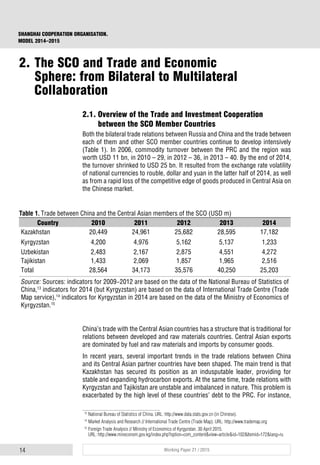
Table 1. Trade between China and the Central Asian members of the SCO (USD m)
Country 2010 2011 2012 2013 2014
Kazakhstan 20,449 24,961 25,682 28,595 17,182
Kyrgyzstan 4,200 4,976 5,162 5,137 1,233
Uzbekistan 2,483 2,167 2,875 4,551 4,272
Tajikistan 1,433 2,069 1,857 1,965 2,516
Total 28,564 34,173 35,576 40,250 25,203
Source: Sources: indicators for 2009-2012 are based on the data of the National Bureau of Statistics of
China,13
indicators for 2014 (but Kyrgyzstan) are based on the data of International Trade Centre (Trade
Map service),14
indicators for Kyrgyzstan in 2014 are based on the data of the Ministry of Economics of
Kyrgyzstan.15
15www.russiancouncil.ru
Ambassador of Tajikistan to the PRC Rashid Alimov showed in his monograph the
economic “anatomy” of the formation and development of “unequal, asymmetrical
pairs” (using the example of the China-Tajikistan model).16
Over the last five years, China has overtaken Russia not only in acquiring goods
and raw materials that used to be exported to Russia, but also in competition for
the sales market with Russian enterprises.17
Russia’s foreign trade turnover with the Central Asian countries rose 5-fold
from 2000 to 2013 (USD 6 bn to USD 31 bn). In 2010-2013, the high growth
rates of commodity turnover between Russia and the region resulted from the
rapid growth of Russia-Kazakhstan trade within the scope of the Customs Union
(CU) (Table 2). Over 2013, commodity turnover went up by 10.6%, which is
comparable to the indicator for the trade with China (13%).
In 2008-2012, the foreign trade balance of all the Central Asian countries with
Russia was negative, with imports from Russia materially exceeding exports to
Russia.18
At the same time, 2014 saw sharp fluctuations in the rouble and drop in imports,
this entailing a cut in the commodity turnover with the region owing to the
decrease in trade with Kazakhstan and Kyrgyzstan.
Russia currently remains the second biggest trading partner of the Central Asian
region.
The predominant export goods from the Central Asian states to Russia are still
natural resources and agricultural raw materials, as well as chemical products.
Russia exports manly end products and partly raw materials to the region.
The Central Asian market is important to Russia from the point of view of end
products’ exports, including substantial proportion of Russian exports of
16
Alimov R.K. Tajikistan and China. A Course Towards Strategic Partnership. M., 2014 (in Russian).
17
UNDP Report on Human Development in Central Asia. 2014, p. 14 // UNDP in Europe and Central Asia.
URL: http://www.europeandcis.undp.org/files/uploads/_rbec%20web/cahdr/cahdr_ru/02%20cahdr%20rus%20I-XVIII.pdf
18
On the State of Foreign Trade in 2014 // Federal State Statistics Service.
URL: http://www.gks.ru/bgd/free/b04_03/IssWWW.exe/Stg/d05/35.htm (in Russian).
2. THE SCO AND TRADE AND ECONOMIC SPHERE:
FROM BILATERAL TO MULTILATERAL COLLABORATION
Table 2. Foreign trade of the Central Asian countries with Russia (2008–2014, USD m)
Country 2009 2010 2011 2012 2013 2014
Kazakhstan 12,844 15,139 19,765 2,428 23,519 21,051
Kyrgyzstan 1,282 1,384 1,453 1,830 2,140 1,817
Tajikistan 786 887 810 745 762 928
Uzbekistan 2,541 3,447 3,967 3,715 4,100 n/a
Entire region 17,453 20,857 25,995 28,718 30,521 23,796
Sources: indicators for 2009-2012 are based on the data of the Ministry for Economic Development of
the Russian Federation, indicators for 2013-2014 are based on the data of the Federal State Statistics
Service.18
16 Working Paper 21 / 2015
SHANGHAI COOPERATION ORGANISATION.
MODEL 2014–2015
foodstuffs, machinery and transport equipment, and, in recent years, textile
products. In the first half of the 2000s, the region absorbed up to 27% of Russian
machinery and transport equipment exports, though the proportion of industrial
goods in total Russian exports to Central Asia dropped from 66% in 2005 to 52%
in 2010, making way for raw materials.19
One specific characteristic of Russian exports to Central Asia is the falling share
of high-tech products, almost halving between 1997 and 2010 (from 19 to 10%).
The share of medium-tech goods fell from 30% in 2002 to 16% in 2010. Only
the share of low-tech goods went up, from 16.6% in 2002 to 22.4% in 2009.20
Poor development of export support mechanisms available in Russia played a
certain role in the drop in Russian exports. The current system of state guarantees
includes the Central Asian countries in the high risk group with minimum outside
limits to the guarantees.21
Consequently, Russian enterprises are less interested
in investing in the region’s economy and cooperation with Central-Asian
countries is less of a priority. Moreover, other export support programmes, such
as reimbursement of part of the interests on export credits out of the budget
and provision of subsidies for supporting small and medium-sized business
manufacturing and selling export goods, are little orientated on promoting
cooperation with the Central Asian countries.
The total foreign trade turnover between the SCO countries in 2013 exceed USD
150 bn, over half of this (about 58%) accounted for by the mutual trade between
China and Russia. The share of intra-regional trade among the Central Asian
countries in the total foreign trade of the SCO countries is not significant as yet –
about 3%. Mutual trade between the Central Asian countries is at a low level: from
15–20% in Uzbekistan and Kyrgyzstan to 5% (or less) in Kazakhstan.22
Real participation in integration processes is of increasing relevance for the Central
Asia countries. On 8 May 2015, the agreement on the accession of Kyrgyzstan to
the EEU was signed in Moscow.23
Experts forecast that Kyrgyzstan’s inclusion
(possibly Tajikistan’s, as well) in the project for Eurasian integration will allow the
standard of living in these countries to be raised.
China’s foreign exchange and financial reserves, which are actively used by the
PRC government both for aggressively buying up resource assets in the Central
Asian countries and for providing credit support for national companies in the
region, are of particular significance given the deepening of regional cooperation.
In terms of capital investment in the Central Asian economy, China is the biggest
investor. From 2001 to 2012, Chinese investments went up 21-fold (over USD
19
Sinitsina I. Economic Collaboration between Russia and the Countries of Central Asia: Trends and Prospects. University
of Central Asia. Report No. 5. Bishkek, 2012. P. 13 (in Russian).
20
Ibid.
21
Directive of the Government of the Russian Federation “List of foreign states for industrial imports to which
state guarantee support is provided in 2008-2010 in consideration of maximum annual guaranteed volumes”
of 25.04.2008. No. 566-р // Garant legal reference system. URL: http://www.base.garant.ru/12160087 (in Russian).
22
UNDP report on human development in Central Asia 2014 p.15. // UNDP in Europe and Central Asia.
URL: http://www.europeandcis.undp.org/files/uploads/_rbec%20web/cahdr/cahdr_ru/02%20cahdr%20rus%20I-XVIII.pdf
(in Russian).
23
EEU Leaders Sign Agreement on Kyrgyzstan’s Accession // REGNUM News Agency. 8 May 2015.
URL: http://www.regnum.ru/news/polit/1922821.html (in Russian).
17www.russiancouncil.ru
22 bn).24
The PRC invests considerable amounts in the region through the Asian
Development Bank (ADB). Through the SCO, in 2009 the PRC allocated to the
Organisation’s member countries preferential credit of USD 10 bn for supporting
financial stability. In June 2011, China Exim Bank, through which the main
financial injections into Central Asia are made, increased the credit facility to USD
12 bn and was already implementing over 50 socio-economic projects in the
countries of the region.25
Total Chinese investments in Kazakhstan, for example, at the end of 2013 –
beginning of 2014 amounted to USD 18.9 bn, including USD 15 bn in the energy
area. In 2013, the contracts signed with Kazakhstan during a visit by China’s
Chairman Xi Jinping were worth an aggregate of USD 30 bn. China’s total
investments in the Uzbek economy amounted in 2012 to over USD 4 bn. Most of
the Chinese funds are invested in the fuel and energy sector and in development of
the natural resources of the republic. In September 2013, the sum of the contracts
signed in Uzbekistan amounted to USD 15 bn. The anti-crisis assistance rendered
by the PRC to the Tajik authorities is acquiring a systemic nature. In September
2013, China agreed to allocate loans of about USD 3 bn to Kyrgyzstan for energy
and infrastructure projects, USD 1.4 bln of this for construction of a pipeline to
China.26
2.2. Prospects for Interbank Economic Cooperation within
the Scope of the SCO. From Bilateral to Multilateral
The expert community shares the view that the economic collaboration between
the SCO countries is in deep crisis. This is largely connected to the imbalance
in the economic potentials of the countries of the group (asymmetric, unequal
partnership), absence of financial mechanisms for the development of the
Organisation (the SCO Development Bank), and the trends towards economic
depression in the poorest countries of the region.
China acts as moderator and creator of the SCO Development Bank, which operates
exclusively on market mechanisms. Russia being concerned about growing PRC’s
dominance in the Organisation’s financial-investment area proposes the concept
of the model to be specified.
Instead of the Development Bank, Moscow proposes strengthening the Eurasian
Development Bank by Beijing joining it. This proposal (prior to the Dushanbe
summit) was not perceived unambiguously by Chinese leaders. However on the
eve of the summit in Dushanbea clear turnaround in the Chinese approach was
observed. It is possible that the Russian idea for strengthening the Eurasian Bank
coincided with the Chinese variant of expanding the Eurasian integration space by
involving it in the Silk Road Economic Belt project.
Expert meetings are still going on with respect to drafting the main principles
for the formation and functioning of a Special SCO Account. Mechanisms for
project finance are being developed as a major item in the financing of multilateral
24
Kuzmina E.M. Foreign Economic Interests as a Factor in the Economic Development of Central Asia: Scientific report.
M., 2013. (In Russian)
25
Ibid.
26
Ibid.
2. THE SCO AND TRADE AND ECONOMIC SPHERE:
FROM BILATERAL TO MULTILATERAL COLLABORATION
18 Working Paper 21 / 2015
SHANGHAI COOPERATION ORGANISATION.
MODEL 2014–2015
projects. On the whole, the financing mechanism for bilateral projects is already in
place, whereas that for multilateral projects needs to be elaborated.
The Central Asian countries look positively on China’s intention to use the mutually
complementary nature of the region’s economic structures as a vital factor in
the development of cross-border economic collaboration. The PRC has at its
disposal a broad range of comparative advantages, above all in labour-intensive
branches of light industry, manufacture of domestic appliances and electronics.
The majority of Central Asian countries have extensive natural resource potential,
as well as constitute a market for Chinese consumer goods and technical
products. The expansion of production cooperation in the area of geological
survey, extraction and processing of minerals, construction of infrastructure,
thermal and hydro-power facilities, and agriculture is therefore promising for the
countries of the region.
Russia’s interests, as it is known, are focused increasingly on formation of the
EEU. Within the scope of its SREB project, China is concentrating on contacts
with 21 states of Eurasia and the Middle East, offering them its own development
concept. At the same time, in institutional terms, the EEU has already advanced
quite far towards integration and Russia preserves its status as the second (after
the PRC) biggest trading partner of the region. The Customs Union has, of course,
set up barriers against external “players”, including the PRC, which causes
dissatisfaction and criticism on the part of Beijing. Even so, the contradictions
between Russia and Cuba do not reach the level of official relations.
Under these conditions, Russia cannot avoid the (so far) latent challenge of the
Chinese integration project SREB and/or slow down the development of the
Chinese initiative. At the same time, there are not yet any precise outlines (even at
the expert level) of the measures of practical cooperation or collaboration between
the different projects. Within the SCO, the PRC continues strenthening bilateral
economic relations with unconditional support of the leaders of the Russian-
Chinese strategic partnership.
Chinese experts note that development of economic integration in the region
should not mean that the Central Asian countries automatically come under
Chinese control and that a zone of “total Chinese influence” develops in the
region.27
Chinese participation “in small doses” in several regional economic pro-
jects is considered quite possible.
In these conditions, it would be advisable for Russia to concentrate its efforts
on development of intra-regional production cooperation in the manufacturing
industry: machine-building, electronics, chemical and certain other sectors,
above all manufacturing of high-tech, science-intensive products. The given
areas of collaboration could be stated in items on the Road Map for the long-
term development of the SCO and be the point of departure for the SCO long-term
development Strategy.
The Russian corporation for cooperation with the countries of Central Asia, set up
in 2012, is trying to attract state and private investment in the region’s promising
27
The New Silk Road: Strategic Interests of Russia and China: interview with Zhao Huasheng // Russian International
Affairs Council. 20 December 2013. URL: http://www.russiancouncil.ru/inner/?id_4=2883#top (in Russian).
19www.russiancouncil.ru
types of industry: hydro-power, high-tech , poultry breeding sectors and so on,
but, due to the lack of substantial funds, no progress in the given direction is
anticipated yet.
The Shanghai Cooperation Organisation Interbank Consortium (SCO IBC), which
was set up by the heads of the governments (prime ministers) of the SCO states
in 2005 by signing the IBC Treaty,28
retains its potential. The Interbank Union
includes the biggest commercial banks of these countries interested in operating
more actively on the SCO economic space, in particular the Development Bank of
Kazakhstan, the China Development Bank, Vnesheconombank, the National Bank
of Tajikistan and the National Bank for Foreign Economic Activity of the Republic
of Uzbekistan. Establishment of the Interbank Consortium of the SCO members
creates considerable opportunities for the development of the economies of this
Organisation member countries.
Currently, the leading project in the sphere of inter-bank cooperation consists
in drafting regulations for collaboration between the banks belonging to the IBC
in selecting, assessing and implementing SCO investment projects. The given
regulations are functional in nature and are called on to establish unified rules,
procedures and methods for assessing projects and coordinating them within the
Union. The SCO IBC coordinators have approved the work carried out by experts
to draw up a framework document on the collaboration and cooperation of the
IBC and the SCO Business Council on a long-term basis. The given document will
help format, organise and step up further cooperation between these two leading
structures in the SCO economic field.29
2.3. The SCO and Transport and Logistics
Cooperation in the Region
SCO summit Beijing in 2012 was marked by a programme to develop joint
investment projects of infrastructural nature. The summits in Bishkek (2013) and
Dushanbe (2014) confirmed the priority status of this initiative.
The PRC has a leading position among the SCO member countries in the field
of transport and the creation of new routes. The alternative trans-Siberian route
using the Eurasian transcontinental line (Lianyungang – Alashankou – Rotterdam)
is now operating at full capacity. China is planning to build new railroads that
bypass Russia. The PRC is gradually creating a transport network geared to its
own needs in the Central Asian region.
At the beginning of the 1990s China adopted a large-scale infrastructure project –
the rebirth of the Great Silk Road (the New Silk Road), which included extensive
construction of transport outlets to the Central Asian region.30
This project has
now received a new start in form of the concept plan for the Silk Road Economic
Belt (SREB), announced in 2013.
28
Agreement on Inter-Bank Association. URL: http://www.sectsco.org/RU123/show.asp?id=61 (in Russian).
29
Priorities of Regional Integration within the SCO // Renmin Ribao in Russian. 31 October 2007.
URL: http://www.russian.people.com.cn/31521/6294009.html (in Russian).
30
Stretching the Threads. November 29, 2014. URL: http://www.economist.com/news/china/21635061-impoverished-
south-west-china-seeks-become-economic-hub-stretching-threads.
2. THE SCO AND TRADE AND ECONOMIC SPHERE:
FROM BILATERAL TO MULTILATERAL COLLABORATION
20 Working Paper 21 / 2015
SHANGHAI COOPERATION ORGANISATION.
MODEL 2014–2015
The SREB is based on the construction of a transcontinental transport network
from the Pacific Ocean to the Baltic Sea. The existing transport network, which
links the PRC with the western part of the Eurasian continent, is no longer able
to meet the country’s growing demands. China has constructed a new rail route
to Khorgos alongside the rail route from Urumqi to Alashankou. There are plans
to build a main line running from Kashgar in the direction of Kyrgyzstan and
Uzbekistan, with a further stretch towards Afghanistan and beyond to Pakistan
and India.
In this situation there are two ways which Russia can respond in: a) get involved in
the construction of the China – Central Asia – Europe route within the framework
of the SREB project, or b) take a passive, wait-and-see position, focusing on
modernising and strengthening the transit potential of the Trans-Siberian Railway.
The first option could be beneficial for the Russian Federation. At the same time
it is obvious that developing the Trans-Siberian Railway as the main Russian
transit route between East Asia and Europe must be a priority initiative in view of
the growing competition on the part of Chinese railways.
Freight transport from China to Europe via the southern sea route currently takes
45 days and more; via the Trans-Siberian Railway it is 18–20 days, and via the
Lianyungang – Hamburg route it is 11–13 days.31
Every two years the World Bank
publishes rankings for the logistical infrastructure of 155 countries,32
based on
a survey of employees in the logistics business. There are six criteria: customs
procedures, transport infrastructure, logistics services (customs brokers,
transport operators), the possibility of tracking freight movement, timeliness of
delivery, and complications in the organisation of international transport.
According to the logistics index for 2012 the rankings of the Central Asian
member states of the SCO were as follows: Kazakhstan is 86th
, Uzbekistan is
117th
, Kyrgyzstan is 130th
and Tajikistan is 136th
out of 155. China is 26th
, and
Russia is 95th
.33
The countries in the region have an especially low rating for
customs procedures. Problems with customs formalities stem from the fact that
electronic documentation does not function well, the logistics of customs points
are not thought through, and the routes to them are in poor condition.
According to the report by the World Economic Forum, in terms of the development
of their information and communication systems the Central Asian countries are
ranked as follows: Kazakhstan in 43rd
place, Tajikistan in 112th
, and Kyrgyzstan in
118th
.34
The Dushanbe summit saw an agreement signed between the governments of
SCO member states on creating favourable conditions for international motor
transport.35
As it is known, four SCO member countries have no outlet to the
31
Central Asia Regional Economic Cooperation // Central Asia Regional Economic Cooperation.
URL: http://www.carecprogram.org/uploads/events/2012/CFCFA-BNF-WGM/Day1-KAZ-Kazakhstan-FreightForwar-
ders-Association-ru.pdf
32
Logistics Performance Index // The World Bank. URL: http://www.lpisurvey.worldbank.org
33
Ibid.
34
The Networked Readiness Index 2013. // World Economic Forum.
URL: http://www3.weforum.org/docs/GITR/2013/GITR_OverallRankings_2013.pdf
35
Government of the Kyrgyz Republic. URL: http://www.gov.kg/?p=28852 (in Russian).
21www.russiancouncil.ru
open sea, and land transport is the most important form of communication for
developing trade and economic cooperation.
The agreement is multilateral rather than bilateral, and its coming into effect
gives the SCO member countries the opportunity to remove the existing barriers
using such measures as simplifying documentation and procedures concerning
international motor transport. Transport operators gain the opportunity to reduce
transport costs by expanding their geographical coverage. Implementation of this
project will create the conditions for gradually integrating neighbouring states
into the SCO transport infrastructure.
The anticipated construction of a transcontinental route should be beneficial to all
the Central Asia countries. It is therefore advisable to find the necessary approaches
and mechanisms in the SCO format for creating a unified transport policy in the area
of tariffs and shares in the capital of transport and logistics companies.
2.4. Conclusions and Recommendations
In order to ensure a sustainable relationship between Russia and smaller countries
of Central Asia (those that are not members of the Eurasian Economic Union but
are part of the SCO) it would be advisable to set up a special federal programme
on building closer relations through integration. At the state level it is necessary
to stimulate private investment in the region’s economy (by providing investors
with profit tax relief, for example). This measure could partially reduce the extent
to which the Russian Federation is lagging behind the PRC in terms of investment
in Central Asia.
Bilateral projects involving the leading countries (the PRC) and other countries in
the Organisation have a dominant position in the investment cooperation between
SCO countries. China is the biggest investor in terms of total capital investment in
the Central Asian economy. At the same time, by making use of the region’s resource
potential,thePRCisnotonlyfulfillingitsobjectivetomodernisethenationaleconomy,
especially that of the Xinjiang Uyghur Autonomous Region, but is also strengthening
its political influence in these countries. Russia cooperates predominantly with
Kazakhstan, Tajikistan and Kyrgyzstan. Systematic multilateral cooperation in the
Organisation’s economic area continues to lag behind bilateral cooperation.
A search is under way for a platform for practical multilateral cooperation in
the SCO format. It would be advisable (initially at the expert level) to define the
zones of potential multilateral cooperation in the fields of finance, economics,
investment, banking and transport. There is a need to smooth out the difficulties
within Central Asia by political and economic means and to bring closer together
the vectors of development of the two Eurasian integration groupings, the EEU
and the SCO, including cooperation between Russia and China in the Central
Asian area. On the basis of the draft SCO Development Strategy to 2025 it is
important to draw up a roadmap for multilateral economic cooperation within the
SCO and for mechanisms for cooperation between the SCO Secretariat and the
EEU executive body (the Eurasian Economic Commission).
The transport sector remains one of the most competitive for Russia and the
PRC. China is very active in the field, creating an alternative network to the
Trans-Siberian Railway on the Eurasian transcontinental route. At the same time
2. THE SCO AND TRADE AND ECONOMIC SPHERE:
FROM BILATERAL TO MULTILATERAL COLLABORATION
22 Working Paper 21 / 2015
SHANGHAI COOPERATION ORGANISATION.
MODEL 2014–2015
Russia’s interests are increasingly focused on infrastructure within the framework
of the EEU project. For the Russian Federation the development of Chinese
transport corridors in Eurasia is a factor in competition and at the same time an
opportunity for regional transport cooperation. Success for Russia and China in
creating transport corridors will be defined not so much in terms of development
of transport routes as of the degree to which these countries are integrated into
the single economic area of the Eurasian market.
The conditions for creating joint Russian–Central Asian and Chinese–Central Asian
enterprises are emerging. The low energy requirements of industrial production
in Central Asia and the availability of a skilled and inexpensive (even by Chinese
standards) workforce in the region could be a factor ensuring that the products of
such joint ventures are competitive on foreign markets. In this connection it would
be advisable for experts to study the macroeconomic viability of such enterprises,
above all in the areas of the electro-technical, energy, chemical industries, some
sections of the machine-building industry, light industry and agriculture.
Opportunities for energy cooperation in the SCO have not yet been effectively
identified. The idea of an “energy club” has not yet received the development it
needs. There is a need to continue the creation of a coordinating body between the
Organisation’s oil- and gas-exporting countries (including permanent members,
observers and dialogue partners), and to draw up a plan for the development and
coordination of hydrocarbon resource exports and imports. Setting up a single
energy (hydrocarbon) market in the SCO could stimulate the joint development
of new sources of renewable energy – solar and wind energy. In terms of
implementing an energy programme it is fundamentally important that despite the
existing tension in the area of the distribution of energy resources in the Russia–
Central Asia–China triangle, there are so far no real clashes between Russian and
Chinese corporations over Turkmen, Kazakh or Uzbek gas resources. This means
that there are enough political opportunities for Russian–Chinese partnership to
resolve individual commercial and energy difficulties.
23www.russiancouncil.ru
3.1. “Soft Power” in the Central Asian Dimension: Russia’s
Competitive Advantages and How to Maintain Them
In terms of attractiveness Russia is in competition in the Central Asian region not
only with Western countries but also with other players, the biggest of which is
China (as well as Turkey and the Arab countries). Language is a big competitive
advantage for Russia in the Russia–China–West triangle: even if the level of
mastering of the Russian language has declined since the collapse of the USSR,
the Russian language remains more widespread in the region than English, and
even more so than Chinese.
In the context of the strategic partnership between Russia and China, however,
the relationship in the Russia–China–West triangle could be regarded as 2 + 1,
i.e. Russia and China on one side and the West on the other. In other words, the
growth of Chinese influence should logically lead to a decline in western influence
and an increase in Russian–Chinese influence.
When planning a “soft power” policy in the region it is, however, worth giving
some thought to the fact that relations in the Russia–China–West triangle could
hypothetically be arranged in a different way. China possesses financial and
innovative advantages in comparison with Russia and is moving forward the
SREB project, which will eventually be capable of covering the Central Asia region
with a number of infrastructure projects. At the same time the Central Asian
transport network will probably experience significant changes: the region’s ties
with the outside world will be mediated not through Russia alone, or perhaps not
so much through Russia as through China and the infrastructure it has created.
Unlike Russia, China is separated from the peoples in the region by a serious
language barrier: despite the efforts of the Confucius Institute, it can hardly
be expected that the population of the Central Asian countries will quickly
learn Chinese (in view of the difficulty of achieving an adequate mastery of
this language for professional use). In this situation China must rely on
communication in Russian or English. The arguments in favour of Russian are
obvious and based on the fact that virtually the entire population of the region
speaks Russian. At the same time new arguments are emerging in favour of
using English. While a large part of the population of the Central Asian SCO
member countries have traditionally regarded the Russian language and culture
as part of their national history and considered that studying them was necessary
if they were to see their career develop and make their way in the world, today
the best specialists, if they have the opportunity, supplement their knowledge
of Russian with knowledge of English. The university education system in China
is well integrated in the western system. Management in Chinese businesses
that employ foreigners is also built, as a rule, on the English language. Finally,
in China itself there are far more employees who speak English than those who
speak Russian.
3. EDUCATIONAL, SCIENTIFIC, AND CULTURAL LINKS
BETWEEN THE SCO MEMBER COUNTRIES
3. Educational, Scientific, and Cultural Links
between the SCO Member Countries
24 Working Paper 21 / 2015
SHANGHAI COOPERATION ORGANISATION.
MODEL 2014–2015
Thus it is sensible to ask: could the growth of China’s influence in the region
lead not to a rise in Russian–Chinese cooperation and the exclusion of the West
but instead to the exclusion of Russia and the transformation of China into that
civilizational bridge to the wider world, and especially the Western world, which
Russia itself was for the countries of the region until recently?
In posing this question purely hypothetically, we should emphasise that China
is unlikely to set itself such goals consciously. China is rather counting on
involving Russia in cooperation. The risk factors stem most of all from Russia
itself, which finds itself today relatively isolated internationally and is neither a
centre of innovation nor a magnet for the most skilled workers. Russia is currently
attractive mainly to low-skilled workers from Central Asia who head for Russia
more out of necessity than desire because of the lack of other options for earning
money. If an improvement in the region’s transport infrastructure sparks new
opportunities for economic development, the skill levels of the workforce will rise,
and the two poles of innovation in the modern world – the West and China – might
become more attractive than Russia in the medium term.
What can Russia do in this situation?
In the context of renewed confrontation with the West we may expect efforts
by Western countries to provoke competition between Russia and China in the
Central Asia region. This competition will also affect the sphere of ideas, i.e. that
of soft power, and at the same time some most dangerous parallels might be
drawn: for example, a number of experts are already making attempts to draw
comparisons between the Russian-speaking population of Ukraine and that of
Central Asia.
It is in Russia’s interests to adopt a participative stance in relation to Chinese
projects such as the SREB and to avoid setting Russian and Chinese projects in
opposition to each other, since only direct involvement in them will ensure the
necessary level of understanding of the situation. Thus it might be most effective
to find points of contact between Russian and Chinese interests.
Russia will undoubtedly have the opportunity to participate in Chinese projects,
since China itself will try to involve Russia in cooperation in order to combine
Russia’s language advantages with its own financial and innovation opportunities.
In addition, the countries of Central Asia will probably try to diversify their sources
of investment in order to avoid too great a dependence on China, and consequently
they will also welcome Russian involvement.
The fact that Russia is already unable to ensure high-quality Russian-language
education in the Central Asia region is a serious challenge to Russia’s position
in the region. In the Soviet era this objective was fulfilled through the system of
compulsory school education, and Russia’s linguistic advantage to this day is a
result of that system. Nowadays, however, Russia does not control school education
in the Central Asian countries and can only support its own language presence
through comparatively much weaker approaches that are by definition targeted at
the foreign audience (Russkiy Mir centres, Russian-language media, etc).
In this situation any contacts between the population of the region and Russia
will help to preserve historical links and the influence of the Russian language.
25www.russiancouncil.ru
Unfortunately, the experience shows that all it takes is one or two generations for
a language to fall into disuse. The extent to which Russian is used varies among
the countries in the region and is tending to decline: in Kazakhstan the greater part
of communication is in Russian as before, but in Uzbekistan and Tajikistan in the
overwhelming majority of cases it is in local languages.
Today we cannot ignore even the low-skilled migrant workers coming into Russia
from Central Asia, who having learned Russian in Russia ensure that it is at least
passed on to another generation in their own country. Flexible immigration laws
will also help to maintain Russia’s competitive language advantage in the Central
Asia region.
The preservation of the Russian language in Central Asia is a powerful competitive
advantage for Russia. It is important for Russia not so much to persuade the local
population that it is internationally attractive as to restore a single cultural space,
which in many ways depends on spreading the Russian language.
Educational cooperation is the most reliable approach. It can take various forms:
special programmes for students and school pupils, university branches, joint
universities and all kinds of educational exchanges. Only in the context of shared
approaches to education is it possible to maintain the popularity of Russian
media and publishing in the region. In Kazakhstan, for example, Gallup data
shows that ratings for news programmes in Russian are 50 per cent higher than
the equivalent programmes in Kazakh. People in the region’s countries watch
either relayed Russian channels or Russian productions purchased by local TV
broadcasters. In their day reports and broadcasts by Russian channels had a
marked influence on the growth of anti-American feeling in Kyrgyzstan and on
the change in status of the Manas air base.
There is also a demand in the region for Russian-language print publications: in
Kazakhstan, for example, 75–90% of the books on sale are imported from Russia.
In Kyrgyzstan, approximately 70–75% of library funds in Bishkek are spent on
Russian science and popular-science books.
Russia, however, will not be able to avoid the rising influence of China in the
region. Neither can Russia stop the people in the region learning English and
Russian. At the same time in view of the difficulty of the Chinese language, it is
very likely that English will spread much more rapidly than Chinese, and the rise
in China’s influence will lead to an increase in the number of people speaking
English.
Nevertheless Russia should not try to restrict the Central Asian countries’ contacts
with China or the West: influence in the region should not be regarded as a zero-
sum game. It is in Russia’s interests to turn the Central Asian states that are
interested in cooperating with Russia into economically developed and socially
successful countries. On the whole, the Central Asian states are independent
states that make their own choices on the basis of what will bring the greatest
benefits. The example of Ukraine shows that if a region’s economic development
is not successful, they will not only cease to be allies of Russia but on the contrary
will be inclined to blame Russian influence for their own failures and move farther
away from Russia towards the West and China.
3. EDUCATIONAL, SCIENTIFIC, AND CULTURAL LINKS
BETWEEN THE SCO MEMBER COUNTRIES
26 Working Paper 21 / 2015
SHANGHAI COOPERATION ORGANISATION.
MODEL 2014–2015
3.2. The SCO University: a Regional Educational Centre
or a “Eurasian Higher Education Zone”?
The idea of creating the SCO University (SCOU) was put forward by Vladimir Putin
at the Bishkek summit meeting of the SCO heads of state on 16 August 2007.36
This organisation is based on the socalled network principle. This means that the
SCO member countries and observer countries select universities (currently a total
of 76 universities in six countries, including 23 Russian universities – MGIMO,
MSU, RUDN etc.37
) which cooperate with each other in the form of multilateral
cooperation, including the fact that students, masters students, post-graduate
students and doctorate students can spend from one semester upwards in any of
the partner universities. This form of cooperation is also named the SCOU.
The idea in itself looks promising, since the project covers a wide range of
participants and combines various educational programmes and standards, and
most importantly it meets the growing demand of young people to study SCO
issues and to be taught the Organisation’s languages by teachers who are native
speakers. A number of experts (A. Maslov) and project heads (the university rector
V. Filippov, etc) regard it as a kind of Asiatic equivalent to the well-known system
of the European Higher Education Area (the Bologna Process).38
As is known,
the Bologna Process is aimed at bringing the higher education systems of the
European countries closer together (Russia acceded to the Bologna declaration
in 2003). Formally the two systems have common features, but in essence the
SCOU will not achieve the same level of mobility and the extent of exchanges that
apply in the European model.
Nevertheless, the implementation of this ambitious multilateral project is running
into significant technical difficulties. Firstly, the member countries have different
educational programmes and standards (for example, a masters course in Russia
and the Central Asian countries takes two years, but three in China; there are
different requirements for the number of academic hours and educational credits
requiredforgraduation,differencesinthecorrelationbetweencompulsorycourses
and optional courses, etc).39
Secondly, while students in the post-Soviet area as
a rule have sufficient mastery of Russian to undergo teaching in the language,
in the case of educational exchanges with China a problem arises with regard
to students achieving an adequate level of Russian and Chinese respectively.
Thirdly, the logic and structure of mobility – the movement of students (pursuing
bachelors and masters degrees) and post-graduate students from one university
to another – is not fully understood. Fourthly, according to people taking part in
the project, the SCOU is also running into financial problems which are especially
acute in the Central Asian member countries.
36
About the University // SCO University. URL: http://www.usco.edu.cn/RUS/dxjj (in Russian).
37
The full list of participating universities is available on the SCO University official website:
URL: http://www.uni-sco.ru/country/0/country_0.html (in Russian). The partner universities shown do not include
universities in SCO member country Uzbekistan, but the Belarusian State University in the dialogue partner country
Belarus is shown.
38
The Rector of RUDN has been Appointed Head of the SCO Universities // Izvestiya. 15 January 2003.
URL: http://www.izvestia.ru/news/543004 (in Russian).
39
Methodology for Approving SCOU Masters Programmes // Belarus State University.
URL: http://www.bsu.edu.ru/bsu/structure/detail.php?ID=64238 (in Russian).
27www.russiancouncil.ru
It should be noted, however, that these difficulties are no different to those
which countries encounter when setting up bilateral educational cooperation,
and therefore are entirely surmountable, as experience of successful bilateral
formats shows. While the SCOU is currently not developing rapidly enough, as
the participants in the project themselves admit, the reasons for this lie not in the
aforementioned technical difficulties but rather in the fact that the project is not
yet fully developed conceptually.
This is why we suggest looking at the SCOU from a strategic rather than
technical perspective. Thus on the basis of the SCOU documents studied40
and
conversations with project participants,41
varied answers can be seen to the
following key questions:
The aim of the project: is the SCOU an educational establishment with an emphasis
on regional issues in study programmes or an integrating process in the field of
education, a kind of “Eurasian higher education zone”?
Objectives: what significance does the SCOU have in training personnel for the
Shanghai Cooperation Organisation and its member states?
Advantages: what added value does the SCOU format bring to the participating
universities in comparison with traditional bilateral cooperation programmes in
the field of higher education?
The aims of the SCOU as an educational establishment with an emphasis on SCO
regional issues and as a kind of Eurasian equivalent of the Bologna process are
complementary, but in our view they should be addressed in different organisational
formats. According to the SCOU Concept, the basic mission of the university is to
trainpersonnelinprofessionswhichareofpriorityinterestforthedevelopmentofthe
SCO member states.42
This aim and also the chosen name “SCO University” evoke
associations with an educational establishment, a research centre or an educational
structure. The SCO University, however, is not an independent establishment but a
unified network of higher educational establishments in the SCO member countries.
The aim of the University is, inter alia, “to develop integration processes in the field
of education, science and technology”,43
which defines the overall features of the
project and of the European Bologna process.
To optimise the SCOU’s role in training personnel in professions which are of
priority interest for the development of the SCO member states with a strong
regional component it is necessary to set up specific specialist educational
40
The most complete list of documents is available on the Belgorod State National Research University website at:
http://www.bsu.edu.ru/bsu/structure/detail.php?ID=64238. List of documents: (1) Concept plan for the SCO University
(adopted at the conference of SCO member states’ education ministers on 24 October 2008 in Astana (Kazakhstan), new
edition adopted at the conference of SCO member states’ education ministers on 23 September 2010 in Novosibirsk
(Russia); (2) Memorandum on cooperation between higher educational establishments in the Republic of Kazakhstan,
the People’s Republic of China, the Kyrgyz Republic, the Russian Federation and the Republic of Tajikistan on the
creation of the Shanghai Cooperation Organisation University (26 April 2010); (3) Agreement on running masters
programmes in the SCO University; (4) Charter of the Shanghai Cooperation Organisation University (7 November
2011) (in Russian).
41
The author thanks Dr. A.N. Karneev, Ph.D. in History, Lomonosov Moscow State University; Mr. A.A. Prutskikh, SCO
Secretariat; Dr. A.A. Kireeva, Ph.D. in Political Science, MGIMO-University; Prof. Wu Dahui, Tsinghua University; Prof.
Feng Yujun, China Institutes of Contemporary International Relations.
42
Concept Plan for the SCO University. // Belgorod State University.
URL: http://www.bsu.edu.ru/bsu/structure/detail.php?ID=64238 (in Russian).
43
Ibid.
3. EDUCATIONAL, SCIENTIFIC, AND CULTURAL LINKS
BETWEEN THE SCO MEMBER COUNTRIES
28 Working Paper 21 / 2015
SHANGHAI COOPERATION ORGANISATION.
MODEL 2014–2015
programmes. This objective can be more efficiently addressed within the
framework of an organisationally unified establishment, not of a rather amorphous
network comprising dozens of national universities. It would seem appropriate
to create the SCOU as an autonomous structure with its own headquarters and
staff separate from the member countries’ universities. The SCOU should have
at least its own administrative personnel. The SCOU format does not require the
creation of a permanent set of professors and teaching staff: it is possible to
organise its work efficiently by inviting professors and experts in specific fields to
run subject-based courses and events which can be organised as both full-time
and long-distance or virtual learning. For logistical purposes it would be sensible
to locate the SCOU headquarters in Russia or China, or create SCOU offices in
both Russia and China. In the longer term offices could also be opened in other
countries involved in the project if they so wish.
In order to determine the advantages of the SCOU in comparison with bilateral
exchange programmes it is necessary to establish a link between the teaching
programmes and regional issues. It would not, however, be appropriate to do
this for all areas of study. The SCOU currently identifies seven professions as
priority areas: regional studies, ecology, energy, economics, IT, nanotechnology
and pedagogy.44
There are regional components in the discipline of regional
studies, and also partly in the ecology, energy and economics, but the disciplines
of IT, nanotechnology and pedagogy involve more than one science. The SCOU
platform should primarily focus on disciplines with a strong regional focus, not
on multi-science disciplines. The courses of study should have an applied nature
and should be aimed not just at students but also at professionals in various
sectors in the SCO member countries.
The idea of the SCOU is also that the student should have the opportunity to
continue his or her education in a partner university, starting in any semester.
This idea could be achieved as a result of a general convergence of educational
standards within the framework of the Eurasian educational area.
The convergence of educational standards should not be restricted to individual
disciplines; instead it would be appropriate to work on a general increase in the
compatibility of standards of higher education and in the mobility of academic
teaching staff and students between the SCO member states. Work on integration
in the field of education could continue in a lightly organised format on the basis
of consultations between universities participating in the project and education
ministries such as the already existing SCO Weeks of Education,45
various inter-
ministerial and inter-university consultations, meetings of SCO rectors, etc. This
work should result in agreements on converging educational standards, periods
of study, and procedures for issuing diplomas and awarding degrees in interested
countries, and primarily the SCO members.
We would emphasise that Russia must show flexibility and trust in its partners
in recognition of the educational results achieved in other countries. In China,
for example, when a student is sent abroad to study, the courses they take are
effectively automatically recognised by the number of credits and not by the
44
SCOU official website. URL: http://www.uni-sco.ru/stat/2/stat_2.html (in Russian).
45
The Latest Education Week of SCO Member States is Planned for 6–9 October 2014 and will Take Place in Barnaul //
Altai State University. URL: http://www.asu.ru/inter_change/sco/week (in Russian).
29www.russiancouncil.ru
content of the study programme, and students do not have to repeat the course
when they return to their home country after an academic semester of year in a
foreign university.
The work on agreeing standards and mutual recognition of educational and
academic achievements should be backed by stipends and grants to support the
mobility of academic workers, teaching staff and students. It is not compulsory
to strive for parity in the number of people taking part in exchanges with partner
countries. It is logical for China and Russia, as the countries with the most developed
higher educational systems in the region, to act as the centres of gravity. Given that
higher education is a most important element in Russia’s “soft power”, it would be
extremely appropriate to invest in this field in the form of stipends and grants for
migrants from the strategically important region of the SCO.
The aim of the SCOU as a format for Eurasian educational integration is to
increase the quality and attractiveness of education in the SCO countries. The
development of the SCOU and the Eurasian higher education zone cannot,
however, be regarded as an alternative to Russia’s involvement in integrational
educational processes in the West. In addressing the objective of increasing the
quality of education and the prestige of the Eurasian higher education zone on
the global educational market it is necessary to take into account best global
practice in the field of educational integration and to develop cooperation with
recognised global leaders in higher education. It is logical to expect that a rise
in the attractiveness of Russian education, including for migrants from the SCO
countries, will in the long term be associated not only with regionalisation or
with study of the Russian language by a large number of applicants but also with
an increase in the compatibility of Russian education with the most prestigious
global educational systems.
3.3. Conclusions and Recommendations
In terms of soft power, Russia’s main competitive advantage in the Central Asia
region is the continuing command of the Russian language among the majority
of the elites and inhabitants of the region. Russia is not in a position, however,
to ensure high-quality study of the Russian language directly through the school
education system of the Central Asian countries, as it used to in Soviet times.
Russia can use other mechanisms for this purpose (for example the development
of Russkiy Mir institutes and centres in the region, and the further creation of
a single information field among the media of the SCO member countries), but
these mechanisms by definition are aimed at the foreign audience and are not
comparable in their degree of influence with the compulsory system of school
education in Russian that existed in the USSR, which up to now has determined
Russia’s influence in the region. Consequently the extent and quality of the use of
Russian is so far showing a tendency to decline.
Educationalexchangesandpolicyinthefieldofthemassmediaaimedatsupporting
the use of the Russian language in the region are proving to be meaningless
given the weakness of economic relations and the limited quantity and quality of
vacancies for Russian-speaking specialists from Central Asia. Although a shift to
communicating in Chinese is unlikely to happen in the very near future, despite
the activity of the Confucius Institute (in view of the objective difficulty of using
3. EDUCATIONAL, SCIENTIFIC, AND CULTURAL LINKS
BETWEEN THE SCO MEMBER COUNTRIES
30 Working Paper 21 / 2015
SHANGHAI COOPERATION ORGANISATION.
MODEL 2014–2015
this language at the professional level), the Chinese language, and also to an even
greater degree the English language, will soon create competition for the Russian
language as the languages for business communication in the region.
In order to maintain Russia’s language advantage in the Central Asia region in
the short and medium term it would be appropriate to be actively involved in
Chinese economic projects such as the Silk Road Economic Belt (SREB), to avoid
setting Russian and Chinese in opposition to each other and to find points of
contact between Russian and Chinese initiatives. Russia needs to adopt positive
rhetoric and flexible immigration practice with regard to immigrants from Central
Asia to Russia, who also represent human resources to maintain the influence
of the Russian language in the region. Finally, Russia needs to make significant
investments in professional Russian-speaking personnel in the Central Asia
region.
In the medium- and long-term perspective Russia needs to address the structural
objective of its economic and innovation attractiveness to elites and professionals
from Central Asia, without giving up cooperating both with China and, once
relations are normalised, with the countries of the West. Russia will not be able to
“cancel out” the growing economic presence of China in the Central Asia region,
nor will it be able to prevent people who live in the region from learning English
and Chinese. It is in Russia’s interests to transform friendly Central Asian states
into economically developed and socially successful states. If the economic
development of the region is not successful, as the example of Ukraine shows,
the Central Asian states will be alienated from Russia, whose influence they will
blame for their own failures, and they will adopt a course of cooperation with
other partners.
The SCO University, which was initiated by Russia in 2007 but which has been
developing with variable success, is a most important project in the humanitarian
area of the SCO’s activity. In order to give a boost to the development of the SCOU
project, in our view it would be logical to implement it in two areas. Firstly, this
meanstheSCOUniversityasanindependenteducationalestablishmentnotdirectly
linked with the administrations of specific national universities. In this format
the SCOU would become the base for training personnel for the Organisation
and the SCO countries in disciplines with a foundational regional component (for
example, regional studies and partly economics, ecologyand energy). Secondly, it
means a “Eurasian higher education zone” which could be based on the existing
know-how within the network of SCO countries’ universities. The work need not
be limited to specialisms with a regional component. Instead, common standards
for the Eurasian educational area in the greatest number of disciplines will help
to increase the mobility of academics, teachers and students, which will have a
favourable effect on all forms of cooperation in the region.
31www.russiancouncil.ru
The logic of the Organisation’s current development raises the issue of the
need to rapidly adopt the long-term SCO Development Strategy to 2025. The
development of the strategy concludes this year within the framework of the
Russian chairmanship, and there are plans to adopt it at the Organisation’s
Ufa (2015) summit. At the same time it is important for the Russian Federation
and the PRC, as well as for other permanent members and observers, to have
clear signposts, aims and means of fulfilling them in the near future and in the
long term. Adopting the strategy will also make it possible to carry out a real
assessment of the possibility of integrational development of Eurasia, including
the SCO’s cooperation with other projects in the region – the EEU and the SREB.
The growing consensus among Russian analysts on Russia’s position in the
SCO testifies to the fact that economic integration within the Organisation and
its cooperation with the EEU and SREB projects are important in the long term.
It is obvious that fulfilling such a large-scale objective will be a multi-stage
process and will require that a consolidated view shared by all members of the
Organisation be developed.
It would be appropriate to use the significant geo-economic potential of the
observer countries at the Organisation and the dialogue partner countries to
create mechanisms for them to participate in multilateral cooperation projects
and for them to be implemented by direct investment.
A gradual strengthening of the SCO’s power bloc and institutions responsible
for the regional security is underway. The key (political) point is to preserve the
non-aligned, non-military nature of the Organisation, which is an integrated
international structure aimed at developing economic and humanitarian
cooperation, preventing challenges and threats, and supporting stability in the
region.
At the same time, a number of challenges to the Organisation can be seen –
a) the unresolved nature of the issue of creating an SCO Development Bank,
b) the Afghan threat, including the emergence of an ISIL zone of influence in
Afghanistan, and c) the fact that multilateral economic cooperation is lagging
behind bilateral formats.
In this context there theoretically exist two possible scenarios for a response to
the challenges of the Organisation’s development in the near and medium terms.
The moderate scenario assumes maintenance of the current level and range of
cooperation between the SCO member countries, concentration on institutional
issues of development and a restrained attitude to substantial expansion of the
Organisation, especially of the group of its permanent members. Within this
scenario the challenges to the Organisation (the lack of the Bank, the increasingly
negative influence of Afghanistan, the lagging behind of multilateral cooperation)
can be mitigated by an active convergence of projects by the SCO, the EEU and
Conclusion. Summary and Scenarios
for the Development of the SCO
CONCLUSION. SUMMARY AND SCENARIOS
FOR THE DEVELOPMENT OF THE SCO
32 Working Paper 21 / 2015
SHANGHAI COOPERATION ORGANISATION.
MODEL 2014–2015
the SREB, including the banking and finance area and the transport area, and by
strengthening of the counter-terrorism components.
The optimistic scenario supposes a more radical response to the challenges and
threats by expanding the group of permanent SCO members (India, Pakistan),
strengthening the global (geopolitical) component, developing the Organisation’s
infrastructure on the basis of multilateral cooperation, creating the Development
Bankand/orarevivedEurasianBank,deepeningthemilitary-politicalandinvestment
components of the SCO (without changing their status). Obviously, the scenario
is also based on a further convergence between the Russian Federation and the
PRC within the framework of strategic partnership and the beginning of cooperation
between the three Eurasian projects – the SCO, the EEU and the SREB.
Integrating India and Pakistan into the SCO as permanent members could be
an important resource for the development and a response to the challenges.
Expansion emphasises and confirms the Organisation’s openness, increases its
international authority, expands its resources and opportunities for multilateral
trade, economic and investment cooperation, and strengthens its resources for
regional (Afghanistan, ISIL) security. At the same time, the inclusion of India and
Pakistan potentially creates an opportunity for dialogue between the SCO member
countries and the West.
This scenario supposes a more efficient use of the SCO’s opportunities to have
a coordinated decision adopted by the member countries, and above all by the
countries of Central Asia, China and Russia, to deepen integration in the field of the
common labour market and to finance the development of vocational education.
The “migration agenda”, which assumes the development of the SCO’s migration
infrastructure, the creation of vacancy databases and migration exchanges, the
convergence of legislation on regulating migrant labour issues, the creation of a
system of social benefits, economic assessments of the advisability of attracting
foreign workers and legalisation on the subject, etc, could become an important
supplement to economic cooperation.
33www.russiancouncil.ru
About the authors
Sergey Luzyanin – Dr. of History, Professor, Acting Director of the Institute of Far
Eastern Studies of the Russian Academy of Sciences, Expert of RIAC
Vladimir Matveev – Ph.D. in Economics, Leading Research Fellow at the Centre for
Strategic Studies of Northeast Asia and the Shanghai Cooperation Organisation of
the Institute of Far Eastern Studies of the Russian Academy of Sciences, Expert
of RIAC
Larisa Smirnova – Ph.D. in Political Science, Foreign Lecturer & Foreign Expert
at Xiamen University, Expert of RIAC
ABOUT THE AUTHORS
34 Working Paper 21 / 2015
SHANGHAI COOPERATION ORGANISATION.
MODEL 2014–2015
The Russian International Affairs Council (RIAC) is a non-profit international
relations think-tank on a mission to provide policy recommendations for all of
the Russian organisations involved in external affairs.
RIAC engages experts, statesmen and entrepreneurs in public discussions with
an end to increase the efficiency of Russian foreign policy.
Along with research and analysis, the Russian Council is involved in educational
activities to create a solid network of young global affairs and diplomacy experts.
RIAC is a player on the second-track and public diplomacy arena, contributing the
Russian view to international debate on the pending issues of global development.
RIAC members are the thought leaders of Russia’s foreign affairs community –
among them diplomats, businessmen, scholars, public leaders and journalists.
RIAC President Igor Ivanov, Corresponding Member of the Russian Academy of
Sciences, served as Minister of Foreign Affairs of the Russian Federation from
1998 to 2004 and Secretary of the Security Council from 2004 to 2007.
RIAC Director General is Andrey Kortunov. From 1995 to 1997, Dr. Kortunov
was Deputy Director of the Institute for US and Canadian Studies of the Russian
Academy of Sciences. Since 2004, he has also served as President of the New
Eurasia Foundation.
Russian International Affairs Council
35www.russiancouncil.ru
Notes
Russian International Affairs Council
Printed in Russia

Shanghai Cooperation Organisation. Model 2014–2015

  • 1.
    INTERNATIONAL ACTIVITY BUSINESS CIVIL S EDUCA INTER ANALYSIS ANDFORECASTING DIPLOM LPOLITICS INTERNATIONAL ORGANIZATIONS INTERNATIONAL ORGANIZATIONS DISCUSSIONS DIALOGUE DIALOGUE INTERNATIONAL RELATIONS NETWORK PROJECTS EXPERT COMMENTARIES CONFERENCES ROUND TABLES SUMMER SCHOOLS REPORTSW LIBRARY SCENARIOS SECURITY MIGRATION PARTNERSHIP COMPETITIONS ANTHOLOGIES ANTHOLOGIES REFERENCE BOOKS REFERENCE BOOKS WEBSITE GLOBALSCIENCE P CIVIL SOCIETY SCIENCE EDUCATION FOREIGN POLICY ANALYSIS AND FORECASTING DIPLOMACY GLOBAL POLITICS AL ORGANIZATIONS POLICY TALENT POOL TIVITY INTERNSHIPS DISCUSSIONS DIALOGUE INTERNATIONALRELATIONS NETWORKPROJECTS EXPERT COMMENTARIES LL CONFERENCES CONFERENCES II ROUNDTABLES SUMMER SCHOOLS REPORTS WORKINGPAPERS GUEST LECTURES LIBRARY CLUB MEETINGSROADMAPS SCENARIOS SECURITY BILATERALRELATIONS MIGRATIONPARTNERSHIP COMPETITIONS ANTHOLOGIES REFERENCEBOOKS WEBSITE GLOBALSCIENCE CIVIL SOCIETY DIPLOMACYOGU SCIENCE EDUCATION FOREIGN POLICY FOREIGN POLICY SC ANALYSIS AND FORECASTING DIPLOMACY DIPLOMACY GLOBAL POLITICS INTERNATIONALORGANIZATIONS FOREIGNPOLICYTALENTPOOL FOREIGN POLICY TALENT POOL NTERNSHIPS DISCUSSIONS Y DIALOGUE INTERNATIONAL RELATIONS NETWORKPROJECTS EXPERTCOMMENTARIES REPOR CONFERENCES ROUND TABLES SUMMER SCHOOLS REPORTS WORKING PAPER GUEST LECTURES LIBRARY CLUB MEETINGS ROADMAPS SCENARIOS SECURITY E BILATERALRELATIONS MIGRATION PARTNERSHIP COMPETITIONS Y ANTHOLOGIES LECTURES REFERENCE BOOKS WEBSITE GLOBAL SCIENCE GLOBAL D SCIENCE EXPERT COMMENTARIES EDUCATION CIVIL SOCIETY SCIENCE EDUCATION FOREIGNPOLICY ANALYSIS AND FORECASTING DIPLOMACY GLOBALPOLITICS INTERNATIONALORGANIZATIONS FOREIGNPOLICYTALENTPOOL AA C INTERNSHIPS DISCUSSIONS DIALOGUE S NETWORK PROJECTS EXPERTCOMMENTARIES CONFERENCES SUMMER SCHOOLS REPORTS W GUESTLECTURES LIBRARY CLUBMEETINGS ROADMAPS SCENARIOS SECURITY ILATERAL ELATIONS MIGRATION PARTNERSHIP COMPETITIONS ANTHOLOGIES REFERENCE BOO WEBSITE GLOBAL SCIENCE ANALYSIS AND FORECASTING REFERENCE BOOKS ANALYSIS ANTHOLOGIES AND FORECASTING SECURITY MIGRATION INTERNATIONAL ORGANIZATIONS DISCUSSIONS INTERNSHIPS SSIONSS N CIVILSOCIETY PARTNERSHIP AA INTERNATIONAL ACTIVITY CSCS EXPERT COMMENTARIES SUMMER SCHOOLS LIBRARY REPORTS ROADMAPS WORKING PAPER RUSSIAN INTERNATIONAL AFFAIRS COUNCIL (RIAC) 1, B. Yakimanka street, 119180, Moscow, Russia Tel.: +7 (495) 225 6283 Fax: +7 (495) 225 6284 E–mail: welcome@russiancouncil.ru www.russiancouncil.ru RUSSIAN INTERNATIONAL AFFAIRS COUNCIL 21 / 2015 SHANGHAI COOPERATION ORGANISATION. MODEL 2014–2015 Cover-21-engl.indd 1Cover-21-engl.indd 1 20.05.2015 1:19:4820.05.2015 1:19:48
  • 2.
    RUSSIAN INTERNATIONAL AFFAIRSCOUNCIL MOSCOW 2015
  • 3.
    П78 Russian International AffairsCouncil Institute of Far Eastern Studies of the Russian Academy of Sciences Editorial Board Editor-in-Chief: I.S. Ivanov, RAS Corresponding Member, Dr. of History Authors: S.G. Luzyanin, Dr. of History (Chairperson, Introduction, Chap. 1, Conclusion); V.A. Matveev, Ph.D. in Economics (Chap. 2); L.N. Smirnova, Ph.D. in Political Science (Chap. 3) Executive editors: I.N. Timofeev, Ph.D. in Political Science; T.A. Makhmutov, Ph.D. in Political Science; L.V. Filippova; D.O. Kholopova Shanghai Cooperation Organisation. Model 2014–2015: Working paper 21/2015 / [S.G. Luzyanin et al.]; [I.S. Ivanov, Editor-in-Chief]; Russian International Affairs Council (RIAC). – M.: Spetskniga, 2015. – 36 pages. – Authors and editors are listed on back of the title page. ISBN 978-5-91891-444-1 The working paper is devoted to the activities of the Shanghai Cooperation Organisation (SCO), its influence on the Central Asian region, adjacent areas and states. Its relevance derives from the national security interests of Russia and the Central Asian region, connected to the need to develop and adopt a long-term SCO Development Strategy up to 2025. The document provides different scenarios for the Organisation’s development, its likely reaction to crises in the region, including in Afghanistan, the possibility of the key players (Russia and China) strengthening its potential, as well as options for increasing the number of permanent members and collaborating with observer countries (India, Pakistan, Iran and Mongolia). The possibilities for and impediments to strengthening the geopolitical role of the SCO are analysed and practical recommendations are given. The authors express gratitude to Lt. Gen. A.F. Klimenko, Ph.D. in Military Science, Ambassador M.A. Konarovsky, Ph.D. in History, Dr. A.N. Karneev, Ph.D. in History, Mr. I.E. Denisov, Mr. A.A. Prutskikh, Dr. A.A. Kireeva, Ph.D. in Political Science, Prof. Wu Dahui, and Prof. Feng Yujun for their comments on the issues covered in the publication. RIAC thanks Ms. Ksenia Kuzmina for her help in preparing this publication. The views and opinions of authors expressed herein do not necessarily state or reflect those of RIAC. Cover photo credits (top down, left to right): sco-russia.ru, REUTERS / Shamil Zhumatov / Pixstream, REUTERS / Mikhail Klimentyev / Pixstream The full text of the working paper is available on RIAC’s website. You can download it and leave your comments via this direct link – russiancouncil.ru/en/paper21 © Authors, 2015 © Drafting, translation and design. NPMP RIAC, 2015
  • 4.
    Introduction 4 1. TheSCO within the System of International Organisations and International Relations 6 1.1. Regional and Global Dimension of the SCO. Problems in Expanding the Organisation 6 1.2. SCO and CSTO. Security Agenda, Challenges and Possibilities of the Organisation 8 1.3. Opportunities for Transformation of the SCO Military Component: Does It Require Strengthening? 9 1.4. Conclusions and Proposals 12 2. The SCO and Trade and Economic Sphere: from Bilateral to Multilateral Collaboration 14 2.1. Overview of the Trade and Investment Cooperation between the SCO Member Countries 14 2.2. Prospects for Interbank Economic Cooperation within the Scope of the SCO. From Bilateral to Multilateral 17 2.3. The SCO and Transport and Logistics Cooperation in the Region 19 2.4. Conclusions and Recommendations 21 3. Educational, Scientific, and Cultural Links between the SCO Member Countries 23 3.1. “Soft Power” in the Central Asian Dimension: Russia’s Competitive Advantages and How to Maintain Them 23 3.2. The SCO University: a Regional Educational Centre or a “Eurasian Higher Education Zone”? 26 3.3. Conclusions and Recommendations 29 Conclusion. Summary and Scenarios for the Development of the SCO 31 TABLE OF CONTENTS
  • 5.
    4 Working Paper21 / 2015 SHANGHAI COOPERATION ORGANISATION. MODEL 2014–2015 Introduction Russia’s chairmanship of the SCO On 11-12 September 2014, at the Summit of the heads of the Shanghai Cooperation Organisation (SCO) member states in Dushanbe (Tajikistan), Russia assumed chairmanship of the Organisation until the next Summit, on 10 July 2015 in Ufa. Which projects and proposals will be presented at the Ufa Summit by the Russian leadership within the scope of its chairmanship? Which fundamentally new challenges will face the Organisation this year? Worth noting that among the relatively new spheres are the following: 1) Completion and official adoption at the Ufa Summit of the long-term SCO Development Strategy up to 2025; 2) Radical expansion of the Organisation’s borders: India and Pakistan, currently observers, joining the SCO, raising the status of Belarus from that of dialogue partner to that of observer; 3) Launch of strategic “convergence” between the three Eurasian projects: the SCO, the Eurasian Economic Union (EEU) and the Chinese project Silk Road Economic Belt (SREB). Still on the agenda are the Organisation’s traditional tasks: • To seek effective multilateral mechanisms for trade, economic, investment and transport cooperation differing substantially from the bilateral formats; • To strengthen cooperation in the area of regional security in light of the Western Coalition’s withdrawal of its troops from Afghanistan and the growing Afghan challenge and the threat from the Islamic State of Iraq and the Levant (ISIL); • To set up an SCO Development Bank and Reserve Fund. The updated SCO agenda is being implemented against the background of severe confrontation between Russia and the Western world. For Russia, the SCO is acquiring particular significance. In fact, it is a matter of large-scale geopolitics, especially considering the possibility of India and Pakistan joining the SCO as permanent members. Expansion of the Organisation will undoubtedly strengthen its openness, increase its international prestige and create new opportinuties in the economy and security areas. The updated agenda offers cooperation potential with respect to the restoration of cooperation with the West. The Organisation’s resources and capabilities, especially in the security, transport, investment and energy cooperation areas, create chances of a new dialogue with the Western countries. Expert discourse One of the prominent Russian research papers concerning current problems of the SCO is the book by Prof. S.G. Luzyanin, analysing the traditional areas
  • 6.
    5www.russiancouncil.ru INTRODUCTION of the Organisation’sactivities in the security, economic and soft power areas.1 A number of the RIAC works under the editorship of I. Ivanov, RAS Corresponding Member, have been published in the recent years. Special researches by the experts on the regional security in Central Asia of the Institute of Far Eastern Studies, and by Prof. A. Lukin, Ambassador V. Vorobyev, former Russian national co-ordinator within the SCO, Ambassador K. Barskiy and others also came out.2 The general line of research by Chinese scholars is to seek possibilities for harmonious cooperation between the SCO, EEU and SREB “without absorbing or infringing anyone’s interests”.3 At the same time, the Chinese approaches are also critical about the current “stagnation” in the activities of the SCO and stress the need for it to be updated and reformed.4 In the working paper, the authors attempt to: • determine the correlations (coincidences and discrepancies) of the national interests of Russia and China in Central Asia and the SCO; • monitor traditional and new challenges and threats to the SCO and the region as a whole, including those connected to Afghanistan; • assess the possibilities for collaboration between the Organisation and NATO and the CSTO and for radical strengthening of the military and political components of the SCO activities and structure, including the possibility of the evolution of its structure; • study the trade, economic, investment and transport resources of the Organisation; • identify the potential of educational, scientific, and cultural cooperation; • provide general and specific conclusions and recommendations on development of the SCO. 1 Luzyanin S.G. Shanghai Cooperation Organisation. 2013-2015. Forecasts, Scenarios and Opportunities for Development. M., 2013 (in Russian). 2 Prospects for Cooperation between Russia and the USA in Central Asia. Joint Assessment / Russian International Affairs Council, ed. I.S. Ivanov. M., 2014 (in Russian); Russia’s Interests in Central Asia: Content, Prospects, Restrictions / Russian International Affairs Council, ed. I.S. Ivanov, M., 2013 (in Russian); Luzyanin S.G., Gordienko D.V. Assessment of the Security Level of the Countries of North-East and Central Asia. M.: IFES RAS, 2013 (in Russian). 3 Development of the Shanghai Cooperation Organisation. Annual report. 2013 / Ed. Prof. LI Yongquan. Beijing, 2013 (in Chinese). 4 Mechanism for Cooperation in the Integration of Central Asia and its Influence on the Shanghai Cooperation Organisation // Study by the Institute of Russia, Eastern Europe and Central Asia, CASS. 2013, No. 12. P. 56 –71 (in Chinese).
  • 7.
    6 Working Paper21 / 2015 SHANGHAI COOPERATION ORGANISATION. MODEL 2014–2015 1.1. Regional and Global Dimension of the SCO. Problems in Expanding the Organisation Each passing year sees a strengthening of the role and influence of the Shanghai Cooperation Organisation at both the regional and the global level. As a result of institutional, political and economic development, significance of the SCO on the world arena, including its role in the UN and the collaboration with such structures as G-20, NATO, ASEAN, BRICS and other organisations. The Organisation is one of the rapidly developing centres of the multipolar world. Reinforcement of the institution of observers through inclusion of Afghanistan and creation of a group of dialogue partners including Turkey, Belarus and Sri Lanka are also boosting the influence of the Organisation in various parts of the world.5 In the coming two years difficult tests await the Organisation in the Central Asian security area. Uncertainty and alarm are increasing over the US Administration’s announcement that, at the end of 2015, the Western coalition is to withdraw its troops from crisis-ridden Afghanistan and transfer the military and political responsibility to the Presidential Administration of the Islamic Republic of Afghanistan. The growing imbalance between the economies of Central Asia, the exacerbation of water, environmental and social problems, and the increasing negative influence of Islamic fundamentalism, particularly the ISIL movement, in the region remain a negative background for the Organisation. There are no manifest contradictions between the SCO’s regional and global positioning as yet. This is especially true considering that the potential conversion into members of India and Pakistan, now observers, will strengthen both the global and the regional agenda of the Organisation, taking into account India’s considerable experience in combating religious extremism and terrorism, as well as the country’s major investment and technological resources. India’s participation in the SCO as a full member would provide additional changes and opportunities for reinforcing the lagging link: multilateral economic cooperation within the SCO. At the same time, what is in fact happening within the scope of the Organisation is institutionalization of the “Russia-India-China” triangle, which has existed as a separate project since 2001. The prospect of strengthening the trilateral collaboration in the “Russia – Mongolia – China” format is also being considered. Updating of the SCO for Russia being under economic and political sanctions imposed by the West would constitute not only a source of economic (exchange and finance, trade, investment and others) resources, but also an additional 5 For more detail, see: Luzyanin S.G. The Shanghai Cooperation Organisation. 2013–2015. Forecasts, Scenarios and Development Opportunities. M., 2013 (in Russian). 1. The SCO within the System of International Organisations and International Relations
  • 8.
    7www.russiancouncil.ru 1. THE SCOWITHIN THE SYSTEM OF INTERNATIONAL ORGANISATIONS AND INTERNATIONAL RELATIONS opportunityforrevivingthedialoguewiththeWestanddefusingtheconfrontational trends. According to the current political logic, it would be appropriate to consider the possibility of several dialogue partner countries (Belarus, Turkey) joining the group of observer countries. The endeavour to bring three neighbouring projects – the EEU, SCO and the Great Silk Road Economic Belt (SREB) is of fundamental importance from the perspective of Russian-Chinese coordination of interests in Eurasia. In fact, this project is directed to shape the long-term Eurasian policy of the SCO. The agenda of the Ufa summit 2015 must reflect this process. So far, three projects (the SCO, EEU and SREB) are simultaneously developing with a certain competition between them in the transport, energy, trade and economic areas. The expert community is considering different options for the development of events, in particular: a) the SREB project proposed by China absorbing the other two and creating a single integrated zone under the auspices of the PRC; b) preserving the status-quo; c) creation of a collaboration structure within which the SCO would play the central (linking) role of a “Eurasian bridge” between the Silk Road Economic Belt project and the Eurasian Economic Union. Analysis of the opportunities for the cooperation between the SCO, EEU and SREB should evidently take into account two basic proposals. First, there are certain initial discrepancies between the Russian and Chinese visions for developing Eurasia. In particular, these concern the rate of regional integration and transport corridors routes. A full and complete “Eurasian alliance” between the Russian Federation and China cannot be achieved by an imposed decision. The basic interests of Russia and China (transport, energy, investment, etc.) do not always coincide, so the “Eurasian compromise” between the two countries must be built on convergence, including mutual concessions in the given spheres. Second, the nature of integration initiatives – the SCO, EEU and the SREB project – is not yet fully determined and the prospects for their merger or codevelopment are also unclear. Yet the very fact that these projects have been put forward testifies to the existence of several versions of regional integration within the scope of the SCO and around it. Some Chinese experts believe that the emergence of the SREB project is a reaction of the Chinese leadership to the slowliness and ineffectiveness of the SCO and that the Chinese version of Eurasian integration and development, covering 21 states from Eastern Asia to the Middle East, has much greater scope and is much more effective. Consequently, all countries, including Russia, should focus their efforts and resources precisely on this project. It should be recognised that the SREB project proposed by China is indeed more global (Eurasian). Yet, for all the significance of Beijing’s proposal, the Silk Road is still just a concept, whereas the SCO has already undergone the stages of institutionalisation (since 2001) and has become, de jure and de facto, a fully-
  • 9.
    8 Working Paper21 / 2015 SHANGHAI COOPERATION ORGANISATION. MODEL 2014–2015 fledged international organisation with six permanent members operating on terms of complete consensus. Results of the SCO Summit in Dushanbe (Tajikistan) 11-12 September 2014 On the Summit, the Dushanbe Declaration was adopted6 and fulfilment of the 2013–2017 Action Plan, implementation of the Programme for Multilateral Trade and Economic Cooperation within the scope of the SCO and List of Measures for Further Development of Project Activities within the scope of the SCO for 2012- 2016 etc. were all positively appraised. The support provided by all the SCO members to the “restoration of peace in Ukraine and continuation of the negotiating process… joint steps towards implementing the Peace Plan of the President of Ukraine and the initiatives of the President of Russia” is a new step.7 A procedure for granting SCO membership status was set forth and the Memorandum “On the obligations of an applicant state for obtaining SCO membership status” was updated. An indirect but important result of the Summit was the strengthening of bilateral and trilateral format for cooperation of SCO members on the margins of the Summit. The meeting between V. Putin and I. Karimov was of major significance for both sides. Considering that, on the eve of the Summit, the President of Uzbekistan visited the PRC, the Uzbek leader is evidently trying to find additional resources for strengthening regional security. The new “Uzbek involvement” is based, among other things, on the Uzbek leader’s refusal to Washington’s request regarding deployment of American troops in the country and the support provided by Tashkent for the Ukrainian item in the final Dushanbe Declaration and for other Russian initiatives. A historic meeting on the margins of the Summit took place between heads of state: V. Putin (Russian Federation), Xi Jinping (PRC) and T. Elbegdorj (Mongolia). Theoretically, Mongolia is still able to transfer from observer to full member status. On the eve of the Summit, in September 2014, PRC Chairman Xi Jinping and Russian President V. Putin visited Mongolia. The Dushanbe Summit evidently marked the beginning of shaping of the “Russia–Mongolia–China” triangle, which might in time, in both economic and regional terms, expand the frontiers of the Organisation in the direction of Mongolia, despite Ulan Bator’s foreign policy concept of a “third neighbour” (USA, Japan, Republic of Korea and the European Union). 1.2. SCO and CSTO. Security Agenda, Challenges, and Possibilities of the Organisation The SCO’s activities are based on the exacerbation and differentiation of the challenges and threats in the region in 2014–2015. The security agenda will reflect the following: 1) Preserving of the universal strategic partnership nature of the Organisation; 6 The Dushanbe Declaration of Heads of the Shanghai Cooperation Organisation member states of 12.09.2014. URL: http://www.sectso.org/RU123/show.asp?id=895 (in Russian). 7 Ibid.
  • 10.
    9www.russiancouncil.ru 2) Formation, withthe help of the SCO and CSTO (de facto), of a dichotomic Central Asian security system, with the CSTO playing the main role, especially considering the 2012 reforms – creation of Collective Rapid Response Forces (CRRF);8 3) Winding down of the cooperation between Russia (CSTO) and the USA (NATO) in combating cross-border terrorism, religious extremism, drug-trafficking in Central Asia, including the possibility of closing the northern (Central Asian) corridors from Afghanistan for the troops of the Western coalition (ISAF); 4) A sharp radicalisation of the Afghan challenge, including the increase of the role of the Middle Eastern extremist movement ISIL, the possibility of the division of Afghanistan into several parts and intensification of overall instability in the region. As it is known, many Central Asian members of the SCO and CSTO are linked by programmes within the scope of the NATO “Partnership for peace” project at the bilateral level. The collaboration between the organisations and NATO is a quite contradictory process. On the one hand, there are common security and cooperation interests with respect to Afghanistan, fight against drug-trafficking and other threats. On the other hand, the SCO and CSTO projects act as competitors to the NATO projects in the area of security in the region. The Ukrainian crisis has exacerbated the contradictions within the SCO/CSTO – NATO system even further. ThespheresofresponsibilityoftheSCOandCSTOlargelycoincidebothfunctionally and geographically. Five of the seven CSTO countries take part in the SCO, and of the six SCO countries, five belong to the CSTO. Until 2007, the two structures had no joint documents on collaboration and cooperation. It is indicative that, in 2007, both alliances held simultaneos military exercises: “Rubezh” (CSTO) and “Peace Mission” (SCO). From 2007 through 2013, the two projects drew gradually closer, particularly after the signature of the “Memorandum of Understanding between the Secretariat of the Collective Security Treaty Organisation and the Secretariat of the Shanghai Cooperation Organisation”in 2007.9 Four relative particularities of the collaboration between the CSTO and the SCO may be distinguished: • Existence of a legal framework – the 2007 Memorandum; • Support for consultation and exchange of information; • Mutual invitations to the events of the organisations; • Development of joint military cooperation programmes. 1.3. Opportunities for Transformation of the SCO Military Component: Does It Require Strengthening? According to its charter documents, the SCO is not a military alliance or a military-political structure preserving the balance between the three main areas of activity: security, economics and the humanitarian sphere. At the same time 8 As it is known, the SCO has no standing collective defence forces. 9 Memorandum of Understanding between the Secretariat of the CSTO and the Secretariat of the SCO // Central Internet Portal of the SCO. URL: http://www.infoshos.ru/ru/?id=31 (in Russian). 1. THE SCO WITHIN THE SYSTEM OF INTERNATIONAL ORGANISATIONS AND INTERNATIONAL RELATIONS
  • 11.
    10 Working Paper21 / 2015 SHANGHAI COOPERATION ORGANISATION. MODEL 2014–2015 military modernisation of the Organisation has been increasingly supported in recent years. The creation of annual joint anti-terrorist exercises “Peace Mission” contributes to the strengthening of the military component. The latest exercises, involving 7 thousand soldiers from the People’s Republic of China, the Russian Federation, Kazakhstan, Kyrgyzstan and Tajikistan, were held on the territory of Inner Mongolia of the PRC from 24 to 29 August 2014. Uzbekistan refrained from taking part.10 The SCO, as it is known, has its own Regional Anti-terrorist Structure (RATS), i.e. regular meetings of defence ministers of the participant countries, meetings of heads of General Staff, and so on.11 Russian Federation and PRC experts have for many years been discussing the possibility of further evolution of the Organisation towards a strengthening of the military-political component. For instance, Deputy Director of the Institute for Strategic Studies of the National Defence University PLA Meng Xiangging stated in an interview for the Xinhua Agency that, given the growing challenges and regional threats, the combat readiness of the SCO member states needed to be boosted.12 On the Russian side, one of the most authoritative supporters of strengthening the military-political component without changing the status of the Organisation is retired Lieutenant General A.F. Klimenko, Ph.D. in Military Science, Deputy Head of the Centre for Strategic Studies of Northeast Asia and the SCO of the Institute of Far Eastern Studies of the Russian Academy of Sciences. We quote the Russian military expert’s argumentation and conclusions in full: “With Afghanistan acquiring the status of SCO observer, the Organisation will have to be more involved in settling the situation within Afghanistan. To a certain extent, this increases the risk but provides additional opportunities for political influence in the Islamic Republic of Afghanistan. At the same time, according to the majority of experts, withdrawal of the Western coalition troops from Afghanistan might directly affect the security interests of every SCO member. Even the best case scenario supposes that the current authorities will retain power only in Kabul and some provincial centres. In less favourable scenarios, a full-scale civil war might break out. Islamist organisations are becoming more active in Afghanistan, this entailing growing instability right up to the Middle Eastern scenarios. Even so, it should not be forgotten that we will be dealing not only with the Taliban or individual Islamist organisations, such as Hizb ut-Tahrir, but groups of the Islamic State movement, which is striving to spread the caliphate it has declared throughout the Greater Middle East. Having stepped up their terrorist activities, ISIL fighters, who have tanks and artillery at their disposal, are not acting chaotically but on the basis of a developed strategy with precise goals. It is not out of the question that one of these goals might be the Central Asian region. Afghan and Pakistani Taliban have already established links with the leaders of the Islamic State set up on the territories of Syria and Iraq and are prepared to support it, as was demonstrated by video-addresses by Taliban leaders posted on the Internet calling openly for the population of 10 Xinhua Agency, 25.08.2014. 11 Xinhua Agency, 29.08.2014. 12 Xinhua Agency, 29.08.2014.
  • 12.
    11www.russiancouncil.ru the Central Asiancountries to fight, weapons in hand, on their side and on the side of ISIL. The threat of ISIL influence spreading in Central Asia, with an accompanying strengthening of the positions of radical Islamism in the region, is explained by the existence of a social base susceptive to this idea and capable to grow in numbers if ISIL supporters returning to their home country become more active. It has been established that the ranks of Afghan and Pakistani Taliban in Syria and Iraq include about four thousand fighters who come from Central Asian countries and an East Turkestan Islamic Movement and an Islamic Movement of Uzbekistan have been set up on the territory of North Waziristan (Pakistan). These fighters have undergone military training and developed international contacts. Experts and political scientists are increasingly discussing a possible repeat of the Arab Spring events, this time in Central Asia. In organising their expansion, radicals from Afghanistan might focus primarily on Kyrgyzstan, Tajikistan and Uzbekistan. This is a logical consequence of these countries’ geopolitical position, allowing fighters to be concentrated on their territory for advancing in all key directions, including the Xinjiang Uygur Autonomous Region of China. The inadequate combating of drug-trafficking in Afghanistan by ISAF had resulted in formation of a ramified drug-trafficking network entangling all Eurasia. According to the Administration for combating drugs and international crime, the share of this country in the global production of opium reached almost 90% in 2013. The SCO, having an impressive potential, is not a fully-fledged regional security institution but continues to seek its own identity. In contracts to a block structure, the SCO countries have created a collaboration mechanism envisaging non-use of force or threat of force and excluding military actions even if stability in the region is disrupted. The SCO states, as is known, are situated in a large-scale “arc of instability”, stretching from North Africa and the Middle East, through the Caucasus and the Caspian, to Central and South Asia. In these conditions, preventive measures need to be taken immediately against the potential military threats. In our opinion, the military component of the regional security system, above all in the framework of the CSTO, should be strengthened. At the same time, the geopolitical potential of the SCO is greater than that of the CSTO and covers a wider area. Yet mechanisms for responding to the new threats and challenges to the SCO states clearly do not suffice. Such measures as statements by the Secretary General, convening of an extraordinary meeting of the Council of Ministers or secretaries of the SCO security councils, and SCO missions to familiarise themselves with the situation on the ground cannot be deemed adequate under the conditions of the growing military threats. The priority task for the SCO participants is apparently to strengthen the legal framework for military cooperation. This might be done through mutual assistance treaties guaranteeing border integrity and provision of military support in the event of a military threat. Such agreements would guarantee the security of the Central Asian countries and constitute a sort of “insurance measure” in view of the oncoming external threat to the entire SCO space. 1. THE SCO WITHIN THE SYSTEM OF INTERNATIONAL ORGANISATIONS AND INTERNATIONAL RELATIONS
  • 13.
    12 Working Paper21 / 2015 SHANGHAI COOPERATION ORGANISATION. MODEL 2014–2015 Alongside the improvement of the SCO’s legal framework, military measures should also be taken for fuller implementation of the charter documents of the Organisation. It is obvious that mechanisms for multilateral military cooperation covering the entire range of Central Asian security and defence problems need to be created within the scope of the Organisation. The Organisation must have the ability to take not only preventive measures but also the entire range of peacekeeping operations (to maintain and enforce peace and so on in accordance with the UN Charter). It would be advisable to raise the question of setting up a Coordinating Committee for Military Cooperation (CCMC) as a standing body of the SCO. Such a body would promote greater efficiency of military and technical collaboration, implementation of programmes for developing the armed forces of the SCO members, and a higher level of readiness. In addition, it would provide for coordination of military cooperation within the SCO. The main purposes of the CCMC should be to respond rapidly to situations threatening the member countries. In the initial stages, the question of a staff structure and system for managing such forces should be analysed, testing them in joint exercises for them to reach the required level of battle readiness. On the basis of the available experience of the functioning of international security organisations, the SCO must maintain a standing contingent of peace-keeping forces. Under normal circumstances, the forces and resources intended for use in operations on the Organisation’s territory may be maintained in each of the states and come together only during exercises, manoeuvres and fulfilment of specific tasks. Some military specialists and political scientists express concerns that, if the above proposals are fulfilled, the SCO might turn into a military-political alliance. The vector of military efforts of the SCO is not directed beyond the frontiers of the Organisation’s member countries. In the security sphere, the intention is to act only in response to a possible threat. Yet if such a threat clearly materialises, failure to act would constitute a major risk. The SCO might, therefore, become a real actor in regional and global politics only if: а) its military-political component is strengthened, b) the contractual and legal basis in the security sphere is developed, including border integrity and mutual assistance in the face of a military threat, and c) the military and political structure of the Organisation is improved”. 1.4. Conclusions and Proposals Within the scope of collaboration between the SCO and the EEU and SREB, a tendency towards convergence of projects can be seen. From the point of view of Russian interests, it would be advisable to begin the convergence in the northerly direction (SCO – EEU), including by strengthening the Eurasian Development Bank with Chinese banking capital. Integration in the southerly direction (SCO – SREB) should most likely be developed at the next stage, since it involves greater difficulties and risks for the Russian Federation, considering the need to coordinate Russian-Chinese transport, energy and other interests. At the same time, it is not out of the question that integration projects could converge in both directions simultaneously.
  • 14.
    13www.russiancouncil.ru Formation in thenear future of an expanded version of the Organisation 6+2 (India, Pakistan) is tactically to Russia’s benefit. On the one hand, the new SCO opportunities will allow Russia to position itself more actively on the international arena, using the global resources of the Organisation thereby reducing the detrimental consequences of the economic and political sanctions imposed by the West. On the other hand, within the SCO, the Russia-India link will balance out the China-Pakistan link. The Organisation will be more harmonious and balanced. At the same time, retention of the right of veto by each member will provide confidence to the Central Asian states of the Organisation, especially those with underdeveloped economies (Tajikistan and Kyrgyzstan). It has long since been time for military-political evolution of the SCO (without changing its status). Given the uncertainty concerning the direction in which the situation is developing in security area and the probability of escalation of terrorist threats, strengthening of the military component of the SCO is beneficial to all the Organisation’s participants. Development of the existing institutions: RATS, the annual Peace Mission military exercises, meetings of Ministers of Defence, heads of army commands and creation of new formats: peace-keeping contingent, committee for military cooperation and so on, provide an opportunity for raising the security cooperation potential within the framework of the Organisation. At the same time, given the deepening cooperation between the SCO and the CSTO, it seems feasible to preserve the current two-level structure of regional security. The given model should be based exclusively on the doctrine of defence and prevention of external threats to the security and territorial integrity of the SCO and CSTO member countries. 1. THE SCO WITHIN THE SYSTEM OF INTERNATIONAL ORGANISATIONS AND INTERNATIONAL RELATIONS
  • 15.
    14 Working Paper21 / 2015 SHANGHAI COOPERATION ORGANISATION. MODEL 2014–2015 2.1. Overview of the Trade and Investment Cooperation between the SCO Member Countries Both the bilateral trade relations between Russia and China and the trade between each of them and other SCO member countries continue to develop intensively (Table 1). In 2006, commodity turnover between the PRC and the region was worth USD 11 bn, in 2010 – 29, in 2012 – 36, in 2013 – 40. By the end of 2014, the turnover shrinked to USD 25 bn. It resulted from the exchange rate volatility of national currencies to rouble, dollar and yuan in the latter half of 2014, as well as from a rapid loss of the competitive edge of goods produced in Central Asia on the Chinese market.131415 China’s trade with the Central Asian countries has a structure that is traditional for relations between developed and raw materials countries. Central Asian exports are dominated by fuel and raw materials and imports by consumer goods. In recent years, several important trends in the trade relations between China and its Central Asian partner countries have been shaped. The main trend is that Kazakhstan has secured its position as an indusputable leader, providing for stable and expanding hydrocarbon exports. At the same time, trade relations with Kyrgyzstan and Tajikistan are unstable and imbalanced in nature. This problem is exacerbated by the high level of these countries’ debt to the PRC. For instance, 13 National Bureau of Statistics of China. URL: http://www.data.stats.gov.cn (in Chinese). 14 Market Analysis and Research // International Trade Centre (Trade Map). URL: http://www.trademap.org 15 Foreign Trade Analysis // Ministry of Economics of Kyrgyzstan. 30 April 2015. URL: http://www.mineconom.gov.kg/index.php?option=com_content&view=article&id=102&Itemid=172&lang=ru 2. The SCO and Trade and Economic Sphere: from Bilateral to Multilateral Collaboration Table 1. Trade between China and the Central Asian members of the SCO (USD m) Country 2010 2011 2012 2013 2014 Kazakhstan 20,449 24,961 25,682 28,595 17,182 Kyrgyzstan 4,200 4,976 5,162 5,137 1,233 Uzbekistan 2,483 2,167 2,875 4,551 4,272 Tajikistan 1,433 2,069 1,857 1,965 2,516 Total 28,564 34,173 35,576 40,250 25,203 Source: Sources: indicators for 2009-2012 are based on the data of the National Bureau of Statistics of China,13 indicators for 2014 (but Kyrgyzstan) are based on the data of International Trade Centre (Trade Map service),14 indicators for Kyrgyzstan in 2014 are based on the data of the Ministry of Economics of Kyrgyzstan.15
  • 16.
    15www.russiancouncil.ru Ambassador of Tajikistanto the PRC Rashid Alimov showed in his monograph the economic “anatomy” of the formation and development of “unequal, asymmetrical pairs” (using the example of the China-Tajikistan model).16 Over the last five years, China has overtaken Russia not only in acquiring goods and raw materials that used to be exported to Russia, but also in competition for the sales market with Russian enterprises.17 Russia’s foreign trade turnover with the Central Asian countries rose 5-fold from 2000 to 2013 (USD 6 bn to USD 31 bn). In 2010-2013, the high growth rates of commodity turnover between Russia and the region resulted from the rapid growth of Russia-Kazakhstan trade within the scope of the Customs Union (CU) (Table 2). Over 2013, commodity turnover went up by 10.6%, which is comparable to the indicator for the trade with China (13%). In 2008-2012, the foreign trade balance of all the Central Asian countries with Russia was negative, with imports from Russia materially exceeding exports to Russia.18 At the same time, 2014 saw sharp fluctuations in the rouble and drop in imports, this entailing a cut in the commodity turnover with the region owing to the decrease in trade with Kazakhstan and Kyrgyzstan. Russia currently remains the second biggest trading partner of the Central Asian region. The predominant export goods from the Central Asian states to Russia are still natural resources and agricultural raw materials, as well as chemical products. Russia exports manly end products and partly raw materials to the region. The Central Asian market is important to Russia from the point of view of end products’ exports, including substantial proportion of Russian exports of 16 Alimov R.K. Tajikistan and China. A Course Towards Strategic Partnership. M., 2014 (in Russian). 17 UNDP Report on Human Development in Central Asia. 2014, p. 14 // UNDP in Europe and Central Asia. URL: http://www.europeandcis.undp.org/files/uploads/_rbec%20web/cahdr/cahdr_ru/02%20cahdr%20rus%20I-XVIII.pdf 18 On the State of Foreign Trade in 2014 // Federal State Statistics Service. URL: http://www.gks.ru/bgd/free/b04_03/IssWWW.exe/Stg/d05/35.htm (in Russian). 2. THE SCO AND TRADE AND ECONOMIC SPHERE: FROM BILATERAL TO MULTILATERAL COLLABORATION Table 2. Foreign trade of the Central Asian countries with Russia (2008–2014, USD m) Country 2009 2010 2011 2012 2013 2014 Kazakhstan 12,844 15,139 19,765 2,428 23,519 21,051 Kyrgyzstan 1,282 1,384 1,453 1,830 2,140 1,817 Tajikistan 786 887 810 745 762 928 Uzbekistan 2,541 3,447 3,967 3,715 4,100 n/a Entire region 17,453 20,857 25,995 28,718 30,521 23,796 Sources: indicators for 2009-2012 are based on the data of the Ministry for Economic Development of the Russian Federation, indicators for 2013-2014 are based on the data of the Federal State Statistics Service.18
  • 17.
    16 Working Paper21 / 2015 SHANGHAI COOPERATION ORGANISATION. MODEL 2014–2015 foodstuffs, machinery and transport equipment, and, in recent years, textile products. In the first half of the 2000s, the region absorbed up to 27% of Russian machinery and transport equipment exports, though the proportion of industrial goods in total Russian exports to Central Asia dropped from 66% in 2005 to 52% in 2010, making way for raw materials.19 One specific characteristic of Russian exports to Central Asia is the falling share of high-tech products, almost halving between 1997 and 2010 (from 19 to 10%). The share of medium-tech goods fell from 30% in 2002 to 16% in 2010. Only the share of low-tech goods went up, from 16.6% in 2002 to 22.4% in 2009.20 Poor development of export support mechanisms available in Russia played a certain role in the drop in Russian exports. The current system of state guarantees includes the Central Asian countries in the high risk group with minimum outside limits to the guarantees.21 Consequently, Russian enterprises are less interested in investing in the region’s economy and cooperation with Central-Asian countries is less of a priority. Moreover, other export support programmes, such as reimbursement of part of the interests on export credits out of the budget and provision of subsidies for supporting small and medium-sized business manufacturing and selling export goods, are little orientated on promoting cooperation with the Central Asian countries. The total foreign trade turnover between the SCO countries in 2013 exceed USD 150 bn, over half of this (about 58%) accounted for by the mutual trade between China and Russia. The share of intra-regional trade among the Central Asian countries in the total foreign trade of the SCO countries is not significant as yet – about 3%. Mutual trade between the Central Asian countries is at a low level: from 15–20% in Uzbekistan and Kyrgyzstan to 5% (or less) in Kazakhstan.22 Real participation in integration processes is of increasing relevance for the Central Asia countries. On 8 May 2015, the agreement on the accession of Kyrgyzstan to the EEU was signed in Moscow.23 Experts forecast that Kyrgyzstan’s inclusion (possibly Tajikistan’s, as well) in the project for Eurasian integration will allow the standard of living in these countries to be raised. China’s foreign exchange and financial reserves, which are actively used by the PRC government both for aggressively buying up resource assets in the Central Asian countries and for providing credit support for national companies in the region, are of particular significance given the deepening of regional cooperation. In terms of capital investment in the Central Asian economy, China is the biggest investor. From 2001 to 2012, Chinese investments went up 21-fold (over USD 19 Sinitsina I. Economic Collaboration between Russia and the Countries of Central Asia: Trends and Prospects. University of Central Asia. Report No. 5. Bishkek, 2012. P. 13 (in Russian). 20 Ibid. 21 Directive of the Government of the Russian Federation “List of foreign states for industrial imports to which state guarantee support is provided in 2008-2010 in consideration of maximum annual guaranteed volumes” of 25.04.2008. No. 566-р // Garant legal reference system. URL: http://www.base.garant.ru/12160087 (in Russian). 22 UNDP report on human development in Central Asia 2014 p.15. // UNDP in Europe and Central Asia. URL: http://www.europeandcis.undp.org/files/uploads/_rbec%20web/cahdr/cahdr_ru/02%20cahdr%20rus%20I-XVIII.pdf (in Russian). 23 EEU Leaders Sign Agreement on Kyrgyzstan’s Accession // REGNUM News Agency. 8 May 2015. URL: http://www.regnum.ru/news/polit/1922821.html (in Russian).
  • 18.
    17www.russiancouncil.ru 22 bn).24 The PRCinvests considerable amounts in the region through the Asian Development Bank (ADB). Through the SCO, in 2009 the PRC allocated to the Organisation’s member countries preferential credit of USD 10 bn for supporting financial stability. In June 2011, China Exim Bank, through which the main financial injections into Central Asia are made, increased the credit facility to USD 12 bn and was already implementing over 50 socio-economic projects in the countries of the region.25 Total Chinese investments in Kazakhstan, for example, at the end of 2013 – beginning of 2014 amounted to USD 18.9 bn, including USD 15 bn in the energy area. In 2013, the contracts signed with Kazakhstan during a visit by China’s Chairman Xi Jinping were worth an aggregate of USD 30 bn. China’s total investments in the Uzbek economy amounted in 2012 to over USD 4 bn. Most of the Chinese funds are invested in the fuel and energy sector and in development of the natural resources of the republic. In September 2013, the sum of the contracts signed in Uzbekistan amounted to USD 15 bn. The anti-crisis assistance rendered by the PRC to the Tajik authorities is acquiring a systemic nature. In September 2013, China agreed to allocate loans of about USD 3 bn to Kyrgyzstan for energy and infrastructure projects, USD 1.4 bln of this for construction of a pipeline to China.26 2.2. Prospects for Interbank Economic Cooperation within the Scope of the SCO. From Bilateral to Multilateral The expert community shares the view that the economic collaboration between the SCO countries is in deep crisis. This is largely connected to the imbalance in the economic potentials of the countries of the group (asymmetric, unequal partnership), absence of financial mechanisms for the development of the Organisation (the SCO Development Bank), and the trends towards economic depression in the poorest countries of the region. China acts as moderator and creator of the SCO Development Bank, which operates exclusively on market mechanisms. Russia being concerned about growing PRC’s dominance in the Organisation’s financial-investment area proposes the concept of the model to be specified. Instead of the Development Bank, Moscow proposes strengthening the Eurasian Development Bank by Beijing joining it. This proposal (prior to the Dushanbe summit) was not perceived unambiguously by Chinese leaders. However on the eve of the summit in Dushanbea clear turnaround in the Chinese approach was observed. It is possible that the Russian idea for strengthening the Eurasian Bank coincided with the Chinese variant of expanding the Eurasian integration space by involving it in the Silk Road Economic Belt project. Expert meetings are still going on with respect to drafting the main principles for the formation and functioning of a Special SCO Account. Mechanisms for project finance are being developed as a major item in the financing of multilateral 24 Kuzmina E.M. Foreign Economic Interests as a Factor in the Economic Development of Central Asia: Scientific report. M., 2013. (In Russian) 25 Ibid. 26 Ibid. 2. THE SCO AND TRADE AND ECONOMIC SPHERE: FROM BILATERAL TO MULTILATERAL COLLABORATION
  • 19.
    18 Working Paper21 / 2015 SHANGHAI COOPERATION ORGANISATION. MODEL 2014–2015 projects. On the whole, the financing mechanism for bilateral projects is already in place, whereas that for multilateral projects needs to be elaborated. The Central Asian countries look positively on China’s intention to use the mutually complementary nature of the region’s economic structures as a vital factor in the development of cross-border economic collaboration. The PRC has at its disposal a broad range of comparative advantages, above all in labour-intensive branches of light industry, manufacture of domestic appliances and electronics. The majority of Central Asian countries have extensive natural resource potential, as well as constitute a market for Chinese consumer goods and technical products. The expansion of production cooperation in the area of geological survey, extraction and processing of minerals, construction of infrastructure, thermal and hydro-power facilities, and agriculture is therefore promising for the countries of the region. Russia’s interests, as it is known, are focused increasingly on formation of the EEU. Within the scope of its SREB project, China is concentrating on contacts with 21 states of Eurasia and the Middle East, offering them its own development concept. At the same time, in institutional terms, the EEU has already advanced quite far towards integration and Russia preserves its status as the second (after the PRC) biggest trading partner of the region. The Customs Union has, of course, set up barriers against external “players”, including the PRC, which causes dissatisfaction and criticism on the part of Beijing. Even so, the contradictions between Russia and Cuba do not reach the level of official relations. Under these conditions, Russia cannot avoid the (so far) latent challenge of the Chinese integration project SREB and/or slow down the development of the Chinese initiative. At the same time, there are not yet any precise outlines (even at the expert level) of the measures of practical cooperation or collaboration between the different projects. Within the SCO, the PRC continues strenthening bilateral economic relations with unconditional support of the leaders of the Russian- Chinese strategic partnership. Chinese experts note that development of economic integration in the region should not mean that the Central Asian countries automatically come under Chinese control and that a zone of “total Chinese influence” develops in the region.27 Chinese participation “in small doses” in several regional economic pro- jects is considered quite possible. In these conditions, it would be advisable for Russia to concentrate its efforts on development of intra-regional production cooperation in the manufacturing industry: machine-building, electronics, chemical and certain other sectors, above all manufacturing of high-tech, science-intensive products. The given areas of collaboration could be stated in items on the Road Map for the long- term development of the SCO and be the point of departure for the SCO long-term development Strategy. The Russian corporation for cooperation with the countries of Central Asia, set up in 2012, is trying to attract state and private investment in the region’s promising 27 The New Silk Road: Strategic Interests of Russia and China: interview with Zhao Huasheng // Russian International Affairs Council. 20 December 2013. URL: http://www.russiancouncil.ru/inner/?id_4=2883#top (in Russian).
  • 20.
    19www.russiancouncil.ru types of industry:hydro-power, high-tech , poultry breeding sectors and so on, but, due to the lack of substantial funds, no progress in the given direction is anticipated yet. The Shanghai Cooperation Organisation Interbank Consortium (SCO IBC), which was set up by the heads of the governments (prime ministers) of the SCO states in 2005 by signing the IBC Treaty,28 retains its potential. The Interbank Union includes the biggest commercial banks of these countries interested in operating more actively on the SCO economic space, in particular the Development Bank of Kazakhstan, the China Development Bank, Vnesheconombank, the National Bank of Tajikistan and the National Bank for Foreign Economic Activity of the Republic of Uzbekistan. Establishment of the Interbank Consortium of the SCO members creates considerable opportunities for the development of the economies of this Organisation member countries. Currently, the leading project in the sphere of inter-bank cooperation consists in drafting regulations for collaboration between the banks belonging to the IBC in selecting, assessing and implementing SCO investment projects. The given regulations are functional in nature and are called on to establish unified rules, procedures and methods for assessing projects and coordinating them within the Union. The SCO IBC coordinators have approved the work carried out by experts to draw up a framework document on the collaboration and cooperation of the IBC and the SCO Business Council on a long-term basis. The given document will help format, organise and step up further cooperation between these two leading structures in the SCO economic field.29 2.3. The SCO and Transport and Logistics Cooperation in the Region SCO summit Beijing in 2012 was marked by a programme to develop joint investment projects of infrastructural nature. The summits in Bishkek (2013) and Dushanbe (2014) confirmed the priority status of this initiative. The PRC has a leading position among the SCO member countries in the field of transport and the creation of new routes. The alternative trans-Siberian route using the Eurasian transcontinental line (Lianyungang – Alashankou – Rotterdam) is now operating at full capacity. China is planning to build new railroads that bypass Russia. The PRC is gradually creating a transport network geared to its own needs in the Central Asian region. At the beginning of the 1990s China adopted a large-scale infrastructure project – the rebirth of the Great Silk Road (the New Silk Road), which included extensive construction of transport outlets to the Central Asian region.30 This project has now received a new start in form of the concept plan for the Silk Road Economic Belt (SREB), announced in 2013. 28 Agreement on Inter-Bank Association. URL: http://www.sectsco.org/RU123/show.asp?id=61 (in Russian). 29 Priorities of Regional Integration within the SCO // Renmin Ribao in Russian. 31 October 2007. URL: http://www.russian.people.com.cn/31521/6294009.html (in Russian). 30 Stretching the Threads. November 29, 2014. URL: http://www.economist.com/news/china/21635061-impoverished- south-west-china-seeks-become-economic-hub-stretching-threads. 2. THE SCO AND TRADE AND ECONOMIC SPHERE: FROM BILATERAL TO MULTILATERAL COLLABORATION
  • 21.
    20 Working Paper21 / 2015 SHANGHAI COOPERATION ORGANISATION. MODEL 2014–2015 The SREB is based on the construction of a transcontinental transport network from the Pacific Ocean to the Baltic Sea. The existing transport network, which links the PRC with the western part of the Eurasian continent, is no longer able to meet the country’s growing demands. China has constructed a new rail route to Khorgos alongside the rail route from Urumqi to Alashankou. There are plans to build a main line running from Kashgar in the direction of Kyrgyzstan and Uzbekistan, with a further stretch towards Afghanistan and beyond to Pakistan and India. In this situation there are two ways which Russia can respond in: a) get involved in the construction of the China – Central Asia – Europe route within the framework of the SREB project, or b) take a passive, wait-and-see position, focusing on modernising and strengthening the transit potential of the Trans-Siberian Railway. The first option could be beneficial for the Russian Federation. At the same time it is obvious that developing the Trans-Siberian Railway as the main Russian transit route between East Asia and Europe must be a priority initiative in view of the growing competition on the part of Chinese railways. Freight transport from China to Europe via the southern sea route currently takes 45 days and more; via the Trans-Siberian Railway it is 18–20 days, and via the Lianyungang – Hamburg route it is 11–13 days.31 Every two years the World Bank publishes rankings for the logistical infrastructure of 155 countries,32 based on a survey of employees in the logistics business. There are six criteria: customs procedures, transport infrastructure, logistics services (customs brokers, transport operators), the possibility of tracking freight movement, timeliness of delivery, and complications in the organisation of international transport. According to the logistics index for 2012 the rankings of the Central Asian member states of the SCO were as follows: Kazakhstan is 86th , Uzbekistan is 117th , Kyrgyzstan is 130th and Tajikistan is 136th out of 155. China is 26th , and Russia is 95th .33 The countries in the region have an especially low rating for customs procedures. Problems with customs formalities stem from the fact that electronic documentation does not function well, the logistics of customs points are not thought through, and the routes to them are in poor condition. According to the report by the World Economic Forum, in terms of the development of their information and communication systems the Central Asian countries are ranked as follows: Kazakhstan in 43rd place, Tajikistan in 112th , and Kyrgyzstan in 118th .34 The Dushanbe summit saw an agreement signed between the governments of SCO member states on creating favourable conditions for international motor transport.35 As it is known, four SCO member countries have no outlet to the 31 Central Asia Regional Economic Cooperation // Central Asia Regional Economic Cooperation. URL: http://www.carecprogram.org/uploads/events/2012/CFCFA-BNF-WGM/Day1-KAZ-Kazakhstan-FreightForwar- ders-Association-ru.pdf 32 Logistics Performance Index // The World Bank. URL: http://www.lpisurvey.worldbank.org 33 Ibid. 34 The Networked Readiness Index 2013. // World Economic Forum. URL: http://www3.weforum.org/docs/GITR/2013/GITR_OverallRankings_2013.pdf 35 Government of the Kyrgyz Republic. URL: http://www.gov.kg/?p=28852 (in Russian).
  • 22.
    21www.russiancouncil.ru open sea, andland transport is the most important form of communication for developing trade and economic cooperation. The agreement is multilateral rather than bilateral, and its coming into effect gives the SCO member countries the opportunity to remove the existing barriers using such measures as simplifying documentation and procedures concerning international motor transport. Transport operators gain the opportunity to reduce transport costs by expanding their geographical coverage. Implementation of this project will create the conditions for gradually integrating neighbouring states into the SCO transport infrastructure. The anticipated construction of a transcontinental route should be beneficial to all the Central Asia countries. It is therefore advisable to find the necessary approaches and mechanisms in the SCO format for creating a unified transport policy in the area of tariffs and shares in the capital of transport and logistics companies. 2.4. Conclusions and Recommendations In order to ensure a sustainable relationship between Russia and smaller countries of Central Asia (those that are not members of the Eurasian Economic Union but are part of the SCO) it would be advisable to set up a special federal programme on building closer relations through integration. At the state level it is necessary to stimulate private investment in the region’s economy (by providing investors with profit tax relief, for example). This measure could partially reduce the extent to which the Russian Federation is lagging behind the PRC in terms of investment in Central Asia. Bilateral projects involving the leading countries (the PRC) and other countries in the Organisation have a dominant position in the investment cooperation between SCO countries. China is the biggest investor in terms of total capital investment in the Central Asian economy. At the same time, by making use of the region’s resource potential,thePRCisnotonlyfulfillingitsobjectivetomodernisethenationaleconomy, especially that of the Xinjiang Uyghur Autonomous Region, but is also strengthening its political influence in these countries. Russia cooperates predominantly with Kazakhstan, Tajikistan and Kyrgyzstan. Systematic multilateral cooperation in the Organisation’s economic area continues to lag behind bilateral cooperation. A search is under way for a platform for practical multilateral cooperation in the SCO format. It would be advisable (initially at the expert level) to define the zones of potential multilateral cooperation in the fields of finance, economics, investment, banking and transport. There is a need to smooth out the difficulties within Central Asia by political and economic means and to bring closer together the vectors of development of the two Eurasian integration groupings, the EEU and the SCO, including cooperation between Russia and China in the Central Asian area. On the basis of the draft SCO Development Strategy to 2025 it is important to draw up a roadmap for multilateral economic cooperation within the SCO and for mechanisms for cooperation between the SCO Secretariat and the EEU executive body (the Eurasian Economic Commission). The transport sector remains one of the most competitive for Russia and the PRC. China is very active in the field, creating an alternative network to the Trans-Siberian Railway on the Eurasian transcontinental route. At the same time 2. THE SCO AND TRADE AND ECONOMIC SPHERE: FROM BILATERAL TO MULTILATERAL COLLABORATION
  • 23.
    22 Working Paper21 / 2015 SHANGHAI COOPERATION ORGANISATION. MODEL 2014–2015 Russia’s interests are increasingly focused on infrastructure within the framework of the EEU project. For the Russian Federation the development of Chinese transport corridors in Eurasia is a factor in competition and at the same time an opportunity for regional transport cooperation. Success for Russia and China in creating transport corridors will be defined not so much in terms of development of transport routes as of the degree to which these countries are integrated into the single economic area of the Eurasian market. The conditions for creating joint Russian–Central Asian and Chinese–Central Asian enterprises are emerging. The low energy requirements of industrial production in Central Asia and the availability of a skilled and inexpensive (even by Chinese standards) workforce in the region could be a factor ensuring that the products of such joint ventures are competitive on foreign markets. In this connection it would be advisable for experts to study the macroeconomic viability of such enterprises, above all in the areas of the electro-technical, energy, chemical industries, some sections of the machine-building industry, light industry and agriculture. Opportunities for energy cooperation in the SCO have not yet been effectively identified. The idea of an “energy club” has not yet received the development it needs. There is a need to continue the creation of a coordinating body between the Organisation’s oil- and gas-exporting countries (including permanent members, observers and dialogue partners), and to draw up a plan for the development and coordination of hydrocarbon resource exports and imports. Setting up a single energy (hydrocarbon) market in the SCO could stimulate the joint development of new sources of renewable energy – solar and wind energy. In terms of implementing an energy programme it is fundamentally important that despite the existing tension in the area of the distribution of energy resources in the Russia– Central Asia–China triangle, there are so far no real clashes between Russian and Chinese corporations over Turkmen, Kazakh or Uzbek gas resources. This means that there are enough political opportunities for Russian–Chinese partnership to resolve individual commercial and energy difficulties.
  • 24.
    23www.russiancouncil.ru 3.1. “Soft Power”in the Central Asian Dimension: Russia’s Competitive Advantages and How to Maintain Them In terms of attractiveness Russia is in competition in the Central Asian region not only with Western countries but also with other players, the biggest of which is China (as well as Turkey and the Arab countries). Language is a big competitive advantage for Russia in the Russia–China–West triangle: even if the level of mastering of the Russian language has declined since the collapse of the USSR, the Russian language remains more widespread in the region than English, and even more so than Chinese. In the context of the strategic partnership between Russia and China, however, the relationship in the Russia–China–West triangle could be regarded as 2 + 1, i.e. Russia and China on one side and the West on the other. In other words, the growth of Chinese influence should logically lead to a decline in western influence and an increase in Russian–Chinese influence. When planning a “soft power” policy in the region it is, however, worth giving some thought to the fact that relations in the Russia–China–West triangle could hypothetically be arranged in a different way. China possesses financial and innovative advantages in comparison with Russia and is moving forward the SREB project, which will eventually be capable of covering the Central Asia region with a number of infrastructure projects. At the same time the Central Asian transport network will probably experience significant changes: the region’s ties with the outside world will be mediated not through Russia alone, or perhaps not so much through Russia as through China and the infrastructure it has created. Unlike Russia, China is separated from the peoples in the region by a serious language barrier: despite the efforts of the Confucius Institute, it can hardly be expected that the population of the Central Asian countries will quickly learn Chinese (in view of the difficulty of achieving an adequate mastery of this language for professional use). In this situation China must rely on communication in Russian or English. The arguments in favour of Russian are obvious and based on the fact that virtually the entire population of the region speaks Russian. At the same time new arguments are emerging in favour of using English. While a large part of the population of the Central Asian SCO member countries have traditionally regarded the Russian language and culture as part of their national history and considered that studying them was necessary if they were to see their career develop and make their way in the world, today the best specialists, if they have the opportunity, supplement their knowledge of Russian with knowledge of English. The university education system in China is well integrated in the western system. Management in Chinese businesses that employ foreigners is also built, as a rule, on the English language. Finally, in China itself there are far more employees who speak English than those who speak Russian. 3. EDUCATIONAL, SCIENTIFIC, AND CULTURAL LINKS BETWEEN THE SCO MEMBER COUNTRIES 3. Educational, Scientific, and Cultural Links between the SCO Member Countries
  • 25.
    24 Working Paper21 / 2015 SHANGHAI COOPERATION ORGANISATION. MODEL 2014–2015 Thus it is sensible to ask: could the growth of China’s influence in the region lead not to a rise in Russian–Chinese cooperation and the exclusion of the West but instead to the exclusion of Russia and the transformation of China into that civilizational bridge to the wider world, and especially the Western world, which Russia itself was for the countries of the region until recently? In posing this question purely hypothetically, we should emphasise that China is unlikely to set itself such goals consciously. China is rather counting on involving Russia in cooperation. The risk factors stem most of all from Russia itself, which finds itself today relatively isolated internationally and is neither a centre of innovation nor a magnet for the most skilled workers. Russia is currently attractive mainly to low-skilled workers from Central Asia who head for Russia more out of necessity than desire because of the lack of other options for earning money. If an improvement in the region’s transport infrastructure sparks new opportunities for economic development, the skill levels of the workforce will rise, and the two poles of innovation in the modern world – the West and China – might become more attractive than Russia in the medium term. What can Russia do in this situation? In the context of renewed confrontation with the West we may expect efforts by Western countries to provoke competition between Russia and China in the Central Asia region. This competition will also affect the sphere of ideas, i.e. that of soft power, and at the same time some most dangerous parallels might be drawn: for example, a number of experts are already making attempts to draw comparisons between the Russian-speaking population of Ukraine and that of Central Asia. It is in Russia’s interests to adopt a participative stance in relation to Chinese projects such as the SREB and to avoid setting Russian and Chinese projects in opposition to each other, since only direct involvement in them will ensure the necessary level of understanding of the situation. Thus it might be most effective to find points of contact between Russian and Chinese interests. Russia will undoubtedly have the opportunity to participate in Chinese projects, since China itself will try to involve Russia in cooperation in order to combine Russia’s language advantages with its own financial and innovation opportunities. In addition, the countries of Central Asia will probably try to diversify their sources of investment in order to avoid too great a dependence on China, and consequently they will also welcome Russian involvement. The fact that Russia is already unable to ensure high-quality Russian-language education in the Central Asia region is a serious challenge to Russia’s position in the region. In the Soviet era this objective was fulfilled through the system of compulsory school education, and Russia’s linguistic advantage to this day is a result of that system. Nowadays, however, Russia does not control school education in the Central Asian countries and can only support its own language presence through comparatively much weaker approaches that are by definition targeted at the foreign audience (Russkiy Mir centres, Russian-language media, etc). In this situation any contacts between the population of the region and Russia will help to preserve historical links and the influence of the Russian language.
  • 26.
    25www.russiancouncil.ru Unfortunately, the experienceshows that all it takes is one or two generations for a language to fall into disuse. The extent to which Russian is used varies among the countries in the region and is tending to decline: in Kazakhstan the greater part of communication is in Russian as before, but in Uzbekistan and Tajikistan in the overwhelming majority of cases it is in local languages. Today we cannot ignore even the low-skilled migrant workers coming into Russia from Central Asia, who having learned Russian in Russia ensure that it is at least passed on to another generation in their own country. Flexible immigration laws will also help to maintain Russia’s competitive language advantage in the Central Asia region. The preservation of the Russian language in Central Asia is a powerful competitive advantage for Russia. It is important for Russia not so much to persuade the local population that it is internationally attractive as to restore a single cultural space, which in many ways depends on spreading the Russian language. Educational cooperation is the most reliable approach. It can take various forms: special programmes for students and school pupils, university branches, joint universities and all kinds of educational exchanges. Only in the context of shared approaches to education is it possible to maintain the popularity of Russian media and publishing in the region. In Kazakhstan, for example, Gallup data shows that ratings for news programmes in Russian are 50 per cent higher than the equivalent programmes in Kazakh. People in the region’s countries watch either relayed Russian channels or Russian productions purchased by local TV broadcasters. In their day reports and broadcasts by Russian channels had a marked influence on the growth of anti-American feeling in Kyrgyzstan and on the change in status of the Manas air base. There is also a demand in the region for Russian-language print publications: in Kazakhstan, for example, 75–90% of the books on sale are imported from Russia. In Kyrgyzstan, approximately 70–75% of library funds in Bishkek are spent on Russian science and popular-science books. Russia, however, will not be able to avoid the rising influence of China in the region. Neither can Russia stop the people in the region learning English and Russian. At the same time in view of the difficulty of the Chinese language, it is very likely that English will spread much more rapidly than Chinese, and the rise in China’s influence will lead to an increase in the number of people speaking English. Nevertheless Russia should not try to restrict the Central Asian countries’ contacts with China or the West: influence in the region should not be regarded as a zero- sum game. It is in Russia’s interests to turn the Central Asian states that are interested in cooperating with Russia into economically developed and socially successful countries. On the whole, the Central Asian states are independent states that make their own choices on the basis of what will bring the greatest benefits. The example of Ukraine shows that if a region’s economic development is not successful, they will not only cease to be allies of Russia but on the contrary will be inclined to blame Russian influence for their own failures and move farther away from Russia towards the West and China. 3. EDUCATIONAL, SCIENTIFIC, AND CULTURAL LINKS BETWEEN THE SCO MEMBER COUNTRIES
  • 27.
    26 Working Paper21 / 2015 SHANGHAI COOPERATION ORGANISATION. MODEL 2014–2015 3.2. The SCO University: a Regional Educational Centre or a “Eurasian Higher Education Zone”? The idea of creating the SCO University (SCOU) was put forward by Vladimir Putin at the Bishkek summit meeting of the SCO heads of state on 16 August 2007.36 This organisation is based on the socalled network principle. This means that the SCO member countries and observer countries select universities (currently a total of 76 universities in six countries, including 23 Russian universities – MGIMO, MSU, RUDN etc.37 ) which cooperate with each other in the form of multilateral cooperation, including the fact that students, masters students, post-graduate students and doctorate students can spend from one semester upwards in any of the partner universities. This form of cooperation is also named the SCOU. The idea in itself looks promising, since the project covers a wide range of participants and combines various educational programmes and standards, and most importantly it meets the growing demand of young people to study SCO issues and to be taught the Organisation’s languages by teachers who are native speakers. A number of experts (A. Maslov) and project heads (the university rector V. Filippov, etc) regard it as a kind of Asiatic equivalent to the well-known system of the European Higher Education Area (the Bologna Process).38 As is known, the Bologna Process is aimed at bringing the higher education systems of the European countries closer together (Russia acceded to the Bologna declaration in 2003). Formally the two systems have common features, but in essence the SCOU will not achieve the same level of mobility and the extent of exchanges that apply in the European model. Nevertheless, the implementation of this ambitious multilateral project is running into significant technical difficulties. Firstly, the member countries have different educational programmes and standards (for example, a masters course in Russia and the Central Asian countries takes two years, but three in China; there are different requirements for the number of academic hours and educational credits requiredforgraduation,differencesinthecorrelationbetweencompulsorycourses and optional courses, etc).39 Secondly, while students in the post-Soviet area as a rule have sufficient mastery of Russian to undergo teaching in the language, in the case of educational exchanges with China a problem arises with regard to students achieving an adequate level of Russian and Chinese respectively. Thirdly, the logic and structure of mobility – the movement of students (pursuing bachelors and masters degrees) and post-graduate students from one university to another – is not fully understood. Fourthly, according to people taking part in the project, the SCOU is also running into financial problems which are especially acute in the Central Asian member countries. 36 About the University // SCO University. URL: http://www.usco.edu.cn/RUS/dxjj (in Russian). 37 The full list of participating universities is available on the SCO University official website: URL: http://www.uni-sco.ru/country/0/country_0.html (in Russian). The partner universities shown do not include universities in SCO member country Uzbekistan, but the Belarusian State University in the dialogue partner country Belarus is shown. 38 The Rector of RUDN has been Appointed Head of the SCO Universities // Izvestiya. 15 January 2003. URL: http://www.izvestia.ru/news/543004 (in Russian). 39 Methodology for Approving SCOU Masters Programmes // Belarus State University. URL: http://www.bsu.edu.ru/bsu/structure/detail.php?ID=64238 (in Russian).
  • 28.
    27www.russiancouncil.ru It should benoted, however, that these difficulties are no different to those which countries encounter when setting up bilateral educational cooperation, and therefore are entirely surmountable, as experience of successful bilateral formats shows. While the SCOU is currently not developing rapidly enough, as the participants in the project themselves admit, the reasons for this lie not in the aforementioned technical difficulties but rather in the fact that the project is not yet fully developed conceptually. This is why we suggest looking at the SCOU from a strategic rather than technical perspective. Thus on the basis of the SCOU documents studied40 and conversations with project participants,41 varied answers can be seen to the following key questions: The aim of the project: is the SCOU an educational establishment with an emphasis on regional issues in study programmes or an integrating process in the field of education, a kind of “Eurasian higher education zone”? Objectives: what significance does the SCOU have in training personnel for the Shanghai Cooperation Organisation and its member states? Advantages: what added value does the SCOU format bring to the participating universities in comparison with traditional bilateral cooperation programmes in the field of higher education? The aims of the SCOU as an educational establishment with an emphasis on SCO regional issues and as a kind of Eurasian equivalent of the Bologna process are complementary, but in our view they should be addressed in different organisational formats. According to the SCOU Concept, the basic mission of the university is to trainpersonnelinprofessionswhichareofpriorityinterestforthedevelopmentofthe SCO member states.42 This aim and also the chosen name “SCO University” evoke associations with an educational establishment, a research centre or an educational structure. The SCO University, however, is not an independent establishment but a unified network of higher educational establishments in the SCO member countries. The aim of the University is, inter alia, “to develop integration processes in the field of education, science and technology”,43 which defines the overall features of the project and of the European Bologna process. To optimise the SCOU’s role in training personnel in professions which are of priority interest for the development of the SCO member states with a strong regional component it is necessary to set up specific specialist educational 40 The most complete list of documents is available on the Belgorod State National Research University website at: http://www.bsu.edu.ru/bsu/structure/detail.php?ID=64238. List of documents: (1) Concept plan for the SCO University (adopted at the conference of SCO member states’ education ministers on 24 October 2008 in Astana (Kazakhstan), new edition adopted at the conference of SCO member states’ education ministers on 23 September 2010 in Novosibirsk (Russia); (2) Memorandum on cooperation between higher educational establishments in the Republic of Kazakhstan, the People’s Republic of China, the Kyrgyz Republic, the Russian Federation and the Republic of Tajikistan on the creation of the Shanghai Cooperation Organisation University (26 April 2010); (3) Agreement on running masters programmes in the SCO University; (4) Charter of the Shanghai Cooperation Organisation University (7 November 2011) (in Russian). 41 The author thanks Dr. A.N. Karneev, Ph.D. in History, Lomonosov Moscow State University; Mr. A.A. Prutskikh, SCO Secretariat; Dr. A.A. Kireeva, Ph.D. in Political Science, MGIMO-University; Prof. Wu Dahui, Tsinghua University; Prof. Feng Yujun, China Institutes of Contemporary International Relations. 42 Concept Plan for the SCO University. // Belgorod State University. URL: http://www.bsu.edu.ru/bsu/structure/detail.php?ID=64238 (in Russian). 43 Ibid. 3. EDUCATIONAL, SCIENTIFIC, AND CULTURAL LINKS BETWEEN THE SCO MEMBER COUNTRIES
  • 29.
    28 Working Paper21 / 2015 SHANGHAI COOPERATION ORGANISATION. MODEL 2014–2015 programmes. This objective can be more efficiently addressed within the framework of an organisationally unified establishment, not of a rather amorphous network comprising dozens of national universities. It would seem appropriate to create the SCOU as an autonomous structure with its own headquarters and staff separate from the member countries’ universities. The SCOU should have at least its own administrative personnel. The SCOU format does not require the creation of a permanent set of professors and teaching staff: it is possible to organise its work efficiently by inviting professors and experts in specific fields to run subject-based courses and events which can be organised as both full-time and long-distance or virtual learning. For logistical purposes it would be sensible to locate the SCOU headquarters in Russia or China, or create SCOU offices in both Russia and China. In the longer term offices could also be opened in other countries involved in the project if they so wish. In order to determine the advantages of the SCOU in comparison with bilateral exchange programmes it is necessary to establish a link between the teaching programmes and regional issues. It would not, however, be appropriate to do this for all areas of study. The SCOU currently identifies seven professions as priority areas: regional studies, ecology, energy, economics, IT, nanotechnology and pedagogy.44 There are regional components in the discipline of regional studies, and also partly in the ecology, energy and economics, but the disciplines of IT, nanotechnology and pedagogy involve more than one science. The SCOU platform should primarily focus on disciplines with a strong regional focus, not on multi-science disciplines. The courses of study should have an applied nature and should be aimed not just at students but also at professionals in various sectors in the SCO member countries. The idea of the SCOU is also that the student should have the opportunity to continue his or her education in a partner university, starting in any semester. This idea could be achieved as a result of a general convergence of educational standards within the framework of the Eurasian educational area. The convergence of educational standards should not be restricted to individual disciplines; instead it would be appropriate to work on a general increase in the compatibility of standards of higher education and in the mobility of academic teaching staff and students between the SCO member states. Work on integration in the field of education could continue in a lightly organised format on the basis of consultations between universities participating in the project and education ministries such as the already existing SCO Weeks of Education,45 various inter- ministerial and inter-university consultations, meetings of SCO rectors, etc. This work should result in agreements on converging educational standards, periods of study, and procedures for issuing diplomas and awarding degrees in interested countries, and primarily the SCO members. We would emphasise that Russia must show flexibility and trust in its partners in recognition of the educational results achieved in other countries. In China, for example, when a student is sent abroad to study, the courses they take are effectively automatically recognised by the number of credits and not by the 44 SCOU official website. URL: http://www.uni-sco.ru/stat/2/stat_2.html (in Russian). 45 The Latest Education Week of SCO Member States is Planned for 6–9 October 2014 and will Take Place in Barnaul // Altai State University. URL: http://www.asu.ru/inter_change/sco/week (in Russian).
  • 30.
    29www.russiancouncil.ru content of thestudy programme, and students do not have to repeat the course when they return to their home country after an academic semester of year in a foreign university. The work on agreeing standards and mutual recognition of educational and academic achievements should be backed by stipends and grants to support the mobility of academic workers, teaching staff and students. It is not compulsory to strive for parity in the number of people taking part in exchanges with partner countries. It is logical for China and Russia, as the countries with the most developed higher educational systems in the region, to act as the centres of gravity. Given that higher education is a most important element in Russia’s “soft power”, it would be extremely appropriate to invest in this field in the form of stipends and grants for migrants from the strategically important region of the SCO. The aim of the SCOU as a format for Eurasian educational integration is to increase the quality and attractiveness of education in the SCO countries. The development of the SCOU and the Eurasian higher education zone cannot, however, be regarded as an alternative to Russia’s involvement in integrational educational processes in the West. In addressing the objective of increasing the quality of education and the prestige of the Eurasian higher education zone on the global educational market it is necessary to take into account best global practice in the field of educational integration and to develop cooperation with recognised global leaders in higher education. It is logical to expect that a rise in the attractiveness of Russian education, including for migrants from the SCO countries, will in the long term be associated not only with regionalisation or with study of the Russian language by a large number of applicants but also with an increase in the compatibility of Russian education with the most prestigious global educational systems. 3.3. Conclusions and Recommendations In terms of soft power, Russia’s main competitive advantage in the Central Asia region is the continuing command of the Russian language among the majority of the elites and inhabitants of the region. Russia is not in a position, however, to ensure high-quality study of the Russian language directly through the school education system of the Central Asian countries, as it used to in Soviet times. Russia can use other mechanisms for this purpose (for example the development of Russkiy Mir institutes and centres in the region, and the further creation of a single information field among the media of the SCO member countries), but these mechanisms by definition are aimed at the foreign audience and are not comparable in their degree of influence with the compulsory system of school education in Russian that existed in the USSR, which up to now has determined Russia’s influence in the region. Consequently the extent and quality of the use of Russian is so far showing a tendency to decline. Educationalexchangesandpolicyinthefieldofthemassmediaaimedatsupporting the use of the Russian language in the region are proving to be meaningless given the weakness of economic relations and the limited quantity and quality of vacancies for Russian-speaking specialists from Central Asia. Although a shift to communicating in Chinese is unlikely to happen in the very near future, despite the activity of the Confucius Institute (in view of the objective difficulty of using 3. EDUCATIONAL, SCIENTIFIC, AND CULTURAL LINKS BETWEEN THE SCO MEMBER COUNTRIES
  • 31.
    30 Working Paper21 / 2015 SHANGHAI COOPERATION ORGANISATION. MODEL 2014–2015 this language at the professional level), the Chinese language, and also to an even greater degree the English language, will soon create competition for the Russian language as the languages for business communication in the region. In order to maintain Russia’s language advantage in the Central Asia region in the short and medium term it would be appropriate to be actively involved in Chinese economic projects such as the Silk Road Economic Belt (SREB), to avoid setting Russian and Chinese in opposition to each other and to find points of contact between Russian and Chinese initiatives. Russia needs to adopt positive rhetoric and flexible immigration practice with regard to immigrants from Central Asia to Russia, who also represent human resources to maintain the influence of the Russian language in the region. Finally, Russia needs to make significant investments in professional Russian-speaking personnel in the Central Asia region. In the medium- and long-term perspective Russia needs to address the structural objective of its economic and innovation attractiveness to elites and professionals from Central Asia, without giving up cooperating both with China and, once relations are normalised, with the countries of the West. Russia will not be able to “cancel out” the growing economic presence of China in the Central Asia region, nor will it be able to prevent people who live in the region from learning English and Chinese. It is in Russia’s interests to transform friendly Central Asian states into economically developed and socially successful states. If the economic development of the region is not successful, as the example of Ukraine shows, the Central Asian states will be alienated from Russia, whose influence they will blame for their own failures, and they will adopt a course of cooperation with other partners. The SCO University, which was initiated by Russia in 2007 but which has been developing with variable success, is a most important project in the humanitarian area of the SCO’s activity. In order to give a boost to the development of the SCOU project, in our view it would be logical to implement it in two areas. Firstly, this meanstheSCOUniversityasanindependenteducationalestablishmentnotdirectly linked with the administrations of specific national universities. In this format the SCOU would become the base for training personnel for the Organisation and the SCO countries in disciplines with a foundational regional component (for example, regional studies and partly economics, ecologyand energy). Secondly, it means a “Eurasian higher education zone” which could be based on the existing know-how within the network of SCO countries’ universities. The work need not be limited to specialisms with a regional component. Instead, common standards for the Eurasian educational area in the greatest number of disciplines will help to increase the mobility of academics, teachers and students, which will have a favourable effect on all forms of cooperation in the region.
  • 32.
    31www.russiancouncil.ru The logic ofthe Organisation’s current development raises the issue of the need to rapidly adopt the long-term SCO Development Strategy to 2025. The development of the strategy concludes this year within the framework of the Russian chairmanship, and there are plans to adopt it at the Organisation’s Ufa (2015) summit. At the same time it is important for the Russian Federation and the PRC, as well as for other permanent members and observers, to have clear signposts, aims and means of fulfilling them in the near future and in the long term. Adopting the strategy will also make it possible to carry out a real assessment of the possibility of integrational development of Eurasia, including the SCO’s cooperation with other projects in the region – the EEU and the SREB. The growing consensus among Russian analysts on Russia’s position in the SCO testifies to the fact that economic integration within the Organisation and its cooperation with the EEU and SREB projects are important in the long term. It is obvious that fulfilling such a large-scale objective will be a multi-stage process and will require that a consolidated view shared by all members of the Organisation be developed. It would be appropriate to use the significant geo-economic potential of the observer countries at the Organisation and the dialogue partner countries to create mechanisms for them to participate in multilateral cooperation projects and for them to be implemented by direct investment. A gradual strengthening of the SCO’s power bloc and institutions responsible for the regional security is underway. The key (political) point is to preserve the non-aligned, non-military nature of the Organisation, which is an integrated international structure aimed at developing economic and humanitarian cooperation, preventing challenges and threats, and supporting stability in the region. At the same time, a number of challenges to the Organisation can be seen – a) the unresolved nature of the issue of creating an SCO Development Bank, b) the Afghan threat, including the emergence of an ISIL zone of influence in Afghanistan, and c) the fact that multilateral economic cooperation is lagging behind bilateral formats. In this context there theoretically exist two possible scenarios for a response to the challenges of the Organisation’s development in the near and medium terms. The moderate scenario assumes maintenance of the current level and range of cooperation between the SCO member countries, concentration on institutional issues of development and a restrained attitude to substantial expansion of the Organisation, especially of the group of its permanent members. Within this scenario the challenges to the Organisation (the lack of the Bank, the increasingly negative influence of Afghanistan, the lagging behind of multilateral cooperation) can be mitigated by an active convergence of projects by the SCO, the EEU and Conclusion. Summary and Scenarios for the Development of the SCO CONCLUSION. SUMMARY AND SCENARIOS FOR THE DEVELOPMENT OF THE SCO
  • 33.
    32 Working Paper21 / 2015 SHANGHAI COOPERATION ORGANISATION. MODEL 2014–2015 the SREB, including the banking and finance area and the transport area, and by strengthening of the counter-terrorism components. The optimistic scenario supposes a more radical response to the challenges and threats by expanding the group of permanent SCO members (India, Pakistan), strengthening the global (geopolitical) component, developing the Organisation’s infrastructure on the basis of multilateral cooperation, creating the Development Bankand/orarevivedEurasianBank,deepeningthemilitary-politicalandinvestment components of the SCO (without changing their status). Obviously, the scenario is also based on a further convergence between the Russian Federation and the PRC within the framework of strategic partnership and the beginning of cooperation between the three Eurasian projects – the SCO, the EEU and the SREB. Integrating India and Pakistan into the SCO as permanent members could be an important resource for the development and a response to the challenges. Expansion emphasises and confirms the Organisation’s openness, increases its international authority, expands its resources and opportunities for multilateral trade, economic and investment cooperation, and strengthens its resources for regional (Afghanistan, ISIL) security. At the same time, the inclusion of India and Pakistan potentially creates an opportunity for dialogue between the SCO member countries and the West. This scenario supposes a more efficient use of the SCO’s opportunities to have a coordinated decision adopted by the member countries, and above all by the countries of Central Asia, China and Russia, to deepen integration in the field of the common labour market and to finance the development of vocational education. The “migration agenda”, which assumes the development of the SCO’s migration infrastructure, the creation of vacancy databases and migration exchanges, the convergence of legislation on regulating migrant labour issues, the creation of a system of social benefits, economic assessments of the advisability of attracting foreign workers and legalisation on the subject, etc, could become an important supplement to economic cooperation.
  • 34.
    33www.russiancouncil.ru About the authors SergeyLuzyanin – Dr. of History, Professor, Acting Director of the Institute of Far Eastern Studies of the Russian Academy of Sciences, Expert of RIAC Vladimir Matveev – Ph.D. in Economics, Leading Research Fellow at the Centre for Strategic Studies of Northeast Asia and the Shanghai Cooperation Organisation of the Institute of Far Eastern Studies of the Russian Academy of Sciences, Expert of RIAC Larisa Smirnova – Ph.D. in Political Science, Foreign Lecturer & Foreign Expert at Xiamen University, Expert of RIAC ABOUT THE AUTHORS
  • 35.
    34 Working Paper21 / 2015 SHANGHAI COOPERATION ORGANISATION. MODEL 2014–2015 The Russian International Affairs Council (RIAC) is a non-profit international relations think-tank on a mission to provide policy recommendations for all of the Russian organisations involved in external affairs. RIAC engages experts, statesmen and entrepreneurs in public discussions with an end to increase the efficiency of Russian foreign policy. Along with research and analysis, the Russian Council is involved in educational activities to create a solid network of young global affairs and diplomacy experts. RIAC is a player on the second-track and public diplomacy arena, contributing the Russian view to international debate on the pending issues of global development. RIAC members are the thought leaders of Russia’s foreign affairs community – among them diplomats, businessmen, scholars, public leaders and journalists. RIAC President Igor Ivanov, Corresponding Member of the Russian Academy of Sciences, served as Minister of Foreign Affairs of the Russian Federation from 1998 to 2004 and Secretary of the Security Council from 2004 to 2007. RIAC Director General is Andrey Kortunov. From 1995 to 1997, Dr. Kortunov was Deputy Director of the Institute for US and Canadian Studies of the Russian Academy of Sciences. Since 2004, he has also served as President of the New Eurasia Foundation. Russian International Affairs Council
  • 36.
  • 37.
    Russian International AffairsCouncil Printed in Russia