An introduction to key terms and
elements.
Note Taking Guide
Rhetoric
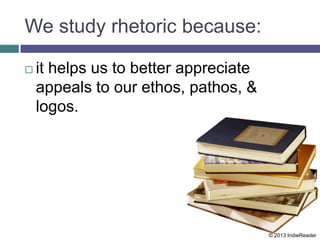
We study rhetoric because:
 it helps us to better appreciate
appeals to our ethos, pathos, &
logos.
© 2013 IndieReader
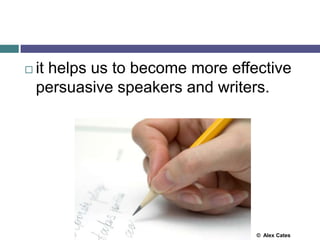
 it helps us to become more effective
persuasive speakers and writers.
© Alex Cates
Rhetoric Defined
 Rhetoric (n) - the art
of effective
expression (speaking
& writing) and the
persuasive use of
language (Burton, 2007)
George Doyle/Stockbyte/Getty Images
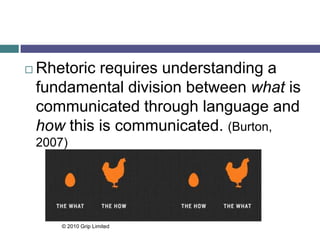
 Rhetoric requires understanding a
fundamental division between what is
communicated through language and
how this is communicated. (Burton,
2007)
© 2010 Grip Limited
 Aristotle stated that an arguer
must state a claim, or a
proposition, and prove it.
 Click Aristotle to learn
more.
© Creative Commons
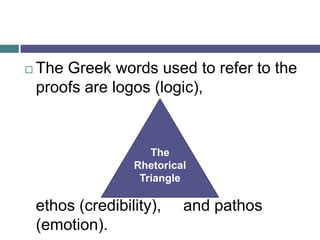
 The Greek words used to refer to the
proofs are logos (logic),
ethos (credibility), and pathos
(emotion).
The
Rhetorical
Triangle
Logos
 Logical proof appeals to people’s
reason, understanding, and common
sense.
(Weida & Stolley, 2013)
 Two main types of logos (logical
proofs) are deduction and induction.
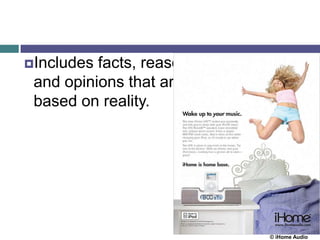
Includes facts,
reasons and
opinions that
are
based on reality.
Example:
iHome
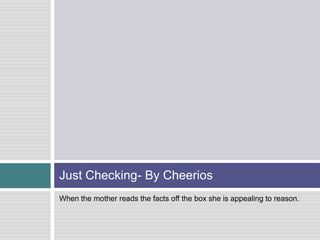
Cheerios
© iHome Audio
Ethos
 The ethical appeal is based on the
character, credibility, or reliability of
the writer.
(Weida & Stolley, 2013)
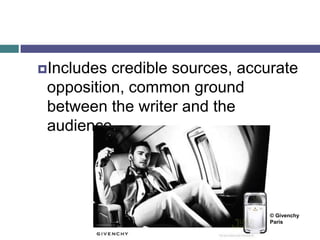
Includes credible sources, accurate
opposition, common ground
between the writer and the
audience.
Example:
Givenchy
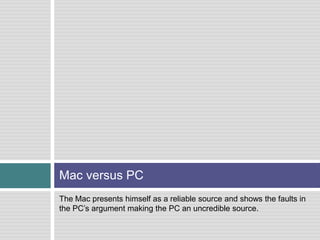
Macintosh
© Givenchy Paris
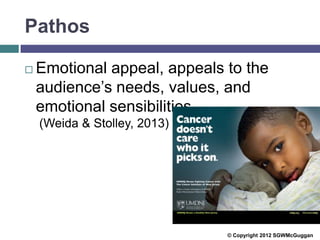
Pathos
 Emotional appeal, appeals to the
audience’s needs, values, and
emotional sensibilities.
(Weida & Stolley, 2013)
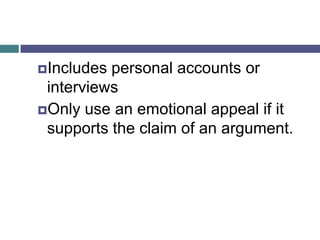
Includes personal accounts or
interviews
Only use an emotional appeal if it
supports the claim
of an argument.
Example:
UMDNJ
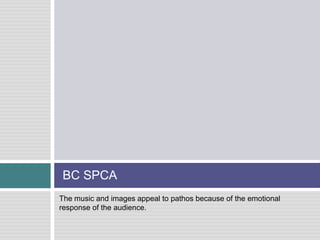
BC SPCA
© Copyright 2012 SGWMcGuggan
Karios
 The opportune occasion for speech.
(Burton, 2007)
©1996-2013 Madison Metropolitan School District
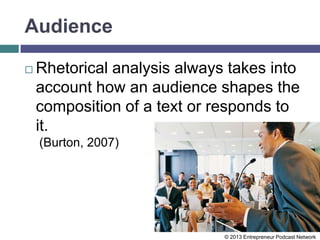
Audience
 Rhetorical analysis always takes into
account how an audience shapes the
composition of a text or responds to
it.
(Burton, 2007)
© 2013 Entrepreneur Podcast Network
Decorum
 One's words and subject
matter must aptly fit
together, to kairos, the
audience, and the speaker.
(Burton, 2007)
© 2013 Wikia, Inc
Practice
Based on the each add determine:
 Ethos, Pathos or Logos?
 What’s the Karios?
 Who’s the audience?
 What’s the decorum?
Scheme
 A scheme is any artful deviation from
the typical arrangement of words in a
sentence
(Burton, 2007)
 Words preserve their literal
meaning, but are placed in a
significant arrangement of some
kind.
Active Voice
 In a sentence using active voice, the
subject of the sentence performs the
action expressed in the verb.
(Toadvine, Brizee, & Angeli, 2011)
Passive Voice
 In a sentence using passive voice,
the subject is acted upon; he or she
receives the action expressed by the
verb.
(Toadvine, Brizee, & Angeli, 2011)
Active Voice versus Passive
Voice
 Active Voice- The boy hit the ball.
 Passive Voice- The ball was hit by
the boy.
© Copyright 2009-2013 real-world-physics-problems.com
Rhetoric uses Active Voice
 This makes the meaning clear for
readers, and keeps the sentences
from becoming too complicated.
(Toadvine, Brizee, & Angeli, 2011)
Works Cited
 Burton, G. O. (2007, Feburary 26). Schemes and Tropes.
Retrieved September 29, 2013, from Silva Rhetoricae:
http://rhetoric.byu.edu/figures/Schemes%20and%20Tropes
.htm
 Toadvine, A., Brizee, A., & Angeli, E. (2011, July 13). Active
and Passive Voice. Retrieved September 29, 2013, from
Purdue Online Writing Lab:
https://owl.english.purdue.edu/owl/resource/539/1/
 Weida, S., & Stolley, K. (2013, March 11). Using Rhetorical
Strategies for Persuasion. Retrieved September 29, 2013,
from Perdue Online Writing Lab:
https://owl.english.purdue.edu/owl/resource/588/04/

Introduction to Rhetoric

  • 1.
    An introduction tokey terms and elements. Note Taking Guide Rhetoric
  • 2.
    We study rhetoricbecause:  it helps us to better appreciate appeals to our ethos, pathos, & logos. © 2013 IndieReader
  • 3.
     it helpsus to become more effective persuasive speakers and writers. © Alex Cates
  • 4.
    Rhetoric Defined  Rhetoric(n) - the art of effective expression (speaking & writing) and the persuasive use of language (Burton, 2007) George Doyle/Stockbyte/Getty Images
  • 5.
     Rhetoric requiresunderstanding a fundamental division between what is communicated through language and how this is communicated. (Burton, 2007) © 2010 Grip Limited
  • 6.
     Aristotle statedthat an arguer must state a claim, or a proposition, and prove it.  Click Aristotle to learn more. © Creative Commons
  • 7.
     The Greekwords used to refer to the proofs are logos (logic), ethos (credibility), and pathos (emotion). The Rhetorical Triangle
  • 8.
    Logos  Logical proofappeals to people’s reason, understanding, and common sense. (Weida & Stolley, 2013)
  • 9.
     Two maintypes of logos (logical proofs) are deduction and induction.
  • 10.
    Includes facts, reasons and opinionsthat are based on reality. Example: iHome Cheerios © iHome Audio
  • 11.
    Ethos  The ethicalappeal is based on the character, credibility, or reliability of the writer. (Weida & Stolley, 2013)
  • 12.
    Includes credible sources,accurate opposition, common ground between the writer and the audience. Example: Givenchy Macintosh © Givenchy Paris
  • 13.
    Pathos  Emotional appeal,appeals to the audience’s needs, values, and emotional sensibilities. (Weida & Stolley, 2013)
  • 14.
    Includes personal accountsor interviews Only use an emotional appeal if it supports the claim of an argument. Example: UMDNJ BC SPCA © Copyright 2012 SGWMcGuggan
  • 15.
    Karios  The opportuneoccasion for speech. (Burton, 2007) ©1996-2013 Madison Metropolitan School District
  • 16.
    Audience  Rhetorical analysisalways takes into account how an audience shapes the composition of a text or responds to it. (Burton, 2007) © 2013 Entrepreneur Podcast Network
  • 17.
    Decorum  One's wordsand subject matter must aptly fit together, to kairos, the audience, and the speaker. (Burton, 2007) © 2013 Wikia, Inc
  • 18.
    Practice Based on theeach add determine:  Ethos, Pathos or Logos?  What’s the Karios?  Who’s the audience?  What’s the decorum?
  • 19.
    Scheme  A schemeis any artful deviation from the typical arrangement of words in a sentence (Burton, 2007)
  • 20.
     Words preservetheir literal meaning, but are placed in a significant arrangement of some kind.
  • 21.
    Active Voice  Ina sentence using active voice, the subject of the sentence performs the action expressed in the verb. (Toadvine, Brizee, & Angeli, 2011)
  • 22.
    Passive Voice  Ina sentence using passive voice, the subject is acted upon; he or she receives the action expressed by the verb. (Toadvine, Brizee, & Angeli, 2011)
  • 23.
    Active Voice versusPassive Voice  Active Voice- The boy hit the ball.  Passive Voice- The ball was hit by the boy. © Copyright 2009-2013 real-world-physics-problems.com
  • 24.
    Rhetoric uses ActiveVoice  This makes the meaning clear for readers, and keeps the sentences from becoming too complicated. (Toadvine, Brizee, & Angeli, 2011)
  • 25.
    Works Cited  Burton,G. O. (2007, Feburary 26). Schemes and Tropes. Retrieved September 29, 2013, from Silva Rhetoricae: http://rhetoric.byu.edu/figures/Schemes%20and%20Tropes .htm  Toadvine, A., Brizee, A., & Angeli, E. (2011, July 13). Active and Passive Voice. Retrieved September 29, 2013, from Purdue Online Writing Lab: https://owl.english.purdue.edu/owl/resource/539/1/  Weida, S., & Stolley, K. (2013, March 11). Using Rhetorical Strategies for Persuasion. Retrieved September 29, 2013, from Perdue Online Writing Lab: https://owl.english.purdue.edu/owl/resource/588/04/

Editor's Notes

  • #7 According to Aristotle, rhetoric is "the ability, in each particular case, to see the available means of persuasion." He described three main forms of rhetoric: Ethos, Logos, and Pathos
  • #11 When the mother reads the facts off the box she is appealing to reason.
  • #13 The Mac presents himself as a reliable source and shows the faults in the PC’s argument making the PC an uncredible source.
  • #14 Some say that there should be no appeals to emotion or attempts to arouse the emotions of the audience in an argument. The idea is that an argument should appeal only to reason.Emotional proofs (pathos) are appropriate in argument when the subject itself is emotional and when it creates strong feelings.
  • #15 Some say that there should be no appeals to emotion or attempts to arouse the emotions of the audience in an argument. The idea is that an argument should appeal only to reason.Emotional proofs (pathos) are appropriate in argument when the subject itself is emotional and when it creates strong feelings.-The music and images appeal to pathos because of the emotional response of the audience.