RHETORICAL
SKILL

Definition
Rhetorical Analysis
"rhetorical analysis" is, at first, rather intimidating for many people, it is easily
understood (at least at its most basic) when broken down and defined.
In rhetorical analysis, then, we examine how authors attempt to persuade their audiences by
looking at the various components that make up the art of persuasion.
Consider how surface features contribute to the message,Syntactical elements are usually there
for either parallelism or differences.
A History of Rhetoric
Rhetorical skills were required and found wanting in biblical figure Moses as mentioned
in Torah (c.1313 BCE)[6], where Moses argued with God that he should not be the one to
deliver the message to the people by saying "Please, my Lord, I am not a man of words..."
(Exodus 4:10).

The Cannons of Rhetoric
Aristotle and other Greek rhetoricians thought of rhetoric as having five canons or established
principles. These principles outline the systems of classical rhetoric. There are Invention,
Arrangement, Style, Memory, Delivery.
Invention
To discover the available means of persuasion. Exigence and audience are the primary building
blocks of a rhetorical situation, in which a person is compelled to communicate with an
audience.
Arrangement:
To assemble the argument effectively. The 5-paragraph essay model many of us learned is
based on classic Greek and Roman structures. Its parts include: Introduction (exordium),
Statement of fact (narratio), Confirmation or proof (confirmatio), Refutation (refutatio),
Conclusion (peroratio).
Memory
To speak extemporaneously
The ancient Greeks thought that reading a speech from a text was sign of a poor rhetor. And a
poor rhetor was an ineffective politician. A citizen might hire a logographer to write a speech,
but the citizen would then memorize it for delivery.
For the Greeks, a good speaker was a good person. It was difficult for them to believe that
eloquence could reside in an unworthy individual.
Delivery
To effectively use voice, gestures, text, and images.
Rhetorical theories & strategies
Stasis Theory
Stasis is a way of looking at an argument’s structure to decide the type of issue the argument
addresses
The Syllogism
A syllogism is a kind of logical argument in which one proposition (the conclusion) is inferred
from two others (the premises) of a certain form. The syllogism is at the core of deductive
reasoning, where facts are determined by combining existing statements, in contrast to
inductive reasoning where facts are determined by repeated observations.

Examples of Syllogisms
All men are animals.
No reptiles have fur.
All kittens are playful.
Enthymemes
An enthymeme, in its modern sense, is an informally stated syllogism (a three-part deductive
argument) with an unstated assumption that must be true for the premises to lead to the
conclusion.
Toulmin on Argument
The theory of argument that informs discussion of argumentative invention in this course is
drawn from Stephen Toulmin's The Uses of Argument. Toulmin's theory was designed, among
other things, to analyze the practical arguments of everyday life.
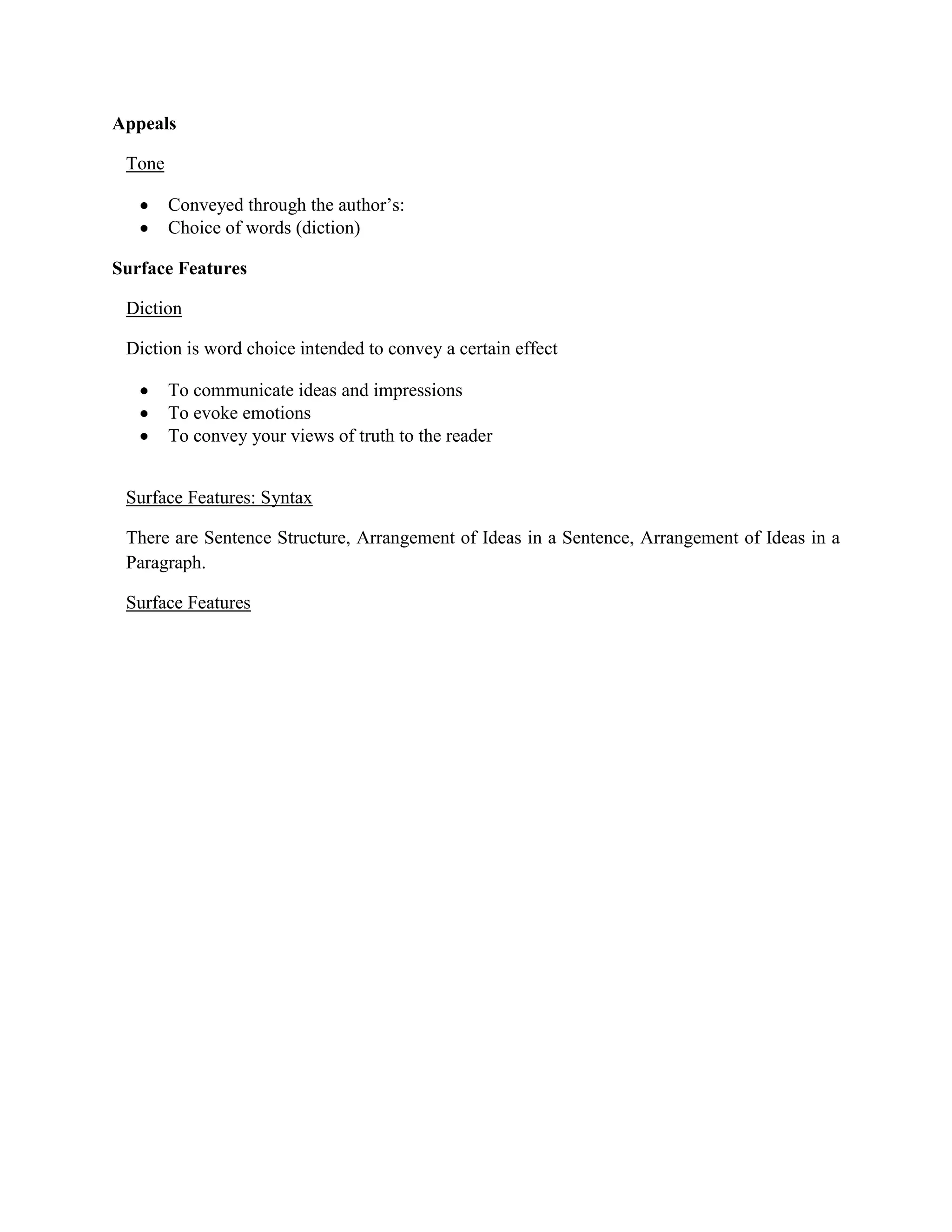
Appeals
Tone
Conveyed through the author’s:
Choice of words (diction)
Surface Features
Diction
Diction is word choice intended to convey a certain effect
To communicate ideas and impressions
To evoke emotions
To convey your views of truth to the reader
Surface Features: Syntax
There are Sentence Structure, Arrangement of Ideas in a Sentence, Arrangement of Ideas in a
Paragraph.
Surface Features

Digo afria

  • 1.
    RHETORICAL SKILL Definition Rhetorical Analysis "rhetorical analysis"is, at first, rather intimidating for many people, it is easily understood (at least at its most basic) when broken down and defined. In rhetorical analysis, then, we examine how authors attempt to persuade their audiences by looking at the various components that make up the art of persuasion. Consider how surface features contribute to the message,Syntactical elements are usually there for either parallelism or differences. A History of Rhetoric Rhetorical skills were required and found wanting in biblical figure Moses as mentioned in Torah (c.1313 BCE)[6], where Moses argued with God that he should not be the one to deliver the message to the people by saying "Please, my Lord, I am not a man of words..." (Exodus 4:10). The Cannons of Rhetoric Aristotle and other Greek rhetoricians thought of rhetoric as having five canons or established principles. These principles outline the systems of classical rhetoric. There are Invention, Arrangement, Style, Memory, Delivery. Invention To discover the available means of persuasion. Exigence and audience are the primary building blocks of a rhetorical situation, in which a person is compelled to communicate with an audience. Arrangement: To assemble the argument effectively. The 5-paragraph essay model many of us learned is based on classic Greek and Roman structures. Its parts include: Introduction (exordium), Statement of fact (narratio), Confirmation or proof (confirmatio), Refutation (refutatio), Conclusion (peroratio). Memory To speak extemporaneously
  • 2.
    The ancient Greeksthought that reading a speech from a text was sign of a poor rhetor. And a poor rhetor was an ineffective politician. A citizen might hire a logographer to write a speech, but the citizen would then memorize it for delivery. For the Greeks, a good speaker was a good person. It was difficult for them to believe that eloquence could reside in an unworthy individual. Delivery To effectively use voice, gestures, text, and images. Rhetorical theories & strategies Stasis Theory Stasis is a way of looking at an argument’s structure to decide the type of issue the argument addresses The Syllogism A syllogism is a kind of logical argument in which one proposition (the conclusion) is inferred from two others (the premises) of a certain form. The syllogism is at the core of deductive reasoning, where facts are determined by combining existing statements, in contrast to inductive reasoning where facts are determined by repeated observations. Examples of Syllogisms All men are animals. No reptiles have fur. All kittens are playful. Enthymemes An enthymeme, in its modern sense, is an informally stated syllogism (a three-part deductive argument) with an unstated assumption that must be true for the premises to lead to the conclusion. Toulmin on Argument The theory of argument that informs discussion of argumentative invention in this course is drawn from Stephen Toulmin's The Uses of Argument. Toulmin's theory was designed, among other things, to analyze the practical arguments of everyday life.
  • 3.
    Appeals Tone Conveyed through theauthor’s: Choice of words (diction) Surface Features Diction Diction is word choice intended to convey a certain effect To communicate ideas and impressions To evoke emotions To convey your views of truth to the reader Surface Features: Syntax There are Sentence Structure, Arrangement of Ideas in a Sentence, Arrangement of Ideas in a Paragraph. Surface Features